


 |
市場調查報告書
商品編碼
2118118
歐洲貨櫃堆場物流:市場佔有率分析、產業趨勢與統計及成長預測(2026-2031)Europe Container Depot Logistics - Market Share Analysis, Industry Trends & Statistics, Growth Forecasts (2026 - 2031) |
||||||

※ 本網頁內容可能與最新版本有所差異。詳細情況請與我們聯繫。
根據 Mordor Intelligence 預測,歐洲貨櫃堆場物流市場規模預計到 2025 年將達到 119.2 億美元,到 2026 年將達到 125.7 億美元,到 2031 年將達到 162.1 億美元。
預計 2026-2031 年的複合年成長率為 5.21%。
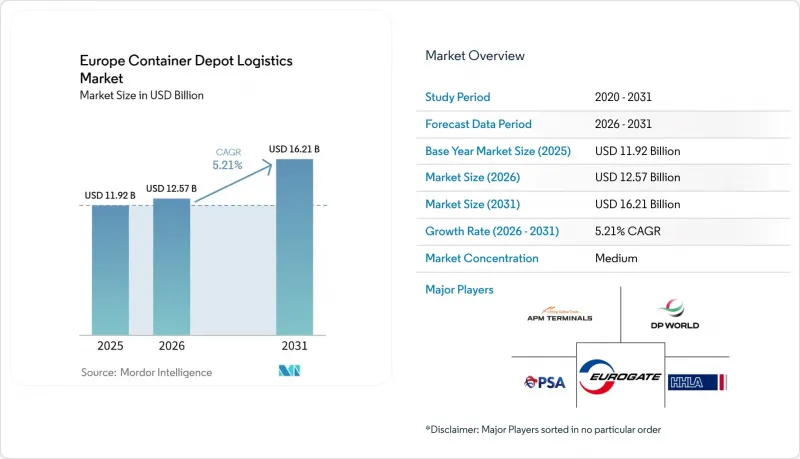
由於歐洲主要門戶港口長期堵塞,內陸和港外緩衝運輸已成為核心營運必需,而非臨時應對措施,歐洲貨櫃堆場物流市場正在擴張。本報告按堆場類型(內陸貨櫃堆場、空箱堆場、其他)、服務類型(貨櫃儲存服務、貨櫃裝卸服務、其他)、貨櫃類型(乾貨貨櫃、冷藏貨櫃)、貿易方向(國際/轉運、國內)和國家/地區(英國、德國、西班牙、義大利、比利時、荷蘭、北歐國家、其他國家/地區細分國家。市場預測以美元計價。
歐洲貨櫃堆場物流市場的趨勢與洞察
擴大內陸和離岸緩衝需求:港口飽和、出口、運力需求、內陸
西北歐港口擁塞已成為長期存在的營運難題,導致內陸和近海堆場的運作週期延長。當過剩的碼頭吞吐能力迫使貨櫃從碼頭設施轉移到能夠處理倉儲、清關和後續運輸的緩衝樞紐時,歐洲貨櫃堆場物流市場將從中受益。在安特衛普和布魯日,儘管2025年上半年標準箱(TEU)吞吐量成長了3.7%,但擁塞問題依然存在,這表明吞吐量增加和物流中斷同時發生。和記港口歐洲分公司也報告稱,由於貨櫃在系統中停留時間延長,2025年的倉儲收入有所成長,這印證了對堆場依賴程度的類似趨勢。耗資29億歐元(31億美元)的安特衛普貨櫃吞吐能力擴建計畫將在未來逐步提高吞吐能力。然而,由於建設預計需要數年時間,預計在預測期內,內陸堆場的重要性仍將保持。
提高冷藏庫的使用率:加強冷鏈正在重組倉庫組合。
溫控貨櫃比標準乾貨貨櫃需要更嚴格的監控、更短的檢查週期和更大的電力供應,這擴大了冷藏庫的作用。在歐洲貨櫃堆場物流市場,對集倉儲、裝運前檢查、插頭監控和冷鏈設備技術維修於一體的設施的需求日益成長。國際冷凍與冷凍協會 (IIR) 預測,全球冷藏貨櫃吞吐量將從 2023 年的 400 萬標準箱 (TEU) 增至 2030 年的 710 萬標準箱 (TEU),這極大地推動了對冷藏基礎設施的需求。馬士基在馬斯弗拉克特第二期 (Maasfracte II) 新建的 35,000 平方米冷藏倉庫毗鄰星光堆場 (Star Depot),展現了營運商如何在同一物流走廊內緊密整合冷鍊和堆場功能。這也是歐洲貨櫃堆場物流市場中,維護和維修服務成長速度超過基礎倉儲服務的原因之一。
主要港口走廊周邊土地短缺:基礎設施需求超過可用土地。
在主要港口走廊附近擴張時,土地資源的稀缺是最大的限制之一。儘管歐洲對貨櫃堆場物流的需求強勁,但堆場仍需位置主要門戶才能維持其營運重要性。在荷蘭和比利時等市場,分區法規和環境核准障礙阻礙了新物流項目的進展,迫使營運商提高現有堆場的密度,而不是進行傳統的待開發區開發。因此,垂直裝卸、高密度佈局和多用途內陸樞紐在歐洲貨櫃堆場物流市場日益普及。
細分市場分析
2025年,內陸貨櫃堆場(ICD)將佔據歐洲貨櫃堆場物流市場39.81%的佔有率,並繼續保持其在各類堆場中的領先地位。內陸貨櫃堆場的功能不僅限於倉儲,還包括支援內陸地區的清關程序、貨物檢驗、貨櫃卸貨、多式聯運轉換以及貨物收集和整合。這種營運模式使內陸貨櫃堆場在歐洲貨櫃堆場物流市場中佔據了穩定的地位,尤其是在港口堵塞導致貨物不得不從碼頭側轉移的情況下,其優勢更為顯著。
預計2026年至2031年間,空箱堆場將以8.07%的複合年成長率成長,成為歐洲貨櫃堆場物流市場中成長最快的堆場類型。這一成長反映了重新部署複雜性的增加、設備不平衡的長期存在,以及進出口通道之間空箱週轉速度加快的需求。根據Sogese的一份報告,到2026年初,隨著貨櫃被重新部署到亞洲,堆場擁塞情況加劇,滯留時間延長。這凸顯了空箱堆場作為資產週轉樞紐的重要性日益增強。
在2025年歐洲貨櫃堆場物流市場中,貨櫃倉儲服務佔34.02%,成為最大的服務類別。這一結果與歐洲貨櫃堆場物流市場的實際運作相符,因為倉儲仍然是大多數堆場的主要收入來源,用於處理與溢出、暫存和滯留相關的需求。雖然清潔、清洗和其他附加價值服務所佔佔有率較小,但業者可以透過為每個貨櫃整合多種服務來提高收入品質。
預計2026年至2031年間,貨櫃維護和維修服務將以9.22%的複合年成長率成長,成為成長最快的服務領域。主要原因是船隊運轉率的提高使得推遲檢查和維修變得更加困難,越來越多的此類任務正從海港碼頭轉移到堆場。 DR Depots在鹿特丹經營超過140個冷藏貨櫃插接點,在安特衛普經營60個,顯示冷藏貨櫃維護需求集中在ARA區域的內陸地區。
其他好處
- Excel格式的市場預測(ME)表
- 3個月的分析師支持
目錄
第1章:引言
- 研究假設和市場定義
- 調查範圍
第2章:調查方法
第3章執行摘要
第4章 市場狀況
- 市場概況及貨櫃場物流的重要性
- 市場促進因素
- 內陸地區和港口外緩衝需求成長
- 冷藏庫利用率提高
- 內陸地區與鐵路的整合
- 倉庫數位化和堆場可視化的要求
- 歐盟在供應鏈排放報告方面面臨壓力
- 貨櫃共享和租賃資產輪換的複雜性
- 市場限制因素
- 主要港口走廊周邊土地短缺
- 高昂的人事費用和公用事業成本
- 歐洲各國許可證制度的差異
- 標準乾貨貨櫃運輸服務的獲利能力敏感度較低
- 法律規範
- 價值鍊和分銷管道的結構分析
- 技術創新的前景
- 波特五力分析
- 貨櫃處理量趨勢
- 進出口貿易分析
- 港口和碼頭基礎設施分析
- 永續性和ESG分析
- 貨櫃堆場物流市場趨勢
- 地緣政治事件對供應鏈變化的影響
第5章 市場規模及成長預測(價值,2026-2031 年)
- 按倉庫類型
- 內陸貨櫃場(ICD)
- 貨櫃貨運站(CFS)
- 空容器堆場(ECD)
- 港口型貨櫃場
- 按服務類型
- 貨櫃儲存服務
- 貨櫃裝卸服務
- 貨櫃維護和修理(M&R)服務
- 貨櫃清潔和清洗服務
- 其他加值物流服務
- 按容器類型
- 乾貨容器
- 冷藏貨櫃
- 按貿易方向
- 國際/轉運貨櫃裝卸
- 國內貨櫃運輸
- 國家
- 英國
- 德國
- 法國
- 西班牙
- 義大利
- 比利時
- 荷蘭
- 北歐國家(丹麥、芬蘭、冰島、挪威、瑞典)
- 其他歐洲國家
第6章 競爭情勢
- 市場集中度
- 關鍵策略趨勢
- 市佔率分析
- 公司簡介
- APM Terminals
- DP World
- PSA International
- Hamburger Hafen und Logistik AG(HHLA)
- Eurogate GmbH & Co. KGaA, KG
- Contargo GmbH & Co. KG
- CMA CGM Group(CEVA Logistics)
- MSC Mediterranean Shipping Company SA(MEDLOG/TIL)
- Hutchison Ports
- Samskip
- Contship Italia Group
- Duisburger Hafen AG(duisport)
- BLG Logistics Group AG & Co. KG
- Rhenus Group
- Bertschi AG
- Van Moer Logistics
- H. Essers
- Den Hartogh Logistics
- Depot Connect International(Europe)
- Interporto Bologna SpA
- Katoen Natie NV
- DR Depots
第7章 市場機會與未來展望
According to Mordor Intelligence, the Europe container depot logistics market size was USD 11.92 billion in 2025 and is projected to reach USD 12.57 billion in 2026 and USD 16.21 billion by 2031 at a CAGR of 5.21% from 2026 to 2031.
The Europe container depot logistics market is expanding because persistent congestion at the region's largest gateways has made inland and off-port buffering a core operating need rather than a temporary workaround. This report is Segmented by Depot Type, (inland Container Depots, Empty Container Depots, and More), by Service Type (Storage, Handling, and More), by Container Type (Dry and Reefer), by Trade Orientation (International and Domestic), and by Geography (United Kingdom, Germany, Spain, Italy, Belgium, Netherlands, Nordics, and More). The Market Forecasts are Provided in Terms of Value (USD).
Europe Container Depot Logistics Market Trends and Insights
Growth in Inland and Off-Port Buffering Demand: Port Saturation, Exports, Capacity Demand, Inland
Port pressure across Northwest Europe has become a recurring operating condition, keeping inland and off-port depots active for longer periods. The Europe container depot logistics market benefits when terminal overflow shifts boxes away from quay-side sites and into buffer locations that can handle storage, customs activity, and onward movement. Antwerp-Bruges reported a 3.7% rise in TEU volumes in the first half of 2025, while congestion remained an issue, suggesting that volume growth and flow disruption are occurring simultaneously. Hutchison Ports' European segment also reported higher storage revenue in 2025, as containers stayed longer in the system, supporting the same pattern of depot dependence. The EUR 2.9 billion (USD 3.1 billion) Extra Container Capacity Antwerp project will add capacity over time. Still, its multi-year build schedule means inland depots will remain important through much of the forecast period.
Rising Reefer-Ready Depot Utilization: Cold Chain Intensity Reshapes the Depot Mix
Reefer-capable depots are taking a larger role because temperature-controlled containers require closer monitoring, shorter inspection cycles, and more electrical support than standard dry boxes. The Europe container depot logistics market is seeing stronger demand for sites that can combine storage with pre-trip inspection, plug monitoring, and technical repair for cold chain equipment. The International Institute of Refrigeration expects global refrigerated container volumes to rise from 4 million TEUs in 2023 to 7.1 million TEUs by 2030, which supports the broader case for reefer-linked infrastructure. Maersk's new 35,000 m2 cold store at Maasvlakte II, located next to its Star Depot, also shows how operators are integrating cold chain and depot functions more closely within the same logistics corridor. This is one reason maintenance and repair are growing faster than basic storage in the container depot logistics market in Europe.
Land Scarcity Near Core Port Corridors: Infrastructure Demand Outpaces Available Ground
Land availability is one of the most significant constraints on expansion near major port corridors. The Europe container depot logistics market may have healthy demand, but depots still need sites close enough to key gateways to remain operationally relevant. In markets such as the Netherlands and Belgium, zoning restrictions and environmental approval hurdles have slowed new logistics projects and pushed operators toward denser use of existing yards rather than conventional greenfield growth. This is why vertical stacking, tighter layouts, and multi-use inland sites are becoming more common in the Europe container depot logistics market.
Other drivers and restraints analyzed in the detailed report include:
- Rail-Linked Hinterland Consolidation: Intermodal Networks Become the Depot's Distribution Spine
- Depot Digitization and Yard Visibility Requirements: Cloud Platforms Alter the Unit Economics of Depot Operations
- High Labor and Utility Cost Structure: Wage Inflation Undermines Standard Depot Margins
For complete list of drivers and restraints, kindly check the Table Of Contents.
Segment Analysis
Inland container depots held 39.81% of the Europe container depot logistics market share in 2025, keeping them in the lead among depot types. Their role extends beyond storage because they support customs clearance, cargo inspection, de-stuffing, intermodal interchange, and cargo consolidation in inland locations. That operating mix gives ICDs a stable position in the Europe container depot logistics market, especially where port congestion pushes cargo away from quay-side terminals.
Empty container depots are projected to grow at a 8.07% CAGR from 2026 to 2031, making them the fastest-growing depot type in the Europe container depot logistics market. That growth reflects rising repositioning complexity, longer equipment imbalances, and the need for quicker turnaround of empties moving between export and import corridors. Sogese reported elevated depot congestion and longer dwell times in early 2026 because equipment was being repositioned toward Asia, which shows why empty depots are becoming more important as asset rotation nodes.
Container storage services accounted for 34.02% share of the Europe container depot logistics market size in 2025, making storage the largest service category. That result aligns with the operating reality of the Europe container depot logistics industry, as storage remains the primary revenue stream for most depots handling overflow, staging, and dwell-related demand. Cleaning, washing, and other value-added services accounted for a smaller share, but they helped operators improve revenue quality by bundling more services into each container visit.
Container maintenance and repair services are expected to grow at a 9.22% CAGR from 2026 to 2031, which makes this the fastest-growing service segment. The main reason is that higher fleet utilization leaves less room for deferred inspection and repair, so more of that work shifts to depots rather than staying at seaport terminals. DR Depots already operates more than 140 reefer plug points in Rotterdam and 60 in Antwerp, which shows how concentrated reefer maintenance demand has become in ARA-range hinterland locations.
Complete Report Scope:
- By Depot Type
- Inland Container Depots (ICDs)
- Container Freight Stations (CFS)
- Empty Container Depots (ECDs)
- Port-Based Container Depots
- By Service Type
- Container Storage Services
- Container Handling Services
- Container Maintenance and Repair (M&R) Services
- Container Cleaning & Washing Services
- Other Value-Added Logistics Services
- By Container Type
- Dry Containers
- Reefer Containers
- By Trade Orientation
- International/Transshipment Container Handling
- Domestic Container Movement
- By Country
- United Kingdom
- Germany
- France
- Spain
- Italy
- Belgium
- Netherlands
- NORDICS (Denmark, Finland, Iceland, Norway, and Sweden)
- Rest of Europe
List of Companies Covered in this Report:
- APM Terminals
- DP World
- PSA International
- Hamburger Hafen und Logistik AG (HHLA)
- Eurogate GmbH & Co. KGaA, KG
- Contargo GmbH & Co. KG
- CMA CGM Group (CEVA Logistics)
- MSC Mediterranean Shipping Company SA (MEDLOG/TIL)
- Hutchison Ports
- Samskip
- Contship Italia Group
- Duisburger Hafen AG (duisport)
- BLG Logistics Group AG & Co. KG
- Rhenus Group
- Bertschi AG
- Van Moer Logistics
- H. Essers
- Den Hartogh Logistics
- Depot Connect International (Europe)
- Interporto Bologna S.p.A.
- Katoen Natie NV
- DR Depots
Additional Benefits:
- The market estimate (ME) sheet in Excel format
- 3 months of analyst support
TABLE OF CONTENTS
1 Introduction
- 1.1 Study Assumptions and Market Definition
- 1.2 Scope of the Study
2 Research Methodology
3 Executive Summary
4 Market Landscape
- 4.1 Market Overview and Importance of Container Depot Logistics
- 4.2 Market Drivers
- 4.2.1 Growth in Inland and Off-Port Buffering Demand
- 4.2.2 Rising Reefer-Ready Depot Utilization
- 4.2.3 Rail-Linked Hinterland Consolidation
- 4.2.4 Depot Digitization and Yard Visibility Requirements
- 4.2.5 EU Supply Chain Emissions Reporting Pressures
- 4.2.6 Container Pooling and Leasing Asset Rotation Complexity
- 4.3 Market Restraints
- 4.3.1 Land Scarcity Near Core Port Corridors
- 4.3.2 High Labor and Utility Cost Structure
- 4.3.3 Fragmented Permitting Across European Countries
- 4.3.4 Low Margin Sensitivity in Standard Dry Container Services
- 4.4 Regulatory Framework
- 4.5 Value Chain and Distribution Channel Architecture Analysis
- 4.6 Technology Innovations Outlook
- 4.7 Porter's Five Forces Analysis
- 4.7.1 Threat of New Entrants
- 4.7.2 Bargaining Power of Suppliers
- 4.7.3 Bargaining Power of Buyers
- 4.7.4 Threat of Substitutes
- 4.7.5 Rivalry Among Competitors
- 4.8 Container Throughput Trends
- 4.9 Import-Export Trade Analysis
- 4.10 Port and Terminal Infrastructure Analysis
- 4.11 Sustainability and ESG Analysis
- 4.12 Evolution of Container Depot Logistics Market
- 4.13 Impact of Geo-Political Events on Supply Chain Shifts
5 Market Size and Growth Forecasts (Value, 2026-2031)
- 5.1 By Depot Type
- 5.1.1 Inland Container Depots (ICDs)
- 5.1.2 Container Freight Stations (CFS)
- 5.1.3 Empty Container Depots (ECDs)
- 5.1.4 Port-Based Container Depots
- 5.2 By Service Type
- 5.2.1 Container Storage Services
- 5.2.2 Container Handling Services
- 5.2.3 Container Maintenance and Repair (M&R) Services
- 5.2.4 Container Cleaning & Washing Services
- 5.2.5 Other Value-Added Logistics Services
- 5.3 By Container Type
- 5.3.1 Dry Containers
- 5.3.2 Reefer Containers
- 5.4 By Trade Orientation
- 5.4.1 International/Transshipment Container Handling
- 5.4.2 Domestic Container Movement
- 5.5 By Country
- 5.5.1 United Kingdom
- 5.5.2 Germany
- 5.5.3 France
- 5.5.4 Spain
- 5.5.5 Italy
- 5.5.6 Belgium
- 5.5.7 Netherlands
- 5.5.8 NORDICS (Denmark, Finland, Iceland, Norway, and Sweden)
- 5.5.9 Rest of Europe
6 Competitive Landscape
- 6.1 Market Concentration
- 6.2 Key Strategic Moves
- 6.3 Market Share Analysis
- 6.4 Company Profiles (includes Global level Overview, Market level overview, Core Segments, Financials as available, Strategic Information, Market Rank/Share for key companies, Products & Services, and Recent Developments)
- 6.4.1 APM Terminals
- 6.4.2 DP World
- 6.4.3 PSA International
- 6.4.4 Hamburger Hafen und Logistik AG (HHLA)
- 6.4.5 Eurogate GmbH & Co. KGaA, KG
- 6.4.6 Contargo GmbH & Co. KG
- 6.4.7 CMA CGM Group (CEVA Logistics)
- 6.4.8 MSC Mediterranean Shipping Company SA (MEDLOG/TIL)
- 6.4.9 Hutchison Ports
- 6.4.10 Samskip
- 6.4.11 Contship Italia Group
- 6.4.12 Duisburger Hafen AG (duisport)
- 6.4.13 BLG Logistics Group AG & Co. KG
- 6.4.14 Rhenus Group
- 6.4.15 Bertschi AG
- 6.4.16 Van Moer Logistics
- 6.4.17 H. Essers
- 6.4.18 Den Hartogh Logistics
- 6.4.19 Depot Connect International (Europe)
- 6.4.20 Interporto Bologna S.p.A.
- 6.4.21 Katoen Natie NV
- 6.4.22 DR Depots
7 Market Opportunities and Future Outlook
- 7.1 White-space and Unmet-Need Assessment

 2026年全球物流自動化人工智慧(AI)市場報告
 歐洲物流自動化:市場佔有率分析、產業趨勢與統計及成長預測(2026-2031 年)物流自動化:市場佔有率分析、產業趨勢與統計、成長預測(2026-2031)貨櫃堆場物流:市場佔有率分析、產業趨勢與統計、成長預測(2026-2031)亞太地區貨櫃堆場物流:市場佔有率分析、產業趨勢與統計及成長預測(2026-2031)美國貨櫃堆場物流:市場佔有率分析、產業趨勢與統計及成長預測(2026-2031 年)
 物流自動化市場預測至2034年-按組件、功能、技術、應用、最終用戶和地區分類的全球分析
 物流自動化市場:按組件、物流類型、技術、運作模式、部署類型、應用和最終用戶產業分類-2026-2032年全球市場預測北美物流自動化:市場佔有率分析、產業趨勢與統計及成長預測(2026-2031 年)
 物流自動化市場機會、成長要素、產業趨勢分析及2026-2035年預測