


 |
市場調查報告書
商品編碼
2118116
美國貨櫃堆場物流:市場佔有率分析、產業趨勢與統計及成長預測(2026-2031 年)United States Container Depot Logistics - Market Share Analysis, Industry Trends & Statistics, Growth Forecasts (2026 - 2031) |
||||||

※ 本網頁內容可能與最新版本有所差異。詳細情況請與我們聯繫。
據 Mordor Intelligence 稱,2025 年美國貨櫃堆場物流市場價值 64.4 億美元,預計到 2031 年將從 2026 年的 67.5 億美元成長至 84.9 億美元,預測期(2026-2031 年)複合年成長率為 4.68%。
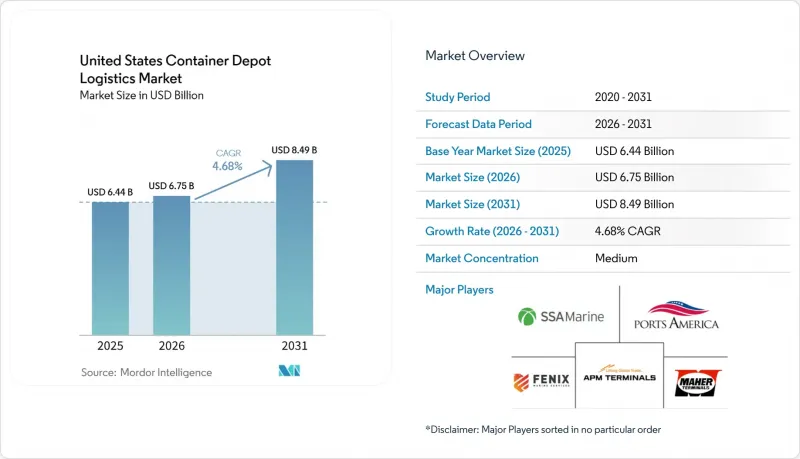
持續的進口活動、多式聯運網路的擴張以及向內陸貨櫃裝卸的穩步轉變,繼續支撐著美國貨櫃堆場物流市場的發展。本報告按堆場類型(內陸貨櫃場、貨櫃貨運站、遠海貨櫃堆場、港口堆場)、服務類型(貨櫃儲存服務、貨櫃裝卸服務、貨櫃清潔/清洗服務、其他)、貨櫃類型(乾貨集裝箱、冷藏貨櫃)、貿易方向(國際/轉運東北部)。市場預測以美元計價。
美國貨櫃堆場物流市場的趨勢與洞察
多式聯運鐵路及避免港口擁擠的需求
內陸貨場正在處理原本會在港口排隊等候更長的貨物。 2026年6月,ITS物流公司報告稱,由於持續的運力限制以及燃油成本飆升導致下游在旺季價格上漲的風險增加,美國各港口和鐵路全部區域仍然高度擔憂。這種轉變提升了位於芝加哥、達拉斯、沃斯堡、孟菲斯和亞特蘭大等內陸鐵路樞紐附近的貨場的戰略價值,因為這些地點現在正在吸收先前積壓在沿海碼頭附近的過剩貨物。鐵路的成本優勢也擴大了內陸貨物處理的範圍,緩解壅塞正從緊急應變轉變為規劃用途。新建的蓋恩斯維爾內陸港耗資1.34億美元,年吞吐能力達20萬個貨櫃,計劃於2026年5月由諾福克南方鐵路公司投入運營,這表明內陸走廊正在成為美國貨櫃貨場物流市場的專屬樞紐。
重新排列進口貨櫃並延長其儲存週期。
在貨櫃處理中,越來越多的部分涉及貨櫃的調撥和倉儲,而非直接運輸進口貨物。美國貿易中貨物調撥效率的下降以及空箱調撥環節的增加,意味著更多貨櫃必須經過堆場進行檢驗、清潔和小型維修,才能重新投入使用。 2025年關稅政策導致的庫存積壓進一步加劇了這一壓力,因為進口量的增加延緩了空箱的返還,使得整個堆場網路都需要進行分類和臨時存儲。這種需求對營運商有利,因為它與每日進口成長率的相關性較低,而與承運商在需求突變後如何調整運力平衡更為密切相關。此外,它還帶來了倉儲之外的持續運營,例如清潔、維修和裝運準備,從而提高了大規模設施的盈利能力。同時,聯邦政府對滯留費和延誤費的監管也促使美國貨櫃堆場物流市場的航運公司和營運商減少空箱滯留時間,提高堆場效率。
船廠和維修作業出現人手不足
在美國貨櫃堆場物流市場,人手不足持續影響著閘口人員、貨櫃裝卸和專業維修作業。員工老化和新員工漫長的培訓期使得營運商在業務中斷後難以迅速調整人員配置。加州、亞利桑那州和德克薩斯州的勞動力人手不足尤其嚴重。在這些地區,龐大的閘合口交通量加劇了人手不足對堆場貨櫃周轉率和維修前置作業時間的影響。 《洛杉磯時報》2025年中期的一份報告指出,由於進口疲軟和勞動力短缺衝擊洛杉磯港的運營,該港口的職缺將大幅減少。儘管營運商正在透過自動化和設備清潔計畫來應對,但冷藏貨櫃的維護、焊接和IICL檢驗仍然依賴熟練的技術人員,而人員短缺導致維修時間延長,瓶頸風險增加。這種壓力在維護和維修領域最為突出,即使缺少一名專業人員也可能導致整個網路貨櫃作業的恢復延遲。
細分市場分析
截至2025年,內陸貨櫃堆場將占美國貨櫃堆場物流市場規模的38.20%,預計到2031年將以7.54%的複合年成長率成長。對於一個成熟的物流細分市場而言,如此規模和成長率的組合實屬罕見,因為同一種資產類型既推動了當前的需求,也推動了未來的網路重塑。內陸貨櫃場(ICD)市場佔有率的擴大,是因為它們能夠緩解門戶地區的堵塞,並將倉儲、清關、冷藏集裝箱等待和轉運等環節轉移到更靠近內陸需求中心的位置。因此,美國貨櫃堆場物流市場正將其部分營運基地從沿海稀缺的土地轉移到與鐵路相連的內陸走廊。蓋恩斯維爾內陸港和其他內陸碼頭專案表明,承運商和鐵路公司不再將內陸通道視為次要的溢出應對方案,而是將其視為貨櫃流設計的核心要素。
由於零售商和電商進口商仍需要在門戶城市和內陸配送中心附近進行拼箱(LCL)裝卸,貨櫃貨運站保持穩定的地位。隨著承運商努力消除需求劇烈變化後設備不足的回撥模式,空箱堆場受益於檢驗、清潔和重新分配需求的成長。港口堆場在即時貨櫃投放方面仍然發揮著至關重要的作用,因為對於那些尋求在碼頭附近快速週轉貨櫃的航運公司而言,直接對接船舶仍然至關重要。 BNSF鐵路公司批准的佔地4500英畝的巴斯托國際門戶(Barstow International Gateway)以內陸分揀和轉運為中心,而非加重沿海堆場的負擔,這表明了長期資本的流向。這種細分結構表明,長效型的競爭不再只是堆場的分類,而是將重點轉移到在更廣泛的鐵路、港口和貨運網路中定位每個資產。
預計到2025年,貨櫃倉儲服務將占美國貨櫃堆場物流市場佔有率的34.99%,而貨櫃維護和維修服務預計到2031年將以8.70%的複合年成長率成長。倉儲服務仍然是最大的服務板塊,這主要得益於進口激增、空箱重新部署以及大規模。這表明,美國貨櫃堆場物流市場正在從服務密度而非單純的堆場佔用率中創造更多價值。
貨物裝卸服務仍依賴貨量,預計將繼續隨海上碼頭和內陸堆場的貨物處理量而波動。隨著進口農產品和冷藏貨櫃的檢驗和生物安全措施日益嚴格,清潔和沖洗服務的重要性也日益凸顯。其他附加價值服務,例如轉運、車隊管理和海關協調,為利潤率擴張提供了最清晰的空間,因為這些服務使營運商能夠參與貨物鏈的更多環節。聯邦政府對滯銷費和延誤費的監管也凸顯了貨櫃維修安排的重要性,以及加快服務執行速度的必要性。在預測期內,與主要依賴倉儲服務的業者相比,提供更廣泛服務的業者預計受貨運壓力的影響較小。
其他好處
- Excel格式的市場預測(ME)表
- 3個月的分析師支持
目錄
第1章:引言
- 研究假設和市場定義
- 調查範圍
第2章:調查方法
第3章執行摘要
第4章 市場狀況
- 市場概況及貨櫃場物流的重要性
- 市場促進因素
- 多式聯運鐵路及避免港口擁擠的需求
- 重新排列進口貨櫃並延長其儲存週期。
- 電子商務推動國內貨櫃運輸
- 擴大加值倉庫服務
- 數位場地視覺化和預約管理的實施現狀
- 對冷藏貨櫃處理系統的需求
- 市場限制因素
- 船廠和維修作業出現人手不足
- 應對排放法規和設備升級成本
- 內陸樞紐的鐵路和公路運輸能力瓶頸
- 門戶樞紐周邊土地供應與分區限制
- 法律規範
- 價值鍊和分銷管道的結構分析
- 技術創新前景
- 波特五力分析
- 貨櫃處理量趨勢
- 進出口貿易分析
- 港口和碼頭基礎設施分析
- 永續性和ESG分析
- 貨櫃堆場物流市場趨勢
- 地緣政治事件對供應鏈變化的影響
第5章 市場規模及成長預測(價值,2026-2031 年)
- 按倉庫類型
- 內陸貨櫃場(ICD)
- 貨櫃貨運站(CFS)
- 空容器堆場(ECD)
- 港口型貨櫃場
- 按服務類型
- 貨櫃儲存服務
- 貨櫃裝卸服務
- 貨櫃維護和修理(M&R)服務
- 貨櫃清潔和清洗服務
- 其他加值物流服務
- 按容器類型
- 乾貨容器
- 冷藏貨櫃
- 按貿易方向
- 國際/轉運貨櫃裝卸
- 國內貨櫃運輸
- 按地區
- 東北
- 東南部
- 中西部
- 西南
- 西
第6章 競爭情勢
- 市場集中度
- 關鍵策略趨勢
- 市佔率分析
- 公司簡介
- SSA Marine
- Ports America
- APM Terminals
- Fenix Marine Services
- Maher Terminals
- Everport Terminal Services
- ConGlobal Industries, LLC
- Yusen Terminals
- Pacific Container Terminal
- ContainerPort Group
- IMC Logistics
- CSX Corporation
- Norfolk Southern Corporation
- BNSF Railway Company
- Union Pacific Corporation
- CMA CGM America(through terminal/depot operations)
- MSC Mediterranean Shipping Company USA
- Hapag-Lloyd USA
- Evergreen Shipping Agency(America)Corp.
- COSCO SHIPPING Lines(North America)Inc.
- Ocean Network Express(ONE)USA
- ZIM Integrated Shipping Services USA
第7章 市場機會與未來展望
According to Mordor Intelligence, the United States container depot logistics market size was valued at USD 6.44 billion in 2025 and estimated to grow from USD 6.75 billion in 2026 to reach USD 8.49 billion by 2031, at a CAGR of 4.68% during the forecast period (2026-2031).
Sustained import activity, wider intermodal links, and a steady move toward inland container handling continue to support the United States container depot logistics market. This report is Segmented by Depot Type (ICDs, CFS, Ecds, Port-Based), by Service Type (Container Storage, Container Handling, Container Cleaning and Washing, and More), by Container Type (Dry, and Reefer), by Trade Orientation (International/Transshipment, Domestic), and by Region (Northeast, Southeast, Midwest, Southwest, and West). The Market Forecasts are Provided in Terms of Value (USD).
United States Container Depot Logistics Market Trends and Insights
Intermodal Rail and Port Congestion Diversion Demand
Inland depots are taking freight that would otherwise sit longer inside port queues. ITS Logistics reported in June 2026 that concern levels remained elevated across the United States' port and rail regions, as capacity remained constrained and rising fuel costs increased the risk of downstream price surges during the peak season. The shift is raising the strategic value of depots near inland rail ramps in Chicago, Dallas, Fort Worth, Memphis, and Atlanta, as those sites now absorb overflow that previously stayed near coastal terminals. Rail's cost advantage is also widening the addressable base for inland handling, so congestion relief is becoming a planned use case instead of an emergency response. The new USD 134 million Gainesville Inland Port, which opened in May 2026 with Norfolk Southern service and 200,000-container annual capacity, shows how inland corridors are becoming dedicated nodes in the United States container depot logistics market.
Growth in Import Container Repositioning and Storage Cycles
A growing share of container activity is tied to repositioning and storage rather than direct loaded import movement. The weaker match-back efficiency in the United States trade and a higher volume of empty repositioning legs, which means more containers must cycle through depots for inspection, cleaning, and minor repair before returning to service. Tariff-led inventory stockpiling in 2025 added to this pressure, as higher inbound flows triggered a later wave of empty returns that had to be sorted and staged across depot networks. This demand base is useful for operators because it is less tied to day-to-day import growth and more tied to how carriers rebalance equipment after demand shocks. It also creates recurring work that extends beyond storage into washing, repair, and turn preparation, which improves revenue stability for larger facilities. Federal scrutiny of detention and demurrage practices is also pushing shipping lines and operators to shorten empty-container dwell time and improve yard efficiency across the United States container depot logistics market.
Labor Shortages in Yard and Repair Operations
Labor shortages continue to affect gate staffing, equipment handling, and specialized maintenance work across the United States container depot logistics market. An aging labor base and long training cycles for new hires limit how quickly operators can rebuild staffing depth after disruptions. These shortages are especially important in California, Arizona, and Texas, where high gateway volume magnifies the impact of any labor shortfall on yard turns and repair lead times. Los Angeles Times reporting in mid-2025 showed port job availability had fallen sharply as import softness and workforce constraints hit activity at the Port of Los Angeles. Operators are responding with automation and cleaner equipment programs, yet reefer servicing, welding, and IICL inspections still depend on trained technicians, whose scarcity extends repair cycles and increases detention exposure. The strain is most visible in maintenance and repair, where each missing specialist can delay container return-to-service for a much wider network.
Other drivers and restraints analyzed in the detailed report include:
- E-Commerce Led Domestic Container Movement
- Expansion of Value-Added Depot Services
- Emissions Compliance and Equipment Replacement Costs
For complete list of drivers and restraints, kindly check the Table Of Contents.
Segment Analysis
Inland container depots accounted for 38.20% of the United States container depot logistics market size in 2025 and are projected to expand at a 7.54% CAGR through 2031. That mix of scale and growth is unusual in a mature logistics niche, as the same asset type is driving both current demand and future network redesign. ICDs are gaining share because they relieve gateway congestion and move storage, customs work, reefer staging, and transloading closer to inland demand centers. The United States container depot logistics industry is therefore shifting part of its operating center away from coastal land scarcity and toward rail-linked inland corridors. Gainesville Inland Port and other inland terminal projects show that carriers and railroads now see inland access as a core piece of container flow design rather than a secondary overflow option.
Container freight stations keep a stable role because retailers and e-commerce importers still need less-than-container-load consolidation and deconsolidation near gateway and inland distribution points. Empty container depots benefit from higher inspection, washing, and repositioning needs as carriers work through weaker equipment match-back patterns after demand shocks. Port-based depots remain important for just-in-time equipment positioning because direct vessel access still matters for lines that want faster box turnaround near terminals. BNSF's approved 4,500-acre Barstow International Gateway shows where long-term capital is moving, with a model built around inland sorting and transloading rather than adding pressure to coastal yards. This segment structure shows that depot-type competition is now less about simple yard classification and more about where each asset sits within broader rail, port, and cargo networks.
Container storage services accounted for 34.99% of the United States container depot logistics market share in 2025, while container maintenance and repair services are set to grow at 8.70% CAGR through 2031. Storage remains the largest service line because import surges, empty repositioning, and volatile demand patterns all keep buffer capacity in use. That gives storage a steady base, especially in networks where shippers use depots as a short-term valve when port or rail conditions tighten. Even so, faster growth is moving toward maintenance and repair because container age profiles have lengthened after the large ordering cycle. This means the United States container depot logistics market is generating more value from service intensity rather than from basic yard occupancy alone.
Handling services remain volume-driven and will continue to track throughput at marine terminals and inland depots. Cleaning and washing services are gaining relevance where imported agricultural and reefer containers face tighter inspection and biosecurity routines. Other value-added services, including transloading, fleet management, and customs coordination, offer the clearest scope for margin expansion because they keep operators inside more steps of the cargo chain. Federal scrutiny of detention and demurrage practices also underscores the importance of repair scheduling and faster service execution when containers are awaiting maintenance work. Over the forecast period, operators with broader service menus should be less exposed to rate pressure than providers that depend mainly on storage.
Complete Report Scope:
- By Depot Type
- Inland Container Depots (ICDs)
- Container Freight Stations (CFS)
- Empty Container Depots (ECDs)
- Port-Based Container Depots
- By Service Type
- Container Storage Services
- Container Handling Services
- Container Maintenance and Repair (M&R) Services
- Container Cleaning & Washing Services
- Other Value-Added Logistics Services
- By Container Type
- Dry Containers
- Reefer Containers
- By Trade Orientation
- International/Transshipment Container Handling
- Domestic Container Movement
- By Region
- Northeast
- Southeast
- Midwest
- Southwest
- West
List of Companies Covered in this Report:
- SSA Marine
- Ports America
- APM Terminals
- Fenix Marine Services
- Maher Terminals
- Everport Terminal Services
- ConGlobal Industries, LLC
- Yusen Terminals
- Pacific Container Terminal
- ContainerPort Group
- IMC Logistics
- CSX Corporation
- Norfolk Southern Corporation
- BNSF Railway Company
- Union Pacific Corporation
- CMA CGM America (through terminal/depot operations)
- MSC Mediterranean Shipping Company USA
- Hapag-Lloyd USA
- Evergreen Shipping Agency (America) Corp.
- COSCO SHIPPING Lines (North America) Inc.
- Ocean Network Express (ONE) USA
- ZIM Integrated Shipping Services USA
Additional Benefits:
- The market estimate (ME) sheet in Excel format
- 3 months of analyst support
TABLE OF CONTENTS
1 Introduction
- 1.1 Study Assumptions and Market Definition
- 1.2 Scope of the Study
2 Research Methodology
3 Executive Summary
4 Market Landscape
- 4.1 Market Overview and Importance of Container Depot Logistics
- 4.2 Market Drivers
- 4.2.1 Intermodal Rail and Port Congestion Diversion Demand
- 4.2.2 Growth in Import Container Repositioning and Storage Cycles
- 4.2.3 E-Commerce Led Domestic Container Movement
- 4.2.4 Expansion of Value-Added Depot Services
- 4.2.5 Digital Yard Visibility and Appointment Management Adoption
- 4.2.6 Demand for Refrigerated Container Handling Readiness
- 4.3 Market Restraints
- 4.3.1 Labor Shortages in Yard and Repair Operations
- 4.3.2 Emissions Compliance and Equipment Replacement Costs
- 4.3.3 Rail and Truck Capacity Bottlenecks at Inland Hubs
- 4.3.4 Land Availability and Zoning Constraints Near Gateway Hubs
- 4.4 Regulatory Framework
- 4.5 Value Chain and Distribution Channel Architecture Analysis
- 4.6 Technology Innovations Outlook
- 4.7 Porter's Five Forces Analysis
- 4.7.1 Threat of New Entrants
- 4.7.2 Bargaining Power of Suppliers
- 4.7.3 Bargaining Power of Buyers
- 4.7.4 Threat of Substitutes
- 4.7.5 Rivalry Among Competitors
- 4.8 Container Throughput Trends
- 4.9 Import-Export Trade Analysis
- 4.10 Port and Terminal Infrastructure Analysis
- 4.11 Sustainability and ESG Analysis
- 4.12 Evolution of Container Depot Logistics Market
- 4.13 Impact of Geo-Political Events on Supply Chain Shifts
5 Market Size and Growth Forecasts (Value, 2026-2031)
- 5.1 By Depot Type
- 5.1.1 Inland Container Depots (ICDs)
- 5.1.2 Container Freight Stations (CFS)
- 5.1.3 Empty Container Depots (ECDs)
- 5.1.4 Port-Based Container Depots
- 5.2 By Service Type
- 5.2.1 Container Storage Services
- 5.2.2 Container Handling Services
- 5.2.3 Container Maintenance and Repair (M&R) Services
- 5.2.4 Container Cleaning & Washing Services
- 5.2.5 Other Value-Added Logistics Services
- 5.3 By Container Type
- 5.3.1 Dry Containers
- 5.3.2 Reefer Containers
- 5.4 By Trade Orientation
- 5.4.1 International/Transshipment Container Handling
- 5.4.2 Domestic Container Movement
- 5.5 By Region
- 5.5.1 Northeast
- 5.5.2 Southeast
- 5.5.3 Midwest
- 5.5.4 Southwest
- 5.5.5 West
6 Competitive Landscape
- 6.1 Market Concentration
- 6.2 Key Strategic Moves
- 6.3 Market Share Analysis
- 6.4 Company Profiles (includes Global level Overview, Market level overview, Core Segments, Financials as available, Strategic Information, Market Rank/Share for key companies, Products & Services, and Recent Developments)
- 6.4.1 SSA Marine
- 6.4.2 Ports America
- 6.4.3 APM Terminals
- 6.4.4 Fenix Marine Services
- 6.4.5 Maher Terminals
- 6.4.6 Everport Terminal Services
- 6.4.7 ConGlobal Industries, LLC
- 6.4.8 Yusen Terminals
- 6.4.9 Pacific Container Terminal
- 6.4.10 ContainerPort Group
- 6.4.11 IMC Logistics
- 6.4.12 CSX Corporation
- 6.4.13 Norfolk Southern Corporation
- 6.4.14 BNSF Railway Company
- 6.4.15 Union Pacific Corporation
- 6.4.16 CMA CGM America (through terminal/depot operations)
- 6.4.17 MSC Mediterranean Shipping Company USA
- 6.4.18 Hapag-Lloyd USA
- 6.4.19 Evergreen Shipping Agency (America) Corp.
- 6.4.20 COSCO SHIPPING Lines (North America) Inc.
- 6.4.21 Ocean Network Express (ONE) USA
- 6.4.22 ZIM Integrated Shipping Services USA
7 Market Opportunities and Future Outlook
- 7.1 White-space and Unmet-Need Assessment

 2026年全球物流自動化人工智慧(AI)市場報告
 歐洲物流自動化:市場佔有率分析、產業趨勢與統計及成長預測(2026-2031 年)物流自動化:市場佔有率分析、產業趨勢與統計、成長預測(2026-2031)貨櫃堆場物流:市場佔有率分析、產業趨勢與統計、成長預測(2026-2031)亞太地區貨櫃堆場物流:市場佔有率分析、產業趨勢與統計及成長預測(2026-2031)歐洲貨櫃堆場物流:市場佔有率分析、產業趨勢與統計及成長預測(2026-2031)
 物流自動化市場預測至2034年-按組件、功能、技術、應用、最終用戶和地區分類的全球分析
 物流自動化市場:按組件、物流類型、技術、運作模式、部署類型、應用和最終用戶產業分類-2026-2032年全球市場預測北美物流自動化:市場佔有率分析、產業趨勢與統計及成長預測(2026-2031 年)
 物流自動化市場機會、成長要素、產業趨勢分析及2026-2035年預測