


 |
市場調查報告書
商品編碼
2118114
亞太地區貨櫃堆場物流:市場佔有率分析、產業趨勢與統計及成長預測(2026-2031)Asia-Pacific Container Depot Logistics - Market Share Analysis, Industry Trends & Statistics, Growth Forecasts (2026 - 2031) |
||||||

※ 本網頁內容可能與最新版本有所差異。詳細情況請與我們聯繫。
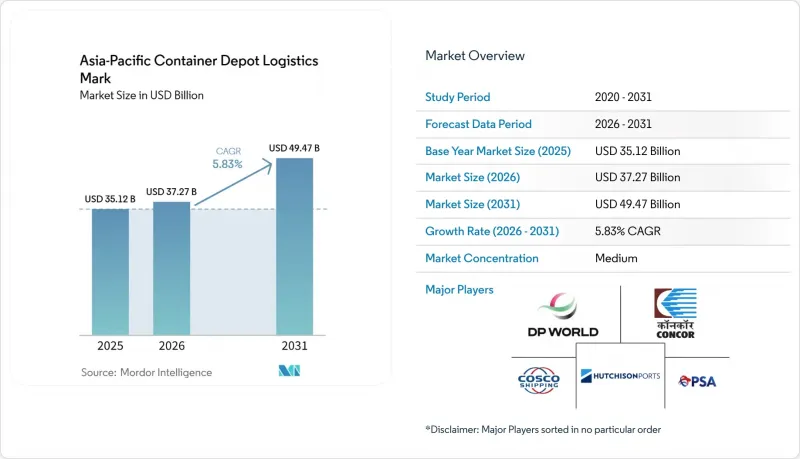
據 Mordor Intelligence 稱,2025 年亞太地區貨櫃堆場物流市場價值為 351.2 億美元,預計 2026 年將達到 372.7 億美元,2031 年將達到 494.7 億美元,2026 年至 2031 年的複合年成長率為 5.83%。
此外,隨著生產活動擴展到越南、印度和印度尼西亞,貨物運輸不僅透過傳統的出口樞紐,還透過更廣泛的內陸和沿海運輸路線。本報告按堆場類型(內陸貨櫃堆場、空箱堆場、其他)、服務類型(貨櫃倉儲服務、貨櫃裝卸服務、其他)、貨櫃類型(乾貨集裝箱、冷藏貨櫃)、貿易方向(國際/轉運、國內)和國家/地區(中國、日本、印度、泰國、澳洲、新加坡地區進行分類、其他國家/地區。市場預測以美元計價。
亞太地區貨櫃堆場物流市場趨勢與洞察
出口主導樞紐對貨櫃重新部署的需求日益成長
亞太地區的貨櫃流動仍不均衡,出口密集型地區對更快取得空箱的需求持續存在。 2026年初,歐洲堆場利用率超過90%,航運公司開始將貨櫃從歐洲運回中國和東南亞。這導致越南、印度和韓國的空箱堆場需要更多的分類、檢驗、維修和裝卸工作。亞太地區的貨櫃堆場物流市場正受益於此趨勢,因為空箱的重新部署不再只是一項輔助服務,而是場外堆場的直接收入來源。此外,航運公司越來越傾向於選擇能夠快速識別貨櫃、管理有序且週轉時間短的堆場合作夥伴。
內陸幹港和內陸貨櫃堆場網路的擴展
內陸港和內陸貨櫃場(ICD)的發展仍然是亞太地區貨櫃堆場物流市場最重要的推動力之一。印度貨櫃公司(CONCOR)已將業務擴展至190多個地點,在印度擁有68個碼頭,並在達爾帕特普爾、坎普爾物流園區和卡達科拉的新設施投入運作。越南已批准在其規劃名單中興建19個內陸貨櫃堆場,其中包括蔡梅港和丹崗木白港;孟加拉已取消對內陸貨櫃堆場設施的外資所有權限制,以吸引外部資本。中國也制定了2026-2030年多模態行動計劃,呼籲將鐵路支線與大規模物流園區直接連接,並加強鐵路海運在內陸地區的合作。隨著海關程序和加值服務向內陸轉移,門戶港口在貨櫃貨運站和堆場定價方面的主導正在逐漸減弱。
主要交通幹線附近倉庫用地短缺且成本不斷上漲。
全部區域,靠近主要港口和工業走廊的合適堆場位置仍然有限。在泰國東部經濟走廊,工業用地價格在過去兩年上漲了20%至30%,工業園區的空置率已降至6.2%。主要港口走廊周邊也面臨類似的壓力,開發商需要硬化地面、卡車通道以及冷藏貨櫃和清洗設施的空間。這使得新進業者難以趕上那些已經擁有穩定所擁有土地基礎的成熟開發商的經濟實力。一些開發商也被迫將業務擴展到都會區以外,但更長的運輸距離和過路費可能會削弱其服務的競爭力。
細分市場分析
至2025年,內陸貨櫃堆場將佔亞太地區貨櫃堆場物流市場佔有率的41.13%。這反映了它們作為大規模出口走廊中重要的海關和鐵路介面點的作用。這一地位得益於政策主導的多模態投資,包括中國提出的2027年鐵路和海運聯運量年均成長15%的目標。貨櫃貨運站繼續在門戶港口附近保持其重要位置,以支援小批量貨物的集散和港口周邊短途貨物的裝卸。空箱堆場是成長最快的堆場類型,預計到2031年將以8.69%的複合年成長率成長,因為由於設施供需失衡,空箱管理正朝著更大規模、更專業化的方向發展。
儘管港口堆場對於需要在碼頭附近進行受控儲存的承運商而言仍然至關重要,但港口區域內土地價格的飆升使得港外替代方案更具吸引力。 RSA Global宣布投資258億印度盧比(約3.05億美元),在JNPA生態系統內建造印度最大的自動化空箱堆場。該堆場每月可處理超過5萬個標準箱。該專案包括自動化倉庫系統(AS/RS)、支援OCR識別的閘口和數位化堆場管理系統,顯示資本正向更有效率的空貨櫃存放場轉移。隨著出口導向製造業的擴張以及人工堆場面臨日益嚴峻的周轉率壓力,預計類似的營運模式在越南和印尼也將變得更加普遍。
到2025年,貨櫃倉儲服務將佔亞太地區貨櫃堆場物流市場規模的33.94%,成為最大的服務板塊。這一主導地位歸因於持續的貿易失衡、高峰期堆場滯銷週期延長,以及托運人為尋求柔軟性的調度安排而增加庫存緩衝的使用。貨櫃維護和維修服務是成長最快的服務類型,預計到2031年將以9.84%的複合年成長率成長,這主要得益於更嚴格的檢驗要求和全球貨櫃船隊的老化。儘管貨櫃裝卸服務仍然是主要的收入來源,但日益成長的標準化給堆場規模的擴大和效率的提升帶來了壓力。
由於部分地區持續存在實際限制,特別是用水和廢水排放法規的限制,清洗服務的成長速度放緩。其他加值物流服務,例如保稅倉儲、越庫作業、重新貼標和貨櫃翻新,隨著堆場業者努力在單一場地內實現更高的貨物處理效率,其重要性日益凸顯。友森物流在平陽省擴建冷藏倉庫,顯示客戶對集倉儲、溫控和物流支援功能於一體的綜合服務包的需求不斷成長。因此,亞太地區的貨櫃堆場物流市場正從獨立的堆場營運模式轉向更廣泛的服務平台。
其他好處
- Excel格式的市場預測(ME)表
- 3個月的分析師支持
目錄
第1章:引言
- 研究假設和市場定義
- 調查範圍
第2章:調查方法
第3章執行摘要
第4章 市場狀況
- 市場概況及貨櫃場物流的重要性
- 市場促進因素
- 出口主導樞紐對貨櫃重新部署的需求日益成長
- 內陸幹港和內陸貨櫃堆場網路的擴展
- 冷藏貨櫃和溫控貨物的處理量增加。
- 向數位化場地可視化和資產追蹤過渡
- 由於港口堵塞,貨物需繞道運往港外及內陸倉庫。
- 保稅區和自由貿易區相關附加價值服務的需求
- 市場限制因素
- 主要交通幹線附近倉庫用地短缺且成本不斷上漲。
- 各倉庫之間存在人工操作流程及IT系統間互通性差的問題。
- 由於海關數位化進程不平衡,導致跨境貨櫃清關手續延誤。
- 清潔和冷藏集裝箱支援作業中的電力可靠性和水資源限制。
- 法律規範
- 價值鍊和分銷管道的結構分析
- 技術創新前景
- 波特五力分析
- 貨櫃處理量趨勢
- 進出口貿易分析
- 港口和碼頭基礎設施分析
- 永續性和ESG分析
- 貨櫃堆場物流市場的演變
- 地緣政治事件對供應鏈變化的影響
第5章 市場規模及成長預測(價值,2026-2031 年)
- 按倉庫類型
- 內陸貨櫃場(ICD)
- 貨櫃貨運站(CFS)
- 空容器堆場(ECD)
- 港口型貨櫃場
- 按服務類型
- 貨櫃儲存服務
- 貨櫃裝卸服務
- 貨櫃維護和修理(M&R)服務
- 貨櫃清潔和清洗服務
- 其他加值物流服務
- 按容器類型
- 乾貨容器
- 冷藏貨櫃
- 按貿易方向
- 國際/轉運貨櫃裝卸
- 國內貨櫃運輸
- 國家
- 中國
- 日本
- 印度
- 韓國
- 澳洲
- 印尼
- 新加坡
- 越南
- 泰國
- 其他亞太國家
第6章 競爭情勢
- 市場集中度
- 關鍵策略趨勢
- 市佔率分析
- 公司簡介
- DP World
- PSA International
- Hutchison Ports
- China COSCO Shipping Ports Limited
- Container Corporation of India Limited
- Yusen Logistics Co., Ltd.
- Nippon Express Holdings, Inc.
- Qube Holdings Limited
- Adani Ports and Special Economic Zone Limited
- Sumitomo Warehouse Co., Ltd.
- Kamigumi Co., Ltd.
- Gulftainer Company Limited
- APM Terminals
- China Merchants Port Holdings
- International Container Terminal Services Inc.(ICTSI)
- Kintetsu World Express(KWE)
- SITC Logistics
- Gemadept Corporation
- Hind Terminals Pvt. Ltd.
- Arshiya Ltd.
- Associated Container Terminals Ltd.(ACTL)
- Flinders Port Holdings
第7章 市場機會與未來展望
According to Mordor Intelligence, the Asia-Pacific container depot logistics market size was valued at USD 35.12 billion in 2025 and is forecast to reach USD 37.27 billion in 2026 and USD 49.47 billion by 2031 at 5.83% CAGR over 2026-2031.
Production is also spreading to Vietnam, India, and Indonesia, so cargo is moving across a wider set of inland and coastal corridors rather than remaining concentrated in older export centers. This report is Segmented by Depot Type, (inland Container Depots, Empty Container Depots, and More), by Service Type (Storage, Handling, and More), by Container Type (Dry and Reefer), by Trade Orientation (International and Domestic), and by Country (China, Japan, India, Australia, Indonesia, Singapore, Vietnam, Thailand, and More). The Market Forecasts are Provided in Terms of Value (USD).
Asia-Pacific Container Depot Logistics Market Trends and Insights
Rising Container Repositioning Needs Across Export-Led Hubs
Container flows across the Asia-Pacific region remain uneven, and export-heavy locations continue to need faster access to empty boxes. In early 2026, carriers were moving equipment back from Europe to China and Southeast Asia after depot utilization in Europe exceeded 90%. That movement increases sorting, inspection, repair, and staging work at empty container depots in Vietnam, India, and South Korea. The Asia-Pacific container depot logistics market benefits from this, as empty repositioning has become a direct operating line for off-dock yards rather than just a support task. Shipping lines are also placing more value on depot partners that can show faster box identification, cleaner yard discipline, and shorter turnaround times.
Expansion of Inland Dry Port and ICD Networks
The build-out of inland dry ports and ICDs remains one of the clearest supports for the Asia-Pacific container depot logistics market. CONCOR expanded its logistics footprint to more than 190 locations with 68 terminals in India, while new facilities were commissioned at Dalpatpur, Kanpur Logistics Park, and Kadakola. Vietnam approved 19 ICDs in its planning list, including Cai Mep and Tan Cang-Moc Bai, and Bangladesh removed foreign ownership caps on ICD facilities to attract outside capital. China also set out a multimodal action plan for 2026-2030 that calls for direct rail siding access at large logistics parks and stronger rail-sea links into inland zones. As more customs clearance and value-added work moves inland, gateway ports lose some of their earlier hold on container freight station and yard pricing.
Scarcity And Cost Inflation Of Depot-Grade Land Near Major Corridors
Depot-grade land near major ports and industrial corridors remains limited across the region. Thailand's Eastern Economic Corridor saw industrial land prices rise by 20-30% over the past 2 years, and vacancy in industrial estates fell to 6.2%. Similar pressure is visible around primary port corridors where operators need hardstand capacity, truck access, and room for reefer or wash support. This makes it harder for new entrants to match the economics of incumbents that already hold legacy land banks. It also pushes some developers toward outer-metro sites, where longer travel distances and toll costs can erode service competitiveness.
Other drivers and restraints analyzed in the detailed report include:
- Growth in Reefer Throughput and Temperature-Controlled Cargo Handling
- Port Congestion Deflection Into Off-Dock and Inland Depots
- Manual Operations And Low Interoperability Across Depot IT Systems
For complete list of drivers and restraints, kindly check the Table Of Contents.
Segment Analysis
Inland container depots accounted for 41.13% of the Asia-Pacific container depot logistics market share in 2025, reflecting their role as the main customs and rail interface across large export corridors. Their position is supported by policy-led multimodal investment, including China's push to expand rail-sea intermodal volumes by 15% a year through 2027. Container freight stations still have an important base near gateway ports because they support less-than-container-load consolidation and short-distance port-side handling. Empty container depots are the fastest-growing depot type, with a 8.69% CAGR through 2031, as equipment imbalance is turning empty box management into a larger and more specialized activity.
Port-based depots still matter for carriers that need controlled storage close to terminals, but higher land costs inside port areas are making off-dock alternatives more attractive. RSA Global announced India's largest automated empty container facility in the JNPA ecosystem with an INR 2,580 crore (USD 305 million) investment, and capacity to handle more than 50,000 TEUs a month. The project includes an automated storage and retrieval system, OCR-enabled gates, and digital yard management, which shows how capital is moving toward higher-efficiency empty yards. Similar operating models are likely to appear more often in Vietnam and Indonesia as export-oriented manufacturing spreads and manual yards face heavier turnaround pressure.
Container storage services accounted for 33.94% of the Asia-Pacific container depot logistics market size in 2025, making them the largest service line. The lead position came from persistent trade imbalances, longer dwell cycles at busy nodes, and wider use of inventory buffers by shippers seeking greater schedule flexibility. Container maintenance and repair services are the fastest-growing service type, with a 9.84% CAGR through 2031, driven by stricter inspection requirements and an aging global container fleet. Container handling services still represent a major revenue stream, but they are becoming more standardized, putting greater pressure on scale and yard productivity.
Cleaning and washing services are growing more slowly because access to water and compliance with wastewater regulations remain practical constraints in several locations. Other value-added logistics services, including bonded warehousing, cross-docking, relabeling, and container modification, are gaining importance as depot operators try to keep more cargo activity inside a single site. Yusen Logistics' cold storage expansion in Binh Duong showed how customers increasingly value service bundles that combine storage, temperature control, and supporting logistics functions in one place. The Asia-Pacific container depot logistics industry is therefore moving toward broader service platforms rather than stand-alone yard operations.
Complete Report Scope:
- By Depot Type
- Inland Container Depots (ICDs)
- Container Freight Stations (CFS)
- Empty Container Depots (ECDs)
- Port-Based Container Depots
- By Service Type
- Container Storage Services
- Container Handling Services
- Container Maintenance and Repair (M&R) Services
- Container Cleaning & Washing Services
- Other Value-Added Logistics Services
- By Container Type
- Dry Containers
- Reefer Containers
- By Trade Orientation
- International/Transshipment Container Handling
- Domestic Container Movement
- By Country
- China
- Japan
- India
- South Korea
- Australia
- Indonesia
- Singapore
- Vietnam
- Thailand
- Rest of Asia-Pacific
List of Companies Covered in this Report:
- DP World
- PSA International
- Hutchison Ports
- China COSCO Shipping Ports Limited
- Container Corporation of India Limited
- Yusen Logistics Co., Ltd.
- Nippon Express Holdings, Inc.
- Qube Holdings Limited
- Adani Ports and Special Economic Zone Limited
- Sumitomo Warehouse Co., Ltd.
- Kamigumi Co., Ltd.
- Gulftainer Company Limited
- APM Terminals
- China Merchants Port Holdings
- International Container Terminal Services Inc. (ICTSI)
- Kintetsu World Express (KWE)
- SITC Logistics
- Gemadept Corporation
- Hind Terminals Pvt. Ltd.
- Arshiya Ltd.
- Associated Container Terminals Ltd. (ACTL)
- Flinders Port Holdings
Additional Benefits:
- The market estimate (ME) sheet in Excel format
- 3 months of analyst support
TABLE OF CONTENTS
1 Introduction
- 1.1 Study Assumptions and Market Definition
- 1.2 Scope of the Study
2 Research Methodology
3 Executive Summary
4 Market Landscape
- 4.1 Market Overview and Importance of Container Depot Logistics
- 4.2 Market Drivers
- 4.2.1 Rising Container Repositioning Needs Across Export-Led Hubs
- 4.2.2 Expansion of Inland Dry Port and ICD Networks
- 4.2.3 Growth in Reefer Throughput and Temperature-Controlled Cargo Handling
- 4.2.4 Shift Toward Digital Yard Visibility and Asset Tracking
- 4.2.5 Port Congestion Deflection Into Off-Dock and Inland Depots
- 4.2.6 Demand for Bonded, Free-Trade-Zone Linked Value-Added Services
- 4.3 Market Restraints
- 4.3.1 Scarcity and Cost Inflation of Depot-Grade Land Near Major Corridors
- 4.3.2 Manual Operations and Low Interoperability Across Depot IT Systems
- 4.3.3 Uneven Customs Digitization Slowing Cross-Border Container Release
- 4.3.4 Power Reliability and Water Constraints for Wash and Reefer Support Operations
- 4.4 Regulatory Framework
- 4.5 Value Chain and Distribution Channel Architecture Analysis
- 4.6 Technology Innovations Outlook
- 4.7 Porter's Five Forces Analysis
- 4.7.1 Threat of New Entrants
- 4.7.2 Bargaining Power of Suppliers
- 4.7.3 Bargaining Power of Buyers
- 4.7.4 Threat of Substitutes
- 4.7.5 Rivalry Among Competitors
- 4.8 Container Throughput Trends
- 4.9 Import-Export Trade Analysis
- 4.10 Port and Terminal Infrastructure Analysis
- 4.11 Sustainability and ESG Analysis
- 4.12 Evolution of Container Depot Logistics Market
- 4.13 Impact of Geo-Political Events on Supply Chain Shifts
5 Market Size and Growth Forecasts (Value, 2026-2031)
- 5.1 By Depot Type
- 5.1.1 Inland Container Depots (ICDs)
- 5.1.2 Container Freight Stations (CFS)
- 5.1.3 Empty Container Depots (ECDs)
- 5.1.4 Port-Based Container Depots
- 5.2 By Service Type
- 5.2.1 Container Storage Services
- 5.2.2 Container Handling Services
- 5.2.3 Container Maintenance and Repair (M&R) Services
- 5.2.4 Container Cleaning & Washing Services
- 5.2.5 Other Value-Added Logistics Services
- 5.3 By Container Type
- 5.3.1 Dry Containers
- 5.3.2 Reefer Containers
- 5.4 By Trade Orientation
- 5.4.1 International/Transshipment Container Handling
- 5.4.2 Domestic Container Movement
- 5.5 By Country
- 5.5.1 China
- 5.5.2 Japan
- 5.5.3 India
- 5.5.4 South Korea
- 5.5.5 Australia
- 5.5.6 Indonesia
- 5.5.7 Singapore
- 5.5.8 Vietnam
- 5.5.9 Thailand
- 5.5.10 Rest of Asia-Pacific
6 Competitive Landscape
- 6.1 Market Concentration
- 6.2 Key Strategic Moves
- 6.3 Market Share Analysis
- 6.4 Company Profiles (includes Global level Overview, Market level overview, Core Segments, Financials as available, Strategic Information, Market Rank/Share for key companies, Products & Services, and Recent Developments)
- 6.4.1 DP World
- 6.4.2 PSA International
- 6.4.3 Hutchison Ports
- 6.4.4 China COSCO Shipping Ports Limited
- 6.4.5 Container Corporation of India Limited
- 6.4.6 Yusen Logistics Co., Ltd.
- 6.4.7 Nippon Express Holdings, Inc.
- 6.4.8 Qube Holdings Limited
- 6.4.9 Adani Ports and Special Economic Zone Limited
- 6.4.10 Sumitomo Warehouse Co., Ltd.
- 6.4.11 Kamigumi Co., Ltd.
- 6.4.12 Gulftainer Company Limited
- 6.4.13 APM Terminals
- 6.4.14 China Merchants Port Holdings
- 6.4.15 International Container Terminal Services Inc. (ICTSI)
- 6.4.16 Kintetsu World Express (KWE)
- 6.4.17 SITC Logistics
- 6.4.18 Gemadept Corporation
- 6.4.19 Hind Terminals Pvt. Ltd.
- 6.4.20 Arshiya Ltd.
- 6.4.21 Associated Container Terminals Ltd. (ACTL)
- 6.4.22 Flinders Port Holdings
7 Market Opportunities and Future Outlook
- 7.1 White-space and Unmet-Need Assessment

 2026年全球物流自動化人工智慧(AI)市場報告
 歐洲物流自動化:市場佔有率分析、產業趨勢與統計及成長預測(2026-2031 年)物流自動化:市場佔有率分析、產業趨勢與統計、成長預測(2026-2031)貨櫃堆場物流:市場佔有率分析、產業趨勢與統計、成長預測(2026-2031)歐洲貨櫃堆場物流:市場佔有率分析、產業趨勢與統計及成長預測(2026-2031)美國貨櫃堆場物流:市場佔有率分析、產業趨勢與統計及成長預測(2026-2031 年)
 物流自動化市場預測至2034年-按組件、功能、技術、應用、最終用戶和地區分類的全球分析
 物流自動化市場:按組件、物流類型、技術、運作模式、部署類型、應用和最終用戶產業分類-2026-2032年全球市場預測北美物流自動化:市場佔有率分析、產業趨勢與統計及成長預測(2026-2031 年)
 物流自動化市場機會、成長要素、產業趨勢分析及2026-2035年預測