


 |
市場調查報告書
商品編碼
2117979
歐洲沿海滾裝海運:市場佔有率分析、產業趨勢與統計及成長預測(2026-2031 年)Europe Short Sea Ro-Ro Ocean Freight Transport - Market Share Analysis, Industry Trends & Statistics, Growth Forecasts (2026 - 2031) |
||||||

※ 本網頁內容可能與最新版本有所差異。詳細情況請與我們聯繫。
根據Mordor Intelligence的數據顯示,2025年歐洲沿海滾裝海運市場價值為67.6億美元,預計2026年將成長至72億美元,到2031年將達到97.1億美元。預計2026年至2031年期間的複合年成長率為6.17%。
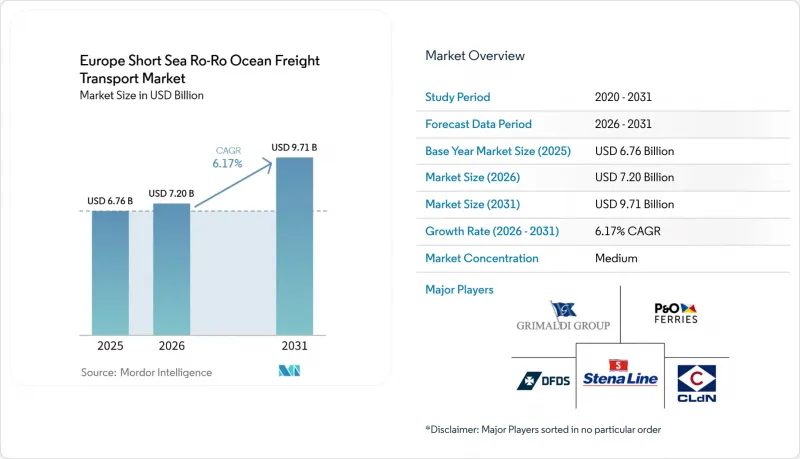
歐洲沿海滾裝海運市場主要受汽車物流趨勢所驅動,這些趨勢仍側重於區域內主要生產和分銷中心之間的沿海車輛運輸。本報告按貨物類型(乘用車、商用車、其他)、船舶尺寸(小型船舶、中型船舶、其他)、貨運量/航線叢集(英國-歐洲大陸、北海-斯堪地那維亞/德國走廊、其他)、終端用戶行業(原始設備製造商、經銷商、其他)以及國家/地區(英國、德國、西班牙、其他)進行細分。市場預測以美元計價。
歐洲沿海滾裝海運市場的趨勢與洞察
歐洲汽車生產和貿易的復甦
歐洲沿海滾裝海運市場與成品車的分銷密切相關,因為沿海運輸在區域汽車分銷中仍然發揮核心作用。根據歐洲汽車製造商協會(ACEA)預測,到2025年,歐盟製造商將供應歐盟市場73%的佔有率,超過三分之一的歐盟產乘用車將銷往歐盟以外地區。這表明汽車生產和海運仍然緊密相連。這種結構支撐著主要汽車碼頭(尤其是德國、比利時和西班牙)的穩定需求。在這些國家,出口和再分銷活動正在重振沿海運輸網路。這種結構也提高了生產基地和港口門戶之間的航線密度,即使部分出口航線運輸速度放緩,也能幫助營運商維持運轉率。隨著越來越多的汽車在歐洲境內或透過鄰近的沿海走廊運輸,該地區持續產生符合滾裝運輸模式的貨物。因此,汽車相關需求仍是歐洲沿海滾裝海運市場中最顯著的貨運量來源之一。
從道路運輸過渡到無人陪伴的短程海上運輸
歐洲沿海滾裝海運市場也受惠於長途道路運輸向無人陪同沿海運輸服務的穩定轉變。這種轉變在北海、波羅的海和英吉利海峽航線上日益重要,這些航線的船班頻次、港口便利性和穩定的工業需求為模式轉換創造了有利條件。其吸引力在於實用性和經濟性兩方面,因為營運商無需依賴長途司機即可運輸拖車。通往伊比利亞半島和斯堪地那維亞半島的航線多樣化也推動了這一轉變,因為新增和擴展的服務為貨運買家提供了比傳統航線模式更多的選擇。 DFDS決定從2026年9月起增加卡爾斯港-克萊佩達航線的運力,顯示市場需求依然強勁,足以支撐在波羅的海航線上運作更大的船舶。隨著這些運輸路線選擇的增加,歐洲沿海滾裝貨運市場正在超越傳統的以公路運輸為基礎的模式,以適應更多種類的貨物運輸。
與英國脫歐相關的摩擦和邊境海關延誤
英國脫歐相關的摩擦持續對歐洲沿海滾裝海運市場造成沉重壓力,尤其是英國與歐洲大陸之間的航線,預計2025年將佔據最大的市場佔有率。繁瑣的行政程序持續影響依賴可預測跨境運輸的貨物的運輸時間、計劃和緩衝需求。對於短途、頻繁的航線而言,這一點尤其關鍵,因為即使是輕微的延誤也可能削弱海運相對於附近陸路運輸的優勢。波羅的海和東歐地區更廣泛的航線走廊也面臨不確定性。在這些地區,衝突引發的混亂可能會改變航線選擇,迫使承運人修改船舶部署計畫。這給處理時效性貨物和跨多個區域航線混合貨物的營運商帶來了更大的壓力。因此,儘管主要航線的需求強勁,但歐洲沿海滾裝海運市場的營運環境正在變得更加謹慎。
細分市場分析
2025年,乘用車在歐洲沿海滾裝海運市場佔有率中佔比高達52.39%,明顯領先其他所有貨物類別。這一主導地位反映了成熟的汽車碼頭網路集中在不來梅港、塞布魯日港和埃姆登港等港口,這些港口的汽車出口和轉運流程已融入常規沿海運輸作業。此外,歐洲汽車物流體係也為此領域帶來益處,大規模成品車從生產地運往沿海碼頭,再轉入海運。根據歐洲汽車製造商協會(ACEA)的報告,2025年歐盟乘用車出口量下降了6.2%。這表明,儘管歐洲內部轉運仍然重要,但部分跨歐洲航線仍面臨壓力。因此,提高歐洲內部營運效率的重要性進一步凸顯,因為承運商可以依靠密集的區域航線來支援幹線運輸。
預計到2031年,非公路車輛的複合年成長率將達到7.86%,成為歐洲沿海滾裝海運市場成長最快的貨物類別。此類別包括施工機械、農業機械以及其他適合滾裝運輸且需要直接進行車輪裝卸的大型重型設備。根據歐洲滾裝船聯盟(UECC)的報告,到2025年,除130萬輛乘用車外,還將有2萬輛大型重型貨物透過滾裝船運輸。這表明,對於擁有合適船舶配置的營運商而言,該類別已佔據重要地位。隨著專案貨物和特殊輪式貨物在現有服務中的佔有率不斷擴大,非公路車輛的運輸量在乘用車運輸量的基礎上,提供了額外的成長空間。
2000至4000標準箱的中型船舶將繼續在市場中佔據核心地位,預計到2025年將佔歐洲沿海滾裝海運市場規模的44.62%。它們的強勢地位源自於其在波羅的海和北海航線上累積的豐富營運經驗。這些航線的許多服務都經過精心設計,以適應港口限制、坡道限制以及適合中型船舶的航線經濟性。在現有航線上,這些船舶繼續提供頻率和運力之間的合理平衡,而無需超大型船舶。然而,儘管中型船舶佔據主導地位,但日益嚴格的排放氣體法規和不斷上漲的燃油成本正推動船舶現代化改造,因為效率對所有類型的船舶都變得越來越重要。因此,儘管中型船舶目前仍主導著營運格局,但它們未來的角色將越來越取決於船隊的老化程度、燃油柔軟性和航線專業化程度。
預計到2031年,載箱量超過4000標準箱的大型船舶將以8.24%的複合年成長率成長,成為所有船型中成長最快的,並在歐洲沿海滾裝海運市場規模前景中佔據越來越重要的地位。 Stena RoRo表示,其新型「C-Flexer」船舶旨在提供靈活的甲板配置,不受貨物類型的影響,並將推動主要航線向更大、更通用的船舶轉型。 UECC公司訂購了4500標準箱和3000標準箱的船舶,這表明其策略與Stena RoRo有所不同,營運商正在尋求使船舶尺寸與航線和貨物需求更加匹配。載箱量低於2000標準箱的小型船舶在吃水受限的支線航線和二級碼頭仍然發揮著重要作用,但在大型船舶單位盈利更高的地區,它們面臨著更大的壓力。因此,歐洲沿海滾裝海運業的船舶組成變得更加分散,船舶尺寸的決定現在比以前更直接地受到監管合規風險和航線需求強度的影響。
其他好處
- Excel格式的市場預測(ME)表
- 3個月的分析師支持
目錄
第1章:引言
- 研究假設和市場定義
- 調查範圍
第2章:調查方法
第3章執行摘要
第4章 市場狀況
- 市場概況及海岸低滾輪海運的重要性
- 市場促進因素
- 歐洲汽車生產和貿易的復甦
- 從道路運輸過渡到無人陪伴的短程海上運輸
- 通往伊比利亞半島和斯堪地那維亞走廊的路線多樣化
- 圍繞港口的汽車物流重組
- 用低排放量滾裝船替換現有船隊
- 數位化泊位規劃和車輛流量可視化
- 市場限制因素
- 與英國脫歐相關的摩擦和邊境海關延誤
- 烏克蘭局勢導致交通路線中斷和繞行帶來的風險
- 歐盟碳排放法規導致成本增加
- 二級樞紐港口側坡道和堆場的容量限制
- 法律規範
- 價值鍊和分銷管道的結構分析
- 技術創新前景
- 波特五力分析
- 滾裝貨運與其他運輸方式的比較
- 港口和碼頭基礎設施分析
- 永續性和ESG分析
- 歐洲沿海滾裝運輸的變化
- 地緣政治事件對供應鏈變化的影響
第5章 市場規模及成長預測(價值,2026-2031 年)
- 按貨物類型
- 乘用車(包括二輪車和三輪車)
- 商用車輛
- 越野車
- 按船舶尺寸
- 小型船舶(小於 2,000 CEU)
- 中型船舶(2,000-4,000CEU)
- 大型船舶(超過 4,000 個貨櫃)
- 按貨運量/航線叢集
- 英國- 歐洲大陸(英吉利海峽/北海)
- 北海-斯堪地那維亞/德國走廊
- 波羅的海國家、波蘭 –斯堪地那維亞、德國
- 地中海和歐洲地區
- 歐洲境內的其他短程海運航線
- 按最終用戶行業分類
- OEM
- 經銷商
- 其他(租車公司、貨運租賃公司、政府/國防機構車輛等)
- 國家
- 英國
- 德國
- 荷蘭
- 比利時
- 西班牙
- 義大利
- 其他歐洲國家
第6章 競爭情勢
- 市場集中度
- 關鍵策略趨勢
- 市佔率分析
- 公司簡介
- DFDS A/S
- CLdN Group
- Grimaldi Group
- Stena Line(Stena AB)
- P&O Ferries
- Brittany Ferries
- Irish Ferries(Irish Continental Group plc)
- Attica Group
- GNV(Grandi Navi Veloci SpA)
- Balearia Eurolineas Maritimas SA
- Color Line AS
- TT-Line GmbH & Co. KG
- Scandlines GmbH
- Tallink Grupp AS
- Viking Line Abp
- Naviera Armas Trasmediterranea
- UECC(United European Car Carriers)
- Polferries(Polska Zegluga Baltycka SA)
- Unity Line
- Eckero Line Oy
- Transfennica Ltd.(Spliethoff Group)
第7章 市場機會與未來展望
According to Mordor Intelligence, the Europe short sea Ro-Ro ocean freight transport market size was valued at USD 6.76 billion in 2025 and is projected to grow to USD 7.20 billion in 2026, reaching USD 9.71 billion by 2031, growing at a CAGR of 6.17% from 2026 to 2031.
The Europe short sea Ro-Ro ocean freight transport market is supported by automotive logistics patterns that still favor coastal vehicle movement between major production and distribution hubs across the region. This report is Segmented by Cargo Type (Passenger Vehicles, Commercial Vehicles, and More), by Vessel Size (Small-Size, Mid-Size, and More), by Route Clusters (UK-Continental Europe, North Sea-Scandinavia/Germany, and More), by End-User Industry (OEMs, Dealers, Others) and by Country (United Kingdom, Germany, Spain, and More). The Market Forecasts are Provided in Terms of Value (USD).
Europe Short Sea Ro-Ro Ocean Freight Transport Market Trends and Insights
Resurgence in Intra-European Vehicle Production and Trade
The Europe short sea Ro-Ro ocean freight transport market remains closely tied to finished vehicle flows, as coastal dispatch continues to play a central role in regional automotive distribution. ACEA stated that EU-based manufacturers supplied 73% of the EU market in 2025, and more than one-third of EU-made passenger cars were sold outside the bloc, indicating that vehicle production and maritime vehicle handling remain closely linked. That structure supports steady demand at major vehicle terminals, especially in Germany, Belgium, and Spain, where export and redistribution activities feed short sea shipping networks. It also strengthens route density between production clusters and port gateways, which helps operators maintain utilization even when some export lanes soften. As more vehicle movements remain within Europe or pass through nearby coastal corridors, the region continues to generate cargo that aligns well with Ro-Ro operating patterns. This keeps automotive-linked demand as one of the clearest volume anchors for the Europe short sea Ro-Ro ocean freight transport market.
Shift From Road to Unaccompanied Short Sea Freight
The Europe short sea Ro-Ro ocean freight transport market is also benefiting from the steady shift of freight away from long-distance road transport and toward unaccompanied short sea services. This is becoming more important on North Sea, Baltic, and Channel routes, where service frequency, port access, and regular industrial demand create favorable conditions for modal substitution. The appeal is both practical and financial, because operators can move trailers without depending on the full availability of long-haul drivers across every corridor. Route diversification toward Iberia and Scandinavia adds to this shift, since new and expanded services give freight buyers more options beyond older route patterns. The DFDS decision to add capacity on the Karlshamn to Klaipeda route from September 2026 shows that demand remains strong enough to justify deploying larger vessels on the Baltic lanes. As these corridor options expand, the European short sea Ro-Ro ocean freight market is moving beyond its traditional automotive base and serving a broader mix of freight movements.
Brexit Friction and Border Processing Delays
Brexit-related friction continues to weigh on the Europe short sea Ro-Ro ocean freight transport market, especially on the United Kingdom and Continental Europe corridor, which held the largest route share in 2025. Administrative complexity still affects timing, planning, and buffer requirements for freight that depends on predictable cross-border movement. This matters most on short, frequent crossings, where even modest delays can erode the relative advantage of maritime services over direct road options on nearby routes. The same part of the market also remains exposed to wider corridor uncertainty in the Baltic and Eastern European region, where conflict-related disruptions can alter routing choices and force carriers to rework vessel deployments. That creates added pressure for operators serving time-sensitive freight or mixed cargo portfolios across several regional lanes. The result is a more cautious operating environment for the Europe short sea Ro-Ro ocean freight transport market, even though demand fundamentals on core corridors remain intact.
Other drivers and restraints analyzed in the detailed report include:
- Fleet Renewal Toward Lower-Emission Ro-Ro Vessels
- Digital Berth Planning and Vehicle Flow Visibility
- EU Carbon Compliance Cost Inflation
For complete list of drivers and restraints, kindly check the Table Of Contents.
Segment Analysis
Passenger vehicles held 52.39% of Europe short sea Ro-Ro ocean freight transport market share in 2025, keeping this segment clearly ahead of all other cargo categories. This lead reflects the concentration of established car terminal networks in ports such as Bremerhaven, Zeebrugge, and Emden, where vehicle export and redistribution flows are already embedded in regular short sea operations. The segment also benefits from the way European automotive logistics are organized, because large batches of finished vehicles move from production locations to coastal terminals before onward maritime dispatch. ACEA reported that EU passenger car exports declined 6.2% in 2025, indicating that the segment still faces pressure on some extra-European lanes even as intra-European distribution remains important. That makes operating efficiency inside Europe more valuable, since carriers can rely on dense regional routes to support baseline volumes.
Off-road vehicles are projected to grow at a 7.86% CAGR through 2031, making them the fastest-growing cargo segment in the Europe short sea Ro-Ro ocean freight transport market. This segment includes construction equipment, agricultural machinery, and other high-and-heavy units that lend themselves well to Ro-Ro loading when direct wheeled handling is important. UECC reported transporting 20,000 high-and-heavy cargo units in 2025 alongside 1.3 million passenger cars, indicating that this category is already meaningful for operators with the right vessel mix. As project cargo and specialized rolling freight gain space within existing services, off-road volumes provide a useful growth layer beyond the passenger vehicle base.
Mid-size vessels with 2,000 to 4,000 CEU accounted for 44.62% of the Europe short sea Ro-Ro ocean freight transport market size in 2025, keeping them at the center of the market. Their strong position reflects the long-standing operating profile of Baltic and North Sea corridors, where many services were built around port limits, ramp constraints, and route economics suited to mid-size ships. These vessels still offer a practical balance between frequency and capacity on established lanes that do not always require very large tonnage. At the same time, their leading share does not remove the growing pressure to modernize, because emissions rules and fuel costs are making efficiency more important across vessel classes. This is why mid-size vessels continue to dominate current deployment, while their future role increasingly depends on fleet age, fuel flexibility, and route specialization.
Large vessels above 4,000 CEU are projected to grow at an 8.24% CAGR through 2031, the fastest pace within vessel sizing, which lifts their position in the Europe short sea Ro-Ro ocean freight transport market size outlook. Stena RoRo stated that its new C-Flexer vessels were designed for flexible deck configurations across cargo types, supporting the move toward larger, more versatile ships on core routes. UECC also showed this split in strategy by ordering both 4,500-CEU and 3,000-CEU vessels, suggesting that operators are matching ship size more closely to route and cargo requirements. Small vessels below 2,000 CEU still matter on restricted-draft feeder routes and secondary terminals, but they are under greater pressure where larger ships can deliver stronger unit economics. This leaves the Europe short sea Ro-Ro ocean freight transport industry with a more divided vessel base, where size decisions are tied more directly to compliance exposure and corridor strength than in the past.
Complete Report Scope:
- By Cargo Type
- Passenger Vehicles (incl. 2 and 3-wheeler vehicles)
- Commercial Vehicles
- Off-road Vehicles
- By Vessel-size
- Small-size Vessels (Less than 2,000 CEU)
- Mid-size Vessels (2,000 - 4,000 CEU)
- Large vessels (More than 4,000 CEU)
- By Flows/Route Clusters
- UK - Continental Europe (Channel/North Sea)
- North Sea - Scandinavia/Germany Corridor
- Baltic/Poland - Scandinavia/Germany
- Mediterranean Intra-Europe
- All Other Intra-European Short-sea Lanes
- By End-user Industry
- OEMs
- Dealers
- Others (Rental Companies, Fleet leasing companies, Government & Defense Fleets, etc.)
- By Country
- United Kingdom
- Germany
- Netherlands
- Belgium
- Spain
- Italy
- Rest of Europe
List of Companies Covered in this Report:
- DFDS A/S
- CLdN Group
- Grimaldi Group
- Stena Line (Stena AB)
- P&O Ferries
- Brittany Ferries
- Irish Ferries (Irish Continental Group plc)
- Attica Group
- GNV (Grandi Navi Veloci S.p.A.)
- Balearia Eurolineas Maritimas S.A.
- Color Line AS
- TT-Line GmbH & Co. KG
- Scandlines GmbH
- Tallink Grupp AS
- Viking Line Abp
- Naviera Armas Trasmediterranea
- UECC (United European Car Carriers)
- Polferries (Polska Zegluga Baltycka S.A.)
- Unity Line
- Eckero Line Oy
- Transfennica Ltd. (Spliethoff Group)
Additional Benefits:
- The market estimate (ME) sheet in Excel format
- 3 months of analyst support
TABLE OF CONTENTS
1 Introduction
- 1.1 Study Assumptions and Market Definition
- 1.2 Scope of the Study
2 Research Methodology
3 Executive Summary
4 Market Landscape
- 4.1 Market Overview and Importance of Short Sea Ro-Ro Ocean Freight Transport
- 4.2 Market Drivers
- 4.2.1 Resurgence in Intra-European Vehicle Production and Trade
- 4.2.2 Shift From Road To Unaccompanied Short-Sea Freight
- 4.2.3 Route Diversification Toward Iberia and Scandinavia Corridors
- 4.2.4 Port-Adjacent Automotive Logistics Reconfiguration
- 4.2.5 Fleet Renewal Toward Lower-Emission Ro-Ro Vessels
- 4.2.6 Digital Berth Planning and Vehicle Flow Visibility
- 4.3 Market Restraints
- 4.3.1 Brexit Friction and Border Processing Delays
- 4.3.2 Ukraine-Related Corridor Disruptions and Risk Re-Routing
- 4.3.3 EU Carbon Compliance Cost Inflation
- 4.3.4 Limited Port-Side Ramp And Yard Capacity At Secondary Hubs
- 4.4 Regulatory Framework
- 4.5 Value Chain and Distribution Channel Architecture Analysis
- 4.6 Technology Innovations Outlook
- 4.7 Porter's Five Forces Analysis
- 4.7.1 Threat of New Entrants
- 4.7.2 Bargaining Power of Suppliers
- 4.7.3 Bargaining Power of Buyers
- 4.7.4 Threat of Substitutes
- 4.7.5 Rivalry Among Competitors
- 4.8 Comparison of Ro-Ro Freight versus Other Transportation Modes
- 4.9 Port and Terminal Infrastructure Analysis
- 4.10 Sustainability and ESG Analysis
- 4.11 Evolution of European Short Sea Ro-Ro Shipping
- 4.12 Impact of Geo-Political Events on Supply Chain Shifts
5 Market Size and Growth Forecasts (Value, 2026-2031)
- 5.1 By Cargo Type
- 5.1.1 Passenger Vehicles (incl. 2 and 3-wheeler vehicles)
- 5.1.2 Commercial Vehicles
- 5.1.3 Off-road Vehicles
- 5.2 By Vessel-size
- 5.2.1 Small-size Vessels (Less than 2,000 CEU)
- 5.2.2 Mid-size Vessels (2,000 - 4,000 CEU)
- 5.2.3 Large vessels (More than 4,000 CEU)
- 5.3 By Flows/Route Clusters
- 5.3.1 UK - Continental Europe (Channel/North Sea)
- 5.3.2 North Sea - Scandinavia/Germany Corridor
- 5.3.3 Baltic/Poland - Scandinavia/Germany
- 5.3.4 Mediterranean Intra-Europe
- 5.3.5 All Other Intra-European Short-sea Lanes
- 5.4 By End-user Industry
- 5.4.1 OEMs
- 5.4.2 Dealers
- 5.4.3 Others (Rental Companies, Fleet leasing companies, Government & Defense Fleets, etc.)
- 5.5 By Country
- 5.5.1 United Kingdom
- 5.5.2 Germany
- 5.5.3 Netherlands
- 5.5.4 Belgium
- 5.5.5 Spain
- 5.5.6 Italy
- 5.5.7 Rest of Europe
6 Competitive Landscape
- 6.1 Market Concentration
- 6.2 Key Strategic Moves
- 6.3 Market Share Analysis
- 6.4 Company Profiles (includes Global level Overview, Market level overview, Core Segments, Financials as available, Strategic Information, Market Rank/Share for key companies, Products & Services, and Recent Developments)
- 6.4.1 DFDS A/S
- 6.4.2 CLdN Group
- 6.4.3 Grimaldi Group
- 6.4.4 Stena Line (Stena AB)
- 6.4.5 P&O Ferries
- 6.4.6 Brittany Ferries
- 6.4.7 Irish Ferries (Irish Continental Group plc)
- 6.4.8 Attica Group
- 6.4.9 GNV (Grandi Navi Veloci S.p.A.)
- 6.4.10 Balearia Eurolineas Maritimas S.A.
- 6.4.11 Color Line AS
- 6.4.12 TT-Line GmbH & Co. KG
- 6.4.13 Scandlines GmbH
- 6.4.14 Tallink Grupp AS
- 6.4.15 Viking Line Abp
- 6.4.16 Naviera Armas Trasmediterranea
- 6.4.17 UECC (United European Car Carriers)
- 6.4.18 Polferries (Polska Zegluga Baltycka S.A.)
- 6.4.19 Unity Line
- 6.4.20 Eckero Line Oy
- 6.4.21 Transfennica Ltd. (Spliethoff Group)
7 Market Opportunities and Future Outlook
- 7.1 White-space and Unmet-Need Assessment

 亞太地區拼箱貨運 (LCL):市場佔有率分析、產業趨勢和統計數據以及成長預測 (2026-2031)北美保溫運輸貨櫃:市場佔有率分析、產業趨勢與統計及成長預測(2026-2031 年)貨櫃航運:市場佔有率分析、產業趨勢與統計、成長預測(2026-2031)
 貨櫃短期租賃市場分析及預測(至2035年):按類型、產品、服務、技術、組件、應用、部署、最終用戶及解決方案分類
 ISO標準貨櫃市場:預測(至2034年)-按貨櫃類型、貨櫃尺寸、材料、所有權、應用、最終用戶和地區分類的全球分析海運貨櫃:市場佔有率分析、產業趨勢與統計、成長預測(2026-2031)
 貨櫃市場:2026-2032年全球市場預測(按類型、材質、尺寸、所有權、運輸方式、應用和銷售管道)中國貨櫃航運業:市場佔有率分析、產業趨勢與統計及成長預測(2026-2031年)美國貨櫃航運:市場佔有率分析、產業趨勢與統計及成長預測(2026-2031)印度貨櫃航運:市場佔有率分析、產業趨勢與統計及成長預測(2026-2031)