


 |
市場調查報告書
商品編碼
2099059
印度貨櫃航運:市場佔有率分析、產業趨勢與統計及成長預測(2026-2031)India Container Shipping - Market Share Analysis, Industry Trends & Statistics, Growth Forecasts (2026 - 2031) |
||||||

※ 本網頁內容可能與最新版本有所差異。詳細情況請與我們聯繫。
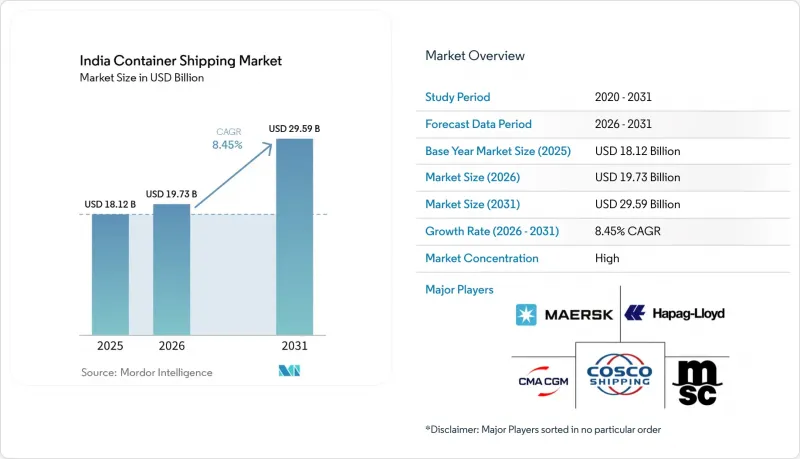
根據 Mordor Intelligence 預測,印度貨櫃航運市場規模將從 2025 年的 181.2 億美元成長到 2026 年的 197.3 億美元,到 2031 年將達到 295.9 億美元,2026 年至 2031 年的複合年成長率為 8.45%。
隨著電子、醫藥和汽車零件製造業的發展,印度的貨物運輸環境正逐漸轉變為適合貨櫃海運的模式,此前未採用貨櫃海運的出口量也開始增加。本報告按服務類型(遠洋、內陸、支線、沿海)、貨櫃類型(乾貨貨櫃、冷藏貨櫃)、貨櫃尺寸(20英尺、40英尺及其他特殊尺寸)、裝載類型(整箱、拼箱)、最終用戶(快速消費品/零售、製造/汽車、其他)和地區(北部、中部、西部、東部南部)進行細分。市場預測以美元計價。
印度貨櫃航運市場的趨勢與洞察
主要工業走廊進出口容器化進程
印度的貨櫃航運市場正受益於主要工業走廊沿線貨櫃使用量的穩定成長。這是因為印度仍有空間將散貨和其他運輸方式轉向貨櫃運輸。在2025-2026會計年度,受整體貨運量成長和主要門戶港口活動擴大的推動,印度港口的貨櫃貨運量也有所增加。這種轉變在古吉拉突邦、泰米爾納德邦和安得拉邦的製造業中心地帶尤為顯著,這些地區的電子產品和汽車零件生產正在推動出口貨櫃貨運量的成長。賈姆訥格爾港(JNPT)創紀錄的吞吐量也表明,這種轉變並非局限於特定貨物類別,該港口在2025-2026會計年度處理了817萬標準箱(TEU),同比成長11.9%。這一趨勢對印度的貨櫃航運市場意義重大,因為它並非出口的暫時性激增,而是製造業供應鏈持續成長的需求。此外,未來的成長可能來自更廣泛的地區和產品類別,這意味著航運公司和碼頭的需求基礎將持續擴大。
開通西部專用貨運走廊及港口與鐵路協調
專用貨運走廊(DFCC)網路於2025年建成,透過更直接地連接內陸生產區與港口,顯著改善了印度貨櫃航運市場的物流基礎設施。據DFCCIL稱,該走廊的貨運服務平均運行速度遠高於傳統鐵路,每列火車的貨櫃運力也遠高於傳統鐵路。此外,該走廊還能實現更可預測的內陸運輸,這對於需要固定發車時間的出口商以及旨在提高船舶運轉率的航運公司至關重要。 2025-2026會計年度,透過印度貨櫃公司(CONCOR)網路運輸的鐵路貨櫃貨運量達到387萬標準貨櫃(TEU),較去年同期成長14.2%。這表明,模式轉換不再只是一項政策目標,而是正在切實落實。馬士基FI2航線的首航於2026年6月4日從上海啟航,也凸顯了皮帕瓦武港作為印度西北部鐵路樞紐港口日益重要的角色。在印度的貨櫃航運市場,鐵路與港口的整合減少了內陸市場的摩擦,並提升了西海岸門戶在進出口方面的價值。
霍爾木茲海峽、紅海、巴拿馬運河以及地緣政治因素造成的航運路線中斷。
2026年初,霍爾木茲海峽的動盪影響了波斯灣及周邊航線的貿易流動,印度的貨櫃航運市場遭受了嚴重的營運衝擊。此次動盪導致大量船舶滯留在波斯灣,使得托運人面臨戰爭相關附加費飆升、運輸成本增加以及貨物延誤等問題。西海岸門戶港口受到的影響尤其顯著,改道和延誤的貨櫃給裝卸和滯留時間帶來了額外壓力。繞行路線的延長增加了燃油消耗,並延長了運往歐洲和美國的運輸時間。這對中小型出口商的打擊更大,因為他們在緊急貨運情況下議價能力較弱。儘管政府推出了緊急政策支援並進行了臨時營運調整,但印度的貨櫃航運市場仍面臨波斯灣和紅海走廊沿線動盪帶來的重大風險。因此,在可預見的未來,航線穩定性仍將是航運公司、港口和出口商面臨的主要風險。
細分市場分析
到2025年,離岸貨櫃運輸將佔印度貨櫃運輸市場的68.17%,成為印度貨櫃運輸市場的支柱。這一地位反映了印度通往歐洲、北美和東亞的長途進出口航線的重要性,其中賈瓦哈拉爾·尼赫魯港(JNPT)和蒙德拉港等主要門戶港口在貨物運輸中仍然發揮著核心作用。這種服務模式受益於規模經濟、既定的航線安排以及主要製造業和消費流產生的貨物集中。港口吞吐量的持續成長也支撐了海運需求,主要港口在2025-2026會計年度的吞吐量將超過9.15億噸,賈瓦哈拉爾·尼赫魯港同期也創下了貨櫃吞吐量的歷史新高。印度周邊地區的貿易格局尚未像東南亞那麼緊密,因此沿海航線的貨運量仍然相對小規模。
預計到2031年,支線和沿海/國內貨櫃航運將以9.43%的複合年成長率成長,成為印度貨櫃航運市場成長最快的服務板塊。這一成長主要受兩個相互關聯的變化驅動:一是印度轉運量增加,二是國內貨物運輸方式從道路運輸運輸。此外,由於航運公司尋求利用印度註冊船舶和本地夥伴關係關係來改善國內航線的准入,因此市場對沿海和支線航線也表現出濃厚的興趣。這一轉變意義重大,因為它擴展了乾線貿易以下的服務層級,並為二級港口和區域貨主提供了更穩定的連接。從實際角度來看,支線航線的成長將降低印度貨櫃航運市場對少數幹線直航的依賴,並提高樞紐港和區域港口之間貨物運輸的柔軟性。同時,它也將提升南印度港口的價值,這些港口能夠將深水港的轉運與沿海運輸連接起來。
預計到2025年,乾貨貨櫃將佔印度貨櫃運輸市場81.90%的佔有率,成為最大的貨櫃類型。這一主導地位歸功於目前仍使用標準乾貨貨櫃運輸的貨物種類繁多,包括日常消費品、製成品、紡織品和工業原料。乾貨貨櫃非常適合印度目前的貿易結構,因為許多進出口貨物無需溫控。此外,乾貨貨櫃也與整箱貨運(FCL)的規模高度契合,而整箱貨運仍是長途航線大規模托運人的主要裝載方式。從這個意義上講,乾貨貨櫃仍然是穩定印度貨櫃運輸市場眾多終端用戶行業貨運量的基礎。
預計到2031年,冷藏貨櫃的複合年成長率將達到12.05%,顯著高於印度貨櫃航運市場的整體成長率。這一快速成長與藥品、疫苗、溫控原料和農產品等貨物的季節性需求之外的低溫運輸需求不斷擴大密切相關。馬士基與印度貨櫃公司(CONCOR)合作,於2026年5月開通了從海得拉巴到納瓦舍瓦的每週專用冷藏鐵路運輸服務,這表明低溫運輸的擴展正變得更加系統化和商業性規模化。隨著藥品出口規模的擴大,冷藏貨櫃的使用可能會從小眾需求轉變為出口計畫中更常見的組成部分。這種轉變對印度貨櫃航運業有重大影響,因為冷藏貨物需要更複雜的服務、對專用設備更高的需求,以及內陸物流和港口裝卸之間更緊密的協調。此外,由於專業運輸涉及更先進的服務,未來該領域的價值成長可能會超過其數量成長。
其他好處:
- Excel格式的市場預測(ME)表
- 3個月的分析師支持
目錄
第1章:引言
- 研究假設和市場定義
- 調查範圍
第2章:調查方法
第3章執行摘要
第4章 市場狀況
- 市場概況及貨櫃運輸在物流中的作用
- 市場促進因素
- 主要工業走廊進出口貨櫃運輸量增加
- 西部專用貨運走廊的營運啟動以及港口和鐵路之間的協調
- 東西海岸主要港口吞吐能力提升
- 透過沿海港口和樞紐港口的航線擴大轉運佔有率。
- 海外航運公司拓展航線並增加營運頻率
- 公共部門努力擴大國內貨櫃航運能力
- 市場限制因素
- 霍爾木茲海峽、紅海、巴拿馬運河以及地緣政治因素造成的航運路線中斷。
- 美國關稅對貨櫃出口產業的影響
- 鐵路運輸成本壓力和內陸地區停留時間效率低。
- 西海岸碼頭擁擠和船舶泊位限制
- 法律規範
- 價值鍊和分銷管道的結構分析
- 技術創新的前景
- 波特五力模型
- 貨櫃航運業的變化
- 比較:貨櫃運輸與其他運輸方式
- 價格分析
- 近岸外包和友善外包的趨勢
- 影響貨櫃需求的經濟指標
- 地緣政治事件對供應鏈變化的影響
第5章 市場規模及成長預測(價值,2026-2031 年)
- 按服務類型
- 遠洋貨櫃運輸
- 沿海貨櫃運輸
- 支線/沿海/國內貨櫃運輸
- 按容器類型
- 乾貨容器(通用)
- 冷藏貨櫃
- 按容器尺寸
- 20英尺貨櫃(20英尺)
- 40英尺貨櫃(40英尺)
- 其他特殊尺寸
- 負載類型
- 整箱貨(FCL)
- 拼箱
- 按最終用戶行業分類
- 快速消費品和零售
- 製造業/汽車
- 醫療和藥品
- 電子電器設備
- 工業化學品和原料
- 其他
- 按地區
- 北方
- 中部
- 西
- 東
- 南部
第6章 競爭情勢
- 市場集中度
- 關鍵策略趨勢
- 市佔率分析
- 公司簡介
- Mediterranean Shipping Company(MSC)
- AP Moller's Maersk
- CMA CGM Group
- COSCO SHIPPING Lines
- Hapag-Lloyd AG
- Ocean Network Express(ONE)
- Evergreen Marine Corporation
- HMM
- Yang Ming Marine Transport
- ZIM Integrated Shipping Services
- Wan Hai Lines
- Pacific International Lines(PIL)
- X-Press Feeders
- SITC International Holdings(SITC Container Lines)
- Unifeeder
- Korea Marine Transport Corporation(KMTC)
- Regional Container Lines(RCL)
- Emirates Shipping Line
- TS Lines
- Interasia Lines
- SM Line
- Shipping Corporation of India(SCI)
第7章 市場機會與未來展望
According to Mordor Intelligence, the India container shipping market size is expected to increase from USD 18.12 billion in 2025 to USD 19.73 billion in 2026 and reach USD 29.59 billion by 2031, growing at a CAGR of 8.45% over 2026-2031.
India's cargo base is becoming more container-friendly as manufacturing programs in electronics, pharmaceuticals, and auto components are adding export volumes that previously did not move through container channels. This report is Segmented by Service Type (Deep-Sea, Short-Sea, Feeder and Coastal), by Container Type (Dry and Reefer), by Container Size (20 Ft, 40 Ft, and Other Specialized Sizes), by Load Type (FCL and LCL), by End-User (FMCG and Retail, Manufacturing and Automotive, and More), and by Region (North, Central, West, East, and South). The Market Forecasts are Provided in Terms of Value (USD).
India Container Shipping Market Trends and Insights
Rising EXIM Containerization Across Key Industrial Corridors
The India container shipping market is benefiting from a steady rise in container use across industrial corridors, as the country still has room to convert more cargo from breakbulk and other modes into containers. Container cargo at Indian ports rose in FY 2025-26, alongside broader cargo growth and rising activity at major gateways. The change is especially visible in manufacturing belts in Gujarat, Tamil Nadu, and Andhra Pradesh, where electronics and auto-component production are driving more export-ready container flows. Record throughput at JNPT also showed that the shift is not limited to one cargo category, as the port handled 8.17 million TEUs in FY 2025-26, posting 11.9% growth. This pattern matters for the India container shipping market because it creates recurring demand from manufacturing supply chains rather than one-time export spikes. It also means future growth is likely to come from more regions and more commodities, broadening the demand base for carriers and terminals.
Western Dedicated Freight Corridor Commissioning and Port Rail Integration
The completion of the Dedicated Freight Corridor network in 2025 improved the logistics base of the India container shipping market by connecting inland production zones more directly with port gates. DFCCIL stated that freight services on the corridor operate at much higher average speeds than legacy rail routes, and the corridor is designed to move far more containers per train than conventional lines. The corridor also supports more predictable inland delivery, which is important for exporters that need fixed sailing windows and for carriers that want stronger vessel utilization. Rail container movement through CONCOR's network rose to 3.87 million TEUs in FY 2025-26, up 14.2% year over year, indicating that the modal shift is now in practice rather than a policy goal. The first sailing of Maersk's FI2 service from Shanghai on June 4, 2026, also highlighted the growing role of Pipavav as a rail-linked gateway for North-West Indian shippers. In the India container shipping market, this rail and port integration is reducing friction in the inland market and strengthening the value of West Coast gateways for both imports and exports.
Strait of Hormuz, Red Sea, Panama Canal, and Geopolitical Route Disruptions
The India container shipping market faced a severe operating shock in early 2026 when the Strait of Hormuz disruption affected trade movement linked to the Gulf and nearby routes. The disruption trapped a large number of ships in the Persian Gulf and sharply raised war-related surcharges for cargo owners, thereby raising transport costs and delaying shipments. The effect was especially visible at West Coast gateways because rerouted and delayed containers increased pressure on handling and dwell times. Longer diversion routes also raised fuel use and extended transit times to Europe and the United States, which hit smaller exporters harder because they have less bargaining power on emergency freight terms. Even with emergency policy support and temporary operational adjustments, the India container shipping market still carries clear exposure to disruptions along the Gulf and Red Sea corridor. This keeps route stability as a major risk for carriers, ports, and exporters through the near term.
Other drivers and restraints analyzed in the detailed report include:
- Capacity Additions at Major West Coast and East Coast Ports
- Foreign Carrier Network Expansion and Service Frequency Uplift
- US Tariff Exposure on Containerized Export Sectors
For complete list of drivers and restraints, kindly check the Table Of Contents.
Segment Analysis
Deep-sea or ocean container shipping held 68.17% of the India container shipping market share in 2025, making it the anchor of the India container shipping market. This position reflects the weight of India's long-haul export and import lanes to Europe, North America, and East Asia, where large gateways such as JNPT and Mundra remain central to cargo routing. The service type benefits from scale, established schedules, and cargo concentration driven by major manufacturing and consumption flows. Deep-sea demand is also supported by the continued rise in port throughput, with major ports handling more than 915 million tons in FY 2025-26 and JNPT reaching record container activity in the same period. Short-sea activity is still smaller because intra-regional trade patterns around India are not yet as dense as those seen in Southeast Asia.
Feeder and coastal or domestic container shipping is projected to grow at a 9.43% CAGR through 2031, making it the fastest-growing service type in the India container shipping market. Its growth is supported by two linked changes: the rise in Indian transshipment handling and the push to move more domestic cargo by coast rather than road. The market is also seeing direct carrier interest in coastal and feeder activity, as operators look to use India-registered tonnage and local partnerships to improve access to domestic routes. This shift matters because it widens service layers below the mainline trade, giving secondary ports and regional cargo owners more consistent connectivity. In practical terms, feeder growth will make the India container shipping market less dependent on a few direct mainline calls and more flexible in the way cargo moves between hubs and regional ports. It also increases the value of South Indian ports that can connect deepwater transshipment with coastal distribution.
Dry containers accounted for 81.90% of the India container shipping market size in 2025, making them the largest container category. This dominance came from the wide range of goods that still move in standard dry units, including FMCG, manufactured products, textiles, and industrial inputs. Dry containers align with India's current trade structure, as many export and import categories do not require temperature control. They also align well with the scale of FCL movement, which remains the primary load format for larger shippers across long-haul routes. In that sense, dry boxes continue to provide the volume base that keeps the India container shipping market stable across many end-use sectors.
Reefer containers are projected to grow at a 12.05% CAGR through 2031, which is well above the overall pace of the India container shipping market. This faster rise is tied to pharmaceuticals, vaccines, temperature-sensitive ingredients, and a wider cold-chain requirement that is moving beyond agricultural seasonality. Maersk's dedicated weekly reefer rail service from Hyderabad to Nhava Sheva, launched in May 2026 with CONCOR, showed that this cold-chain buildout is becoming more structured and commercially scalable. As the pharmaceutical export base expands, reefer use is likely to spread from a niche requirement into a more regular part of export planning. That change matters for the Indian container shipping industry because reefer cargo requires higher service complexity, greater demand for specialized equipment, and tighter coordination between inland logistics and port handling. It also means that future value growth may outpace volume growth in this segment, as specialized movement entails higher service content.
Complete Report Scope:
- By Service Type
- Deep-Sea/Ocean Container Shipping
- Short-Sea Container Shipping
- Feeder and Coastal/Domestic Container Shipping
- By Container Type
- Dry Containers (General Purpose)
- Reefer Containers
- By Container Size
- 20-foot Containers (20 ft)
- 40-foot Containers (40 ft)
- Other Specialized Sizes
- By Load Type
- Full-Container-Load (FCL)
- Less-Than-Container-Load (LCL)
- By End-User Industry
- FMCG and Retail
- Manufacturing and Automotive
- Healthcare and Pharmaceuticals
- Electronics and Electrical Equipment
- Industrial Chemicals and Raw Materials
- Others
- By Region
- North
- Central
- West
- East
- South
List of Companies Covered in this Report:
- Mediterranean Shipping Company (MSC)
- A.P. Moller's Maersk
- CMA CGM Group
- COSCO SHIPPING Lines
- Hapag-Lloyd AG
- Ocean Network Express (ONE)
- Evergreen Marine Corporation
- HMM
- Yang Ming Marine Transport
- ZIM Integrated Shipping Services
- Wan Hai Lines
- Pacific International Lines (PIL)
- X-Press Feeders
- SITC International Holdings (SITC Container Lines)
- Unifeeder
- Korea Marine Transport Corporation (KMTC)
- Regional Container Lines (RCL)
- Emirates Shipping Line
- TS Lines
- Interasia Lines
- SM Line
- Shipping Corporation of India (SCI)
Additional Benefits:
- The market estimate (ME) sheet in Excel format
- 3 months of analyst support
TABLE OF CONTENTS
1 Introduction
- 1.1 Study Assumptions & Market Definition
- 1.2 Scope of the Study
2 Research Methodology
3 Executive Summary
4 Market Landscape
- 4.1 Market Overview and Role of Container Shipping in Logistics
- 4.2 Market Drivers
- 4.2.1 Rising EXIM Containerization Across Key Industrial Corridors
- 4.2.2 Western Dedicated Freight Corridor Commissioning and Port Rail Integration
- 4.2.3 Capacity Additions at Major West Coast and East Coast Ports
- 4.2.4 Transshipment Share Gains Through Coastal and Hub Port Routing
- 4.2.5 Foreign Carrier Network Expansion and Service Frequency Uplift
- 4.2.6 Public Sector Push for Indigenous Container Shipping Capacity
- 4.3 Market Restraints
- 4.3.1 Strait of Hormuz, Red Sea, Panama Canal, and Geopolitical Route Disruptions
- 4.3.2 US Tariff Exposure on Containerized Export Sectors
- 4.3.3 Rail Haulage Cost Pressure and Inland Dwell Time Inefficiency
- 4.3.4 West Coast Terminal Congestion and Vessel Slot Constraints
- 4.4 Regulatory Framework
- 4.5 Value Chain and Distribution Channel Architecture Analysis
- 4.6 Technology Innovations Outlook
- 4.7 Porter's Five Forces
- 4.7.1 Threat of New Entrants
- 4.7.2 Bargaining Power of Suppliers
- 4.7.3 Bargaining Power of Buyers
- 4.7.4 Threat of Substitutes
- 4.7.5 Rivalry Among Competitors
- 4.8 Evolution of Container Shipping Industry
- 4.9 Comparison: Container Shipping vs Other Freight Modes
- 4.10 Pricing Analysis
- 4.11 Nearshoring and Friend-Shoring Developments
- 4.12 Economic Indicators Influencing Container Demand
- 4.13 Impact of Geo-Political Events on Supply Chain Shifts
5 Market Size & Growth Forecasts (Value, 2026-2031)
- 5.1 By Service Type
- 5.1.1 Deep-Sea/Ocean Container Shipping
- 5.1.2 Short-Sea Container Shipping
- 5.1.3 Feeder and Coastal/Domestic Container Shipping
- 5.2 By Container Type
- 5.2.1 Dry Containers (General Purpose)
- 5.2.2 Reefer Containers
- 5.3 By Container Size
- 5.3.1 20-foot Containers (20 ft)
- 5.3.2 40-foot Containers (40 ft)
- 5.3.3 Other Specialized Sizes
- 5.4 By Load Type
- 5.4.1 Full-Container-Load (FCL)
- 5.4.2 Less-Than-Container-Load (LCL)
- 5.5 By End-User Industry
- 5.5.1 FMCG and Retail
- 5.5.2 Manufacturing and Automotive
- 5.5.3 Healthcare and Pharmaceuticals
- 5.5.4 Electronics and Electrical Equipment
- 5.5.5 Industrial Chemicals and Raw Materials
- 5.5.6 Others
- 5.6 By Region
- 5.6.1 North
- 5.6.2 Central
- 5.6.3 West
- 5.6.4 East
- 5.6.5 South
6 Competitive Landscape
- 6.1 Market Concentration
- 6.2 Key Strategic Moves
- 6.3 Market Share Analysis
- 6.4 Company Profiles (includes Global level Overview, Market level overview, Core Segments, Financials as available, Strategic Information, Market Rank/Share for key companies, Products & Services, and Recent Developments)
- 6.4.1 Mediterranean Shipping Company (MSC)
- 6.4.2 A.P. Moller's Maersk
- 6.4.3 CMA CGM Group
- 6.4.4 COSCO SHIPPING Lines
- 6.4.5 Hapag-Lloyd AG
- 6.4.6 Ocean Network Express (ONE)
- 6.4.7 Evergreen Marine Corporation
- 6.4.8 HMM
- 6.4.9 Yang Ming Marine Transport
- 6.4.10 ZIM Integrated Shipping Services
- 6.4.11 Wan Hai Lines
- 6.4.12 Pacific International Lines (PIL)
- 6.4.13 X-Press Feeders
- 6.4.14 SITC International Holdings (SITC Container Lines)
- 6.4.15 Unifeeder
- 6.4.16 Korea Marine Transport Corporation (KMTC)
- 6.4.17 Regional Container Lines (RCL)
- 6.4.18 Emirates Shipping Line
- 6.4.19 TS Lines
- 6.4.20 Interasia Lines
- 6.4.21 SM Line
- 6.4.22 Shipping Corporation of India (SCI)
7 Market Opportunities & Future Outlook
- 7.1 White-space & Unmet-Need Assessment

 貨櫃市場:2026-2032年全球市場預測(按類型、材質、尺寸、所有權、運輸方式、應用和銷售管道)
 中國貨櫃航運業:市場佔有率分析、產業趨勢與統計及成長預測(2026-2031年)美國貨櫃航運:市場佔有率分析、產業趨勢與統計及成長預測(2026-2031)
 貨櫃改造市場-全球產業規模、佔有率、趨勢、機會、預測:按類型、改造類型、應用、產業、地區和競爭格局分類,2021-2031年
 貨櫃船市場:按部件、燃料類型和地區分類貨物固定設備市場:2026-2032年全球市場預測(依產品、材料、應用及通路分類)
 貨櫃船市場規模、佔有率、成長及全球產業分析:按類型、應用和地區分類,並預測至2026-2034年海運貨櫃:市場佔有率分析、產業趨勢與統計、成長預測(2026-2031)全球智慧貨櫃市場規模、佔有率、趨勢和成長分析報告(2026-2034)全球貨櫃市場規模、佔有率、趨勢和成長分析報告(2026-2034)