


 |
市場調查報告書
商品編碼
2099234
中國貨櫃航運業:市場佔有率分析、產業趨勢與統計及成長預測(2026-2031年)China Container Shipping - Market Share Analysis, Industry Trends & Statistics, Growth Forecasts (2026 - 2031) |
||||||

※ 本網頁內容可能與最新版本有所差異。詳細情況請與我們聯繫。
根據 Mordor Intelligence 預測,中國貨櫃航運市場規模將從 2025 年的 925.6 億美元成長到 2026 年的 966.4 億美元,到 2031 年將達到 1,187.1 億美元,2026 年至 2031 年的複合成長率預計為 4.20%。
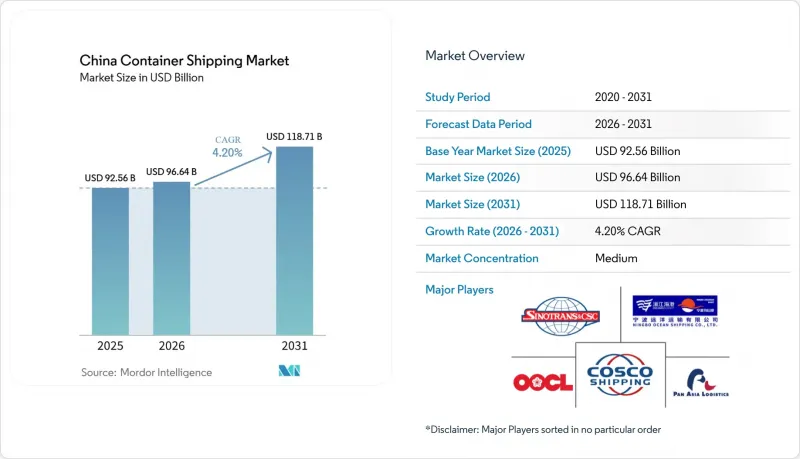
中國貨櫃航運市場受益於出口導向製造業持續向沿海主要叢集集中,這維持了貨物通過中國最大門戶港口的流通,並強化了遠洋航線和支線航線在同一貿易體系中的作用。本報告按服務類型(遠洋、內河、支線、沿海)、貨櫃類型(乾貨貨櫃、冷藏貨櫃)、貨櫃尺寸(20英尺、40英尺及其他特殊尺寸)、貨物類型(整箱、拼箱)、最終用戶(快速消費品/零售、製造/汽車及其他)和地區(北方、中部、西部、東部、南方及其他)進行細分。市場預測以美元計價。
中國貨櫃航運市場的趨勢與洞察
出口製造地向沿海中心轉移的趨勢正在加速。
在中國貨櫃航運市場,貨物向沿海生產帶(尤其是Delta和珠江三角洲Delta)的集中度正在加劇。這一轉變意義重大,因為它不僅增加了貨運量,還改變了航運公司部署船舶、管理港口停靠以及規劃從小規模沿海港口到主要門戶系統的支線航線的方式。 2026年1月及2月,中國港口貨物吞吐量達28.7億噸,其中外貿貨櫃吞吐量成長13.7%。這表明主要沿海門戶仍在吸引更多出口貨物進入其網路。 2026年3月,沿海港口貨櫃吞吐量達到2,720萬標準箱,進一步印證了這一趨勢,並表明幹線貨運將進一步集中在主要港口。實際上,大型航運公司正受益於這些樞紐的規模經濟,而中小型航運公司則在同一沿海系統的支線分銷和二級航線中找到了更多機會。
短途國內運輸受到電子商務發展的影響。
跨境電商的蓬勃發展正推動中國貨櫃航運市場的成長。這促使貨物運輸模式從大規模拼箱運輸轉向更頻繁、更小批量的運輸。根據中國商務部預測,2025年,跨境電商進出口總額將達2.75兆元人民幣(約4069億美元),比2020年增加69.7%。這一成長擴大了拼箱貨運、港口附近拼箱以及更頻繁連接內陸出口商與門戶港口的短途沿海航線的作用。此外,許多出口商在滿足第三國需求以及出口美國的同時,也減少了對傳統長程航線的依賴。因此,中國貨櫃航運市場正吸引更多中小型出口商的貨物,這些貨物的運輸模式更適合靈活的沿海和支線運輸網路。
本地服務網路供過於求的壓力
中國貨櫃航運市場正面臨運力供應過剩的壓力,而運力供應的成長速度超過了運費紀律的改善速度。即使航運公司暫停營運或調整運力,新增運能仍對中國主要航線的運費造成沉重壓力。這給依賴運費回升來維持利潤率的業者帶來了困境。此外,由於航運公司需要在不進一步壓低運費的情況下維持船舶裝載率,聯盟設計和服務最佳化變得更加重要。因此,運力過剩仍是限制中國貨櫃航運市場盈利能力的最顯著因素之一。
細分市場分析
至2025年,遠洋和長途運輸將佔中國貨櫃航運市場佔有率的67.33%,而支線和沿海運輸服務預計到2031年將以5.18%的複合年成長率成長。由於中國仍是製成品長途運輸的主要出口樞紐,中國貨櫃航運市場仍高度依賴遠洋航線。這一地位凸顯了門戶港口和支持亞歐及跨太平洋航線的全球聯盟的重要角色。同時,支線和沿海運輸服務的快速成長表明,同一網路內的區域間物流日益重要。
隨著沿海樞紐、內陸轉運點及周邊區域目的地之間的短程運輸需求不斷成長,中國的支線和沿海運輸市場正在擴張。 「一帶一路」相關貨物以及更廣泛的亞洲內部貿易推動了這一趨勢,使得更多貨物通過多港航線而非單一長途航線運輸。中小航運公司正抓住這一機遇,將企業發展重心放在沿海環線和次要港口停靠上。雖然遠洋航運公司仍佔據最大的收入基礎,但現在它們越來越依賴綜合支線服務來維持船期和船舶運作。這意味著中國貨櫃航運業的服務結構正變得更加緊密地相互關聯,而非像以往那樣分散在不同的船舶類型之間。
預計到2025年,乾貨貨櫃將佔中國貨櫃運輸市場規模的75.63%,而冷藏貨櫃預計到2031年將以7.80%的複合年成長率成長。乾貨貨櫃的龐大基數反映了中國在製成品、電子產品、機械和工業貨物方面的廣泛貿易。這一核心板塊仍然佔據重要地位,因為它仍然佔中國貨櫃出口的大部分。然而,隨著食品、藥品和其他易腐貨物需要更嚴格的溫度控制和特殊處理,對冷藏貨櫃的需求正在快速成長。
這種轉變不僅體現在設備配置的改變上,它還提升了冷藏介面、碼頭運作品質和內陸低溫運輸協調的重要性。能夠可靠地支援此類貨物運輸的航運公司,相比那些僅處理標準乾貨的公司,更有可能獲得更高的貨物品質和更牢固的客戶關係。因此,儘管乾貨貨櫃仍佔據最大佔有率,但冷藏貨櫃的成長正成為中國貨櫃航運市場的關鍵因素。未來,服務品質和低溫運輸能力很可能成為整個中國貨櫃航運市場競爭的焦點。
其他好處:
- Excel格式的市場預測(ME)表
- 3個月的分析師支持
目錄
第1章:引言
- 研究假設和市場定義
- 調查範圍
第2章:調查方法
第3章執行摘要
第4章 市場狀況
- 市場概況及貨櫃運輸在物流中的作用
- 市場促進因素
- 出口導向製造業轉移到沿海地區的趨勢正在加速。
- 短途國內運輸受到電子商務發展的影響。
- 擴大網路規模,以提高艙位利用率和船舶週轉時間。
- 食品、醫藥和生鮮食品產業對冷藏運輸能力的需求不斷成長。
- 港口數位化和營運可靠性提升
- 與「一帶一路」計劃相關的貿易多元化正在支撐航空公司的貨物運輸量。
- 市場限制因素
- 本地服務網路供過於求的壓力
- 票價波動以及合約續約時降低票價的壓力
- 港口擁擠、天氣相關干擾和內陸瓶頸
- 更嚴格的排放氣體法規以及燃料成本轉嫁給消費者的風險
- 法律規範
- 價值鍊和分銷管道的結構分析
- 技術創新前景
- 波特五力分析
- 貨櫃航運業的變化
- 比較:貨櫃運輸與其他運輸方式
- 價格分析
- 近岸外包和友善外包的趨勢
- 影響貨櫃需求的經濟指標
- 地緣政治事件對供應鏈變化的影響
第5章 市場規模及成長預測(價值,2026-2031 年)
- 按服務類型
- 遠洋貨櫃運輸
- 沿海貨櫃運輸
- 支線/沿海/國內貨櫃運輸
- 按容器類型
- 乾貨容器(通用)
- 冷藏貨櫃
- 按容器尺寸
- 20英尺貨櫃(20英尺)
- 40英尺貨櫃(40英尺)
- 其他特殊尺寸
- 按貨物類型
- 整箱貨(FCL)
- 拼箱
- 按最終用戶行業分類
- 快速消費品和零售
- 製造業/汽車
- 醫療和藥品
- 電子電器設備
- 工業化學品和原料
- 其他
- 按地區
- 北方
- 東北
- 東
- 中部
- 南部
- 西南
- 西北
第6章 競爭情勢
- 市場集中度
- 關鍵策略趨勢
- 市佔率分析
- 公司簡介
- COSCO Shipping Lines
- Orient Overseas Container Line(OOCL)
- Shanghai Pan Asia Shipping(SPA)
- Sinotrans Container Lines
- Ningbo Ocean Shipping Co., Ltd.(NBOSCO)
- Antong Holdings Co., Ltd.(QASC)
- Tangshan Port Hede Shipping
- Mediterranean Shipping Company(MSC)
- AP Moller-Maersk A/S
- CMA CGM Group
- Hapag-Lloyd AG
- Ocean Network Express(ONE)
- Evergreen Marine Corporation
- HMM Co., Ltd.
- Yang Ming Marine Transport Corporation
- ZIM Integrated Shipping Services
- Wan Hai Lines Ltd.
- Pacific International Lines(PIL)
- SITC International Holdings
- X-Press Feeders
- Korea Marine Transport Co.(KMTC)
- Sinokor Merchant Marine
第7章 市場機會與未來展望
According to Mordor Intelligence, the China container shipping market size is projected to grow from USD 92.56 billion in 2025 to USD 96.64 billion in 2026, and reach USD 118.71 billion by 2031, growing at a CAGR of 4.20% from 2026 to 2031.
The China container shipping market is being supported by the continued pull of export manufacturing toward major coastal clusters, which keeps cargo moving through the country's largest gateway ports and reinforces the role of deep-sea and feeder links within the same trade system. This report is Segmented by Service Type (Deep-Sea, Short-Sea, Feeder and Coastal), by Container Type (Dry and Reefer), by Container Size (20 Ft, 40 Ft, and Other Specialized Sizes), by Load Type (FCL and LCL), by End-User (FMCG and Retail, Manufacturing and Automotive, and More), and by Region (North, Central, West, East, South, and More). The Market Forecasts are Provided in Terms of Value (USD).
China Container Shipping Market Trends and Insights
Accelerating Export Manufacturing Re-Allocation To Coastal Hubs
The China container shipping market is seeing a stronger concentration of cargo around coastal production belts, especially in the Yangtze River Delta and the Pearl River Delta. This shift matters because it does more than lift volumes; it also changes how carriers deploy vessels, manage terminal calls, and plan feeder links from smaller coastal ports into the main gateway system. China's port cargo throughput reached 2.87 billion tons in January and February 2026, while foreign trade container throughput increased by 13.7%, indicating that the main coastal gateways are still attracting more export traffic into their networks. Coastal port container throughput reached 27.2 million TEUs in March 2026, reinforcing the same direction of travel and supporting a denser concentration of linehaul volumes through the leading ports. In practical terms, larger carriers benefit from better scale at these hubs, while smaller operators find more room in feeder distribution and secondary routing around the same coastal system.
Growth In E-Commerce Driven Short-Haul Domestic Movements
The China container shipping market is gaining support from the spread of cross-border e-commerce, which is changing the shipment profile from larger consolidated orders to more frequent, smaller lots. China's Ministry of Commerce stated that cross-border e-commerce import and export volume reached CNY 2.75 trillion (USD 406.9 billion) in 2025, up 69.7% from 2020. That growth is widening the role of LCL cargo, port-adjacent consolidation, and short-haul coastal services that connect inland exporters with gateway ports more often. It also reduces reliance on a narrow set of traditional long-haul lanes, as many of these sellers serve third-country demand rather than shipping only to the United States. As a result, the China container shipping market is drawing more volume from smaller exporters whose cargo patterns fit flexible coastal and feeder networks.
Overcapacity Pressure In Regional Service Networks
The China container shipping market is facing pressure from vessel supply growth that is outpacing the improvement in rate discipline. Even when carriers blank sailings or shift capacity between loops, the added tonnage still weighs on pricing across major China-origin lanes. This creates a difficult setting for operators that depend on freight rate recovery to protect margins. It also makes alliance design and service rationalization more important, as carriers need to keep ships full without further weakening rates. As a result, overcapacity remains one of the clearest checks on earnings quality in the China container shipping market.
Other drivers and restraints analyzed in the detailed report include:
- Network Upsizing To Improve Slot Utilization And Vessel Turnaround
- Higher Demand For Reefer Capacity From Food, Pharma, And Perishables
- Freight Rate Volatility And Contract-Renewal Compression
For complete list of drivers and restraints, kindly check the Table Of Contents.
Segment Analysis
Deep-sea and ocean shipping held 67.33% of the China container shipping market share in 2025, while feeder and coastal services are projected to grow at a 5.18% CAGR through 2031. The China container shipping market still leans heavily on deep-sea routes because the country remains a leading export base for manufactured goods moving on long-haul lanes. That position supports the large-scale role of gateway ports and the global alliances that anchor Asia-Europe and transpacific services. At the same time, the faster growth of feeder and coastal services shows that regional distribution is becoming more important within the same network.
The China container shipping market for feeder and coastal services is expanding as cargo increasingly requires short-haul movements between coastal hubs, inland connectors, and nearby regional destinations. Belt and Road traffic and broader intra-Asia trade are strengthening this pattern by moving more cargo through multi-stop routes rather than single, long-haul shipments. Smaller and mid-sized carriers are using this opening to position themselves around coastal loops and secondary port calls. Deep-sea operators still retain the largest revenue base, but they now depend more on integrated feeder support to maintain schedules and equipment flow. This means the service mix in the China container shipping industry is becoming more connected across vessel classes rather than more divided.
Dry containers accounted for 75.63% of the China container shipping market size in 2025, while reefer containers are projected to grow at a 7.80% CAGR through 2031. The large dry-container base reflects China's broad trade in manufactured goods, electronics, machinery, and industrial cargo. That core remains important because it still carries most of the country's containerized export volume. Even so, reefer demand is rising faster because food products, pharmaceuticals, and other perishable cargo require tighter temperature control and more specialized handling.
This shift changes more than the equipment mix. It also raises the importance of reefer plugs, terminal operating quality, and inland cold chain coordination. Carriers that can reliably support this cargo may achieve better cargo quality and stickier customer relationships than operators focused solely on standard dry freight. The result is that reefer growth is becoming a meaningful part of the China container shipping market, even though dry containers still account for the largest share. Over time, this should make service quality and cold chain capability a larger point of competition across the China container shipping market.
Complete Report Scope:
- By Service Type
- Deep-Sea/Ocean Container Shipping
- Short-Sea Container Shipping
- Feeder and Coastal/Domestic Container Shipping
- By Container Type
- Dry Containers (General Purpose)
- Reefer Containers
- By Container Size
- 20-foot Containers (20 ft)
- 40-foot Containers (40 ft)
- Other Specialized Sizes
- By Load Type
- Full-Container-Load (FCL)
- Less-Than-Container-Load (LCL)
- By End-User Industry
- FMCG and Retail
- Manufacturing and Automotive
- Healthcare and Pharmaceuticals
- Electronics and Electrical Equipment
- Industrial Chemicals and Raw Materials
- Others
- By Region
- North
- Northeast
- East
- Central
- South
- Southwest
- Northwest
List of Companies Covered in this Report:
- COSCO Shipping Lines
- Orient Overseas Container Line (OOCL)
- Shanghai Pan Asia Shipping (SPA)
- Sinotrans Container Lines
- Ningbo Ocean Shipping Co., Ltd. (NBOSCO)
- Antong Holdings Co., Ltd. (QASC)
- Tangshan Port Hede Shipping
- Mediterranean Shipping Company (MSC)
- A.P. Moller - Maersk A/S
- CMA CGM Group
- Hapag-Lloyd AG
- Ocean Network Express (ONE)
- Evergreen Marine Corporation
- HMM Co., Ltd.
- Yang Ming Marine Transport Corporation
- ZIM Integrated Shipping Services
- Wan Hai Lines Ltd.
- Pacific International Lines (PIL)
- SITC International Holdings
- X-Press Feeders
- Korea Marine Transport Co. (KMTC)
- Sinokor Merchant Marine
Additional Benefits:
- The market estimate (ME) sheet in Excel format
- 3 months of analyst support
TABLE OF CONTENTS
1 Introduction
- 1.1 Study Assumptions & Market Definition
- 1.2 Scope of the Study
2 Research Methodology
3 Executive Summary
4 Market Landscape
- 4.1 Market Overview and Role of Container Shipping in Logistics
- 4.2 Market Drivers
- 4.2.1 Accelerating Export Manufacturing Re-Allocation To Coastal Hubs
- 4.2.2 Growth In E-Commerce Driven Short-Haul Domestic Movements
- 4.2.3 Network Upsizing To Improve Slot Utilization And Vessel Turnaround
- 4.2.4 Higher Demand For Reefer Capacity From Food, Pharma, And Perishables
- 4.2.5 Port Digitalization And Schedule Reliability Improvements
- 4.2.6 Belt And Road-Linked Trade Diversification Supporting Carrier Volumes
- 4.3 Market Restraints
- 4.3.1 Overcapacity Pressure In Regional Service Networks
- 4.3.2 Freight Rate Volatility And Contract-Renewal Compression
- 4.3.3 Port Congestion, Weather Disruption, And Inland Bottlenecks
- 4.3.4 Stricter Emissions Compliance And Fuel Cost Pass-Through Risk
- 4.4 Regulatory Framework
- 4.5 Value Chain and Distribution Channel Architecture Analysis
- 4.6 Technology Innovations Outlook
- 4.7 Porter's Five Forces Analysis
- 4.7.1 Threat of New Entrants
- 4.7.2 Bargaining Power of Suppliers
- 4.7.3 Bargaining Power of Buyers
- 4.7.4 Threat of Substitutes
- 4.7.5 Rivalry Among Competitors
- 4.8 Evolution of Container Shipping Industry
- 4.9 Comparison: Container Shipping vs Other Freight Modes
- 4.10 Pricing Analysis
- 4.11 Nearshoring and Friend-Shoring Developments
- 4.12 Economic Indicators Influencing Container Demand
- 4.13 Impact of Geo-Political Events on Supply Chain Shifts
5 Market Size & Growth Forecasts (Value, 2026-2031)
- 5.1 By Service Type
- 5.1.1 Deep-Sea/Ocean Container Shipping
- 5.1.2 Short-Sea Container Shipping
- 5.1.3 Feeder and Coastal/Domestic Container Shipping
- 5.2 By Container Type
- 5.2.1 Dry Containers (General Purpose)
- 5.2.2 Reefer Containers
- 5.3 By Container Size
- 5.3.1 20-foot Containers (20 ft)
- 5.3.2 40-foot Containers (40 ft)
- 5.3.3 Other Specialized Sizes
- 5.4 By Load Type
- 5.4.1 Full-Container-Load (FCL)
- 5.4.2 Less-Than-Container-Load (LCL)
- 5.5 By End-User Industry
- 5.5.1 FMCG and Retail
- 5.5.2 Manufacturing and Automotive
- 5.5.3 Healthcare and Pharmaceuticals
- 5.5.4 Electronics and Electrical Equipment
- 5.5.5 Industrial Chemicals and Raw Materials
- 5.5.6 Others
- 5.6 By Region
- 5.6.1 North
- 5.6.2 Northeast
- 5.6.3 East
- 5.6.4 Central
- 5.6.5 South
- 5.6.6 Southwest
- 5.6.7 Northwest
6 Competitive Landscape
- 6.1 Market Concentration
- 6.2 Key Strategic Moves
- 6.3 Market Share Analysis
- 6.4 Company Profiles (includes Global level Overview, Market level overview, Core Segments, Financials as available, Strategic Information, Market Rank/Share for key companies, Products & Services, and Recent Developments)
- 6.4.1 COSCO Shipping Lines
- 6.4.2 Orient Overseas Container Line (OOCL)
- 6.4.3 Shanghai Pan Asia Shipping (SPA)
- 6.4.4 Sinotrans Container Lines
- 6.4.5 Ningbo Ocean Shipping Co., Ltd. (NBOSCO)
- 6.4.6 Antong Holdings Co., Ltd. (QASC)
- 6.4.7 Tangshan Port Hede Shipping
- 6.4.8 Mediterranean Shipping Company (MSC)
- 6.4.9 A.P. Moller - Maersk A/S
- 6.4.10 CMA CGM Group
- 6.4.11 Hapag-Lloyd AG
- 6.4.12 Ocean Network Express (ONE)
- 6.4.13 Evergreen Marine Corporation
- 6.4.14 HMM Co., Ltd.
- 6.4.15 Yang Ming Marine Transport Corporation
- 6.4.16 ZIM Integrated Shipping Services
- 6.4.17 Wan Hai Lines Ltd.
- 6.4.18 Pacific International Lines (PIL)
- 6.4.19 SITC International Holdings
- 6.4.20 X-Press Feeders
- 6.4.21 Korea Marine Transport Co. (KMTC)
- 6.4.22 Sinokor Merchant Marine
7 Market Opportunities & Future Outlook
- 7.1 White-space & Unmet-Need Assessment

 貨櫃市場:2026-2032年全球市場預測(按類型、材質、尺寸、所有權、運輸方式、應用和銷售管道)
 美國貨櫃航運:市場佔有率分析、產業趨勢與統計及成長預測(2026-2031)印度貨櫃航運:市場佔有率分析、產業趨勢與統計及成長預測(2026-2031)
 貨櫃改造市場-全球產業規模、佔有率、趨勢、機會、預測:按類型、改造類型、應用、產業、地區和競爭格局分類,2021-2031年
 貨櫃船市場:按部件、燃料類型和地區分類貨物固定設備市場:2026-2032年全球市場預測(依產品、材料、應用及通路分類)
 貨櫃船市場規模、佔有率、成長及全球產業分析:按類型、應用和地區分類,並預測至2026-2034年海運貨櫃:市場佔有率分析、產業趨勢與統計、成長預測(2026-2031)全球智慧貨櫃市場規模、佔有率、趨勢和成長分析報告(2026-2034)全球貨櫃市場規模、佔有率、趨勢和成長分析報告(2026-2034)