

 |
市場調查報告書
商品編碼
2124788
北美保溫運輸貨櫃:市場佔有率分析、產業趨勢與統計及成長預測(2026-2031 年)North America Insulated Shipping Containers - Market Share Analysis, Industry Trends & Statistics, Growth Forecasts (2026 - 2031) |
||||||

※ 本網頁內容可能與最新版本有所差異。詳細情況請與我們聯繫。
據 Mordor Intelligence 稱,北美保溫貨櫃市場預計到 2026 年價值 19.7 億美元,高於 2025 年的 18.5 億美元,預計到 2031 年將達到 26.8 億美元。
預計從 2026 年到 2031 年,其複合年成長率將達到 6.37%。
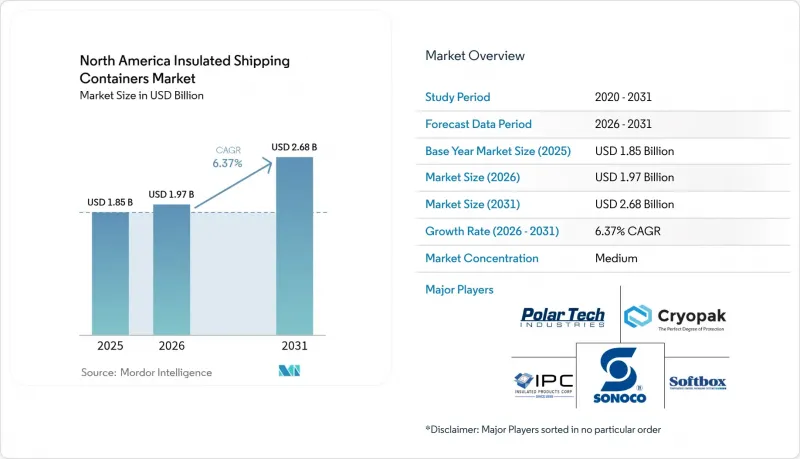
本報告按材料類型(發泡聚苯乙烯、聚氨酯泡棉、發泡聚丙烯及其他)、最終用途(生命科學/製藥、生鮮食品及其他)、產品類型(一次性硬質包裝盒、可重複使用硬質包裝盒及其他)、容量範圍(5公升以下、5-20公升及其他)和國家/地區進行細分。市場預測以美元計價。
北美保溫貨櫃市場趨勢與洞察
對溫度敏感型食材自煮包的電子商務激增
對溫度敏感的食材自煮包服務正在迅速擴張,由此催生了對緊湊、高性能包裝的需求,這種包裝能夠承受48至72小時的運輸時間。諸如SeaWell的Active Packaging等技術可以延長保存期限,並支援品質聲明。注重成本的企業正在採用更小、更輕的容器來降低運輸成本,而可生物分解的發泡材則有助於品牌展現對永續性的承諾。儘管由於行業重組導致企業數量減少,因此預計此類包裝的採用率將在兩年內達到峰值,但小型容器的部署數量仍在持續成長。北美保溫運輸容器市場正積極應對這一趨勢,推出壁更薄但仍能滿足「最後一公里」溫度控制目標的產品。
藥品冷鏈的擴張伴隨著成長。
生技藥品、細胞療法和個人化醫療需要在2至8 度C的溫度下進行精準運輸,而這種需求正超越傳統疫苗運輸路線的範疇。默克公司2024年斥資15億美元擴建冷鏈的計畫凸顯了長期資本投資的重要性。真空絕熱板(VIP)和相變材料(PCM)可在長途運輸過程中保護貨物,並降低溫度偏差的風險。隨著直接送藥給患者的模式日益普及,對具備資料登錄功能的小型、檢驗的運輸容器的需求也日益成長。隨著分銷網路的日趨成熟,北美保溫運輸容器市場正在引入即時監控功能,以滿足跨境審計要求。
生物基絕緣樹脂成本上漲
生物基樹脂比石油基樹脂貴15-25%,這給環保加工商的利潤率帶來了壓力。原物料供給能力有限和農產品價格波動進一步加劇了價格波動。小規模供應商難以承擔額外的成本,被迫將其轉嫁給客戶,並面臨訂單延遲的風險。雖然技術進步和規模經濟可能會縮小這種差距,但短期內這些不利因素仍可能持續存在,從而延緩從EPS樹脂的全面轉型。
細分市場分析
到2025年,發泡聚苯乙烯(EPS)將佔據北美保溫貨櫃市場43.35%的佔有率,因為其單位成本的保溫性能在包括食品和藥品在內的眾多應用領域中仍然無可匹敵。聚氨酯泡棉因其密度可控性而被廣泛應用於高價值生物製藥的運輸,而EPP則因其更高的抗跌落性能而在回收項目中日益普及。儘管可生物分解的澱粉混合泡沫的市場規模小規模,但由於監管獎勵和品牌對社會責任的承諾,其複合年成長率(CAGR)仍高達6.74%。 VIP和氣凝膠技術為北美保溫貨櫃市場的整體價值池提供了支持,滿足了高價值貨物運輸的需求,使其能夠承受高成本結構。
在FDA檢驗協議和EPA回收指南的推動下,隔熱性能標準日益嚴格。像Sealed Air這樣的供應商正在提供低矮的VIP面板,在保持保溫時間的同時,可將包裝面積減少30%。 EPS供應商正在試行使用回收材料的產品,以符合各州特定的塑膠法規。因此,材料選擇呈現日益細分的格局,買家需要權衡採購成本與逆向物流成本、處置成本以及客戶對永續性的期望。
到2025年,生命科學和製藥產業將佔據北美保溫運輸貨櫃市場37.45%的佔有率,他們通常指定檢驗適用於2-8 度C運輸路線、具備防漏和資料通訊功能的貨櫃。合規要求雖然延長了銷售週期,但也有助於維持高價位和可預測的補貨週期。直接面對消費者的蛋白質服務正在推動生肉和魚貝類的配送,其複合年成長率高達6.79%。為了滿足隔日送達的要求,貨櫃需要具備冷卻劑重量與箱壁厚度的平衡比例。
食材自煮包製造商對配備冰袋的中容量EPS保溫箱的需求持續旺盛,而冷凍食品業對可承載乾冰的硬質保溫箱的需求也十分強勁。在花卉物流等專業細分市場,防潮內襯對於降低花卉枯萎風險至關重要。醫藥產業由於其較高的成本接受度和嚴格的檢驗要求,正在推動市場成長;同時,食品產業的多元化發展也擴大了北美保溫運輸容器的整體潛在市場規模。
其他好處
- Excel格式的市場預測(ME)表
- 3個月的分析師支持
目錄
第1章:引言
- 研究假設和市場定義
- 調查範圍
第2章:調查方法
第3章執行摘要
第4章 市場狀況
- 市場概覽
- 市場促進因素
- 對溫度敏感型食材自煮包的電子商務激增
- 藥品冷鏈的擴張伴隨著成長。
- 美國食品藥物管理局 (FDA) 收緊了生技藥品。
- 零售商在可重複使用運輸容器方面的永續性要求
- 美國農業部 (USDA) 為減少食物浪費計畫提供的津貼
- 創業投資進入直接患者物流領域。
- 市場限制因素
- 生物基絕緣樹脂成本上漲
- 缺乏退貨逆向物流基礎設施
- 再生EPS原料供應波動
- 州級生產者延伸責任(EPR)費用
- 價值供應鏈分析
- 監理情勢
- 技術展望
- 波特五力分析
第5章 市場規模與成長預測
- 依材料類型
- 發泡聚苯乙烯(EPS)
- 聚氨酯泡棉(PU)
- 發泡聚丙烯(EPP)
- 可生物分解的澱粉混合發泡體
- 其他材料(VIP、凝膠包)
- 按最終用途
- 生命科學與製藥
- 已調理食品及冷凍食品
- 生鮮食品
- 生鮮肉和魚貝類
- 麵包店、植物、花
- 其他(化妝品、葡萄酒、飲料)
- 依產品類型
- 一次性硬紙箱運輸箱
- 可重複使用的硬紙箱運輸箱
- 免洗郵寄袋
- 托盤大小的散裝運輸車
- 按容量範圍
- 5公升或以下
- 5~20L
- 20~60L
- 60公升或更多(托盤)
- 國家
- 美國
- 加拿大
第6章 競爭情勢
- 市場集中度
- 策略趨勢
- 市佔率分析
- 公司簡介
- Sonoco Products Company
- TemperPack Technologies Inc.
- Polar Tech Industries Inc.
- Intelsius Ltd.(DGP Intelsius)
- Cascades Inc.
- Sofrigam SA
- Softbox Systems US LLC
- Cold Chain Technologies LLC
- Cryopak Industries Inc.
- Insulated Products Corporation
- KodiaKooler, a division of Airlite Plastics Co.
- Packaging Technology Group Inc.
- Therapak LLC(Avantor, Inc.)
- NanoCool LLC(part of UPS Healthcare)
- Chill-Pak Inc.
- va-Q-tec AG
- Envirotainer AB
- Pelican BioThermal LLC
- Emball'iso SA
- InsulTote LLC
第7章 市場機會與未來展望
According to Mordor Intelligence, North America insulated shipping containers market size in 2026 is estimated at USD 1.97 billion, growing from 2025 value of USD 1.85 billion with 2031 projections showing USD 2.68 billion, growing at 6.37% CAGR over 2026-2031.
This report is Segmented by Material Type (Expanded Polystyrene, Polyurethane Foam, Expanded Polypropylene, and More), End-User Application (Life Sciences and Pharmaceutical, Fresh Produce, and More), Product Type (Single-Use Rigid Box, Reusable Rigid Box, and More), Capacity Range (<=5L, 5-20L, and More), and Country. The Market Forecasts are Provided in Terms of Value (USD).
North America Insulated Shipping Containers Market Trends and Insights
E-commerce Surge in Temperature-Sensitive Meal Kits
Temperature-sensitive meal kit services are scaling quickly and require compact, high-performance packaging that sustains 48-72-hour transit windows. Technology such as SeaWell active packaging lengthens shelf life and supports quality claims. Cost-conscious operators use smaller, lighter containers that cut freight expenses, and biodegradable foams help brands communicate sustainability commitments. Adoption peaks within two years as consolidation reduces operator count, yet installed volumes of small containers keep rising. The North America insulated shipping containers market responds with thinner wall profiles that still meet last-mile thermal targets.
Growth in Pharmaceutical Cold-Chain Expansion
Biologics, cell therapies, and personalized medicine demand precise 2-8 °C shipping, expanding beyond routine vaccine lanes. Merck's USD 1.5 billion cold-chain build-out in 2024 underscores the long-term capital push. Vacuum insulated panels (VIPs) and phase change materials (PCMs) safeguard payloads during extended transit and reduce excursion risk. Direct-to-patient delivery fuels the need for small, validated shippers with data-logging features. As distribution networks mature, the North America insulated shipping containers market embeds real-time monitoring to satisfy audit requirements across borders.
Escalating Cost of Bio-Based Insulation Resins
Bio-based resins cost 15-25% more than petroleum equivalents, eroding margins for eco-focused converters. Limited feedstock capacity and agricultural price swings magnify volatility. Smaller vendors struggle to absorb surcharges and must pass them to customers, risking order deferrals. Technology learning curves and scale economies could narrow the gap, yet near-term headwinds remain, slowing the wholesale shift away from EPS.
Other drivers and restraints analyzed in the detailed report include:
- Tightening U.S. FDA Biologics Stability Guidance
- Retailer Sustainability Mandates for Reusable Shippers
- Limited Reverse-Logistics Infrastructure for Returns
For complete list of drivers and restraints, kindly check the Table Of Contents.
Segment Analysis
Expanded polystyrene holds a 43.35% share within the North America insulated shipping containers market size in 2025 because its insulation value per dollar remains unmatched for broad food and pharma use cases. Polyurethane foam secures high-value biologics shipping through its density tunability, and EPP gains favor in reuse programs that demand higher drop resistance. Biodegradable starch-blend foams, though at a modest base, rise at a 6.74% CAGR thanks to regulatory incentives and brand stewardship. VIP and aerogel technologies serve premium payloads that justify elevated cost structures, supporting the total value pool of the North America insulated shipping containers market.
Thermal performance standards are tightening, spurred by FDA validation protocols and EPA recycling guidance. Vendors such as Sealed Air deliver thinner VIP panels that shrink package footprints by 30% while maintaining temperature hold times. EPS suppliers pilot recycled content formulations to comply with state plastics statutes. The result is an increasingly segmented material choice matrix where purchasers weigh acquisition costs against reverse-logistics savings, disposal fees, and customer sustainability expectations.
Life sciences and pharmaceuticals account for 37.45% of North America's insulated shipping containers market share in 2025 and typically specify leak-proof, data-ready containers validated for 2-8 °C lanes. Compliance burdens extend sales cycles but also sustain premium price points and predictable reorder cadence. Direct-to-consumer protein services push fresh meat and seafood shipping, growing at a 6.79% CAGR, and require containers that balance ice-pack mass with box wall thickness to meet overnight timelines.
Meal kit operators maintain demand for mid-capacity EPS boxes fitted with gel packs, while frozen food categories sustain a baseline for rigid boxes capable of dry-ice payloads. Specialty niches like floral logistics rely on humidity-resilient liners to mitigate wilting risk. Pharmaceutical dominance is anchored in higher cost tolerance and stringent validation, even as diversified food verticals broaden the total addressable volume for the North America insulated shipping containers market.
Complete Report Scope:
- By Material Type
- Expanded Polystyrene (EPS)
- Polyurethane Foam (PU)
- Expanded Polypropylene (EPP)
- Biodegradable Starch-blend Foams
- Other Materials (VIPs, Gel Packs)
- By End-User Application
- Life Sciences and Pharmaceutical
- Pre-cooked and Frozen Food
- Fresh Produce
- Fresh Meat and Seafood
- Bakery, Plants and Flowers
- Other (Cosmetics, Wine, Beverages)
- By Product Type
- Single-Use Rigid Box Shippers
- Reusable Rigid Box Shippers
- Single-Use Pouch and Mailer Shippers
- Pallet-sized Bulk Shippers
- By Capacity Range
- Upto 5 L
- 5 - 20 L
- 20 - 60 L
- Greater than 60 L (Pallet)
- By Country
- United States
- Canada
List of Companies Covered in this Report:
- Sonoco Products Company
- TemperPack Technologies Inc.
- Polar Tech Industries Inc.
- Intelsius Ltd. (DGP Intelsius)
- Cascades Inc.
- Sofrigam SA
- Softbox Systems US LLC
- Cold Chain Technologies LLC
- Cryopak Industries Inc.
- Insulated Products Corporation
- KodiaKooler, a division of Airlite Plastics Co.
- Packaging Technology Group Inc.
- Therapak LLC (Avantor, Inc.)
- NanoCool LLC (part of UPS Healthcare)
- Chill-Pak Inc.
- va-Q-tec AG
- Envirotainer AB
- Pelican BioThermal LLC
- Emball'iso S.A.
- InsulTote LLC
Additional Benefits:
- The market estimate (ME) sheet in Excel format
- 3 months of analyst support
TABLE OF CONTENTS
1 INTRODUCTION
- 1.1 Study Assumptions and Market Definition
- 1.2 Scope of the Study
2 RESEARCH METHODOLOGY
3 EXECUTIVE SUMMARY
4 MARKET LANDSCAPE
- 4.1 Market Overview
- 4.2 Market Drivers
- 4.2.1 E-commerce surge in temperature-sensitive meal kits
- 4.2.2 Growth in pharmaceutical cold-chain expansion
- 4.2.3 Tightening U.S. FDA biologics stability guidance
- 4.2.4 Retailer sustainability mandates for reusable shippers
- 4.2.5 USDA grants for food-loss reduction programs
- 4.2.6 Venture capital entering direct-to-patient logistics
- 4.3 Market Restraints
- 4.3.1 Escalating cost of bio-based insulation resins
- 4.3.2 Limited reverse-logistics infrastructure for returns
- 4.3.3 Volatile recycled EPS feedstock availability
- 4.3.4 State-level EPR (extended-producer-responsibility) fees
- 4.4 Value / Supply-Chain Analysis
- 4.5 Regulatory Landscape
- 4.6 Technological Outlook
- 4.7 Porter's Five Forces Analysis
- 4.7.1 Bargaining Power of Suppliers
- 4.7.2 Bargaining Power of Buyers
- 4.7.3 Threat of New Entrants
- 4.7.4 Threat of Substitutes
- 4.7.5 Competitive Rivalry
5 MARKET SIZE AND GROWTH FORECASTS (VALUE)
- 5.1 By Material Type
- 5.1.1 Expanded Polystyrene (EPS)
- 5.1.2 Polyurethane Foam (PU)
- 5.1.3 Expanded Polypropylene (EPP)
- 5.1.4 Biodegradable Starch-blend Foams
- 5.1.5 Other Materials (VIPs, Gel Packs)
- 5.2 By End-User Application
- 5.2.1 Life Sciences and Pharmaceutical
- 5.2.2 Pre-cooked and Frozen Food
- 5.2.3 Fresh Produce
- 5.2.4 Fresh Meat and Seafood
- 5.2.5 Bakery, Plants and Flowers
- 5.2.6 Other (Cosmetics, Wine, Beverages)
- 5.3 By Product Type
- 5.3.1 Single-Use Rigid Box Shippers
- 5.3.2 Reusable Rigid Box Shippers
- 5.3.3 Single-Use Pouch and Mailer Shippers
- 5.3.4 Pallet-sized Bulk Shippers
- 5.4 By Capacity Range
- 5.4.1 Upto 5 L
- 5.4.2 5 - 20 L
- 5.4.3 20 - 60 L
- 5.4.4 Greater than 60 L (Pallet)
- 5.5 By Country
- 5.5.1 United States
- 5.5.2 Canada
6 COMPETITIVE LANDSCAPE
- 6.1 Market Concentration
- 6.2 Strategic Moves
- 6.3 Market Share Analysis
- 6.4 Company Profiles (includes Global level Overview, Market level overview, Core Segments, Financials as available, Strategic Information, Market Rank/Share for key companies, Products and Services, and Recent Developments)
- 6.4.1 Sonoco Products Company
- 6.4.2 TemperPack Technologies Inc.
- 6.4.3 Polar Tech Industries Inc.
- 6.4.4 Intelsius Ltd. (DGP Intelsius)
- 6.4.5 Cascades Inc.
- 6.4.6 Sofrigam SA
- 6.4.7 Softbox Systems US LLC
- 6.4.8 Cold Chain Technologies LLC
- 6.4.9 Cryopak Industries Inc.
- 6.4.10 Insulated Products Corporation
- 6.4.11 KodiaKooler, a division of Airlite Plastics Co.
- 6.4.12 Packaging Technology Group Inc.
- 6.4.13 Therapak LLC (Avantor, Inc.)
- 6.4.14 NanoCool LLC (part of UPS Healthcare)
- 6.4.15 Chill-Pak Inc.
- 6.4.16 va-Q-tec AG
- 6.4.17 Envirotainer AB
- 6.4.18 Pelican BioThermal LLC
- 6.4.19 Emball'iso S.A.
- 6.4.20 InsulTote LLC
7 MARKET OPPORTUNITIES AND FUTURE OUTLOOK
- 7.1 White-space and Unmet-Need Assessment

 亞太地區拼箱貨運 (LCL):市場佔有率分析、產業趨勢和統計數據以及成長預測 (2026-2031)貨櫃航運:市場佔有率分析、產業趨勢與統計、成長預測(2026-2031)
 貨櫃短期租賃市場分析及預測(至2035年):按類型、產品、服務、技術、組件、應用、部署、最終用戶及解決方案分類
 ISO標準貨櫃市場:預測(至2034年)-按貨櫃類型、貨櫃尺寸、材料、所有權、應用、最終用戶和地區分類的全球分析海運貨櫃:市場佔有率分析、產業趨勢與統計、成長預測(2026-2031)歐洲沿海滾裝海運:市場佔有率分析、產業趨勢與統計及成長預測(2026-2031 年)
 貨櫃市場:2026-2032年全球市場預測(按類型、材質、尺寸、所有權、運輸方式、應用和銷售管道)中國貨櫃航運業:市場佔有率分析、產業趨勢與統計及成長預測(2026-2031年)美國貨櫃航運:市場佔有率分析、產業趨勢與統計及成長預測(2026-2031)印度貨櫃航運:市場佔有率分析、產業趨勢與統計及成長預測(2026-2031)