


 |
市場調查報告書
商品編碼
2117465
泰國摩托車市場:市場佔有率分析、產業趨勢與統計、成長預測(2026-2031)Thailand Two Wheeler - Market Share Analysis, Industry Trends & Statistics, Growth Forecasts (2026 - 2031) |
||||||

※ 本網頁內容可能與最新版本有所差異。詳細情況請與我們聯繫。
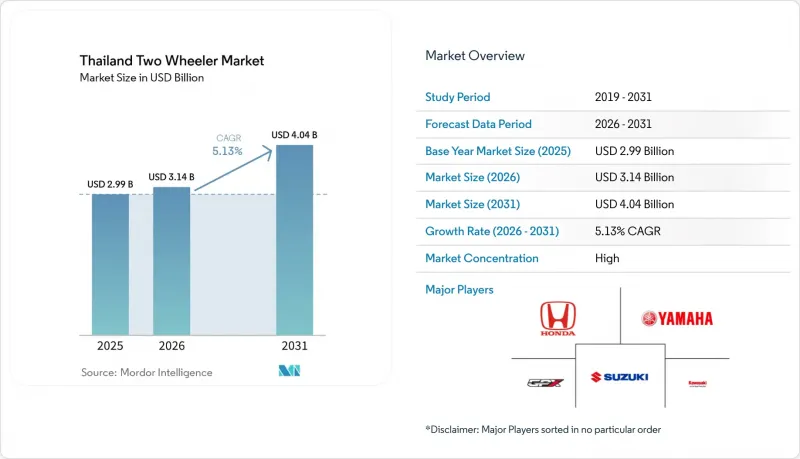
據 Mordor Intelligence 稱,2025 年泰國摩托車市場價值 29.9 億美元,預計到 2031 年將從 2026 年的 31.4 億美元成長至 40.4 億美元,預測期(2026-2031 年)複合年成長率為 5.13%。
本報告按車輛類型(摩托車、踏板車及其他)、動力系統(內燃機(100cc以下、101-125cc及其他)、E2W(1kW以下、1-3kW及其他)、其他替代燃料(CNG/LPG))、傳動系統(鏈條傳動、皮帶傳動及其他)、應用領域(個人、商業通路及其他地區進行細分、銷售和商業通路及其他)、應用區域(個人、商業通路及其他地區)進行細分、銷售管道。市場預測以價值(美元)和銷售(輛)為單位。
泰國摩托車市場的趨勢和洞察
用於最後一公里配送的摩托車需求正在成長。
電商物流公司正在重新思考其車輛策略,重點轉向能夠降低燃料成本、減少怠速時間和維護成本的電動車。泰國郵政正在對部分電動機車進行實地測試,計劃在2025年將其納入一支25,000輛的車隊,併計劃擴大部署規模,以實現其碳中和目標。到2026年4月,Grab將在其平台上新增超過30,000輛電動車,使電動叫車服務成長35%。 Grab還制定了具有競爭力的每日收費標準,使電動車對每天行駛100-150公里的駕駛者更具成本優勢。食品配送產業全年成長顯著,由於頻繁的走走停停,對摩托車的需求強勁,而電動車的扭力優勢顯而易見。 GrabBike Saver使用量的顯著成長凸顯了向電動出行的持續轉變。曼谷繼續引領這一轉型,但預計在未來幾年,這一趨勢將擴展到其他樞紐,如林查班港和烏塔堡機場。
政府的電動車補貼計畫降低了E2W(從起點到終點)旅行的初始成本。
「EV3.5」框架為特定價格區間的電動機車提供補貼,旨在2027年大幅提升註冊量。 2025年的修訂延長了補貼期限並擴大了出口補貼範圍,提振了組裝的信心。本田的「UC3」符合這些補貼條件,且定位低於大眾市場價格區間。同時,韓國國內品牌也發布了多款新車型,並公佈了在2026年建設計畫,以充分利用這些激勵措施。這些優惠政策主要集中在2020年代中期,旨在鼓勵首次購買電動車的用戶在保單到期前購買。
對分期付款購買實施更嚴格的信用評估標準
2025年,隨著家庭債務達到相當高的水平,金融機構採取了更為謹慎的態度。 Krungsiri Auto提高了利率並要求更高的首付,將許多入門級購車者拒之門外。 Aeon提供了具有競爭力的利率,而Siam Digital則設定了更高的價格並瞄準了更小的客戶群。這種影響在收入遠低於曼谷等都市區的農業地區最為嚴重。因此,在整個預測期內,消費者將延長車輛持有期限,推遲更換,並避免購買新車。
細分市場分析
預計到2031年,踏板車的成長率將超過整體市場成長速度,並在泰國二輪車市場佔據更大的佔有率。截至2025年,摩托車的市佔率為72.33%,這主要受農村地區偏好手排車款的影響。然而,曼谷的交通堵塞凸顯了踏板車的優勢,例如自動擋和座下儲物空間。本田推出的限量版「Scoopy」和「ADV160」車型吸引了注重形象的千禧世代,而Yamaha的「NMAX Connected」則憑藉「Blue Core」技術在燃油效率方面展開競爭。時尚的設計和智慧型手機互聯功能的引入正在擴大女性騎士群體,此前女性騎士在手排車型中的佔比並不高。
隨著旅遊業的復甦,普吉島和清邁的摩托車租賃業務蓬勃發展。每天200泰銖起的定價吸引了許多不熟悉泰國交通系統的遊客,而Skoot的保險應用程式也贏得了用戶的信任。此外,外送業務的成長也帶動了對可容納大型後行李箱的跨騎式車架的需求。預計泰國二輪車市場中,摩托車市場將以6.48%的複合年成長率成長。本田公司正將WN7——一款融合了摩托車的便利性和摩托車造型的電動概念車型——定位在下一代價格區間。
儘管內燃摩托車在2025年仍佔據91.25%的市場佔有率,但其主導地位正在逐漸減弱。 101-125cc排氣量等級的摩托車價格區間維持在39,000-48,800泰銖,價格適中,支撐農村地區的需求。 Zontes憑藉著比日本競爭對手更低的價格策略,在2026年初實現了顯著成長。同時,電池更換服務和補貼政策推動電動機車銷量以11.25%的複合年成長率成長。本田的UC3,功率為6kW,續航里程為122公里,是符合10,000泰銖補貼條件的大眾市場的電動機車的典型代表。
對於每天行駛100-150公里的配送車隊而言,考慮到燃料成本的節省和維護週期的縮短,投資可在18個月內收回成本。如果已宣布的電池工廠能夠解決目前的電池供不應求,到2031年,泰國電動摩托車市場預計將進一步擴張。由於政策優先事項和基礎設施預算都優先考慮電池技術,替代燃料的佔有率仍然很小。
其他好處:
- Excel格式的市場預測(ME)表
- 3個月的分析師支持
目錄
第1章:引言
- 市場分析與定義的前提條件
- 分析範圍
第2章 分析方法
第3章執行摘要
第4章 市場狀況
- 市場概覽
- 市場促進因素
- 最後一公里配送摩托車的需求增加
- 政府電動車補貼計畫降低了電動輪式車輛(E2W)的初始成本。
- 大型石油和能源公司擴大電池更換站網路
- 透過手機應用程式進行的數位摩托車貸款正迅速普及。
- 旅遊業的復甦帶動了度假區摩托車租賃需求的成長。
- 針對都市區千禧世代的訂閱式摩托車租賃服務正在興起。
- 市場限制因素
- 對分期付款銷售採取更嚴格的信用評估標準
- 城市中心以外地區缺乏公共快速充電基礎設施。
- 摩托車事故的高死亡率促使當局推出更嚴格的安全法規。
- 日本鋰離子電池供不應求導致電動二輪車(E2W)組裝製造商的原料成本上升。
- 價值鍊和供應鏈分析
- 監理情勢
- 技術展望
- 波特五力分析
第5章:預測市場規模與成長率
- 按車輛類型
- 摩托車
- 小型摩托車
- 輕型機踏車
- 透過推進方法
- 內燃機(ICE)
- 小於100毫升
- 101~125 cc
- 126~250 cc
- 250毫升或以上
- 電動摩托車(E2W)
- 小於1千瓦
- 1 kW~3 kW
- 3 kW~7.5 kW
- 7.5千瓦或以上
- 其他替代燃料
- CNG/LPG
- 內燃機(ICE)
- 透過驅動系統
- 鏈傳動
- 皮帶傳動
- 軸傳動
- 按最終用途
- 個人
- 商業的
- 配送和車隊管理服務
- 按銷售管道
- 線上
- 離線
- 按地區
- 泰國中部曼谷
- 東部經濟走廊
- 泰國北部
- 泰國東北部
- 泰國南部
第6章 競爭情勢
- 市場集中度
- 策略趨勢
- 市佔率分析
- 公司簡介
- Honda Motor Co., Ltd.
- Yamaha Motor Co., Ltd.
- GP Motor Thailand Company Limited
- Kawasaki Motors, Ltd.
- Suzuki Motor Corporation
- Piaggio & C. SpA
- Triumph Motorcycles Ltd.
- Ducati Motor Holding SpA
- Harley-Davidson, Inc.
- Royal Enfield(Eicher Motors Ltd.)
- Bajaj Auto Ltd.
- TVS Motor Company
- Deco Green Energy Co. Ltd.
- Edison Motors(Thailand)
- Yadea Group Holdings Ltd.
- Arun Plus Co., Ltd.
第7章 市場機會與未來展望
According to Mordor Intelligence, the Thailand two-wheeler market size was valued at USD 2.99 billion in 2025 and estimated to grow from USD 3.14 billion in 2026 to reach USD 4.04 billion by 2031, at a CAGR of 5.13% during the forecast period (2026-2031).
This report is Segmented by Vehicle Type (Motorcycles, Scooters, and More), Propulsion Type (ICE (Below 100 Cc, 101-125 Cc, and More), E2W (Below 1 KW, 1-3 KW, and More), Other Alternative Fuels (CNG/LPG)), Drive Type (Chain Drive, Belt Drive, and More), End Use (Personal Use, Commercial Use, and More), Sales Channel, and Region. Market Forecasts are Provided in Value (USD) and Volume (Units).
Thailand Two Wheeler Market Trends and Insights
Rising Demand for Last-Mile Delivery Motorcycles
E-commerce logistics operators are rewriting fleet strategies around low-maintenance electric units that cut fuel spend and idle time. Thailand Post field-tested several electric bikes as part of a 25,000-unit fleet in 2025 and plans wider rollouts tied to carbon-neutral goals. Grab added more than 30,000 electric vehicles to its platform by April 2026, achieved a 35% rise in EV rides, and offered competitive daily pricing, which makes electrics cost-competitive for drivers covering 100-150 km per day . The food delivery segment experienced substantial growth during the year, maintaining strong demand for stop-and-go bikes, where electric torque offers distinct advantages. GrabBike Saver trips saw a significant increase, highlighting the growing shift toward electric mobility. While Bangkok remains at the forefront of this transition, the trend is expected to expand to Laem Chabang port and U-Tapao airport hubs over the coming years.
Government EV Subsidy Scheme Reducing Upfront Cost of E2Ws
The EV3.5 framework provides rebates on electric bikes within a specific price range, aiming to achieve significant registrations by 2027. Amendments made in 2025 extended deadlines and introduced enhanced export credits, strengthening assembler confidence. Honda's UC3 qualifies for the subsidy, positioning it below the mass-market threshold. Meanwhile, a domestic brand announced several new models to leverage the incentive and outlined plans for a battery plant in 2026. The benefits are concentrated in the mid-decade period, encouraging first-time EV buyers before the policy concludes.
Tightening of Hire-Purchase Credit Approval Criteria
In 2025, lenders grew cautious as household debt reached significant levels. Krungsri Auto increased rates and required larger down payments, excluding many entry-level buyers. While AEON offered competitive rates, Siam Digital targeted a smaller customer base with higher pricing. The impact is most severe in farming provinces, where incomes are considerably lower compared to urban areas like Bangkok. Consequently, consumers are extending ownership cycles, delaying upgrades, and reducing new unit purchases over the forecast period.
Other drivers and restraints analyzed in the detailed report include:
- Expansion of Battery-Swap Station Networks by Oil and Energy Majors
- Rapid Adoption of Digital Motorcycle Financing Via Mobile Apps
- Limited Public Fast-Charging Infrastructure Outside Urban Cores
For complete list of drivers and restraints, kindly check the Table Of Contents.
Segment Analysis
Scooters are forecast to outpace overall growth and lift their slice of the Thailand two-wheeler market by 2031. Motorcycles controlled 72.33% share in 2025, a legacy of rural manual-shift preference, yet Bangkok congestion amplifies scooter advantages such as automatic gearing and under-seat storage. Honda's limited-edition Scoopy and ADV160 refreshes appeal to image-conscious millennials, while Yamaha's NMAX Connected competes on Blue Core efficiency. The push into fashion-forward designs plus smartphone pairing is expanding female ridership, historically underrepresented in manual segments.
Tourism recovery multiplies scooter rentals in Phuket and Chiang Mai. Daily rates from THB 200 attract visitors unfamiliar with Thai traffic, and Skoot's insurance-bundled app builds trust. Rising delivery volumes also favor step-through frames that accept large rear boxes. The Thailand two-wheeler market size for scooters is projected to climb at a 6.48% CAGR, with Honda positioning its WN7 electric concept to merge scooter convenience and motorcycle styling at next-generation price points.
Internal-combustion bikes still account for 91.25% share in 2025, but their grip is loosening. The 101-125 cc bracket anchors affordability at THB 39,000-48,800, underpinning rural demand. Zontes gained significant growth in early 2026 by undercutting Japanese rivals. Concurrently, battery swaps and subsidies create an 11.25% CAGR runway for electric sales. Honda's UC3 at 6 kW and 122 km range exemplifies mass-market electrics that qualify for the THB 10,000 rebate.
Delivery fleets running 100-150 km daily see payback inside 18 months once fuel savings and lower service intervals are tallied. The Thailand two-wheeler market size for electric models could rise further by 2031 if announced battery plants bridge the present cell-supply gap. Alternative fuels remain negligible, as policy focus and infrastructure budgets stay aligned with battery paths.
Complete Report Scope:
- By Vehicle Type
- Motorcycles
- Scooters
- Mopeds
- By Propulsion Type
- Internal Combustion Engine (ICE)
- Below 100 cc
- 101-125 cc
- 126-250 cc
- Above 250 cc
- Electric Two-Wheelers (E2W)
- Below 1 kW
- 1 kW - 3 kW
- 3 kW - 7.5 kW
- Above 7.5 kW
- Other Alternative Fuels
- CNG/LPG
- Internal Combustion Engine (ICE)
- By Drive Type
- Chain Drive
- Belt Drive
- Shaft Drive
- By End Use
- Personal Use
- Commercial Use
- Delivery and Fleet Services
- By Sales Channel
- Online
- Offline
- By Region
- Bangkok and Central Thailand
- Eastern Economic Corridor
- Northern Thailand
- Northeastern Thailand
- Southern Thailand
List of Companies Covered in this Report:
- Honda Motor Co., Ltd.
- Yamaha Motor Co., Ltd.
- GP Motor Thailand Company Limited
- Kawasaki Motors, Ltd.
- Suzuki Motor Corporation
- Piaggio & C. SpA
- Triumph Motorcycles Ltd.
- Ducati Motor Holding S.p.A.
- Harley-Davidson, Inc.
- Royal Enfield (Eicher Motors Ltd.)
- Bajaj Auto Ltd.
- TVS Motor Company
- Deco Green Energy Co. Ltd.
- Edison Motors (Thailand)
- Yadea Group Holdings Ltd.
- Arun Plus Co., Ltd.
Additional Benefits:
- The market estimate (ME) sheet in Excel format
- 3 months of analyst support
TABLE OF CONTENTS
1 Introduction
- 1.1 Study Assumptions and Market Definition
- 1.2 Scope of the Study
2 Research Methodology
3 Executive Summary
4 Market Landscape
- 4.1 Market Overview
- 4.2 Market Drivers
- 4.2.1 Rising Demand for Last-Mile Delivery Motorcycles
- 4.2.2 Government EV Subsidy Scheme Reducing Upfront Cost of E2Ws
- 4.2.3 Expansion of Battery-Swap Station Networks by Oil and Energy Majors
- 4.2.4 Rapid Adoption of Digital Motorcycle Financing Via Mobile Apps
- 4.2.5 Tourism Rebound Boosting Rental Motorcycle Demand in Resort Provinces
- 4.2.6 Emergence of Subscription-Based Motorcycle Leasing for Urban Millennials
- 4.3 Market Restraints
- 4.3.1 Tightening of Hire-Purchase Credit Approval Criteria
- 4.3.2 Limited Public Fast-Charging Infrastructure Outside Urban Cores
- 4.3.3 High Motorcycle Fatality Rate Prompting Stricter Safety Regulations
- 4.3.4 Domestic Lithium-Ion Cell Supply Gap Increasing Input Costs for E2W Assemblers
- 4.4 Value / Supply-Chain Analysis
- 4.5 Regulatory Landscape
- 4.6 Technological Outlook
- 4.7 Porter's Five Forces
- 4.7.1 Threat of New Entrants
- 4.7.2 Bargaining Power of Suppliers
- 4.7.3 Bargaining Power of Buyers
- 4.7.4 Threat of Substitutes
- 4.7.5 Industry Rivalry
5 Market Size and Growth Forecasts (Value(USD) and Volume(Units))
- 5.1 By Vehicle Type
- 5.1.1 Motorcycles
- 5.1.2 Scooters
- 5.1.3 Mopeds
- 5.2 By Propulsion Type
- 5.2.1 Internal Combustion Engine (ICE)
- 5.2.1.1 Below 100 cc
- 5.2.1.2 101-125 cc
- 5.2.1.3 126-250 cc
- 5.2.1.4 Above 250 cc
- 5.2.2 Electric Two-Wheelers (E2W)
- 5.2.2.1 Below 1 kW
- 5.2.2.2 1 kW - 3 kW
- 5.2.2.3 3 kW - 7.5 kW
- 5.2.2.4 Above 7.5 kW
- 5.2.3 Other Alternative Fuels
- 5.2.3.1 CNG/LPG
- 5.2.1 Internal Combustion Engine (ICE)
- 5.3 By Drive Type
- 5.3.1 Chain Drive
- 5.3.2 Belt Drive
- 5.3.3 Shaft Drive
- 5.4 By End Use
- 5.4.1 Personal Use
- 5.4.2 Commercial Use
- 5.4.3 Delivery and Fleet Services
- 5.5 By Sales Channel
- 5.5.1 Online
- 5.5.2 Offline
- 5.6 By Region
- 5.6.1 Bangkok and Central Thailand
- 5.6.2 Eastern Economic Corridor
- 5.6.3 Northern Thailand
- 5.6.4 Northeastern Thailand
- 5.6.5 Southern Thailand
6 Competitive Landscape
- 6.1 Market Concentration
- 6.2 Strategic Moves
- 6.3 Market Share Analysis
- 6.4 Company Profiles (includes Global Level Overview, Market Level Overview, Core Segments, Financials as Available, Strategic Information, Market Rank/Share for Key Companies, Products and Services, SWOT Analysis, and Recent Developments)
- 6.4.1 Honda Motor Co., Ltd.
- 6.4.2 Yamaha Motor Co., Ltd.
- 6.4.3 GP Motor Thailand Company Limited
- 6.4.4 Kawasaki Motors, Ltd.
- 6.4.5 Suzuki Motor Corporation
- 6.4.6 Piaggio & C. SpA
- 6.4.7 Triumph Motorcycles Ltd.
- 6.4.8 Ducati Motor Holding S.p.A.
- 6.4.9 Harley-Davidson, Inc.
- 6.4.10 Royal Enfield (Eicher Motors Ltd.)
- 6.4.11 Bajaj Auto Ltd.
- 6.4.12 TVS Motor Company
- 6.4.13 Deco Green Energy Co. Ltd.
- 6.4.14 Edison Motors (Thailand)
- 6.4.15 Yadea Group Holdings Ltd.
- 6.4.16 Arun Plus Co., Ltd.
7 Market Opportunities & Future Outlook

 印度電動摩托車電池更換市場:市場佔有率分析、行業趨勢和統計數據以及成長預測(2026-2031 年)印度摩托車市場:市場佔有率分析、產業趨勢與統計及成長預測(2026-2031)
 摩托車市場規模、佔有率和成長分析:按車型、傳動系統、引擎排氣量、應用、最終用戶、銷售管道和地區分類-2026-2033年產業預測電動摩托車電池更換:市場佔有率分析、行業趨勢和統計數據以及成長預測(2026-2031 年)
 摩托車市場-全球產業規模、佔有率、趨勢、機會和預測:按車型、動力系統、地區和競爭格局分類,2021-2031年
 摩托車市場:2026年至2032年全球預測(按車型、動力系統、性能類型、類別、變速箱類型、價格範圍、應用和最終用戶分類)
 摩托車照明市場規模、佔有率、成長及全球產業分析:按類型、應用和地區分類,並預測至2026-2034年摩托車市場規模、佔有率、成長及全球產業分析:按類型、應用和地區分類的洞察,2026-2034 年預測
 日本摩托車市場:規模、佔有率、趨勢和預測:按類型、技術、變速箱、引擎排氣量、燃料類型、分銷管道、最終用戶和地區分類(2026-2034 年)中國摩托車市場:市場佔有率分析、產業趨勢與統計及成長預測(2026-2031年)