


 |
市場調查報告書
商品編碼
2061739
電動摩托車電池更換:市場佔有率分析、行業趨勢和統計數據以及成長預測(2026-2031 年)Battery-Swapping For Electric Two-Wheeler - Market Share Analysis, Industry Trends & Statistics, Growth Forecasts (2026 - 2031) |
||||||

※ 本網頁內容可能與最新版本有所差異。詳細情況請與我們聯繫。
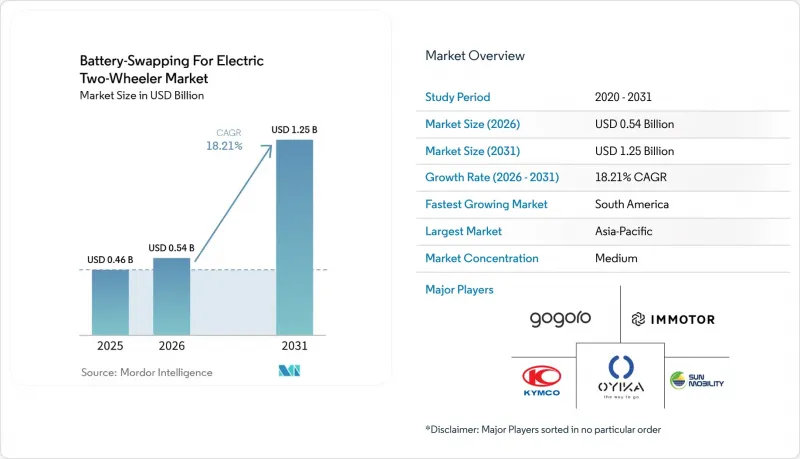
據 Mordor Intelligence 稱,2025 年電動摩托車電池更換市場價值 4.6 億美元,預計到 2031 年將從 2026 年的 5.4 億美元成長到 12.5 億美元,在預測期(2026-2031 年)內複合年成長率為 18.21%。
本報告按服務類型(計量收費和訂閱模式)、電池類型(鋰離子電池和鉛酸電池)、充電站類型(手動和自動)、電池容量(1.5kWh及以下和以上)、二輪車輛類型(電動滑板車/輕型機踏車和電動機車)、應用領域、最終用戶和地區進行細分。市場預測以美元(USD)計價。
全球電動摩托車電池更換市場趨勢及洞察。
強制性和補貼性的主動脫碳
世界各國政府將換電視為推動二輪車電氣化進程的低電網負載促進因素,加速了相關政策的推進。 2024年3月,新加坡推出了全球首個針對可換電池的專用技術標準,為營運商提供了清晰的互通性指南。中國透過省級基金補貼高達三分之一的換電站建設成本,加速了二線城市的換電部署。印度的「電動出行促進計畫」針對配備鋰離子電池的兩輪和三輪車輛,為換電模式提供優惠獎勵。國際標準化組織也積極參與其中,IEC 63584和ISO 15118-20定義了認證和資料交換層,以確保與第三方電池的兼容性。這些措施共同降低了投資者的風險,並支持了電動二輪車市場換電的預期成長。
送貨車輛的成長和零工經濟
對於高運轉率的商業車隊而言,運作絕對不可接受,而電池更換是業務永續營運的關鍵。 Zomato 和 Swiggy 等外送平台正在將電池更換整合到城市物流工作流程中。根據 Battery Smart 統計,目前印度每天的電池更換量超過 10 萬次,其中大部分由正規車隊完成。地方政府也積極跟進。杜拜道路交通管理局 (RTA) 已批准設立 36 個專門為外送騎士服務的換電站。由於使用模式可預測,營運商可以最佳化電池庫存水平,提高換電站利用率,並確保長期訂閱收入。因此,電動摩托車電池更換市場正成為最後一公里配送業務的重要基礎。
車站設備投資和電池庫存
營運商通常會為每輛運作中車輛配備若干備用電池組,以確保供應。機器人換電站價格昂貴(不含電池),需要大量投資。 Spiro 已投入巨資在非洲各地部署了大量自行車和換電站,並正在尋求更多資金籌措用於下一階段的建設。這種網路部署的資本密集特點,不僅有利於成熟的大型企業,尤其是在資金受限的市場,也阻礙了電動摩托車換電產業的即時發展。
細分市場分析
到2025年,訂閱合約將佔電動摩托車換電市場62.72%的佔有率。這表明市場更傾向於可預測的月度行程成本和有保障的換電服務。這一主導地位資金籌措,並加速了電動摩托車換電市場自助換電亭的部署。配套的車隊管理儀錶板使營運商能夠動態重新分配電池,從而使運轉率超過4/5。預計到2031年,付費使用制模式的複合年成長率將達到18.62%,尤其是在換電服務仍處於發展階段的地區,因為非專業用戶更重視柔軟性而非合約義務。同時,儘管訂閱佔有率預計將逐步下降,但由於大規模車隊傾向於選擇簡化費用報銷的全包套餐,訂閱模式仍然是重要的收入來源。
隨著網路密度的增加,良性循環得以形成。更多用戶促使企業增設新的換電站,而平均繞行距離的縮短又吸引了更多用戶。差異化的定價結構有利於高頻用戶和大型車隊契約,從而使專業配送公司成為都市區中心的關鍵租戶。印度重工業部等機構的政策制定者也獎勵基於訂閱的部署模式,因為這種模式能夠產生可靠的使用數據,用於安全監控。因此,訂閱模式對於電動摩托車換電市場的長期盈利至關重要。
截至2025年,鋰離子電池平台在電動摩托車電池更換市場佔73.85%的佔有率。此外,預計到2031年,鋰離子電池將保持18.55%的強勁複合年成長率,這得益於其卓越的性能,例如超過1000次循環的耐久性和超過200 Wh/kg的能量密度,這些優勢鞏固了其在電動摩托車電池更換市場的主導地位。中國禁止都市區使用不合格鉛酸電池組的監管政策正在加速這項技術轉型。預計電動摩托車電池更換的鋰離子電池市場規模將以強勁的複合年成長率呈指數級成長。鈉離子電池原型產品雖然因其使用廉價原料而吸引了研發資金,但預計要到2030年或更晚才能商業化。
此外,內建電池管理系統符合IEC 63584認證標準,這是自動化電池更換站的強制性要求。鉛酸電池由於成本低廉,目前仍在本地分銷市場佔有一席之地,但隨著再生鋰供應量的增加以及低能量密度化學電池補貼政策的實施,其市場佔有率可能會逐漸下降。
截至2025年,人工換電站佔電動摩托車電池更換市場50.62%的佔有率。這是因為與機器人系統相比,人工換電站的初始成本大約低三分之一,更適合新興市場。然而,隨著中國、新加坡和海灣國家人事費用的上升,預計2031年,自動化換電站將在電動摩托車電池更換市場超越人工換電站,複合年成長率預計達到18.49%。機械臂能夠將換電站的運作時間縮短至30秒以內,並透過消除人體工學安全隱患,滿足歐洲和北美更嚴格的勞動標準。
資本支出(Capex)呈下降趨勢。目前,一級供應商提供的模組化系統每個工位的價格低於6.5萬美元,縮小了與人工工位之間的價格差距。自動化還實現了全天候無人運行,提高了每日交易量,並縮短了投資回收期。隨著都市區工作場所安全法規的日益嚴格,保險公司開始為採用機器人基礎設施的企業提供保費折扣,進一步推動了自動化技術的普及。
區域分析
到2025年,亞太地區將佔據電動摩托車換電市場45.02%的佔有率。這主要得益於中國大陸、台灣和印度成熟的電池生態系統以及較高的摩托車普及率。 2023年,中國電動摩托車銷量顯著成長,佔據市場主導地位。同時,印度也實現了顯著成長,較去年同期成長顯著。這些國家建立的基礎設施模式正在越南、泰國和印尼迅速推廣,鞏固了它們在該地區的領先地位。
南美洲的複合年成長率最高,達到18.32%,這主要得益於巴西的電子配送激勵計劃和布宜諾斯艾利斯的電動出行藍圖劃定了路邊換電站區域)等舉措。北美和歐洲的成長基數小規模,但高昂的人事費用促使當地部署了整合電網業務收益的自動化換電站。中東和非洲地區發展相對滯後,但杜拜和內羅畢的試點計畫證實了這個模式的有效性,即使在電網覆蓋有限的地區也是如此。整體而言,這些區域趨勢凸顯了電動摩托車電池更換市場機會的多樣性。
在北美和歐洲,小眾市場對電動摩托車電池更換服務的需求正在成長。紐約市和馬德里的餐飲外送平台正在利用電池更換來滿足噪音和排放氣體法規的要求。不斷上漲的房地產成本意味著自助更換亭往往位於利用率較低的室內停車場和路邊微型樞紐。嚴格的職業安全標準迫使營運商實施全自動換電站,這與該地區高階電動摩托車電池更換市場的發展趨勢相符。
其他好處:
- Excel格式的市場預測(ME)表
- 3個月的分析師支持
目錄
第1章:引言
- 研究假設和市場定義
- 調查範圍
第2章:調查方法
第3章執行摘要
第4章 市場狀況
- 市場概覽
- 市場促進因素
- 強制性和補貼性的主動脫碳
- 送貨車輛增加和零工經濟
- 降低鋰離子電池的成本
- 一個成熟的大規模互換生態系統
- 都市區土地資源有限,有利於小型售貨亭的發展。
- Second Life 和 Grid Services 的收入來源
- 市場限制因素
- 高站設備投資和電池庫存
- 互通性以及原始設備製造商對智慧財產權的反對
- 獨立電池的稅收劣勢
- 超快速充電技術的進步
- 價值供應鏈分析
- 監理情勢
- 技術展望
- 波特五力模型
第5章 市場規模與成長預測
- 按服務類型
- 計量收費模式
- 訂閱模式
- 依電池類型
- 鋰離子電池
- 鉛酸電池
- 依站點類型
- 手動的
- 自動的
- 按電池容量
- 1.5千瓦時或更少
- 1.6~3 kWh
- 超過 3 千瓦時
- 按摩托車類型
- 電動滑板車/輕型機踏車
- 電動機車
- 透過使用
- 個人出行
- 商用車隊
- 最終用戶
- 個人消費者
- 車隊營運商
- 配送聚合器
- 按地區
- 北美洲
- 美國
- 加拿大
- 其他北美國家
- 南美洲
- 巴西
- 阿根廷
- 其他南美國家
- 歐洲
- 德國
- 英國
- 法國
- 義大利
- 西班牙
- 其他歐洲國家
- 亞太地區
- 中國
- 印度
- 日本
- 韓國
- 其他亞太國家
- 中東和非洲
- 阿拉伯聯合大公國
- 沙烏地阿拉伯
- 南非
- 土耳其
- 其他中東和非洲國家
- 北美洲
第6章 競爭情勢
- 市場集中度
- 策略趨勢
- 市佔率分析
- 公司簡介
- Gogoro Inc.
- Battery Smart
- Sun Mobility
- KYMCO(iONEX)
- Immotor Technology
- Oyika Pte Ltd
- Bounce Infinity
- Swobbee GmbH
- Yulu(Yuma Energy)
- VoltUp
- Spiro M Mobility
- Selex Motors
- CATL(EVOGO)
- Aulton New Energy
- Amara Raja Energy & Mobility
- Charge-up
- Sheru Energy
- GreenPack(via Swobbee)
- Yadea Energy Cubes
第7章 市場機會與未來展望
According to Mordor Intelligence, the battery-Swapping for electric two-Wheeler market size was valued at USD 0.46 billion in 2025 and estimated to grow from USD 0.54 billion in 2026 to reach USD 1.25 billion by 2031, at a CAGR of 18.21% during the forecast period (2026-2031).
This report is Segmented by Service Type (Pay-Per-Use Model and Subscription Model), Battery Type (Lithium-Ion Battery and Lead-Acid Battery), Station Type (Manual and Automated), Battery Capacity (Up To 1. 5 KWh and More), Two-Wheeler Type (E-Scooters/Mopeds and E-Motorcycles), Application, End User, and Geography. The Market Forecasts are Provided in Terms of Value (USD).
Global Battery-Swapping For Electric Two-Wheeler Market Trends and Insights
Aggressive Decarbonization Mandates & Subsidies
Policy momentum is accelerating because governments view battery swapping as a low-grid-impact catalyst for two-wheeler electrification. Singapore introduced the world's first dedicated technical code for swappable batteries in March 2024, offering a clear interoperability playbook for operators . China reimburses up to one-third of station capex through provincial funds, fast-tracking installations in tier-2 cities. India's Electric Mobility Promotion Scheme is earmarked for lithium-ion two- and three-wheelers, with battery swapping models receiving priority incentives . Global standard bodies are also active; IEC 63584 and ISO 15118-20 now define authentication and data-exchange layers that unlock cross-brand compatibility. Collectively, these measures reduce investor risk and underpin forecast growth in the battery swapping for the electric two-wheeler market.
Growth of Delivery & Gig-Economy Fleets
High-utilization commercial fleets consider downtime non-negotiable, making battery swapping indispensable for business continuity. Delivery aggregators such as Zomato and Swiggy have embedded swapping into their urban logistics workflows, and Battery Smart now records over 100,000 daily swaps across India, mostly from organized fleets. Municipal agencies echo this trend; Dubai's Roads and Transport Authority green-lit 36 dedicated swapping sites targeting food-delivery riders. Predictable usage patterns allow operators to optimize battery float levels, elevate station utilization, and secure long-term subscription revenue streams. Consequently, the battery swapping for the electric two-wheeler market is becoming a critical backbone for last-mile commerce.
High Station Capex & Battery Inventory
Operators typically stock several spare battery packs per active vehicle, ensuring availability. Robotic kiosks, priced within a high range (excluding batteries), represent a significant investment. Spiro, having already invested a substantial amount to roll out a large number of bikes and stations across Africa, is eyeing additional funding for the next phase. This capital intensity in deploying networks, especially in markets with limited capital, not only favors established players but also curtails immediate expansion in the battery swapping sector for electric two-wheelers.
Other drivers and restraints analyzed in the detailed report include:
- Declining Li-Ion Battery Costs
- Proven Large-Scale Swap Ecosystems
- Interoperability & IP Push-Back From OEMs
For complete list of drivers and restraints, kindly check the Table Of Contents.
Segment Analysis
Subscription contracts commanded 62.72% of the battery swapping for electric two-wheeler market share in 2025, signaling market preference for predictable per-month mobility costs and guaranteed swap access. This leadership translates into stable cash flow financing and accelerated kiosk roll-outs within the battery swapping for electric two-wheeler market. Complementary fleet dashboards allow operators to reallocate batteries dynamically, lifting utilization rates beyond four-fifths. Pay-per-use options record an 18.62% CAGR to 2031 as casual riders value flexibility over commitment, especially in nascent swap geographies. The subscription share is expected to decline slowly yet remain the core monetization pillar because large-scale fleets gravitate toward all-inclusive packages that simplify expense reporting.
Network density fuels a virtuous cycle: more subscribers justify new stations that bring down average trip detour distance, attracting additional users. Differential pricing structures reward high-volume accounts and bulk fleet sign-ups, cementing professional delivery firms as anchor tenants across urban nodes. Policy makers such as India's Ministry of Heavy Industries channel incentives toward subscription-backed deployments because they generate reliable utilization data for safety oversight. Consequently, the subscription archetype will remain vital to long-term profitability within the battery swapping for electric two-wheeler market.
Lithium-ion platforms owned 73.85% of the battery swapping for electric two-wheeler market share in 2025. Also, they registered a robust CAGR of 18.55% till 2031, underpinning the battery swapping for the electric two-wheeler market share advantage through superior 1,000-cycle durability and energy density above 200 Wh/kg. Regulatory updates in China prohibit sub-par lead-acid packs for urban fleets, accelerating the technology shift. The battery swapping for the electric two-wheeler market size for lithium-ion formats is projected to grow exponentially at a robust CAGR. Sodium-ion prototypes attract R&D budgets because they use inexpensive raw materials, yet commercialization remains post-2030.
Additionally, built-in battery management systems comply with IEC 63584 authentication rules, a non-negotiable requirement for automated swap bays. Lead-acid still survives in rural delivery markets owing to low sticker price, but will cede share as recycled lithium capacities expand and subsidy regimes penalize low-energy-density chemistries.
Manual kiosks held 50.62% of the battery swapping for electric two-wheeler market share in 2025 because they demand around one-third lower upfront spend versus robotic alternatives, making them suitable for emerging markets. However, automated stations show an 18.49% CAGR to 2031, outpacing manual formats within the battery swapping for electric two-wheeler market as labor rates rise in China, Singapore, and the Gulf. Robotic arms deliver sub-30-second swap cycles and eliminate ergonomic safety risks, satisfying stricter labor codes in Europe and North America.
Capex is falling: tier-one suppliers now offer modular systems priced below USD 65,000 per bay, narrowing the gap with manual booths. Automation also unlocks 24X7 unattended operations, which increases daily transaction counts and shortens payback periods. As cities tighten occupational safety regulations, insurers are beginning to discount premiums for robotic infrastructure, providing yet another tailwind to automated adoption.
Geography Analysis
Asia-Pacific held a 45.02% of the battery swapping for electric two-wheeler market share in 2025, driven by mature battery ecosystems in China, Taiwan, and India, alongside high two-wheeler density. In 2023, China dominated the electric two-wheeler market with significant sales volumes. Meanwhile, India experienced substantial growth, achieving a notable year-on-year increase. Established infrastructure templates in these nations are swiftly being adapted in Vietnam, Thailand, and Indonesia, solidifying their regional leadership.
South America shows the highest 18.32% CAGR owing to initiatives like Brazil's e-delivery incentive program and Buenos Aires' electric mobility roadmap that earmarks curbside swap zones. North America and Europe grow from smaller bases but leverage high labor costs to justify automated kiosks that bundle grid-service revenue. The Middle East and Africa trail, but pilot schemes in Dubai and Nairobi confirm the concept's relevance, where grid access is limited. Collectively, regional dynamics reinforce the diversified nature of opportunity across the battery swapping for the electric two-wheeler market.
North America and Europe pursue niche adoption. Restaurant delivery platforms in New York City and Madrid use swapping to meet noise and emission ordinances. Higher real-estate costs drive kiosks to occupy underused indoor garages or curbside micro-hubs. Stringent worker safety codes push operators toward fully automated bays, aligning regionally with the premium segment of the battery swapping for electric two-wheeler market.
- Gogoro Inc.
- Battery Smart
- Sun Mobility
- KYMCO (iONEX)
- Immotor Technology
- Oyika Pte Ltd
- Bounce Infinity
- Swobbee GmbH
- Yulu (Yuma Energy)
- VoltUp
- Spiro M Mobility
- Selex Motors
- CATL (EVOGO)
- Aulton New Energy
- Amara Raja Energy & Mobility
- Charge-up
- Sheru Energy
- GreenPack (via Swobbee)
- Yadea Energy Cubes
Additional Benefits:
- The market estimate (ME) sheet in Excel format
- 3 months of analyst support
TABLE OF CONTENTS
1 Introduction
- 1.1 Study Assumptions & Market Definition
- 1.2 Scope of the Study
2 Research Methodology
3 Executive Summary
4 Market Landscape
- 4.1 Market Overview
- 4.2 Market Drivers
- 4.2.1 Aggressive Decarbonization Mandates & Subsidies
- 4.2.2 Growth Of Delivery & Gig-Economy Fleets
- 4.2.3 Declining Li-Ion Battery Costs
- 4.2.4 Proven Large-Scale Swap Ecosystems
- 4.2.5 Urban Land Constraints Favoring Compact Kiosks
- 4.2.6 Second-Life & Grid-Service Revenue Streams
- 4.3 Market Restraints
- 4.3.1 High Station Capex & Battery Inventory
- 4.3.2 Interoperability & IP Push-Back From Oems
- 4.3.3 Tax Disincentives On Standalone Batteries
- 4.3.4 Advances In Ultra-Fast Charging
- 4.4 Value / Supply-Chain Analysis
- 4.5 Regulatory Landscape
- 4.6 Technological Outlook
- 4.7 Porter's Five Forces
- 4.7.1 Threat of New Entrants
- 4.7.2 Bargaining Power of Buyers
- 4.7.3 Bargaining Power of Suppliers
- 4.7.4 Threat of Substitutes
- 4.7.5 Intensity of Competitive Rivalry
5 Market Size & Growth Forecasts (Value (USD))
- 5.1 By Service Type
- 5.1.1 Pay-Per-Use Model
- 5.1.2 Subscription Model
- 5.2 By Battery Type
- 5.2.1 Lithium-ion Battery
- 5.2.2 Lead-acid Battery
- 5.3 By Station Type
- 5.3.1 Manual
- 5.3.2 Automated
- 5.4 By Battery Capacity
- 5.4.1 Up to 1.5 kWh
- 5.4.2 1.6 - 3 kWh
- 5.4.3 More than 3 kWh
- 5.5 By Two-Wheeler Type
- 5.5.1 E-Scooters / Mopeds
- 5.5.2 E-Motorcycles
- 5.6 By Application
- 5.6.1 Personal Mobility
- 5.6.2 Commercial Fleets
- 5.7 By End User
- 5.7.1 Individual consumers
- 5.7.2 Fleet operators
- 5.7.3 Delivery aggregators
- 5.8 By Geography
- 5.8.1 North America
- 5.8.1.1 United States
- 5.8.1.2 Canada
- 5.8.1.3 Rest of North America
- 5.8.2 South America
- 5.8.2.1 Brazil
- 5.8.2.2 Argentina
- 5.8.2.3 Rest of South America
- 5.8.3 Europe
- 5.8.3.1 Germany
- 5.8.3.2 United Kingdom
- 5.8.3.3 France
- 5.8.3.4 Italy
- 5.8.3.5 Spain
- 5.8.3.6 Rest of Europe
- 5.8.4 Asia-Pacific
- 5.8.4.1 China
- 5.8.4.2 India
- 5.8.4.3 Japan
- 5.8.4.4 South Korea
- 5.8.4.5 Rest of Asia-Pacific
- 5.8.5 Middle East and Africa
- 5.8.5.1 United Arab Emirates
- 5.8.5.2 Saudi Arabia
- 5.8.5.3 South Africa
- 5.8.5.4 Turkey
- 5.8.5.5 Rest of Middle East and Africa
- 5.8.1 North America
6 Competitive Landscape
- 6.1 Market Concentration
- 6.2 Strategic Moves
- 6.3 Market Share Analysis
- 6.4 Company Profiles (Includes Global Level Overview, Market Level Overview, Core Segments, Financials as Available, Strategic Information, Market Rank/Share for Key Companies, Products and Services, SWOT Analysis, and Recent Developments)
- 6.4.1 Gogoro Inc.
- 6.4.2 Battery Smart
- 6.4.3 Sun Mobility
- 6.4.4 KYMCO (iONEX)
- 6.4.5 Immotor Technology
- 6.4.6 Oyika Pte Ltd
- 6.4.7 Bounce Infinity
- 6.4.8 Swobbee GmbH
- 6.4.9 Yulu (Yuma Energy)
- 6.4.10 VoltUp
- 6.4.11 Spiro M Mobility
- 6.4.12 Selex Motors
- 6.4.13 CATL (EVOGO)
- 6.4.14 Aulton New Energy
- 6.4.15 Amara Raja Energy & Mobility
- 6.4.16 Charge-up
- 6.4.17 Sheru Energy
- 6.4.18 GreenPack (via Swobbee)
- 6.4.19 Yadea Energy Cubes
7 Market Opportunities & Future Outlook
- 7.1 White-space & Unmet-Need Assessment

 印度摩托車市場:市場佔有率分析、產業趨勢與統計及成長預測(2026-2031)
 摩托車市場規模、佔有率和成長分析:按車型、傳動系統、引擎排氣量、應用、最終用戶、銷售管道和地區分類-2026-2033年產業預測
 摩托車市場-全球產業規模、佔有率、趨勢、機會和預測:按車型、動力系統、地區和競爭格局分類,2021-2031年
 摩托車市場:2026年至2032年全球預測(按車型、動力系統、性能類型、類別、變速箱類型、價格範圍、應用和最終用戶分類)
 摩托車照明市場規模、佔有率、成長及全球產業分析:按類型、應用和地區分類,並預測至2026-2034年摩托車市場規模、佔有率、成長及全球產業分析:按類型、應用和地區分類的洞察,2026-2034 年預測
 日本摩托車市場:規模、佔有率、趨勢和預測:按類型、技術、變速箱、引擎排氣量、燃料類型、分銷管道、最終用戶和地區分類(2026-2034 年)中國摩托車市場:市場佔有率分析、產業趨勢與統計及成長預測(2026-2031年)
 摩托車市場機會、成長要素、產業趨勢分析及2026年至2035年預測歐洲摩托車市場佔有率分析、行業趨勢、統計數據和成長預測(2026-2031)