


 |
市場調查報告書
商品編碼
2116899
人才招聘軟體:市佔率分析、產業趨勢與統計、成長預測(2026-2031)Talent Acquisition Software - Market Share Analysis, Industry Trends & Statistics, Growth Forecasts (2026 - 2031) |
||||||

※ 本網頁內容可能與最新版本有所差異。詳細情況請與我們聯繫。
據 Mordor Intelligence 稱,2025 年人才招聘軟體市場價值 103.7 億美元,預計到 2031 年將達到 144 億美元,而 2026 年為 109.5 億美元,預測期(2026-2031 年)複合年成長率為 5.63%。
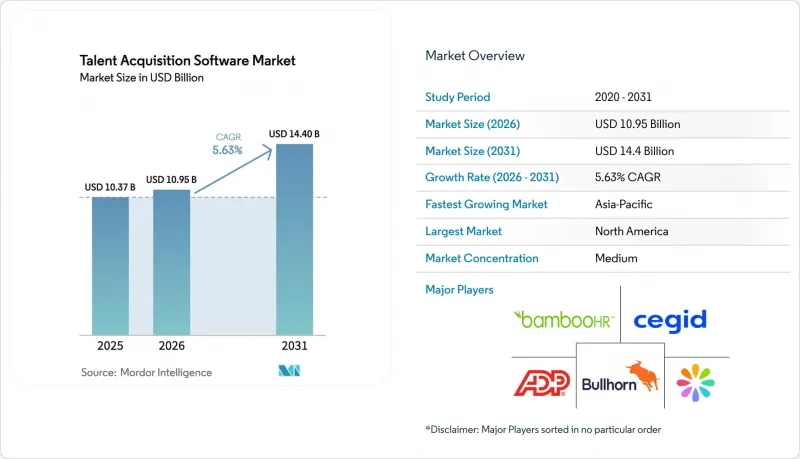
本報告按部署模式(本地部署、雲端部署)、組件(應徵者追蹤系統、招聘行銷套件等)、公司規模(大型企業、中小企業)、最終用戶行業(製造業、醫療保健、銀行、金融服務和保險、教育、酒店、TT和電信等)以及地區進行細分。市場預測以美元計價。
全球人才招聘軟體市場趨勢與洞察
人力資源技術棧雲遷移加速平台整合
遷移到雲端原生人力資源架構的企業報告稱,其成本和效能均獲得了兩位數的收益。即時數據整合打破了傳統的資訊孤島,改進了招募分析,並實現了全公司範圍的人才洞察。更快的實施週期和強大的可擴展性使得雲端採用對於大規模招募尤其具有吸引力。 API優先的設計使雇主能夠將專業的尋源、評估或背景調查模組整合到統一的工作流程中,進一步鞏固了人才招聘軟體市場作為更廣泛的人力資源數位轉型基石的地位。
人工智慧驅動的候選人匹配正在改變招募品質的衡量標準。
目前,機器學習引擎透過分析履歷、評估和行為訊號,提取出比關鍵字搜尋更精準的候選人資料。預計到2024年,領先平台將處理數十萬個職缺發布,負責人的處理能力將提升50%以上。隨著監管審查的日益嚴格,可解釋的AI儀錶板和偏見審計正成為必不可少的功能。儘管效率提升顯而易見,但近九成的大型企業尚未在其招聘網站上部署AI驅動的個人化功能。這種應用差距持續推動成長機會。
資料隱私合規成本是推廣應用的一大障礙。
更嚴格的監管要求迫使雇主在同意管理、資訊防止洩漏對策和候選人資料管治方面進行投資。一些跨國公司正投入數百萬美元來修正過時的工作流程並管理跨境資料傳輸。這些支出延緩了採購決策,並阻礙了將資金分配給功能創新,從而給人才招聘軟體市場帶來短期壓力。
細分市場分析
與雲端運算應用相關的人才招聘軟體市場預計到2025年將超過73.5億美元,凸顯了客戶對訂閱模式的明顯偏好。雲端服務預計將以6.62%的複合年成長率成長,到2031年預計將佔據更大的市場佔有率。本地部署在監管嚴格的行業仍然普遍,但隨著安全認證和自主雲端選項的普及,其使用率正在穩步下降。混合模式正成為企業逐步淘汰敏感資料(尤其是在金融服務和醫療保健產業)的過渡方案。新加坡、加拿大不列顛哥倫比亞省和美國部分州的政府資助計畫正在進一步加速向雲端遷移,這將直接惠及人才招聘軟體市場。
雲端遷移能夠實現傳統架構無法實現的AI功能和持續更新。因此,供應商正在將高階分析、互動式AI機器人和技能圖譜技術打包成標準的雲端功能。如此一來,買家無需投入大量資金,即可大幅提升招募品質。這些優勢正在強化SaaS(軟體即服務)交付模式的長期發展趨勢,並進一步拉大雲端領導企業與落後於傳統本地部署企業的差距。
到2025年,應徵者追蹤系統將佔據最大的收入佔有率,達到37.25%,並將成為企業和中端市場的核心工作流程層。然而,隨著招募行銷、候選人關係管理和入職模組的整合度不斷提高,買家越來越傾向於從單一供應商採購整合套件。預計這一轉變將使招募行銷功能實現6.45%的複合年成長率,其次是培養潛在人才庫的候選人關係管理模組。由於複雜的全球部署需要專業知識,服務、實施和最佳化諮詢也呈現強勁成長。
負責人對單螢幕儀錶板、整合分析和降低供應商管理成本的需求推動了套件之間的整合。現代ATS產品將履歷分析、面試安排和預測分析等功能捆綁在一起——這些功能以前需要單獨的許可證——從而降低了總體擁有成本(TCO),並推動了人才招聘軟體市場的整合。
區域分析
到2025年,北美將佔全球支出的34.05%,這反映了其較高的SaaS滲透率和成熟的整合生態系統。美國企業優先考慮人工智慧的可解釋性和候選人體驗指標,而加拿大買家則優先考慮雙語工作流程和跨國人才招募。隨著墨西哥製造業的擴張,對能夠同時支援技術工人和工程師的擴充性招募系統的需求日益成長。
預計到2031年,亞太地區將以6.18%的複合年成長率實現最高成長,這主要得益於印度2024年三位數的就業成長以及中國科技業的招聘熱潮。在新加坡、馬來西亞和泰國,政府已推出扶持人力資源技術應用的計劃,多語言支援仍然是一項核心需求。各地不同的勞動法和資料居住要求促使供應商提供靈活的託管和合規選項,從而推動了該地區人才招聘軟體市場的整體發展。
在歐洲,GDPR相關的系統升級和單一市場內的跨境應用推動了持續成長。德國和英國繼續引領企業應用,而法國和西班牙則專注於多語言能力和歐盟內部人才流動。即將訂定的歐盟人工智慧法案迫切需要更透明的演算法和偏見緩解報告機制,這將進一步影響我們的產品藍圖。
隨著經濟多元化和外商投資加速企業數位轉型,拉丁美洲、中東和非洲正成為新興成長區域,對新需求的需求日益成長。巴西的科技生態系和波灣合作理事會(GCC)的公共部門現代化計畫就是這些新採購趨勢的例證。在這些地區,提供輕量級部署環境和本地語言支援的供應商預計將逐步擴大其在人才招聘軟體市場的佔有率。
其他好處:
- Excel格式的市場預測(ME)表
- 三個月的分析師支持
目錄
第1章:引言
- 研究假設和市場定義
- 調查範圍
第2章:調查方法
第3章執行摘要
第4章 市場狀況
- 市場概覽
- 市場促進因素
- 人力資源技術堆疊的雲端遷移
- 人工智慧驅動的候選人匹配提高了招募品質。
- 對高度個人化候選人體驗的期望
- 非正規就業人口日益增多
- 為 DEI 記分卡實施人力資源分析
- 政府對數位化招聘平台的支持措施
- 市場限制因素
- 資料隱私合規成本(GDPR、CPRA)
- 整合傳統人力資源資訊系統面臨的挑戰
- 受景氣衰退,招募凍結
- 與演算法偏見相關的訴訟風險
- 產業生態系分析
- 監理情勢
- 技術展望
- 宏觀經濟因素的影響
- 波特五力分析
第5章 市場規模與成長預測
- 按部署模式
- 現場
- 基於雲端的
- 按組件
- 申請人追蹤系統
- 候選人關係管理
- 招募行銷套件
- 服務和支持
- 按公司規模
- 大公司
- 小型企業
- 按最終用途行業分類
- 製造業
- 衛生保健
- BFSI
- 教育
- 飯店業
- 資訊科技/通訊
- 零售與電子商務
- 其他
- 按地區
- 北美洲
- 美國
- 加拿大
- 墨西哥
- 南美洲
- 巴西
- 阿根廷
- 哥倫比亞
- 其他南美國家
- 歐洲
- 德國
- 英國
- 法國
- 俄羅斯
- 西班牙
- 其他歐洲國家
- 亞太地區
- 中國
- 印度
- 日本
- 澳洲
- 其他亞太國家
- 中東
- 阿拉伯聯合大公國
- 沙烏地阿拉伯
- 土耳其
- 其他中東國家
- 非洲
- 南非
- 奈及利亞
- 肯亞
- 其他非洲國家
- 北美洲
第6章 競爭情勢
- 市場集中度
- 策略趨勢
- 市佔率分析
- 公司簡介
- ADP LLC
- Applicant Tracking System Inc.(Trakstar)
- Bamboo HR LLC
- Bullhorn Inc.
- Cegid Group SA
- ClearCompany HRM Inc.
- Cornerstone OnDemand Inc.
- Greenhouse Software Inc.
- HireVue Inc.
- iCIMS Inc.
- IBM Corporation
- Jobvite Inc.
- Learning Technologies Group PLC
- Lever Inc.
- Oracle Corporation
- PeopleFluent Inc.
- Recruit Holdings Co. Ltd.
- SAP SE
- SmartRecruiters Inc.
- Workday Inc.
- Zoho Corporation Pvt. Ltd.
第7章 市場機會與未來展望
According to Mordor Intelligence, the talent acquisition software market size was valued at USD 10.37 billion in 2025 and estimated to grow from USD 10.95 billion in 2026 to reach USD 14.4 billion by 2031, at a CAGR of 5.63% during the forecast period (2026-2031).
This report is Segmented by Deployment Model (On-Premises, and Cloud), Component (Applicant Tracking System, Recruitment Marketing Suite, and More), Enterprise Size (Large Enterprises, and Small and Medium Enterprises), End-Use Industry (Manufacturing, Healthcare, BFSI, Education, Hospitality, IT and Telecom, and More), and Geography. The Market Forecasts are Provided in Terms of Value (USD).
Global Talent Acquisition Software Market Trends and Insights
Cloud Migration of HR Tech Stacks Accelerates Platform Consolidation
Organizations shifting to cloud-native HR architectures report double-digit cost and performance benefits. Real-time data integration collapses historical silos, improving hiring analytics and enabling enterprise-wide workforce insights. Faster implementation cycles and elastic scalability make cloud deployments especially attractive for high-volume recruiting. API-first designs let employers plug specialized sourcing, assessment, or background-check modules into unified workflows, positioning the talent acquisition software market as the cornerstone of broader HR digital transformation.
AI-Powered Candidate Matching Transforms Quality-of-Hire Metrics
Machine-learning engines now parse resumes, assessments, and behavioral signals to surface best-fit profiles with greater precision than keyword searches. Leading platforms processed hundreds of thousands of requisitions in 2024, boosting recruiter capacity by more than half. Explainable-AI dashboards and bias audits have become must-have features amid heightened regulatory scrutiny. Despite clear efficiency gains, nearly nine in ten large employers have yet to deploy AI-driven personalization on career sites-an adoption gap that continues to fuel growth opportunities
Data-Privacy Compliance Costs Create Implementation Barriers
Heightened regulatory requirements obligate employers to invest in consent management, breach safeguards, and candidate data governance. Some multinationals now allocate multimillion-dollar budgets for remediation of legacy workflows and cross-border data-transfer controls. These expenditures slow purchase decisions and divert funds away from feature innovation, placing short-term pressure on the talent acquisition software market.
Other drivers and restraints analyzed in the detailed report include:
- Hyper-Personalised Candidate Experience Becomes Competitive Differentiator
- Rising Contingent Workforce Penetration Expands Platform Scope
- Legacy HRIS Integration Hurdles Constrain Adoption Velocity
For complete list of drivers and restraints, kindly check the Table Of Contents.
Segment Analysis
The talent acquisition software market size tied to cloud deployments eclipsed USD 7.35 billion in 2025, underscoring a decisive customer preference for subscription-based delivery. With a future 6.62% CAGR, cloud offerings are poised to capture even greater share by 2031. On-premises installations persist in highly regulated verticals but face steady attrition as security certifications and sovereign-cloud options multiply. Hybrid models serve as interim waypoints for organizations migrating sensitive data in phases, especially in financial services and healthcare. Government funding programs in Singapore, British Columbia, and selected U.S. states further hasten cloud transitions, directly benefiting the talent acquisition software market.
Cloud migration simultaneously unlocks AI capabilities and continuous updates that legacy architectures cannot match. Vendors therefore package advanced analytics, conversational AI bots, and skills-graph technology as standard cloud features. In turn, buyers gain measurable quality-of-hire improvements without capital-expense burdens. These advantages reinforce the long-term gravitational pull toward software-as-a-service delivery, widening the gap between cloud leaders and lagging on-premises incumbents.
Applicant tracking systems accounted for the largest 37.25% slice of 2025 revenue, making them the anchoring workflow layer across enterprise and mid-market segments. Yet as recruitment marketing, candidate relationship management, and onboarding modules converge, buyers increasingly source integrated suites from a single provider. This shift propels recruitment marketing functionality to a projected 6.45% CAGR, closely followed by candidate relationship modules that nurture passive talent pools. Services, implementation, and optimization consulting also record healthy growth because complex global rollouts require specialized expertise.
Cross-suite convergence is shaped by recruiter demand for single-pane dashboards, unified analytics, and lower vendor-management overhead. Modern ATS products bundle resume parsing, interview scheduling, and predictive analytics that once required separate licenses, compressing total cost of ownership and driving consolidation in the talent acquisition software market.
Complete Report Scope:
- By Deployment Model
- On-premises Solutions
- Cloud-based Solutions
- By Component
- Applicant Tracking System
- Candidate Relationship Management
- Recruitment Marketing Suite
- Services and Support
- By Enterprise Size
- Large Enterprises
- Small and Medium Enterprises
- By End-use Industry
- Manufacturing
- Healthcare
- BFSI
- Education
- Hospitality
- IT and Telecom
- Retail and E-commerce
- Other End-use Industries
- By Region
- North America
- United States
- Canada
- Mexico
- South America
- Brazil
- Argentina
- Colombia
- Rest of South America
- Europe
- Germany
- United Kingdom
- France
- Russia
- Spain
- Rest of Europe
- Asia Pacific
- China
- India
- Japan
- Australia
- Rest of Asia Pacific
- Middle East
- United Arab Emirates
- Saudi Arabia
- Turkey
- Rest of Middle East
- Africa
- South Africa
- Nigeria
- Kenya
- Rest of Africa
- North America
Geography Analysis
North America captured 34.05% of 2025 spending, reflecting deep SaaS penetration and mature integration ecosystems. U.S. organizations emphasize AI explainability and candidate-experience metrics, whereas Canadian buyers prioritize bilingual workflows and cross-border talent sourcing. Mexico's expanding manufacturing footprint increases the appetite for scalable recruitment systems that support both skilled trades and engineering roles.
Asia Pacific posts the strongest 6.18% CAGR to 2031, underpinned by India's triple-digit job-offer growth in 2024 and China's technology-sector hiring surges. Government programs in Singapore, Malaysia, and Thailand subsidize HR tech adoption, and multi-language localization remains a core requirement. Diverse labor laws and data-residency mandates encourage vendors to maintain flexible hosting and compliance options, lifting the overall talent acquisition software market in the region.
Europe shows durable growth, propelled by GDPR-linked upgrades and cross-border hiring within the single market. Germany and the United Kingdom continue to lead enterprise adoption, while France and Spain focus on multilingual capability and EU talent mobility. The forthcoming EU AI Act adds urgency to demand for transparent algorithms and bias-mitigation reporting, further shaping product roadmaps.
Latin America, the Middle East, and Africa represent emerging demand corridors as economic diversification and foreign investment fuel enterprise digitization. Brazil's tech ecosystem and Gulf Cooperation Council public-sector modernization projects exemplify new procurement momentum. Vendors that offer light-footprint deployments and regional language support stand to capture incremental talent acquisition software market share in these geographies.
- ADP LLC
- Applicant Tracking System Inc. (Trakstar)
- Bamboo HR LLC
- Bullhorn Inc.
- Cegid Group SA
- ClearCompany HRM Inc.
- Cornerstone OnDemand Inc.
- Greenhouse Software Inc.
- HireVue Inc.
- iCIMS Inc.
- IBM Corporation
- Jobvite Inc.
- Learning Technologies Group PLC
- Lever Inc.
- Oracle Corporation
- PeopleFluent Inc.
- Recruit Holdings Co. Ltd.
- SAP SE
- SmartRecruiters Inc.
- Workday Inc.
- Zoho Corporation Pvt. Ltd.
Additional Benefits:
- The market estimate (ME) sheet in Excel format
- 3 months of analyst support
TABLE OF CONTENTS
1 INTRODUCTION
- 1.1 Study Assumptions and Market Definition
- 1.2 Scope of the Study
2 RESEARCH METHODOLOGY
3 EXECUTIVE SUMMARY
4 MARKET LANDSCAPE
- 4.1 Market Overview
- 4.2 Market Drivers
- 4.2.1 Cloud-migration of HR tech stacks
- 4.2.2 AI-powered candidate matching improving quality-of-hire
- 4.2.3 Hyper-personalised candidate experience expectations
- 4.2.4 Rising contingent workforce penetration
- 4.2.5 Talent analytics adoption for DEI scorecards
- 4.2.6 Government incentives for digital hiring platforms
- 4.3 Market Restraints
- 4.3.1 Data-privacy compliance costs (GDPR, CPRA)
- 4.3.2 Legacy HRIS integration hurdles
- 4.3.3 Economic downturn hiring freezes
- 4.3.4 Algorithmic-bias litigation risk
- 4.4 Industry Ecosystem Analysis
- 4.5 Regulatory Landscape
- 4.6 Technological Outlook
- 4.7 Impact of Macroeconomic Factors
- 4.8 Porter's Five Forces Analysis
- 4.8.1 Threat of New Entrants
- 4.8.2 Bargaining Power of Buyers
- 4.8.3 Bargaining Power of Suppliers
- 4.8.4 Threat of Substitutes
- 4.8.5 Intensity of Competitive Rivalry
5 MARKET SIZE AND GROWTH FORECASTS (VALUE)
- 5.1 By Deployment Model
- 5.1.1 On-premises Solutions
- 5.1.2 Cloud-based Solutions
- 5.2 By Component
- 5.2.1 Applicant Tracking System
- 5.2.2 Candidate Relationship Management
- 5.2.3 Recruitment Marketing Suite
- 5.2.4 Services and Support
- 5.3 By Enterprise Size
- 5.3.1 Large Enterprises
- 5.3.2 Small and Medium Enterprises
- 5.4 By End-use Industry
- 5.4.1 Manufacturing
- 5.4.2 Healthcare
- 5.4.3 BFSI
- 5.4.4 Education
- 5.4.5 Hospitality
- 5.4.6 IT and Telecom
- 5.4.7 Retail and E-commerce
- 5.4.8 Other End-use Industries
- 5.5 By Region
- 5.5.1 North America
- 5.5.1.1 United States
- 5.5.1.2 Canada
- 5.5.1.3 Mexico
- 5.5.2 South America
- 5.5.2.1 Brazil
- 5.5.2.2 Argentina
- 5.5.2.3 Colombia
- 5.5.2.4 Rest of South America
- 5.5.3 Europe
- 5.5.3.1 Germany
- 5.5.3.2 United Kingdom
- 5.5.3.3 France
- 5.5.3.4 Russia
- 5.5.3.5 Spain
- 5.5.3.6 Rest of Europe
- 5.5.4 Asia Pacific
- 5.5.4.1 China
- 5.5.4.2 India
- 5.5.4.3 Japan
- 5.5.4.4 Australia
- 5.5.4.5 Rest of Asia Pacific
- 5.5.5 Middle East
- 5.5.5.1 United Arab Emirates
- 5.5.5.2 Saudi Arabia
- 5.5.5.3 Turkey
- 5.5.5.4 Rest of Middle East
- 5.5.6 Africa
- 5.5.6.1 South Africa
- 5.5.6.2 Nigeria
- 5.5.6.3 Kenya
- 5.5.6.4 Rest of Africa
- 5.5.1 North America
6 COMPETITIVE LANDSCAPE
- 6.1 Market Concentration
- 6.2 Strategic Moves
- 6.3 Market Share Analysis
- 6.4 Company Profiles (includes Global level Overview, Market level overview, Core Segments, Financials as available, Strategic Information, Market Rank/Share for key companies, Products and Services, and Recent Developments)
- 6.4.1 ADP LLC
- 6.4.2 Applicant Tracking System Inc. (Trakstar)
- 6.4.3 Bamboo HR LLC
- 6.4.4 Bullhorn Inc.
- 6.4.5 Cegid Group SA
- 6.4.6 ClearCompany HRM Inc.
- 6.4.7 Cornerstone OnDemand Inc.
- 6.4.8 Greenhouse Software Inc.
- 6.4.9 HireVue Inc.
- 6.4.10 iCIMS Inc.
- 6.4.11 IBM Corporation
- 6.4.12 Jobvite Inc.
- 6.4.13 Learning Technologies Group PLC
- 6.4.14 Lever Inc.
- 6.4.15 Oracle Corporation
- 6.4.16 PeopleFluent Inc.
- 6.4.17 Recruit Holdings Co. Ltd.
- 6.4.18 SAP SE
- 6.4.19 SmartRecruiters Inc.
- 6.4.20 Workday Inc.
- 6.4.21 Zoho Corporation Pvt. Ltd.
7 MARKET OPPORTUNITIES AND FUTURE OUTLOOK
- 7.1 White-Space and Unmet-Need Assessment

 醫療人員強化與外派市場:策略性洞察與預測(2026-2031)
 IT人員配備服務:市場佔有率分析、產業趨勢與統計及成長預測(2026-2031年)歐洲IT人員配置:市場佔有率分析、產業趨勢與統計數據以及成長預測(2026-2031年)
 數位人才招聘市場:按組件、技術類型、最終用戶、部署模式、產業和應用分類-2026-2032年全球市場預測IT永續發展人才與培訓平台:市場佔有率分析、產業趨勢與統計、成長預測(2026-2031年)亞太地區人才招聘軟體:市佔率分析、產業趨勢與統計及成長預測(2026-2031)北美人才招聘軟體:市佔率分析、產業趨勢與統計及成長預測(2026-2031 年)醫療保健產業人才招聘:市場佔有率分析、行業趨勢和統計數據以及成長預測(2026-2031 年)銀行、金融服務和保險 (BFSI) 市場的人才招聘:市場佔有率分析、行業趨勢和統計數據以及成長預測 (2026-2031)
 人才招募技術與服務市場分析及預測(至2035年):依類型、產品類型、服務、技術、組件、應用、部署類型、最終用戶與功能分類