


 |
市場調查報告書
商品編碼
2073135
IT永續發展人才與培訓平台:市場佔有率分析、產業趨勢與統計、成長預測(2026-2031年)IT Sustainability Talent and Training Platform - Market Share Analysis, Industry Trends & Statistics, Growth Forecasts (2026 - 2031) |
||||||

※ 本網頁內容可能與最新版本有所差異。詳細情況請與我們聯繫。
據 Mordor Intelligence 稱,IT 永續發展人才和培訓平台市場預計將從 2025 年的 11.7 億美元成長到 2026 年的 14.2 億美元,到 2031 年達到 39.7 億美元,預計 2026 年至 2031 年的複合年成長率為 2.83%。
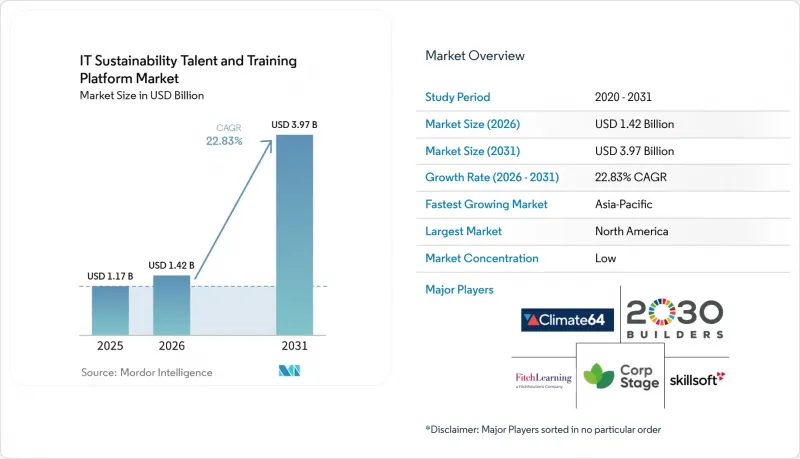
本報告按組件(平台和服務)、部署方式(雲端、本地部署、混合部署)、最終用戶(IT 和數位化專業人員、經營團隊和領導團隊、人力資源和人才發展負責人等)、學習方式(自主學習、混合式學習等)以及地區進行細分。市場預測以美元計價。
全球IT永續發展人才與培訓平台市場趨勢及洞察
對ESG和綠色IT能力日益成長的強制性要求
日益嚴格的資訊揭露要求正在對IT永續發展人才和培訓平台市場產生新的培訓需求。這是因為越來越多的員工需要掌握報告方法、數位化永續發展管理和證據標準的實用知識。歐盟的《企業永續發展報告指令》要求越來越多的公司和非歐盟母公司創建結構化的永續發展資訊揭露,從而導致對與環境、社會和管治報告標準 (ESRS) 要求和審計準備相關的可重複學習的需求增加。 ISO/IEC TS 20125-1:2026 的發布也意義重大,因為它為數位化服務的生態設計提供了一個更清晰的技術框架,IT團隊可以在培訓和實踐中加以利用。這些變化迫使企業不再局限於通用意識模組,而是轉向為IT、數據、採購、內部審計和永續發展報告人員提供特定角色的學習路徑。因此,IT永續發展人才和培訓平台市場對能夠快速更新內容、將學習與工作角色關聯並儲存完成記錄以支援更廣泛的合規營運的平台的需求不斷成長。隨著報告期限擴展到更多地區和營運職能,能夠在地化監管內容而不造成實施延誤的供應商將獲得更多關注。
混合工作模式的日益普及推動了對高度擴充性的數位化培訓解決方案的需求。
混合式和分散式工作模式正在改變永續發展學習的營運模式,使IT永續發展人才和培訓平台市場在交付方面比傳統課堂教學方式更具優勢。如今,企業需要在同一報告週期內為多個國家的IT工程師、ESG分析師、採購經理和高階主管提供培訓,這使得固定的年度培訓計畫難以實施。自主學習模式、模組化更新和基於角色的學習路徑正成為採購決策的核心,支援分散式團隊的快速部署。 IT永續發展人才和培訓平台市場也受益於培訓需要跟上多項報告和技術法規的修訂、擴展和新解釋。因此,買家傾向於選擇雲端主導或混合模式,這些模式允許按地區、職位職能和監管相關性對內容進行分類,而無需每次都重新建構學習結構。這一趨勢鞏固了能夠為全球分散式員工提供規模化、管治控制和詳細完成追蹤的供應商的地位。
除合規培訓舉措外,其他培訓項目的預算批准受到限制。
IT永續發展人才和培訓平台市場在支出模式上仍然較為分散,因為許多公司尚未將永續發展能力差距與直接的合規或財務風險討論聯繫起來。許多公司仍然透過可自由支配的培訓預算而非合規、風險或轉型預算來分配資金,這使得它們在成本優先順序更加嚴格時更有可能推遲專案。這導致了採用模式的兩極化:面臨直接報告壓力的公司迅速推進,而那些不受直接監管影響的公司則推遲更廣泛的部署。因此,在資訊揭露義務、供應商要求或投資者監督等因素形成明確的商業理由的領域,IT永續發展人才和培訓平台市場更具韌性。強調合規性的供應商比那些僅將永續發展培訓視為一種軟性文化或意識提升專案的供應商更具優勢。隨著採購和報告要求在整個供應鏈中蔓延,預算阻力預計會隨著時間的推移而緩解,但短期內不同買家群體的需求仍可能保持波動。
細分市場分析
至2025年,平台細分市場將佔IT永續發展人才和培訓平台市場的68.14%。這反映出企業明顯傾向於將內容、管理、技能分析和報告功能整合到單一系統中的環境。買家越來越需要能夠展示哪些人完成了哪些培訓、內容對應哪些框架,以及這些記錄如何用於內部稽核和資訊揭露準備的平台架構。這一趨勢的驅動力不僅來自運營,也來自商業性因素,因為當需要能夠經受董事會審查和外部保證機構檢驗的可衡量結果時,僅提供內容的服務吸引力就會下降。因此,IT永續發展人才和培訓平台市場正傾向於那些不僅將產品定位為獨立內容庫,而且將其融入更廣泛的管治工作流程的供應商。這一趨勢也反映了標準化部署的優勢,因為大型企業正在尋求一個能夠跨多個國家、業務部門和職位團隊運作的通用學習層,而無需強制使用單獨的本地系統。
儘管服務領域的市場佔有率仍然小規模,但預計從2026年到2031年,其複合年成長率將達到22.91%,這表明實施的深度與平台所有權同等重要。企業在將永續發展學習部署到不同的報告系統和技術團隊時,通常需要在地化內容、法規遵循、入職計畫和變更管理方面的協助。實際上,當企業同時管理多種需求,例如CSRD準備、ISSB合規性、內部控制設計以及建構數位化永續發展能力時,僅靠平臺本身無法提供全部價值。因此,IT永續發展人才和培訓平台市場預計將繼續保持軟體和服務支出之間的緊密聯繫,尤其是在多區域部署中,不同職能部門和國家的管治和內容要求各不相同。 Skillsoft於2026年2月發布的下一代Percipio平台表明,領先的供應商正擴大將技能智慧和人才準備度評估功能更深入地整合到其平台設計中,而不是僅僅將其視為附加元件。隨著買家期望的提高,能夠將可擴展的架構與本地化、整合和衡量方面的實際支援相結合的供應商,可能會看到合約續約率的提高。
預計到2025年,基於雲端的部署將維持其64.17%的主導市場佔有率,繼續在IT永續發展人才和培訓平台市場佔據核心地位。這一主導地位源於其便捷的全球部署、快速的內容更新以及定價模式,使企業能夠根據資訊揭露截止日期和採購需求等突發情況靈活調整使用規模。當企業需要在多個國家和職位部門快速更新模組,而無需等待內部基礎設施的變更時,基於雲端的交付方式尤其有效。隨著永續發展學習從靜態的年度課程演變為持續更新的合規流程,這種模式在IT永續發展人才和培訓平台市場持續受到青睞。買家也重視在廣泛的員工隊伍中標準化報告儀表板和參與者記錄的能力,而當交付在單一的雲端主導環境中進行時,這種效率將進一步提升。
混合部署預計將在2026年至2031年間以23.02%的複合年成長率成長,這體現了一種兼顧規模和管理的務實折衷方案。受監管行業的公司雖然仍然需要雲端解決方案具備廣泛的覆蓋範圍和快速的更新速度,但也需要更強大的資料居住、存取限制、本地託管偏好以及特定產業安全規則方面的選擇。對於金融服務機構、政府相關組織以及在多個國家同時運作並受資料法規約束的跨國公司而言,這尤其具有挑戰性。因此,IT永續發展人才和培訓平台市場正在轉向支援集中式學習管理的部署模式,同時根據需要對使用者資料和內部記錄保持更嚴格的控制。本地部署預計仍將僅限於有限的用例,但由於難以將內容更新、區域部署和評估流程與監管變化同步,它們面臨結構性壓力。能夠提供以目標為導向的混合架構且不會在部署過程中造成重大阻礙的供應商,很可能在複雜的企業採購中繼續保持競爭優勢。
區域分析
到2025年,北美將佔據IT永續發展人才和培訓平台市場34.18%的佔有率,成為收入最高的區域市場。該地區受益於跨國科技公司的高度集中、更成熟的企業培訓預算,以及董事會層面日益成長的對永續發展管治、數位風險和資訊揭露品質的關注。美國在該地區的需求中佔據了很大一部分,因為金融服務、科技和能源公司面臨許多挑戰,包括投資者壓力、技術再培訓的需求以及內部報告的要求。在加拿大,隨著上市公司和大型企業為應對更系統化的氣候變遷和ESG資訊揭露要求做好準備,企業永續發展能力的基礎也不斷增強。雖然南美洲的收入仍然相對小規模,但隨著企業永續發展活動、供應鏈資訊揭露需求以及事件驅動型培訓需求的成長,巴西正在崛起成為一個明顯的成長中心。 2025 年 7 月,思科與 Senac 合作,在貝倫舉行的 COP30 之前培訓了 500 名 IT 專業人員,這表明大規模如何引發新興市場對永續發展技能的需求激增。
在IT永續發展人才和培訓平台市場,合規性仍是歐洲最為重要的地區。這是因為資訊揭露義務更加正式和透明,並且與企業的管治直接相關。德國和英國是該地區最大的市場,擁有龐大的報告企業群體以及成熟的學習和發展生態系統。由於企業需要將治理預期與IT、數據、採購和內部控制等職能的技術實施相結合,因此整個歐洲的需求尤其強勁。德國的NABIT舉措將於2026年至2028年實施,該計畫正在開發關於綠色編碼、循環硬體策略和IT基礎設施二氧化碳運算的開放教育資源,凸顯了公眾教育對數位化永續發展能力日益重視。其他歐洲市場的發展速度也各不相同,跨國公司的子公司往往比純粹的本土公司發展得更快,這是因為母公司層面的資訊揭露義務帶來了更緊迫的培訓壓力。
預計到2031年,亞太地區將以23.34%的複合年成長率成長,並有望成為IT永續發展人才和培訓平台市場成長最快的地區。日本正透過更強力的綠色IT議程來推動發展,該議程支持公司企業管治改革、企業數位轉型,並滿足技術和報告部門對系統化數位學習的需求。印度擁有最大的市場規模機遇,這得益於其快速擴張的企業部門、透過BRSR(商業報告永續發展報告)框架加強的正式報告體系,以及大規模的IT服務基礎設施,這些因素共同創造了對技術培訓和資訊揭露相關培訓的需求。隨著出口導向企業積極應對日益嚴格的國際供應鏈監管,以及對可審計的永續發展數據和範圍3合規性日益成長的期望,中國的重要性也不斷提升。韓國和澳洲仍然是成熟的企業學習市場,能夠將永續發展相關內容整合到更廣泛的專業發展體系中。雖然中東和非洲的普及速度仍然很慢,但像阿拉伯聯合大公國和沙烏地阿拉伯這樣的國家正在透過國家層面的永續發展計畫、經濟多元化計畫以及對大規模國有企業和金融機構的正式要求,來建立更強大的基礎。
其他好處:
- Excel格式的市場預測(ME)表
- 3個月的分析師支持
目錄
第1章:引言
- 研究假設和市場定義
- 調查範圍
第2章:調查方法
第3章執行摘要
第4章 市場狀況
- 市場概覽
- 市場促進因素
- 對ESG和綠色IT能力日益成長的強制性要求
- 混合工作模式的廣泛採用正在推動對高度擴充性的數位化培訓的需求不斷成長。
- 雲端運算、人工智慧和永續運算領域的工作技能快速過時。
- 董事會施壓要求建立可衡量的永續發展能力。
- 微證書和基於角色的學習路徑的廣泛應用
- 對以採購主導的整合學習和報告平台的偏好報告不足。
- 市場限制因素
- 合規培訓舉措預算核准的限制
- IT、永續發展與學習與發展團隊之間的職責分配
- 內部數據對訓練效果和技能轉移的可見性較低。
- 在地化帶來的負擔,即更新內容以符合多個地區的法規,這是一個鮮有報道的議題。
- 監理情勢
- 技術展望
- 產業價值鏈分析
- 波特五力分析
第5章 市場規模與成長預測
- 按組件
- 平台
- 服務
- 不同的發展
- 基於雲端的
- 現場
- 混合
- 最終用戶
- IT與數位專家
- 永續發展與ESG專家
- 人力資源和培訓負責人
- 營運和設施管理負責人
- 經營團隊和領導團隊
- 透過學習風格
- 自主學習,隨時隨地掌握數位化學習方法
- 教師主導的虛擬學習
- 混合式學習
- 基於模擬和基於情境的學習
- 按地區
- 北美洲
- 美國
- 加拿大
- 墨西哥
- 南美洲
- 巴西
- 阿根廷
- 其他南美國家
- 歐洲
- 德國
- 英國
- 法國
- 義大利
- 西班牙
- 俄羅斯
- 其他歐洲國家
- 亞太地區
- 中國
- 印度
- 日本
- 韓國
- 澳洲
- 其他亞太國家
- 中東和非洲
- 中東
- 阿拉伯聯合大公國
- 沙烏地阿拉伯
- 土耳其
- 其他中東國家
- 非洲
- 南非
- 埃及
- 其他非洲國家
- 中東
- 北美洲
第6章 競爭情勢
- 市場集中度
- 策略趨勢
- 市佔率分析
- 公司簡介
- Climate64
- 2030 Builders
- CorpStage
- Green Software Foundation
- Pluralsight LLC
- Skillsoft Corp.
- NIIT Learning Systems Limited
- Learning Tree International, Inc.
- Fast Lane Institute for Knowledge Transfer GmbH
- Firebrand Training Limited
- QA Limited
- CBT Nuggets, LLC
- ISACA
- The Linux Foundation
- AWS Training and Certification
- Microsoft Corporation
- IBM Corporation
- Oracle Corporation
- SAP SE
- Cisco Systems, Inc.
- Docebo Inc.
第7章 市場機會與未來展望
According to Mordor Intelligence, the IT sustainability talent and Training Platform Market size is expected to increase from USD 1.17 billion in 2025 to USD 1.42 billion in 2026 and reach USD 3.97 billion by 2031, growing at a CAGR of 22.83% over 2026-2031.
This report is Segmented by Component (Platform, and Services), Deployment (Cloud-Based, On-Premises, and Hybrid), End User (IT and Digital Professionals, Executive and Leadership Teams, HR and Learning Professionals, and More), Learning Modality (Self-Paced Digital Learning, Blended Learning, and More), and Geography. The Market Forecasts are Provided in Terms of Value (USD).
Global IT Sustainability Talent and Training Platform Market Trends and Insights
Rising Mandatory ESG and Green IT Capability Requirements
Mandatory disclosure rules are creating a new layer of training demand within the IT Sustainability Talent and Training Platform Market, as more employees now need working knowledge of reporting methods, digital sustainability controls, and evidence standards. The EU Corporate Sustainability Reporting Directive expanded the number of companies and non-EU parent entities that must prepare structured sustainability disclosures, thereby increasing the need for repeatable learning tied to ESRS expectations and audit preparation. The publication of ISO/IEC TS 20125-1:2026 is also important because it provides digital services ecodesign with a clearer technical framework that IT teams can use in training and operational practice. These changes are pushing enterprises to move beyond generic awareness modules and toward role-based learning paths for IT, data, procurement, internal audit, and sustainability reporting staff. The IT Sustainability Talent and Training Platform Market is therefore seeing stronger demand for platforms that can refresh content quickly, map lessons to job roles, and preserve completion records that support broader compliance work. Providers that can localize regulatory content without slowing deployment are likely to gain more attention as reporting timelines extend across additional geographies and business functions.
Hybrid Work Models Increasing Demand for Scalable Digital Training Delivery
Hybrid and distributed work has changed the operating model for sustainability learning, giving the IT Sustainability Talent and Training Platform Market a durable delivery advantage over traditional classroom-led approaches. Enterprises now need to reach IT engineers, ESG analysts, procurement managers, and business leaders across many countries within the same reporting cycle, making static annual programs less practical. Self-paced delivery, modular updates, and role-specific learning paths have moved closer to the center of procurement decisions because they support faster rollout across dispersed teams. The IT Sustainability Talent and Training Platform Market is also benefiting from the fact that training now has to keep pace with amendments, extensions, and new interpretations across multiple reporting and technology rules. Buyers are therefore leaning toward cloud-led or hybrid models that can segment content by geography, function, and regulatory relevance without rebuilding the learning structure each time. This dynamic is strengthening the position of vendors that can combine scale, governance control, and detailed completion tracking across a globally distributed workforce.
Limited Budget Approval for Non-Compliance Training Initiatives
The IT Sustainability Talent and Training Platform Market still faces uneven spending patterns in enterprises that have not yet turned sustainability capability gaps into direct compliance or financial risk discussions. Many companies continue to fund this area through discretionary learning budgets rather than compliance, risk, or transformation budgets, making projects easier to defer when cost priorities tighten. This creates a two-speed adoption pattern in which companies under direct reporting pressure move ahead faster, while firms outside the immediate regulatory perimeter postpone broader rollouts. The IT Sustainability Talent and Training Platform Market, therefore, remains more resilient where disclosure obligations, supplier mandates, or investor scrutiny create a clear business case for action. Vendors with a stronger compliance message are better positioned than providers that present sustainability learning as a soft culture or awareness program. Budget resistance should ease over time as procurement and reporting requirements spread through supply chains, but near-term demand is still likely to remain uneven across buyer groups.
Other drivers and restraints analyzed in the detailed report include:
- Fast Skill Obsolescence In Cloud, AI, and Sustainable Computing Roles
- Board-Level Pressure For Measurable Sustainability Competency Building
- Fragmented Ownership Between IT, Sustainability, and Learning and Development Teams
For complete list of drivers and restraints, kindly check the Table Of Contents.
Segment Analysis
The platform segment held 68.14% of the IT Sustainability Talent and Training Platform Market share in 2025, reflecting a clear enterprise preference for integrated environments that combine content, administration, skills analytics, and reporting in one system. Buyers increasingly want a platform architecture that can show who completed which training, what framework the content addressed, and how records can support internal audit and disclosure preparation. This preference is commercial as well as operational, because content-only offerings are less attractive when buyers need measurable outputs that can withstand board review and external assurance scrutiny. The IT Sustainability Talent and Training Platform Market has therefore tilted toward vendors that can position their products within a wider governance workflow rather than as stand-alone content libraries. This lead also reflects the advantage of standardized rollout because large companies want a common learning layer that can work across multiple countries, business units, and role groups without forcing separate local systems.
The services segment remained smaller in base share, but it is projected to grow at a 22.91% CAGR from 2026 to 2031, which shows that implementation depth matters almost as much as platform ownership. Enterprises often need help with localized content, regulatory mapping, onboarding plans, and change management when they roll out sustainability learning across different reporting regimes and technical teams. In practice, the platform does not create full value on its own when organizations are managing simultaneous needs around CSRD preparation, ISSB alignment, internal control design, and digital sustainability capability building. The IT Sustainability Talent and Training Platform Market is therefore likely to keep a close link between software and service spending, especially in multi-region deployments where governance and content requirements vary by function and country. Skillsoft's next-generation Percipio Platform launch in February 2026 illustrates how larger vendors are embedding skills intelligence and workforce-readiness measurement more deeply into platform design, rather than treating those functions as add-ons. As buyer expectations rise, providers that can combine scalable architecture with practical support for localization, integration, and measurement are likely to see stronger renewal performance.
Cloud-based deployment retained the largest share at 64.17% in 2025, which kept it at the center of the IT Sustainability Talent and Training Platform Market. Its lead came from easier global rollout, faster content updates, and a pricing model that lets organizations scale usage when disclosure deadlines or procurement demands create sudden training needs. Cloud delivery is especially useful when enterprises need to update modules quickly across several countries and role groups without waiting for internal infrastructure changes. The IT Sustainability Talent and Training Platform Market continues to favor this model because sustainability learning now behaves more like a continuously updated compliance stream than a static annual course. Buyers also value the ability to standardize reporting dashboards and learner records across a broad workforce, which is more efficient when delivery sits in a single cloud-led environment.
Hybrid deployment is projected to grow at a 23.02% CAGR from 2026 to 2031, reflecting a practical compromise between scale and control. Enterprises in regulated sectors still want cloud-based reach and update speed, but they also need stronger options around data residency, access restrictions, internal hosting preferences, and sector-specific security rules. This is particularly relevant in financial services, government-linked organizations, and multinational firms operating under multiple national data rules simultaneously. The IT Sustainability Talent and Training Platform Market is therefore moving toward deployment models that can support centralized learning management while preserving tighter control over user data and internal records where needed. On-premises deployment will remain in a narrow set of use cases, but it faces structural pressure because it is harder to keep content updates, regional rollouts, and measurement processes in step with regulatory change. Vendors that can offer purpose-built hybrid architectures without adding major implementation friction are likely to remain well-positioned in complex enterprise procurements.
Complete Report Scope:
- By Component
- Platform
- Services
- By Deployment
- Cloud-Based
- On-Premises
- Hybrid
- By End User
- IT and Digital Professionals
- Sustainability and ESG Professionals
- HR and Learning Professionals
- Operations and Facilities Professionals
- Executive and Leadership Teams
- By Learning Modality
- Self-Paced Digital Learning
- Instructor-Led Virtual Learning
- Blended Learning
- Simulation-Based and Scenario-Based Learning
- By Geography
- North America
- United States
- Canada
- Mexico
- South America
- Brazil
- Argentina
- Rest of South America
- Europe
- Germany
- United Kingdom
- France
- Italy
- Spain
- Russia
- Rest of Europe
- Asia-Pacific
- China
- India
- Japan
- South Korea
- Australia
- Rest of Asia-Pacific
- Middle East and Africa
- Middle East
- United Arab Emirates
- Saudi Arabia
- Turkey
- Rest of Middle East
- Africa
- South Africa
- Egypt
- Rest of Africa
- Middle East
- North America
Geography Analysis
North America held 34.18% of the IT Sustainability Talent and Training Platform Market share in 2025, making it the largest regional block by revenue. The region benefits from a dense concentration of multinational technology companies, more mature enterprise learning budgets, and stronger board-level attention to sustainability governance, digital risk, and disclosure quality. The United States accounted for most regional demand because financial services, technology, and energy companies faced a strong mix of investor pressure, technical retraining needs, and internal reporting expectations. Canada is also building a firmer base for enterprise sustainability capability as listed issuers and large organizations prepare for more structured climate and ESG disclosure expectations. South America remained smaller in revenue, but Brazil is becoming a clearer point of traction as corporate sustainability activity, supply chain disclosure needs, and event-led training demand move higher. Cisco's July 2025 partnership with Senac to train 500 IT professionals ahead of COP30 in Belem demonstrated how large climate events can generate focused waves of demand for sustainability skills in emerging regional markets.
Europe remains the most compliance-driven regional setting in the IT Sustainability Talent and Training Platform Market because disclosure obligations are more formal, more visible, and more directly tied to enterprise readiness work. Germany and the United Kingdom are the largest country markets in the region because they combine a broad base of reporting companies with mature learning and development ecosystems. Demand across Europe is especially strong, as organizations need to connect governance expectations with technical execution across IT, data, procurement, and internal control functions. Germany's NABIT initiative, running from 2026 to 2028, is developing open educational resources on green coding, circular hardware strategies, and CO2 accounting for IT infrastructure, confirming that digital sustainability capability is becoming a recognized public education priority. Other European markets remain active at different speeds, with multinational subsidiaries often moving earlier than purely domestic firms because parent-level reporting obligations create more immediate training pressure.
Asia-Pacific is projected to expand at a 23.34% CAGR through 2031, giving it the fastest growth pace in the IT Sustainability Talent and Training Platform Market. Japan is advancing through corporate governance reform, enterprise digital transformation, and a stronger green IT agenda that supports demand for structured digital learning across technology and reporting roles. India represents the largest volume opportunity because its corporate sector is expanding quickly, its BRSR framework is increasing formal reporting discipline, and its large IT services base creates simultaneous demand for both technical and disclosure-focused training. China is also becoming more relevant as export-oriented enterprises respond to rising international scrutiny of supply chains and stronger expectations for auditable sustainability data and Scope 3 readiness. South Korea and Australia remain established enterprise learning markets with the capacity to integrate sustainability content into broader professional development systems. The Middle East and Africa are still lagging in adoption, but the UAE and Saudi Arabia are laying a firmer foundation through national sustainability programs, economic diversification plans, and formal requirements for large state-linked enterprises and financial institutions.
- Climate64
- 2030 Builders
- CorpStage
- Green Software Foundation
- Pluralsight LLC
- Skillsoft Corp.
- NIIT Learning Systems Limited
- Learning Tree International, Inc.
- Fast Lane Institute for Knowledge Transfer GmbH
- Firebrand Training Limited
- QA Limited
- CBT Nuggets, LLC
- ISACA
- The Linux Foundation
- AWS Training and Certification
- Microsoft Corporation
- IBM Corporation
- Oracle Corporation
- SAP SE
- Cisco Systems, Inc.
- Docebo Inc.
Additional Benefits:
- The market estimate (ME) sheet in Excel format
- 3 months of analyst support
TABLE OF CONTENTS
1 INTRODUCTION
- 1.1 Study Assumptions and Market Definition
- 1.2 Scope of the Study
2 RESEARCH METHODOLOGY
3 EXECUTIVE SUMMARY
4 MARKET LANDSCAPE
- 4.1 Market Overview
- 4.2 Market Drivers
- 4.2.1 Rising Mandatory ESG and Green IT Capability Requirements
- 4.2.2 Hybrid Work Models Increasing Demand for Scalable Digital Training Delivery
- 4.2.3 Fast Skill Obsolescence in Cloud, AI, and Sustainable Computing Roles
- 4.2.4 Board-Level Pressure for Measurable Sustainability Competency Building
- 4.2.5 Growing Adoption of Micro-Credentials and Role-Based Learning Paths
- 4.2.6 Under-Reported, Procurement-Led Preference for Integrated Learning and Reporting Platforms
- 4.3 Market Restraints
- 4.3.1 Limited Budget Approval for Non-Compliance Training Initiatives
- 4.3.2 Fragmented Ownership Between IT, Sustainability, and L and D Teams
- 4.3.3 Weak Internal Data Visibility on Training Impact and Skill Transfer
- 4.3.4 Under-Reported, Localization Burden for Multi-Region Regulatory Content Updates
- 4.4 Regulatory Landscape
- 4.5 Technological Outlook
- 4.6 Industry Value Chain Analysis
- 4.7 Porter's Five Forces Analysis
- 4.7.1 Bargaining Power of Buyers
- 4.7.2 Bargaining Power of Suppliers
- 4.7.3 Threat of New Entrants
- 4.7.4 Threat of Substitutes
- 4.7.5 Intensity of Competitive Rivalry
5 MARKET SIZE AND GROWTH FORECASTS (VALUE)
- 5.1 By Component
- 5.1.1 Platform
- 5.1.2 Services
- 5.2 By Deployment
- 5.2.1 Cloud-Based
- 5.2.2 On-Premises
- 5.2.3 Hybrid
- 5.3 By End User
- 5.3.1 IT and Digital Professionals
- 5.3.2 Sustainability and ESG Professionals
- 5.3.3 HR and Learning Professionals
- 5.3.4 Operations and Facilities Professionals
- 5.3.5 Executive and Leadership Teams
- 5.4 By Learning Modality
- 5.4.1 Self-Paced Digital Learning
- 5.4.2 Instructor-Led Virtual Learning
- 5.4.3 Blended Learning
- 5.4.4 Simulation-Based and Scenario-Based Learning
- 5.5 By Geography
- 5.5.1 North America
- 5.5.1.1 United States
- 5.5.1.2 Canada
- 5.5.1.3 Mexico
- 5.5.2 South America
- 5.5.2.1 Brazil
- 5.5.2.2 Argentina
- 5.5.2.3 Rest of South America
- 5.5.3 Europe
- 5.5.3.1 Germany
- 5.5.3.2 United Kingdom
- 5.5.3.3 France
- 5.5.3.4 Italy
- 5.5.3.5 Spain
- 5.5.3.6 Russia
- 5.5.3.7 Rest of Europe
- 5.5.4 Asia-Pacific
- 5.5.4.1 China
- 5.5.4.2 India
- 5.5.4.3 Japan
- 5.5.4.4 South Korea
- 5.5.4.5 Australia
- 5.5.4.6 Rest of Asia-Pacific
- 5.5.5 Middle East and Africa
- 5.5.5.1 Middle East
- 5.5.5.1.1 United Arab Emirates
- 5.5.5.1.2 Saudi Arabia
- 5.5.5.1.3 Turkey
- 5.5.5.1.4 Rest of Middle East
- 5.5.5.2 Africa
- 5.5.5.2.1 South Africa
- 5.5.5.2.2 Egypt
- 5.5.5.2.3 Rest of Africa
- 5.5.5.1 Middle East
- 5.5.1 North America
6 COMPETITIVE LANDSCAPE
- 6.1 Market Concentration
- 6.2 Strategic Moves
- 6.3 Market Share Analysis
- 6.4 Company Profiles (includes Global Level Overview, Market Level Overview, Core Segments, Financials as available, Strategic Information, Market Rank/Share, Products and Services, Recent Developments)
- 6.4.1 Climate64
- 6.4.2 2030 Builders
- 6.4.3 CorpStage
- 6.4.4 Green Software Foundation
- 6.4.5 Pluralsight LLC
- 6.4.6 Skillsoft Corp.
- 6.4.7 NIIT Learning Systems Limited
- 6.4.8 Learning Tree International, Inc.
- 6.4.9 Fast Lane Institute for Knowledge Transfer GmbH
- 6.4.10 Firebrand Training Limited
- 6.4.11 QA Limited
- 6.4.12 CBT Nuggets, LLC
- 6.4.13 ISACA
- 6.4.14 The Linux Foundation
- 6.4.15 AWS Training and Certification
- 6.4.16 Microsoft Corporation
- 6.4.17 IBM Corporation
- 6.4.18 Oracle Corporation
- 6.4.19 SAP SE
- 6.4.20 Cisco Systems, Inc.
- 6.4.21 Docebo Inc.
7 MARKET OPPORTUNITIES AND FUTURE OUTLOOK
- 7.1 White-Space and Unmet-Need Assessment

 醫療人員強化與外派市場:策略性洞察與預測(2026-2031)
 人才招聘軟體:市佔率分析、產業趨勢與統計、成長預測(2026-2031)IT人員配備服務:市場佔有率分析、產業趨勢與統計及成長預測(2026-2031年)歐洲IT人員配置:市場佔有率分析、產業趨勢與統計數據以及成長預測(2026-2031年)
 數位人才招聘市場:按組件、技術類型、最終用戶、部署模式、產業和應用分類-2026-2032年全球市場預測亞太地區人才招聘軟體:市佔率分析、產業趨勢與統計及成長預測(2026-2031)北美人才招聘軟體:市佔率分析、產業趨勢與統計及成長預測(2026-2031 年)醫療保健產業人才招聘:市場佔有率分析、行業趨勢和統計數據以及成長預測(2026-2031 年)銀行、金融服務和保險 (BFSI) 市場的人才招聘:市場佔有率分析、行業趨勢和統計數據以及成長預測 (2026-2031)
 人才招募技術與服務市場分析及預測(至2035年):依類型、產品類型、服務、技術、組件、應用、部署類型、最終用戶與功能分類