


 |
市場調查報告書
商品編碼
2063867
亞太地區人才招聘軟體:市佔率分析、產業趨勢與統計及成長預測(2026-2031)Asia Pacific Talent Acquisition Software - Market Share Analysis, Industry Trends & Statistics, Growth Forecasts (2026 - 2031) |
||||||

※ 本網頁內容可能與最新版本有所差異。詳細情況請與我們聯繫。
根據 Mordor Intelligence 預測,亞太地區人才招聘軟體市場規模將從 2025 年的 33.1 億美元成長到 2026 年的 33.9 億美元,然後在 2031 年達到 53.1 億美元,2026 年至 2031 年的複合年成長率為 9.4%。
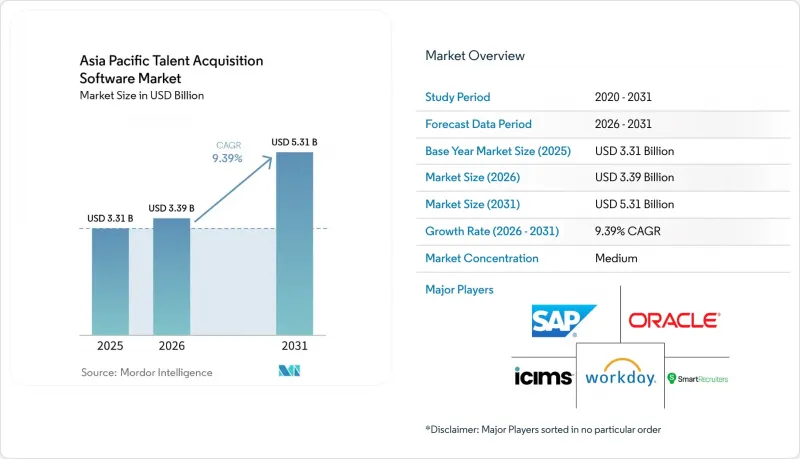
本報告按部署模式(雲端、本地部署、混合部署)、應用領域(應徵者追蹤系統、招募行銷等)、公司規模(大型企業、中小企業)、產業(資訊科技與通訊、醫療保健與生命科學等)以及地區進行細分。市場預測以美元計價。
亞太地區人才招聘軟體市場趨勢與洞察。
擴大人工智慧候選人匹配和篩檢的應用。
在亞太地區的人才招聘軟體市場,人工智慧已從實驗性工具轉變為核心營運層。截至2025年第二季度,新加坡已有82%的企業使用人工智慧進行招募、入職或培訓,高於81%的區域平均值和67%的全球平均水準。這顯示人工智慧主導的人力資源工作流程在該地區正迅速普及。在韓國,2026年4月發布的一項調查顯示,65%的公司已經實施或正在考慮實施人工智慧招募系統,而人才搜尋和應徵者篩選是自動化的主要目標。這一轉變意義重大,因為雇主不再僅僅為了縮短篩檢時間而採用人工智慧,而是將其用於擴大候選人範圍,並確保對大量招聘進行一致的評估。在中國和該地區的主要科技中心,人工智慧驅動的篩選已成為標準招募流程的一部分,這提高了亞太地區人才招募軟體供應商的最低產品要求。隨著監管日益嚴格,買家追求的不僅僅是速度和自動化;他們需要能夠提供審計追蹤、人工監督和支援可解釋決策的工具。
透過雲端優先策略加速人力資源數位轉型
在亞太地區,雲端交付已成為人才招聘軟體市場中大多數企業的預設架構,因為它降低了採用門檻,並使企業能夠在多個司法管轄區保持合規更新。這在傳統人力資源技術架構有限的市場中尤其重要,因為它使企業能夠直接遷移到 API 優先的系統,而無需承擔遷移舊有系統的成本。 Omni HR 的案例研究表明,雲端遷移後,客戶入職時間縮短了 50%,IT 成本降低了 25-30%,這凸顯了雲端的經濟效益為何對東南亞精簡的人力資源團隊具有吸引力。營運方面的優勢同樣重要。雲端平台可以自動更新法定繳款規則,例如新加坡中央公積金 (CPF)、馬來西亞僱員公積金 (EPF) 和泰國社會安全局 (SSO) 的規則,從而減少跨境招聘團隊重複性人工操作的需求。 SAP 於 2026 年 4 月發布了 SuccessFactors 2026 年上半年更新,進一步強化了這個發展方向。此次更新在招聘、薪資核算和入職等所有領域引入了基於代理的人工智慧,並包含依賴雲端基礎設施實現持續改進和跨模組數據利用的功能。因此,在亞太地區的人才招募軟體市場,雲端不再只是一個可選功能,而是正在成為實現高階招募能力的基本要求。
亞太地區資料隱私法規碎片化
在亞太地區的人才招募軟體市場,基於技能的招募方式正變得日益重要,因為工作需求變化如此之快,固定的資格認證已無法滿足需求。 2025年6月發布的一項研究表明,2016年至2024年間,工作所需的技能變化了40%,預計到2030年還將變化70%。研究顯示,取消不必要的資格篩選條件,可以使印度的候選人庫擴大11.4倍,印尼擴大9.5倍,澳洲擴大7.7倍。這種轉變降低了對履歷的依賴,並增加了對結構化面試、評估工具和更完善的技能映射的需求。這也提升了內部調配工具的價值,這些工具使企業能夠在啟動外部招募之前,辨識出具備相關技能的現有員工。在新加坡,政府正透過「MyCareersFuture」和「Workforce Singapore」等計畫加強對此轉變的公共政策支持。這些項目旨在使支援基於能力的選拔的軟體與雇主的招聘實踐相匹配。
細分市場分析
數據顯示,到2025年,雲端部署將佔亞太地區人才招聘軟體市場68.7%的佔有率,成為該市場支出核心,預計到2031年將以10.6%的複合年成長率成長。值得注意的是,領先的雲端解決方案廠商正透過新用戶採用、拓展中小企業市場以及公共部門現代化等方式不斷擴大市場佔有率。從實際角度來看,買家選擇雲端解決方案的原因在於,他們需要頻繁的功能更新、輕鬆整合到整個招聘流程以及相比本地部署系統更低的維護成本。從合規角度來看,雲端解決方案也極具吸引力,因為跨國營運的企業需要能夠快速更新法規和資料處理工作流程的系統,而無需等待漫長的內部發布週期。對許多企業而言,決策不再是“雲端還是本地部署”,而是“工作流程的哪些部分應該部署在雲端”以及“如何快速地將剩餘的本地系統連接到雲端”。
此外,雲端運算的普及正在推動亞太地區人才招聘軟體產業的產品發展方向,因為新的人工智慧功能依賴於持續的模型更新和模組間的資料存取。 SAP 於 2026 年 4 月上半年發布的版本將基於代理的人工智慧整合到整個招聘和入職流程中,再次凸顯了現代人才工作流程對雲端基礎設施的依賴。 AWS 在其 Omni HR案例研究中也報告了營運效益,顯示透過雲端遷移,入職時間縮短了 50%,IT 成本降低了 25-30%。對於內部支援有限的地區的人力資源團隊而言,這是一個非常重要的結果。在高度監管的環境中,例如日本和韓國的國防部門以及某些金融環境,本地部署系統仍然佔有一席之地,因為在這些環境中,資料主權仍然是一個嚴峻的設計挑戰。因此,混合部署作為一種「橋樑模式」正受到關注,它允許企業在利用雲端分析和匹配工具的同時,將敏感資料保留在國內。這種平衡解釋了為什麼亞太地區的人才招募軟體市場繼續向雲端轉移,而某些細分市場卻沒有淘汰本地基礎設施。
到2025年,應徵者追蹤系統(ATS)將佔應用層收入的29.8%,成為亞太地區人才招募軟體市場應用層級中最大的單一細分市場。 ATS仍然是許多部署的入口點,它作為職位要求、應徵者同意、工作流程追蹤以及招募相關文件管理的記錄系統。大型企業仍然將這一層視為其營運的基礎,並逐步添加候選人關係管理、招募行銷、分析和入職等模組。隨著隱私法規要求更清晰的審計追蹤和結構化記錄,ATS的角色變得更加重要。採購模式也更傾向於現有供應商,因為一旦核心工作流程建立起來,添加相鄰模組比替換現有模組要容易得多。正因如此,即使整個亞太地區人才招聘軟體市場正向更專業化的工具擴展,ATS仍保持其核心地位。
目前,成長最快的領域是面試管理和評估,預計到2031年將以11.4%的複合年成長率成長,因為雇主越來越不只關注資歷和經驗。技能變化的研究推動了這一轉變,因為工作要求正在快速變化,使得靜態的履歷不再能可靠地預測未來的適應性。雇主正在透過建立更結構化的評估流程來應對這項變化,包括能力檢查、引導式面試和與工作相關的評估。因此,對能夠幫助實現一致評分、協調面試團隊並在甄選過程中收集更準確證據的軟體的需求日益成長。因此,應用程式架構正變得更加多層次,ATS(招募管理系統)處於流程的核心,評估工具則圍繞其擴展。對於亞太地區人才招聘軟體市場的供應商而言,這意味著:雖然取得核心工作流程是有益的,但成長越來越取決於他們能否很好地支持圍繞其展開的技能主導評估。
其他好處:
- Excel格式的市場預測(ME)表
- 3個月的分析師支持
目錄
第1章:引言
- 研究假設和市場定義
- 調查範圍
第2章:調查方法
第3章執行摘要
第4章 市場狀況
- 市場概覽
- 市場促進因素
- 透過雲端優先策略加速人力資源數位轉型
- 人工智慧驅動的候選人匹配和篩檢已廣泛應用。
- 高成長產業對數位人才的競爭日益激烈
- 政府獎勵促進勞動力數位轉型
- 大型企業內部人才市場的擴張
- 向基於技能的招募框架過渡
- 市場限制因素
- 亞太地區資料隱私法規的差異
- 與傳統人力資源資訊系統整合的複雜性
- 人工智慧持續存在的偏見以及對可解釋性的擔憂
- 成本壁壘阻礙中小企業採用先進平台。
- 宏觀經濟因素對市場的影響
- 產業價值鏈分析
- 監理情勢
- 技術展望
- 波特五力分析
第5章 市場規模與成長預測
- 按部署模式
- 雲
- 現場
- 混合
- 透過使用
- 應徵者追蹤系統(ATS)
- 候選人關係管理(CRM)
- 招募行銷
- 入職
- 面試管理和評估
- 其他用途
- 按最終用戶公司規模分類
- 大公司
- 小型企業
- 按最終用戶:按公司/行業
- 資訊科技(IT)和通訊
- 銀行、金融服務和保險(BFSI)
- 醫療保健和生命科學
- 工業製造
- 零售與電子商務
- 政府/公共部門
- 其他終端用戶公司行業細分市場
- 國家
- 中國
- 印度
- 日本
- 韓國
- 新加坡
- 馬來西亞
- 泰國
- 澳洲
- 其他亞太國家
第6章 競爭情勢
- 市場集中度
- 策略趨勢
- 市佔率分析
- 公司簡介
- SAP SE
- Oracle Corporation
- Workday Inc.
- Automatic Data Processing Inc.
- International Business Machines Corporation
- Cornerstone OnDemand Inc.
- iCIMS Inc.
- SmartRecruiters Inc.
- Jobvite Inc.
- Greenhouse Software Inc.
- Lever Inc.
- Avature Limited
- Bullhorn Inc.
- Workable Technology Limited
- Zoho Corporation Pvt. Ltd.
- Eightfold AI Inc.
- BambooHR LLC
- Ceridian HCM Holding Inc.
- Randstad NV
- Recruit Holdings Co., Ltd.
第7章 市場機會與未來展望
According to Mordor Intelligence, the asia pacific talent acquisition software market size is expected to grow from USD 3.31 billion in 2025 to USD 3.39 billion in 2026 and is forecast to reach USD 5.31 billion by 2031 at 9.4% CAGR over 2026-2031.
This report is Segmented by Deployment Model (Cloud, On-Premise, and Hybrid), Application (Applicant Tracking System, Recruitment Marketing, and More), Enterprise Size (Large Enterprises and Small and Medium Enterprises), Industry Vertical (Information Technology and Telecom, Healthcare and Life Sciences, and More), and Geography. The Market Forecasts are Provided in Terms of Value (USD).
Asia Pacific Talent Acquisition Software Market Trends and Insights
Rising Adoption Of AI-Based Candidate Matching And Screening
AI has moved from a pilot tool to a core operating layer in the Asia Pacific talent acquisition software market. In Singapore, 82% of organizations were already using AI for hiring, onboarding, or training in Q2 2025, ahead of the regional average of 81% and the global average of 67%, indicating how quickly the region has normalized AI-led people workflows. In South Korea, a survey published in April 2026 found that 65% of companies had adopted or were considering AI recruiting agents, with sourcing and applicant review standing out as the main targets for automation. This shift matters because employers are no longer buying AI only to reduce screening time; they are also using it to widen candidate reach and support more consistent evaluation across large hiring volumes. In China and major technology hubs across the region, AI-assisted screening has already become part of standard recruitment practice, raising the minimum product expectations for vendors serving the Asia Pacific talent acquisition software market. As regulations become tighter, buyers also want tools that can show audit trails, provide human oversight, and support explainable decision-making rather than just speed and automation.
Accelerating Cloud-First HR Digitalization
Cloud delivery has become the default architecture for much of the Asia Pacific talent acquisition software market because it reduces deployment friction and keeps compliance updates up to date across multiple jurisdictions. The value case is especially strong in markets where earlier HR technology stacks were limited, as organizations can move directly to API-first systems rather than spend on legacy migrations. A case study on Omni HR reported a 50% reduction in customer onboarding time and 25-30% lower IT costs after the cloud migration, underscoring why cloud economics are appealing to lean HR teams in Southeast Asia. The operational case is equally important because cloud platforms can automate updates to statutory contribution rules, such as Singapore's Central Provident Fund, Malaysia's Employees Provident Fund, and Thailand's Social Security Office, reducing the need for repeated manual effort for cross-border hiring teams. SAP reinforced this direction in April 2026 when it released the 1H 2026 SuccessFactors update, featuring agentic AI across recruiting, payroll, and onboarding, with features that depend on cloud infrastructure for continuous improvement and cross-module data use. As a result, cloud is no longer a feature choice in the Asia Pacific talent acquisition software market; it is increasingly the base requirement for advanced recruiting capability.
Fragmented Data-Privacy Regulations Across Asia-Pacific
Skills-based hiring is becoming more important in the Asia Pacific talent acquisition software market because job requirements are changing faster than static credentials can reflect. Research published in June 2025 found that the skills required for jobs changed by 40% between 2016 and 2024 and are projected to change by another 70% by 2030. The same research showed that removing unnecessary qualification filters can expand the potential candidate pool by up to 11.4 times in India, 9.5 times in Indonesia, and 7.7 times in Australia. That change reduces reliance on resumes as the main filter and raises demand for structured interviews, assessment tools, and better skills mapping. It also increases the value of internal mobility tools that can identify existing employees with adjacent skills before an employer starts an external search. Singapore has added public policy support to this shift through programs tied to MyCareersFuture and Workforce Singapore, which help align employer practices with software that supports competency-based selection.
Other drivers and restraints analyzed in the detailed report include:
- Intensifying Competition For Digital Talent In High-Growth Sectors
- Shift Toward Skills-Based Hiring Frameworks
- Integration Complexity With Legacy HR Information Systems
For complete list of drivers and restraints, kindly check the Table Of Contents.
Segment Analysis
Cloud-based deployment accounted for 68.7% in 2025, indicating it already represented the core of spending in the Asia Pacific talent acquisition software market, and it is also projected to grow at a 10.6% CAGR through 2031. That combination is notable because the leading model is still gaining share through new implementations, expansion into SMEs, and public-sector modernization. In practical terms, buyers are choosing the cloud because they want frequent feature updates, easier integration across recruiting steps, and less local maintenance. The compliance argument is strong as well, since cross-border employers need systems that can update statutory and data-handling workflows without long internal release cycles. For many organizations, the decision is no longer cloud versus on-premise, but how much of the workflow should sit in the cloud and how quickly the remaining local systems can be connected.
Cloud adoption also supports the product direction of the Asia Pacific talent acquisition software industry, as new AI functions depend on continuous model updates and data access across modules. SAP's April 2026 1H release embedded agentic AI across recruiting and onboarding, which reinforced the dependence of modern talent workflows on cloud infrastructure. AWS also documented operational gains in its Omni HR case study, where cloud migration reduced onboarding time by 50% and lowered IT costs by 25-30%, a result with clear relevance for regional HR teams with limited internal support. On-premise systems still hold a place in highly regulated settings such as defense and some financial environments in Japan and South Korea, where data sovereignty remains a serious design issue. Hybrid deployment is therefore gaining traction as a bridge model, since it lets employers keep sensitive data in-country while still using cloud-based analytics and matching tools. That balance explains why the Asia Pacific talent acquisition software market continues to move toward the cloud, while not eliminating local infrastructure in certain segments.
Applicant tracking systems accounted for 29.8% of application-layer revenue in 2025, making ATS the largest single segment in the Asia Pacific talent acquisition software market at the application level. ATS remains the entry point for many purchases because it acts as the system of record for requisitions, applicant consent, workflow tracking, and hiring documentation. Large enterprises still treat this layer as the operational backbone onto which candidate relationship management, recruitment marketing, analytics, and onboarding modules are added over time. That role has become even more important as privacy rules require clearer audit trails and more structured records. The purchasing pattern also favors incumbents because once the core workflow is in place, adjacent modules are easier to add than replace. This is why ATS retains a central position even while the broader Asia Pacific talent acquisition software market expands into more specialized tools.
The fastest-growing momentum now lies in interview management and assessment, which is projected to grow at a 11.4% CAGR through 2031 as employers place less weight on credentials alone. Research on skills change helps explain the shift because rapid movement in job requirements makes static resumes weaker indicators of future fit. Employers are responding by building more structured evaluation processes, including competency checks, guided interviews, and role-relevant assessments. That in turn lifts demand for software that supports consistent scoring, panel coordination, and better evidence capture during the selection process. The application mix is therefore becoming more layered, with ATS holding the process center while assessment tools expand around it. For vendors in the Asia Pacific talent acquisition software market, the implication is clear: winning the core workflow is helpful, but growth increasingly depends on how well they support skills-led evaluation around it.
List of Companies Covered in this Report:
- SAP SE
- Oracle Corporation
- Workday Inc.
- Automatic Data Processing Inc.
- International Business Machines Corporation
- Cornerstone OnDemand Inc.
- iCIMS Inc.
- SmartRecruiters Inc.
- Jobvite Inc.
- Greenhouse Software Inc.
- Lever Inc.
- Avature Limited
- Bullhorn Inc.
- Workable Technology Limited
- Zoho Corporation Pvt. Ltd.
- Eightfold AI Inc.
- BambooHR LLC
- Ceridian HCM Holding Inc.
- Randstad N.V.
- Recruit Holdings Co., Ltd.
Additional Benefits:
- The market estimate (ME) sheet in Excel format
- 3 months of analyst support
TABLE OF CONTENTS
1 INTRODUCTION
- 1.1 Study Assumptions and Market Definition
- 1.2 Scope of the Study
2 RESEARCH METHODOLOGY
3 EXECUTIVE SUMMARY
4 MARKET LANDSCAPE
- 4.1 Market Overview
- 4.2 Market Drivers
- 4.2.1 Accelerating Cloud-First HR Digitalization
- 4.2.2 Rising Adoption of AI-Based Candidate Matching and Screening
- 4.2.3 Intensifying Competition for Digital Talent in High-Growth Sectors
- 4.2.4 Government Incentives for Workforce Digital Transformation
- 4.2.5 Expansion of Internal Talent Marketplaces Among Large Enterprises
- 4.2.6 Shift Toward Skills-Based Hiring Frameworks
- 4.3 Market Restraints
- 4.3.1 Fragmented Data-Privacy Regulations Across Asia-Pacific
- 4.3.2 Integration Complexity with Legacy HR Information Systems
- 4.3.3 Persistent AI Bias and Explainability Concerns
- 4.3.4 Cost Barriers Limiting SME Adoption of Advanced Platforms
- 4.4 Impact of Macroeconomic Factors on the Market
- 4.5 Industry Value-Chain Analysis
- 4.6 Regulatory Landscape
- 4.7 Technological Outlook
- 4.8 Porter's Five Forces Analysis
- 4.8.1 Threat of New Entrants
- 4.8.2 Bargaining Power of Suppliers
- 4.8.3 Bargaining Power of Buyers
- 4.8.4 Threat of Substitutes
- 4.8.5 Intensity of Competitive Rivalry
5 MARKET SIZE AND GROWTH FORECASTS (VALUE)
- 5.1 By Deployment Model
- 5.1.1 Cloud
- 5.1.2 On-Premise
- 5.1.3 Hybrid
- 5.2 By Application
- 5.2.1 Applicant Tracking System (ATS)
- 5.2.2 Candidate Relationship Management (CRM)
- 5.2.3 Recruitment Marketing
- 5.2.4 Onboarding
- 5.2.5 Interview Management and Assessment
- 5.2.6 Other Applications
- 5.3 By End User Enterprise Size
- 5.3.1 Large Enterprises
- 5.3.2 Small and Medium Enterprises
- 5.4 By End User Enterprise Industry Vertical
- 5.4.1 Information Technology (IT) and Telecom
- 5.4.2 Banking, Financial Services and Insurance (BFSI)
- 5.4.3 Healthcare and Life Sciences
- 5.4.4 Industrial Manufacturing
- 5.4.5 Retail and eCommerce
- 5.4.6 Government and Public Sector
- 5.4.7 Other End User Enterprise Industry Verticals
- 5.5 By Country
- 5.5.1 China
- 5.5.2 India
- 5.5.3 Japan
- 5.5.4 South Korea
- 5.5.5 Singapore
- 5.5.6 Malaysia
- 5.5.7 Thailand
- 5.5.8 Australia
- 5.5.9 Rest of Asia Pacific
6 COMPETITIVE LANDSCAPE
- 6.1 Market Concentration
- 6.2 Strategic Moves
- 6.3 Market Share Analysis
- 6.4 Company Profiles (includes Global Level Overview, Market Level Overview, Core Segments, Financials as available, Strategic Information, Market Rank/Share, Products and Services, Recent Developments)
- 6.4.1 SAP SE
- 6.4.2 Oracle Corporation
- 6.4.3 Workday Inc.
- 6.4.4 Automatic Data Processing Inc.
- 6.4.5 International Business Machines Corporation
- 6.4.6 Cornerstone OnDemand Inc.
- 6.4.7 iCIMS Inc.
- 6.4.8 SmartRecruiters Inc.
- 6.4.9 Jobvite Inc.
- 6.4.10 Greenhouse Software Inc.
- 6.4.11 Lever Inc.
- 6.4.12 Avature Limited
- 6.4.13 Bullhorn Inc.
- 6.4.14 Workable Technology Limited
- 6.4.15 Zoho Corporation Pvt. Ltd.
- 6.4.16 Eightfold AI Inc.
- 6.4.17 BambooHR LLC
- 6.4.18 Ceridian HCM Holding Inc.
- 6.4.19 Randstad N.V.
- 6.4.20 Recruit Holdings Co., Ltd.
7 MARKET OPPORTUNITIES AND FUTURE OUTLOOK
- 7.1 White-Space and Unmet-Need Assessment

 醫療人員強化與外派市場:策略性洞察與預測(2026-2031)
 人才招聘軟體:市佔率分析、產業趨勢與統計、成長預測(2026-2031)IT人員配備服務:市場佔有率分析、產業趨勢與統計及成長預測(2026-2031年)歐洲IT人員配置:市場佔有率分析、產業趨勢與統計數據以及成長預測(2026-2031年)
 數位人才招聘市場:按組件、技術類型、最終用戶、部署模式、產業和應用分類-2026-2032年全球市場預測IT永續發展人才與培訓平台:市場佔有率分析、產業趨勢與統計、成長預測(2026-2031年)北美人才招聘軟體:市佔率分析、產業趨勢與統計及成長預測(2026-2031 年)醫療保健產業人才招聘:市場佔有率分析、行業趨勢和統計數據以及成長預測(2026-2031 年)銀行、金融服務和保險 (BFSI) 市場的人才招聘:市場佔有率分析、行業趨勢和統計數據以及成長預測 (2026-2031)
 人才招募技術與服務市場分析及預測(至2035年):依類型、產品類型、服務、技術、組件、應用、部署類型、最終用戶與功能分類