


 |
市場調查報告書
商品編碼
2100707
歐洲IT人員配置:市場佔有率分析、產業趨勢與統計數據以及成長預測(2026-2031年)Europe IT Staffing - Market Share Analysis, Industry Trends & Statistics, Growth Forecasts (2026 - 2031) |
||||||

※ 本網頁內容可能與最新版本有所差異。詳細情況請與我們聯繫。
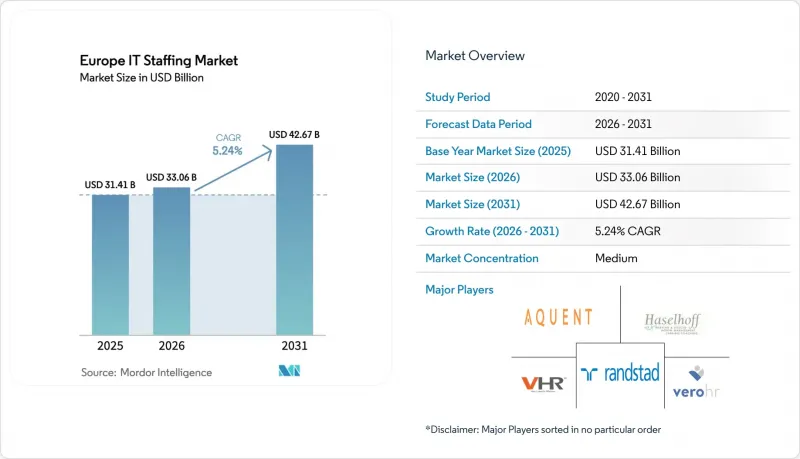
根據 Mordor Intelligence 預測,歐洲 IT 人員配備市場預計將從 2025 年的 314.1 億美元成長到 2026 年的 330.6 億美元,然後在 2031 年達到 426.7 億美元,2026 年至 2031 年的複合年成長率為 5.24%。
本報告按最終用戶行業(電信、銀行、金融服務和保險、醫療保健和生命科學等)、僱用類型(合約工/臨時工、正式工、臨時轉正、工作說明書)、技能領域(軟體開發/DevOps、雲端運算和基礎設施等)以及地區進行細分。市場預測以美元計價。
歐洲IT人員配置市場的趨勢與洞察
數位轉型正在歐盟企業中迅速擴展。
歐盟企業正以前所未有的速度擴展其雲端運算、人工智慧和高階分析項目,這促使大量短期項目職位湧入人力資源機構。德國領先的製造商和法國的銀行尤其需要能夠快速實現舊有系統現代化的DevOps和雲端架構師。客戶現在委託的跨國職位涵蓋開發、遷移和安全等多個角色,促使供應商建立泛歐人才庫。其結果是平均計費率上升,專案周轉率加快,支撐了歐洲IT人才市場的長期成長。
資訊通訊技術技能缺口擴大和勞動力老化。
超過一半的歐洲公司無法獲得所需的專業人才,而離職造成的人才流失進一步加劇了中高階工程師的短缺。資料工程師和網路安全架構師的薪資尤其高昂,推高了整體人事費用,迫使公司為了控制預算而選擇合約員工。這種持續存在的人才錯配使得公司越來越依賴能夠跨國招募人才或利用近岸人才庫的專業公司,這將使歐洲IT人才市場在2030年之前維持成長動能。
小眾技能人才長期短缺
歐盟網路安全專業人員短缺27.4萬人,加上德國招募週期通常超過六個月,嚴重限制了專案執行能力。客戶無法獲得關鍵技能人才,被迫延後或縮減專案規模,導致供應商短期收入成長放緩。為因應此局面,人力資源公司正投資建設技能提升培訓機構和跨國招募平台,以緩解人才瓶頸,但供應成長仍落後於需求。
細分市場分析
受5G部署和網路虛擬化專案的推動,通訊業預計將保持最大的支出佔有率,到2025年將佔歐洲IT人員配置市場的28.12%。在電子健康記錄升級和遠距遠端醫療擴展的推動下,醫療保健和生命科學產業預計將在所追蹤的產業中實現最高的複合年成長率(CAGR),達到5.88%,這需要專業的安全性和互通性知識。由於醫院正努力解決IT人員長期短缺的問題,這威脅到病患資料的完整性,預計到2031年,歐洲醫療保健產業的IT人員配置市場規模將逐年成長。
在製造業領域,為滿足工業4.0生產線的需求,物聯網和自動化工程師的招聘仍在繼續;與此同時,銀行、金融和保險(BFSI)機構也在穩步招聘安全和金融科技開發人員,以滿足開放銀行的實施期限。致力於人工智慧驅動個人化服務的零售和電商企業正在聘請資料科學家來重新訓練其演算法。西班牙和北歐國家公共部門的數位政府計畫正在推動基礎需求的成長,並創造多元化的客戶群,這反過來又增強了歐洲IT人才服務市場多元化供應商的收入前景。
其他好處:
- Excel格式的市場預測(ME)表
- 3個月的分析師支持
目錄
第1章:引言
- 研究假設和市場定義
- 調查範圍
第2章:調查方法
第3章執行摘要
第4章 市場狀況
- 市場概覽
- 市場促進因素
- 歐盟企業數位轉型迅速推進
- 資訊通訊技術技能差距擴大和勞動力老化
- 遠距辦公和混合辦公模式的普及
- MSP/RPO外包框架採用範圍擴大
- 遵守歐盟人工智慧法案正在提升人工智慧倫理領域人才的需求。
- CSRD對「綠色軟體」工程師的需求
- 市場限制因素
- 小眾技能領域(例如 SAP/DevOps)人才持續短缺
- 不穩定的宏觀經濟情勢阻礙了對非必需IT專業人員的招募。
- 加強對臨時用工的監管(例如,德國的AUG改革)
- 直接採購和自由職業平台的興起
- 監理情勢
- 技術展望
- 波特五力分析
第5章 市場規模與成長預測
- 按最終用戶行業分類
- 溝通
- BFSI
- 醫療保健和生命科學
- 製造業和工業4.0
- 零售與電子商務
- 其他終端用戶產業
- 按就業類型
- 合約工/臨時工
- 全職員工
- 從臨時工轉為正式員工
- 工作說明書(SOW)/企劃為基礎
- 按技能領域
- 軟體開發和DevOps
- 雲端和基礎設施
- 數據、人工智慧、分析
- 網路安全
- 新興技術(物聯網/擴增實境/虛擬實境/區塊鏈)
- 國家
- 英國
- 德國
- 法國
- 西班牙
- 義大利
- 其他歐洲國家
第6章 競爭情勢
- 市場集中度
- 策略趨勢
- 市佔率分析
- 公司簡介
- Adecco Group AG
- Randstad NV
- ManpowerGroup Inc.
- Hays plc
- Robert Half Inc.
- PageGroup plc
- Allegis Group LLC
- Akkodis SAS
- Capgemini SE(Sogeti Staffing)
- Alten SA
- Harvey Nash Group Ltd
- Experis(ManpowerGroup)
- AQUENT LLC
- Vero HR Ltd.
- Haselhoff Groep BV
- VHR Consulting Ltd.
- Pertemps Ltd
- Tiger Recruitment Ltd
- MAS Recruiting Inc.
- Chronos Consulting Ltd
- Morgan Hunt UK Ltd
- Computer Futures(SThree plc)
- Modis Ltd(Akkodis)
第7章 市場機會與未來展望
According to Mordor Intelligence, the Europe IT staffing market size is expected to grow from USD 31.41 billion in 2025 to USD 33.06 billion in 2026 and is forecast to reach USD 42.67 billion by 2031 at 5.24% CAGR over 2026-2031.
This report is Segmented by End-User Industry (Telecom, BFSI, Healthcare and Life-Sciences, and More), Employment Type (Contract/Temporary, Permanent Placement, and Temp-To-Perm, and Statement-Of-Work), Skill Area (Software Development and DevOps, Cloud and Infrastructure, and More), and Geography. The Market Forecasts are Provided in Terms of Value (USD).
Europe IT Staffing Market Trends and Insights
Digital-Transformation Surge Across EU Enterprises
EU companies are scaling cloud, AI, and advanced analytics programs at record pace, which is driving steady inflows of short-cycle project mandates for staffing suppliers. Large German manufacturers and French banks place premium demand on DevOps and cloud architects able to modernize legacy estates swiftly. Clients now issue multi-country requisitions that bundle development, migration, and security roles, encouraging vendors to cultivate pan-European talent benches. The outcome is rising average bill rates and faster assignment turnover, underpinning long-term volume growth in the Europe IT staffing market.
Widening ICT Skills Gap and Ageing Workforce
More than half of European businesses cannot secure the expertise they require, and retirement-driven attrition is widening the shortage for mid-to-senior technologists. Salary inflation is most acute for data engineers and cybersecurity architects, sending total labor costs upward and steering enterprises toward contract sourcing to stay within budgets. This persistent mismatch increases client reliance on specialist firms that can recruit across borders or tap near-shore talent pools, sustaining momentum in the Europe IT staffing market through 2030.
Persistent Talent Shortages in Niche Skills
The cybersecurity workforce gap of 274,000 professionals across the EU and prolonged search cycles, often six months or more in Germany, are constraining delivery capacity. Clients unable to secure mission-critical skillsets delay or down-scale projects, tempering near-term revenue upside for vendors. In response, staffing firms are investing in re-skilling academies and cross-border recruitment desks to alleviate bottlenecks, but supply growth remains slower than demand.
Other drivers and restraints analyzed in the detailed report include:
- Proliferation of Remote and Hybrid-Work Staffing Models
- Growing Adoption of MSP / RPO Outsourcing Frameworks
- Volatile Macro Conditions Curbing Discretionary IT Hiring
For complete list of drivers and restraints, kindly check the Table Of Contents.
Segment Analysis
Telecom retained the largest slice of spending, accounting for 28.12% of Europe IT staffing market share in 2025, anchored by 5G roll-outs and network virtualization programs. Healthcare and Life Sciences is projected to log a 5.88% CAGR, the fastest among tracked verticals, on the back of electronic health record upgrades and telemedicine scale-ups that demand specialized security and interoperability expertise. The Europe IT staffing market size for healthcare engagements is set to widen every year through 2031 as hospitals address chronic IT vacancies that jeopardize patient data integrity.
Manufacturing continues to procure IoT and automation engineers for Industry 4.0 lines, while BFSI institutions keep security and fintech developers in steady rotation to meet open-banking deadlines. Retail and e-commerce operators, pursuing AI-driven personalization, contract data scientists for algorithm re-training. Public-sector digital-government programs in Spain and the Nordics add to baseline demand, producing a broad client mix that strengthens revenue visibility for diversified providers across the Europe IT staffing market.
Complete Report Scope:
- By End-user Industry
- Telecom
- BFSI
- Healthcare and Life-Sciences
- Manufacturing and Industry 4.0
- Retail and e-Commerce
- Other End-user Industries
- By Employment Type
- Contract/Temporary
- Permanent Placement
- Temp-to-Perm
- Statement-of-Work (SOW) / Project-Based
- By Skill Area
- Software Development and DevOps
- Cloud and Infrastructure
- Data, AI and Analytics
- Cyber-security
- Emerging Tech (IoT/AR-VR/Blockchain)
- By Country
- United Kingdom
- Germany
- France
- Spain
- Italy
- Rest of Europe
List of Companies Covered in this Report:
- Adecco Group AG
- Randstad N.V.
- ManpowerGroup Inc.
- Hays plc
- Robert Half Inc.
- PageGroup plc
- Allegis Group LLC
- Akkodis SAS
- Capgemini SE (Sogeti Staffing)
- Alten S.A.
- Harvey Nash Group Ltd
- Experis (ManpowerGroup)
- AQUENT LLC
- Vero HR Ltd.
- Haselhoff Groep B.V.
- VHR Consulting Ltd.
- Pertemps Ltd
- Tiger Recruitment Ltd
- MAS Recruiting Inc.
- Chronos Consulting Ltd
- Morgan Hunt UK Ltd
- Computer Futures (SThree plc)
- Modis Ltd (Akkodis)
Additional Benefits:
- The market estimate (ME) sheet in Excel format
- 3 months of analyst support
TABLE OF CONTENTS
1 INTRODUCTION
- 1.1 Study Assumptions and Market Definition
- 1.2 Scope of the Study
2 RESEARCH METHODOLOGY
3 EXECUTIVE SUMMARY
4 MARKET LANDSCAPE
- 4.1 Market Overview
- 4.2 Market Drivers
- 4.2.1 Digital-transformation surge across EU enterprises
- 4.2.2 Widening ICT skills gap and ageing workforce
- 4.2.3 Proliferation of remote and hybrid-work staffing models
- 4.2.4 Growing adoption of MSP / RPO outsourcing frameworks
- 4.2.5 EU AI-Act compliance spurring demand for AI-ethics talent
- 4.2.6 CSRD-driven need for "green-software" engineers
- 4.3 Market Restraints
- 4.3.1 Persistent talent shortages in niche skills (e.g., SAP/DevOps)
- 4.3.2 Volatile macro conditions curbing discretionary IT hiring
- 4.3.3 Stricter labour-leasing rules (e.g., Germany AUG reforms)
- 4.3.4 Rise of direct-sourcing and freelancer platforms
- 4.4 Regulatory Landscape
- 4.5 Technological Outlook
- 4.6 Porter's Five Forces Analysis
- 4.6.1 Bargaining Power of Suppliers
- 4.6.2 Bargaining Power of Buyers/Consumers
- 4.6.3 Threat of New Entrants
- 4.6.4 Threat of Substitute Products
- 4.6.5 Intensity of Competitive Rivalry
5 MARKET SIZE AND GROWTH FORECASTS (VALUE)
- 5.1 By End-user Industry
- 5.1.1 Telecom
- 5.1.2 BFSI
- 5.1.3 Healthcare and Life-Sciences
- 5.1.4 Manufacturing and Industry 4.0
- 5.1.5 Retail and e-Commerce
- 5.1.6 Other End-user Industries
- 5.2 By Employment Type
- 5.2.1 Contract/Temporary
- 5.2.2 Permanent Placement
- 5.2.3 Temp-to-Perm
- 5.2.4 Statement-of-Work (SOW) / Project-Based
- 5.3 By Skill Area
- 5.3.1 Software Development and DevOps
- 5.3.2 Cloud and Infrastructure
- 5.3.3 Data, AI and Analytics
- 5.3.4 Cyber-security
- 5.3.5 Emerging Tech (IoT/AR-VR/Blockchain)
- 5.4 By Country
- 5.4.1 United Kingdom
- 5.4.2 Germany
- 5.4.3 France
- 5.4.4 Spain
- 5.4.5 Italy
- 5.4.6 Rest of Europe
6 COMPETITIVE LANDSCAPE
- 6.1 Market Concentration
- 6.2 Strategic Moves
- 6.3 Market Share Analysis
- 6.4 Company Profiles (includes Global level Overview, Market level overview, Core Segments, Financials as available, Strategic Information, Market Rank/Share, Products and Services, Recent Developments)
- 6.4.1 Adecco Group AG
- 6.4.2 Randstad N.V.
- 6.4.3 ManpowerGroup Inc.
- 6.4.4 Hays plc
- 6.4.5 Robert Half Inc.
- 6.4.6 PageGroup plc
- 6.4.7 Allegis Group LLC
- 6.4.8 Akkodis SAS
- 6.4.9 Capgemini SE (Sogeti Staffing)
- 6.4.10 Alten S.A.
- 6.4.11 Harvey Nash Group Ltd
- 6.4.12 Experis (ManpowerGroup)
- 6.4.13 AQUENT LLC
- 6.4.14 Vero HR Ltd.
- 6.4.15 Haselhoff Groep B.V.
- 6.4.16 VHR Consulting Ltd.
- 6.4.17 Pertemps Ltd
- 6.4.18 Tiger Recruitment Ltd
- 6.4.19 MAS Recruiting Inc.
- 6.4.20 Chronos Consulting Ltd
- 6.4.21 Morgan Hunt UK Ltd
- 6.4.22 Computer Futures (SThree plc)
- 6.4.23 Modis Ltd (Akkodis)
7 MARKET OPPORTUNITIES AND FUTURE OUTLOOK
- 7.1 White-space and Unmet-Need Assessment

 數位人才招聘市場:按組件、技術類型、最終用戶、部署模式、產業和應用分類-2026-2032年全球市場預測
 IT永續發展人才與培訓平台:市場佔有率分析、產業趨勢與統計、成長預測(2026-2031年)亞太地區人才招聘軟體:市佔率分析、產業趨勢與統計及成長預測(2026-2031)北美人才招聘軟體:市佔率分析、產業趨勢與統計及成長預測(2026-2031 年)醫療保健產業人才招聘:市場佔有率分析、行業趨勢和統計數據以及成長預測(2026-2031 年)銀行、金融服務和保險 (BFSI) 市場的人才招聘:市場佔有率分析、行業趨勢和統計數據以及成長預測 (2026-2031)
 人才招募技術與服務市場分析及預測(至2035年):依類型、產品類型、服務、技術、組件、應用、部署類型、最終用戶與功能分類IT人員配備:市場佔有率分析、產業趨勢與統計資料、成長預測(2026-2031年)
 醫療保健人員增補市場 - 2026-2031 年預測
 人才招募軟體市場規模、佔有率和成長分析(按部署類型、組織規模、垂直產業、功能、定價模式和地區分類)-2026-2033年產業預測