


 |
市場調查報告書
商品編碼
2115854
歐洲化學品物流:市場佔有率分析、產業趨勢與統計及成長預測(2026-2031 年)Europe Chemical Logistics - Market Share Analysis, Industry Trends & Statistics, Growth Forecasts (2026 - 2031) |
||||||

※ 本網頁內容可能與最新版本有所差異。詳細情況請與我們聯繫。
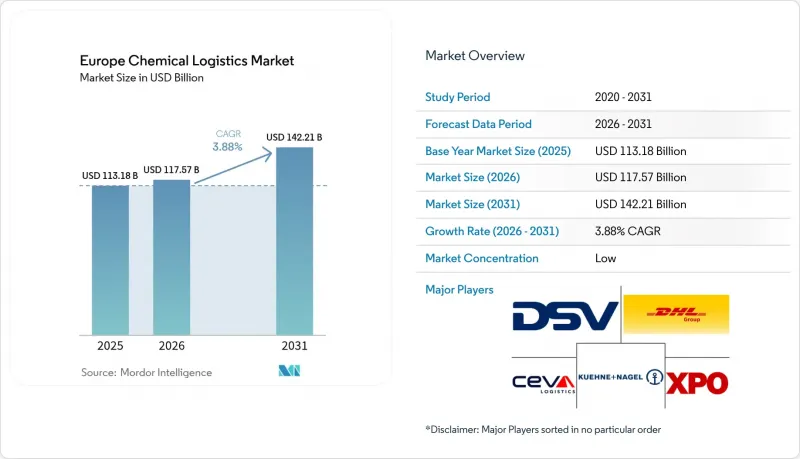
據 Mordor Intelligence 稱,2025 年歐洲化學品物流市場價值為 1131.8 億美元,預計到 2031 年將達到 1422.1 億美元,而 2026 年為 1175.7 億美元,預測期(2026-2031 年)的複合成長率為 3.88%。
本報告按服務(運輸、倉儲、配送和庫存管理等)、終端用戶行業(製藥、化妝品、石油和天然氣、特種化學品等)、危險材料分類(危險材料、非危險材料)、溫度控制(溫控、非溫控)以及地區(英國等)進行細分。市場預測以美元計價。
歐洲化學品物流市場的趨勢與洞察
由於對綠色化學品的需求,收集工作集中在靠近專業樞紐的地區。
專注於永續化學的製造商正將生產基地遷至更靠近成熟產業叢集,這縮短了運輸距離,同時也提高了對溫控和符合ADR標準的設施的要求。 ICIG將Valtris Advanced Organics的設施整合到其Vynova平台中,顯示化學園區內的垂直整合如何提高裝載密度,並需要配備持續環境監測的專用倉庫。擁有檢驗的低溫運輸能力和配備防漏措施的ISO罐式貨車的物流供應商正在獲得更高的運費,因為醫藥和化妝品中間體需要嚴格的處理規程。
REPowerEU 加速了歐洲境內散裝化學品運輸路線的變革。
歐盟旨在減少對俄羅斯原料依賴的政策正將大宗化學品分銷通路轉向西部港口和內陸多模態樞紐。德國將一項價值2.29億歐元(約2.5273億美元)的鐵路運輸補貼延長至2028年,此舉提高了鐵路運輸的獲利能力,與長途公路運輸相比,全程成本最多可降低20%。能夠協調多個成員國海關、安全和永續性的靈活第三方物流公司,正隨著製造商重新談判供應鏈而獲得新的合約。
持有ADR認證的駕駛人短缺
600至1700英鎊的培訓費用構成了准入門檻,而退休人員數量又超過了新持證人員的數量。因此,歐洲化學品物流市場出現了路線不平衡和現貨運費突然飆升的情況。營運商正透過建立內部培訓機構、提高薪資和最佳化路線規劃來應對,但運輸能力短缺的問題依然存在,尤其是對於風險極高的危險品而言。
細分市場分析
到2025年,運輸業將佔銷售額的64.40%,其中專用油輪、鐵路罐車和ISO貨櫃運輸仍將是歐洲化學品物流市場的支柱。該領域正透過網路整合專案實現規模經濟,例如DSV計劃收購DB Schenker。同時,歐洲化學品物流市場的附加價值服務領域規模預計將以3.56%的複合年成長率成長。這反映出標籤、重新包裝和品質檢驗服務擴大融入多客戶化學品配銷中心。
在運輸方式方面,道路運輸優先考慮準點率和危險品處理,而鐵路在政府獎勵的支持下,正在擴大其在長途線路上的市場佔有率。將符合ADR(替代分銷商規則)的運輸能力與回程貨物進行匹配的數位化平台,即使通行費附加費上漲,也能減少空運並提高利潤率。空運和沿海運輸解決方案則服務於小眾、高價值貨物,這些貨物的運輸時間和體積折扣超過了成本溢價。
附加價值服務日益涵蓋監管文件編制、安全資料管理和永續發展報告,使托運人能夠將複雜的合規任務外包。隨著環境、社會和管治(ESG) 資訊揭露成為強制性要求,第三方物流 (3PL) 公司正在其入口網站中整合二氧化碳排放儀表板,提供可操作的排放資料以視覺化物流績效。對現場物流、混合和樣品測試日益成長的需求進一步模糊了契約製造和第三方物流之間的界限,推動了整個歐洲化工物流行業的服務水準不斷提高。
石油和天然氣產業在成熟的石化原料供應體系的支持下,預計到2025年將佔銷售額的25.60%。然而,醫藥和化妝品產業對特種化學品的需求預計將以3.73%的複合年成長率成長,超過大宗化學品市場。歐洲醫藥分銷領域的化學品物流市場規模正受益於新型生物製藥中心的建設,這些中心強制要求採用符合GDP認證的低溫運輸解決方案,例如UPS醫療保健公司擴建的都柏林園區。
化妝品物流如今已達到醫藥級標準,強調溫度一致性、過敏原隔離和批次可追溯性。綠色化學計劃進一步提升了對受控環境的需求。相較之下,石化產品托運人則面臨價格波動和能源轉型帶來的挑戰,推動了諸如煉油廠鐵路支線和駁船連接維修等效率提升項目。農業化學品和工業氣體仍然是穩定的收入來源,但其多樣化的包裝需求(從IBC噸桶到鋼瓶組)要求歐洲化學品物流市場具備更廣泛的第三方物流能力。
其他好處:
- Excel格式的市場預測(ME)表
- 3個月的分析師支持
目錄
第1章:引言
- 研究假設和市場定義
- 調查範圍
第2章:調查方法
第3章執行摘要
第4章 市場狀況
- 市場概覽
- 市場促進因素
- 綠色化學品的需求導致負荷集中在特種化學品生產基地附近。
- REPowerEU 正在加速歐洲大宗化學品運輸路線的轉型。
- 德國和荷蘭鐵路線內鐵路支線的補貼
- 擴大符合ADR標準的ISO儲槽租賃池
- 透過併購提高第三方物流網路密度
- 用於運輸危險物品的數位化貨物匹配平台
- 市場限制因素
- 持有ADR認證的駕駛人短缺
- 德國高速公路通行費根據二氧化碳排放量而增加。
- 歐洲綠色新政下交通方式轉變對鐵路運輸能力的限制
- 通貨膨脹導致特殊包裝成本飆升。
- 價值供應鏈分析
- 監理情勢
- 技術展望
- 該行業的吸引力
- 波特五力模型
- 供應商的議價能力
- 買方的議價能力
- 新進入者的威脅
- 替代品的威脅
- 競爭公司之間的競爭
- 地緣政治事件對供應鏈變化的影響
第5章 市場規模與成長預測
- 按服務
- 運輸
- 路
- 鐵路
- 航空
- 海
- 倉儲、物流和庫存管理
- 其他服務
- 運輸
- 按最終用戶行業分類
- 製藥
- 化妝品
- 石油和天然氣
- 特種化學品
- 其他最終用戶
- 依危險分類
- 危險化學品
- 無害化學品
- 按類型進行溫度控制
- 溫控(冷氣/暖氣)
- 無溫度控制
- 按地區
- 德國
- 英國
- 荷蘭
- 法國
- 義大利
- 西班牙
- 波蘭
- 比荷盧經濟聯盟(比利時、荷蘭、盧森堡)
- 北歐國家(丹麥、芬蘭、冰島、挪威、瑞典)
- 其他歐洲國家
第6章 競爭情勢
- 市場集中度
- 策略趨勢
- 市佔率分析
- 公司簡介
- DHL
- DSV A/S
- CEVA Logistics
- XPO Logistics
- Kuehne+Nagel
- BDP International
- Bertschi AG
- Suttons International
- Den Hartogh Logistics
- Broekman Logistics
- Rhenus Logistics
- H. Essers
- Log4Chem
- Chemical Express
- JCL Logistics
- MOL Logistics
- DACHSER
- De Rijke Group
- Noatum Logistics
- Pfenning Logistics GmbH
第7章 市場機會與未來展望
According to Mordor Intelligence, the Europe chemical logistics market size was valued at USD 113.18 billion in 2025 and estimated to grow from USD 117.57 billion in 2026 to reach USD 142.21 billion by 2031, at a CAGR of 3.88% during the forecast period (2026-2031).
This report is Segmented by Service (Transportation, Warehousing/Distribution/Inventory Management, and More), End-User Industry (Pharmaceutical, Cosmetic, Oil & Gas, Specialty Chemicals, and More), Hazard Class (Hazardous, Non-Hazardous), Temperature Control (Temperature-Controlled, Non-Temperature-Controlled), and Geography (UK, and More). Market Forecasts are Provided in Terms of Value (USD).
Europe Chemical Logistics Market Trends and Insights
Green-chemicals demand concentrating loads closer to specialty hubs
Manufacturers dedicated to sustainable chemistry are relocating production near established clusters, shortening delivery distances yet heightening requirements for temperature-controlled and ADR-compliant infrastructure. ICIG's integration of Valtris Advanced Organics sites into its Vynova platform illustrates how vertical integration inside chemical parks boosts load density and necessitates specialized warehouses with continuous environmental monitoring. Logistics providers offering validated cold-chain capability and leak-proof ISO-tank fleets capture premium rates because pharmaceutical and cosmetic intermediates demand strict handling protocols.
REPowerEU accelerating intra-Europe bulk chemicals re-routing
The EU policy to reduce dependence on Russian feedstocks has redirected bulk chemical flows toward western ports and inland multimodal hubs. Germany's extension of EUR 229 million (USD 252.73 million) in track-access subsidies until 2028 strengthens rail viability, cutting end-to-end costs up to 20% compared with long-haul trucking. Agile 3PLs able to harmonize customs, safety, and sustainability compliance across several member states secure new contracts as manufacturers renegotiate supply lines.
Shortage of ADR-certified truck drivers
Training fees ranging from GBP 600-1,700 pose an entry barrier, while retirements outpace new license issuances. The Europe chemical logistics market therefore experiences lane imbalances and spot-rate surges on short notice. Providers counteract with in-house academies, pay premiums, and tighter route planning, yet capacity gaps persist, particularly for high consequence dangerous goods.
Other drivers and restraints analyzed in the detailed report include:
- On-site rail siding subsidies in Germany and Netherlands
- Expansion of ADR-compliant ISO-tank leasing pools
- Stricter CO2 corridor tolls on German Autobahn
For complete list of drivers and restraints, kindly check the Table Of Contents.
Segment Analysis
Transportation retained 64.40% revenue in 2025 as specialized tank-truck, rail-tank-wagon, and ISO-container moves remain the backbone of the Europe chemical logistics market. The segment secures economies of scale via network densification projects such as DSV's pending takeover of DB Schenker. Meanwhile, the Europe chemical logistics market size for value-added services is forecast to expand at 3.56% CAGR, reflecting an uptick in labeling, repacking, and quality inspection tasks embedded into multi-client chemical distribution centers.
Within transportation, road carries time-critical or hazardous parcels, whereas rail gains share on long corridors backed by government incentives. Digital platforms matching ADR-compliant capacity with backhaul loads curb empty runs, improving margins even as toll surcharges escalate. Airfreight and short-sea solutions address niche, high-value payloads where transit time or bulk discounts outweigh cost premiums.
Value-added offerings increasingly include regulatory documentation, safety data management, and sustainability reporting, enabling shippers to outsource compliance complexity. As environmental, social, and governance (ESG) disclosure becomes mandatory, 3PLs embed CO2 dashboards into portals, translating logistics performance into actionable emissions data. Growing demand for site logistics, blending, and sample testing further blurs the line between contract manufacturing and third-party logistics, elevating service sophistication across the Europe chemical logistics industry.
Oil & gas accounted for 25.60% of 2025 revenue, underpinned by established petrochemical feedstock flows. However, specialty chemical demand from pharmaceuticals and cosmetics is projected to grow at 3.73% CAGR, outpacing bulk segments. The Europe chemical logistics market size for pharmaceutical distribution benefits from new biologics sites that mandate GDP-certified cold-chain solutions, like UPS Healthcare's enlarged Dublin campus.
Cosmetics logistics now mirrors drug-grade conditions, emphasizing temperature consistency, allergen segregation, and batch traceability. Green-chemistry initiatives intensify urgency for controlled environments. Petrochemical shippers, in contrast, confront price volatility and energy transition headwinds, prompting efficiency projects such as rail-siding retrofits and barge connectivity at refinery complexes. Agricultural chemicals and industrial gases remain steady contributors, though they require diverse packaging from IBCs to cylinder bundles stretching 3PL capability sets in the Europe chemical logistics market.
Complete Report Scope:
- By Service (Value, USD Million)
- Transportation
- Road
- Rail
- Air
- Sea
- Warehousing, Distribution and Inventory Management
- Other Services
- Transportation
- By End-User Industry (Value, USD Million)
- Pharmaceutical
- Cosmetic
- Oil and Gas
- Specialty Chemicals
- Other End-Users
- By Hazard Class (Value, USD Million)
- Hazardous Chemicals
- Non-hazardous Chemicals
- By Temperature Control (Value, USD Million)
- Temperature-Controlled (Refrigerated/Heated)
- Non-Temperature-Controlled
- By Geography (Value, USD Million)
- Germany
- United Kingdom
- Netherlands
- France
- Italy
- Spain
- Poland
- BENELUX (Belgium, Netherlands, and Luxembourg)
- NORDICS (Denmark, Finland, Iceland, Norway, and Sweden)
- Rest of Europe
List of Companies Covered in this Report:
- DHL
- DSV A/S
- CEVA Logistics
- XPO Logistics
- Kuehne + Nagel
- BDP International
- Bertschi AG
- Suttons International
- Den Hartogh Logistics
- Broekman Logistics
- Rhenus Logistics
- H. Essers
- Log4Chem
- Chemical Express
- JCL Logistics
- MOL Logistics
- DACHSER
- De Rijke Group
- Noatum Logistics
- Pfenning Logistics GmbH
Additional Benefits:
- The market estimate (ME) sheet in Excel format
- 3 months of analyst support
TABLE OF CONTENTS
1 Introduction
- 1.1 Study Assumptions and Market Definition
- 1.2 Scope of the Study
2 Research Methodology
3 Executive Summary
4 Market Landscape
- 4.1 Market Overview
- 4.2 Market Drivers
- 4.2.1 Green-chemicals demand concentrating loads closer to specialty hubs
- 4.2.2 REPowerEU accelerating intra-Europe bulk chemicals re-routing
- 4.2.3 On-site rail siding subsidies in Germany and Netherlands
- 4.2.4 Expansion of ADR-compliant ISO-tank leasing pools
- 4.2.5 MandA-driven 3PL network densification
- 4.2.6 Digital freight-matching platforms for hazardous cargo
- 4.3 Market Restraints
- 4.3.1 Shortage of ADR-certified truck drivers
- 4.3.2 Stricter CO2 corridor tolls on German Autobahn
- 4.3.3 Limited rail path capacity post-European Green Deal modal shift
- 4.3.4 Inflation-led surge in specialty packaging costs
- 4.4 Value / Supply-Chain Analysis
- 4.5 Regulatory Landscape
- 4.6 Technological Outlook
- 4.7 Industry Attractiveness
- 4.7.1 Porter's Five Forces
- 4.7.2 Bargaining Power of Suppliers
- 4.7.3 Bargaining Power of Buyers
- 4.7.4 Threat of New Entrants
- 4.7.5 Threat of Substitutes
- 4.7.6 Competitive Rivalry
- 4.8 Impact of Geo-Political Events on Supply Chain Shifts
5 Market Size and Growth Forecasts (Value, USD Billion)
- 5.1 By Service (Value, USD Million)
- 5.1.1 Transportation
- 5.1.1.1 Road
- 5.1.1.2 Rail
- 5.1.1.3 Air
- 5.1.1.4 Sea
- 5.1.2 Warehousing, Distribution and Inventory Management
- 5.1.3 Other Services
- 5.1.1 Transportation
- 5.2 By End-User Industry (Value, USD Million)
- 5.2.1 Pharmaceutical
- 5.2.2 Cosmetic
- 5.2.3 Oil and Gas
- 5.2.4 Specialty Chemicals
- 5.2.5 Other End-Users
- 5.3 By Hazard Class (Value, USD Million)
- 5.3.1 Hazardous Chemicals
- 5.3.2 Non-hazardous Chemicals
- 5.4 By Temperature Control (Value, USD Million)
- 5.4.1 Temperature-Controlled (Refrigerated/Heated)
- 5.4.2 Non-Temperature-Controlled
- 5.5 By Geography (Value, USD Million)
- 5.5.1 Germany
- 5.5.2 United Kingdom
- 5.5.3 Netherlands
- 5.5.4 France
- 5.5.5 Italy
- 5.5.6 Spain
- 5.5.7 Poland
- 5.5.8 BENELUX (Belgium, Netherlands, and Luxembourg)
- 5.5.9 NORDICS (Denmark, Finland, Iceland, Norway, and Sweden)
- 5.5.10 Rest of Europe
6 Competitive Landscape
- 6.1 Market Concentration
- 6.2 Strategic Moves
- 6.3 Market Share Analysis
- 6.4 Company Profiles {(includes Global level Overview, Market level overview, Core Segments, Financials as available, Strategic Information, Market Rank/Share for key companies, Products and Services, and Recent Developments)}
- 6.4.1 DHL
- 6.4.2 DSV A/S
- 6.4.3 CEVA Logistics
- 6.4.4 XPO Logistics
- 6.4.5 Kuehne + Nagel
- 6.4.6 BDP International
- 6.4.7 Bertschi AG
- 6.4.8 Suttons International
- 6.4.9 Den Hartogh Logistics
- 6.4.10 Broekman Logistics
- 6.4.11 Rhenus Logistics
- 6.4.12 H. Essers
- 6.4.13 Log4Chem
- 6.4.14 Chemical Express
- 6.4.15 JCL Logistics
- 6.4.16 MOL Logistics
- 6.4.17 DACHSER
- 6.4.18 De Rijke Group
- 6.4.19 Noatum Logistics
- 6.4.20 Pfenning Logistics GmbH
7 Market Opportunities and Future Outlook
- 7.1 White-space and Unmet-need Assessment

 英國化學品物流:市場佔有率分析、產業趨勢與統計、成長預測(2026-2031 年)化學品物流:市場佔有率分析、產業趨勢與統計、成長預測(2026-2031)
 零售油氣物流市場-全球預測,2026-2032年印度特種油品物流:市場佔有率分析、產業趨勢與統計及成長預測(2026-2031)中國化工物流:市場佔有率分析、產業趨勢與統計及成長預測(2026-2031)印度化學品物流:市場佔有率分析、產業趨勢與統計及成長預測(2026-2031)德國化學品物流:市場佔有率分析、產業趨勢與統計及成長預測(2026-2031)
 全球化學品物流市場零售油氣物流:市佔率分析、產業趨勢及統計、成長預測(2026-2031)
 化學品物流市場規模、佔有率、趨勢和預測:按類型、服務和地區分類,2026-2034年