


 |
市場調查報告書
商品編碼
2125743
英國化學品物流:市場佔有率分析、產業趨勢與統計、成長預測(2026-2031 年)United Kingdom Chemical Logistics - Market Share Analysis, Industry Trends & Statistics, Growth Forecasts (2026 - 2031) |
||||||

※ 本網頁內容可能與最新版本有所差異。詳細情況請與我們聯繫。
據 Mordor Intelligence 稱,2025 年英國化學品物流市場價值為 75.8 億美元,預計到 2031 年將從 2026 年的 79.3 億美元成長至 99.4 億美元,預測期(2026-2031 年)複合年成長率為 4.62%。
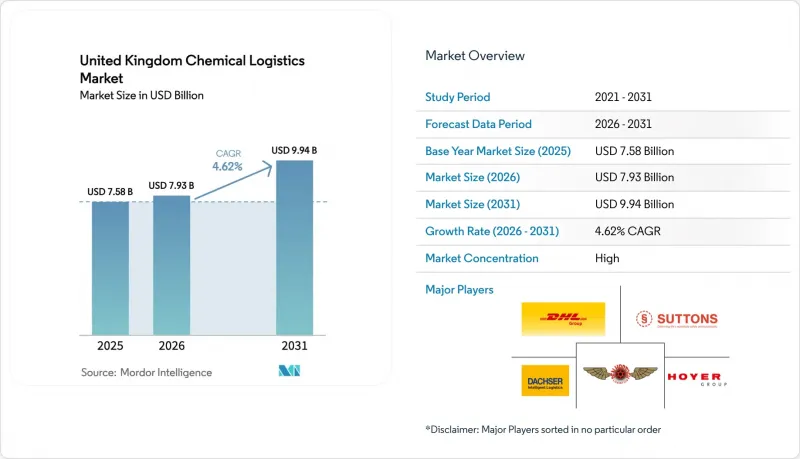
本報告按服務(運輸、倉儲、配送和庫存管理等)、最終用戶(藥品、化妝品等)、危險分類(危險化學品、非危險化學品)、溫度控制(溫控等)和地區(英格蘭、蘇格蘭等)進行分類。市場預測以美元計價。
英國化學品物流市場的趨勢與洞察
蒂賽德地區以英國為中心的化工產業叢集擴張
蒂斯賽德的「淨零排放蒂斯賽德」(Net Zero Teesside)和「氫氣蒂斯賽德」(H2Teesside)專案將化學品生產與碳捕獲基礎設施相結合,創建了二氧化碳和氫氣的專用運輸通道。英國石油公司(BP)承諾每年捕獲高達400萬噸二氧化碳,刺激了對用於液化二氧化碳和藍氫原料的ISO儲槽的新需求。與東海岸叢集的整合正在從傳統的點對點卡車運輸轉向結合管道、鐵路和公路的循環物流系統。因此,物流業者正在投資建造模組化ISO儲槽區,這些儲槽區可以在液化二氧化碳、氨和氫氣之間切換。結合蒂斯賽德直通公海的優勢,這些能力正在使該地區成為低碳化學品的出口中心。這種連鎖反應正在向北蔓延,隨著蘇格蘭碼頭進行改造以處理氫氣和捕獲的二氧化碳的回程傳輸運輸,進一步增強了英國化學品物流市場的韌性。
石油和化學品港口現場儲存能力的限制
伊明漢姆等主要碼頭的營運運轉率已達85-90%,遠超過70-75%的效率基準。自2023年以來,貨物停留時間增加了15%,迫使托運人拆分貨物,並接受單位運輸成本增加12-18%。由於《重大事故危害管制條例》(COMAH)的區域分類和規劃法規限制了快速擴張,營運商正轉向「樞紐輻射式」模式,該模式基於一座耗資7800萬英鎊(9929萬美元)的新建臨時倉儲設施,該設施將於2024年投入使用。物聯網賦能的庫存管理平台已將緩衝庫存需求降低了高達12%,緩解了瓶頸問題,但並未完全消除。這些因素共同推動了英國化學品物流市場倉儲服務的強勁成長。
主要碼頭鐵路罐車車位短缺
由於與客運列車共用鐵軌,且使用數十年前的裝卸平台,化學品運輸列車經常錯過最佳發車時間。由此造成的延誤迫使托運人增加道路運輸的使用,從而推高成本並增加碳排放。雖然整合多家營運商時刻請求的數位化分配工具略微提高了鐵路運轉率,但在新建側線之前,仍存在結構性差距。前瞻性的供應商正在透過利用鐵路進行幹線運輸,並結合道路運輸完成最後一公里配送,從而在確保按時交付的同時減少排放。儘管採取了緩解措施,但這些限制因素仍使英國化學品物流市場的潛在複合年成長率降低了0.5個百分點。
細分市場分析
2025年,運輸業將佔英國化學品物流市場的66.20%,其中道路運輸佔主導地位,其貨運量佔比超過70%。倉儲、配送和庫存管理是成長最快的領域,年複合成長率達5.34%,並在英國化學品物流市場中穩步提升其佔有率。數位化技術最佳化的越庫作業、溫控儲存區以及符合COMAH標準的惰性氣體儲存設施,正將倉庫轉變為高利潤的服務樞紐。
因此,綜合服務合約模糊了卡車運輸和倉儲之間的界線。像Bertschi這樣的業者經營連接鐵路支線和槽式貨櫃堆場的內陸倉庫,實現了乾線運輸的脫碳和準時制庫存管理。這種模式減少了裝卸流程,並整合了諸如混合等附加價值服務。因此,儘管運輸業的佔有率成長緩慢(儘管絕對值有所成長),但倉儲業和「其他服務」(例如海關和監管諮詢)在英國化學品物流市場正變得越來越有利可圖。
預計到2025年,石油和天然氣產業將在英國化學品物流市場維持30.40%的佔有率,但由於能源轉型和煉油商為提高效率所做的努力,該領域的成長前景較為溫和。相較之下,製藥業預計將以6.68%的複合年成長率成長,這主要得益於持續高水準的研發投入以及對活性成分嚴格的溫度要求。如今,涵蓋常溫、冷藏、冷凍和超低溫的溫控包裝已成為製藥供應鏈的標準配備。
化妝品和特種化學品等二級產業高度依賴靈活的小批量交付,以適應配方快速變化。物流供應商不僅透過處理危險物品來提升自身競爭力,還透過確保符合GMP規範和批次可追溯性來增強競爭力。這些變化共同推動英國化學品物流市場朝向更靈活、更高品質的服務方向發展。石油和天然氣產業的公司正在積極應對,將ADR儲槽區改造用於儲存替代燃料和碳捕獲中間體,從而在石化燃料業務量佔比下降的情況下,仍能維持資產運轉率。
其他好處:
- Excel格式的市場預測(ME)表
- 3個月的分析師支持
目錄
第1章:引言
- 研究假設和市場定義
- 調查範圍
第2章:調查方法
第3章執行摘要
第4章 市場狀況
- 市場概覽
- 市場促進因素
- 蒂賽德地區以英國為中心的化工產業叢集擴張
- 石油和化學品港口本地儲存能力的限制
- 數位化ADR合規平台加速企業重組
- 隨著氫能經濟的擴張,對ISO罐式運輸的需求也增加。
- 農業化學品出口的合約包裝業務正在迅速成長。
- 英國脫歐後,REACH法規的差異正創造對物流的需求。
- 市場限制因素
- 主要碼頭鐵路油罐車裝卸空間短缺
- ADR 8級和6.1級駕駛人短缺
- M25走廊沿線的道路通行費是根據嚴格的二氧化碳排放標準制定。
- 當地社區反對大型化學品儲存設施
- 供應鏈/價值鏈分析
- 產業的技術創新
- 政府法規和政策
- 波特五力模型
- 地緣政治事件對市場的影響
第5章 市場規模與成長預測
- 按服務
- 運輸
- 路
- 鐵路
- 海事/海洋
- 航空
- 倉儲、物流和庫存管理
- 其他服務
- 運輸
- 按最終用戶行業分類
- 製藥
- 化妝品和個人護理
- 石油和天然氣
- 特種化學品
- 其他最終用戶
- 依危險分類
- 危險化學品
- 無害化學品
- 按類型控制溫度
- 溫控(冷氣/暖氣)
- 無溫度控制
- 按地區
- 英格蘭
- 蘇格蘭
- 威爾斯
- 北愛爾蘭
第6章 競爭情勢
- 市場集中度
- 策略趨勢
- 市佔率分析
- 公司簡介
- DHL Supply Chain
- Suttons Group
- Hoyer Group
- Den Hartogh Logistics
- DACHSER UK
- Rhenus Logistics
- CEVA Logistics
- BDP International
- CH Robinson
- XPO Logistics
- Wincanton
- Bertschi AG
- Kuehne+Nagel
- DSV
- Maersk Logistics & Services
- GEFCO Chemical
- Univar Solutions(3PL)
- AW Jenkinson Logistics
- GEODIS UK Ltd
- DFDS Logistics
- John K Philips Transport
- Waberer's International UK
- PD Ports Logistics
- Europa Worldwide Group
第7章 市場機會與未來展望
According to Mordor Intelligence, the United Kingdom chemical logistics market size was valued at USD 7.58 billion in 2025 and estimated to grow from USD 7.93 billion in 2026 to reach USD 9.94 billion by 2031, at a CAGR of 4.62% during the forecast period (2026-2031).
This report is Segmented by Service (Transportation, Warehousing, Distribution & Inventory Management, and More), by End User (Pharmaceuticals, Cosmetics, and More), by Hazard Class (Hazardous Chemicals, and Non-Hazardous Chemicals), by Temperature Control (Temperature-Controlled and More), and by Geography (England, Scotland, and More). The Market Forecasts are Provided in Terms of Value (USD).
United Kingdom Chemical Logistics Market Trends and Insights
UK-centric Chemical Cluster Expansion in Teesside
Teesside's Net Zero Teesside and H2Teesside projects are consolidating chemical production and carbon capture infrastructure, creating specialized transport corridors for CO2 and hydrogen. BP's commitment to capture up to 4 million tons of CO2 annually is stimulating new ISO-tank demand for liquefied CO2 and blue hydrogen feedstocks. Integration with the East Coast Cluster is shifting traditional point-to-point trucking into circular flows that blend pipeline, rail, and road legs. Logistics providers are therefore investing in modular ISO-tank farms capable of switching between liquid CO2, ammonia, and hydrogen. Coupled with Teesside's direct deep-sea access, these capabilities position the region as a launchpad for low-carbon chemical exports. The ripple effect extends northwards as Scottish terminals re-gear to back-haul hydrogen and captured CO2, reinforcing the United Kingdom chemical logistics market's resilience.
On-site Storage Capacity Constraints at Petro-Chem Ports
Major terminals such as Immingham are running at 85-90% utilization, materially above the 70-75% efficiency benchmark. Dwell-time inflation has reached 15% since 2023, forcing shippers to split loads and accept 12-18% higher unit transport costs. COMAH zoning and planning rules restrict fast expansion, so operators are pivoting to hub-and-spoke designs backed by GBP 78 million (USD 99.29 million) of new intermediate storage in 2024 . IoT-enabled inventory platforms have cut buffer stock needs by up to 12%, easing but not eliminating the bottleneck. Together, these factors keep warehousing services on a robust growth curve within the United Kingdom chemical logistics market.
Limited Rail-tanker Slots at Key Terminals
Shared lines with passenger traffic and decades-old loading racks mean chemical trains frequently miss optimal departure windows. The resulting backlogs push shippers toward more road legs, elevating costs and carbon footprints. Digital allocation tools that pool slot requests across multiple operators have raised rail utilization modestly, yet a structural gap remains until new sidings are built. Forward-looking providers mix rail for trunk haul with road final mile to trim emissions while keeping schedules credible. Despite mitigation, the constraint clips 0.5 percentage points from the United Kingdom chemical logistics market's potential CAGR.
Other drivers and restraints analyzed in the detailed report include:
- Digital ADR Compliance Platforms Accelerating Turn-around
- Growing Hydrogen-Economy Demand for ISO-Tank Transport
- Driver Shortage for ADR Class 8 & 6.1
For complete list of drivers and restraints, kindly check the Table Of Contents.
Segment Analysis
Transportation accounted for 66.20% of the United Kingdom chemical logistics market in 2025, a position underpinned by road haulage, which moves more than 70% of volumes. Warehousing, distribution and inventory management is the fastest-rising category, expanding at a 5.34% CAGR and steadily lifting its portion of the United Kingdom chemical logistics market size. Digitally orchestrated cross-docking, temperature-segmented bays and COMAH-compliant inert-gas storage convert warehouses into margin-rich service hubs.
Integrated service contracts are therefore blurring the lines between trucking and storage. Operators such as Bertschi run inland depots that splice rail spurs into tank-container yards, pairing line-haul decarbonization with just-in-time inventory. The model cuts handling steps and embeds value-added services like blending. As a result, transport's share will moderate despite absolute growth, while warehousing and "other services" such as customs and regulatory consulting capture more revenue inside the United Kingdom chemical logistics market.
Oil & gas retained a 30.40% share of the United Kingdom chemical logistics market in 2025, but the segment's outlook is tempered by energy-transition dynamics and refiners' efficiency drives. Pharmaceuticals, in contrast, are set to rise at a 6.68% CAGR thanks to persistently high R&D spend and stringent temperature specs for active ingredients. Temperature-validated packaging across ambient, refrigerated, frozen, and Cryo bands is now standard for the pharma supply chain.
Second-tier industries such as cosmetics and specialty chemicals lean heavily on flexible, smaller-lot deliveries aligned to rapid formulation changeovers. Logistics providers differentiate on GMP compliance and batch-traceability rather than pure hazard handling. Together, these shifts nudge the United Kingdom chemical logistics market toward nimbler, quality-assured services. Oil & gas players are responding by repurposing ADR tank farms for alternative fuels and carbon-capture intermediates, sustaining asset utilization while the fossil share of throughput declines.
Complete Report Scope:
- By Service
- Transportation
- Road
- Rail
- Sea/Ocean
- Air
- Warehousing, Distribution & Inventory Management
- Other Services
- Transportation
- By End-user Industry
- Pharmaceuticals
- Cosmetics & Personal Care
- Oil & Gas
- Specialty Chemicals
- Other End-users
- By Hazard Class
- Hazardous Chemicals
- Non-hazardous Chemicals
- By Temperature Control
- Temperature-Controlled (Refrigerated/Heated)
- Non-Temperature-Controlled
- By Geography
- England
- Scotland
- Wales
- Northern Ireland
List of Companies Covered in this Report:
- DHL Supply Chain
- Suttons Group
- Hoyer Group
- Den Hartogh Logistics
- DACHSER UK
- Rhenus Logistics
- CEVA Logistics
- BDP International
- C.H. Robinson
- XPO Logistics
- Wincanton
- Bertschi AG
- Kuehne + Nagel
- DSV
- Maersk Logistics & Services
- GEFCO Chemical
- Univar Solutions (3PL)
- AW Jenkinson Logistics
- GEODIS UK Ltd
- DFDS Logistics
- John K Philips Transport
- Waberer's International UK
- PD Ports Logistics
- Europa Worldwide Group
Additional Benefits:
- The market estimate (ME) sheet in Excel format
- 3 months of analyst support
TABLE OF CONTENTS
1 Introduction
- 1.1 Study Assumptions & Market Definition
- 1.2 Scope of the Study
2 Research Methodology
3 Executive Summary
4 Market Landscape
- 4.1 Market Overview
- 4.2 Market Drivers
- 4.2.1 UK-centric Chemical Cluster Expansion in Teesside
- 4.2.2 On-site Storage Capacity Constraints at Petro-Chem Ports
- 4.2.3 Digital ADR Compliance Platforms Accelerating Turn-around
- 4.2.4 Growing Hydrogen Economy Demand for ISO-Tank Transport
- 4.2.5 Sharp Rise in Contract Packaging for Agri-chem Exports
- 4.2.6 Post-Brexit Divergent REACH Rules Creating Logistics Demand
- 4.3 Market Restraints
- 4.3.1 Limited Rail-tanker Slots at Key Terminals
- 4.3.2 Driver Shortage for ADR Class 8 & 6.1
- 4.3.3 Strict CO2-Based Road Tolls on M25 Corridor
- 4.3.4 Community Opposition to Bulk Chemical Warehousing
- 4.4 Supply-Chain / Value-Chain Analysis
- 4.5 Technological Innovations in the Industry
- 4.6 Government Regulations and Policies
- 4.7 Porter's Five Forces
- 4.7.1 Bargaining Power of Suppliers
- 4.7.2 Bargaining Power of Buyers
- 4.7.3 Threat of New Entrants
- 4.7.4 Threat of Substitutes
- 4.7.5 Competitive Rivalry
- 4.8 Impact of Geopolitical Events on the Market
5 Market Size & Growth Forecasts (Value & Volume)
- 5.1 By Service
- 5.1.1 Transportation
- 5.1.1.1 Road
- 5.1.1.2 Rail
- 5.1.1.3 Sea/Ocean
- 5.1.1.4 Air
- 5.1.2 Warehousing, Distribution & Inventory Management
- 5.1.3 Other Services
- 5.1.1 Transportation
- 5.2 By End-user Industry
- 5.2.1 Pharmaceuticals
- 5.2.2 Cosmetics & Personal Care
- 5.2.3 Oil & Gas
- 5.2.4 Specialty Chemicals
- 5.2.5 Other End-users
- 5.3 By Hazard Class
- 5.3.1 Hazardous Chemicals
- 5.3.2 Non-hazardous Chemicals
- 5.4 By Temperature Control
- 5.4.1 Temperature-Controlled (Refrigerated/Heated)
- 5.4.2 Non-Temperature-Controlled
- 5.5 By Geography
- 5.5.1 England
- 5.5.2 Scotland
- 5.5.3 Wales
- 5.5.4 Northern Ireland
6 Competitive Landscape
- 6.1 Market Concentration
- 6.2 Strategic Moves
- 6.3 Market Share Analysis
- 6.4 Company Profiles (includes Global-level Overview, Market-level Overview, Core Segments, Financials as available, Strategic Information, Market Rank/Share, Products & Services, Recent Developments)
- 6.4.1 DHL Supply Chain
- 6.4.2 Suttons Group
- 6.4.3 Hoyer Group
- 6.4.4 Den Hartogh Logistics
- 6.4.5 DACHSER UK
- 6.4.6 Rhenus Logistics
- 6.4.7 CEVA Logistics
- 6.4.8 BDP International
- 6.4.9 C.H. Robinson
- 6.4.10 XPO Logistics
- 6.4.11 Wincanton
- 6.4.12 Bertschi AG
- 6.4.13 Kuehne + Nagel
- 6.4.14 DSV
- 6.4.15 Maersk Logistics & Services
- 6.4.16 GEFCO Chemical
- 6.4.17 Univar Solutions (3PL)
- 6.4.18 AW Jenkinson Logistics
- 6.4.19 GEODIS UK Ltd
- 6.4.20 DFDS Logistics
- 6.4.21 John K Philips Transport
- 6.4.22 Waberer's International UK
- 6.4.23 PD Ports Logistics
- 6.4.24 Europa Worldwide Group
7 Market Opportunities & Future Outlook
- 7.1 White-space & Unmet-Need Assessment

 化學品物流:市場佔有率分析、產業趨勢與統計、成長預測(2026-2031)歐洲化學品物流:市場佔有率分析、產業趨勢與統計及成長預測(2026-2031 年)
 零售油氣物流市場-全球預測,2026-2032年印度特種油品物流:市場佔有率分析、產業趨勢與統計及成長預測(2026-2031)中國化工物流:市場佔有率分析、產業趨勢與統計及成長預測(2026-2031)印度化學品物流:市場佔有率分析、產業趨勢與統計及成長預測(2026-2031)德國化學品物流:市場佔有率分析、產業趨勢與統計及成長預測(2026-2031)
 全球化學品物流市場零售油氣物流:市佔率分析、產業趨勢及統計、成長預測(2026-2031)
 化學品物流市場規模、佔有率、趨勢和預測:按類型、服務和地區分類,2026-2034年