


 |
市場調查報告書
商品編碼
2099834
印度特種油品物流:市場佔有率分析、產業趨勢與統計及成長預測(2026-2031)India Specialty Oil Logistics - Market Share Analysis, Industry Trends & Statistics, Growth Forecasts (2026 - 2031) |
||||||

※ 本網頁內容可能與最新版本有所差異。詳細情況請與我們聯繫。
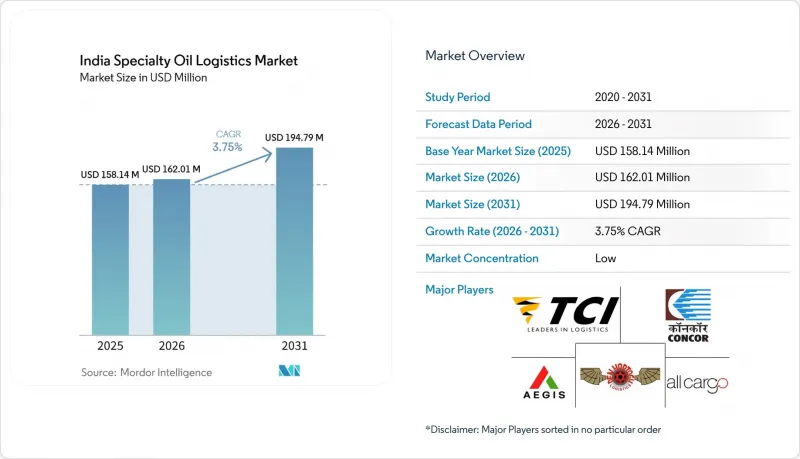
據 Mordor Intelligence 稱,印度特種油品物流市場預計將從 2025 年的 1.5814 億美元成長到 2026 年的 1.6201 億美元,到 2031 年達到 1.9479 億美元,2026 年至 2031 年的複合年成長率為 3.75%。
印度特種油物流市場受惠於強勁的基礎需求。這主要得益於印度潤滑油和特種流體消費量預計在2025年達到483萬噸,年增9.40%;同時,基礎油進口量預計將超過300萬噸,年增11.00%。本報告按服務類型(運輸、倉儲等)、產品類型(變壓器油/絕緣油、白油/加工油)、裝卸/運輸方式(散裝液體、IBC集裝箱等)以及最終用戶行業(汽車/運輸、鋼鐵/金屬加工等)進行細分。市場預測以價值(美元)和數量兩種單位呈現。
印度特種油物流市場趨勢與洞察
工業潤滑油和特殊流體的需求推動了銷售成長。
預計到2025年,印度潤滑油消費量將達483萬噸,年增9.40%。這一消費量的成長將直接擴大印度特種油物流市場服務供應商可用的貨物和倉儲基礎設施。成品潤滑油和特種油品的產量增加也將帶動對整車製造商、工業工廠、維修車間和零售通路的出貨量成長。此外,隨著電動車的普及,汽車潤滑油面臨壓力,而工業和特殊油品的比例正在上升,產品結構也在改變。這項變更意義重大,因為金屬加工液、變壓器油以及食品和醫藥級潤滑油需要更嚴格的處理標準、更清潔的設施和更完善的文件記錄。嘉實多印度公司預計 2025 年的銷售額將達到創紀錄的 5722 印度盧比(6.3684 億美元),其分銷網路覆蓋 15 萬個銷售點,這凸顯了銷售管道的擴張正在推動印度特種油物流市場持續成長的物流需求。
對基礎油進口的依賴正在造成港口至內陸走廊的持續需求。
印度的特種油物流市場仍然嚴重依賴主導,因為國內產量無法完全滿足關鍵基礎油的需求,尤其是用於變壓器油和絕緣油的環烷基基礎油。預計到2025年,基礎油進口量將超過300萬噸,這將導致主要進口走廊上液態散貨的接收、儲槽和內陸運輸活動頻繁。儘管韓國的供應總量為1322161噸,但來自馬來西亞的貨運量激增進一步提升了西海岸港口在印度特種油物流市場中的重要性。這種進口模式形成了兩種實際的內陸物流系統:一種以坎德拉港為中心,透過公路罐車將產品分銷到北部和西部的調配油輪;另一種以賈瓦哈拉爾·尼赫魯港(JNPT)和納瓦舍瓦港為中心,具有更大的多模態潛力。即使新的國內潤滑油產能投入運作,印度的特種油物流市場仍將繼續出現連接新工廠、下游經銷商和工業客戶的短途運輸。
進口基油和運費的波動給整個供應鏈的利潤率帶來了壓力。
印度特種油物流市場極易受到進口原料和運費波動的影響,因為其價值鏈的很大一部分依賴基礎油的海運。當進口成本和運費同時上漲時,接收成本會迅速增加,這種壓力會蔓延至倉儲、陸路運輸和交貨安排。這是一個重大問題,因為許多國內運輸合約都有固定期限,難以快速調整價格。 2026年,由於海灣衝突導致航線變更,賈瓦哈拉爾·尼赫魯港出現堵塞,迫使港口、航運和水文部與液體散裝進口商召開緊急會議。因此,在進口量高峰期,印度特種油物流市場的利潤率管理變得更加嚴格,計畫的確定性也隨之降低。
細分市場分析
到2025年,運輸業將佔印度特種石油物流市場的70.72%,顯示該產業仍高度依賴港口、工廠、碼頭和終端用戶之間的實體運輸。由於印度特種石油物流市場歷來受散裝運輸經濟效益的影響,運輸仍是大多數客戶合約的基礎。油輪、幹線運輸規劃以及港口到工廠的轉運仍然佔據物流成本的大部分。這種趨勢不太可能改變,因為基礎油進口、內陸調和以及下游分銷將繼續決定市場運作的節奏。
然而,附加價值服務的成長速度超過了核心運輸環節,預計到2031年將以5.24%的複合年成長率成長。這反映了印度特種油品物流市場顧客偏好的轉變,簡單的貨運已無法滿足許多顧客的需求。製藥、個人護理和特種工業領域的客戶越來越需要庫存管理、重新包裝、重新貼標、品質分類和按需組裝等服務,並希望在一個工作流程中完成這些環節。倉儲和配送仍然是連接進口收貨和最終出貨的核心環節,營運商正在擴展這些資產以擴大其服務範圍。 Aegis Logistics在JNPA的碼頭擴建計畫表明,液體倉儲設施的建設不僅是為了滿足當前的吞吐量,也是為了回應未來的需求。因此,印度特種油品物流市場正逐步從單純的資產營運模式轉向更整合的服務模式,進而提高客戶維繫和每噸收入。
到2025年,變壓器油和絕緣油將佔印度特種油物流市場40.57%的佔有率,成為佔據市場主導地位的最大產品類型。這一主導地位與印度電網投資的步伐以及變壓器在印度的部署密切相關。根據《經濟時報》報道,預計到2032年,印度輸電產業的資本支出將達到9兆印度盧比,這將為該產品領域提供強勁的需求基礎。 《電力線雜誌》也指出,到2027會計年度,印度需要增加776,330兆伏安的變壓器容量,這將有助於絕緣油在進口點、調配點、變壓器製造商和工程現場之間的持續流通。
白油和加工油是成長最快的產品類別,預計2026年至2031年複合年成長率將達到5.01%。在印度的特種油產業,這項成長主要得益於醫藥和個人保健產品製造業的擴張。在這些產業中,產品純度和操作規範比標準散裝流體供應鏈更為關鍵。 APAR Industries公司以自有品牌「POWEROIL PEARL」供應醫藥級和食品級白油,並出口到125多個國家。該公司強調了進口採購的必要性以及嚴格管控運輸系統的重要性。金屬加工和加工流體在馬哈拉斯特拉邦拉邦、泰米爾納德邦以及更廣泛的汽車工業帶的機械加工叢集中也繼續發揮至關重要的作用。研究表明,汽車金屬成型產業正在快速發展,這為工業油和流體的穩定供應提供了支撐。總而言之,這些趨勢表明,雖然目前電網油在印度特種油物流市場主導,但高附加價值白油和加工油的分銷對於未來的成長將變得越來越重要。
其他好處:
- Excel格式的市場預測(ME)表
- 3個月的分析師支持
目錄
第1章:引言
- 研究假設和市場定義
- 調查範圍
第2章:調查方法
第3章執行摘要
第4章 市場狀況
- 市場概覽
- 市場促進因素
- 工業潤滑油和特種流體需求不斷成長
- 對進口基礎油的依賴維持了從港口到內陸地區的大宗運輸。
- 對高附加價值特種液體的標準化儲存和處理的需求日益成長。
- 利用EPR技術開發廢油逆向物流網路
- DFC主導的多模態走廊正在改善內陸地區液體運輸的經濟效益。
- 擴大OEM認證和優質品牌潤滑油的分銷網路。
- 市場限制因素
- 進口基油和運費的波動給物流成本帶來了壓力。
- 油輪產業的碎片化結構阻礙了網路標準化。
- 遵守危險廢棄物的負擔正在減緩到非正規途徑的轉變。
- 進口激增期間港口和碼頭堵塞
- 價值供應鏈分析
- 監理情勢
- 技術展望
- 波特五力分析
- 地緣政治事件對市場的影響
第5章 市場規模與成長預測
- 按服務類型
- 運輸
- 路
- 整車運輸 (FTL)
- 低於100%的運費(零擔運輸)
- 鐵路
- 多式聯運
- 路
- 倉儲/物流
- 附加價值服務(庫存管理、重新包裝、重新貼標、套件組裝等)
- 運輸
- 產品類型
- 變壓器油和絕緣油
- 白油和加工油
- 金屬加工和處理用流體
- 其他產品類型
- 按處理方式/按運輸方式
- 散裝液體
- 中型散貨箱(IBC)
- 鼓
- 零售和商用(瓶子、果凍桶、立式袋、桶、酒桶等)
- 按最終用途行業分類
- 汽車和運輸業
- 重型機械、採礦和建築
- 鋼鐵和金屬加工
- 能源/發電
- 橡膠和輪胎製造
- 個人護理和藥品
- 食品/飲料加工
- 航太/國防
- 其他終端用戶產業
第6章 競爭情勢
- 市場集中度
- 策略趨勢
- 市佔率分析
- 公司簡介
- 20Cube Logistics Pte. Ltd.
- Aegis Logistics Ltd.
- Allcargo Logistics Limited
- CJ Darcl Logistics Limited
- DHL Group
- DSV A/S
- Express Roadways Private Limited
- KD Supply Chain Solutions Pvt. Ltd.
- Kuehne+Nagel
- Mahindra Logistics, Ltd.
- MTI Logistics
- Nippon Express Holdings
- Om Logistics Limited
- Safexpress Private Limited
- Siddhartha Logistics Co. Pvt. Ltd.
- Toll Holdings Limited
- Transport Corporation of India Limited
- V Power Logistics
- Varuna Group
- VRL Logistics Limited
第7章 市場機會與未來展望
According to Mordor Intelligence, the India specialty oil logistics market size is expected to increase from USD 158.14 million in 2025 to USD 162.01 million in 2026 and reach USD 194.79 million by 2031, growing at a CAGR of 3.75% over 2026-2031.
The India specialty oil logistics market is being supported by steady underlying demand, since India's lubricant and specialty fluid consumption reached 4.83 million tons in 2025, up 9.40% year over year, while base oil imports exceeded 3.00 million tons, up 11.00% from the prior year. This report is Segmented by Service Type (Transportation, Warehousing, and More), by Product Category (Transformer and Insulating Oils, White Oils and Process Oils, and More), by Handling/Shipment Format (Bulk Liquid, Ibcs, and More), and by End-Use Industry (Automotive & Transportation, Steel and Metal Machining, and More). The Market Forecasts are Provided in Value (USD) and Volume.
India Specialty Oil Logistics Market Trends and Insights
Industrial Lubricant and Specialty Fluid Demand Underpins Volume Growth
India's lubricant consumption reached 4.83 million tons in 2025, up 9.40% year over year, and that volume increase directly widened the freight and storage base available to service providers in the India specialty oil logistics market. More finished lubricant and specialty fluid output means more shipments to OEMs, industrial plants, workshops, and retail channels. The product mix is also shifting, as industrial and specialty fluids are gaining weight even as automotive lubricants face pressure from the adoption of electric vehicles. That shift matters because metalworking fluids, transformer oils, and food and pharma grade oils need tighter handling standards, cleaner equipment, and stronger documentation. Castrol India's FY2025 revenue reached a record INR 5,722 crores (USD 636.84 million), and its distribution network covered 150,000 outlets, underscoring how broader channel reach drives recurring logistics demand across India's specialty oil logistics market.
Base-Oil Import Dependence Generates Sustained Port-to-Inland Corridor Demand
The India specialty oil logistics market continues to depend on import-led movement because domestic production does not fully cover demand for key base oils, especially naphthenic grades used in transformer and insulating oils. Base oil imports crossed 3.00 million tons in 2025, which kept liquid bulk reception, tank storage, and inland dispatch active across the main import corridors. South Korea supplied 1,322,161 tons, while Malaysia's shipments rose sharply, which reinforced the importance of west coast ports in the India specialty oil logistics market. This import pattern creates two practical inland systems, one centered on Kandla for road tanker dispatch to northern and western blending hubs, and another centered on JNPT and Nhava Sheva with stronger multimodal potential. Even if new domestic lube capacity comes online, the India specialty oil logistics market will still see fresh short-haul movement between new complexes, downstream distributors, and industrial customers.
Imported Base-Oil and Freight Volatility Creates Margin Pressure Throughout the Chain
The India specialty oil logistics market remains exposed to imported feedstock and freight volatility because so much of the value chain depends on seaborne base oil arrivals. When import costs and freight rates rise together, landed costs move up quickly and the pressure spreads to storage, road movement, and delivery scheduling. This matters because many domestic haulage contracts are fixed for a period and cannot be repriced quickly. In 2026, Gulf conflict rerouting contributed to congestion at Jawaharlal Nehru Port and forced the Ministry of Ports, Shipping, and Waterways to hold an emergency session with liquid bulk importers. The result is tighter margin management and less planning certainty across the India specialty oil logistics market during import-heavy periods.
Other drivers and restraints analyzed in the detailed report include:
- Compliant Storage and Handling Needs Rising for High-Value Specialty Fluids
- Used-Oil EPR Formalizes Reverse Logistics Networks
- Fragmented Tanker Ecosystem Caps Network Standardization
For complete list of drivers and restraints, kindly check the Table Of Contents.
Segment Analysis
Transportation held 70.72% of the India specialty oil logistics market share in 2025, which shows how strongly the sector still depends on physical movement between ports, plants, terminals, and end users. The India specialty oil logistics market has historically been shaped by bulk movement economics, so transportation remains the base layer of most customer contracts. Road tankers, line-haul planning, and port-to-plant transfer still absorb the largest part of logistics spend. That pattern is unlikely to disappear, because base oil imports, inland blending, and downstream delivery continue to define the operating rhythm of the market.
Value-added services, however, are growing faster than the core transport layer and are forecast to expand at a 5.24% CAGR through 2031. This reflects a change in customer preference inside the India specialty oil logistics market, where simple freight execution is no longer enough for many accounts. Pharmaceutical, personal care, and specialty industrial users increasingly request inventory management, repacking, relabeling, quality segregation, and order-specific kitting within a single workflow. Warehousing and distribution remain the middle layer that connects import receipt with final dispatch, and operators are scaling those assets to improve service depth. Aegis Logistics' terminal expansion at JNPA shows that liquid storage is being built ahead of future demand, not just to support current throughput. As a result, the India specialty oil logistics market is gradually shifting from an asset-only model toward a more integrated service model with better customer retention and higher revenue per ton.
Transformer and insulating oils accounted for 40.57% of the India specialty oil logistics market size in 2025, making them the largest product category by a wide margin. This leadership is closely tied to the pace of grid investment and transformer deployment across India. The Economic Times reported that India's power transmission sector is set to receive INR 9.00 trillion in capex through 2032, giving this product segment a strong demand base. Power Line Magazine also noted that India must add 776,330 MVA of transformer capacity by FY2027, which supports continued movement of insulating oils between import points, blending locations, transformer manufacturers, and project sites.
White oils and process oils are the fastest-growing product segment, with a 5.01% CAGR projected for 2026-2031. In the India specialty oil industry, this growth is being supported by rising pharmaceutical and personal care manufacturing, where product purity and handling discipline matter more than in standard bulk fluid chains. APAR Industries supplies pharmaceutical- and food-grade white oils under its POWEROIL PEARL brand and exports to more than 125 countries, underscoring the need for inbound sourcing and tightly managed outbound dispatch. Metalworking and process fluids also remain important in machining clusters across Maharashtra, Tamil Nadu, and the broader automotive belt. According to research, the automotive metal forming sector is advancing in a fast pace, which supports stable movement of industrial oils and fluids. Taken together, these patterns show that the India specialty oil logistics market is led by grid-linked oils today, while higher-value white oil and process oil flows are becoming more important to future growth.
Complete Report Scope:
- By Service Type
- Transportation
- Road
- Full-Truck-Load (FTL)
- Less than-Truck-Load (LTL)
- Rail
- Multimodal Transport
- Road
- Warehousing and Distribution
- Value-added Services (Inventory management, Repacking, Relabeling, and Kitting etc.)
- Transportation
- By Product Category
- Transformer and insulating oils
- White oils and process oils
- Metalworking and process fluids
- Other Product Categories
- By Handling / Shipment Format
- Bulk liquid
- Intermediate Bulk Containers (IBCs)
- Drums
- Small Retail and Commercial (Bottles and Jerry Cans, Stand-up Pouches, Pails, Kegs, etc.)
- By End-use Industry
- Automotive and Transportation
- Heavy Equipment, Mining and Construction
- Steel and Metal Machining
- Energy/Power Generation
- Rubber and Tire Manufacturing
- Personal Care and Pharmaceuticals
- Food and Beverage Processing
- Aerospace and Defense
- Other End-user Industries
List of Companies Covered in this Report:
- 20Cube Logistics Pte. Ltd.
- Aegis Logistics Ltd.
- Allcargo Logistics Limited
- CJ Darcl Logistics Limited
- DHL Group
- DSV A/S
- Express Roadways Private Limited
- K D Supply Chain Solutions Pvt. Ltd.
- Kuehne+Nagel
- Mahindra Logistics, Ltd.
- MTI Logistics
- Nippon Express Holdings
- Om Logistics Limited
- Safexpress Private Limited
- Siddhartha Logistics Co. Pvt. Ltd.
- Toll Holdings Limited
- Transport Corporation of India Limited
- V Power Logistics
- Varuna Group
- VRL Logistics Limited
Additional Benefits:
- The market estimate (ME) sheet in Excel format
- 3 months of analyst support
TABLE OF CONTENTS
1 Introduction
- 1.1 Study Assumptions and Market Definition
- 1.2 Scope of the Study
2 Research Methodology
3 Executive Summary
4 Market Landscape
- 4.1 Market Overview
- 4.2 Market Drivers
- 4.2.1 Industrial Lubricant and Specialty Fluid Demand Expansion
- 4.2.2 Base-Oil Import Dependence Sustaining Port-to-Inland Bulk Movements
- 4.2.3 Compliant Storage and Handling Needs Rising for High-Value Specialty Fluids
- 4.2.4 Used-Oil EPR Formalizing Reverse Logistics Networks
- 4.2.5 DFC-Led Multimodal Corridors Improving Inland Liquid Movement Economics
- 4.2.6 Expansion of OEM-Approved and Premium Branded Lubricant Distribution Networks
- 4.3 Market Restraints
- 4.3.1 Imported Base-Oil and Freight Volatility Pressuring Logistics Costs
- 4.3.2 Fragmented Tanker Ecosystem Limiting Network Standardization
- 4.3.3 Hazardous-Waste Compliance Burden Slowing Informal Channel Conversion
- 4.3.4 Port and Terminal Congestion During Import Surges
- 4.4 Value / Supply-Chain Analysis
- 4.5 Regulatory Landscape
- 4.6 Technological Outlook
- 4.7 Porter's Five Forces Analysis
- 4.7.1 Threat of new entrants
- 4.7.2 Bargaining power of suppliers
- 4.7.3 Bargaining power of buyers
- 4.7.4 Threat of substitutes
- 4.7.5 Competitive rivalry
- 4.8 Impact of Geopolitical Events on the Market
5 Market Size and Growth Forecasts (Value and Volume)
- 5.1 By Service Type
- 5.1.1 Transportation
- 5.1.1.1 Road
- 5.1.1.1.1 Full-Truck-Load (FTL)
- 5.1.1.1.2 Less than-Truck-Load (LTL)
- 5.1.1.2 Rail
- 5.1.1.3 Multimodal Transport
- 5.1.1.1 Road
- 5.1.2 Warehousing and Distribution
- 5.1.3 Value-added Services (Inventory management, Repacking, Relabeling, and Kitting etc.)
- 5.1.1 Transportation
- 5.2 By Product Category
- 5.2.1 Transformer and insulating oils
- 5.2.2 White oils and process oils
- 5.2.3 Metalworking and process fluids
- 5.2.4 Other Product Categories
- 5.3 By Handling / Shipment Format
- 5.3.1 Bulk liquid
- 5.3.2 Intermediate Bulk Containers (IBCs)
- 5.3.3 Drums
- 5.3.4 Small Retail and Commercial (Bottles and Jerry Cans, Stand-up Pouches, Pails, Kegs, etc.)
- 5.4 By End-use Industry
- 5.4.1 Automotive and Transportation
- 5.4.2 Heavy Equipment, Mining and Construction
- 5.4.3 Steel and Metal Machining
- 5.4.4 Energy/Power Generation
- 5.4.5 Rubber and Tire Manufacturing
- 5.4.6 Personal Care and Pharmaceuticals
- 5.4.7 Food and Beverage Processing
- 5.4.8 Aerospace and Defense
- 5.4.9 Other End-user Industries
6 Competitive Landscape
- 6.1 Market Concentration
- 6.2 Strategic Moves
- 6.3 Market Share Analysis
- 6.4 Company Profiles (Includes Global Level Overview, Market Level Overview, Core Segments, Financials as Available, Strategic Information, Market Rank/Share for Key Companies, Products and Services, and Recent Developments)
- 6.4.1 20Cube Logistics Pte. Ltd.
- 6.4.2 Aegis Logistics Ltd.
- 6.4.3 Allcargo Logistics Limited
- 6.4.4 CJ Darcl Logistics Limited
- 6.4.5 DHL Group
- 6.4.6 DSV A/S
- 6.4.7 Express Roadways Private Limited
- 6.4.8 K D Supply Chain Solutions Pvt. Ltd.
- 6.4.9 Kuehne+Nagel
- 6.4.10 Mahindra Logistics, Ltd.
- 6.4.11 MTI Logistics
- 6.4.12 Nippon Express Holdings
- 6.4.13 Om Logistics Limited
- 6.4.14 Safexpress Private Limited
- 6.4.15 Siddhartha Logistics Co. Pvt. Ltd.
- 6.4.16 Toll Holdings Limited
- 6.4.17 Transport Corporation of India Limited
- 6.4.18 V Power Logistics
- 6.4.19 Varuna Group
- 6.4.20 VRL Logistics Limited
7 Market Opportunities and Future Outlook
- 7.1 White-space and unmet-need assessment

 英國化學品物流:市場佔有率分析、產業趨勢與統計、成長預測(2026-2031 年)化學品物流:市場佔有率分析、產業趨勢與統計、成長預測(2026-2031)歐洲化學品物流:市場佔有率分析、產業趨勢與統計及成長預測(2026-2031 年)
 零售油氣物流市場-全球預測,2026-2032年中國化工物流:市場佔有率分析、產業趨勢與統計及成長預測(2026-2031)印度化學品物流:市場佔有率分析、產業趨勢與統計及成長預測(2026-2031)德國化學品物流:市場佔有率分析、產業趨勢與統計及成長預測(2026-2031)
 全球化學品物流市場零售油氣物流:市佔率分析、產業趨勢及統計、成長預測(2026-2031)
 化學品物流市場規模、佔有率、趨勢和預測:按類型、服務和地區分類,2026-2034年