


 |
市場調查報告書
商品編碼
2100702
越南設施管理:市場佔有率分析、產業趨勢與統計、成長預測(2026-2031)Vietnam Facility Management - Market Share Analysis, Industry Trends & Statistics, Growth Forecasts (2026 - 2031) |
||||||

※ 本網頁內容可能與最新版本有所差異。詳細情況請與我們聯繫。
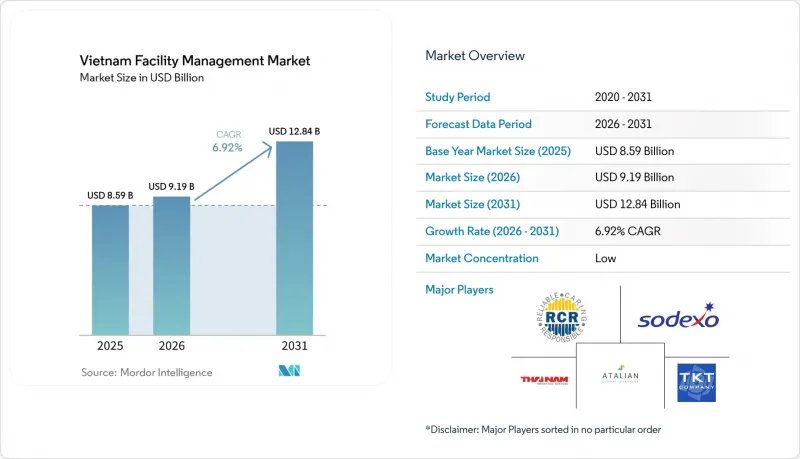
據 Mordor Intelligence 稱,越南設施管理市場規模在 2025 年達到 85.9 億美元,預計到 2031 年將從 2026 年的 91.9 億美元成長至 128.4 億美元,預測期(2026-2031 年)的複合年成長率為 6.92%。
本報告依服務類型(硬性服務[資產管理等]、軟性服務[辦公室支援、保全等])、交付方式(內部營運、外包[單一設施管理、綜合設施管理等])及最終用戶產業(商業、飯店、機構/公共基礎設施、工業/流程等)分類。市場預測以美元計價。
越南設施管理(FM)市場趨勢與洞察
甲級辦公室和混合用途房地產存量的增加
預計2024年至2025年間,胡志明市和河內甲級物業的存量將成長18%,新增超過120萬平方公尺的優質空間,這些物業需要先進的機械、電氣和管道維護、提升租戶體驗的服務以及嚴格的生命安全標準。開發商目前正在洽談5至10年的綜合契約,通常將付款與獲得LEED或LOTUS認證的里程碑掛鉤,從而帶來10%至15%的租金溢價。像Vinhomes Golden River這樣的綜合用途項目將住宅門房服務、零售區域維護和辦公硬體服務整合到一份合約中,這有利於能夠管理多元化資產的供應商。峴港新建的物業正瞄準區域總部搬遷,將越南的物業管理市場擴展到河內-胡志明市走廊以外的地區。隨著物業老化,對預測性維護、外觀維修和電梯現代化的需求可能會進一步增加。
透過「中國+1」策略和自由貿易協定促進製造業和物流業成長
預計到2025年,將有228億美元的外國投資流入製造業,推動平陽省、北寧省和海防市新建1,500萬平方公尺的工廠和物流中心。半導體組裝、電池生產和紡織品整理生產線均需要符合ISO標準的無塵室、危險廢棄物處理設施以及全天候的溫控監控,這擴大了越南設施管理市場對硬性服務的需求。工業園區營運商從一開始就將安保、景觀美化和廢水處理等服務納入租賃協議,從而有效地實現了營運外包。區域全面經濟夥伴關係協定(RCEP)和歐盟-越南自由貿易協定(FTA)下的關稅減讓正在鞏固越南的長期出口競爭力,並確保設施供應穩定,這些設施需要保證98%以上的運轉率和環境合規性審計。
技術純熟勞工短缺,設施管理(FM)人員離職率率高。
建築管理系統操作員、暖通空調技術人員和消防安全專家的年離職率超過30%,推高了招募成本,並將合約生效前的準備期延長了長達三個月。只有12%的員工持有設施管理(FM)認證資格,迫使服務供應商營運內部培訓機構,這又使人事費用增加了8%至12%。英語程度的差距阻礙了跨國公司客戶的知識轉移,並延緩了全球最佳實踐的採納。除非將設施管理模組納入職業培訓課程,並透過稅收優惠促進技能發展,否則人才短缺將限制越南設施管理市場吸收先進技能的能力。
細分市場分析
預計2025年,硬性服務將佔越南物業管理市場的58.34%。這一佔有率主要得益於建築機械設備比例高,以及嚴格的安全法規,例如每季進行檢查和每年進行系統重新認證。由於越南地處熱帶氣候,暖氣、通風和空調(HVAC)支出佔很大比例,因為辦公大樓、購物中心和超大規模資料中心都需要持續冷氣。 2010年至2015年間建造的第一代甲級辦公室目前亟需進行全面的生命週期維修,這導致對消防系統升級、電梯維修和外立面維護的需求增加。資產管理諮詢服務在房地產投資信託基金(REITs)和機構投資者中越來越受歡迎,他們需要數據驅動的資本規劃來維持收益,這進一步鞏固了硬性服務專家在越南整體物業管理市場的收入基礎。
儘管軟性服務市場規模較小,但其正以7.32%的複合年成長率快速成長,這主要得益於企業強制性衛生標準以及清潔和安保服務獲得正式認可。國際連鎖飯店和JCI認證醫院要求提供服務業者遵守有記錄的審計追蹤、化學品處理標準和感染控制清單,這正在逐步取代非正式用工。隨著辦公室重新開放,辦公室餐飲業務正在復甦,工業園區也擴大將餐飲服務外包,以提高員工留任率。園林綠化和廢棄物管理合約與LOTUS綠建築認證積分掛鉤,使得越南軟性服務設施管理市場中原本利潤率較低的服務轉變為增值交付成果。
其他好處:
- Excel格式的市場預測(ME)表
- 3個月的分析師支持
目錄
第1章:引言
- 研究假設和市場定義
- 調查範圍
第2章:調查方法
第3章執行摘要
第4章 市場狀況
- 市場概覽
- 目前運轉率
- 主要設施管理業者的盈利指標
- 勞動指標 - 勞動參與率
- 按服務類型分類的設施管理市場佔有率(%)
- 按硬體服務分類的設施管理市場佔有率(%)
- 軟性服務在設施管理市場佔有率(%)
- 主要都會區的都市化和人口成長
- 越南基礎設施發展計畫中的產業投資重點
- 與勞動和安全標準相關的監管因素
- 市場促進因素
- 甲級辦公室和混合用途房地產存量的增加
- 透過「中國+1」策略和自由貿易協定促進製造業和物流業成長
- 政府主導的智慧城市和基礎設施公私合營(PPP)舉措
- 公共機構與私人企業外包成本最佳化趨勢
- 超大規模資料中心的擴張正在推動關鍵環境中的設施管理。
- 綠建築:能源效率認證需求-LOTUS、EDGE
- 市場限制因素
- 設施管理業技術純熟勞工短缺及人員離職率率高
- 價格驅動型採購正在導致服務品質下降。
- 缺乏統一的FM許可和標準導致市場碎片化。
- 對網路實體安全的擔憂正在減緩物聯網和建築管理系統的普及。
- 產業價值鏈分析
- PESTLE分析
- 市場准入者的法規和法律體制
- 宏觀經濟指標對FM需求的影響
- 波特五力分析
- 投資和資金籌措分析
第5章 市場規模與成長預測
- 按服務類型
- 硬服務
- 資產管理
- 機電及暖通空調服務
- 消防設備和安全措施
- 其他硬體設施管理服務
- 軟服務
- 辦公室支援和安全
- 清潔服務
- 餐飲服務
- 其他軟性設施管理服務
- 硬服務
- 按規定表格
- 內部回應
- 外包
- 單一設施管理
- 綜合設施管理
- 綜合設施管理
- 按最終用戶行業分類
- 商業
- 飯店業
- 機構和公共基礎設施
- 衛生保健
- 行業與流程
- 其他
第6章 競爭情勢
- 市場集中度
- 策略舉措和夥伴關係
- 市佔率分析
- 公司簡介
- RCR Vietnam
- Sodexo Vietnam
- ADEN Vietnam
- Thainam Facility Services
- TKT Cleaning
- ATALIAN Global Services Vietnam
- Savills Vietnam
- AEON Delight Vietnam
- PMC Building Services and Engineering
- P. Dussmann Co. Ltd Vietnam
- Vintek Facility Management
- S4S Facility Services
- VSIP Facility Management
- CBRE Vietnam
- JLL Vietnam
- G4S Secure Solutions Vietnam
- Compass Group Vietnam
- Cleanhouse Vietnam
- Visaho Joint Stock Company
- Knight Frank Vietnam
第7章 市場機會與未來展望
According to Mordor Intelligence, the Vietnam facility management market size was valued at USD 8.59 billion in 2025 and estimated to grow from USD 9.19 billion in 2026 to reach USD 12.84 billion by 2031, at a CAGR of 6.92% during the forecast period (2026-2031).
This report is Segmented by Service Type (Hard Services [Asset Management, and More], and Soft Services [Office Support and Security, and More]), Offering Type (In-House, and Outsourced [Single FM, Bundled FM, and More]), and End-User Industry (Commercial. Hospitality, Institutional and Public Infrastructure, Industrial and Process, and More). The Market Forecasts are Provided in Terms of Value (USD).
Vietnam Facility Management Market Trends and Insights
Expansion of Grade-A Office and Mixed-Use Real Estate Stock
Grade-A inventory in Ho Chi Minh City and Hanoi climbed 18% between 2024 and 2025, adding more than 1.2 million m2 of premium space that requires sophisticated mechanical, electrical, and plumbing upkeep, tenant-experience services, and stringent life-safety compliance. Developers now pre-negotiate five-to-ten-year integrated contracts, often linking payment to LEED or LOTUS certification milestones that deliver 10%-15% rental premiums. Mixed-use schemes such as Vinhomes Golden River bundle residential concierge, retail area maintenance, and office hard services in a single scope, which favors providers able to manage multifaceted assets. New completions in Da Nang are targeting regional headquarters relocations, stretching the Vietnam facility management market beyond the Hanoi-Ho Chi Minh City corridor. As stock ages, demand will intensify for predictive maintenance, facade refurbishment, and elevator modernization.
Manufacturing and Logistics Growth via China + 1 and FTAs
Foreign capital of USD 22.8 billion flowed into manufacturing in 2025, stimulating the build-out of 15 million m2 of factories and logistics hubs across Binh Duong, Bac Ninh, and Hai Phong. Semiconductor assembly, battery production, and textile finishing lines all mandate ISO-class cleanrooms, hazardous-waste handling, and 24/7 HVAC monitoring, expanding the hard-services wallet within the Vietnam facility management market. Industrial-park operators bundle security, landscaping, and wastewater treatment into leases, effectively outsourcing operations from day one. Reduced tariffs under RCEP and the EU-Vietnam Free Trade Agreement lock in long-run export competitiveness, ensuring a steady stream of facilities that will require uptime guarantees above 98% and environmental compliance audits.
Skilled-Labour Shortage and High Turnover in FM Workforce
Annual turnover tops 30% for BMS operators, HVAC technicians, and fire-safety specialists, inflating recruitment costs and lengthening contract mobilization by up to three months. Only 12% of workers hold recognized FM certifications, forcing service providers to run in-house academies that add 8%-12% to labor expense. English-language gaps hinder knowledge transfer from multinational clients, slowing adoption of global best practices. Unless vocational curricula incorporate FM modules and tax incentives encourage upskilling, constrained talent will limit the Vietnam facility management market's ability to absorb sophisticated technologies.
Other drivers and restraints analyzed in the detailed report include:
- Hyperscale Data-Center Build-Out Driving Critical-Environment FM
- Government Smart-City and Infrastructure PPP Initiatives
- Price-Focused Procurement Undercutting Service Quality
For complete list of drivers and restraints, kindly check the Table Of Contents.
Segment Analysis
Hard Services accounted for 58.34% of the Vietnam facility management market in 2025, a share underpinned by mechanically intensive buildings and stringent safety regulations that require quarterly inspections and annual system recertification. Heating, ventilation, and air-conditioning dominates spend because Vietnam's tropical climate forces continuous cooling in offices, malls, and hyperscale data centers. Fire-system upgrades, elevator refurbishment, and facade maintenance are rising as first-generation Grade-A towers built between 2010 and 2015 now require lifecycle overhauls. Asset-management advisory is gaining favor among REITs and institutional landlords that need data-driven capital planning to defend yields, further cementing the revenue base for hard-service specialists across the Vietnam facility management market.
Soft Services represent a smaller dollar pool but expand at a 7.32% CAGR, driven by corporate hygiene mandates and the formalization of cleaning and security roles. International hospitality chains and JCI-accredited hospitals compel providers to meet documented audit trails, chemical-handling standards, and infection-control checklists, displacing informal labor pools. Office catering rebounds in tandem with workplace re-occupancy, and industrial campuses are outsourcing meal programs to manage worker retention. Landscaping and waste-management contracts are increasingly tied to LOTUS green-building points, transforming previously low-margin tasks into value-added deliverables within the Vietnam facility management market size for soft services.
Complete Report Scope:
- By Service Type
- Hard Services
- Asset Management
- MEP and HVAC Services
- Fire Systems and Safety
- Other Hard Facility Management Services
- Soft Services
- Office Support and Security
- Cleaning Services
- Catering Services
- Other Soft Facility Management Services
- Hard Services
- By Offering Type
- In-house
- Outsourced
- Single Facility Management
- Bundled Facility Management
- Integrated Facility Management
- By End-User Industry
- Commercial
- Hospitality
- Institutional and Public Infrastructure
- Healthcare
- Industrial and Process
- Other End-User Industries
List of Companies Covered in this Report:
- RCR Vietnam
- Sodexo Vietnam
- ADEN Vietnam
- Thainam Facility Services
- TKT Cleaning
- ATALIAN Global Services Vietnam
- Savills Vietnam
- AEON Delight Vietnam
- PMC Building Services and Engineering
- P. Dussmann Co. Ltd Vietnam
- Vintek Facility Management
- S4S Facility Services
- VSIP Facility Management
- CBRE Vietnam
- JLL Vietnam
- G4S Secure Solutions Vietnam
- Compass Group Vietnam
- Cleanhouse Vietnam
- Visaho Joint Stock Company
- Knight Frank Vietnam
Additional Benefits:
- The market estimate (ME) sheet in Excel format
- 3 months of analyst support
TABLE OF CONTENTS
1 INTRODUCTION
- 1.1 Study Assumptions and Market Definition
- 1.2 Scope of the Study
2 RESEARCH METHODOLOGY
3 EXECUTIVE SUMMARY
4 MARKET LANDSCAPE
- 4.1 Market Overview
- 4.1.1 Current Occupancy Rates
- 4.1.2 Profitability Rates of Major FM Players
- 4.1.3 Workforce Indicators - Labor Participation
- 4.1.4 Facility Management Market Share (%) by Service Type
- 4.1.5 Facility Management Market Share (%) by Hard Services
- 4.1.6 Facility Management Market Share (%) by Soft Services
- 4.1.7 Urbanization and Population Growth in Major Metros
- 4.1.8 Sector Investment Priorities in Vietnam's Infrastructure Pipeline
- 4.1.9 Regulatory Drivers Specific to Labor and Safety Standards
- 4.2 Market Drivers
- 4.2.1 Expansion of Grade-A Office and Mixed-Use Real Estate Stock
- 4.2.2 Manufacturing and Logistics Growth via China+1 and FTAs
- 4.2.3 Government Smart-City and Infrastructure PPP Initiatives
- 4.2.4 Cost-Optimization Outsourcing Trend in State and Private Enterprises
- 4.2.5 Hyperscale Data-Center Build-Out Driving Critical-Environment FM
- 4.2.6 Green-Building, Energy-Efficiency Certification Demand - LOTUS, EDGE
- 4.3 Market Restraints
- 4.3.1 Skilled-Labor Shortage and High Turnover in FM Workforce
- 4.3.2 Price-Focused Procurement Undercutting Service Quality
- 4.3.3 Absence of Unified FM Licensing and Standards Causing Fragmentation
- 4.3.4 Cyber-Physical Security Concerns Slowing IoT, BMS Adoption
- 4.4 Industry Value Chain Analysis
- 4.5 PESTEL Analysis
- 4.6 Regulatory and Legislative Framework for Market Entrants
- 4.7 Impact of Macroeconomic Indicators on FM Demand
- 4.8 Porter's Five Forces Analysis
- 4.8.1 Bargaining Power of Suppliers
- 4.8.2 Bargaining Power of Buyers
- 4.8.3 Threat of New Entrants
- 4.8.4 Threat of Substitute Services
- 4.8.5 Intensity of Competitive Rivalry
- 4.9 Investment and Funding Analysis
5 MARKET SIZE AND GROWTH FORECASTS (VALUE)
- 5.1 By Service Type
- 5.1.1 Hard Services
- 5.1.1.1 Asset Management
- 5.1.1.2 MEP and HVAC Services
- 5.1.1.3 Fire Systems and Safety
- 5.1.1.4 Other Hard Facility Management Services
- 5.1.2 Soft Services
- 5.1.2.1 Office Support and Security
- 5.1.2.2 Cleaning Services
- 5.1.2.3 Catering Services
- 5.1.2.4 Other Soft Facility Management Services
- 5.1.1 Hard Services
- 5.2 By Offering Type
- 5.2.1 In-house
- 5.2.2 Outsourced
- 5.2.2.1 Single Facility Management
- 5.2.2.2 Bundled Facility Management
- 5.2.2.3 Integrated Facility Management
- 5.3 By End-User Industry
- 5.3.1 Commercial
- 5.3.2 Hospitality
- 5.3.3 Institutional and Public Infrastructure
- 5.3.4 Healthcare
- 5.3.5 Industrial and Process
- 5.3.6 Other End-User Industries
6 COMPETITIVE LANDSCAPE
- 6.1 Market Concentration
- 6.2 Strategic Moves and Partnerships
- 6.3 Market Share Analysis
- 6.4 Company Profiles (includes Global Level Overview, Market Level Overview, Core Segments, Financials as available, Strategic Information, Market Rank/Share, Products and Services, Recent Developments)
- 6.4.1 RCR Vietnam
- 6.4.2 Sodexo Vietnam
- 6.4.3 ADEN Vietnam
- 6.4.4 Thainam Facility Services
- 6.4.5 TKT Cleaning
- 6.4.6 ATALIAN Global Services Vietnam
- 6.4.7 Savills Vietnam
- 6.4.8 AEON Delight Vietnam
- 6.4.9 PMC Building Services and Engineering
- 6.4.10 P. Dussmann Co. Ltd Vietnam
- 6.4.11 Vintek Facility Management
- 6.4.12 S4S Facility Services
- 6.4.13 VSIP Facility Management
- 6.4.14 CBRE Vietnam
- 6.4.15 JLL Vietnam
- 6.4.16 G4S Secure Solutions Vietnam
- 6.4.17 Compass Group Vietnam
- 6.4.18 Cleanhouse Vietnam
- 6.4.19 Visaho Joint Stock Company
- 6.4.20 Knight Frank Vietnam
7 MARKET OPPORTUNITIES AND FUTURE OUTLOOK
- 7.1 White-space and Unmet-Need Assessment
- 7.2 Technology-led Integrated FM (IoT, BMS, AI-Based Predictive Maintenance)
- 7.3 ESG-Compliant FM Solutions Demand
- 7.4 Future Service-Model Shifts (Outcome-Based Contracts)

 2026-2030年全球設施管理市場
 設施管理(FM)軟體:市場佔有率分析、行業趨勢和統計數據以及成長預測(2026-2031 年)北美設施管理:市場佔有率分析、產業趨勢與統計、成長預測(2026-2031 年)亞太地區硬設施管理:市場佔有率分析、產業趨勢與統計及成長預測(2026-2031)硬設施管理:市場佔有率分析、產業趨勢與統計、成長預測(2026-2031 年)日本設施管理:市場佔有率分析、產業趨勢與統計及成長預測(2026-2031)
 Frost Radar™:泰國設施管理,2026 年中國設施管理:市場佔有率分析、產業趨勢與統計、成長預測(2026-2031)印尼設施管理:市場佔有率分析、產業趨勢與統計、成長預測(2026-2031)德國設施管理:市場佔有率分析、產業趨勢與統計、成長預測(2026-2031)