


 |
市場調查報告書
商品編碼
2100275
整合終端管理:市場佔有率分析、產業趨勢與統計、成長預測(2026-2031)Unified Endpoint Management - Market Share Analysis, Industry Trends & Statistics, Growth Forecasts (2026 - 2031) |
||||||

※ 本網頁內容可能與最新版本有所差異。詳細情況請與我們聯繫。
據 Mordor Intelligence 稱,2025 年整合端點管理市場價值為 70.7 億美元,預計到 2031 年將達到 270.3 億美元,而 2026 年為 87.2 億美元,預測期(2026-2031 年)的複合年成長率為 25.38%。
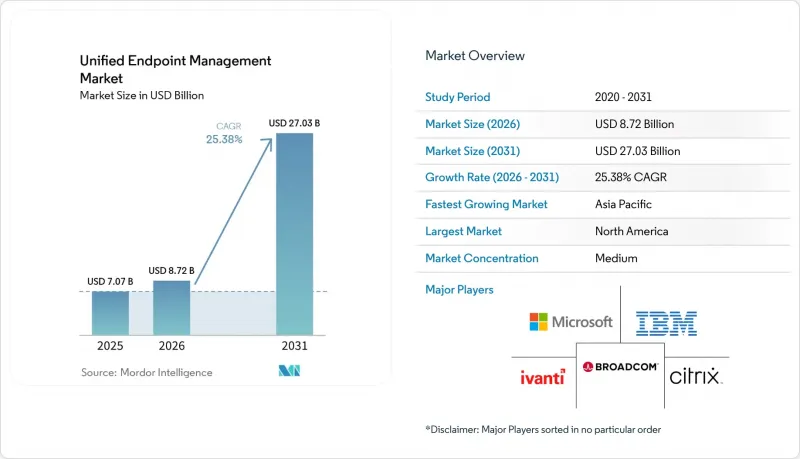
本報告按組件(解決方案和服務)、部署類型(雲端、本地部署等)、組織規模(大型企業和中小企業)、最終用戶產業(IT和電信、銀行、金融服務和保險、政府和國防、醫療保健和生命科學、零售和電子商務等)以及國家/地區進行細分。市場預測以美元計價。
全球整合端點管理市場趨勢與洞察
特權、敏感和受監管工作負載的「安全優先」數位化
在統一端點管理 (UEM) 市場,安全性不再是裝置控制的次要功能,而是主要的購買動機。由於律師事務所、金融機構和醫療保健提供者處理特權數據、機密數據和受監管數據,端點安全漏洞可能立即導致訴訟、隱私問題或審計風險。美國律師協會 (ABA) 發布的第 512 號官方意見進一步凸顯了端點和人工智慧工具治理的重要性,該意見規定管治有義務審查供應商的資料處理流程。這種壓力也推高了合約金額,因為許多買家將 UEM 與身分和存取管理相結合,以整合策略、存取和稽核控制。 HCL BigFix 於 2025 年 7 月獲得 NIAP 認證,進一步鞏固了其在安全檢驗至關重要的受監管環境和聯邦機構中的地位。
以雲端優先的方式對面向客戶和內部的工作流程進行現代化改造
2025年,雲端技術的普及將推動整合端點管理市場的發展,持續推動由更快的部署速度和更簡化的遠端環境支援所驅動的採購趨勢。雲端代理透過標準協定存取分散式設備,從而減輕通常會拖慢本地部署速度的基礎設施負擔。隨著裝置管理遷移到雲端,許多組織也將重新思考其協作、虛擬桌面基礎架構 (VDI)、內網和工作流程工具,並將它們整合到同一技術堆疊中。這為在整合端點管理市場中擁有成熟平台產品組合的供應商創造了擴大市場佔有率的機會。微軟計劃在2026年將Intune的高級功能擴展到Microsoft 365 E3和E5套件,這表明供應商正在利用雲端統一端點管理 (UEM) 將平台應用範圍擴展到簡單的端點控制之外。
與原有文件管理、計費管理和案例管理系統整合時存在較大摩擦。
在法律和專業服務行業,整合摩擦仍然是統一端點管理 (UEM) 市場面臨的最大障礙。許多公司仍然依賴在雲端原生架構成為標準之前建立的文件管理、計費和案件管理系統。將這些系統連接到現代 UEM 平台通常需要客製化中間件、長期服務合約以及持續的部署後維護。因此,端點風險最高的組織往往在統一端點管理市場實現全面覆蓋方面進展最慢。中型律師事務所尤其面臨風險,因為它們通常缺乏大規模內部整合團隊,同時又需要更嚴格的管治。
細分市場分析
該解決方案預計到2025年將佔據整合端點管理市場66.78%的佔有率,並將以26.14%的複合年成長率持續成長至2031年。企業傾向於採用整合平台許可,因為他們希望減少主機數量、更清晰地執行策略,並實現跨裝置類型的更一致的覆蓋範圍。就解決方案領域而言,整合端點管理和企業行動管理仍然是最成熟的需求領域。通訊與協作、員工體驗、內網工具、工作流程自動化和知識管理等相鄰領域仍在整合過程中,這為整合端點管理市場的收購和合作留下了空間。
服務在統一端點管理 (UEM) 行業仍然根深蒂固,因為大規模部署仍然需要配置、整合和託管支援。當環境跨越多個作業系統、區域和合規性法規時,這一點尤其重要。 IBM 在 2025 年為 MaaS360 增加了基於 WatsonX 的策略建議功能,使團隊能夠檢測與 STIG 和 HIPAA 合規配置的偏差並提案糾正措施。即使自動化程度不斷提高,受監管的採購公司仍需要變更管理、整合工作和持續管治,因此對整合端點管理市場服務的需求仍然強勁。
預計到 2025 年,雲端將佔統一端點管理 (UEM) 市場規模的 60.42%,並將以 26.45% 的複合年成長率持續成長至 2031 年。這一趨勢表明,主流部署模式尚未成熟,仍在快速發展。雲端代理可以繞過許多本地環境所需的大量基礎設施,使 IT 團隊能夠更快地管理遠端環境中的設備叢集。此外,透過雲端交付建構的共用資料層有助於在統一端點管理市場中實現更持續的策略執行和更快速的糾正措施。
在本地控制和嚴格資料管理仍然是重中之重的敏感環境中,本地部署仍然發揮著至關重要的作用。混合模式也日益普及,使企業能夠在更靠近內部網路的位置維護敏感工作負載,同時透過雲端服務管理標準終端。微軟在 2026 年繼續擴展 Intune 的高階功能,在維持與微軟技術堆疊緊密結合的更廣泛的管理層的同時,促進向雲端管理環境的過渡。這種雲端規模和本地控制之間的平衡確保了整合終端管理產業中多種部署路徑仍然可行。
區域分析
到2025年,北美將佔據統一端點管理 (UEM) 市場39.78%的佔有率,成為最大的區域市場。早期雲端採用和強大的網路安全投資文化持續支撐全部區域的需求。此外,醫療保健、法律服務和金融等受監管行業對完整的審計追蹤和更嚴格的端點管理的需求日益成長。美國主要城市的大型律師事務所和企業服務網路仍然是極具吸引力的客戶群,因為客戶保密和電子電子證據揭示合規性對其營運至關重要。 Kyndryl於2026年3月在德克薩斯州獲得的DIR合約表明,公共部門現代化正在進一步推動對端點安全、雲端和人工智慧相關服務的需求。
歐洲仍然是統一端點管理 (UEM) 市場的關鍵區域,GDPR、零信任策略以及混合辦公模式的普及都在影響採購決策。德國及其周邊市場的買家仍在權衡雲端的柔軟性、本地控制以及嚴格的資料處理要求。 Kyndryl 於 2026 年 4 月在西班牙簽署的 SANDETEL 合約表明,地方政府正在將雲端採用、流程自動化和合規性融入更廣泛的現代化計劃中。在南美洲,UEM 的應用仍處於早期階段,主要由尋求在各區域辦事處採用一致端點標準的跨國公司推動。
預計到2031年,亞太地區將以26.68%的複合年成長率成長,成為整合端點管理市場成長最快的地區。該地區受益於行動工作人員的增加、數位轉型(DX)計劃的推進以及多種部署環境中傳統基礎設施負擔的減輕。中國、日本、印度和韓國仍然是最大的需求中心,在醫療保健IT和製造業管治擁有不斷成長的應用案例。雖然中東和非洲目前的市場規模較小,但沙烏地阿拉伯和阿拉伯聯合大公國的智慧城市和公共部門數位化措施正在為具備區域服務交付能力的供應商創造中期商機。
其他好處:
- Excel格式的市場預測(ME)表
- 3個月的分析師支持
目錄
第1章:引言
- 研究假設和市場定義
- 調查範圍
第2章:調查方法
第3章執行摘要
第4章 市場狀況
- 市場概覽
- 宏觀經濟因素對市場的影響
- 市場促進因素
- 擴展混合辦公和自備設備管治
- 零信任與端點安全的融合
- 在分散式車隊中引入「雲端優先」統一緊急處理機制
- 擴展第一線和加固型設備計劃
- Windows 10 停止支援裝置的現代化週期
- NIS2 和 DORA 合規性的準備成本
- 市場限制因素
- 遷移和整合遺留工具鏈的複雜性
- 資料主權和區域託管限制
- 從 VMware 遷移到 Omnissa 後,採購方面出現猶豫。
- 端點代理負載與效能之間的權衡
- 產業價值鏈分析
- 監理情勢
- 技術展望
- 波特五力分析
- 相關人員分析
- 用例分析
第5章 市場規模與成長預測
- 按組件
- 解決方案
- 設備管理
- 應用程式管理
- 內容管理
- 安全與合規管理
- 分析與自動化
- 服務
- 解決方案
- 部署模式
- 基於雲端的
- 現場
- 混合
- 按組織規模
- 大公司
- 小型企業
- 按最終用戶行業分類
- IT/通訊
- BFSI
- 政府/國防
- 醫療保健和生命科學
- 製造業
- 零售與電子商務
- 教育
- 運輸/物流
- 能源公用事業
- 其他終端用戶產業
- 按地區
- 北美洲
- 美國
- 加拿大
- 墨西哥
- 南美洲
- 巴西
- 阿根廷
- 智利
- 其他南美國家
- 歐洲
- 德國
- 英國
- 法國
- 義大利
- 西班牙
- 荷蘭
- 俄羅斯
- 其他歐洲國家
- 亞太地區
- 中國
- 日本
- 印度
- 韓國
- 澳洲和紐西蘭
- 東南亞
- 其他亞太國家
- 中東
- 沙烏地阿拉伯
- 阿拉伯聯合大公國
- 土耳其
- 其他中東國家
- 非洲
- 南非
- 埃及
- 奈及利亞
- 其他非洲國家
- 北美洲
第6章 競爭情勢
- 市場集中度
- 策略趨勢
- 市佔率分析
- 公司簡介
- Jamf Holding Corp.
- Ivanti Software, Inc.
- SOTI Inc.
- Mitsogo Inc.
- 42Gears Mobility Systems Pvt. Ltd.
- Matrix42 GmbH
- Omnissa, LLC
- NinjaOne, LLC
- Tanium Inc.
- Automox, Inc.
- JumpCloud Inc.
- Kandji, Inc.
- Addigy, Inc.
- Mosyle Corporation
- ProMobi Technologies Pvt. Ltd.
- Syxsense Inc.
- Action1 Corporation
- Absolute Software Corporation
- Atera Networks Ltd.
- baramundi software GmbH
- Aagon GmbH
- Adaptiva Corporation
- Miradore Oy
- Codeproof Technologies Inc.
- SimpleMDM, Inc.
- FileWave AG
第7章 市場機會與未來展望
According to Mordor Intelligence, the unified endpoint management market size was valued at USD 7.07 billion in 2025 and estimated to grow from USD 8.72 billion in 2026 to reach USD 27.03 billion by 2031, at a CAGR of 25.38% during the forecast period (2026-2031).
This report is Segmented by Component (Solutions and Services), Deployment Mode (Cloud-Based, On-Premise, and More), Organization Size (Large Enterprises and Small and Medium Enterprises), End-User Industry (IT and Telecommunications, BFSI, Government and Defense, Healthcare and Life Sciences, Retail and E-Commerce, and More), and Country. The Market Forecasts are Provided in Terms of Value (USD).
Global Unified Endpoint Management Market Trends and Insights
Security-First Digitization for Privileged, Confidential, and Regulated Workloads
Security has become the main buying trigger in the unified endpoint management market, rather than a secondary feature layered onto device control. Legal firms, financial institutions, and healthcare providers handle privileged, confidential, and regulated data, so endpoint compromise can quickly turn into litigation, privacy, or audit exposure. The American Bar Association's Formal Opinion 512 made vendor data handling review a professional obligation for lawyers, which raised the importance of governance around endpoint and AI tools. That pressure is also lifting contract values because many buyers pair UEM with identity and access management so that policy, access, and audit controls are tied together. HCL BigFix received NIAP certification in July 2025, which strengthened its position in regulated and federal settings where security validation carries unusual weight.
Cloud-First Modernization of Client-Facing and Internal Workflows
Cloud deployments led the unified endpoint management market in 2025 and continue to push buying patterns toward faster rollouts and simpler remote coverage. Cloud agents reach distributed devices over standard protocols, which reduces the infrastructure burden that usually slows on-premises deployments. Once device management moves to the cloud, many organizations also review collaboration, VDI, intranet, and workflow tools on the same stack. That creates broader wallet-share opportunities for vendors with established platform portfolios inside the unified endpoint management market. Microsoft's 2026 expansion of advanced Intune capabilities into Microsoft 365 E3 and E5 bundles shows how vendors are using cloud UEM to widen platform adoption beyond endpoint control alone.
High Integration Friction with Legacy Document, Billing, and Case Management Systems
Integration friction remains the clearest brake on the unified endpoint management market in legal and professional services. Many firms still rely on document, billing, and case systems that were built before cloud-native architectures became standard. Connecting those estates to modern UEM platforms often requires custom middleware, long service engagements, and continuous maintenance after rollout. The result is that the organizations with the greatest endpoint risk often face the slowest path to full coverage in the unified endpoint management market. Mid-sized firms are especially exposed because they need stronger governance but often do not have large in-house integration teams.
Other drivers and restraints analyzed in the detailed report include:
- Continuing Hybrid Work in Law Firms and Professional Services
- Rising Demand for AI-Assisted Knowledge Retrieval and Matter Workflow Automation
- Elevated Confidentiality, E-Discovery, and Data Residency Compliance Burden
For complete list of drivers and restraints, kindly check the Table Of Contents.
Segment Analysis
Solutions held 66.78% of unified endpoint management market share in 2025 and are projected to expand at a 26.14% CAGR through 2031. Enterprises favor consolidated platform licenses because they want fewer consoles, clearer policy enforcement, and more consistent coverage across device types. Within solutions, unified endpoint management and enterprise mobility management remain the most established areas of demand. Adjacent areas such as communication and collaboration, employee experience, intranet tools, workflow automation, and knowledge management are still moving through consolidation, which leaves room for acquisition and partnership activity in the unified endpoint management market.
Services remain embedded in the UEM industry because large deployments still need configuration, integration, and managed support. This is especially true when estates span multiple operating systems, geographies, and compliance rules. IBM added WatsonX-based policy recommendations to MaaS360 in 2025, which helps teams detect drift from STIG or HIPAA-aligned settings and suggests corrective steps. Even with stronger automation, services demand stays resilient in the unified endpoint management market because regulated buyers still need change management, integration work, and ongoing governance.
Cloud accounted for 60.42% of the UEM market size in 2025 and is forecast to grow at a 26.45% CAGR through 2031. That pattern shows the leading deployment model is still gaining ground instead of settling into maturity. Cloud agents let IT teams cover remote fleets faster because they avoid the heavier infrastructure prerequisites tied to many on-premises environments. The shared data layer created by cloud delivery also supports more continuous policy enforcement and faster remediation in the unified endpoint management market.
On-premises deployments still matter in sensitive environments where local control and strict data handling remain top priorities. Hybrid models are also gaining traction because they let firms keep sensitive workloads closer to home while managing standard endpoints through cloud services. Microsoft continued to widen Intune's advanced capabilities in 2026, which reinforced the pull toward cloud-managed environments while keeping the broader management layer tied to the Microsoft stack. This balance between cloud scale and local control is keeping several deployment paths relevant across the unified endpoint management industry.
Complete Report Scope:
- By Component
- Solutions
- Device Management
- Application Management
- Content Management
- Security and Compliance Management
- Analytics and Automation
- Services
- Solutions
- By Deployment Mode
- Cloud-Based
- On-Premise
- Hybrid
- By Organization Size
- Large Enterprises
- Small and Medium Enterprises
- By End-User Industry
- IT and Telecommunications
- BFSI
- Government and Defense
- Healthcare and Life Sciences
- Manufacturing
- Retail and E-Commerce
- Education
- Transportation and Logistics
- Energy and Utilities
- Other end-user industries
- By Geography
- North America
- United States
- Canada
- Mexico
- South America
- Brazil
- Argentina
- Chile
- Rest of South America
- Europe
- Germany
- United Kingdom
- France
- Italy
- Spain
- Netherlands
- Russia
- Rest of Europe
- Asia-Pacific
- China
- Japan
- India
- South Korea
- Australia and New Zealand
- Southeast Asia
- Rest of Asia-Pacific
- Middle East
- Saudi Arabia
- United Arab Emirates
- Turkey
- Rest of Middle East
- Africa
- South Africa
- Egypt
- Nigeria
- Rest of Africa
- North America
Geography Analysis
North America accounted for 39.78% of unified endpoint management (UEM) market share in 2025, making it the largest regional block. Early cloud adoption and a stronger cybersecurity spending culture continue to support demand across the region. Regulated sectors such as healthcare, legal services, and finance also raise the value of complete audit trails and tighter endpoint control. Large law firms and enterprise service networks in major US cities remain attractive customers because client confidentiality and e-discovery readiness are central operating requirements. Kyndryl's March 2026 Texas DIR contract shows how public sector modernization is adding another layer of demand for endpoint security, cloud, and AI-linked services.
Europe remains a key geography in the unified endpoint management (UEM) market because GDPR, zero-trust priorities, and hybrid work are all shaping buying decisions. Buyers in Germany and nearby markets continue to weigh cloud flexibility against local control and strict data handling requirements. Kyndryl's April 2026 SANDETEL contract in Spain shows how regional governments are tying cloud adoption, process automation, and compliance into wider modernization programs. South America is still earlier in adoption, with activity centered on multinational firms that want consistent endpoint standards across regional offices.
Asia-Pacific is projected to grow at a 26.68% CAGR through 2031, the fastest pace among regions in the unified endpoint management market. The region benefits from mobile workforce growth, digital transformation programs, and lower legacy infrastructure burdens in several deployment settings. China, Japan, India, and South Korea remain the largest national demand centers, while healthcare IT and manufacturing governance are widening the use case base. Middle East and Africa are smaller today, but smart city and public digitalization efforts in Saudi Arabia and the UAE are building a medium-term opening for vendors with regional delivery capacity.
- Jamf Holding Corp.
- Ivanti Software, Inc.
- SOTI Inc.
- Mitsogo Inc.
- 42Gears Mobility Systems Pvt. Ltd.
- Matrix42 GmbH
- Omnissa, LLC
- NinjaOne, LLC
- Tanium Inc.
- Automox, Inc.
- JumpCloud Inc.
- Kandji, Inc.
- Addigy, Inc.
- Mosyle Corporation
- ProMobi Technologies Pvt. Ltd.
- Syxsense Inc.
- Action1 Corporation
- Absolute Software Corporation
- Atera Networks Ltd.
- baramundi software GmbH
- Aagon GmbH
- Adaptiva Corporation
- Miradore Oy
- Codeproof Technologies Inc.
- SimpleMDM, Inc.
- FileWave AG
Additional Benefits:
- The market estimate (ME) sheet in Excel format
- 3 months of analyst support
TABLE OF CONTENTS
1 INTRODUCTION
- 1.1 Study Assumptions and Market Definition
- 1.2 Scope of the Study
2 RESEARCH METHODOLOGY
3 EXECUTIVE SUMMARY
4 MARKET LANDSCAPE
- 4.1 Market Overview
- 4.2 Impact of Macroeconomic Factors on the Market
- 4.3 Market Drivers
- 4.3.1 Hybrid Work and BYOD Governance Expansion
- 4.3.2 Zero-Trust and Endpoint Security Convergence
- 4.3.3 Cloud-First UEM Adoption Across Distributed Fleets
- 4.3.4 Expansion of Frontline and Rugged Device Programs
- 4.3.5 Windows 10 End-of-Support Device Modernization Cycle
- 4.3.6 NIS2 and DORA Compliance Readiness Spending
- 4.4 Market Restraints
- 4.4.1 Legacy Toolchain Migration and Integration Complexity
- 4.4.2 Data Sovereignty and Regional Hosting Constraints
- 4.4.3 Procurement Hesitation After the VMware-to-Omnissa Transition
- 4.4.4 Endpoint Agent Fatigue and Performance Trade-Offs
- 4.5 Industry Value Chain Analysis
- 4.6 Regulatory Landscape
- 4.7 Technological Outlook
- 4.8 Porter's Five Forces Analysis
- 4.8.1 Threat of New Entrants
- 4.8.2 Bargaining Power of Suppliers
- 4.8.3 Bargaining Power of Buyers
- 4.8.4 Threat of Substitutes
- 4.8.5 Intensity of Rivalry
- 4.9 Stakeholder Analysis
- 4.10 Use-Case Analysis
5 MARKET SIZE AND GROWTH FORECASTS (VALUE)
- 5.1 By Component
- 5.1.1 Solutions
- 5.1.1.1 Device Management
- 5.1.1.2 Application Management
- 5.1.1.3 Content Management
- 5.1.1.4 Security and Compliance Management
- 5.1.1.5 Analytics and Automation
- 5.1.2 Services
- 5.1.1 Solutions
- 5.2 By Deployment Mode
- 5.2.1 Cloud-Based
- 5.2.2 On-Premise
- 5.2.3 Hybrid
- 5.3 By Organization Size
- 5.3.1 Large Enterprises
- 5.3.2 Small and Medium Enterprises
- 5.4 By End-User Industry
- 5.4.1 IT and Telecommunications
- 5.4.2 BFSI
- 5.4.3 Government and Defense
- 5.4.4 Healthcare and Life Sciences
- 5.4.5 Manufacturing
- 5.4.6 Retail and E-Commerce
- 5.4.7 Education
- 5.4.8 Transportation and Logistics
- 5.4.9 Energy and Utilities
- 5.4.10 Other end-user industries
- 5.5 By Geography
- 5.5.1 North America
- 5.5.1.1 United States
- 5.5.1.2 Canada
- 5.5.1.3 Mexico
- 5.5.2 South America
- 5.5.2.1 Brazil
- 5.5.2.2 Argentina
- 5.5.2.3 Chile
- 5.5.2.4 Rest of South America
- 5.5.3 Europe
- 5.5.3.1 Germany
- 5.5.3.2 United Kingdom
- 5.5.3.3 France
- 5.5.3.4 Italy
- 5.5.3.5 Spain
- 5.5.3.6 Netherlands
- 5.5.3.7 Russia
- 5.5.3.8 Rest of Europe
- 5.5.4 Asia-Pacific
- 5.5.4.1 China
- 5.5.4.2 Japan
- 5.5.4.3 India
- 5.5.4.4 South Korea
- 5.5.4.5 Australia and New Zealand
- 5.5.4.6 Southeast Asia
- 5.5.4.7 Rest of Asia-Pacific
- 5.5.5 Middle East
- 5.5.5.1 Saudi Arabia
- 5.5.5.2 United Arab Emirates
- 5.5.5.3 Turkey
- 5.5.5.4 Rest of Middle East
- 5.5.6 Africa
- 5.5.6.1 South Africa
- 5.5.6.2 Egypt
- 5.5.6.3 Nigeria
- 5.5.6.4 Rest of Africa
- 5.5.1 North America
6 COMPETITIVE LANDSCAPE
- 6.1 Market Concentration
- 6.2 Strategic Moves
- 6.3 Market Share Analysis
- 6.4 Company Profiles (includes Global Level Overview, Market Level Overview, Core Segments, Financials as available, Strategic Information, Market Rank/Share, Products and Services, Recent Developments)
- 6.4.1 Jamf Holding Corp.
- 6.4.2 Ivanti Software, Inc.
- 6.4.3 SOTI Inc.
- 6.4.4 Mitsogo Inc.
- 6.4.5 42Gears Mobility Systems Pvt. Ltd.
- 6.4.6 Matrix42 GmbH
- 6.4.7 Omnissa, LLC
- 6.4.8 NinjaOne, LLC
- 6.4.9 Tanium Inc.
- 6.4.10 Automox, Inc.
- 6.4.11 JumpCloud Inc.
- 6.4.12 Kandji, Inc.
- 6.4.13 Addigy, Inc.
- 6.4.14 Mosyle Corporation
- 6.4.15 ProMobi Technologies Pvt. Ltd.
- 6.4.16 Syxsense Inc.
- 6.4.17 Action1 Corporation
- 6.4.18 Absolute Software Corporation
- 6.4.19 Atera Networks Ltd.
- 6.4.20 baramundi software GmbH
- 6.4.21 Aagon GmbH
- 6.4.22 Adaptiva Corporation
- 6.4.23 Miradore Oy
- 6.4.24 Codeproof Technologies Inc.
- 6.4.25 SimpleMDM, Inc.
- 6.4.26 FileWave AG
7 MARKET OPPORTUNITIES AND FUTURE OUTLOOK
- 7.1 White-Space and Unmet-Need Assessment

 整合端點管理市場-2026-2032年全球市場預測
 中東和非洲統一端點管理 (UEM):市場佔有率分析、行業趨勢和統計數據以及成長預測 (2026-2031)亞太地區統一端點管理 (UEM):市場佔有率分析、產業趨勢與統計、成長預測(2026-2031 年)北美統一端點管理 (UEM):市場佔有率分析、行業趨勢和統計數據、成長預測(2026-2031 年)南美洲統一端點管理 (UEM):市場佔有率分析、行業趨勢和統計數據以及成長預測 (2026-2031)東協統一端點管理 (UEM):市場佔有率分析、產業趨勢與統計及成長預測 (2026-2031)歐洲統一端點管理 (UEM):市場佔有率分析、產業趨勢與統計及成長預測 (2026-2031)銀行、金融服務和保險 (BFSI) 行業的統一端點管理 (UEM):市場佔有率分析、行業趨勢和統計數據以及成長預測 (2026-2031)泰國:市場佔有率分析、產業趨勢與統計、成長預測(2026-2031)越南統一端點管理 (UEM):市場佔有率分析、產業趨勢與統計及成長預測 (2026-2031)