


 |
市場調查報告書
商品編碼
2098453
銀行、金融服務和保險 (BFSI) 行業的統一端點管理 (UEM):市場佔有率分析、行業趨勢和統計數據以及成長預測 (2026-2031)UEM In BFSI - Market Share Analysis, Industry Trends & Statistics, Growth Forecasts (2026 - 2031) |
||||||

※ 本網頁內容可能與最新版本有所差異。詳細情況請與我們聯繫。
據 Mordor Intelligence 稱,2025 年 BFSI 行業的 UEM(統一端點管理)市場價值為 11.2 億美元,預計到 2031 年將從 2026 年的 13.9 億美元成長至 44.7 億美元,預測期(2026-2031 年)的複合年成長率為 26.32%。
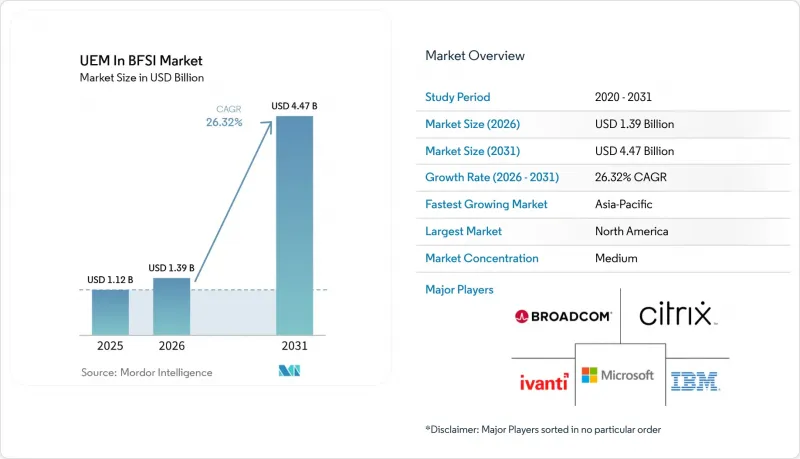
本報告按元件(解決方案[設備管理、應用管理、內容管理、安全與合規管理等]和服務)、部署模式(雲端、本地部署、混合部署)、組織規模(大型企業、中小企業)和地區(北美、南美等)進行細分。市場預測以美元計價。
銀行、金融服務和保險業統一端點管理 (UEM) 的全球趨勢和洞察
銀行業務中混合辦公和自備設備辦公模式的擴展
銀行、金融服務和保險 (BFSI) 產業對統一端點管理 (UEM) 的需求日益成長,源自於混合辦公模式的日益普及。這種模式使得個人自有設備的管治成為銀行和保險公司面臨的核心安全挑戰。美國銀行 2024 年的指導意見指出,金融機構除了需要製定明確的自帶設備 (BYOD) 計劃參與規則外,還需要實施端點安全、VPN 控制和多因素身份驗證,以保護敏感的財務資料。這種營運模式增加了受管節點的數量,因為所有連接到核心銀行系統的已通過核准筆記型電腦和行動裝置都需要執行策略、生命週期管理和安全存取管理。共用和分散式分店設備也增加了工作量,因為即使是部署到外勤員工,仍然需要在通用端點上實現安全的使用者隔離和受控登入行為。一家小型金融銀行在 25,000 台裝置上部署 ManageEngine Mobile Device Manager Plus 的案例表明,大型金融機構已經透過集中式策略框架管理遠端分店、共用裝置和 BYOD 端點。實際上,這使得終端健康管理成為銀行日常營運中的持續管理內容,這也是為什麼 BFSI 中的 UEM(統一終端管理)越來越接近安全和合規預算的主流。
在金融機構中實施零信任
銀行、金融服務和保險 (BFSI) 行業的統一端點管理 (UEM) 也受益於零信任計劃,該計劃將設備認證與身分、網路、應用程式和資料管理並列。歐盟委員會的 DORA 技術標準要求在更廣泛的 ICT 風險框架內安全管理攜帶式和非攜帶式端點設備,為受監管實體提供了加強端點管理的直接政策依據。發表在《世界先進工程技術與科學期刊》上的一項研究指出,端點保護、設備認證和行動裝置管理是金融機構零信任環境中的核心實施工具。歐洲銀行管理局 (EBA) 為 DORA 所做的準備工作也強調了金融機構需要加強營運彈性和第三方 ICT 監管,從而支援在整個結算和交易環境中實施更嚴格的設備管治。因此,BFSI 行業的統一端點管理 (UEM) 正在發展成為一種工具,它在受監管的零信任計劃下,結合了政策深度、即時態勢監控和快速響應措施。
資料主權和隱私合規性限制
在銀行、金融服務和保險 (BFSI) 行業,統一端點管理 (UEM) 面臨著資料主權方面最嚴峻的挑戰之一,因為端點平台現在必須遵守有關資料儲存位置、加密流程和資料匯出計劃的正式要求。國際應用專業人士協會 (IAPP) 對 2025 年 GDPR 和 DORA 整合的審查表明,金融機構必須將資訊通訊技術 (ICT) 合約視為合規手段,而不僅僅是例行的供應商文件,這縮小了雲端採用的選擇範圍。 Ivanti 於 2026 年 4 月發布了基於歐盟主權標準、託管在經 BSI 認證的歐洲基礎設施上並符合歐盟雲端主權框架的 Neurons for MDM 歐盟主權版,這表明供應商正在積極應對這一壓力。在法國,法國審慎監理局 (ACPR) 批准了 EBA/GL/2025/02《資訊通訊科技風險管理指南》,該指南將於 2025 年 5 月 20 日生效,進一步加重了合規負擔,強化了當地對受管資訊通訊科技管治的期望。因此,在銀行、金融服務和保險 (BFSI) 行業中,統一端點管理 (UEM) 供應商的選擇不再只是選擇產品的問題。這是因為部署位置、資料處理和合約結構現在都會影響平台是否獲得批准。類似的趨勢正在歐洲以外蔓延,自主部署和客戶控制的資料隔離仍然是採購審查的核心。
細分市場分析
預計到2025年,解決方案將佔總收入的68.43%,軟體平台在基準年仍將在銀行、金融服務和保險(BFSI)產業的統一端點管理(UEM)中佔據核心地位。銀行和保險公司更傾向於選擇功能更全面的套件,因為將安全合規管理、設備管理和分析工具整合到單一策略框架中更易於管理。這一趨勢與《資料保護條例》(DORA)及其相關財務管理中日益嚴格的文件要求密切相關,這些要求要求金融機構證明其如何識別、監控和應對整個端點環境中的設備風險。自備設備辦公室(BYOD)計畫的普及也提升了應用程式和內容管理的重要性,因為銀行需要在不削弱監管力度的前提下,將業務資料與個人內容分開。
儘管銀行、金融服務和保險 (BFSI) 行業的統一端點管理 (UEM) 服務部門規模仍然小規模,但隨著越來越多的金融機構尋求外部支援以進行部署設計、身分和存取管理 (IAM) 整合以及持續的合規性檢驗,其重要性日益凸顯。託管服務也滿足了該行業對明確第三方責任的需求,因為與 DORA 相關的合約強調服務連續性和明確的管理責任。根據 Ivanti 發布的 2025 年 DEX 報告,僅有 24% 的 IT 團隊表示在廣泛的 UEM 堆疊中部署了高度整合的 DEX 解決方案,這表明在體驗監控和工具整合方面存在服務交付方面的機會。未來,BFSI 行業的 UEM 可能會配置為支援規模化擴展和服務的平台,以應對整合、策略映射和審計合規性等更具挑戰性的任務。
區域分析
2025年,北美地區在BFSI(銀行、金融服務和保險)行業的統一端點管理(UEM)領域佔據了36.14%的收入佔有率,是該領域最大的市場佔有率。該地區的領先地位得益於成熟的網路安全廠商基礎、較高的企業雲端採用率以及已推動銀行設備管治更加規範化的法規環境。美國金融機構較早採用了「條件存取」方案,該方案將端點合規狀態反映在即時存取決策中,而不是將其儲存為單獨的審計記錄。在加拿大和墨西哥,隨著數位銀行的擴張以及當地監管機構越來越重視更嚴格的ICT管治,市場需求穩步成長。然而,該地區在實施方面仍存在差距。根據Talenbrium在2025年發布的報告顯示,55%的美國BFSI產業高層意識到迫切需要提升其在現代端點平台的技能。
歐洲仍然是金融服務業統一端點管理 (UEM) 的第二大貢獻者。這是因為 GDPR 和 DORA 將端點監管納入了更正式的董事會層面合規討論。德國和法國是要求極高的市場,金融機構必須將技術控制與嚴格的文件記錄和監管要求相一致。 2025 年 5 月,法國金融監理局 (ACPR) 通過了 EBA/GL/2025/02《資訊通訊技術風險管理指南》,進一步加強了法國金融機構的管治規範。南美、中東和非洲仍處於起步階段,但由於開放銀行的發展、沙烏地阿拉伯金融管理局 (SAMA)主導的網路安全要求以及行動支付和分散式代理網路的規範化,覆蓋的設備基數正在穩步擴大。
預計亞太地區在2026年至2031年間將以27.32%的複合年成長率成長,成為市場中成長最快的區域板塊。印度是關鍵的成長引擎,隨著數位銀行和支付銀行業務的擴張,以及對監管相關的IT風險日益成長的預期,正規金融管道中受管理的終端數量不斷增加。中國正透過廣泛的金融科技整合和嚴格的資料本地化措施擴大市場規模,這提升了集中式終端管治在大規模的員工和分店網路中的價值。日本和韓國則透過大型銀行和保險公司更結構化的雲端和安全監管機制為市場做出貢獻。東南亞在該地區的地位日益增強,行動優先的金融服務模式推動了面向客戶和員工管理的設備數量的激增,這些設備需要更嚴格的策略控制。
其他好處:
- Excel格式的市場預測(ME)表
- 3個月的分析師支持
目錄
第1章:引言
- 研究假設和市場定義
- 調查範圍
第2章:調查方法
第3章執行摘要
第4章 市場狀況
- 市場概覽
- 市場促進因素
- 銀行業務中混合辦公和自備設備辦公模式的擴展
- 在金融機構中實施零信任
- UEM(統一端點管理)與身分和存取控制的整合。
- 利用人工智慧最佳化數位化員工體驗
- 設備級碳排放和能源報告以履行ESG承諾
- 擴展一線和專用終端集群
- 市場限制因素
- 資料主權和隱私合規性限制
- 遷移和整合原有系統成本高昂
- 由於博通和VMware生態系統的變化,採購不確定性。
- 缺乏 UEM(統一端點管理)自動化和腳本編寫技能。
- 產業價值鏈分析
- 監理情勢
- 技術展望
- 宏觀經濟因素對市場的影響
- 波特五力分析
第5章 市場規模與成長預測
- 按組件
- 解決方案
- 設備管理
- 應用程式管理
- 內容管理
- 安全與合規管理
- 分析與自動化
- 服務
- 解決方案
- 部署模式
- 基於雲端的
- 現場
- 混合
- 按組織規模
- 大公司
- 小型企業
- 按地區
- 北美洲
- 美國
- 加拿大
- 墨西哥
- 南美洲
- 巴西
- 阿根廷
- 智利
- 哥倫比亞
- 其他南美國家
- 歐洲
- 德國
- 英國
- 法國
- 義大利
- 西班牙
- 荷蘭
- 北歐的
- 俄羅斯
- 其他歐洲國家
- 亞太地區
- 中國
- 日本
- 印度
- 韓國
- 澳洲和紐西蘭
- 東南亞
- 其他亞太國家
- 中東
- 沙烏地阿拉伯
- 阿拉伯聯合大公國
- 土耳其
- 以色列
- 其他中東國家
- 非洲
- 南非
- 埃及
- 奈及利亞
- 肯亞
- 其他非洲國家
- 北美洲
第6章 競爭情勢
- 市場集中度
- 策略趨勢
- 市佔率分析
- 公司簡介
- Microsoft Corporation
- Broadcom Inc.
- IBM Corporation
- Ivanti, Inc.
- Citrix Systems, Inc.
- BlackBerry Limited
- 42Gears Mobility Systems Private Limited
- Matrix42 AG
- SOTI Inc.
- Sophos Limited
- Zoho Corporation Pvt. Ltd.
- Cisco Systems, Inc.
- Jamf Holding Corp.
- Tanium Inc.
- Google LLC
- Kaseya Limited
- NinjaOne, LLC
- Automox, Inc.
- Open Text Corporation
- Quest Software Inc.
第7章 市場機會與未來展望
According to Mordor Intelligence, the UEM in BFSI market size was valued at USD 1.12 billion in 2025 and estimated to grow from USD 1.39 billion in 2026 to reach USD 4.47 billion by 2031, at a CAGR of 26.32% during the forecast period (2026-2031).
This report is Segmented by Component (Solutions [Device Management, Application Management, Content Management, Security and Compliance Management, and More], and Services), Deployment Mode (Cloud-Based, On-Premise, and Hybrid), Organization Size (Large Enterprises, and Small and Medium Enterprises), and Geography (North America, South America, and More). The Market Forecasts are Provided in Terms of Value (USD).
Global UEM In BFSI Market Trends and Insights
Hybrid Work and BYOD Expansion in Banking Operations
The UEM in BFSI market is seeing stronger demand because hybrid work has made personal-device governance a core security task for banks and insurers. Bank of America's 2024 guidance states that institutions need clear rules on which devices can enter BYOD programs, along with endpoint security, VPN controls, and multifactor authentication to protect sensitive financial data. That operating model increases the number of managed nodes because every approved laptop or mobile device that connects to core banking systems requires policy enforcement, lifecycle management, and secure access management. Shared and distributed branch devices add to the same workload because frontline worker deployments still require secure user separation and controlled sign-in behavior across common endpoints. Small Finance Bank's rollout of ManageEngine Mobile Device Manager Plus across 25,000 devices shows how large financial institutions are already managing remote branches, shared devices, and BYOD endpoints through centralized policy frameworks. In practice, this makes endpoint posture a standing control in day-to-day banking operations, which is why the UEM in BFSI market keeps moving closer to mainstream security and compliance budgets.
Zero Trust Rollouts Across Financial Institutions
The UEM in BFSI market is also benefiting from zero trust programs that place device verification alongside identity, network, application, and data controls. The European Commission's DORA technical standards require the secure management of portable and non-portable endpoint devices within the broader ICT risk framework, providing regulated institutions with a direct policy basis for stronger endpoint control. Research in the World Journal of Advanced Engineering Technology and Sciences describes endpoint protection, device attestation, and mobile device management as core enforcement tools within zero-trust environments for financial institutions. The EBA's DORA preparation work also reinforces the need for financial entities to strengthen operational resilience and third-party ICT oversight, which supports more disciplined device governance across payment and transaction environments. As a result, the UEM in BFSI market is moving toward tools that combine policy depth, live posture monitoring, and faster response actions under regulated zero trust programs.
Data Sovereignty and Privacy Compliance Constraints
The UEM in BFSI market faces one of its clearest limits in data sovereignty because endpoint platforms now sit inside formal requirements on data location, encryption handling, and exit planning. IAPP's 2025 review of GDPR and DORA integration shows that financial institutions must treat ICT contracts as compliance instruments, not as routine vendor paperwork, which narrows the field for cloud deployments. Ivanti's April 2026 launch of a sovereign EU edition for Neurons for MDM, hosted on BSI-certified European infrastructure and aligned with the EU Cloud Sovereignty Framework, shows how directly vendors are responding to this pressure. France also added to the compliance load when ACPR endorsed the EBA/GL/2025/02 ICT risk management guidelines, effective May 20, 2025, which reinforced local expectations around controlled ICT governance. The practical effect is that vendor selection in the UEM in BFSI market is not only a product decision, because deployment location, data handling, and contractual structure now influence whether a platform can be approved at all. Similar patterns are spreading beyond Europe, keeping sovereign deployment and customer-managed data separation near the center of procurement reviews.
Other drivers and restraints analyzed in the detailed report include:
- Convergence of UEM With Identity and Access Controls
- AI-Driven Digital Employee Experience Optimization
- High Migration and Integration Cost of Legacy Estates
For complete list of drivers and restraints, kindly check the Table Of Contents.
Segment Analysis
Solutions accounted for 68.43% of revenue in 2025, keeping software platforms at the center of the UEM in the BFSI market during the base year. Banks and insurers favored broader suites because security and compliance management, device management, and analytics tools are easier to manage when they sit within a single policy structure. That preference is tied to stronger documentation requirements under DORA and related financial controls, where institutions must demonstrate how device risk is identified, monitored, and addressed across the endpoint estate. Application management and content management also gained weight as BYOD programs required banks to separate business data from personal content without weakening oversight.
The services side of the UEM in BFSI market remained smaller, but it gained importance as institutions sought outside help with rollout design, IAM integration, and ongoing compliance validation. Managed services also meet the sector's need for clearer third-party accountability, as DORA-related contracting emphasizes service continuity and documented control responsibilities. Ivanti's 2025 DEX report found that only 24% of IT teams reported highly integrated DEX solutions within the broader UEM stack, suggesting a service opportunity in experience monitoring and tool integration. Over time, this leaves the UEM in BFSI industry with a component mix where platforms drive scale, while services support the harder work of integration, policy mapping, and audit readiness.
Complete Report Scope:
- By Component
- Solutions
- Device Management
- Application Management
- Content Management
- Security and Compliance Management
- Analytics and Automation
- Services
- Solutions
- By Deployment Mode
- Cloud-Based
- On-Premise
- Hybrid
- By Organization Size
- Large Enterprises
- Small and Medium Enterprises
- By Geography
- North America
- United States
- Canada
- Mexico
- South America
- Brazil
- Argentina
- Chile
- Colombia
- Rest of South America
- Europe
- Germany
- United Kingdom
- France
- Italy
- Spain
- Netherlands
- Nordics
- Russia
- Rest of Europe
- Asia-Pacific
- China
- Japan
- India
- South Korea
- Australia and New Zealand
- Southeast Asia
- Rest of Asia-Pacific
- Middle East
- Saudi Arabia
- United Arab Emirates
- Turkey
- Israel
- Rest of Middle East
- Africa
- South Africa
- Egypt
- Nigeria
- Kenya
- Rest of Africa
- North America
Geography Analysis
North America accounted for 36.14% of revenue in 2025, giving the region the largest position in the UEM BFSI market share during the base year. The region's lead rests on a mature cybersecurity vendor base, high enterprise cloud use, and a regulatory setting that already pushes banks toward more formalized device governance. United States institutions have moved early on conditional-access endpoint programs, in which real-time device compliance is linked to access decisions rather than recorded as a separate audit record. Canada and Mexico added incremental demand as digital banking expanded and local oversight moved closer to stronger ICT governance expectations. The region still faces an execution gap, as Talenbrium reported in 2025 that 55% of United States BFSI executives identified urgent upskilling needs in modern endpoint platforms.
Europe remained the second-largest contributor to the UEM in BFSI market because GDPR and DORA have pushed endpoint oversight into a more formal board-level compliance discussion. Germany and France stood out as demanding markets where institutions must align technical controls with strict documentation and supervisory expectations. ACPR's adoption of the EBA/GL/2025/02 ICT risk management guidelines from May 2025 added another layer of governance discipline for French institutions ACPR. South America, the Middle East, and Africa remained earlier-stage regions, but open banking growth, SAMA-led cybersecurity requirements, and formalization of mobile money and distributed agent networks were steadily broadening the addressable device base.
Asia-Pacific is projected to grow at a 27.32% CAGR from 2026 to 2031, which makes it the fastest-growing regional block in the UEM in BFSI market size outlook. India is a major growth engine because digital banking expansion, payment bank activity, and stronger regulated IT risk expectations are increasing the number of managed endpoints across formal financial channels. China adds scale through broad fintech integration and strict data localization practices, which raise the value of centralized endpoint governance across large employee and branch networks. Japan and South Korea contribute through more structured cloud and security oversight across major banks and insurers. Southeast Asia strengthens the regional profile because mobile-first financial services models create growing volumes of customer-facing and employee-managed devices that require tighter policy control.
- Microsoft Corporation
- Broadcom Inc.
- IBM Corporation
- Ivanti, Inc.
- Citrix Systems, Inc.
- BlackBerry Limited
- 42Gears Mobility Systems Private Limited
- Matrix42 AG
- SOTI Inc.
- Sophos Limited
- Zoho Corporation Pvt. Ltd.
- Cisco Systems, Inc.
- Jamf Holding Corp.
- Tanium Inc.
- Google LLC
- Kaseya Limited
- NinjaOne, LLC
- Automox, Inc.
- Open Text Corporation
- Quest Software Inc.
Additional Benefits:
- The market estimate (ME) sheet in Excel format
- 3 months of analyst support
TABLE OF CONTENTS
1 INTRODUCTION
- 1.1 Study Assumptions and Market Definition
- 1.2 Scope of the Study
2 RESEARCH METHODOLOGY
3 EXECUTIVE SUMMARY
4 MARKET LANDSCAPE
- 4.1 Market Overview
- 4.2 Market Drivers
- 4.2.1 Hybrid Work and BYOD Expansion in Banking Operations
- 4.2.2 Zero Trust Rollouts Across Financial Institutions
- 4.2.3 Convergence of UEM with Identity and Access Controls
- 4.2.4 AI-Driven Digital Employee Experience Optimization
- 4.2.5 Device-Level Carbon and Energy Reporting for ESG Commitments
- 4.2.6 Growth in Frontline and Specialized Endpoint Fleets
- 4.3 Market Restraints
- 4.3.1 Data Sovereignty and Privacy Compliance Constraints
- 4.3.2 High Migration and Integration Cost of Legacy Estates
- 4.3.3 Procurement Uncertainty Following Broadcom and VMware Ecosystem Changes
- 4.3.4 Shortage of UEM Automation and Scripting Skills
- 4.4 Industry Value Chain Analysis
- 4.5 Regulatory Landscape
- 4.6 Technological Outlook
- 4.7 Impact of Macroeconomic Factors on the Market
- 4.8 Porter's Five Forces Analysis
- 4.8.1 Threat of New Entrants
- 4.8.2 Bargaining Power of Buyers
- 4.8.3 Bargaining Power of Suppliers
- 4.8.4 Threat of Substitutes
- 4.8.5 Industry Rivalry
5 MARKET SIZE AND GROWTH FORECASTS (VALUE)
- 5.1 By Component
- 5.1.1 Solutions
- 5.1.1.1 Device Management
- 5.1.1.2 Application Management
- 5.1.1.3 Content Management
- 5.1.1.4 Security and Compliance Management
- 5.1.1.5 Analytics and Automation
- 5.1.2 Services
- 5.1.1 Solutions
- 5.2 By Deployment Mode
- 5.2.1 Cloud-Based
- 5.2.2 On-Premise
- 5.2.3 Hybrid
- 5.3 By Organization Size
- 5.3.1 Large Enterprises
- 5.3.2 Small and Medium Enterprises
- 5.4 By Geography
- 5.4.1 North America
- 5.4.1.1 United States
- 5.4.1.2 Canada
- 5.4.1.3 Mexico
- 5.4.2 South America
- 5.4.2.1 Brazil
- 5.4.2.2 Argentina
- 5.4.2.3 Chile
- 5.4.2.4 Colombia
- 5.4.2.5 Rest of South America
- 5.4.3 Europe
- 5.4.3.1 Germany
- 5.4.3.2 United Kingdom
- 5.4.3.3 France
- 5.4.3.4 Italy
- 5.4.3.5 Spain
- 5.4.3.6 Netherlands
- 5.4.3.7 Nordics
- 5.4.3.8 Russia
- 5.4.3.9 Rest of Europe
- 5.4.4 Asia-Pacific
- 5.4.4.1 China
- 5.4.4.2 Japan
- 5.4.4.3 India
- 5.4.4.4 South Korea
- 5.4.4.5 Australia and New Zealand
- 5.4.4.6 Southeast Asia
- 5.4.4.7 Rest of Asia-Pacific
- 5.4.5 Middle East
- 5.4.5.1 Saudi Arabia
- 5.4.5.2 United Arab Emirates
- 5.4.5.3 Turkey
- 5.4.5.4 Israel
- 5.4.5.5 Rest of Middle East
- 5.4.6 Africa
- 5.4.6.1 South Africa
- 5.4.6.2 Egypt
- 5.4.6.3 Nigeria
- 5.4.6.4 Kenya
- 5.4.6.5 Rest of Africa
- 5.4.1 North America
6 COMPETITIVE LANDSCAPE
- 6.1 Market Concentration
- 6.2 Strategic Moves
- 6.3 Market Share Analysis
- 6.4 Company Profiles (includes Global Level Overview, Market Level Overview, Core Segments, Financials as available, Strategic Information, Market Rank/Share, Products and Services, Recent Developments)
- 6.4.1 Microsoft Corporation
- 6.4.2 Broadcom Inc.
- 6.4.3 IBM Corporation
- 6.4.4 Ivanti, Inc.
- 6.4.5 Citrix Systems, Inc.
- 6.4.6 BlackBerry Limited
- 6.4.7 42Gears Mobility Systems Private Limited
- 6.4.8 Matrix42 AG
- 6.4.9 SOTI Inc.
- 6.4.10 Sophos Limited
- 6.4.11 Zoho Corporation Pvt. Ltd.
- 6.4.12 Cisco Systems, Inc.
- 6.4.13 Jamf Holding Corp.
- 6.4.14 Tanium Inc.
- 6.4.15 Google LLC
- 6.4.16 Kaseya Limited
- 6.4.17 NinjaOne, LLC
- 6.4.18 Automox, Inc.
- 6.4.19 Open Text Corporation
- 6.4.20 Quest Software Inc.
7 MARKET OPPORTUNITIES AND FUTURE OUTLOOK
- 7.1 White-Space and Unmet-Need Assessment

 整合端點管理市場-2026-2032年全球市場預測
 中東和非洲統一端點管理 (UEM):市場佔有率分析、行業趨勢和統計數據以及成長預測 (2026-2031)亞太地區統一端點管理 (UEM):市場佔有率分析、產業趨勢與統計、成長預測(2026-2031 年)北美統一端點管理 (UEM):市場佔有率分析、行業趨勢和統計數據、成長預測(2026-2031 年)南美洲統一端點管理 (UEM):市場佔有率分析、行業趨勢和統計數據以及成長預測 (2026-2031)整合終端管理:市場佔有率分析、產業趨勢與統計、成長預測(2026-2031)東協統一端點管理 (UEM):市場佔有率分析、產業趨勢與統計及成長預測 (2026-2031)歐洲統一端點管理 (UEM):市場佔有率分析、產業趨勢與統計及成長預測 (2026-2031)泰國:市場佔有率分析、產業趨勢與統計、成長預測(2026-2031)越南統一端點管理 (UEM):市場佔有率分析、產業趨勢與統計及成長預測 (2026-2031)