


 |
市場調查報告書
商品編碼
2098460
南美洲統一端點管理 (UEM):市場佔有率分析、行業趨勢和統計數據以及成長預測 (2026-2031)South America UEM - Market Share Analysis, Industry Trends & Statistics, Growth Forecasts (2026 - 2031) |
||||||

※ 本網頁內容可能與最新版本有所差異。詳細情況請與我們聯繫。
據 Mordor Intelligence 稱,2025 年南美 UEM(統一端點管理)市場價值為 3.6 億美元,預計從 2026 年到 2031 年將以 27.08% 的複合年成長率成長,到 2031 年達到 14.8 億美元。
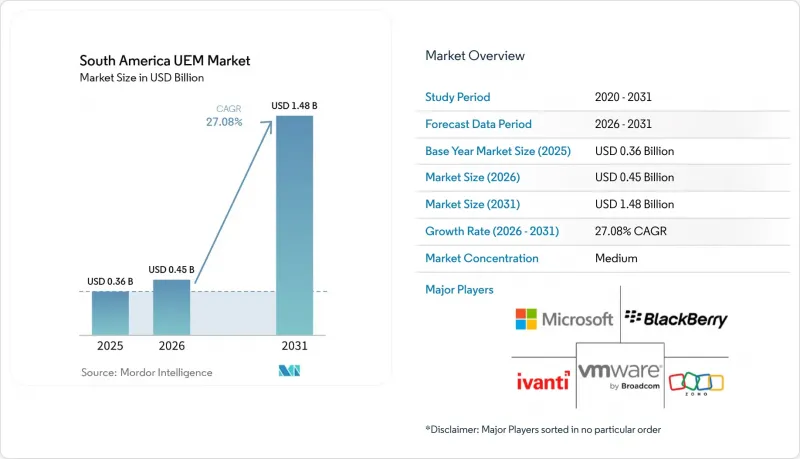
本報告按組件(解決方案和服務)、部署模式(雲端、本地部署等)、組織規模(大型企業和中小企業)、最終用戶產業(IT與電信、政府與國防、醫療保健與生命科學、製造業、零售與電子商務等)以及國家/地區進行細分。市場預測以美元計價。
南美洲統一端點管理 (UEM) 市場的趨勢與洞察
自帶設備辦公室 (BYOD) 和混合辦公模式的興起導致設備數量的增加。
南美洲統一端點管理 (UEM) 市場正受到企業環境中個人和遠端辦公設備激增的推動。這種壓力並非主要來自端點數量的成長,而是源自於 iOS、Android 和 Windows 裝置如今被整合到單一企業身分和存取架構下的複雜局面。混合辦公模式的興起進一步加劇了這項挑戰,因為員工在同一工作週期內需要在辦公室網路、家庭網路連線和公共網路基地台之間切換。這使得執行注重隱私的策略變得更加重要,因為 IT 團隊必須在保護個人裝置上的工作資料的同時,避免過度干擾員工的個人使用。在南美洲 UEM 市場,這種轉變促使買家從單一功能的行動裝置管理工具轉向能夠從單一主機整合註冊、修補程式和合規性管理的平台。因此,市場對能夠消除不同設備群間策略不一致,同時又便於區域 IT 團隊管理的軟體的需求正在穩步成長。
網路攻擊頻率激增,主要目標是終端設備。
南美洲的整合端點管理 (UEM) 市場也受到針對端點的網路風險激增的推動。 Fortinet 的一份報告顯示,到 2025 年,巴西企業將遭受 7,538 億次網路攻擊,光是 10 月就記錄了 1,980 億次攻擊。政府、教育和能源產業尤其容易受到攻擊。 Acronis 也指出,在 2025 年上半年,巴西將成為全球惡意軟體攻擊數量第二高的國家,LockBit、Play 和 8Base 等勒索軟體組織將繼續攻擊製造業和 IT 相關目標。 Sophos 的研究表明,2025 年巴西 54% 的勒索軟體事件導致資料加密,高於 50% 的全球平均值。這充分顯示了端點的脆弱性。在南美洲的 UEM 市場,由於現有工具難以偵測到受感染設備之間的橫向移動,買家越來越將整合遙測功能視為一項安全要求。因此,端點管理正在從單純的管理功能轉變為支援更廣泛的保全行動的控制點。
中型企業的預算考量
預算壓力仍然是南美洲統一端點管理 (UEM) 市場發展的一大阻礙,尤其對於必須在設備軟體成本與其他緊迫的 IT 需求之間取得平衡的中型企業而言更是如此。這種情況在阿根廷尤為突出,貨幣不穩定導致一些企業推遲了廣泛的平台整合,或選擇功能更輕的行動工具。此外,許多企業缺乏專門的端點管理專家,這意味著總成本不僅受授權費用影響,還受外部部署和支援費用的影響。雖然通訊業者捆綁的設備管理方案提供了一些替代方案,但就策略性細化和合規性報告而言,它們往往無法滿足受監管買家的需求。在南美洲 UEM 市場,這意味著即使在潛力最大的細分市場,其普及速度也遠不及設備成長速度。對於管理設備數量少於 500 台的企業而言,在雲端定價變得更加永續之前,這種限制可能會持續存在。
細分市場分析
至2025年,「解決方案」細分市場將佔市場佔有率的63.66%,而在南美整合終端管理市場,該細分市場預計到2031年將以28.22%的複合年成長率成長。如此龐大的市場規模和成長率表明,買家仍然傾向於軟體主導的整合方案,而不是僅依賴服務。企業正朝著整合套件的方向發展,這些套件將設備管理、應用控制、合規性管理、內容監控和分析功能整合到一個統一的環境中。對於那些需要在不增加冗餘工具的情況下實現更廣泛控制的IT團隊而言,這一趨勢尤其明顯。這也反映出企業需要將行動裝置、筆記型電腦、桌上型電腦和現場終端統一到一個策略框架下進行管理。
由於南美洲統一端點管理 (UEM) 市場在安全性和合規性方面面臨著巨大的營運壓力,解決方案中包含的軟體配置正朝著安全性和合規性方向發展。買家越來越需要端點遙測資料來最佳化安全工作流程,因此,與僅使用基本裝置管理軟體相比,專用軟體在支出決策中扮演更重要的角色。分析和自動化也變得越來越重要,尤其對於那些尋求預測性修補程式和自我修復功能以減少工單量的大規模客戶而言更是如此。由巴西 Mater Dei 大學實施的 ManageEngine Endpoint Central 展示了單一平台如何幫助 IT 團隊更新大規模端點環境、管理應用程式,並透過統一的主機提供安全的遠端支援。雖然服務仍然至關重要,尤其對於那些需要在策略設計和生命週期執行方面獲得外部支援的中型企業而言,但最終的購買決策仍然圍繞著平臺本身。
預計到2025年,基於雲端的部署將佔據56.78%的市場佔有率,而採用這種方式的南美統一端點管理 (UEM) 市場預計到2031年將以28.67%的複合年成長率成長。這一成長既反映了雲端部署的實際優勢,也反映了託管企業軟體在該地區日益普及。雲端交付縮短了部署時間,無需大規模的基礎設施,並實現了基於設備的定價。此外,它還使客戶能夠快速存取新功能,這在安全性策略和端點行為不斷演變的快速變化的領域至關重要。在南美洲統一端點管理市場,對於那些尋求減少設定負擔和定期功能更新的買家而言,雲端架構正成為他們的標準選擇。
基礎設施也得到了改善。微軟承諾向巴西的雲端和人工智慧基礎設施投資147億雷亞爾(約29億美元),加上AWS在聖保羅的擴張,緩解了先前阻礙高敏感環境採用雲端服務的資料儲存位置的擔憂。微軟也透過2026年Intune藍圖,為雲端租戶增加了熱補丁安全更新、增強了對Linux的登入支援以及人工智慧輔助的策略設定功能。在政府、國防、銀行、金融、保險和證券(BFSI)以及製造業等對業務連續性和主權要求仍然很高的行業,本地部署仍然至關重要。混合模式也越來越受歡迎,它允許在本地基礎設施上維護舊的Windows環境,同時將雲端策略應用於自帶設備辦公室(BYOD)和行動終端。這為供應商帶來了兩個機會:既可以留住現有的本地部署客戶,又可以逐步引導他們過渡到雲端訂閱。
其他好處:
- Excel格式的市場預測(ME)表
- 3個月的分析師支持
目錄
第1章:引言
- 研究假設和市場定義
- 調查範圍
第2章:調查方法
第3章執行摘要
第4章 市場狀況
- 市場概覽
- 市場促進因素
- 自帶設備辦公室 (BYOD) 的興起以及混合辦公環境中設備的無序擴張。
- 針對終端的網路攻擊日益頻繁
- 選擇雲端解決方案可實現快速部署並降低初始成本。
- 在多作業系統環境中,需要集中式策略執行。
- 關於遙測資料和設備合規性日誌的資料儲存位置的壓力。
- 零售、物流和現場工作人員的行動性正在推動對託管終端的需求。
- 市場限制因素
- 中端市場買家對預算的敏感度
- 傳統終端工具的碎片化與遷移複雜性
- 缺乏內部政策編配和自動化方面的技能
- 對雲控制平面中的延遲和主權問題的擔憂
- 產業價值鏈分析
- 宏觀經濟因素對市場的影響
- 監理情勢
- 技術展望
- 波特五力分析
第5章 市場規模與成長預測
- 按組件
- 解決方案
- 設備管理
- 應用程式管理
- 內容管理
- 安全與合規管理
- 分析與自動化
- 服務
- 解決方案
- 部署模式
- 基於雲端的
- 現場
- 混合
- 按組織規模
- 大公司
- 小型企業
- 按最終用戶行業分類
- 資訊科技/通訊
- BFSI
- 政府/國防
- 醫療保健和生命科學
- 製造業
- 零售與電子商務
- 教育
- 運輸/物流
- 能源公用事業
- 其他終端用戶產業
- 國家
- 巴西
- 阿根廷
- 智利
- 其他南美國家
第6章 競爭情勢
- 市場集中度
- 策略趨勢
- 市佔率分析
- 公司簡介
- Microsoft Corporation
- VMware, Inc.(Broadcom Inc.)
- Ivanti, Inc.
- BlackBerry Limited
- IBM Corporation
- Citrix Systems, Inc.(Cloud Software Group, Inc.)
- Zoho Corporation Pvt. Ltd.
- SOTI Inc.
- Sophos Limited
- HCL Technologies Limited
- ManageEngine(Zoho Corporation Pvt. Ltd.)
- Jamf Holding Corp.
- Kandji, Inc.
- CrowdStrike Holdings, Inc.
- Google LLC
- Samsung Electronics Co., Ltd.
- Motorola Solutions, Inc.
- Lenovo Group Limited
- Dell Technologies Inc.
- HP Inc.
- Baramundi Software GmbH
第7章 市場機會與未來展望
According to Mordor Intelligence, the South America UEM market size was valued at USD 0.36 billion in 2025 and is forecast to reach USD 1.48 billion by 2031 at a CAGR of 27.08% during 2026-2031.
This report is Segmented by Component (Solutions and Services), Deployment Mode (Cloud-Based, On-Premise, and More), Organization Size (Large Enterprises and Small and Medium Enterprises), End-User Industry (IT and Telecommunications, Government and Defense, Healthcare and Life Sciences, Manufacturing, Retail and E-Commerce, and More), and Country. The Market Forecasts are Provided in Terms of Value (USD).
South America UEM Market Trends and Insights
Rising BYOD and Hybrid Work Device Sprawl
The South America UEM market is gaining support from the spread of personal and remote-work devices across enterprise environments. The pressure comes less from the number of endpoints alone and more from the mix of iOS, Android, and Windows devices that now sit under one corporate identity and access structure. Hybrid work has made that challenge harder, because employees move between office networks, home connections, and public access points during the same work cycle. This has made privacy-aware policy enforcement more important, since IT teams must secure business data on personal devices without overreaching into personal use. In the South America UEM market, this shift is moving buyers away from narrow mobile device tools and toward platforms that can manage enrollment, patching, and compliance from one console. The result is steady demand for software that can reduce policy gaps across mixed fleets while keeping administration practical for regional IT teams.
Escalating Endpoint-Centric Cyberattack Frequency
The South America unified endpoint management market is also being pushed by a sharp increase in endpoint-focused cyber risk. Fortinet reported 753.8 billion attempted cyberattacks against Brazilian organizations in 2025, and October alone absorbed 198 billion attempts, with government, education, and energy among the most exposed sectors. Acronis also identified Brazil as the second most malware-attacked country globally in H1 2025, while ransomware groups such as LockBit, Play, and 8Base sustained campaigns against manufacturing and IT targets. Sophos found that 54% of ransomware incidents in Brazil resulted in data encryption in 2025, above the global average of 50%, which shows how exposed endpoints have become in practical terms. In the South America UEM market, buyers increasingly treat unified telemetry as a security requirement because separate tools make lateral movement harder to detect across compromised devices. This is turning endpoint management from an administrative function into a control point that feeds broader security operations.
Budget Sensitivity Among Mid-Market Buyers
Budget pressure remains a real brake on the South America UEM market, especially in mid-market organizations that must weigh per-device software costs against other immediate IT needs. This is especially visible in Argentina, where currency instability has pushed some organizations to delay broader platform consolidation or choose lighter mobility tools instead. Many of these companies also lack dedicated endpoint specialists, so total cost depends not just on licensing but also on outside implementation and support. Telco-bundled device management options offer a partial alternative, but they often fall short on policy depth and compliance reporting for regulated buyers. In the South America UEM market, this means the segment with the widest untapped potential still adopts more slowly than its device growth would suggest. Until cloud pricing becomes easier to sustain for organizations managing fewer than 500 devices, this restraint is likely to remain visible.
Other drivers and restraints analyzed in the detailed report include:
- Cloud Delivery Preference for Faster Rollout and Lower Upfront Cost
- Need for Centralized Policy Enforcement Across Multi-OS Fleets
- Legacy Endpoint Tool Fragmentation and Migration Complexity
For complete list of drivers and restraints, kindly check the Table Of Contents.
Segment Analysis
Solutions held 63.66% of the market in 2025, and within the South America unified endpoint management market, the same segment is projected to grow at a 28.22% CAGR through 2031. This combination of scale and growth shows that buyers still prefer software-led consolidation over a services-only approach. Companies are moving toward integrated suites that combine device management, application control, compliance management, content oversight, and analytics in one environment. That preference is strongest where IT teams need broader control without adding more overlapping tools. It also reflects the need to unify administration across mobile devices, laptops, desktops, and frontline endpoints under one policy structure.
The software mix inside solutions is shifting toward security and compliance functions because that is where operational pressure is highest in the South America UEM market. Buyers increasingly want endpoint telemetry to feed security workflows, and that makes purpose-built software more central to spending decisions than basic device administration alone. Analytics and automation are also gaining weight, especially in larger accounts that want predictive patching and self-healing actions to reduce ticket volumes. ManageEngine's Endpoint Central deployment at Mater Dei in Brazil showed how one platform could help IT teams update large endpoint estates, control applications, and provide secure remote support from a unified console. Services still matter, especially for mid-sized organizations that need outside help with policy design and lifecycle execution, but the buying center remains anchored in the platform itself.
Cloud-based deployment held 56.78% share in 2025, and the South America UEM market size for this mode is projected to expand at a 28.67% CAGR through 2031. That performance reflects both practical deployment advantages and broader acceptance of hosted enterprise software in the region. Cloud delivery shortens rollout time, removes heavy infrastructure requirements, and makes pricing easier to match to device counts. It also gives customers faster access to new features, which matters in a category where security policy and endpoint behavior change quickly. In the South America unified endpoint management market, cloud architecture is becoming the default path for buyers that want lower setup friction and regular feature updates.
The infrastructure backdrop has also improved. Microsoft's BRL 14.7 billion (USD 2.9 billion), commitment to Brazilian cloud and AI infrastructure and AWS expansion in Sao Paulo helped reduce the data-location concern that once slowed adoption in sensitive environments. Microsoft also used its 2026 Intune roadmap to add hotpatch security updates, stronger Linux sign-on support, and AI-assisted policy configuration for cloud tenants. On-premises deployments still hold relevance in government, defense, BFSI, and manufacturing where continuity and sovereignty concerns remain stronger. Hybrid models are also gaining use because they let organizations apply cloud policy to BYOD and mobile endpoints while keeping older Windows environments on local infrastructure. This leaves vendors with a two-track opportunity, defending installed on-premises accounts while pulling those customers toward cloud subscriptions over time.
Complete Report Scope:
- By Component
- Solutions
- Device Management
- Application Management
- Content Management
- Security and Compliance Management
- Analytics and Automation
- Services
- Solutions
- By Deployment Mode
- Cloud-Based
- On-Premise
- Hybrid
- By Organization Size
- Large Enterprises
- Small and Medium Enterprises
- By End-User Industry
- IT and Telecommunications
- BFSI
- Government and Defense
- Healthcare and Life Sciences
- Manufacturing
- Retail and E-Commerce
- Education
- Transportation and Logistics
- Energy and Utilities
- Other End-User Industries
- By Country
- Brazil
- Argentina
- Chile
- Rest of South America
List of Companies Covered in this Report:
- Microsoft Corporation
- VMware, Inc. (Broadcom Inc.)
- Ivanti, Inc.
- BlackBerry Limited
- IBM Corporation
- Citrix Systems, Inc. (Cloud Software Group, Inc.)
- Zoho Corporation Pvt. Ltd.
- SOTI Inc.
- Sophos Limited
- HCL Technologies Limited
- ManageEngine (Zoho Corporation Pvt. Ltd.)
- Jamf Holding Corp.
- Kandji, Inc.
- CrowdStrike Holdings, Inc.
- Google LLC
- Samsung Electronics Co., Ltd.
- Motorola Solutions, Inc.
- Lenovo Group Limited
- Dell Technologies Inc.
- HP Inc.
- Baramundi Software GmbH
Additional Benefits:
- The market estimate (ME) sheet in Excel format
- 3 months of analyst support
TABLE OF CONTENTS
1 INTRODUCTION
- 1.1 Study Assumptions and Market Definition
- 1.2 Scope of the Study
2 RESEARCH METHODOLOGY
3 EXECUTIVE SUMMARY
4 MARKET LANDSCAPE
- 4.1 Market Overview
- 4.2 Market Drivers
- 4.2.1 Rising BYOD and Hybrid Work Device Sprawl
- 4.2.2 Escalating Endpoint-Centric Cyberattack Frequency
- 4.2.3 Cloud Delivery Preference for Faster Rollout and Lower Upfront Cost
- 4.2.4 Need for Centralized Policy Enforcement Across Multi-OS Fleets
- 4.2.5 Data Residency Pressure on Telemetry and Device Compliance Logs
- 4.2.6 Retail, Logistics, and Field Workforce Mobility Expanding Managed Endpoint Demand
- 4.3 Market Restraints
- 4.3.1 Budget Sensitivity Among Mid-Market Buyers
- 4.3.2 Legacy Endpoint Tool Fragmentation and Migration Complexity
- 4.3.3 Limited Internal Skill Availability for Policy Orchestration and Automation
- 4.3.4 Concerns Over Cloud Control Plane Latency and Sovereignty
- 4.4 Industry Value Chain Analysis
- 4.5 Impact of Macroeconomic Factors on the Market
- 4.6 Regulatory Landscape
- 4.7 Technological Outlook
- 4.8 Porter's Five Forces Analysis
- 4.8.1 Threat of New Entrants
- 4.8.2 Bargaining Power of Suppliers
- 4.8.3 Bargaining Power of Buyers
- 4.8.4 Threat of Substitutes
- 4.8.5 Intensity of Competitive Rivalry
5 MARKET SIZE AND GROWTH FORECASTS
- 5.1 By Component
- 5.1.1 Solutions
- 5.1.1.1 Device Management
- 5.1.1.2 Application Management
- 5.1.1.3 Content Management
- 5.1.1.4 Security and Compliance Management
- 5.1.1.5 Analytics and Automation
- 5.1.2 Services
- 5.1.1 Solutions
- 5.2 By Deployment Mode
- 5.2.1 Cloud-Based
- 5.2.2 On-Premise
- 5.2.3 Hybrid
- 5.3 By Organization Size
- 5.3.1 Large Enterprises
- 5.3.2 Small and Medium Enterprises
- 5.4 By End-User Industry
- 5.4.1 IT and Telecommunications
- 5.4.2 BFSI
- 5.4.3 Government and Defense
- 5.4.4 Healthcare and Life Sciences
- 5.4.5 Manufacturing
- 5.4.6 Retail and E-Commerce
- 5.4.7 Education
- 5.4.8 Transportation and Logistics
- 5.4.9 Energy and Utilities
- 5.4.10 Other End-User Industries
- 5.5 By Country
- 5.5.1 Brazil
- 5.5.2 Argentina
- 5.5.3 Chile
- 5.5.4 Rest of South America
6 COMPETITIVE LANDSCAPE
- 6.1 Market Concentration
- 6.2 Strategic Moves
- 6.3 Market Share Analysis
- 6.4 Company Profiles (includes Global Level Overview, Market Level Overview, Core Segments, Financials as available, Strategic Information, Market Rank/Share, Products and Services, Recent Developments)
- 6.4.1 Microsoft Corporation
- 6.4.2 VMware, Inc. (Broadcom Inc.)
- 6.4.3 Ivanti, Inc.
- 6.4.4 BlackBerry Limited
- 6.4.5 IBM Corporation
- 6.4.6 Citrix Systems, Inc. (Cloud Software Group, Inc.)
- 6.4.7 Zoho Corporation Pvt. Ltd.
- 6.4.8 SOTI Inc.
- 6.4.9 Sophos Limited
- 6.4.10 HCL Technologies Limited
- 6.4.11 ManageEngine (Zoho Corporation Pvt. Ltd.)
- 6.4.12 Jamf Holding Corp.
- 6.4.13 Kandji, Inc.
- 6.4.14 CrowdStrike Holdings, Inc.
- 6.4.15 Google LLC
- 6.4.16 Samsung Electronics Co., Ltd.
- 6.4.17 Motorola Solutions, Inc.
- 6.4.18 Lenovo Group Limited
- 6.4.19 Dell Technologies Inc.
- 6.4.20 HP Inc.
- 6.4.21 Baramundi Software GmbH
7 MARKET OPPORTUNITIES AND FUTURE OUTLOOK
- 7.1 White-Space and Unmet-Need Assessment

 整合端點管理市場-2026-2032年全球市場預測
 中東和非洲統一端點管理 (UEM):市場佔有率分析、行業趨勢和統計數據以及成長預測 (2026-2031)亞太地區統一端點管理 (UEM):市場佔有率分析、產業趨勢與統計、成長預測(2026-2031 年)北美統一端點管理 (UEM):市場佔有率分析、行業趨勢和統計數據、成長預測(2026-2031 年)整合終端管理:市場佔有率分析、產業趨勢與統計、成長預測(2026-2031)東協統一端點管理 (UEM):市場佔有率分析、產業趨勢與統計及成長預測 (2026-2031)歐洲統一端點管理 (UEM):市場佔有率分析、產業趨勢與統計及成長預測 (2026-2031)銀行、金融服務和保險 (BFSI) 行業的統一端點管理 (UEM):市場佔有率分析、行業趨勢和統計數據以及成長預測 (2026-2031)泰國:市場佔有率分析、產業趨勢與統計、成長預測(2026-2031)越南統一端點管理 (UEM):市場佔有率分析、產業趨勢與統計及成長預測 (2026-2031)