


 |
市場調查報告書
商品編碼
2098463
東協統一端點管理 (UEM):市場佔有率分析、產業趨勢與統計及成長預測 (2026-2031)ASEAN UEM - Market Share Analysis, Industry Trends & Statistics, Growth Forecasts (2026 - 2031) |
||||||

※ 本網頁內容可能與最新版本有所差異。詳細情況請與我們聯繫。
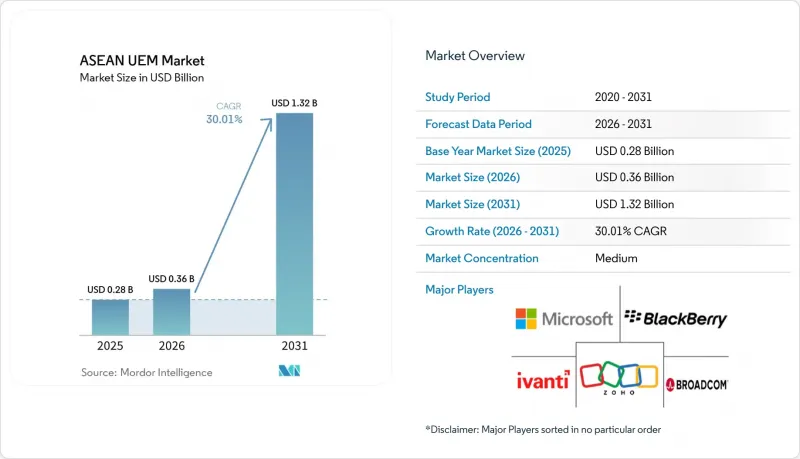
根據 Mordor Intelligence 預測,東協統一端點管理 (UEM) 市場規模將從 2025 年的 2.8 億美元成長到 2026 年的 3.6 億美元,然後在 2031 年達到 13.2 億美元,2026 年至 2031 年的複合年成長率為 30.01%。
本報告按組件(解決方案和服務)、部署模式(雲端、本地部署等)、組織規模(大型企業和中小企業)、最終用戶行業(IT和電信、銀行、金融服務和保險、政府和國防、醫療保健和生命科學、製造業、零售和電子商務等)以及國家/地區進行細分。市場預測以價值(美元)表示。
東協UEM市場的趨勢與洞察
混合辦公和自備設備辦公室(BYOD)模式的擴展
對許多東協公司而言,混合辦公模式正從臨時措施逐漸轉變為標準工作方式,這一轉變導致需要正式管理的設備數量激增。員工個人設備存取公司應用程式、客戶記錄、協作工具和內部網路的頻率遠高於幾年前,因此,統一策略的執行變得至關重要。隨著雇主希望在不影響日常營運管治的前提下,全面了解所有公司所有和員工所有的設備,東協統一端點管理 (UEM) 市場正在不斷擴張。新加坡個人資料保護委員會 (PDPC) 在 2024 年採取的糾正措施凸顯了存取控制漏洞和憑證管理不善如何將設備安全風險升級為大規模客戶資料外洩。這迫使許多公司加強端點註冊管理和策略執行。此外,由於董事會和風險委員會現在要求明確的證據,證明遠端設備的管理標準與辦公室資產相同,採購週期也在縮短。如果供應商能夠在單一營運模式下支援安全註冊、遠端擦拭巾、策略隔離和可審計的存取控制,則他們將獲得競爭優勢。
網路威脅攻擊面擴大與零信任架構的採用
隨著企業不斷擴展雲端應用並支援更多分散式辦公室模式,網路安全優先事項正日益將端點管理與身分和存取控制連結起來。零信任計畫要求將裝置本身視為“主動控制點”,這意味著存取權限決策不僅基於憑證,還基於裝置狀態、合規狀態和策略狀態。東協統一端點管理 (UEM) 市場正受益於此轉變,因為買家越來越將設備健康檢查視為其基礎安全架構不可或缺的一部分,而不僅僅是可選的設備管理功能。由新加坡政府科技局 (GovTech) 主導的 SEED 專案清晰地展示了 2025 年的發展方向,該專案透過集中管理其大規模的工程用戶群的端點,同時利用 CrowdStrike EDR 保持全面覆蓋和強大的運作可見性。新加坡的「政府零信任架構」框架也將端點健康狀況視為持續存取控制中的一個變量,其設計邏輯正從公共系統擴展到私部門的安全計畫。隨著越來越多的組織開始將設備可信度與資源存取權限聯繫起來,那些未能將端點健康狀況納入其更廣泛的安全工作流程的平台可能會失去其相關性。
資料主權和隱私合規的障礙
跨境終端管治仍面臨挑戰,因為設備遙測資料、策略資料、使用者ID和應用程式存取記錄並非總是能完全契合於單一的法律體制。跨國營運商通常需要統一的控制模型以提高營運效率,而東協各司法管轄區在資料儲存、傳輸和存取審查方面又面臨不同的要求。因此,東協統一終端安全管理(UEM)市場在合規性約束下不斷擴張,僅靠技術能力不足以應對挑戰,必須建立一致的可信任資料居住。儘管東協在跨境雲端原則和資料管治指南方面的區域性努力已取得進展,朝著協調統一的方向邁進,但其步伐仍落後於企業採購計畫和實際實施需求。此外,新加坡個人資料保護委員會於2025年1月發布了三項區域資料管治指南。這些指南雖然澄清了一些合規路徑,但並未減輕在整個共用設備環境中管理各國特定義務的負擔。因此,能夠提供區域託管選項、清晰的策略邊界和更強大的審計支持,同時又不迫使客戶使用多個不整合主機的供應商將更具優勢。
細分市場分析
預計到2025年,東協整合端點管理市場中,解決方案將佔據65.66%的市場佔有率,複合年成長率(CAGR)為31.23%。這顯示企業仍將大部分支出用於核心控制平台,而非外圍服務層。買家尋求的是一個能夠處理設備註冊、應用管治、合規策略、內容存取和工作流程自動化的單一營運環境,而無需團隊管理多個互不相容的工具。在安全性和合規性要求日益提高的領域,這一趨勢尤其明顯,因為企業不希望在基本設備控制和高風險管治能力之間出現策略差距。在解決方案堆疊中,安全性和合規性管理、分析和自動化正變得愈發重要,因為買家現在期望姿態監控、策略檢驗和快速問題解決等功能成為標配。設備管理仍然至關重要,但它已不再像過去那樣具有競爭優勢,因為多作業系統支援和遠端策略控制現在已成為最低競標要求。正因如此,在東協 UEM 市場,能夠證明對整個終端生命週期進行可衡量控制(而不僅僅是提供資產可見性)的供應商備受重視。
服務層級的擴展源於這樣一個事實:如今許多部署都涉及跨多個業務部門和國家的整合工作、策略重新設計、基於角色的存取控制調整以及使用者培訓。對許多公司而言,購買平臺本身並不難;困難的是建立一套能夠相容於舊有應用程式、規範工作流程以及IT和安全團隊之間職責分類的營運體系。因此,在東協統一端點管理 (UEM) 產業,服務需求的成長不再只是一種附帶活動,而是成功部署和更新的必要條件。託管式 UEM 支援正變得日益重要,尤其是在中階市場,買家尋求集中式端點管治的優勢,但未必具備內部高階自動化技術。 Ivanti 於 2025 年 10 月透過 PT Berca Hardayaperkasa 在印尼推出其「安全統一端點管理」解決方案,這反映了通路主導的服務機遇,並展示了供應商如何建構以平台銷售為中心的本地交付架構。隨著東協各組織擴大設備覆蓋範圍並加強管理標準,服務正成為將平台功能轉化為日常營運中可用功能的關鍵層面。
到2025年,基於雲端的部署將佔據59.34%的市場佔有率,這一領先優勢反映了企業對更快配置、更輕的基礎設施所有權負擔以及更便捷的跨分散式設備群遠端策略管理的偏好。預計到2031年,雲端交付的複合年成長率將達到31.23%,使其成為目前需求結構中成長最快的部署模式。從實際角度來看,基於雲端的統一緊急管理 (UEM) 可以減少諸如新員工入職、修補程式分發、遠端故障排除和零接觸設定等操作摩擦,隨著員工分佈在包括辦公室、家庭、倉庫、診所和現場環境在內的各種地點,這些功能變得越來越重要。東協地區基於雲端的UEM市場不斷擴張,其驅動力在於買家對彈性和標準化的雙重需求,尤其是在設備數量快速變化以及業務部門拓展到新國家的情況下。 2026年1月發布的《東協跨境雲端運算原則架構》進一步支援了這個發展方向,推薦採用更容易在全部區域不同業務地點使用的互通雲端架構。雖然這項政策訊號並不能解決所有主權問題,但它確實加強了區域商業計畫中採用雲端運算的基礎。
對於政府機構、國防機構和高度監管的組織而言,本地部署仍然至關重要,因為管理流量、策略日誌或設備記錄必須處於直接的本地控制之下。雖然這個細分市場規模較小,但它在塑造供應商在主權和高可靠性環境中的信譽方面具有戰略價值。 BlackBerry 於 2026 年 6 月發布的 UEM 平台更新進一步強化了這項需求,它透過單一的本機主機擴展了對 Apple、Windows 和 Android 裝置的主權管理功能,而無需依賴雲端。混合部署介於這兩種模式之間,在並行運行數位前端和受監管的後勤部門系統的複雜組織中仍然佔據優勢。預計東協地區的 UEM 產業將繼續支援對混合部署的需求,因為許多區域性企業集團需要通用的策略邏輯,但又不希望所有工作負載都集中在單一的基礎設施路徑上。因此,混合部署不僅僅是一種折衷方案,而是大型企業在規模、管理和國家/地區合規性之間尋求平衡的一種深思熟慮的營運設計。
其他好處:
- Excel格式的市場預測(ME)表
- 3個月的分析師支持
目錄
第1章:引言
- 研究假設和市場定義
- 調查範圍
第2章:調查方法
第3章執行摘要
第4章 市場狀況
- 市場概覽
- 市場促進因素
- 混合辦公和自備設備辦公模式的擴展
- 網路威脅攻擊面擴大與零信任架構的採用
- 端點、身分和存取管理平台整合
- 利用人工智慧最佳化數位化員工體驗
- 倉庫和現場作業中一線設備和物聯網設備的成長
- ESG驅動下對設備級碳分析的需求增加
- 市場限制因素
- 資料主權和隱私合規的障礙
- 遷移和整合原有系統成本高昂
- VMware遷移後環境中的採購不確定性
- UEM領域低程式碼自動化和腳本編寫人才短缺
- 產業價值鏈分析
- 產業供應鏈分析
- 監理情勢
- 技術展望
- 宏觀經濟因素對市場的影響
- 波特五力分析
第5章 市場規模與成長預測
- 按組件
- 解決方案
- 設備管理
- 應用程式管理
- 內容管理
- 安全與合規管理
- 分析與自動化
- 服務
- 解決方案
- 部署模式
- 基於雲端的
- 現場
- 混合
- 按組織規模
- 大公司
- 小型企業
- 按最終用戶行業分類
- 資訊科技/通訊
- BFSI
- 政府/國防
- 醫療保健和生命科學
- 製造業
- 零售與電子商務
- 教育
- 運輸/物流
- 能源公用事業
- 其他終端用戶產業
- 國家
- 印尼
- 菲律賓
- 馬來西亞
- 新加坡
- 越南
- 其他東南亞國協
第6章 競爭情勢
- 市場集中度
- 策略趨勢
- 市佔率分析
- 公司簡介
- Microsoft Corporation
- Ivanti, Inc.
- BlackBerry Limited
- IBM Corporation
- Broadcom Inc.
- Citrix Systems, Inc.
- Jamf Holding Corp.
- SOTI Inc.
- Sophos Limited
- HCL Technologies Limited
- Zoho Corporation Private Limited
- 42Gears Mobility Systems Pvt. Ltd.
- Absolute Software Corporation
- Tanium Inc.
- JumpCloud, Inc.
- Atera Networks Ltd.
- Open Text Corporation
- Matrix42 AG
- Miradore Ltd.
- Micro Focus International plc
- ManageEngine, a division of Zoho Corporation
第7章 市場機會與未來展望
According to Mordor Intelligence, the ASEAN UEM market size is expected to grow from USD 0.28 billion in 2025 to USD 0.36 billion in 2026, and is forecast to reach USD 1.32 billion by 2031 at a 30.01% CAGR over 2026-2031.
This report is Segmented by Component (Solutions and Services), Deployment Mode (Cloud-Based, On-Premise, and More), Organization Size (Large Enterprises and Small and Medium Enterprises), End-User Industry (IT and Telecommunications, BFSI, Government and Defense, Healthcare and Life Sciences, Manufacturing, Retail and E-Commerce, and More), and Country. The Market Forecasts are Provided in Terms of Value (USD).
ASEAN UEM Market Trends and Insights
Hybrid Work and Bring Your Own Device Expansion
Hybrid work has moved from a temporary arrangement to a standard operating pattern across many ASEAN enterprises, and that shift is widening the number of devices that need formal control. Personal devices now touch enterprise applications, customer records, collaboration tools, and internal networks far more often than they did a few years ago, which raises the baseline need for unified policy enforcement. The ASEAN UEM market is benefiting because employers want visibility across company-owned and employee-owned devices without slowing daily work. Enforcement action by Singapore's Personal Data Protection Commission in 2024 reinforced how weak access controls and poor credential governance can turn device exposure into large customer-data incidents, which has pushed many enterprises to tighten endpoint enrollment and policy coverage. Procurement cycles have also shortened in environments where boards and risk committees now expect clearer proof that remote devices are governed to the same standard as office-based assets. This gives vendors an advantage when they can support secure onboarding, remote wipe, policy separation, and auditable access control in one operating model.
Escalating Cyber Threat Surface and Zero Trust Rollouts
Cybersecurity priorities are pulling endpoint management closer to identity and access control, especially as enterprises extend cloud usage and support more distributed workforces. Zero trust programs require the device itself to be treated as a live control point, which means access decisions depend on posture, compliance state, and policy status rather than on credentials alone. The ASEAN UEM market is gaining from this shift because buyers increasingly treat device health checks as part of basic security architecture rather than as optional device administration. Singapore GovTech's SEED program showed this direction clearly in 2025 by centralizing endpoint management across a large engineering user base while maintaining full CrowdStrike EDR coverage and strong operational visibility. The Government Zero Trust Architecture framework in Singapore also treats endpoint health as a continuous access-control variable, and that design logic is moving from public systems into private-sector security programs. As more organizations map device trust to resource access, platforms that cannot feed clean endpoint posture into broader security workflows are likely to lose relevance.
Data Sovereignty and Privacy Compliance Hurdles
Cross-border endpoint governance remains difficult because device telemetry, policy data, user identity, and application access records do not always fit neatly within one legal framework. Multi-country operators often need one control model for business efficiency, but they face separate expectations for data storage, transfer, and access review across ASEAN jurisdictions. The ASEAN UEM market therefore expands under a compliance constraint, where technical capability alone is not enough unless it is paired with credible data-residency alignment. ASEAN's regional work on cross-border cloud principles and data governance guides shows that harmonization is moving forward, but the pace still trails enterprise procurement timelines and practical deployment needs. Singapore's Personal Data Protection Commission also published 3 regional data governance guides in January 2025, which helped clarify some compliance pathways but did not eliminate the burden of managing country-specific obligations across a shared device estate. This leaves an advantage for vendors that can show regional hosting options, clear policy boundaries, and stronger audit support without forcing customers into multiple disconnected consoles.
Other drivers and restraints analyzed in the detailed report include:
- Platform Convergence of Endpoint, Identity, and Access Management
- AI-Based Digital Employee Experience Optimization
- High Migration and Integration Cost of Legacy Estates
For complete list of drivers and restraints, kindly check the Table Of Contents.
Segment Analysis
Solutions accounted for 65.66% of the ASEAN unified endpoint management market share in 2025, with a growth rate of 31.23% CAGR, which shows that enterprises still direct most spending toward the core control platform rather than toward surrounding service layers. Buyers want one operating environment that can handle device enrollment, application governance, compliance policy, content access, and workflow automation without forcing teams to manage several disconnected tools. That preference is strongest where security and compliance requirements are rising because enterprises do not want policy gaps between basic device control and higher-risk governance functions. Within the solutions stack, security and compliance management, analytics, and automation are carrying more strategic weight because buyers now expect posture monitoring, policy validation, and faster issue resolution as standard capabilities. Device management remains essential, but it no longer defines competitive differentiation in the same way because multi-OS support and remote policy control have become baseline tender requirements. This is why the ASEAN UEM market is rewarding vendors that can move beyond inventory visibility and show measurable control across the full endpoint lifecycle.
The services layer is scaling because a larger share of deployments now involve integration work, policy redesign, role-based access tuning, and user training across several business units or countries. Many enterprises do not struggle to buy the platform, they struggle to operationalize it in a way that fits legacy applications, regulated workflows, and shared accountability between IT and security teams. The ASEAN UEM industry is therefore seeing service demand rise not as a side activity, but as a practical condition for successful rollout and renewal. Managed UEM support is especially relevant in the mid-market, where buyers want the benefits of centralized endpoint governance but do not always have in-house automation depth. Ivanti's October 2025 launch of its Secure Unified Endpoint Management offering in Indonesia through PT Berca Hardayaperkasa reflected that channel-led services opportunity and showed how vendors are building local delivery capacity around the platform sale. As ASEAN organizations widen device coverage and tighten control standards, services become the layer that turns platform capability into usable daily operations.
Cloud-based deployment held 59.34% of the market in 2025, and that lead reflects how enterprises prefer faster provisioning, lighter infrastructure ownership, and easier remote policy administration across distributed device fleets. Cloud delivery is also projected to advance at a 31.23% CAGR through 2031, which makes it the fastest-moving deployment model in the current structure of demand. In practical terms, cloud UEM reduces the operational friction of onboarding, patch distribution, remote troubleshooting, and zero-touch setup, which matters more as workforces stretch across offices, homes, warehouses, clinics, and field environments. The ASEAN UEM market size for cloud-based deployment is growing because buyers want elasticity and standardization at the same time, especially when device counts change quickly or business units expand into new countries. The ASEAN Framework on Cross-Border Cloud Computing Principles, published in January 2026, supports this direction by encouraging interoperable cloud architectures that are easier to use across regional operating footprints. That policy signal does not remove every sovereignty issue, but it gives cloud deployment a firmer foundation in regional enterprise planning.
On-premises deployment still matters in government, defense, and tightly regulated institutions where management traffic, policy logs, or device records must remain under direct local control. This part of the market is smaller, but it carries strategic value because it shapes vendor credibility in sovereign and high-assurance environments. BlackBerry's June 2026 update to its UEM platform reinforced this need by expanding sovereign management capabilities for Apple, Windows, and Android devices from a single on-premises console without cloud dependency. Hybrid deployment sits between those 2 models and retains a strong hold in complex organizations that operate digital front ends alongside regulated back-office systems. The ASEAN UEM industry is likely to keep supporting hybrid demand because many regional conglomerates need shared policy logic without forcing every workload into one infrastructure path. Hybrid therefore works less as a compromise and more as a deliberate operating design for large enterprises balancing scale, control, and country-level compliance.
Complete Report Scope:
- By Component
- Solutions
- Device Management
- Application Management
- Content Management
- Security and Compliance Management
- Analytics and Automation
- Services
- Solutions
- By Deployment Mode
- Cloud-Based
- On-Premise
- Hybrid
- By Organization Size
- Large Enterprises
- Small and Medium Enterprises
- By End-User Industry
- IT and Telecommunications
- BFSI
- Government and Defense
- Healthcare and Life Sciences
- Manufacturing
- Retail and E-Commerce
- Education
- Transportation and Logistics
- Energy and Utilities
- Other End-User Industries
- By Country
- Indonesia
- Philippines
- Malaysia
- Singapore
- Vietnam
- Rest of ASEAN
List of Companies Covered in this Report:
- Microsoft Corporation
- Ivanti, Inc.
- BlackBerry Limited
- IBM Corporation
- Broadcom Inc.
- Citrix Systems, Inc.
- Jamf Holding Corp.
- SOTI Inc.
- Sophos Limited
- HCL Technologies Limited
- Zoho Corporation Private Limited
- 42Gears Mobility Systems Pvt. Ltd.
- Absolute Software Corporation
- Tanium Inc.
- JumpCloud, Inc.
- Atera Networks Ltd.
- Open Text Corporation
- Matrix42 AG
- Miradore Ltd.
- Micro Focus International plc
- ManageEngine, a division of Zoho Corporation
Additional Benefits:
- The market estimate (ME) sheet in Excel format
- 3 months of analyst support
TABLE OF CONTENTS
1 INTRODUCTION
- 1.1 Study Assumptions and Market Definition
- 1.2 Scope of the Study
2 RESEARCH METHODOLOGY
3 EXECUTIVE SUMMARY
4 MARKET LANDSCAPE
- 4.1 Market Overview
- 4.2 Market Drivers
- 4.2.1 Hybrid Work and Bring Your Own Device Expansion
- 4.2.2 Escalating Cyber Threat Surface and Zero Trust Rollouts
- 4.2.3 Platform Convergence of Endpoint, Identity, and Access Management
- 4.2.4 AI-Based Digital Employee Experience Optimization
- 4.2.5 Frontline and Internet of Things Device Growth in Warehousing and Field Operations
- 4.2.6 ESG-Led Demand for Device-Level Carbon Analytics
- 4.3 Market Restraints
- 4.3.1 Data Sovereignty and Privacy Compliance Hurdles
- 4.3.2 High Migration and Integration Cost of Legacy Estates
- 4.3.3 Procurement Uncertainty in Post-VMware Transition Environments
- 4.3.4 Talent Gap in Low-Code Automation and Scripting for UEM
- 4.4 Industry Value Chain Analysis
- 4.5 Industry Supply Chain Analysis
- 4.6 Regulatory Landscape
- 4.7 Technological Outlook
- 4.8 Impact of Macroeconomic Factors on the Market
- 4.9 Porter's Five Forces Analysis
- 4.9.1 Bargaining Power of Buyers
- 4.9.2 Bargaining Power of Suppliers
- 4.9.3 Threat of New Entrants
- 4.9.4 Threat of Substitutes
- 4.9.5 Competitive Rivalry
5 MARKET SIZE AND GROWTH FORECASTS (VALUE)
- 5.1 By Component
- 5.1.1 Solutions
- 5.1.1.1 Device Management
- 5.1.1.2 Application Management
- 5.1.1.3 Content Management
- 5.1.1.4 Security and Compliance Management
- 5.1.1.5 Analytics and Automation
- 5.1.2 Services
- 5.1.1 Solutions
- 5.2 By Deployment Mode
- 5.2.1 Cloud-Based
- 5.2.2 On-Premise
- 5.2.3 Hybrid
- 5.3 By Organization Size
- 5.3.1 Large Enterprises
- 5.3.2 Small and Medium Enterprises
- 5.4 By End-User Industry
- 5.4.1 IT and Telecommunications
- 5.4.2 BFSI
- 5.4.3 Government and Defense
- 5.4.4 Healthcare and Life Sciences
- 5.4.5 Manufacturing
- 5.4.6 Retail and E-Commerce
- 5.4.7 Education
- 5.4.8 Transportation and Logistics
- 5.4.9 Energy and Utilities
- 5.4.10 Other End-User Industries
- 5.5 By Country
- 5.5.1 Indonesia
- 5.5.2 Philippines
- 5.5.3 Malaysia
- 5.5.4 Singapore
- 5.5.5 Vietnam
- 5.5.6 Rest of ASEAN
6 COMPETITIVE LANDSCAPE
- 6.1 Market Concentration
- 6.2 Strategic Moves
- 6.3 Market Share Analysis
- 6.4 Company Profiles (includes Global Level Overview, Market Level Overview, Core Segments, Financials as available, Strategic Information, Market Rank/Share, Products and Services, Recent Developments)
- 6.4.1 Microsoft Corporation
- 6.4.2 Ivanti, Inc.
- 6.4.3 BlackBerry Limited
- 6.4.4 IBM Corporation
- 6.4.5 Broadcom Inc.
- 6.4.6 Citrix Systems, Inc.
- 6.4.7 Jamf Holding Corp.
- 6.4.8 SOTI Inc.
- 6.4.9 Sophos Limited
- 6.4.10 HCL Technologies Limited
- 6.4.11 Zoho Corporation Private Limited
- 6.4.12 42Gears Mobility Systems Pvt. Ltd.
- 6.4.13 Absolute Software Corporation
- 6.4.14 Tanium Inc.
- 6.4.15 JumpCloud, Inc.
- 6.4.16 Atera Networks Ltd.
- 6.4.17 Open Text Corporation
- 6.4.18 Matrix42 AG
- 6.4.19 Miradore Ltd.
- 6.4.20 Micro Focus International plc
- 6.4.21 ManageEngine, a division of Zoho Corporation
7 MARKET OPPORTUNITIES AND FUTURE OUTLOOK
- 7.1 White-Space and Unmet-Need Assessment

 整合端點管理市場-2026-2032年全球市場預測
 中東和非洲統一端點管理 (UEM):市場佔有率分析、行業趨勢和統計數據以及成長預測 (2026-2031)亞太地區統一端點管理 (UEM):市場佔有率分析、產業趨勢與統計、成長預測(2026-2031 年)北美統一端點管理 (UEM):市場佔有率分析、行業趨勢和統計數據、成長預測(2026-2031 年)南美洲統一端點管理 (UEM):市場佔有率分析、行業趨勢和統計數據以及成長預測 (2026-2031)整合終端管理:市場佔有率分析、產業趨勢與統計、成長預測(2026-2031)歐洲統一端點管理 (UEM):市場佔有率分析、產業趨勢與統計及成長預測 (2026-2031)銀行、金融服務和保險 (BFSI) 行業的統一端點管理 (UEM):市場佔有率分析、行業趨勢和統計數據以及成長預測 (2026-2031)泰國:市場佔有率分析、產業趨勢與統計、成長預測(2026-2031)越南統一端點管理 (UEM):市場佔有率分析、產業趨勢與統計及成長預測 (2026-2031)