


 |
市場調查報告書
商品編碼
2098512
中東和非洲統一端點管理 (UEM):市場佔有率分析、行業趨勢和統計數據以及成長預測 (2026-2031)Middle East and Africa UEM - Market Share Analysis, Industry Trends & Statistics, Growth Forecasts (2026 - 2031) |
||||||

※ 本網頁內容可能與最新版本有所差異。詳細情況請與我們聯繫。
根據 Mordor Intelligence 預測,中東和非洲的 UEM(統一端點管理)市場規模將從 2025 年的 4.6 億美元和 2026 年的 5.7 億美元成長到 2031 年的 18.8 億美元,2026 年至 2031 年的年複合成長率(CAGR)為 26.86%。
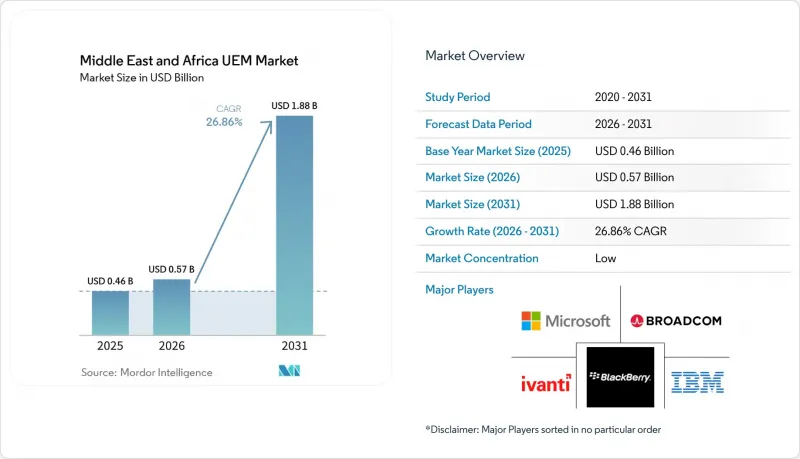
本報告按組件(解決方案和服務)、部署模式(雲端、本地部署、混合部署)、組織規模(大型企業和中小企業)、最終用戶產業(IT與電信、政府與國防、醫療保健與生命科學、零售與電子商務等)以及地區進行細分。市場預測以美元(USD)為單位。
中東和非洲 UEM 市場的趨勢和洞察
自備設備辦公室 (BYOD) 和企業移動性的普及應用日益廣泛
目前,員工自備設備已成為該地區大型企業日常營運的重要組成部分,中東和非洲統一端點管理 (UEM) 市場中設備多樣性不再是暫時的 IT 挑戰。這種轉變擴大了安全風險的範圍,因為員工可以透過未經正式註冊和策略執行的智慧型手機和平板電腦存取商用應用程式。 Zylo 的報告顯示,到 2026 年,87% 的企業應用程式將由 IT 部門以外的管道購買,這表明在不受中央管理團隊完全控制的終端設備上,非託管存取模式正在迅速蔓延。因此,負責人越來越重視能夠註冊自帶設備 (BYOD) 並清楚區分業務資料和個人資料的 UEM 工具。這一趨勢促使供應商專注於簡化註冊流程、提供一致的應用程式存取控制,並降低在公司自有設備和員工自有設備混合環境中的部署負擔。
對集中式設備和應用程式管治。
在中東和非洲的統一端點管理 (UEM) 市場,集中式管理的需求日益成長,因為分別管理應用程式、身分和裝置的工具會造成安全和 IT 團隊難以彌合的漏洞。當應用程式存取權限和裝置合規性分別管理時,在一個系統中看似合規的存取路徑在另一個系統中可能存在風險。因此,預算支援力度不斷加大,尤其是那些能夠減少主機數量並簡化分散式設備群報告的整合平台。 2026 年 3 月,微軟宣布了三家新的 Intune for MSP 認證合作夥伴。這進一步強化了集中式管理的發展趨勢,並擴大了對服務主導模式的多租戶端點管理的支援。因此,在中東和非洲的 UEM 市場,能夠將設備策略、應用程式監控和服務交付整合到單一營運層的平台備受青睞。
碎片化的傳統 IT 和終端工具堆疊
在中東和非洲的統一端點管理 (UEM) 市場,眾多舊有系統的存在仍然是推廣應用的一大障礙。這是因為許多組織並沒有一個乾淨、檢驗的資產帳簿基準。混合作業系統、冗餘的安全代理程式以及依賴電子表格的資產記錄常常會使初始部署變得複雜,並延誤實施進度。這種複雜性還會增加初始部署被認為成本高且難度高的風險,甚至在簽訂初始合約後也會阻礙後續擴展。 Tanium 在 2026 年上半年的平台更新中,將即時智慧和糾正措施擴展到了營運技術環境和行動裝置。這表明,供應商正在努力應對比傳統辦公環境更廣泛、更分散的環境。能夠分階段引導客戶上線,而不是一開始就強制客戶完全替換現有工具的供應商,在舊有系統複雜性仍然很高的市場中,更有能力抓住市場需求。
細分市場分析
該解決方案預計在2025年將佔據65.46%的市場佔有率,並以27.06%的複合年成長率成長至2031年,預計該類別仍將是中東和非洲UEM市場支出的核心。買家顯然更傾向於功能更全面的管治方案,而非功能有限的單一行動裝置管理工具,因為他們要求跨裝置、應用程式、合規性和糾正措施的策略一致性。設備管理仍然是銷售量的基礎,因為每次部署都始於對終端環境的可見性、註冊和基本控制。同時,隨著越來越多的客戶要求基於證據的策略執行,而非簡單的配置報告,安全性和合規性管理也日益受到關注。分析和自動化也成為產品評估的核心,因為買家現在重視能夠檢測策略偏差、識別風險模式並自動執行糾正措施而無需等待人工審核的平台。
儘管服務業規模相對較小,但在內部 IT 資源有限且託管交付能夠提供切實可行的部署途徑時,它仍然至關重要。在這種情況下,隨著平台複雜性的增加,對服務的需求也會增加,因為客戶通常需要在部署後獲得策略設計、遷移和生命週期管理的協助。因此,在中東和非洲的統一端點管理 (UEM) 市場,服務並非僅僅被視為事後考慮,而是被視為即使在人員有限的環境中也能實現更廣泛平台部署的一種手段。隨著自動化能力的提升,服務供應商也傾向於從手動管理轉向基於異常的管理,這使他們能夠在不增加每個客戶同等人力資源的情況下提高服務品質。
預計到2025年,基於雲端的部署將佔中東和非洲地區統一端點管理 (UEM) 市場規模的58.27%,並有望在2031年之前以27.19%的複合年成長率成長。其吸引力在於功能交付的速度;與依賴本地升級週期的環境相比,雲端管理平台提供更頻繁的更新、更廣泛的設備支援和更快的功能交付。在策略要求快速變化且買家希望在不延遲部署的情況下獲得新的控制功能的市場中,這是一個至關重要的因素。微軟承諾從2026年初開始在阿拉伯聯合大公國進行資料處理,這也推動了向雲端的轉變,因為它表明本地基礎設施可以解決注重主權的客戶最關心的問題之一。然而,雲端的主導並不意味著架構方面的討論將就此停止。中東和非洲UEM市場的部署決策仍將受到資料管理、合約條款以及每個買家的法規環境的影響。
本地部署的需求依然旺盛,尤其對於國防機構和受嚴格監管的企業而言,這些機構和企業無法在其自身管理模式下透過公共網路發送終端遙測資料。混合部署正逐漸成為一種遷移路徑,適用於那些希望將部分資產保留在本地,同時將特定使用者或裝置類別遷移到雲端管理的企業。雖然這種分離有助於更平穩的過渡,但也可能導致策略不一致和維運複雜性,因為團隊需要為不同的終端組管理不同的控制平面。能夠提供從混合環境到更統一的管理結構可靠遷移路徑,同時保留本地控制選項的供應商,預計在預測期內佔據與此遷移相關的更大佔有率。
其他好處:
- Excel格式的市場預測(ME)表
- 3個月的分析師支持
目錄
第1章:引言
- 研究假設和市場定義
- 調查範圍
第2章:調查方法
第3章執行摘要
第4章 市場狀況
- 市場概覽
- 市場促進因素
- 自備設備辦公室 (BYOD) 和企業行動解決方案的普及應用日益廣泛。
- 對設備和應用程式集中管治的需求日益成長。
- 受監管產業對終端安全的要求日益提高
- 分散式企業中混合工作流程的擴展
- 中型企業中管理不善的 SaaS 和行動應用程式氾濫。
- 對自動化政策執行和糾正措施的需求日益成長
- 市場限制因素
- 碎片化的傳統 IT 和終端工具堆疊
- 資料居住要求和主權限制
- 與傳統身分和安全系統整合的複雜性。
- 缺乏UEM政策制定和生命週期管理的技能
- 產業價值鏈分析
- 宏觀經濟因素對市場的影響
- 監理情勢
- 技術展望
- 波特五力分析
第5章 市場規模與成長預測
- 按組件
- 解決方案
- 設備管理
- 應用程式管理
- 內容管理
- 安全與合規管理
- 分析與自動化
- 服務
- 解決方案
- 部署模式
- 基於雲端的
- 現場
- 混合
- 按組織規模
- 大公司
- 小型企業
- 按最終用戶行業分類
- 資訊科技/通訊
- BFSI
- 政府/國防
- 醫療保健和生命科學
- 製造業
- 零售與電子商務
- 教育
- 運輸/物流
- 能源公用事業
- 其他終端用戶產業
- 按地區
- 中東
- 沙烏地阿拉伯
- 阿拉伯聯合大公國
- 卡達
- 科威特
- 其他中東國家
- 非洲
- 南非
- 埃及
- 其他非洲國家
- 中東
第6章 競爭情勢
- 市場集中度
- 策略趨勢
- 市佔率分析
- 公司簡介
- Microsoft Corporation
- Broadcom Inc.
- Ivanti, Inc.
- BlackBerry Limited
- IBM Corporation
- Sophos Group plc
- ManageEngine, A Division Of Zoho Corporation Private Limited
- SOTI Inc.
- Jamf Holding Corp.
- Cisco Systems, Inc.
- Samsung Electronics Co., Ltd.
- Google LLC
- Oracle Corporation
- Citrix Systems, Inc.
- Baramundi Software GmbH
- Matrix42 AG
- HCL Technologies Limited
- Accenture plc
- Fortinet, Inc.
- Tanium Inc.
第7章 市場機會與未來展望
According to Mordor Intelligence, the Middle East and Africa UEM market size is projected to expand from USD 0.46 billion in 2025 and USD 0.57 billion in 2026 to USD 1.88 billion by 2031, registering a CAGR of 26.86% between 2026 to 2031.
This report is Segmented by Component (Solutions, and Services), Deployment Mode (Cloud-Based, On-Premise, and Hybrid), Organization Size (Large Enterprises, and Small and Medium Enterprises), End-User Industry (IT and Telecommunications, Government and Defense, Healthcare and Life Sciences, Retail and E-Commerce, and More), and Geography. The Market Forecasts are Provided in Terms of Value (USD).
Middle East and Africa UEM Market Trends and Insights
Increasing BYOD and Corporate Mobility Adoption
Personal devices are now a permanent part of daily work across large employers in the region, which means device diversity in the Middle East and Africa UEM market is no longer a temporary IT issue. That shift widens exposure when staff access business applications through phones and tablets that sit outside formal enrollment and policy coverage. Zylo stated in 2026 that 87% of enterprise applications were purchased outside IT, which shows how quickly unmanaged access patterns can spread across endpoints that central teams do not fully control. Buyers are therefore placing more weight on UEM tools that can enroll bring-your-own devices with clear separation between work data and personal data. This preference is pushing vendors to emphasize light-touch enrollment, consistent app access controls, and lower-friction onboarding for mixed corporate and employee-owned fleets.
Rising Need for Centralized Device and Application Governance
The Middle East and Africa UEM market is seeing stronger demand for centralized control because separate tools for apps, identities, and devices leave gaps that security and IT teams cannot easily reconcile. When application entitlement and device compliance are managed on different tracks, organizations often end up with access paths that appear compliant in one system and risky in another. That is why integrated platforms are gaining budget support, especially when they reduce console sprawl and simplify reporting across distributed fleets. Microsoft announced 3 new validated partners for Intune for MSPs in March 2026, which widened multi-tenant endpoint management support for service-led delivery models and reinforced the push toward centralized administration. As a result, the Middle East and Africa UEM market is rewarding platforms that combine device policy, application oversight, and service delivery under one operating layer.
Fragmented Legacy IT and Endpoint Tool Stacks
Legacy-heavy environments still slow deployment in the Middle East and Africa UEM market because many organizations do not begin with a clean, validated inventory baseline. Mixed operating systems, overlapping security agents, and spreadsheet-led asset records make early rollout more complex and often stretch implementation timelines. That complexity also raises the risk that first deployments feel costly and difficult, which can reduce later expansion even after initial contracts are signed. Tanium extended real-time intelligence and remediation into operational technology environments and mobile devices in its 2026H1 platform update, which shows how vendors are trying to address estates that are broader and more fragmented than traditional office. Vendors that can onboard customers in stages, rather than forcing a full replacement of existing tools at the start, are in a better position to convert demand where legacy complexity remains high.
Other drivers and restraints analyzed in the detailed report include:
- Growing Endpoint Security Requirements in Regulated Industries
- Expansion of Hybrid Workflows in Distributed Enterprises
- Data Residency and Sovereignty Constraints
For complete list of drivers and restraints, kindly check the Table Of Contents.
Segment Analysis
Solutions held 65.46% share in 2025 and are projected to expand at 27.06% CAGR through 2031, which keeps this category at the center of spending in the Middle East and Africa UEM market. Buyers are clearly favoring fuller governance stacks over narrow mobile device management point tools because they want policy consistency across devices, applications, compliance, and remediation. Device management still anchors volume because every deployment begins with visibility, enrollment, and basic control over the endpoint estate. At the same time, security and compliance management is taking a larger share of attention as more customers need evidence-backed enforcement instead of simple configuration reporting. Analytics and automation are also moving into the center of product evaluation because buyers now value platforms that can detect drift, identify risk patterns, and trigger corrective action without waiting for manual review.
The Services segment remains smaller, but it is still important where internal IT resources are limited and managed delivery is the practical path to adoption. In these cases, service demand rises alongside platform complexity because customers often need help with policy design, migration, and lifecycle administration after deployment. The Middle East and Africa Unified Endpoint Management (UEM) market is therefore not treating services as a separate afterthought, it is using them to make broader platform adoption possible in thinner-staffed environments. As automation features improve, service providers are also likely to shift from manual administration toward exception-based management, which can lift service quality without adding the same staffing burden at each account.
Cloud-based deployments accounted for 58.27% of the Middle East and Africa Unified Endpoint Management market size in 2025 and are projected to expand at 27.19% CAGR through 2031. Their appeal is tied to capability velocity because cloud-managed platforms receive frequent updates, broader device support, and faster feature delivery than environments that rely on internal upgrade cycles. This matters in a market where policy needs are changing quickly and buyers want new controls without long implementation delays. Microsoft's UAE in-country processing commitment from early 2026 also supports the cloud path by showing that local infrastructure can narrow one of the biggest objections for sovereign-sensitive customers. Even so, cloud leadership does not remove the architecture debate, because deployment decisions in the Middle East and Africa UEM market are still shaped by data control, contract conditions, and the regulatory profile of each buyer.
On-premise deployments continue to hold meaningful demand among defense organizations and highly restricted operators that cannot route endpoint telemetry through public networks under their own control models. Hybrid deployment is gaining ground as a transition path for organizations that keep some estates in-house while moving selected users or device classes to cloud management. That split can ease migration, but it also creates policy inconsistency and operating complexity when teams manage separate control planes for different endpoint groups. Vendors that can offer a credible path from hybrid to more unified administration, while preserving local control options, are likely to capture more of this transitional spending across the forecast period.
Complete Report Scope:
- By Component
- Solutions
- Device Management
- Application Management
- Content Management
- Security and Compliance Management
- Analytics and Automation
- Services
- Solutions
- By Deployment Mode
- Cloud-Based
- On-Premise
- Hybrid
- By Organization Size
- Large Enterprises
- Small and Medium Enterprises
- By End-User Industry
- IT and Telecommunications
- BFSI
- Government and Defense
- Healthcare and Life Sciences
- Manufacturing
- Retail and E-Commerce
- Education
- Transportation and Logistics
- Energy and Utilities
- Other End-User Industries
- By Geography
- Middle East
- Saudi Arabia
- United Arab Emirates
- Qatar
- Kuwait
- Rest of Middle East
- Africa
- South Africa
- Egypt
- Rest of Africa
- Middle East
List of Companies Covered in this Report:
- Microsoft Corporation
- Broadcom Inc.
- Ivanti, Inc.
- BlackBerry Limited
- IBM Corporation
- Sophos Group plc
- ManageEngine, A Division Of Zoho Corporation Private Limited
- SOTI Inc.
- Jamf Holding Corp.
- Cisco Systems, Inc.
- Samsung Electronics Co., Ltd.
- Google LLC
- Oracle Corporation
- Citrix Systems, Inc.
- Baramundi Software GmbH
- Matrix42 AG
- HCL Technologies Limited
- Accenture plc
- Fortinet, Inc.
- Tanium Inc.
Additional Benefits:
- The market estimate (ME) sheet in Excel format
- 3 months of analyst support
TABLE OF CONTENTS
1 INTRODUCTION
- 1.1 Study Assumptions and Market Definition
- 1.2 Scope of the Study
2 RESEARCH METHODOLOGY
3 EXECUTIVE SUMMARY
4 MARKET LANDSCAPE
- 4.1 Market Overview
- 4.2 Market Drivers
- 4.2.1 Increasing BYOD and Corporate Mobility Adoption
- 4.2.2 Rising Need for Centralized Device And Application Governance
- 4.2.3 Growing Endpoint Security Requirements in Regulated Industries
- 4.2.4 Expansion of Hybrid Workflows in Distributed Enterprises
- 4.2.5 Under-Managed SaaS and Mobile App Sprawl Across Mid-Market Firms
- 4.2.6 Rising Demand for Automation-Driven Policy Enforcement and Remediation
- 4.3 Market Restraints
- 4.3.1 Fragmented Legacy IT and Endpoint Tool Stacks
- 4.3.2 Data Residency and Sovereignty Constraints
- 4.3.3 Integration Complexity with Legacy Identity and Security Systems
- 4.3.4 Skills Shortage for UEM Policy Design and Lifecycle Operations
- 4.4 Industry Value Chain Analysis
- 4.5 Impact of Macroeconomic Factors on the Market
- 4.6 Regulatory Landscape
- 4.7 Technological Outlook
- 4.8 Porter's Five Forces Analysis
- 4.8.1 Bargaining Power of Buyers
- 4.8.2 Bargaining Power of Suppliers
- 4.8.3 Threat of New Entrants
- 4.8.4 Threat of Substitutes
- 4.8.5 Competitive Rivalry
5 MARKET SIZE AND GROWTH FORECASTS (VALUE)
- 5.1 By Component
- 5.1.1 Solutions
- 5.1.1.1 Device Management
- 5.1.1.2 Application Management
- 5.1.1.3 Content Management
- 5.1.1.4 Security and Compliance Management
- 5.1.1.5 Analytics and Automation
- 5.1.2 Services
- 5.1.1 Solutions
- 5.2 By Deployment Mode
- 5.2.1 Cloud-Based
- 5.2.2 On-Premise
- 5.2.3 Hybrid
- 5.3 By Organization Size
- 5.3.1 Large Enterprises
- 5.3.2 Small and Medium Enterprises
- 5.4 By End-User Industry
- 5.4.1 IT and Telecommunications
- 5.4.2 BFSI
- 5.4.3 Government and Defense
- 5.4.4 Healthcare and Life Sciences
- 5.4.5 Manufacturing
- 5.4.6 Retail and E-Commerce
- 5.4.7 Education
- 5.4.8 Transportation and Logistics
- 5.4.9 Energy and Utilities
- 5.4.10 Other End-User Industries
- 5.5 By Geography
- 5.5.1 Middle East
- 5.5.1.1 Saudi Arabia
- 5.5.1.2 United Arab Emirates
- 5.5.1.3 Qatar
- 5.5.1.4 Kuwait
- 5.5.1.5 Rest of Middle East
- 5.5.2 Africa
- 5.5.2.1 South Africa
- 5.5.2.2 Egypt
- 5.5.2.3 Rest of Africa
- 5.5.1 Middle East
6 COMPETITIVE LANDSCAPE
- 6.1 Market Concentration
- 6.2 Strategic Moves
- 6.3 Market Share Analysis
- 6.4 Company Profiles (includes Global Level Overview, Market Level Overview, Core Segments, Financials as available, Strategic Information, Market Rank/Share, Products and Services, Recent Developments)
- 6.4.1 Microsoft Corporation
- 6.4.2 Broadcom Inc.
- 6.4.3 Ivanti, Inc.
- 6.4.4 BlackBerry Limited
- 6.4.5 IBM Corporation
- 6.4.6 Sophos Group plc
- 6.4.7 ManageEngine, A Division Of Zoho Corporation Private Limited
- 6.4.8 SOTI Inc.
- 6.4.9 Jamf Holding Corp.
- 6.4.10 Cisco Systems, Inc.
- 6.4.11 Samsung Electronics Co., Ltd.
- 6.4.12 Google LLC
- 6.4.13 Oracle Corporation
- 6.4.14 Citrix Systems, Inc.
- 6.4.15 Baramundi Software GmbH
- 6.4.16 Matrix42 AG
- 6.4.17 HCL Technologies Limited
- 6.4.18 Accenture plc
- 6.4.19 Fortinet, Inc.
- 6.4.20 Tanium Inc.
7 MARKET OPPORTUNITIES AND FUTURE OUTLOOK
- 7.1 White-Space and Unmet-Need Assessment

 整合端點管理市場-2026-2032年全球市場預測
 亞太地區統一端點管理 (UEM):市場佔有率分析、產業趨勢與統計、成長預測(2026-2031 年)北美統一端點管理 (UEM):市場佔有率分析、行業趨勢和統計數據、成長預測(2026-2031 年)南美洲統一端點管理 (UEM):市場佔有率分析、行業趨勢和統計數據以及成長預測 (2026-2031)整合終端管理:市場佔有率分析、產業趨勢與統計、成長預測(2026-2031)東協統一端點管理 (UEM):市場佔有率分析、產業趨勢與統計及成長預測 (2026-2031)歐洲統一端點管理 (UEM):市場佔有率分析、產業趨勢與統計及成長預測 (2026-2031)銀行、金融服務和保險 (BFSI) 行業的統一端點管理 (UEM):市場佔有率分析、行業趨勢和統計數據以及成長預測 (2026-2031)泰國:市場佔有率分析、產業趨勢與統計、成長預測(2026-2031)越南統一端點管理 (UEM):市場佔有率分析、產業趨勢與統計及成長預測 (2026-2031)