


 |
市場調查報告書
商品編碼
2098462
歐洲統一端點管理 (UEM):市場佔有率分析、產業趨勢與統計及成長預測 (2026-2031)Europe UEM - Market Share Analysis, Industry Trends & Statistics, Growth Forecasts (2026 - 2031) |
||||||

※ 本網頁內容可能與最新版本有所差異。詳細情況請與我們聯繫。
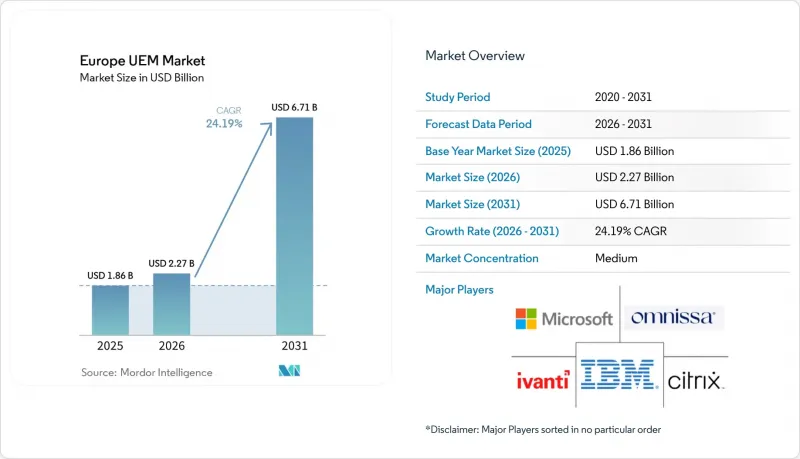
根據 Mordor Intelligence 預測,歐洲統一端點管理 (UEM) 市場規模預計將在 2025 年達到 18.6 億美元,2026 年達到 22.7 億美元,到 2031 年達到 67.1 億美元,2026 年至 2031 年的複合成長率為 24.19%。
本報告按組件(解決方案和服務)、部署模式(雲端、本地部署等)、組織規模(大型企業和中小企業)、最終用戶行業(IT和電信、銀行、金融服務和保險、政府和國防、醫療保健和生命科學、製造業、零售和電子商務等)以及國家/地區進行細分。市場預測以價值(美元)表示。
歐洲統一端點管理 (UEM) 市場的趨勢與洞察
受監管公司中混合辦公室和自備設備辦公模式的擴展
混合辦公已成為許多歐洲企業成熟的營運模式,因此,終端管理正從IT部門的單一任務轉變為歐洲統一終端管理(UEM)市場更廣泛的管治需求。隨著遠端使用的筆記型電腦、智慧型手機或平板電腦數量的增加,策略團隊需要管理的設備範圍也隨之擴大,這要求透過單一的營運框架進行管理,而不是為每種設備類型使用單獨的工具。受監管行業的自帶設備辦公室(BYOD)策略要求明確區分企業數據和個人數據,並對共用設備實施更嚴格的身份驗證和存取控制。 NIS2 進一步加速了這一轉變,它強制要求實施風險管理和安全措施,而這些措施在桌面、行動裝置和非協調系統上難以一致地實施。因此,企業越來越傾向於選擇能夠將單一控制模型應用於 Windows、macOS、iOS、Android、ChromeOS 及相關終端類型的平台,而無需重複工作流程。因此,提供現成合規模板和集中式報告功能的供應商更有能力將混合辦公的需求轉化為歐洲統一終端管理(UEM)市場的快速部署。
在分散式端點環境中實施零信任
在歐洲,隨著設備識別、存取控制和持續檢驗與正式的網路安全義務日益緊密地聯繫在一起,零信任架構的採用變得愈發重要。實際上,所有請求存取企業應用程式和網路資源的終端都必須具備最先進的、已知的身份,並且符合相關合規性要求。這項要求凸顯了統一控制層的價值,因為它允許在單一平台上集中協調註冊、策略、遙測和執行等工作。由歐盟「地平線」計畫資助的MEDIATE計畫也表明,跨越雲端、邊緣和物聯網環境的聯合零信任模型需要動態更新和可重新配置的安全控制。這使得買家的關注點從靜態規則集轉向能夠根據終端狀況的即時變化自動調整策略的平台。因此,越來越多的安全預算被分配給終端管理成本,推動了歐洲統一終端管理(UEM)市場合約價值的提升。
資料主權與跨境行政限制
資料主權仍然是限制採購速度的重要因素。這是因為歐洲企業必須仔細權衡雲端服務的便利性與資料儲存、存取和傳輸的嚴格義務。 《資料法》要求服務提供者採取技術和組織措施,防止歐盟以外政府的非法訪問,而歐洲資料傳輸指南則專注於個人資料如何在不同司法管轄區之間流動。因此,法律和安全團隊通常會在採購前仔細審查託管模式、加密控制和金鑰管理機制。如果買家對這些問題不滿意,他們可能會推遲決策、要求提供主權解決方案,或將供應商選擇範圍縮小到在歐盟司法管轄區內擁有更強大架構的提供者。因此,供應商需要投入額外成本來建構和維護滿足營運需求和正式保障要求的區域環境。最終,歐洲統一端點管理 (UEM) 市場整體而言往往銷售週期較長,部署計畫也更加謹慎。
細分市場分析
預計到2025年,這些解決方案將佔據68.33%的市場佔有率,並在2026年至2031年間以25.12%的複合年成長率成長,確保軟體在歐洲統一端點管理(UEM)市場中繼續保持其商業性價值創造的核心地位。設備管理、安全管理和合規性管理仍然是基礎層,企業通常從註冊、策略執行、修補程式可見性和報告入手。隨後,應用程式管理和內容管理滿足了第二個營運需求:維護受管端點間軟體、存取權限和分散式檔案的一致性。隨著本地工具、SaaS工作負載和行動優先的工作模式在同一營運基礎架構中並存,此需求在企業環境中的重要性日益凸顯。此外,由於買家要求儘早發現問題並減少手動糾正程序,解決方案層中的分析和自動化功能也越來越受到關注。
隨著軟體部署的推進,服務層也不斷擴展。這是因為,隨著跨多個作業系統和位置的終端規模不斷擴大,對配置、策略設計和環境調優的要求也日益嚴格。在周期的早期階段,專業服務至關重要,因為企業需要協助制定註冊計劃、策略架構、整合方案以及符合監管用例的報告框架。當客戶缺乏內部人員來日常運行企業級終端控制,同時也要保持風險態勢所需的一致性時,託管服務的重要性就更加凸顯。此外,BlackBerry 於 2026 年 6 月增強了可選的 AI 輔助操作功能,這表明供應商正在擴展軟體層的可操作範圍,從而產生了對部署和最佳化等輔助服務的需求。從這個意義上講,雖然解決方案仍然是收入的核心,但服務在幫助企業利用軟體承諾的營運標準,將歐洲整合終端管理市場變為現實方面發揮著重要作用。
預計到2025年,基於雲端的部署將佔市場佔有率的63.55%,並將以25.23%的複合年成長率持續成長至2031年。這凸顯了託管管理正成為歐洲統一端點管理(UEM)市場眾多新計畫的標準方向。企業青睞零接觸配置、遠端策略更新和集中式遙測功能,因為這些特性比基於位置的管理模式更適合分散式辦公模式。在政府、國防和關鍵基礎設施等產業,本地部署仍然佔據重要地位,因為在這些產業中,對託管和資料處理的直接控制仍然是合約或政策上的優先事項。混合模式也日益重要,因為一些組織希望在為標準員工設備提供雲端服務的便利性的同時,為特定工作負載和敏感資產維護一個受控環境。因此,部署策略不再像表面看起來那麼簡單,尤其是在監管嚴格的行業。
「主權」的概念賦予了當前的雲端遷移獨特的歐洲特徵。 2026年4月,Ivanti發布了基於BSI認證基礎設施的「Neurons for MDM-Sovereign Edition-EU」。該公司將該產品定位為歐盟資料主權、合規性和多作業系統支持,所有功能均可透過單一主機實現。 2025年10月,Omnissa和GEMA也針對德國和奧地利推出了「Sovereign Workspace ONE」服務,旨在將SaaS模式與本地基礎設施控制相結合。這些產品的發布表明,雲端成長不僅僅是擴大託管規模,更重要的是明確管轄權,而這種轉變正在歐洲整合端點管理市場中催生一個高階細分市場。因此,儘管基於雲端的細分市場在規模上佔據主導地位,但主權雲的變體正在提高歐洲「高品質成長」的標準。
其他好處:
- Excel格式的市場預測(ME)表
- 3個月的分析師支持
目錄
第1章:引言
- 研究假設和市場定義
- 調查範圍
第2章:調查方法
第3章執行摘要
第4章 市場狀況
- 市場概覽
- 市場促進因素
- 受監管公司中混合辦公室和自備設備辦公模式的擴展
- 在分散式端點環境中實施零信任
- 跨身分、存取和裝置控制的端點整合。
- 端點操作和策略編配的雲端遷移
- 歐盟在網路安全和資料保護合規方面的支出。
- 人工智慧驅動的終端自動化和數位化員工體驗最佳化
- 市場限制因素
- 數據主權和跨境監管約束
- 在採購現有部署基礎設施的過程中,博通和 VMware 之間產生了摩擦。
- 傳統 Windows、行動裝置和專用裝置之間整合的複雜性。
- 對中階市場買家重疊的安全工具和預算進行分析。
- 產業價值鏈分析
- 監理情勢
- 技術展望
- 宏觀經濟因素對市場的影響
- 波特五力分析
第5章 市場規模與成長預測
- 按組件
- 解決方案
- 設備管理
- 應用程式管理
- 內容管理
- 安全與合規管理
- 分析與自動化
- 服務
- 專業服務
- 託管服務
- 解決方案
- 部署模式
- 基於雲端的
- 現場
- 混合
- 按組織規模
- 大公司
- 小型企業
- 按最終用戶行業分類
- 資訊科技/通訊
- BFSI
- 政府/國防
- 醫療保健和生命科學
- 製造業
- 零售與電子商務
- 教育
- 運輸/物流
- 能源公用事業
- 其他終端用戶產業
- 國家
- 德國
- 英國
- 法國
- 義大利
- 西班牙
- 荷蘭
- 俄羅斯
- 其他歐洲國家
第6章 競爭情勢
- 市場集中度
- 策略趨勢
- 市佔率分析
- 公司簡介
- Microsoft Corporation
- Ivanti, Inc.
- Omnissa, LLC
- IBM Corporation
- Citrix Systems, Inc.
- BlackBerry Limited
- Sophos Ltd.
- SOTI Inc.
- Matrix42 AG
- baramundi software USA, Inc.
- 42Gears Mobility Systems Pvt Ltd.
- ManageEngine(Zoho Corporation Pvt. Ltd.)
- Jamf Holding Corp.
- Kandji, Inc.
- HCL Technologies Limited
- Microland Limited
- STEFANINI
- TANGOE
- SCALEFUSION(Promobi Technologies Pvt Ltd)
- Mitsogo Inc.
第7章 市場機會與未來展望
According to Mordor Intelligence, the Europe UEM market size is projected to be USD 1.86 billion in 2025, USD 2.27 billion in 2026, and reach USD 6.71 billion by 2031, growing at a CAGR of 24.19% from 2026 to 2031.
This report is Segmented by Component (Solutions and Services), Deployment Mode (Cloud-Based, On-Premise, and More), Organization Size (Large Enterprises and Small and Medium Enterprises), End-User Industry (IT and Telecommunications, BFSI, Government and Defense, Healthcare and Life Sciences, Manufacturing, Retail and E-Commerce, and More), and Country. The Market Forecasts are Provided in Terms of Value (USD).
Europe UEM Market Trends and Insights
Hybrid Work and BYOD Expansion Across Regulated Enterprises
Hybrid work is now a durable operating model in many European organizations, so endpoint control has moved from a narrow IT task to a wider governance need across the Europe UEM market. Each additional remote laptop, phone, and tablet widens the device surface that policy teams must manage through one operating framework instead of separate tools for separate device classes. BYOD policies in regulated sectors also require clear separation between corporate and personal data, along with stronger authentication and access control on shared devices. NIS2 reinforced this shift by requiring risk management and security measures that are harder to enforce consistently when desktop, mobile, and access policies sit in disconnected systems. That is why enterprises are favoring platforms that can apply one control model across Windows, macOS, iOS, Android, ChromeOS, and adjacent endpoint types without duplicating workflows. Vendors that ship ready-made compliance templates and centralized reporting are therefore better placed to turn hybrid-work demand into faster deployments across the Europe unified endpoint management (UEM) market.
Zero-Trust Rollouts Across Distributed Endpoint Environments
Zero-trust adoption is gaining more weight in Europe because device identity, access control, and continuous verification now sit closer to formal cybersecurity obligations. In practice, every endpoint that requests access to a corporate application or network resource must present a current state, a known identity, and a compliant posture. That requirement increases the value of a unified control layer because the same platform can tie enrollment, policy, telemetry, and enforcement together in one place. The MEDIATE project under Horizon funding also showed that federated zero-trust models across cloud, edge, and IoT settings need security controls that can be updated and reconfigured dynamically. This shifts buyer attention away from static rule sets and toward platforms that can automate policy changes as endpoint conditions change in real time. As a result, security budgets are absorbing a larger share of endpoint management spending, which supports higher-value contracts across the Europe UEM market.
Data Sovereignty and Cross-Border Control Constraints
Data sovereignty remains a real brake on buying speed because European organizations must weigh cloud convenience against strict obligations around data location, access, and transfer. The Data Act requires providers to take technical and organizational measures against unlawful non-EU government access, while European data-transfer guidance keeps attention on how personal data moves across jurisdictions. This means legal and security teams often review hosting models, encryption control, and key-management arrangements before procurement can move forward. When buyers cannot get comfortable with those issues, they either delay decisions, ask for sovereign variants, or narrow the vendor list to providers with stronger EU-jurisdiction positioning. Vendors then face extra cost to build and maintain regional environments that satisfy both operational needs and formal assurance expectations. The result is longer sales cycles and more cautious deployment planning across the Europe UEM market.
Other drivers and restraints analyzed in the detailed report include:
- Endpoint Consolidation Across Identity, Access, and Device Control
- Cloud Migration of Endpoint Operations and Policy Orchestration
- Broadcom-VMware Transition Friction in Installed Base Procurement
For complete list of drivers and restraints, kindly check the Table Of Contents.
Segment Analysis
Solutions held 68.33% of the market in 2025 and are projected to expand at a 25.12% CAGR from 2026 to 2031, which keeps software at the center of commercial value creation in the Europe UEM market. Device management and security and compliance management continue to form the base layer because enterprises usually start with enrollment, policy enforcement, patch visibility, and reporting. Application management and content management then address a second operational need, which is keeping software, access, and distributed files consistent across managed endpoints. This becomes more important as enterprise environments mix on-premises tools, SaaS workloads, and mobile-first work patterns in the same operating estate. Analytics and automation inside the solutions layer are also attracting more attention because buyers want earlier issue detection and fewer manual remediation steps.
The services layer is growing in step with those software deployments because configuration, policy design, and environment tuning become more demanding as fleets expand across multiple operating systems and locations. Professional services matter early in the cycle when enterprises need help with enrollment planning, policy architecture, integration choices, and reporting frameworks that align with regulated use cases. Managed services become more relevant when customers lack internal staff to run enterprise-grade endpoint control day after day with the consistency their risk posture requires. BlackBerry's June 2026 enhancement of optional AI-assisted operations also shows how vendors are widening the practical scope of the software layer, which in turn creates follow-on service demand for rollout and optimization. In that sense, solutions remain the core revenue driver, while services help organizations adopt the Europe unified endpoint management market at the operational standard the software now promises.
Cloud-based deployment accounted for 63.55% of the market in 2025 and is projected to expand at a 25.23% CAGR through 2031, which confirms that hosted management has become the default direction for many new projects in the Europe UEM market. Enterprises are drawn to zero-touch provisioning, remote policy updates, and centralized telemetry because these features fit distributed workforces better than site-bound administration models. On-premises deployments still matter in government, defense, and critical infrastructure settings where direct control over hosting and data handling remains a contractual or political priority. Hybrid models are also gaining relevance because some organizations want cloud convenience for standard employee fleets while keeping selected workloads or sensitive estates in controlled environments. This leaves deployment strategy less binary than it first appears, especially in regulated sectors.
The sovereignty layer is what gives the current cloud shift its distinctly European shape. Ivanti launched Neurons for MDM - Sovereign Edition - EU in April 2026 on BSI-certified infrastructure, and the company positioned it around EU data sovereignty, compliance, and multi-OS coverage through one console. Omnissa and GEMA made a similar move in October 2025 with a sovereign Workspace ONE service for Germany and Austria that aimed to combine SaaS-style delivery with local infrastructure control. These launches show that cloud growth is not simply moving toward more hosting, but toward more jurisdictional clarity, and that shift is creating a premium track within the Europe unified endpoint management market. The cloud-based segment therefore leads on scale, while sovereign cloud variants are raising the bar on what qualified growth looks like in Europe.
Complete Report Scope:
- By Component
- Solutions
- Device Management
- Application Management
- Content Management
- Security and Compliance Management
- Analytics and Automation
- Services
- Professional Services
- Managed Services
- Solutions
- By Deployment Mode
- Cloud-Based
- On-Premise
- Hybrid
- By Organization Size
- Large Enterprises
- Small and Medium Enterprises
- By End-User Industry
- IT and Telecommunications
- BFSI
- Government and Defense
- Healthcare and Life Sciences
- Manufacturing
- Retail and E-Commerce
- Education
- Transportation and Logistics
- Energy and Utilities
- Other End-User Industries
- By Country
- Germany
- United Kingdom
- France
- Italy
- Spain
- Netherlands
- Russia
- Rest of Europe
List of Companies Covered in this Report:
- Microsoft Corporation
- Ivanti, Inc.
- Omnissa, LLC
- IBM Corporation
- Citrix Systems, Inc.
- BlackBerry Limited
- Sophos Ltd.
- SOTI Inc.
- Matrix42 AG
- baramundi software USA, Inc.
- 42Gears Mobility Systems Pvt Ltd.
- ManageEngine (Zoho Corporation Pvt. Ltd.)
- Jamf Holding Corp.
- Kandji, Inc.
- HCL Technologies Limited
- Microland Limited
- STEFANINI
- TANGOE
- SCALEFUSION (Promobi Technologies Pvt Ltd)
- Mitsogo Inc.
Additional Benefits:
- The market estimate (ME) sheet in Excel format
- 3 months of analyst support
TABLE OF CONTENTS
1 INTRODUCTION
- 1.1 Study Assumptions and Market Definition
- 1.2 Scope of the Study
2 RESEARCH METHODOLOGY
3 EXECUTIVE SUMMARY
4 MARKET LANDSCAPE
- 4.1 Market Overview
- 4.2 Market Drivers
- 4.2.1 Hybrid Work and BYOD Expansion Across Regulated Enterprises
- 4.2.2 Zero-Trust Rollouts Across Distributed Endpoint Environments
- 4.2.3 Endpoint Consolidation Across Identity, Access, and Device Control
- 4.2.4 Cloud Migration of Endpoint Operations and Policy Orchestration
- 4.2.5 EU Cyber Resilience and Data-Protection Compliance Spend
- 4.2.6 AI-Enabled Endpoint Automation and Digital Employee Experience Optimization
- 4.3 Market Restraints
- 4.3.1 Data Sovereignty and Cross-Border Control Constraints
- 4.3.2 Broadcom-VMware Transition Friction in Installed Base Procurement
- 4.3.3 Integration Complexity Across Legacy Windows, Mobile, and Specialized Devices
- 4.3.4 Security Tool Overlap and Budget Scrutiny in Midmarket Buyers
- 4.4 Industry Value Chain Analysis
- 4.5 Regulatory Landscape
- 4.6 Technological Outlook
- 4.7 Impact of Macroeconomic Factors on the Market
- 4.8 Porter's Five Forces Analysis
- 4.8.1 Bargaining Power of Suppliers
- 4.8.2 Bargaining Power of Buyers
- 4.8.3 Threat of New Entrants
- 4.8.4 Threat of Substitutes
- 4.8.5 Competitive Rivalry
5 MARKET SIZE AND GROWTH FORECAST (VALUE)
- 5.1 By Component
- 5.1.1 Solutions
- 5.1.1.1 Device Management
- 5.1.1.2 Application Management
- 5.1.1.3 Content Management
- 5.1.1.4 Security and Compliance Management
- 5.1.1.5 Analytics and Automation
- 5.1.2 Services
- 5.1.2.1 Professional Services
- 5.1.2.2 Managed Services
- 5.1.1 Solutions
- 5.2 By Deployment Mode
- 5.2.1 Cloud-Based
- 5.2.2 On-Premise
- 5.2.3 Hybrid
- 5.3 By Organization Size
- 5.3.1 Large Enterprises
- 5.3.2 Small and Medium Enterprises
- 5.4 By End-User Industry
- 5.4.1 IT and Telecommunications
- 5.4.2 BFSI
- 5.4.3 Government and Defense
- 5.4.4 Healthcare and Life Sciences
- 5.4.5 Manufacturing
- 5.4.6 Retail and E-Commerce
- 5.4.7 Education
- 5.4.8 Transportation and Logistics
- 5.4.9 Energy and Utilities
- 5.4.10 Other End-User Industries
- 5.5 By Country
- 5.5.1 Germany
- 5.5.2 United Kingdom
- 5.5.3 France
- 5.5.4 Italy
- 5.5.5 Spain
- 5.5.6 Netherlands
- 5.5.7 Russia
- 5.5.8 Rest of Europe
6 COMPETITIVE LANDSCAPE
- 6.1 Market Concentration
- 6.2 Strategic Moves
- 6.3 Market Share Analysis
- 6.4 Company Profiles (includes Global Level Overview, Market Level Overview, Core Segments, Financials as available, Strategic Information, Market Rank/Share, Products and Services, Recent Developments)
- 6.4.1 Microsoft Corporation
- 6.4.2 Ivanti, Inc.
- 6.4.3 Omnissa, LLC
- 6.4.4 IBM Corporation
- 6.4.5 Citrix Systems, Inc.
- 6.4.6 BlackBerry Limited
- 6.4.7 Sophos Ltd.
- 6.4.8 SOTI Inc.
- 6.4.9 Matrix42 AG
- 6.4.10 baramundi software USA, Inc.
- 6.4.11 42Gears Mobility Systems Pvt Ltd.
- 6.4.12 ManageEngine (Zoho Corporation Pvt. Ltd.)
- 6.4.13 Jamf Holding Corp.
- 6.4.14 Kandji, Inc.
- 6.4.15 HCL Technologies Limited
- 6.4.16 Microland Limited
- 6.4.17 STEFANINI
- 6.4.18 TANGOE
- 6.4.19 SCALEFUSION (Promobi Technologies Pvt Ltd)
- 6.4.20 Mitsogo Inc.
7 MARKET OPPORTUNITIES AND FUTURE OUTLOOK
- 7.1 White-Space and Unmet-Need Assessment

 整合端點管理市場-2026-2032年全球市場預測
 中東和非洲統一端點管理 (UEM):市場佔有率分析、行業趨勢和統計數據以及成長預測 (2026-2031)亞太地區統一端點管理 (UEM):市場佔有率分析、產業趨勢與統計、成長預測(2026-2031 年)北美統一端點管理 (UEM):市場佔有率分析、行業趨勢和統計數據、成長預測(2026-2031 年)南美洲統一端點管理 (UEM):市場佔有率分析、行業趨勢和統計數據以及成長預測 (2026-2031)整合終端管理:市場佔有率分析、產業趨勢與統計、成長預測(2026-2031)東協統一端點管理 (UEM):市場佔有率分析、產業趨勢與統計及成長預測 (2026-2031)銀行、金融服務和保險 (BFSI) 行業的統一端點管理 (UEM):市場佔有率分析、行業趨勢和統計數據以及成長預測 (2026-2031)泰國:市場佔有率分析、產業趨勢與統計、成長預測(2026-2031)越南統一端點管理 (UEM):市場佔有率分析、產業趨勢與統計及成長預測 (2026-2031)