


 |
市場調查報告書
商品編碼
2097455
越南統一端點管理 (UEM):市場佔有率分析、產業趨勢與統計及成長預測 (2026-2031)Vietnam UEM - Market Share Analysis, Industry Trends & Statistics, Growth Forecasts (2026 - 2031) |
||||||

※ 本網頁內容可能與最新版本有所差異。詳細情況請與我們聯繫。
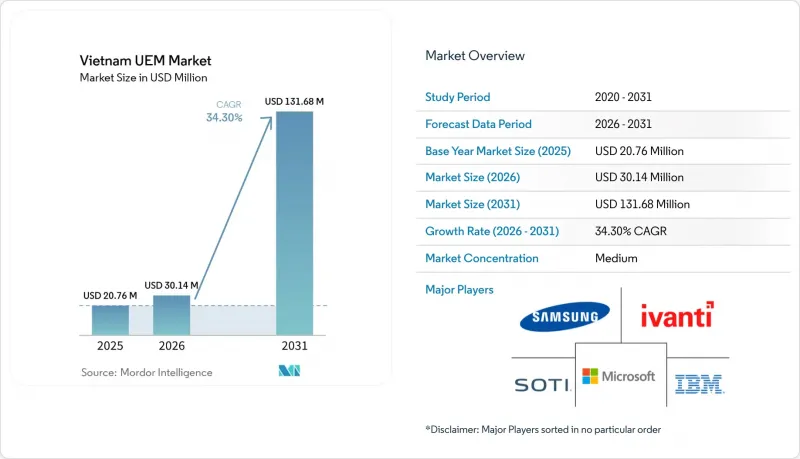
據 Mordor Intelligence 稱,越南統一端點管理 (UEM) 市場在 2025 年的價值為 2076 萬美元,預計到 2031 年將達到 1.3168 億美元,而 2026 年為 3014 萬美元,2026 年至 2031 年預測期內的複合年成長率。
本報告按組件(解決方案和服務)、部署模式(雲端、本地部署、混合部署)、組織規模(大型企業和中小企業)以及最終用戶行業(IT和電信、銀行、金融服務和保險、政府和國防、醫療保健和生命科學、製造業、零售和電子商務等)進行細分。市場預測以價值(美元)表示。
越南統一端點管理 (UEM) 市場的趨勢與洞察
越南企業移動化的發展
企業行動化的擴展正在提升越南統一端點管理 (UEM) 的潛在市場,因為許多企業現在管理的設備不再局限於傳統的辦公室筆記型電腦。行動端點正成為銷售、服務、物流、醫療保健和政府等行業日常營運不可或缺的一部分,這凸顯了跨多個作業系統和使用模式的單一策略層的重要性。這項轉變意義重大,因為在許多企業中,設備數量的成長速度超過了內部策略的標準化速度,即使數位化進程順利推進,也可能加劇管治的差距。這種需求不僅限於員工智慧型手機,還包括平板電腦、防震手持手持終端機、共用設備和現場終端,所有這些設備都需要配置、存取控制、修補程式管理和遠端支援。能夠自動執行註冊、合規性檢查和糾正措施的供應商將佔據有利地位,尤其是在 IT 團隊無法以與設備數量同步的速度擴展人員的情況下,這些供應商更能抓住這一市場需求。主要供應商近期推出的平台更新表明,該領域的管理模式正從手動管理轉向“低接觸管理”,這將進一步加速越南 UEM 市場的整體發展。
BYOD 和 COPE 在知識型勞動力中的快速普及
越南統一端點管理 (UEM) 市場也受益於知識型員工中自帶設備辦公 (BYOD) 和企業自有設備辦公室 (COPE) 模式的普及,因為這些機制在降低硬體成本的同時,也提高了管理要求。當個人設備或混合用途設備連接到企業應用程式時,如果沒有統一的控制平面,資料隔離、存取策略、應用程式分發和裝置狀態管理將變得困難。這為 UEM 平台創造了實際機遇,因為單一工具可以保護端點環境的部分內容,但通常無法涵蓋整個工作流程,包括註冊、策略管理、合規性和支援。這種需求模式在處理受監管和敏感資料的行業中尤其重要,因為在這些行業中,需要在員工柔軟性和雇主控制之間取得平衡。此外,共用和混合設備環境需要更嚴格的自動化,因為隨著使用者、應用程式和裝置角色的變化,手動分配策略變得越來越困難。供應商在 2026 年發布的新產品反映了這種轉變,透過增強合規性自動化和簡化 Android 和 Apple 設備的管理,這將有助於 UEM 在整個越南市場更自然地普及。
中小企業的預算考量
預算限制仍然是限制越南統一端點管理 (UEM) 市場短期成長的最主要因素之一。這是因為許多中小企業 (SME) 在端點管理方面仍然優先考慮成本控制而非管治。這項挑戰具有結構性,因為對於收入基礎小規模、IT 人員有限的公司而言,每年 5,000 萬越南盾(約 1,970 美元)至 2 億越南盾(約 7,880 美元)的軟體支出可能難以承受。這一點至關重要,因為儘管合規壓力存在,但購買力和部署能力未必能同步提升。中小企業通常會選擇基本的端點保護或延遲採用更全面的管理工具。因此,即使對統一管理的需求確實存在,其商業化進程也會被延遲。此外,自帶設備辦公室 (BYOD) 可能會進一步擴大這種差距,因為它降低了硬體成本,但除非企業採用更強大的管理工具,否則策略和資料風險仍無法解決。因此,儘管越南統一端點管理 (UEM) 市場為中小企業提供了大量且快速成長的商機,但該市場更有可能從較低水平開始擴張,而不是立即達到大規模的市場規模。
細分市場分析
預計到2025年,解決方案將佔據越南統一端點管理 (UEM) 市場66.37%的佔有率,這表明買家仍然優先考慮軟體控制層而非獨立的外部支援。這一趨勢反映了市場對能夠協調管理設備、應用程式、內容、安全性、合規性、分析和自動化等功能的單一平台的需求。在這種配置下,設備管理和安全功能仍然至關重要,因為企業需要管理其不斷擴展的端點基礎架構中的註冊、存取、修補程式和策略執行。此外,該類別也正在從基本控制向自動化發展。例如,Ivanti 於2026年第二季發布的 Neurons 更新增加了人工智慧驅動的工作流程功能和自主端點管理功能。
在越南統一端點管理 (UEM) 市場,服務仍然至關重要,其銷售佔有率僅次於解決方案。這是因為許多部署都需要實施支援、管理員培訓和部署後託管支援。當企業在端點管理方面經驗有限,或需要將新的 UEM 層整合到現有應用環境中時,這種趨勢尤其明顯。因此,在越南的 UEM 產業,平台銷售和服務主導的部署實際上存在重疊,當地合作夥伴通常扮演著產品功能與日常營運執行之間的橋樑角色。隨著分析、自動化和 AI主導的糾正措施的興起,託管服務的價值可能會進一步提升,因為一些買家更重視結果和持續支持,而不是完全的內部管理。這些趨勢解釋了為什麼儘管解決方案目前在銷售方面佔據主導地位,但服務對於拓展更廣泛的越南 UEM 市場仍然至關重要。
預計到 2025 年,基於雲端的部署將佔越南 UEM(統一端點管理)市場收入的 64.35%,在目前的部署配置下,雲端部署將成為越南 UEM 市場佔有率的核心。雲端平台的普及源自於其支援更快的部署速度、持續的功能交付、更低的初始基礎設施要求以及更便捷的分散式設備支援。三星於 2026 年 6 月發布的「Knox 雲端服務」進一步增強了直接設備註冊和管理功能,展現了基於雲端的管理如何在大規模Android 環境中更輕鬆地擴展。這些功能為越南 UEM 市場帶來了顯著價值,幫助企業管理跨多個地點的行動端點、遠端團隊和共用設備。
在越南統一端點管理 (UEM) 市場,本地部署仍然具有重要的戰略意義,因為政府機構和銀行、金融和保險 (BFSI) 行業的買家可能對工作負載和資料處理更加謹慎。因此,混合環境正在成為一種切實可行的折衷方案,它允許在雲端管理敏感度較低的端點,同時將受監管的工作負載置於更嚴格的本地控制之下。能夠提供跨兩種環境的統一管理視圖,而不是強迫客戶二選一的供應商,將最具發展潛力。 Ivanti 於 2026 年 6 月發布的「Sovereign Cloud」就是此類產品的典範,它在解決管轄權和合規性問題的同時,又不犧牲集中式端點管理的核心優勢。這種柔軟性和控制力的平衡將確保混合模式和本地部署模式在越南 UEM 市場保持穩固的地位,同時雲端仍然佔據主導。
其他好處:
- Excel格式的市場預測(ME)表
- 3個月的分析師支持
目錄
第1章:引言
- 研究假設和市場定義
- 調查範圍
第2章:調查方法
第3章執行摘要
第4章 市場狀況
- 市場概覽
- 市場促進因素
- 越南企業移動化的發展
- BYOD 和 COPE 在知識型勞動力中的快速普及
- 加速網路安全和資料保護要求
- 擴大公共部門數位化規模並實現終端標準化
- Android公司和自助服務終端在零售和物流領域的成長
- 分散式設備環境增加了對統一策略管理的需求。
- 市場限制因素
- 中小企業的預算敏感性
- 與傳統 Windows 和特定產業應用程式的複雜整合。
- 對高度敏感的政府和銀行、金融服務和保險(BFSI)工作負載的雲端主權問題表示擔憂
- 中型企業缺乏有限的終端安全和UEM管理技能
- 產業價值鏈分析
- 監理情勢
- 技術展望
- 宏觀經濟因素對市場的影響
- 波特五力分析
第5章 市場規模與成長預測
- 按組件
- 解決方案
- 設備管理
- 應用程式管理
- 內容管理
- 安全與合規管理
- 分析與自動化
- 服務
- 解決方案
- 部署模式
- 基於雲端的
- 現場
- 混合
- 按組織規模
- 大公司
- 小型企業
- 按最終用戶行業分類
- 資訊科技/通訊
- BFSI
- 政府/國防
- 醫療保健和生命科學
- 製造業
- 零售與電子商務
- 教育
- 運輸/物流
- 能源公用事業
- 其他終端用戶產業
第6章 競爭情勢
- 市場集中度
- 策略趨勢
- 市佔率分析
- 公司簡介
- Microsoft Corporation
- Ivanti, Inc.
- Samsung Electronics Co., Ltd.
- BlackBerry Limited
- SOTI Inc.
- IBM Corporation
- Citrix Systems, Inc.
- Jamf Holding Corp.
- Zoho Corporation Private Limited
- Google LLC
- Hexnode
- OpenText Corporation
- Cisco Systems, Inc.
- Hewlett Packard Enterprise Company
- Dell Technologies Inc.
第7章 市場機會與未來展望
According to Mordor Intelligence, the Vietnam UEM market size was valued at USD 20.76 million in 2025 and estimated to grow from USD 30.14 million in 2026 to reach USD 131.68 million by 2031, at a CAGR of 34.30% during the forecast period 2026-2031.
This report is Segmented by Component (Solutions, and Services), Deployment Mode (Cloud-Based, On-Premise, and Hybrid), Organization Size (Large Enterprises, and Small and Medium Enterprises), and End-User Industry (IT and Telecommunications, BFSI, Government and Defense, Healthcare and Life Sciences, Manufacturing, Retail and E-Commerce, and More). The Market Forecasts are Provided in Terms of Value (USD).
Vietnam UEM Market Trends and Insights
Rising Enterprise Mobility in Vietnam
Enterprise mobility is expanding the addressable market for the Vietnam UEM market, as more organizations now manage devices beyond traditional office laptops. Mobile endpoints are becoming part of daily operations across sales, service, logistics, healthcare, and public administration, underscoring the need for a single policy layer across multiple operating systems and usage models. This shift matters because device growth is outpacing internal policy standardization in many organizations, so governance gaps can widen even when digital adoption appears positive. The need is not limited to employee smartphones, as tablets, rugged handhelds, shared devices, and field terminals also require provisioning, access control, patching, and remote support. Vendors that can automate enrollment, compliance checks, and remediation are better placed to capture this demand, especially where IT teams cannot scale headcount at the same pace as device fleets. Recent platform updates from leading vendors show that the category is moving toward lower-touch management rather than manual administration, which supports broader deployment across the Vietnam UEM market.
Rapid BYOD and COPE Adoption Across Knowledge Workforces
The Vietnam UEM market is also benefiting from the spread of BYOD and COPE models across knowledge workforces, as these arrangements reduce hardware costs but increase control requirements. Once personal or mixed-use devices connect to enterprise apps, data separation, access policy, app distribution, and device posture become harder to manage without a unified control plane. This creates a practical opening for UEM platforms, as point tools can protect parts of the endpoint environment but often do not cover the full workflow of enrollment, policy management, compliance, and support. The demand pattern is especially relevant in sectors that handle regulated or sensitive data, where organizations need a workable balance between employee flexibility and employer control. Shared- and mixed-device environments also require tighter automation, as manual policy assignment becomes more difficult as users, apps, and device roles change. Vendor releases in 2026 reflected this shift through stronger compliance automation and simpler management of Android and Apple fleets, which supports more organic adoption across the Vietnam UEM market.
Budget Sensitivity Among Small and Medium Enterprises
Budget sensitivity remains one of the clearest limits on near-term expansion in the Vietnam UEM market because most smaller firms still approach endpoint management through cost control first and governance second. The challenge is structural, since annual software spending of VND 50 million (USD 1,970) to VND 200 million (USD 7,880) can be difficult for firms with modest revenue bases and limited IT staff. This matters because compliance pressure may exist, but purchasing power and implementation capacity do not always move at the same speed. Smaller organizations often respond by choosing basic endpoint protection or delaying broader management tools, which slows revenue conversion even when the need for unified control is real. BYOD can also deepen this gap by reducing hardware costs while leaving policy and data risks unresolved until a company adopts stronger management tools. As a result, the SME opportunity in the Vietnam UEM market is large and fast growing, but it is still likely to build from a low base rather than deliver immediate scale.
Other drivers and restraints analyzed in the detailed report include:
- Accelerating Cybersecurity and Data Protection Requirements
- Expansion of Public Sector Digitization and Endpoint Standardization
- Complex Integration with Legacy Windows and Industry-Specific Applications
For complete list of drivers and restraints, kindly check the Table Of Contents.
Segment Analysis
Solutions held a 66.37% share of the Vietnam UEM market in 2025, indicating that buyers still place greater value on the software control layer than on standalone external support. That preference reflects demand for one platform that can manage devices, applications, content, security, compliance, analytics, and automation in a coordinated way. Within this mix, device management and security functions remain central because organizations need to control enrollment, access, patching, and policy enforcement across a widening endpoint base. The category is also moving beyond basic control into automation, as shown by Ivanti's Q2 2026 Neurons update that added AI-driven workflow features and autonomous endpoint management capabilities.
Services still matter in the Vietnam UEM market, even though they trail solutions in revenue share, because many deployments require implementation support, administrator training, and managed support after rollout. This is particularly true when organizations have limited internal endpoint expertise or when they must connect a new UEM layer to older application environments. The Vietnam UEM industry is therefore seeing a practical overlap between platform sales and service-led adoption, with local partners often acting as the bridge between product capability and day-to-day execution. The shift toward analytics, automation, and AI-led remediation may raise the value of managed services further, since some buyers will prefer outcomes and ongoing support over full in-house administration. That dynamic helps explain why solutions dominate current revenue while services remain important to expansion across the broader Vietnam UEM market.
Cloud-based deployment accounted for 64.35% of revenue in 2025, putting it at the center of Vietnam's UEM market share in the current adoption mix. Cloud platforms appeal because they support faster implementation, continuous feature delivery, lower upfront infrastructure needs, and easier support for distributed devices. Samsung's June 2026 Knox Cloud Services release, which added more direct fleet enrollment and management functions, illustrates how cloud-based administration is getting easier to scale in high-volume Android environments. Those features are valuable in the Vietnam UEM market when organizations manage mobile endpoints, remote teams, and shared devices across multiple sites.
On-premises deployment still holds strategic relevance in the Vietnam UEM market, as government and BFSI buyers may be more sensitive to workloads and data handling. That is why hybrid environments are emerging as a practical middle path, allowing less sensitive endpoints to stay under cloud administration while regulated workloads remain under tighter local control. The strongest vendors are likely to be those that present one administrative view across both settings rather than forcing customers into a binary choice. Ivanti's sovereign cloud launch in June 2026 provides a useful product example of how the category is adapting to jurisdiction and compliance concerns without abandoning the core benefits of centralized endpoint management. This balance between flexibility and control should keep cloud in the lead while preserving a durable place for hybrid and on-premise models in the Vietnam UEM market.
Complete Report Scope:
- By Component
- Solutions
- Device Management
- Application Management
- Content Management
- Security and Compliance Management
- Analytics and Automation
- Services
- Solutions
- By Deployment Mode
- Cloud-Based
- On-Premise
- Hybrid
- By Organization Size
- Large Enterprises
- Small and Medium Enterprises
- By End-User Industry
- IT and Telecommunications
- BFSI
- Government and Defense
- Healthcare and Life Sciences
- Manufacturing
- Retail and E-Commerce
- Education
- Transportation and Logistics
- Energy and Utilities
- Other End-User Industries
List of Companies Covered in this Report:
- Microsoft Corporation
- Ivanti, Inc.
- Samsung Electronics Co., Ltd.
- BlackBerry Limited
- SOTI Inc.
- IBM Corporation
- Citrix Systems, Inc.
- Jamf Holding Corp.
- Zoho Corporation Private Limited
- Google LLC
- Hexnode
- OpenText Corporation
- Cisco Systems, Inc.
- Hewlett Packard Enterprise Company
- Dell Technologies Inc.
Additional Benefits:
- The market estimate (ME) sheet in Excel format
- 3 months of analyst support
TABLE OF CONTENTS
1 INTRODUCTION
- 1.1 Study Assumptions and Market Definition
- 1.2 Scope of the Study
2 RESEARCH METHODOLOGY
3 EXECUTIVE SUMMARY
4 MARKET LANDSCAPE
- 4.1 Market Overview
- 4.2 Market Drivers
- 4.2.1 Rising Enterprise Mobility in Vietnam
- 4.2.2 Rapid BYOD and COPE Adoption Across Knowledge Workforces
- 4.2.3 Accelerating Cybersecurity and Data Protection Requirements
- 4.2.4 Expansion of Public Sector Digitization and Endpoint Standardization
- 4.2.5 Android Enterprise and Kiosk Device Growth in Retail and Logistics
- 4.2.6 Fragmented Device Estates Increasing Need for Unified Policy Control
- 4.3 Market Restraints
- 4.3.1 Budget Sensitivity Among Small and Medium Enterprises
- 4.3.2 Complex Integration With Legacy Windows and Industry-Specific Applications
- 4.3.3 Cloud Sovereignty Concerns for Sensitive Government and BFSI Workloads
- 4.3.4 Limited Endpoint Security and UEM Administration Skills in Mid-Market Firms
- 4.4 Industry Value Chain Analysis
- 4.5 Regulatory Landscape
- 4.6 Technological Outlook
- 4.7 Impact of Macroeconomic Factors on the Market
- 4.8 Porter's Five Forces Analysis
- 4.8.1 Threat of New Entrants
- 4.8.2 Bargaining Power of Buyers
- 4.8.3 Bargaining Power of Suppliers
- 4.8.4 Threat of Substitutes
- 4.8.5 Industry Rivalry
5 MARKET SIZE AND GROWTH FORECASTS (VALUE)
- 5.1 By Component
- 5.1.1 Solutions
- 5.1.1.1 Device Management
- 5.1.1.2 Application Management
- 5.1.1.3 Content Management
- 5.1.1.4 Security and Compliance Management
- 5.1.1.5 Analytics and Automation
- 5.1.2 Services
- 5.1.1 Solutions
- 5.2 By Deployment Mode
- 5.2.1 Cloud-Based
- 5.2.2 On-Premise
- 5.2.3 Hybrid
- 5.3 By Organization Size
- 5.3.1 Large Enterprises
- 5.3.2 Small and Medium Enterprises
- 5.4 By End-User Industry
- 5.4.1 IT and Telecommunications
- 5.4.2 BFSI
- 5.4.3 Government and Defense
- 5.4.4 Healthcare and Life Sciences
- 5.4.5 Manufacturing
- 5.4.6 Retail and E-Commerce
- 5.4.7 Education
- 5.4.8 Transportation and Logistics
- 5.4.9 Energy and Utilities
- 5.4.10 Other End-User Industries
6 COMPETITIVE LANDSCAPE
- 6.1 Market Concentration
- 6.2 Strategic Moves
- 6.3 Market Share Analysis
- 6.4 Company Profiles (includes Global Level Overview, Market Level Overview, Core Segments, Financials as available, Strategic Information, Market Rank/Share, Products and Services, Recent Developments)
- 6.4.1 Microsoft Corporation
- 6.4.2 Ivanti, Inc.
- 6.4.3 Samsung Electronics Co., Ltd.
- 6.4.4 BlackBerry Limited
- 6.4.5 SOTI Inc.
- 6.4.6 IBM Corporation
- 6.4.7 Citrix Systems, Inc.
- 6.4.8 Jamf Holding Corp.
- 6.4.9 Zoho Corporation Private Limited
- 6.4.10 Google LLC
- 6.4.11 Hexnode
- 6.4.12 OpenText Corporation
- 6.4.13 Cisco Systems, Inc.
- 6.4.14 Hewlett Packard Enterprise Company
- 6.4.15 Dell Technologies Inc.
7 MARKET OPPORTUNITIES AND FUTURE OUTLOOK
- 7.1 White-Space and Unmet-Need Assessment

 整合端點管理市場-2026-2032年全球市場預測
 中東和非洲統一端點管理 (UEM):市場佔有率分析、行業趨勢和統計數據以及成長預測 (2026-2031)亞太地區統一端點管理 (UEM):市場佔有率分析、產業趨勢與統計、成長預測(2026-2031 年)北美統一端點管理 (UEM):市場佔有率分析、行業趨勢和統計數據、成長預測(2026-2031 年)南美洲統一端點管理 (UEM):市場佔有率分析、行業趨勢和統計數據以及成長預測 (2026-2031)整合終端管理:市場佔有率分析、產業趨勢與統計、成長預測(2026-2031)東協統一端點管理 (UEM):市場佔有率分析、產業趨勢與統計及成長預測 (2026-2031)歐洲統一端點管理 (UEM):市場佔有率分析、產業趨勢與統計及成長預測 (2026-2031)銀行、金融服務和保險 (BFSI) 行業的統一端點管理 (UEM):市場佔有率分析、行業趨勢和統計數據以及成長預測 (2026-2031)泰國:市場佔有率分析、產業趨勢與統計、成長預測(2026-2031)