


 |
市場調查報告書
商品編碼
2099175
機架式GPU:市佔率分析、產業趨勢與統計及成長預測(2026-2031年)Rack-Scale GPU - Market Share Analysis, Industry Trends & Statistics, Growth Forecasts (2026 - 2031) |
||||||

※ 本網頁內容可能與最新版本有所差異。詳細情況請與我們聯繫。
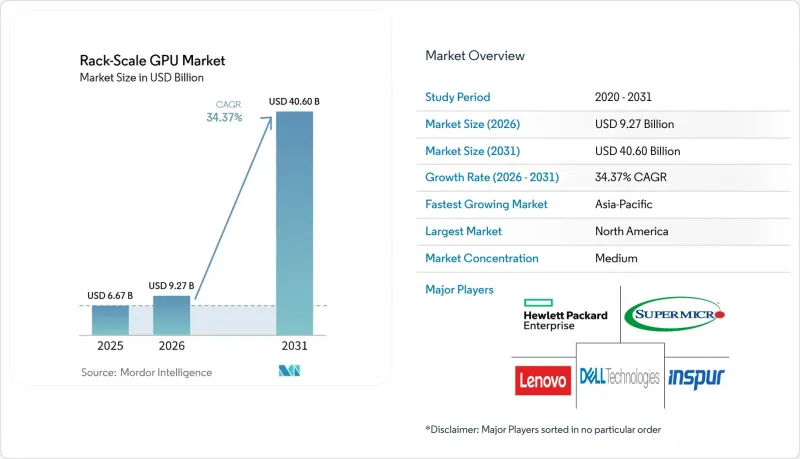
根據 Mordor Intelligence 預測,機架級 GPU 市場規模將從 2025 年的 66.7 億美元和 2026 年的 92.7 億美元成長到 2031 年的 406 億美元,2026 年至 2031 年的年複合成長率(CAGR)為 34.37%。
本報告按交付類型(硬體、軟體、服務)、機架密度(最多 16 個 GPU、17-64 個 GPU、65-128 個 GPU、128 個 GPU 及以上)、冷卻技術(風冷、水冷、混合冷卻)、最終用戶(雲端服務供應商、企業、政府和研究機構、電信和邊緣營運商)以及電信地區進行細分。市場預測以美元 (USD) 為單位。
全球機架式GPU市場趨勢及洞察
超大規模人工智慧叢集日益成長的密度需求
機架級GPU市場正受到超大規模雲端營運商的推動,這些營運商建構的大規模AI叢集需要更高密度的基礎設施,而這需要在每個新的引進週期中實現。 NVIDIA表示,其Vera Rubin NVL72平台在一個機架級系統中整合了72個Rubin GPU和36個Vera CPU,這表明效能目標已從獨立節點轉向整合架構。 NVIDIA也指出,到2025年,GB200 NVL72級系統的單機架功耗將達到132千瓦,而Vera Rubin級平台正朝著更高的機架密度發展。這使得每個擴展階段都更加依賴專門設計的電源和散熱方案。因此,機架級GPU市場不僅在加速器方面,而且在機架交付、液冷迴路、光纖擴展,甚至是系統部署前的工廠級檢驗,都出現了投資成長。戴爾已確認,其基於NVIDIA Vera Rubin平台的首批系統於2026年6月交付給CoreWeave,這反映出當前超大規模需求下,市場更傾向於採用整合式機架級交付模式,而非傳統的基於組件的引進週期。 NVIDIA的「百萬GPU級AI工廠」也反映了類似的轉變,機架級GPU市場正由平台級建構模式而非傳統的伺服器更換週期來塑造。
從 GPU 節點遷移到機架級架構
隨著越來越多採用人工智慧技術的公司需要能夠作為單一邏輯運算系統而非多個獨立GPU伺服器集合的機架,機架級GPU市場也不斷發展。 NVIDIA將Vera Rubin NVL72描述為一個統一的機架平台,整合了260 TB/s的NVLink 6光纖通道網路,其架構直接支援向大規模共用記憶體域遷移,以滿足高要求的人工智慧工作負載。開放運算專案(Open Compute Project)在人工智慧開放叢集設計方面的努力進一步表明,基礎設施標準正從傳統的以節點為中心的方法轉向以高功率叢集佈局、更寬的機架規格和機架原生電源分配為中心的方法。這對機架級GPU市場具有重大意義,因為採購活動正變得更加系統化,買家將機箱、網路、液冷和可維護性作為一個整體進行評估。 AMD也在使其「Helios AI」機架設計與Meta的開放式運算專案保持一致,這表明這種以光纖通道網路主導的方向並非僅限於單一供應商生態系統。因此,機架級 GPU 市場正在向平台競爭轉變,切換成本、檢驗週期和操作熟練度幾乎與加速器的純粹性能同等重要。
前期投資負擔沉重。
機架級GPU市場仍面臨許多限制因素。完整的機架式AI系統需要大量的初步投資,涵蓋硬體、機架整合、冷卻、網路和設施搭建等面向。廠商的公告本身就表明,價值集中在整個系統。買家不再只是訂購GPU闆卡,而是採購包含配套基礎設施的完整機架級環境。這種成本結構使得機架級GPU市場主要由超大規模資料中心業者、政府主導計畫以及少數資金雄厚的雲端服務專家主導。託管配置和託管式AI運算可以減輕企業的擁有成本負擔,AMD與Rackspace簽訂的30兆瓦合約表明,服務主導的存取模式正在成為解決方案的一部分。然而,由於每次部署都需要對運算和設施能力進行大量投資,因此進入機架級GPU市場仍然比進入傳統伺服器市場更加困難。雖然這種資本結構有利於長期成長,但也縮小了短期客戶群。
細分市場分析
到 2025 年,硬體銷售額將佔 62.98%,成為機架級 GPU 市場中最大的組成部分。這反映了客戶在加速器、NVLink 交換器、機架機箱、電源系統和散熱硬體方面的大量支出。這種情況與最初的建置週期相吻合,當時許多客戶仍在建立新的 AI 容量,需要在最佳化層成為主要支出重點之前購買整個實體堆疊。戴爾、HPE、超微、聯想和其他系統整合商已將完整的機架式 AI 平台商業化,在當前的擴展階段,硬體仍然是買家預算的核心。雖然軟體銷售佔有率仍然很小,但隨著使用傳統 HPC 工具管理網路架構、散熱控制和工作負載編配變得越來越困難,其營運重要性正在不斷提高。簡而言之,儘管硬體仍然是支出的基礎,但機架級 GPU 市場不再僅僅由伺服器硬體定義。
預計到2031年,服務業將以34.96%的複合年成長率成長,成為成長最快的產業。這表明營運複雜性正在迅速增加,超出了許多買家的可接受範圍。 CoreWeave於2026年6月推出的NVIDIA Vera Rubin NVL72,包含水冷儲存、客製化軟體定義冷卻控制和整合機架管理,展現了機架投入生產前所需的深度調整。戴爾的「整合式機架可擴展系統」模式也呈現出類似的趨勢,它將檢驗、現場部署和生命週期支援與硬體捆綁銷售,而不是作為可選附加組件。在機架級GPU產業,這擴展了試運行、散熱設計最佳化、韌體檢驗、光連接模組配置和安全配置等環節。因此,對於那些需要機架原生AI功能但又不想組成完整內部營運團隊的企業、二級雲端服務和公共機構而言,機架級GPU市場的業務收益可能會成長得更快。
到了2025年,17-64 GPU層級佔39.83%的營收佔有率,成為機架級GPU市場中領先的密度等級。這得歸功於其能夠滿足企業級AI、區域雲和中等規模主權運算等廣泛的需求。此層級提供了一個切實可行的中間點,使用戶能夠在無需立即轉向最大、最苛刻的機架式部署的情況下,獲得可操作的運算密度。此外,此層級也滿足了那些需要高階訓練和推理能力,但又希望在可控的功耗預算和部署計畫內運作的組織的需求。因此,到2025年,17-64 GPU層級佔據了機架級GPU市場佔有率的39.83%,對於那些尋求規模但又不想承擔最高密度規格全部複雜性的用戶而言,它仍然是領先的選擇。此層級透過彌合初始企業部署和完全超大規模配置之間的差距,為整個機架級GPU市場做出了貢獻。
預計到2031年,擁有超過128個GPU的機架層將以35.17%的複合年成長率成長,這預示著下一波擴展浪潮的發展方向,因為大規模的AI模型需要更快的通訊速度和更低的機架內延遲。 Supermicro宣布,其Vera Rubin NVL4 DCBBS藍圖可以在一個3.2兆瓦的單元中擴展至1152個NVIDIA Rubin GPU,這表明供應商已經在設計時考慮到了超高密度AI部署模組。戴爾也發布了PowerEdge XE8812,該產品在ORv3標準下每個機架最多支援144個GPU,進一步證實了機架級GPU市場正在向更高密度的機架級發展。致力於開放叢集設計的開放運算專案(OCP)正在透過制定未來高密度AI叢集的機殼和電源標準,為這一趨勢增添一層標準化。雖然擁有 16 個和 65-128 個 GPU 的配置在機架式 GPU 行業仍然很重要,但發展勢頭明顯轉向大規模的機架域,以減少尖端工作負載中的通訊開銷。
區域分析
到2025年,北美將佔據機架式GPU市場53.34%的佔有率,成為領先的區域市場。這反映了超大規模雲端買家、人工智慧基礎設施專家以及早期水冷架構的集中。美國仍然是重要的樞紐,擁有規模最大的平台推出、初始系統出貨量以及眾多備受矚目的人工智慧工廠項目。戴爾於2026年6月向CoreWeave交付了一套基於Vera Rubin架構的系統,顯示北美機架式GPU市場仍受惠於廠商與客戶之間的緊密合作以及快速的商業化週期。英偉達也已向CoreWeave投資20億美元,擴大了雙方的合作關係,旨在到2030年幫助其建造超過5吉瓦的人工智慧工廠,凸顯了該地區正在進行的基礎設施投資規模之大。因此,該地區的主導地位不僅源於其當前的產能,還源於其在電源供應、機架整合和生態系統支援等領域的快速行動。
儘管歐洲的成長基數相對較小,但該地區的機架式GPU市場正憑藉科研計算、國家主導的人工智慧策略以及對高效、高密度基礎設施日益成長的需求而蓬勃發展。 NVIDIA的2026年科學系統計畫涵蓋了萊布尼茨超級運算中心,這表明該地區在採用先進的機架式原生人工智慧和高效能運算平台方面持續保持著高度關注。 HPE和聯想也分別將其2026年的「AI工廠」和「Vera Rubin」計畫定位為多租戶和大規模部署,這進一步印證了歐洲買家正從逐步增加節點轉向採用完整的機架平台。該地區的發展趨勢表明,在計算自主權、科研工作負載以及對效率驅動型設施設計的重視的推動下,市場將穩步成長。
預計到2031年,亞太地區將以35.31%的複合年成長率成長,成為機架級GPU市場成長最快的區域市場。在日本,市場已具備部署條件,這得益於高密度水冷運行以及IDC Frontier、Vertiv和Equinix等供應商提供的商業水冷服務。中國則走著自己的本土發展道路,華為的「CloudMatrix384」論文描述了一種機架級超級節點架構,該架構擁有384個NPU和一個橫跨16個機架的統一記憶體池。華為也表示,其「Atlas 950 SuperPoD」可擴展至8192個NPU,顯示本土替代方案正迅速發展成為系統級AI基礎設施。除亞太地區外,南美市場規模仍然小規模,主要原因是超大規模資料中心託管需求有限。同時,中東和非洲正透過政府主導的人工智慧基礎設施建設和大規模人工智慧工廠計劃,不斷擴大其影響力,但與北美相比,其部署基礎仍然更加集中。
其他好處:
- Excel格式的市場預測(ME)表
- 3個月的分析師支持
目錄
第1章:引言
- 研究假設和市場定義
- 調查範圍
第2章:調查方法
第3章執行摘要
第4章 市場狀況
- 市場概覽
- 市場促進因素
- 超大規模人工智慧集群日益成長的密度需求
- 從 GPU 節點遷移到機架級架構
- 新人工智慧資料中心水冷實施的準備情況
- 國家主導的人工智慧基礎建設
- 電源供應的限制正在推動高密度機架設計的應用。
- 將多租戶人工智慧服務貨幣化的壓力
- 市場限制因素
- 高初始投資
- 電力和冷卻系統維修的複雜性
- 先進封裝和高頻寬記憶體供不應求
- 各OEM廠商在機架級標準化上有差異
- 宏觀經濟因素對市場的影響
- 產業價值鏈分析
- 監理情勢
- 技術展望
- 波特五力分析
第5章 市場規模與成長預測
- 報價
- 硬體
- 軟體
- 服務
- 按貨架密度
- 最多可支援 16 個 GPU
- 17~64 GPU
- 65至128個GPU
- 128 或更多 GPU
- 按類型分類的冷卻技術
- 空冷式
- 液冷
- 混合冷卻
- 最終用戶
- 雲端服務供應商
- 公司
- 政府和研究機構
- 通訊業者和邊緣營運商
- 按地區
- 北美洲
- 美國
- 加拿大
- 墨西哥
- 歐洲
- 德國
- 英國
- 法國
- 義大利
- 其他歐洲國家
- 亞太地區
- 中國
- 日本
- 韓國
- 印度
- 東南亞
- 其他亞太國家
- 南美洲
- 中東和非洲
- 北美洲
第6章 競爭情勢
- 市場集中度
- 策略趨勢
- Market Positioning Analysis
- 公司簡介
- Dell Technologies Inc.
- Hewlett Packard Enterprise Company
- Super Micro Computer, Inc.
- Lenovo Group Limited
- Inspur Group Co., Ltd.
- NVIDIA Corporation
- Advanced Micro Devices, Inc.
- Cisco Systems, Inc.
- Huawei Technologies Co., Ltd.
- GIGABYTE Technology Co., Ltd.
- ASUSTeK Computer Inc.
- Fujitsu Limited
- International Business Machines Corporation
- Intel Corporation
- Oracle Corporation
- CoreWeave, Inc.
- Quanta Computer Inc.
- Wistron Corporation
- Wiwynn Corporation
- Hon Hai Precision Industry Co., Ltd.
第7章 市場機會與未來展望
According to Mordor Intelligence, the rack-scale GPU market size is projected to expand from USD 6.67 billion in 2025 and USD 9.27 billion in 2026 to USD 40.60 billion by 2031, registering a CAGR of 34.37% between 2026 and 2031.
This report is Segmented by Offering (Hardware, Software, and Services), Rack Density (Up To 16 GPUs, 17-64 GPUs, 65-128 GPUs, and Above 128 GPUs), Cooling Technology (Air Cooled, Liquid Cooled, and Hybrid Cooled), End-User (Cloud Service Providers, Enterprises, Government and Research Institutions, and Telecom and Edge Operators), and Geography. The Market Forecasts are Provided in Terms of Value (USD).
Global Rack-Scale GPU Market Trends and Insights
Rising Hyperscale AI Cluster Density Requirements
The rack-scale GPU market is being driven by hyperscale cloud operators building larger AI clusters that require denser infrastructure in every new deployment cycle. NVIDIA stated that the Vera Rubin NVL72 platform combines 72 Rubin GPUs and 36 Vera CPUs in a single rack-scale system, underscoring how the performance target has already shifted from isolated nodes to integrated fabrics. NVIDIA also showed that GB200 NVL72-class systems reached 132 kW per rack in 2025, and that Vera Rubin-class platforms are moving toward far higher rack densities, making each expansion phase increasingly dependent on purpose-built power and cooling design. As a result, the rack-scale GPU market is drawing higher spending not only for accelerators, but also for rack delivery, liquid loops, optical scale-up, and factory-level validation before systems are installed. Dell confirmed the first shipment of systems built on the NVIDIA Vera Rubin platform to CoreWeave in June 2026, reflecting how hyperscale demand now favors integrated rack delivery over slower component-led installation cycles. The same shift is evident in NVIDIA's description of million-GPU AI factories, where the rack-scale GPU market is being shaped by platform-scale buildouts rather than typical server refresh cycles.
Shift From GPU Nodes To Rack-Scale Fabrics
The rack-scale GPU market is also advancing as AI buyers increasingly want racks that behave like a single logical compute system rather than a collection of separate GPU servers. NVIDIA described Vera Rubin NVL72 as a unified rack platform tied together by a 260 TB/s NVLink 6 fabric, and that architecture directly supports the move toward large shared memory domains for demanding AI workloads. Open Compute Project's work on open cluster designs for AI further shows that infrastructure standards are now being built around high-power cluster layouts, wider rack formats, and rack-native power distribution, rather than legacy node assumptions. That matters for the rack-scale GPU market because procurement is becoming more system-oriented, with buyers evaluating enclosures, networking, liquid cooling, and service readiness as one package. AMD also tied its Helios AI rack design to Meta's Open Compute work, suggesting that this fabric-led direction is not confined to a single supplier ecosystem. The rack-scale GPU market is therefore moving toward platform competition where switching costs, validation cycles, and operational familiarity matter almost as much as raw accelerator performance.
High Upfront Capital Intensity
The rack-scale GPU market still faces a meaningful restraint because full-rack AI systems require a large upfront commitment across hardware, rack integration, cooling equipment, networking, and facility preparation. Vendor announcements themselves show how much value is concentrated in the full system, since buyers are no longer ordering only GPU boards and are instead procuring complete rack-scale environments with supporting infrastructure. That cost profile keeps the rack-scale GPU market tilted toward hyperscalers, sovereign programs, and a small group of well-capitalized cloud specialists. Managed deployment and hosted AI compute can reduce the ownership burden for enterprises, and AMD's 30 MW agreement with Rackspace shows that service-led access models are becoming part of the response. Even so, the rack-scale GPU market remains harder to enter than conventional server markets because each deployment requires a matched investment in both compute and facility capability. This capital profile supports long-term growth but narrows the immediate customer pool.
Other drivers and restraints analyzed in the detailed report include:
- Liquid-Cooling Readiness in New AI Data Centers
- Sovereign AI Infrastructure Buildouts
- Power And Cooling Retrofit Complexity
For complete list of drivers and restraints, kindly check the Table Of Contents.
Segment Analysis
Hardware accounted for 62.98% of revenue in 2025, making it the largest offering in the rack-scale GPU market and reflecting the heavy spending required for accelerators, NVLink switches, rack enclosures, power systems, and cooling hardware. That position was consistent with an early build cycle, when many customers were still building new AI capacity and had to purchase the full physical stack before optimization layers became the primary focus of spending. Dell, HPE, Supermicro, Lenovo, and other system builders are commercializing full-rack AI platforms, keeping hardware at the center of buyers' budgets during the current expansion phase. Software remains smaller in revenue share, yet it has become operationally more important as fabrics, cooling controls, and workload orchestration become harder to manage with traditional HPC tools. That means the rack-scale GPU market is no longer defined solely by server hardware, even if hardware still anchors spending.
Services are projected to expand at a 34.96% CAGR through 2031, making it the fastest-growing offering and showing how quickly operating complexity is moving beyond the comfort level of many buyers. CoreWeave's June 2026 bring-up of NVIDIA Vera Rubin NVL72 involved liquid-cooled storage, custom software-defined cooling control, and unified rack management, which illustrates the depth of coordination required before a rack enters production use. Dell's Integrated Rack Scalable Systems model also points in the same direction, packaging validation, on-site deployment, and lifecycle support alongside the hardware rather than selling them as optional follow-on work. In the rack-scale GPU industry, this creates a wider role for commissioning, thermal tuning, firmware validation, optical interconnect setup, and security configuration. The rack-scale GPU market is therefore likely to see service revenue rise faster wherever enterprises, second-tier clouds, and public institutions want the capability of rack-native AI without building a full operations team internally.
The 17-64 GPU tier accounted for 39.83% of revenue in 2025, making it the leading density class in the rack-scale GPU market, as it meets a broad set of enterprise AI, regional cloud, and mid-scale sovereign requirements. This tier offered a practical middle ground where buyers could deploy meaningful compute density without immediately moving into the largest and most demanding rack footprints. The segment also matched the needs of organizations that wanted advanced training and inference capacity while still working within more manageable power envelopes and deployment schedules. For that reason, 17-64 GPUs held 39.83% of the rack-scale GPU market share in 2025, and it remained the workhorse bracket for buyers seeking scale without the full complexity of the highest-density formats. The rack-scale GPU market benefited from this segment, as it bridged early enterprise adoption and full hyperscale configurations.
The above-128 GPU tier is projected to expand at a 35.17% CAGR through 2031, which shows where the next wave of scale is heading as larger AI models demand tighter intra-rack communication and lower latency. Supermicro said its Vera Rubin NVL4 DCBBS blueprint can scale to 1,152 NVIDIA Rubin GPUs within a 3.2 MW unit, which demonstrates how suppliers are already designing around extremely dense AI deployment blocks. Dell also introduced the PowerEdge XE8812, which supports up to 144 GPUs per ORv3-standard rack, further confirming that the rack-scale GPU market is moving toward much denser rack classes. The Open Compute Project, which works on open cluster designs, adds a standards layer to this movement by preparing enclosures and power formats for future high-density AI clusters. In the rack-scale GPU industry, the up-to-16 and 65-128 GPU brackets still matter, but the strongest momentum is clearly shifting toward larger rack domains that can reduce communication overhead for frontier workloads.
Complete Report Scope:
- By Offering
- Hardware
- Software
- Services
- By Rack Density
- Up to 16 GPUs
- 17-64 GPUs
- 65-128 GPUs
- Above 128 GPUs
- By Cooling Technology
- Air Cooled
- Liquid Cooled
- Hybrid Cooled
- By End User
- Cloud Service Providers
- Enterprises
- Government and Research Institutions
- Telecom and Edge Operators
- By Geography
- North America
- United States
- Canada
- Mexico
- Europe
- Germany
- United Kingdom
- France
- Italy
- Rest of Europe
- Asia-Pacific
- China
- Japan
- South Korea
- India
- Southeast Asia
- Rest of Asia-Pacific
- South America
- Middle East and Africa
- North America
Geography Analysis
North America accounted for 53.34% of the rack-scale GPU market in 2025, making it the leading regional market and reflecting the concentration of hyperscale cloud buyers, AI infrastructure specialists, and early liquid-cooled buildouts. The United States remains the main anchor because the largest platform launches, first system shipments, and many of the most visible AI factory projects are centered there. Dell shipped Vera Rubin-based systems to CoreWeave in June 2026, showing that the rack-scale GPU market in North America still benefits from close vendor-customer coordination and fast commercialization cycles. NVIDIA also invested USD 2 billion in CoreWeave and expanded the partnership to support a 5+ GW AI factory buildout by 2030, underscoring the scale of the infrastructure commitment already underway in the region. The regional lead is therefore not only a matter of current capacity, but also of faster execution across power, rack integration, and ecosystem support.
Europe is growing from a smaller base, but the rack-scale GPU market there is gaining traction through research computing, sovereign AI priorities, and rising interest in efficient high-density infrastructure. NVIDIA's 2026 science systems announcement included the Leibniz Supercomputing Center, demonstrating that the region remains active in deploying advanced rack-native AI and HPC platforms. HPE and Lenovo also positioned their 2026 AI factory and Vera Rubin programs for multi-tenant and large-scale deployments, which supports the view that European buyers are moving toward full-rack platforms rather than incremental node additions. The regional profile suggests steady growth where compute sovereignty, research workloads, and efficiency-oriented facility design come together.
Asia-Pacific is projected to expand at a 35.31% CAGR through 2031, making it the fastest-growing regional segment in the rack-scale GPU market. Japan is already demonstrating stronger deployment readiness through high-density liquid-cooled operations and commercial liquid-cooling services from operators such as IDC Frontier, Vertiv, and Equinix. China is advancing along a distinct domestic path, and Huawei's CloudMatrix384 paper described a 384 NPU rack-scale supernode architecture with unified memory pooling across 16 racks. Huawei also said its Atlas 950 SuperPoD would scale to 8,192 NPUs, which shows how quickly local alternatives are moving toward system-level AI infrastructure. Outside Asia-Pacific, South America remains a smaller market, centered on selective hyperscale colocation demand, while the Middle East and Africa are becoming more visible through sovereign AI buildouts and large AI factory ambitions, even though the installed base remains more concentrated than in North America.
- Dell Technologies Inc.
- Hewlett Packard Enterprise Company
- Super Micro Computer, Inc.
- Lenovo Group Limited
- Inspur Group Co., Ltd.
- NVIDIA Corporation
- Advanced Micro Devices, Inc.
- Cisco Systems, Inc.
- Huawei Technologies Co., Ltd.
- GIGABYTE Technology Co., Ltd.
- ASUSTeK Computer Inc.
- Fujitsu Limited
- International Business Machines Corporation
- Intel Corporation
- Oracle Corporation
- CoreWeave, Inc.
- Quanta Computer Inc.
- Wistron Corporation
- Wiwynn Corporation
- Hon Hai Precision Industry Co., Ltd.
Additional Benefits:
- The market estimate (ME) sheet in Excel format
- 3 months of analyst support
TABLE OF CONTENTS
1 INTRODUCTION
- 1.1 Study Assumptions and Market Definition
- 1.2 Scope of the Study
2 RESEARCH METHODOLOGY
3 EXECUTIVE SUMMARY
4 MARKET LANDSCAPE
- 4.1 Market Overview
- 4.2 Market Drivers
- 4.2.1 Rising Hyperscale AI Cluster Density Requirements
- 4.2.2 Shift From GPU Nodes to Rack-Scale Fabrics
- 4.2.3 Liquid-Cooling Readiness in New AI Data Centers
- 4.2.4 Sovereign AI Infrastructure Buildouts
- 4.2.5 Power-Availability Constraints Favoring High-Density Rack Design
- 4.2.6 Multi-Tenant AI Service Monetization Pressure
- 4.3 Market Restraints
- 4.3.1 High Upfront Capital Intensity
- 4.3.2 Power and Cooling Retrofit Complexity
- 4.3.3 Limited Supply of Advanced Packaging and High-Bandwidth Memory
- 4.3.4 Rack-Level Standardization Gaps Across OEMs
- 4.4 Impact of Macroeconomic Factors on the Market
- 4.5 Industry Value Chain Analysis
- 4.6 Regulatory Landscape
- 4.7 Technological Outlook
- 4.8 Porter's Five Forces Analysis
- 4.8.1 Bargaining Power of Buyers
- 4.8.2 Bargaining Power of Suppliers
- 4.8.3 Threat of New Entrants
- 4.8.4 Threat of Substitutes
- 4.8.5 Intensity of Competitive Rivalry
5 MARKET SIZE AND GROWTH FORECASTS (VALUE)
- 5.1 By Offering
- 5.1.1 Hardware
- 5.1.2 Software
- 5.1.3 Services
- 5.2 By Rack Density
- 5.2.1 Up to 16 GPUs
- 5.2.2 17-64 GPUs
- 5.2.3 65-128 GPUs
- 5.2.4 Above 128 GPUs
- 5.3 By Cooling Technology
- 5.3.1 Air Cooled
- 5.3.2 Liquid Cooled
- 5.3.3 Hybrid Cooled
- 5.4 By End User
- 5.4.1 Cloud Service Providers
- 5.4.2 Enterprises
- 5.4.3 Government and Research Institutions
- 5.4.4 Telecom and Edge Operators
- 5.5 By Geography
- 5.5.1 North America
- 5.5.1.1 United States
- 5.5.1.2 Canada
- 5.5.1.3 Mexico
- 5.5.2 Europe
- 5.5.2.1 Germany
- 5.5.2.2 United Kingdom
- 5.5.2.3 France
- 5.5.2.4 Italy
- 5.5.2.5 Rest of Europe
- 5.5.3 Asia-Pacific
- 5.5.3.1 China
- 5.5.3.2 Japan
- 5.5.3.3 South Korea
- 5.5.3.4 India
- 5.5.3.5 Southeast Asia
- 5.5.3.6 Rest of Asia-Pacific
- 5.5.4 South America
- 5.5.5 Middle East and Africa
- 5.5.1 North America
6 COMPETITIVE LANDSCAPE
- 6.1 Market Concentration
- 6.2 Strategic Moves
- 6.3 Market Positioning Analysis
- 6.4 Company Profiles (includes Global Level Overview, Market Level Overview, Core Segments, Financials as available, Strategic Information, Market Rank/Share, Products and Services, Recent Developments)
- 6.4.1 Dell Technologies Inc.
- 6.4.2 Hewlett Packard Enterprise Company
- 6.4.3 Super Micro Computer, Inc.
- 6.4.4 Lenovo Group Limited
- 6.4.5 Inspur Group Co., Ltd.
- 6.4.6 NVIDIA Corporation
- 6.4.7 Advanced Micro Devices, Inc.
- 6.4.8 Cisco Systems, Inc.
- 6.4.9 Huawei Technologies Co., Ltd.
- 6.4.10 GIGABYTE Technology Co., Ltd.
- 6.4.11 ASUSTeK Computer Inc.
- 6.4.12 Fujitsu Limited
- 6.4.13 International Business Machines Corporation
- 6.4.14 Intel Corporation
- 6.4.15 Oracle Corporation
- 6.4.16 CoreWeave, Inc.
- 6.4.17 Quanta Computer Inc.
- 6.4.18 Wistron Corporation
- 6.4.19 Wiwynn Corporation
- 6.4.20 Hon Hai Precision Industry Co., Ltd.
7 MARKET OPPORTUNITIES AND FUTURE OUTLOOK
- 7.1 White-Space and Unmet-Need Assessment

 GPU(影像處理)市場:按產品類型、記憶體類型、散熱方式、部署方式、應用和最終用戶分類 - 全球市場預測(2026-2032 年)
 GPU代工廠:市佔率分析、產業趨勢與統計、成長預測(2026-2031年)GPU網路:市佔率分析、產業趨勢與統計、成長預測(2026-2031年)GPU軟體:市佔率分析、產業趨勢與統計、成長預測(2026-2031年)CAD/CAM GPU:市場佔有率分析、產業趨勢與統計、成長預測(2026-2031)GPU半導體:市佔率分析、產業趨勢與統計、成長預測(2026-2031年)工業GPU:市場佔有率分析、產業趨勢與統計、成長預測(2026-2031年)工作站GPU:市場佔有率分析、產業趨勢與統計及成長預測(2026-2031年)整合顯示卡:市場佔有率分析、產業趨勢與統計、成長預測(2026-2031)
 圖形處理器 (GPU) 市場預測至 2034 年——按 GPU 類型、部署模式、記憶體類型、裝置類型、功能、應用程式、最終用戶和地區分類的全球分析