


 |
市場調查報告書
商品編碼
2099057
CAD/CAM GPU:市場佔有率分析、產業趨勢與統計、成長預測(2026-2031)CAD/CAM GPU - Market Share Analysis, Industry Trends & Statistics, Growth Forecasts (2026 - 2031) |
||||||

※ 本網頁內容可能與最新版本有所差異。詳細情況請與我們聯繫。
根據 Mordor Intelligence 預測,CAD/CAM GPU 市場規模預計將在 2025 年達到 29.1 億美元,2026 年達到 34.8 億美元,到 2031 年達到 80.2 億美元,2026 年至 2031 年的複合年成長率為 18.17%。
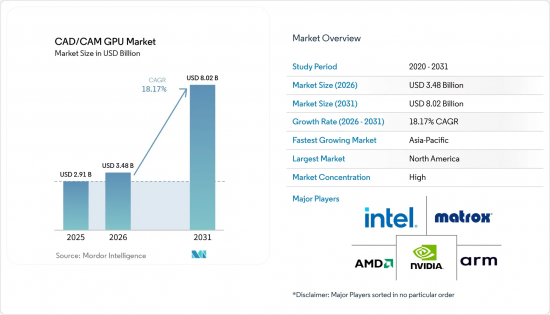
本報告按GPU產品類型(桌面專業/工作站獨立GPU、行動專業/工作站獨立GPU等)、GPU平台/架構(NVIDIA GPU平台等)、應用領域(電腦輔助設計和3D建模、電腦輔助製造等)、最終用戶(汽車產業等)以及地區進行細分。市場預測以美元(USD)為單位。
全球CAD/CAM GPU市場趨勢與洞察
對即時CAD和CAM工作流程的需求日益成長
CAD/CAM GPU市場的發展動力源自於專業設計和製造軟體對即時反應能力日益成長的需求。大規模組裝、多視窗工作以及與模擬相關的設計評審,如今對GPU記憶體和平行處理能力的要求遠高於僅依賴CPU速度。 NVIDIA於2025年3月發布了RTX PRO Blackwell工作站系列產品,其中包括配備96GB GDDR7顯存的RTX PRO 6000工作站版,這表明廠商的產品藍圖正瞄準要求更高的專業工作負載。這對CAD/CAM GPU市場意義重大,因為設計團隊越來越希望在同一工作站會話中流暢地處理複雜模型、模擬輸出和評審工作。此外,新工作流程的需求縮短了舊硬體的使用壽命,因為在正常的更換週期結束之前,記憶體和吞吐量的極限就會暴露出來。因此,工作站廠商不再將圖形處理視為次要的系統元件,而是將產品發佈時間與專業級GPU的升級同步。
擴展人工智慧驅動的衍生設計與渲染
CAD/CAM GPU市場的發展也得益於人工智慧輔助設計和渲染工具在整個工程工作流程中的普及。新型專業顯示卡新增了人工智慧專屬的加速功能,從而提升了緊湊型和全尺寸系統中的迭代建模、渲染和設計效能。 2025年8月,NVIDIA發表了RTX PRO 2000 Blackwell顯示卡,其CAD效能比上一代產品提升高達1.4倍,3D建模速度提升高達1.6倍。這顯示人工智慧驅動的效能提升正在滲透到主流工作站領域。 2025年7月,AMD也推出了工作站的Radeon AI PRO R9700顯示卡,配備32GB GDDR6顯存和128個AI加速器,為尋求AI圖形硬體的工程工作室提供了更多選擇。這項轉變對CAD/CAM GPU市場意義重大,因為以前需要卸載的渲染和設計任務現在可以在單一工作站上更快完成。此外,這將提高專業系統中記憶體頻寬和本地 AI 處理的要求,並將提升現有工程團隊的整體升級需求。
專業GPU總體擁有成本高
CCAD/CAM GPU市場在普及方面仍面臨著許多障礙,尤其是在專業系統的整體擁有成本(TCO)方面。這不僅包括顯示卡本身的成本,還包括認證驅動程式、工作站檢驗、電源、散熱支持,以及可能更廣泛的基礎設施改造。 NVIDIA將擁有96GB顯存和工作站級性能的RTX PRO 6000 Blackwell工作站版定位在其產品線的頂端,這凸顯了高階部署即使在未計入整合成本的情況下也可能價格不菲。 AMD也在2025年8月推出了Radeon PRO W7400,作為一款低功耗入門級顯示卡,這表明供應商已經意識到緊湊型專業系統需要具成本效益的替代方案。然而,性能上的妥協可能會限制低成本方案在生產關鍵型工程任務中的吸引力。因此,CAD/CAM GPU 市場的需求模式呈現兩極化,大型企業能夠承擔高價系統的成本,而中小企業則被迫延長升級週期或降低配置水準。
細分市場分析
2025年,面向桌面專業與工作站的獨立顯示卡銷售量佔比達到56.77%,持續維持CAD/CAM GPU市場最大產品系列的地位。這一主導地位源自於大規模組裝CAD、多物理場模擬和高保真渲染領域的強勁需求,在這些領域,大容量顯存和穩定的認證仍然至關重要。這些系統仍然是頂級工程環境的首選,能夠處理高密度模型、多個活動視圖以及模擬密集型專案審查。它們在CAD/CAM GPU行業也佔據核心地位,在該行業,運作、應用穩定性和可預測的認證行為比初始成本更為重要。面向行動專業和工作站的獨立顯示卡構成了下一個需求層級,為現場工程、現場工作和分散式企劃團隊提供支持,這些應用仍然需要經過認證的圖形效能。
預計從2026年到2031年,整合式和統一記憶體GPU的複合年成長率將達到18.66%,成為CAD/CAM GPU市場中成長最快的產品類型。這一成長反映了主流2D繪圖和輕量級3D任務表現的提升,顯示在所有專業環境中,獨立顯示卡已不再是必需品。因此,產品配置正呈現兩極化:高階獨立系統用於複雜的仿真,而更有效率的整合平台則面向小規模企業、教育機構和入門級專業工作流程。 AMD推出的Radeon PRO W7400功耗僅為55W,專為緊湊型工作站環境設計,這也顯示廠商正在努力滿足受限的外形規格,同時又不完全退出專業領域。其他專業GPU配置,包括虛擬化和伺服器連接環境,目前市場佔有率仍然較小,但隨著雲端交付工作站模式在CAD/CAM GPU市場日益普及,它們的重要性正在不斷提升。
2025年,NVIDIA平台貢獻了77.33%的收入,持續維持在CAD/CAM GPU市場平台層面的領先地位。這一地位不僅體現了硬體優勢,也得益於基於CUDA的工作流程規模、與Omniverse的整合以及整體廣泛使用的工程軟體的認證支援。從實際角度來看,該平台已深深融入許多大型企業的採購標準,即使效能差距縮小,切換成本也居高不下。這使得NVIDIA能夠在CAD/CAM GPU市場中保持最強大的部署基礎,尤其是在那些優先考慮長期軟體支援的設計環境中。這一地位也使NVIDIA能夠透過硬體發布和生態系統擴展來影響升級時機。
預計英特爾的GPU平台將在2026年至2031年間以19.21%的複合年成長率(CAGR)實現最高成長,顯示其在價值型和主流專業領域的市場將逐步開放。英特爾的崛起與其專業圖形技術堆疊日益增強的信心以及優先考慮注重成本效益的工作站應用場景的策略密切相關。對於那些尋求強大視覺化功能但又不想支付過高溢價的買家而言,AMD仍然是一個強力的選擇。 2025年發表的Radeon AI PRO R9700則為這個市場增添了明確的AI賦能選項。因此,儘管NVIDIA仍然牢牢佔據平台主導,但在頂級產品以外的CAD/CAM GPU行業,競爭正在加劇。其他用於專業CAD和CAM應用的平台選擇仍然有限,但它們的發展趨勢正在虛擬工作站和AI驅動的設計環境中引起關注,因為在這些環境中,軟體堆疊可能會發展得更快。
區域分析
到2025年,北美將佔35.16%的銷售額,領先區域CAD/CAM GPU市場。該地區受益於美國、加拿大和墨西哥境內高度集中的航太承包商、汽車設計部門、半導體工廠和國防工程項目。這些因素共同支撐了對認證工作站系統的穩定需求,尤其是在那些無法完全依賴遠端或共用運算環境的領域。此外,北美CAD/CAM GPU市場也受益於軟體的早期普及、龐大的企業IT預算以及為尋求大規模部署人工智慧工程工具的組織奠定的堅實基礎。
到2025年,歐洲在CAD/CAM GPU市場仍將佔有重要地位,其中德國、英國、法國和義大利是區域需求的主要中心。德國尤其如此,這得益於其強大的製造業、完善的工程軟體基礎設施以及眾多高度依賴CAD工業工作流程的企業。 2025年6月,NVIDIA宣布將在德國建造一個擁有1萬塊GPU的工業AI雲端平台,寶馬集團、Cadence和西門子等公司將從初期階段就參與其中。這凸顯了該地區在工業數位轉型中扮演的重要角色。在歐洲其他地區,特別是北歐國家、比荷盧經濟聯盟國家以及中東歐地區,隨著工業4.0投資週期的推進,也存在著次要的需求層。
預計亞太地區在2026年至2031年間將以19.04%的複合年成長率成長,成為CAD/CAM GPU市場成長最快的區域市場。這一成長主要得益於韓國的半導體產業基礎、日本的精密製造能力、印度不斷擴張的工程服務、中國的工業設計規模以及東南亞在先進組裝日益重要的角色。日本國內的工作站生態系統仍充滿活力,TSUKUMO將於2026年5月推出搭載英特爾至強600系列處理器的工作站,以滿足高度依賴模擬和人工智慧的專業工作負載需求。此次發布反映了日本國內工程用戶對專業系統的持續需求,而他們仍然依賴國內硬體銷售管道。儘管南美、中東和非洲的市場規模仍然小規模,但基礎設施、建築和設計服務領域的專案主導需求正在逐步催生新的採購週期。隨著認證視覺化、BIM和模擬工作流程成為標準工程實務的一部分,這些地區的CAD/CAM GPU市場預計將進一步擴張。
其他好處:
- Excel格式的市場預測(ME)表
- 3個月的分析師支持
目錄
第1章:引言
- 研究假設和市場定義
- 調查範圍
第2章:調查方法
第3章執行摘要
第4章 市場狀況
- 市場概覽
- 市場促進因素
- 對基於 GPU 加速的工作站的即時 CAD 和 CAM 工作流程的需求日益成長。
- 擴展人工智慧驅動的衍生設計與渲染
- 擴展大量利用數位孿生和模擬技術的工程項目。
- 廣泛採用結合本地部署和雲端技術的設計環境。
- 在多品種、小批量生產工作流程中擴大GPU的使用
- 遠端協作可視化和審查的需求日益成長。
- 市場限制因素
- 專業GPU總體擁有成本高
- 驅動程式身份驗證和軟體相容性限制
- 先進製程、記憶體和互連技術的供應鏈波動
- 高密度工作站的功率、發熱量和外形尺寸限制
- 產業價值鏈分析
- 宏觀經濟因素對市場的影響
- 監理情勢
- 技術展望
- 波特五力分析
第5章 市場規模與成長預測
- GPU 產品類型
- 桌上型電腦專業人士/工作站的獨立顯示卡
- 行動專業人士/工作站的獨立顯示卡
- 整合/統一記憶體 GPU
- 其他專業GPU配置
- 按GPU平台/架構
- NVIDIA GPU平台
- AMD GPU平台
- 英特爾 GPU 平台
- 其他GPU平台
- 透過使用
- 電腦輔助設計 (CAD) 和 3D 建模
- 電腦輔助製造(CAM)
- 電腦輔助工程與仿真
- 渲染、視覺化、數位孿生
- 其他進階設計工作負載
- 最終用戶
- 車
- 航太/國防
- 工業機械和重型設備
- 電子和半導體
- 建築、工程及施工
- 其他最終使用者(教育機構、學術機構和研究機構;醫療保健、醫療設備和牙科)
- 按地區
- 北美洲
- 美國
- 加拿大
- 墨西哥
- 歐洲
- 德國
- 英國
- 法國
- 義大利
- 其他歐洲國家
- 亞太地區
- 中國
- 日本
- 韓國
- 印度
- 東南亞
- 其他亞太國家
- 南美洲
- 中東和非洲
- 北美洲
第6章 競爭情勢
- 市場集中度
- 策略趨勢
- Market Positioning Analysis
- 公司簡介
- NVIDIA Corporation
- Advanced Micro Devices, Inc.
- Intel Corporation
- Matrox Electronic Systems Ltd.
- HP Inc.
- BOXX Technologies, Inc.
- Dell Technologies Inc.
- ASUSTeK Computer Inc.
- Micro-Star International Co., Ltd.
- GIGA-BYTE Technology Co., Ltd.
- ZOTAC Technology Limited
- PNY Technologies, Inc.
- Leadtek Research Inc.
- Palit Microsystems Ltd.
- Gainward Co., Ltd.
- Colorful Technology Company Limited
- Manli Technology Group Limited
- ASRock Incorporation
- InnoVISION Multimedia Limited
- Sapphire Technology Limited
第7章 市場機會與未來展望
According to Mordor Intelligence, the CAD/CAM GPU market size is projected to be USD 2.91 billion in 2025, USD 3.48 billion in 2026, and reach USD 8.02 billion by 2031, growing at a CAGR of 18.17% from 2026 to 2031.
This report is Segmented by GPU Product Type (Desktop Professional/Workstation Discrete GPUs, Mobile Professional/Workstation Discrete GPUs, and More), GPU Platform / Architecture (NVIDIA GPU Platform, and More), Application (Computer-Aided Design and 3D Modeling, Computer-Aided Manufacturing, and More), End User (Automotive, and More), and Geography. The Market Forecasts are Provided in Terms of Value (USD).
Global CAD/CAM GPU Market Trends and Insights
Rising Demand For Real-Time CAD And CAM Workflows
The CAD/CAM GPU market is being lifted by the growing need for real-time responsiveness in professional design and manufacturing software. Large assemblies, multi-viewport work, and simulation-linked design reviews now place more pressure on GPU memory and parallel compute than on CPU speed alone. NVIDIA launched the RTX PRO Blackwell workstation lineup in March 2025, including the RTX PRO 6000 Workstation Edition with 96GB of GDDR7 memory, which shows how vendor roadmaps are targeting heavier professional workloads. This matters for the CAD/CAM GPU market because design teams increasingly expect smooth handling of complex models, simulation output, and review tasks inside the same workstation session. It also shortens the practical life of older hardware, because new workflow demands can expose memory and throughput limits before normal replacement cycles end. As a result, workstation vendors are aligning product launches with professional GPU upgrades rather than treating graphics as a secondary system component.
Expansion Of AI-Assisted Generative Design And Rendering
The CAD/CAM GPU market is also being supported by the spread of AI-assisted design and rendering tools across engineering workflows. New professional cards are adding AI-focused acceleration in a way that improves modeling, rendering, and design iteration inside compact and full-size systems. NVIDIA introduced the RTX PRO 2000 Blackwell in August 2025 and reported up to 1.4x faster CAD performance and 1.6x faster 3D modeling than its prior generation, which shows how AI-enabled gains are moving into mainstream workstation tiers. AMD also positioned the Radeon AI PRO R9700 with 32GB of GDDR6 and 128 AI accelerators for workstation deployments in July 2025, which widened the set of options for engineering studios seeking AI-ready graphics hardware. This shift is important for the CAD/CAM GPU market because rendering and design tasks that once required offloading can now be completed faster on a single workstation. It also raises the baseline for memory bandwidth and local AI processing in professional systems, which strengthens replacement demand across established engineering teams.
High Total Cost Of Ownership Of Professional-Grade GPUs
The CAD/CAM GPU market still faces a clear adoption limit in the total cost of ownership tied to professional systems. The cost is not limited to the graphics card, because buyers also need certified drivers, workstation validation, power delivery, cooling support, and, in some cases, broader infrastructure changes. NVIDIA positioned the RTX PRO 6000 Blackwell Workstation Edition at the top end of the stack with a 96GB frame buffer and workstation-class performance, which highlights why premium deployments can become expensive even before integration costs are counted. AMD also launched the Radeon PRO W7400 in August 2025 as a lower-power entry option, which shows that suppliers recognize the need for cost-controlled alternatives in compact professional systems. Even so, performance trade-offs can limit the appeal of lower-cost options in production-critical engineering work. This leaves the CAD/CAM GPU market with a split demand pattern, where large enterprises can absorb premium system costs while smaller firms stretch refresh cycles or reduce configuration levels.
Other drivers and restraints analyzed in the detailed report include:
- Growth In Digital Twin And Simulation-Heavy Engineering Programs
- Wider Adoption Of Hybrid On-Premises And Cloud-Based Design Environments
- Driver Certification And Software Compatibility Constraints
For complete list of drivers and restraints, kindly check the Table Of Contents.
Segment Analysis
Desktop professional and workstation discrete GPUs held 56.77% of revenue in 2025, which kept them as the largest product group in the CAD/CAM GPU market. That lead came from strong demand in large-assembly CAD, multi-physics simulation, and high-fidelity rendering, where higher VRAM capacity and stable certification remain essential. These systems are still the default choice in tier-one engineering environments that manage dense models, multiple active views, and simulation-heavy project reviews. They also remain central in the CAD/CAM GPU industry, where uptime, application stability, and predictable certified behavior matter more than entry cost. Mobile professional and workstation discrete GPUs form the next layer of demand, because they support field engineering, client-site work, and distributed project teams that still need certified graphics performance.
Integrated and unified-memory GPUs are projected to grow at an 18.66% CAGR from 2026 to 2031, making them the fastest-expanding product type in the CAD/CAM GPU market. Their growth reflects improving capability in mainstream 2D drafting and lighter 3D work, where a separate, discrete card is no longer required in every professional setup. The product mix is therefore splitting into premium discrete systems for complex simulation and more efficient integrated platforms for smaller firms, education users, and entry-level professional workflows. AMD's Radeon PRO W7400, introduced for compact workstation environments at 55W, also shows how vendors are trying to serve constrained form factors without leaving the professional segment entirely. Other professional GPU configurations, including virtualized and server-linked setups, remain smaller in share but are growing in importance as cloud-delivered workstation models become more common across the CAD/CAM GPU market.
The NVIDIA platform held 77.33% of revenue in 2025, which gave it the leading position in the CAD/CAM GPU market share at the platform level. That position reflects not only hardware strength, but also the scale of CUDA-based workflows, Omniverse alignment, and broad certification coverage across widely used engineering software. In practical terms, the platform remains deeply embedded in procurement standards for many large enterprises, which raises switching costs even when performance gaps narrow. This has helped NVIDIA keep the strongest installed base in the CAD/CAM GPU market, especially in design environments that place high value on long-term software support. The same position also allows NVIDIA to influence upgrade timing through both hardware launches and ecosystem expansion.
The Intel GPU platform is projected to record the fastest 19.21% CAGR from 2026 to 2031, which points to a gradual opening at the value and mainstream professional tiers. Intel's rise is linked to growing confidence in its professional graphics stack and a strategy that targets cost-sensitive workstation use cases first. AMD remains a credible alternative where buyers want strong visualization capability without accepting the highest premium, and its Radeon AI PRO R9700 added a clearer AI-ready option to that discussion in 2025. The CAD/CAM GPU industry is therefore becoming more competitive below the top tier, even if platform leadership still sits firmly with NVIDIA. Other platform options remain limited in professional CAD and CAM use, but they are being watched in virtual workstation and AI-in-design environments where software stacks may evolve faster.
Complete Report Scope:
- By GPU Product Type
- Desktop Professional/Workstation Discrete GPUs
- Mobile Professional/Workstation Discrete GPUs
- Integrated/Unified-Memory GPUs
- Other Professional GPU Configurations
- By GPU Platform / Architecture
- NVIDIA GPU Platform
- AMD GPU Platform
- Intel GPU Platform
- Other GPU Platforms
- By Application
- Computer-Aided Design and 3D Modeling
- Computer-Aided Manufacturing
- Computer-Aided Engineering and Simulation
- Rendering, Visualization, and Digital Twins
- Other Advanced Design Workloads
- By End User
- Automotive
- Aerospace and Defense
- Industrial Machinery and Heavy Equipment
- Electronics and Semiconductor
- Architecture, Engineering, and Construction
- Other End Users (Education, Academia, and Research Institutions; Healthcare, Medical Devices, and Dental)
- By Geography
- North America
- United States
- Canada
- Mexico
- Europe
- Germany
- United Kingdom
- France
- Italy
- Rest of Europe
- Asia-Pacific
- China
- Japan
- South Korea
- India
- Southeast Asia
- Rest of Asia-Pacific
- South America
- Middle East and Africa
- North America
Geography Analysis
North America held 35.16% of revenue in 2025, which gave it the leading position in the CAD/CAM GPU market share by geography. The region benefits from the close concentration of aerospace contractors, automotive design operations, semiconductor facilities, and defense engineering programs across the United States, Canada, and Mexico. That combination supports steady demand for certified workstation systems, especially in sectors that cannot rely fully on remote or shared compute environments. The CAD/CAM GPU market in North America also gains from early software adoption, larger enterprise IT budgets, and a stronger base of organizations willing to deploy AI-assisted engineering tools at scale.
Europe maintained a meaningful position in the CAD/CAM GPU market in 2025, with Germany, the United Kingdom, France, and Italy acting as the main centers of regional demand. Germany remains especially important because of its manufacturing depth, established engineering software base, and concentration of companies that rely on CAD-intensive industrial workflows. NVIDIA announced in June 2025 that it would build an industrial AI cloud in Germany with 10,000 GPUs and early participation from BMW Group, Cadence, and Siemens, which highlights the region's role in industrial digital transformation. The rest of Europe forms a secondary tier of demand that follows Industry 4.0 investment cycles, especially in the Nordics, Benelux, and Central and Eastern Europe.
Asia-Pacific is projected to grow at a 19.04% CAGR from 2026 to 2031, which makes it the fastest-growing regional segment in the CAD/CAM GPU market size. The region draws support from South Korea's semiconductor base, Japan's precision manufacturing strength, India's engineering services expansion, China's industrial design scale, and Southeast Asia's rising role in advanced assembly. Japan's local workstation ecosystem remains active, and TSUKUMO launched Intel Xeon 600-based workstation models in May 2026 for simulation-heavy and AI-intensive professional workloads. That release reflects continuing demand for professional systems from domestic engineering users who still depend on local hardware channels. South America and the Middle East and Africa remain smaller markets, but project-led demand in infrastructure, construction, and design services is gradually creating new procurement cycles. Over time, the CAD/CAM GPU market in these regions is likely to deepen where certified visualization, BIM, and simulation workflows become part of standard engineering delivery.
- NVIDIA Corporation
- Advanced Micro Devices, Inc.
- Intel Corporation
- Matrox Electronic Systems Ltd.
- HP Inc.
- BOXX Technologies, Inc.
- Dell Technologies Inc.
- ASUSTeK Computer Inc.
- Micro-Star International Co., Ltd.
- GIGA-BYTE Technology Co., Ltd.
- ZOTAC Technology Limited
- PNY Technologies, Inc.
- Leadtek Research Inc.
- Palit Microsystems Ltd.
- Gainward Co., Ltd.
- Colorful Technology Company Limited
- Manli Technology Group Limited
- ASRock Incorporation
- InnoVISION Multimedia Limited
- Sapphire Technology Limited
Additional Benefits:
- The market estimate (ME) sheet in Excel format
- 3 months of analyst support
TABLE OF CONTENTS
1 INTRODUCTION
- 1.1 Study Assumptions and Market Definition
- 1.2 Scope of the Study
2 RESEARCH METHODOLOGY
3 EXECUTIVE SUMMARY
4 MARKET LANDSCAPE
- 4.1 Market Overview
- 4.2 Market Drivers
- 4.2.1 Rising Demand for Real-Time CAD and CAM Workflows on GPU-Accelerated Workstations
- 4.2.2 Expansion of AI-Assisted Generative Design and Rendering
- 4.2.3 Growth in Digital Twin and Simulation-Heavy Engineering Programs
- 4.2.4 Wider Adoption of Hybrid On-Premises and Cloud-Based Design Environments
- 4.2.5 Increasing GPU Use in High-Mix, Low-Volume Manufacturing Workflows
- 4.2.6 Rising Need for Remote Collaborative Visualization and Review
- 4.3 Market Restraints
- 4.3.1 High Total Cost of Ownership of Professional-Grade GPUs
- 4.3.2 Driver Certification and Software Compatibility Constraints
- 4.3.3 Supply Chain Volatility in Advanced Nodes, Memory, and Interconnects
- 4.3.4 Power, Thermal, and Form-Factor Limits in Dense Workstations
- 4.4 Industry Value Chain Analysis
- 4.5 Impact of Macroeconomic Factors on the Market
- 4.6 Regulatory Landscape
- 4.7 Technological Outlook
- 4.8 Porter's Five Forces Analysis
- 4.8.1 Bargaining Power of Suppliers
- 4.8.2 Bargaining Power of Buyers
- 4.8.3 Threat of New Entrants
- 4.8.4 Threat of Substitutes
- 4.8.5 Industry Rivalry
5 MARKET SIZE AND GROWTH FORECASTS (VALUE)
- 5.1 By GPU Product Type
- 5.1.1 Desktop Professional/Workstation Discrete GPUs
- 5.1.2 Mobile Professional/Workstation Discrete GPUs
- 5.1.3 Integrated/Unified-Memory GPUs
- 5.1.4 Other Professional GPU Configurations
- 5.2 By GPU Platform / Architecture
- 5.2.1 NVIDIA GPU Platform
- 5.2.2 AMD GPU Platform
- 5.2.3 Intel GPU Platform
- 5.2.4 Other GPU Platforms
- 5.3 By Application
- 5.3.1 Computer-Aided Design and 3D Modeling
- 5.3.2 Computer-Aided Manufacturing
- 5.3.3 Computer-Aided Engineering and Simulation
- 5.3.4 Rendering, Visualization, and Digital Twins
- 5.3.5 Other Advanced Design Workloads
- 5.4 By End User
- 5.4.1 Automotive
- 5.4.2 Aerospace and Defense
- 5.4.3 Industrial Machinery and Heavy Equipment
- 5.4.4 Electronics and Semiconductor
- 5.4.5 Architecture, Engineering, and Construction
- 5.4.6 Other End Users (Education, Academia, and Research Institutions; Healthcare, Medical Devices, and Dental)
- 5.5 By Geography
- 5.5.1 North America
- 5.5.1.1 United States
- 5.5.1.2 Canada
- 5.5.1.3 Mexico
- 5.5.2 Europe
- 5.5.2.1 Germany
- 5.5.2.2 United Kingdom
- 5.5.2.3 France
- 5.5.2.4 Italy
- 5.5.2.5 Rest of Europe
- 5.5.3 Asia-Pacific
- 5.5.3.1 China
- 5.5.3.2 Japan
- 5.5.3.3 South Korea
- 5.5.3.4 India
- 5.5.3.5 Southeast Asia
- 5.5.3.6 Rest of Asia-Pacific
- 5.5.4 South America
- 5.5.5 Middle East and Africa
- 5.5.1 North America
6 COMPETITIVE LANDSCAPE
- 6.1 Market Concentration
- 6.2 Strategic Moves
- 6.3 Market Positioning Analysis
- 6.4 Company Profiles (includes Global Level Overview, Market Level Overview, Core Segments, Financials as available, Strategic Information, Market Rank/Share, Products and Services, Recent Developments)
- 6.4.1 NVIDIA Corporation
- 6.4.2 Advanced Micro Devices, Inc.
- 6.4.3 Intel Corporation
- 6.4.4 Matrox Electronic Systems Ltd.
- 6.4.5 HP Inc.
- 6.4.6 BOXX Technologies, Inc.
- 6.4.7 Dell Technologies Inc.
- 6.4.8 ASUSTeK Computer Inc.
- 6.4.9 Micro-Star International Co., Ltd.
- 6.4.10 GIGA-BYTE Technology Co., Ltd.
- 6.4.11 ZOTAC Technology Limited
- 6.4.12 PNY Technologies, Inc.
- 6.4.13 Leadtek Research Inc.
- 6.4.14 Palit Microsystems Ltd.
- 6.4.15 Gainward Co., Ltd.
- 6.4.16 Colorful Technology Company Limited
- 6.4.17 Manli Technology Group Limited
- 6.4.18 ASRock Incorporation
- 6.4.19 InnoVISION Multimedia Limited
- 6.4.20 Sapphire Technology Limited
7 MARKET OPPORTUNITIES AND FUTURE OUTLOOK
- 7.1 White-Space and Unmet-Need Assessment

 GPU(影像處理)市場:按產品類型、記憶體類型、散熱方式、部署方式、應用和最終用戶分類 - 全球市場預測(2026-2032 年)
 GPU代工廠:市佔率分析、產業趨勢與統計、成長預測(2026-2031年)GPU網路:市佔率分析、產業趨勢與統計、成長預測(2026-2031年)GPU軟體:市佔率分析、產業趨勢與統計、成長預測(2026-2031年)機架式GPU:市佔率分析、產業趨勢與統計及成長預測(2026-2031年)GPU半導體:市佔率分析、產業趨勢與統計、成長預測(2026-2031年)工業GPU:市場佔有率分析、產業趨勢與統計、成長預測(2026-2031年)工作站GPU:市場佔有率分析、產業趨勢與統計及成長預測(2026-2031年)整合顯示卡:市場佔有率分析、產業趨勢與統計、成長預測(2026-2031)
 圖形處理器 (GPU) 市場預測至 2034 年——按 GPU 類型、部署模式、記憶體類型、裝置類型、功能、應用程式、最終用戶和地區分類的全球分析