


 |
市場調查報告書
商品編碼
2098555
GPU半導體:市佔率分析、產業趨勢與統計、成長預測(2026-2031年)GPU Semiconductor - Market Share Analysis, Industry Trends & Statistics, Growth Forecasts (2026 - 2031) |
||||||

※ 本網頁內容可能與最新版本有所差異。詳細情況請與我們聯繫。
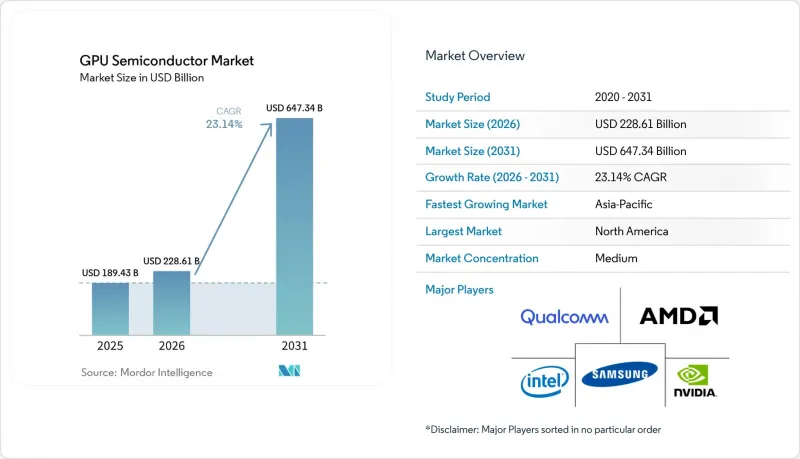
根據 Mordor Intelligence 預測,GPU 半導體市場預計將從 2025 年的 1,894.3 億美元成長到 2026 年的 2,286.1 億美元,到 2031 年達到 6,473.4 億美元,2026 年至 2031 年的複合年成長率為 23.14%。
本報告按整合類型(整合GPU和獨立GPU)、裝置應用(行動裝置和平板電腦、PC和工作站、資料中心和伺服器加速器、遊戲主機和掌上裝置等)、最終用戶(消費性電子產品和遊戲等)、記憶體類型(基於GDDR的GPU等)以及地區進行細分。市場預測以美元(USD)為單位。
全球GPU半導體市場趨勢及洞察
超大規模人工智慧訓練與推理叢集擴展
GPU半導體市場正受到主要雲端服務供應商將GPU容量定位為基礎架構這項決策的推動。亞馬遜、Alphabet、Meta、微軟和Oracle在2026年的總合資本支出接近6,000億美元,其中大部分將用於擴展人工智慧基礎設施。 NVIDIA在2026年5月發布的報告顯示,其2027會計年度第一季的資料中心營收為752億美元(年增92%),顯示採購週期轉化為供應商營收的速度非常快。半導體產業協會(SIA)也指出,2026年人工智慧資料中心半導體銷售額將達6,700億美元,證實人工智慧基礎設施是整個半導體產業最大的需求來源。據同一資訊來源稱,推理工作負載預計將比訓練工作負載成長更快,即使在第一批用於大型模型的訓練叢整合熟之後,GPU半導體市場預計仍將保持強勁勢頭。由於最先進的 AI 機架的系統成本非常高,即使超大規模容量略有增加,也會對整個 GPU 半導體市場產生非常重大的影響,包括 GPU 出貨量、產品組合和定價。
企業人工智慧工廠和主權運算採購
GPU半導體市場也受到企業人工智慧工廠和主權運算計畫的推動,這些計畫並非基於短期盈利閾值,而是基於政策目標。這種需求與資料主權、國家產業規劃以及將敏感模型開發置於國內控制之下的必要性密切相關。 NVIDIA指出,在所引用的主權人工智慧指數草案中,其平台在追蹤的主權基礎設施項目中佔據了很大比例,這意味著在國家平台選定後,採購週期可能會延長。這一趨勢意義重大,因為它有助於維持GPU半導體市場的價格上限,因為即使私人買家的決策速度放緩,政府和監管機構通常也會購買高階系統。因此,形成了一個更廣泛的需求基礎,該基礎對超大規模資料中心業者資料中心訂單高峰的依賴性降低。這也為主要供應商提供了一個機會,讓他們能夠圍繞硬體、軟體堆疊和持續支援建立牢固的關係,從而確保整個GPU半導體市場未來的更新周期。
出口限制和關稅波動
由於出口法規和關稅措施的變化影響定價、合規性和交易時間,GPU半導體市場面臨明顯的限制。 2026年1月,美國工業與安全局(BIS)修訂了對出口到中國的先進半導體的許可審查政策,將部分審查改為個案審查,並需最終用戶進行身份驗證和檢驗。隨後,在2026年5月,BIS明確表示,先進運算產品的授權要求將繼續適用於D:5組國家的營業單位,無論其實際所在地為何。這為高階供應商拓展特定海外需求領域帶來了結構性限制。草案也指出,關稅增加了跨境AI晶片交易的直接成本,使經銷商和雲端服務供應商的採購計畫更加複雜。這些措施共同導致決策速度放緩、文件負擔加重,並使整個GPU半導體市場的收入變化難以預測。
細分市場分析
預計到2025年,獨立GPU將佔據GPU半導體市場84.31%的銷售額,凸顯了人工智慧運算需求目前如何影響整個市場的格局。這一佔有率反映了一個簡單的事實:整合顯示卡仍然無法提供大規模模型訓練和推理所需的記憶體頻寬、專用顯存容量和浮點運算吞吐量。據美國半導體產業協會(SIA)稱,人工智慧加速器佔據了人工智慧伺服器機架中大部分的半導體價值,這也是獨立GPU佔據如此大佔有率的原因之一。 NVIDIA和AMD產品推出進一步鞏固了它們的地位,使用戶能夠在基本上保留現有軟體環境和部署邏輯的情況下採用新硬體。這種連續性在GPU半導體產業至關重要,因為如今的更換決策不僅取決於效能提升,而且很大程度取決於生態系統的穩定性。
英特爾在2026年台北國際電腦展(Computex 2026)上發布的Crescent Island架構表明,獨立資料中心領域仍有廣闊的發展空間,吸引著在伺服器運算領域擁有成熟業績和封裝能力的參與企業。同時,整合GPU在行動裝置、筆記型電腦、以顯示為中心的汽車系統以及輕量級邊緣推理任務中仍然具有重要的戰略意義,在這些應用中,能效比峰值吞吐量更為重要。該草案也強調了基於晶片組的架構(尤其是在AMD的Instinct藍圖中)在提高大規模運算設計良率和使供應商能夠在不依賴單一單晶片的情況下擴展產品規模方面的作用。這種架構透過將單一設計基礎與針對不同應用場景(例如人工智慧、遊戲和專業應用場景)客製化的不同記憶體方案相結合,從而實現了更廣泛的產品規劃。因此,在GPU半導體市場,獨立GPU將繼續主導高價值的人工智慧工作負載,而整合設計將在大規模生產的用戶端和嵌入式應用中保持重要地位。
預計到2025年,資料中心和伺服器加速器將佔GPU半導體市場的73.52%,並有望以24.35%的複合年成長率成長至2031年。根據半導體產業協會(SIA)的報告,人工智慧資料中心半導體的銷售額將在2026年達到6,700億美元,凸顯了該應用在整體GPU半導體市場中的核心地位。該報告指出,人工智慧加速器在人工智慧伺服器機架的半導體含量價值中佔據很大比例,因此,應用構成比如今更多地受到基礎設施投資趨勢的影響,而非消費性產品的出貨量。另一個顯著的變化是,推理需求預計將比訓練需求成長更快,這有望在維持現有平台生產力的同時,支援新的部署,並延長其使用壽命。這種平衡有利於維持持續的銷售需求,即使隨著時間的推移,每個機架的價格競爭力有所下降。
其他裝置應用程式依然重要,因為它們將GPU需求分散到多種使用模式和更新周期。 PC和工作站受益於本地AI推理的需求,而微軟在2026年擴展對獨立RTX系統的軟體支持,也延長了現有用戶的更新周期。汽車和ADAS仍然是非資料中心應用領域中成長最快的領域,因為更強大的運算能力正被應用於更大的車輛細分市場。嵌入式和邊緣設備也構成了一個重要的需求領域,因為GPU IP授權和模組化平台設計使得晶片製造商無需從頭開始建立完整的客製化堆疊即可整合圖形和AI功能。因此,GPU半導體市場雖然明顯以資料中心為中心,但並非集中於單一應用。
區域分析
預計到2025年,北美將佔據GPU半導體市場49.51%的佔有率,並預計在2026年繼續保持領先地位。主要原因是最大的超大規模資料中心業者買家總部設在美國,他們的AI基礎設施預算持續推動半導體市場對GPU的需求。亞馬遜、微軟、Alphabet、Meta和Oracle預計將在2026年投入超過6000億美元用於AI基礎設施建設,這解釋了為何儘管資料中心擴張的地域分佈日益分散,但區域需求仍然保持集中。 NVIDIA 2026會計年度的營收和AMD 第一季的資料中心業績均反映了這種支出模式,因為北美買家在高階產品的採購和認證方面仍然發揮著核心作用。加拿大也透過政策支持吸引了更多對AI計算的投資,而墨西哥作為第二個資料中心位置,其重要性日益凸顯,這與近岸外包和地域多角化密切相關。這些因素共同確保北美繼續在GPU半導體市場的需求、平台測試和早期採用活動方面保持重要地位。
預計到2031年,亞太地區將以24.57%的複合年成長率成長,成為GPU半導體市場成長最快的區域板塊。該地區的成長得益於多種因素的共同作用,終端用戶需求、記憶體供應、封裝產能、資本投資以及國家主導的運算項目等因素共同構成了一個龐大的生態系統。韓國佔據著尤為重要的地位,三星電子和SK海力士是HBM生產的核心,使其成為高階AI供應鏈的中心,即使終端系統的需求可能來自其他地區。日本也為GPU半導體市場的上游發展提供了支持,日本半導體製造設備協會預測,到2026年,日本的半導體和FPD製造設備市場規模將達到5.5,004兆日圓(約367億美元)。這一成長反映了AI相關對先進邏輯和記憶體生產能力的投資,這意味著GPU的需求正在向設備、材料和生產基礎設施領域溢出。
歐洲在GPU半導體市場中的地位主要受合規性、資料居住要求以及在受監管用例中對本地運行的AI計算的偏好所驅動。德國、英國和法國仍是該地區最大的需求來源,其國內雲端服務供應商正在擴大本地GPU容量以滿足企業需求。該地區的需求趨勢與消費者的更換週期關係不大,而更多地與金融、醫療保健和公共部門工作負載的可靠部署條件相關。除歐洲外,南美以及中東和非洲仍佔據較小但具有重要戰略意義的市場。這是因為能源供應狀況、不斷擴展的數位基礎設施以及國家層面的技術優先事項正在為高品質AI運算需求創造新的中心。因此,GPU半導體市場呈現出明顯的區域結構:北美是當前需求的主要驅動力,亞太地區透過擴大供應和部署實現了最快速的成長,而其他地區則在法規、基礎設施或國家主導專案的明確推動下不斷擴張。
其他好處:
- Excel格式的市場預測(ME)表
- 3個月的分析師支持
目錄
第1章:引言
- 研究假設和市場定義
- 調查範圍
第2章:調查方法
第3章執行摘要
第4章 市場狀況
- 市場概覽
- 市場促進因素
- 擴展超大規模人工智慧訓練和推理集群
- 企業人工智慧工廠和主權運算採購
- 面向PC和行動裝置的邊緣AI升級週期
- 每輛車配備的ADAS和車載計算功能數量增加
- 基於晶片組的GPU藍圖提高了良率和產品可擴展性。
- GPU即服務:拓展超大規模資料中心業者以外的應用場景
- 市場限制因素
- 出口限制和關稅波動
- GPU 和記憶體的平均售價 (ASP) 持續居高不下,減緩了它們在主流市場的普及。
- HBM 和 CoWoS 中對 AI 機架的分配偏差
- 高密度GPU園區電網連接延遲
- 產業價值鏈分析
- 監理情勢
- 技術展望
- 波特五力分析
第5章 市場規模與成長預測
- 按類型整合
- 整合顯示卡
- 獨立顯示卡
- 裝置應用程式
- 行動裝置和平板電腦
- 個人電腦和工作站
- 資料中心和伺服器加速器
- 遊戲機和掌上設備
- 汽車和高級駕駛輔助系統
- 嵌入式設備和邊緣設備
- 最終用戶
- 消費性電子產品和遊戲
- 雲端、資料中心和企業IT
- 溝通
- 車
- 工業與機器人
- 其他
- 按記憶體類型
- 配備 GDDR 記憶體的 GPU
- 配備 HBM 記憶體的 GPU
- 具有共用DDR/LPDDR 記憶體的 GPU
- 其他
- 按地區
- 北美洲
- 美國
- 加拿大
- 墨西哥
- 歐洲
- 德國
- 英國
- 法國
- 義大利
- 其他歐洲國家
- 亞太地區
- 中國
- 日本
- 韓國
- 印度
- 東南亞
- 其他亞太國家
- 南美洲
- 中東和非洲
- 北美洲
第6章 競爭情勢
- 市場集中度
- 策略趨勢
- Vendor Positioning Analysis
- 公司簡介
- NVIDIA Corporation
- Advanced Micro Devices, Inc.
- Intel Corporation
- Qualcomm Incorporated
- Samsung Electronics Co., Ltd.
- MediaTek Inc.
- Imagination Technologies Group Ltd.
- Huawei Technologies Co., Ltd.
- Moore Threads Intelligent Technology(Beijing)Co., Ltd.
- Biren Technology Co., Ltd.
- VeriSilicon Microelectronics(Shanghai)Co., Ltd.
- Zhaoxin Semiconductor Co., Ltd.
- UNISOC Technologies Co., Ltd.
- Rockchip Electronics Co., Ltd.
- Bolt Graphics, Inc.
第7章 市場機會與未來展望
According to Mordor Intelligence, the GPU semiconductor market size is expected to increase from USD 189.43 billion in 2025 to USD 228.61 billion in 2026 and reach USD 647.34 billion by 2031, growing at a CAGR of 23.14% over 2026-2031.
This report is Segmented by Integration Type (Integrated GPUs and Discrete GPUs), Device Application (Mobile Devices and Tablets, Pcs and Workstations, Data Center and Server Accelerators, Gaming Consoles and Handheld Devices, and More), End User (Consumer Electronics and Gaming, and More), Memory Type (GDDR-Based GPUs, and More), and Geography. The Market Forecasts are Provided in Terms of Value (USD).
Global GPU Semiconductor Market Trends and Insights
Hyperscale AI Training and Inference Cluster Expansion
The GPU semiconductor market is being pushed higher by the decision of the largest cloud operators to treat GPU capacity as foundational infrastructure. The combined capital expenditure of Amazon, Alphabet, Meta, Microsoft, and Oracle approached USD 600 billion in 2026, with a large share directed toward AI infrastructure build-outs. NVIDIA reported Q1 FY2027 data center revenue of USD 75.2 billion in May 2026, up 92% year over year, which shows how quickly this procurement cycle translated into supplier revenue. The Semiconductor Industry Association also showed that AI data center semiconductor revenue reached USD 670 billion in 2026, confirming that AI infrastructure has become the largest demand engine in the broader chip stack. The same source indicated that inference workloads are expected to grow faster than training workloads, suggesting the GPU semiconductor market should remain robust even after the first wave of large-model training clusters matures. Each leading-edge AI rack carries a very high system cost, so even a modest expansion in hyperscale capacity has an outsized effect on GPU volumes, mix, and pricing across the GPU semiconductor market.
Enterprise AI Factory and Sovereign Compute Procurement
The GPU semiconductor market is also gaining support from enterprise AI factories and sovereign compute programs that follow policy goals rather than short-cycle return thresholds. The source text shows that this demand is tied to data sovereignty, national industrial planning, and the need to keep sensitive model development under domestic control. NVIDIA stated, in the context of the Sovereign AI Index cited in the draft, that its platforms account for a large share of tracked sovereign infrastructure projects, suggesting long procurement cycles once a national platform is selected. That pattern matters because governments and regulated institutions often buy premium systems even as commercial buyers slow down decision-making, helping keep a pricing floor in the GPU semiconductor market. The result is a broader demand base that is less dependent on the timing of hyperscaler ordering waves. It also gives leading vendors a chance to build durable relationships around hardware, software stacks, and ongoing support, which can lock in future replacement cycles across the GPU semiconductor market.
Export Controls and Tariff Volatility
The GPU semiconductor market faces a clear restraint from export control changes and tariff actions that affect pricing, compliance, and deal timing. The US Bureau of Industry and Security revised its license review policy for advanced semiconductors exported to China in January 2026, moving certain reviews to a case-by-case process subject to end-user certification and verification. BIS then clarified in May 2026 that license requirements for advanced computing items still apply to entities headquartered in Country Group D:5, regardless of their physical location. That keeps a structural limit on how freely high-end suppliers can address some overseas demand pools. The draft also notes that tariffs added a direct cost to cross-border AI chip transactions, complicating procurement planning for distributors and cloud operators. Together, these measures slow decisions, raise documentation burdens, and make revenue conversion less predictable across the GPU semiconductor market.
Other drivers and restraints analyzed in the detailed report include:
- Edge AI Upgrade Cycle in PCs and Mobile Devices
- Rising ADAS and In-Cabin Compute Content per Vehicle
- Elevated GPU And Memory ASPs Slowing Mainstream Adoption
For complete list of drivers and restraints, kindly check the Table Of Contents.
Segment Analysis
Discrete GPUs accounted for 84.31% of revenue in the GPU semiconductor market in 2025, underscoring how AI computing needs now shape the overall mix. That share reflects the simple fact that integrated graphics still cannot provide the memory bandwidth, dedicated VRAM capacity, and floating-point throughput needed for large-scale model training and inference. The Semiconductor Industry Association reported that AI accelerators account for most of the semiconductor value in AI server racks, which helps explain why discrete designs hold such a large share of the GPU semiconductor market. Product launches across NVIDIA and AMD have reinforced that position because buyers can adopt new hardware while keeping much of the same software environment and deployment logic. That continuity matters in the GPU semiconductor industry because replacement decisions now depend as much on ecosystem stability as on raw performance gains.
Intel's Crescent Island launch at Computex 2026 showed that the discrete data center segment remains open enough to attract major entrants with server compute relationships and packaging capabilities. At the same time, integrated GPUs remain strategically relevant in mobile devices, notebooks, display-centric automotive systems, and lighter edge inference tasks where power efficiency matters more than peak throughput. The draft also highlights the role of chiplet-based architecture, especially in AMD's Instinct roadmap, because it improves yield economics for large compute designs and allows suppliers to scale products without relying on a single monolithic die. That architecture supports broader product planning because one design base can be paired with different memory approaches for AI, gaming, and professional use cases. The result is a GPU semiconductor market where discrete GPUs keep control of high-value AI workloads, while integrated designs retain an important role in high-volume client and embedded deployments.
Data center and server accelerators held a 73.52% share of the GPU semiconductor market in 2025 and are projected to expand at a 24.35% CAGR through 2031. The Semiconductor Industry Association reported that AI data center semiconductor revenue reached USD 670 billion in 2026, underscoring the centrality of this application to the broader GPU semiconductor market. The same report also shows that AI accelerators capture the majority of semiconductor content value in AI server racks, so application mix now follows infrastructure investment more than consumer unit shipments. Another important shift is that inference demand is expected to grow faster than training demand, which should keep installed platforms productive for longer while still supporting new deployments. That balance is useful because it supports continuing volume demand even if per-rack pricing becomes less aggressive over time.
Other device applications still matter because they spread GPU demand across several usage models and replacement cycles. PCs and workstations are benefiting from local AI inference needs, and Microsoft's 2026 software support expansion for discrete RTX systems widened the refresh path for installed users. Automotive and ADAS remains the fastest-moving non-data-center application in the draft because higher compute content is moving into larger vehicle segments. Embedded and edge devices also provide a meaningful layer of demand because GPU IP licensing and modular platform design let chipmakers integrate graphics and AI capability without building full custom stacks from scratch. This leaves the GPU semiconductor market with a clear center of gravity in data centers, but not a single-point dependence on one application alone.
Complete Report Scope:
- By Integration Type
- Integrated GPUs
- Discrete GPUs
- By Device Application
- Mobile Devices and Tablets
- PCs and Workstations
- Data Center and Server Accelerators
- Gaming Consoles and Handheld Devices
- Automotive and ADAS
- Embedded and Edge Devices
- By End User
- Consumer Electronics and Gaming
- Cloud, Data Center, and Enterprise IT
- Telecom
- Automotive
- Industrial and Robotics
- Other End Users
- By Memory Type
- GDDR-Based GPUs
- HBM-Based GPUs
- Shared DDR/LPDDR Memory GPUs
- Other Memory Types
- By Geography
- North America
- United States
- Canada
- Mexico
- Europe
- Germany
- United Kingdom
- France
- Italy
- Rest of Europe
- Asia-Pacific
- China
- Japan
- South Korea
- India
- Southeast Asia
- Rest of Asia-Pacific
- South America
- Middle East and Africa
- North America
Geography Analysis
North America held a 49.51% share of the GPU semiconductor market in 2025, keeping the region in the lead entering 2026. The main reason is that the largest hyperscaler buyers are headquartered in the United States, and their AI infrastructure budgets continue to drive demand for GPUs in the semiconductor market. The draft states that Amazon, Microsoft, Alphabet, Meta, and Oracle were on track to spend more than USD 600 billion on AI infrastructure in 2026, which helps explain why regional demand remained concentrated even when data center build-outs were geographically distributed. NVIDIA's FY2026 revenue and AMD's Q1 2026 data center performance both reflect that spending pattern, since North American buyers remain central to high-end procurement and product qualification. Canada is also drawing more AI compute investment through policy support, while Mexico is gaining relevance as a secondary data center location tied to nearshoring and regional diversification. Together, these factors keep North America at the core of demand, platform testing, and early deployment activity in the GPU semiconductor market.
Asia-Pacific is projected to expand at a 24.57% CAGR through 2031, making it the fastest-growing regional layer in the GPU semiconductor market. The region is growing through a different mix of drivers, since it combines end demand, memory supply, packaging capacity, equipment investment, and sovereign compute programs in one broad ecosystem. South Korea remains especially important because Samsung Electronics and SK Hynix anchor HBM production, which makes the region central to the premium AI supply chain even when final system demand is located elsewhere. Japan also supports the GPU semiconductor market upstream, and the Semiconductor Equipment Association of Japan forecast that the country's semiconductor and FPD manufacturing equipment market would reach JPY 5,500.4 billion (USD 36.7 billion) in FY2026. That rise reflects AI-linked investment in advanced logic and memory capacity, which means GPU demand is spreading back through tools, materials, and production infrastructure.
Europe's role in the GPU semiconductor market is being supported by compliance, data residency, and the preference for locally operated AI compute in regulated use cases. Germany, the United Kingdom, and France remain the largest demand pools in the region, and domestic cloud operators are scaling local GPU capacity in response to enterprise requirements. The region's demand profile is less tied to consumer replacement cycles and more tied to trusted deployment conditions for finance, healthcare, and public sector workloads. Outside Europe, South America and the Middle East and Africa remain smaller in share but important in strategic terms because energy availability, digital infrastructure expansion, and sovereign technology priorities are creating new pockets of premium AI compute demand. This leaves the GPU semiconductor market with a regional structure where North America leads in current demand, Asia-Pacific grows fastest through supply and deployment depth, and other regions expand where regulation, infrastructure, or state-backed programs create clear buying triggers.
- NVIDIA Corporation
- Advanced Micro Devices, Inc.
- Intel Corporation
- Qualcomm Incorporated
- Samsung Electronics Co., Ltd.
- MediaTek Inc.
- Imagination Technologies Group Ltd.
- Huawei Technologies Co., Ltd.
- Moore Threads Intelligent Technology (Beijing) Co., Ltd.
- Biren Technology Co., Ltd.
- VeriSilicon Microelectronics (Shanghai) Co., Ltd.
- Zhaoxin Semiconductor Co., Ltd.
- UNISOC Technologies Co., Ltd.
- Rockchip Electronics Co., Ltd.
- Bolt Graphics, Inc.
Additional Benefits:
- The market estimate (ME) sheet in Excel format
- 3 months of analyst support
TABLE OF CONTENTS
1 INTRODUCTION
- 1.1 Study Assumptions and Market Definition
- 1.2 Scope of the Study
2 RESEARCH METHODOLOGY
3 EXECUTIVE SUMMARY
4 MARKET LANDSCAPE
- 4.1 Market Overview
- 4.2 Market Drivers
- 4.2.1 Hyperscale AI Training and Inference Cluster Expansion
- 4.2.2 Enterprise AI Factory and Sovereign Compute Procurement
- 4.2.3 Edge AI Upgrade Cycle in PCs and Mobile Devices
- 4.2.4 Rising ADAS and In-Cabin Compute Content per Vehicle
- 4.2.5 Chiplet-Based GPU Roadmaps Improving Yield and Product Scaling
- 4.2.6 GPU-as-a-Service Broadening Access Beyond Hyperscalers
- 4.3 Market Restraints
- 4.3.1 Export Controls and Tariff Volatility
- 4.3.2 Elevated GPU and Memory ASPs Slowing Mainstream Adoption
- 4.3.3 HBM and CoWoS Allocation Bias Toward AI Racks
- 4.3.4 Grid Interconnection Delays for High-Density GPU Campuses
- 4.4 Industry Value Chain Analysis
- 4.5 Regulatory Landscape
- 4.6 Technological Outlook
- 4.7 Porter's Five Forces Analysis
- 4.7.1 Bargaining Power of Suppliers
- 4.7.2 Bargaining Power of Buyers
- 4.7.3 Threat of New Entrants
- 4.7.4 Threat of Substitutes
- 4.7.5 Competitive Rivalry
5 MARKET SIZE AND GROWTH FORECASTS (VALUE)
- 5.1 By Integration Type
- 5.1.1 Integrated GPUs
- 5.1.2 Discrete GPUs
- 5.2 By Device Application
- 5.2.1 Mobile Devices and Tablets
- 5.2.2 PCs and Workstations
- 5.2.3 Data Center and Server Accelerators
- 5.2.4 Gaming Consoles and Handheld Devices
- 5.2.5 Automotive and ADAS
- 5.2.6 Embedded and Edge Devices
- 5.3 By End User
- 5.3.1 Consumer Electronics and Gaming
- 5.3.2 Cloud, Data Center, and Enterprise IT
- 5.3.3 Telecom
- 5.3.4 Automotive
- 5.3.5 Industrial and Robotics
- 5.3.6 Other End Users
- 5.4 By Memory Type
- 5.4.1 GDDR-Based GPUs
- 5.4.2 HBM-Based GPUs
- 5.4.3 Shared DDR/LPDDR Memory GPUs
- 5.4.4 Other Memory Types
- 5.5 By Geography
- 5.5.1 North America
- 5.5.1.1 United States
- 5.5.1.2 Canada
- 5.5.1.3 Mexico
- 5.5.2 Europe
- 5.5.2.1 Germany
- 5.5.2.2 United Kingdom
- 5.5.2.3 France
- 5.5.2.4 Italy
- 5.5.2.5 Rest of Europe
- 5.5.3 Asia-Pacific
- 5.5.3.1 China
- 5.5.3.2 Japan
- 5.5.3.3 South Korea
- 5.5.3.4 India
- 5.5.3.5 Southeast Asia
- 5.5.3.6 Rest of Asia-Pacific
- 5.5.4 South America
- 5.5.5 Middle East and Africa
- 5.5.1 North America
6 COMPETITIVE LANDSCAPE
- 6.1 Market Concentration
- 6.2 Strategic Moves
- 6.3 Vendor Positioning Analysis
- 6.4 Company Profiles (includes Global Level Overview, Market Level Overview, Core Segments, Financials as available, Strategic Information, Market Rank/Share, Products and Services, Recent Developments)
- 6.4.1 NVIDIA Corporation
- 6.4.2 Advanced Micro Devices, Inc.
- 6.4.3 Intel Corporation
- 6.4.4 Qualcomm Incorporated
- 6.4.5 Samsung Electronics Co., Ltd.
- 6.4.6 MediaTek Inc.
- 6.4.7 Imagination Technologies Group Ltd.
- 6.4.8 Huawei Technologies Co., Ltd.
- 6.4.9 Moore Threads Intelligent Technology (Beijing) Co., Ltd.
- 6.4.10 Biren Technology Co., Ltd.
- 6.4.11 VeriSilicon Microelectronics (Shanghai) Co., Ltd.
- 6.4.12 Zhaoxin Semiconductor Co., Ltd.
- 6.4.13 UNISOC Technologies Co., Ltd.
- 6.4.14 Rockchip Electronics Co., Ltd.
- 6.4.15 Bolt Graphics, Inc.
7 MARKET OPPORTUNITIES AND FUTURE OUTLOOK
- 7.1 White-Space and Unmet-Need Assessment

 GPU(影像處理)市場:按產品類型、記憶體類型、散熱方式、部署方式、應用和最終用戶分類 - 全球市場預測(2026-2032 年)
 GPU代工廠:市佔率分析、產業趨勢與統計、成長預測(2026-2031年)GPU網路:市佔率分析、產業趨勢與統計、成長預測(2026-2031年)GPU軟體:市佔率分析、產業趨勢與統計、成長預測(2026-2031年)機架式GPU:市佔率分析、產業趨勢與統計及成長預測(2026-2031年)CAD/CAM GPU:市場佔有率分析、產業趨勢與統計、成長預測(2026-2031)工業GPU:市場佔有率分析、產業趨勢與統計、成長預測(2026-2031年)工作站GPU:市場佔有率分析、產業趨勢與統計及成長預測(2026-2031年)整合顯示卡:市場佔有率分析、產業趨勢與統計、成長預測(2026-2031)
 圖形處理器 (GPU) 市場預測至 2034 年——按 GPU 類型、部署模式、記憶體類型、裝置類型、功能、應用程式、最終用戶和地區分類的全球分析