


 |
市場調查報告書
商品編碼
2098498
工業GPU:市場佔有率分析、產業趨勢與統計、成長預測(2026-2031年)Industrial GPU - Market Share Analysis, Industry Trends & Statistics, Growth Forecasts (2026 - 2031) |
||||||

※ 本網頁內容可能與最新版本有所差異。詳細情況請與我們聯繫。
根據 Mordor Intelligence 預測,工業 GPU 市場預計將從 2025 年的 43.2 億美元成長到 2026 年的 51.8 億美元,到 2031 年達到 120.9 億美元,2026 年至 2031 年的複合年成長率預計為 18.47%。
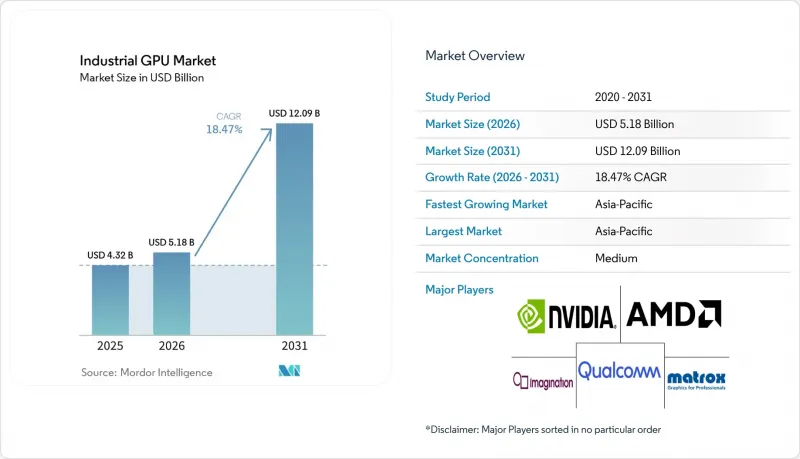
本報告按GPU架構(例如獨立GPU加速器)、硬體外形尺寸(例如PCIe擴充卡)、應用領域(例如機器視覺和品質檢測、機器人和自主物料輸送)、終端用戶產業(例如製造業、物流和倉儲、醫療保健和生命科學)以及地區進行細分。市場預測以美元(USD)為單位。
全球工業GPU市場趨勢與洞察
工業自動化領域對邊緣人工智慧推理的需求日益成長
隨著人工智慧推理從集中式運算環境轉向生產線、偵測站和自主移動系統轉移,工業GPU市場正經歷重塑。如今,實體人工智慧工作負載融合了視覺推理、感測器融合和機器間協作,將並行處理置於工業運算設計的核心地位。 NVIDIA將具備即時實體人工智慧能力的IGX Thor定位於工業和醫療邊緣部署,顯示工業GPU市場正從改造的資料中心硬體轉向專門設計的邊緣平台。 2026年4月,Cognex發布了基於NVIDIA Jetson技術的In-Sight 6900視覺控制器,進一步鞏固了這一趨勢,該控制器專為邊緣人工智慧檢測工作負載而設計。隨著部署越來越靠近生產線,買家不再將基於GPU的邊緣系統視為臨時的測試工具,而是將其視為核心工業基礎設施,從而支援整個工業GPU市場更長、更精細的採購週期。
高吞吐量工業工作負載中獨立GPU的採用率不斷提高
獨立加速器仍然是工業GPU市場的核心,因為它們允許營運商在不更換認證伺服器或工業用電腦平台的情況下增加運算能力。這種模組化方法對於工廠團隊盡量避免的系統維修至關重要,因為每次系統變更都會產生成本、停機時間和合規性問題。研華科技於2026年1月發布了MIC-78系列擴展模組,用於MIC-780模組化工業電腦,該系列模組包含用於邊緣AI推理和機器視覺的PCIe Gen 5 GPU模組,最高功率可達250W,從而支持了這一模式。該公司於2026年3月進一步拓展了這一領域,開始量產基於NVIDIA RTX PRO Blackwell嵌入式GPU的「SKY-MXM」系列產品,該系列產品適用於緊湊型、即時處理的AI密集型工業系統。這些產品發布表明,在工業GPU市場,兼具升級柔軟性、與現有系統相容性以及處理高吞吐量檢測和模擬任務能力的外形尺寸仍然備受重視。
嚴苛的工業環境中存在嚴重的散熱和功率限制
由於許多工業環境並非為滿足資料中心級加速器規格而設計,散熱和功耗限制仍限制部分工業GPU市場的發展。 Premio指出,工業系統通常在封閉機殼內運作,溫度範圍很廣,且易受灰塵和振動的影響,所有這些因素都會縮小高性能GPU硬體的可用性能範圍。該資訊來源還指出,灰塵導致的散熱效率降低會隨著時間的推移而降低散熱性能,增加在嚴苛部署環境下發生降頻的風險,並可能縮短組件壽命。這造成了先進AI加速器的功耗與許多穩健平台所能達到的低散熱設計極限之間的設計差距。因此,在非溫控設施的部署環境中,工業GPU市場仍依賴專用嵌入式系統、無風扇設計以及精心的工作負載平衡。
細分市場分析
到2025年,獨立GPU加速器將佔據工業GPU市場43.84%的佔有率,成為生產線側AI伺服器和機架式邊緣系統的主導架構。這一地位體現了模組化升級、廣泛的PCIe相容性以及無需完全重新設計即可整合到現有工業運算環境中的實際優勢。在許多現有工廠中,這種柔軟性減少了營運中斷,並有助於逐步擴展視覺檢測、模擬和AI控制功能。這種方法在工業GPU市場仍然很受歡迎,因為許多業者更傾向於逐步提升效能,而不是徹底更換平台。然而,隨著買家越來越同時評估功耗、生命週期支援和軟體整合,這個細分市場不再僅僅由加速卡來定義。
預計到2031年,整合GPU的異構邊緣SoC將以19.42%的複合年成長率成長,顯示邊緣端向緊湊型整合的轉變正在加速。這些裝置將GPU、NPU、影像處理和安全支援功能整合到單一封裝中,與體積更大的獨立系統相比,它們更容易安裝在低功耗的工業機殼中。 2026年1月,AMD朝著這個方向邁出了一步,發布了Ryzen AI Embedded P100系列。該系列結合了Zen 5 CPU核心、50 TOPS的XDNA 2 NPU和整合Radeon顯示卡,專為機器視覺、自主移動機器人和3D醫學影像處理等應用而設計的IPC(工業處理器)。整合GPU處理器和APU在監控視覺化、人機互動(HMI)以及對資本預算和散熱設計要求嚴格的輕量級推理任務中繼續發揮至關重要的作用。從整個工業 GPU 市場來看,這種配置表明,在需要高效能的應用場景中,獨立系統仍然佔據主導地位,而緊湊型 SoC 設計在部署密度、功耗控制和簡化認證流程更為重要的領域中正迅速流行起來。
到2025年,PCIe擴充卡將佔36.42%的市場佔有率,成為工業GPU市場中最大的硬體規格。其優勢在於與現有工業伺服器的兼容性,以及為機架級機器視覺、AI分析和模擬任務提供的簡易升級路徑。這在需要提高運算密度但又不想改變現有系統結構的環境中尤其重要。研華科技分別於2026年1月和3月發布了MIC-78 GPU擴展模組和SKY-MXM,這兩款產品都顯示了其對工業運算模組化加速器的持續投入。這一趨勢表明,工業GPU市場仍然高度依賴基於標準的擴展卡,可維護性和與現有部署的兼容性仍然是重中之重。
預計到2031年,系統級模組(SoM)和組件級模組(CoM)的複合年成長率將達到19.64%,成為工業GPU市場成長最快的封裝形式。原始設備製造商(OEM)正轉向標準化模組,以縮短開發週期,實現硬體更新,並減少與全客製化電路板相比的重新設計負擔。研華科技將於2026年3月推出以緊湊型工業系統為導向的高GPU嵌入式模組,反映了在更狹小空間內實現更高密度的趨勢。 MXM和夾層圖形模組繼續應用於嚴苛環境和交通運輸相關領域,在這些領域,焊接互連的穩定性至關重要。同時,單板電腦和載板解決方案在相機、閘道器和低功耗邊緣節點中仍然發揮著重要作用。焊接式GPU和SoC設計也在大規模生產的產品中發揮作用,在這些產品中,材料清單(BOM)管理和緊湊封裝比現場可更換性更為重要,這推動了工業GPU市場封裝形式的多樣化。
區域分析
預計到2025年,亞太地區將佔據工業GPU市場46.63%的佔有率,並將以19.38%的複合年成長率持續成長至2031年。該地區仍然是最大的部署基地,這得益於其高度集中的電子製造、汽車和半導體生產能力,以及積極的工廠現代化改造計劃。 2026年2月,日本SmartVision發布了基於NVIDIA Jetson Thor的EAC-7000系列,進一步加速了這一成長勢頭,該系列產品面向下一代邊緣AI機器人。 2026年4月,日立宣布其邊緣AI半導體開發已進入實施階段,應用於製造、檢測、機器人和物流等領域的硬體。與通用GPU處理相比,這使其能源效率提高了10倍以上。這些進展表明,亞太地區的工業GPU市場仍然強勁,新建工廠建設計畫和嵌入式硬體開發持續相互促進。
北美和歐洲是工業GPU市場的兩大主要區域叢集,但它們的需求趨勢與亞太地區有所不同。北美受益於圍繞加速運算、機器人軟體和模擬平台構建的豐富生態系統,這些平台可針對多種工業應用場景進行認證。另一方面,歐洲則高度重視安全導向的採購,尤其是在協作機器人、機器控制和監管嚴格的工業環境中,這些領域對合規性要求更高。 NVIDIA於2025年6月發布的面向歐洲製造業的工業AI雲舉措,重點介紹了數位孿生工具如何在該地區的大規模製造網路中部署。因此,這兩個地區的工業GPU市場並非主要由簡單的銷售決定,而是由認證的部署模式、深度軟體整合以及貫穿整個生命週期的平台支援所驅動。
儘管南美、中東和非洲在工業圖形處理器 (GPU) 市場中所佔佔有率仍然相對較小,但由於其應用場景與主要地區有所不同,因此這些市場也十分重要。在南美,採礦、流程工業和分散式製造地對邊緣系統的需求正在興起,這些系統能夠實現預測性維護、機器視覺和遠端支援。在中東和非洲,智慧基礎設施、建築、物流和能源項目正在為 GPU 驅動的工業自動化創造早期市場機會。這些市場仍在發展中,但它們正在將工業 GPU 市場從溫控工廠環境擴展到更廣泛的領域,從而增加了對穩健、節能且針對特定部署場景的硬體設計的需求。
其他好處:
- Excel格式的市場預測(ME)表
- 3個月的分析師支持
目錄
第1章:引言
- 研究假設和市場定義
- 調查範圍
第2章:調查方法
第3章執行摘要
第4章 市場狀況
- 市場概覽
- 宏觀經濟因素對市場的影響
- 市場促進因素
- 工業自動化領域對邊緣人工智慧推理的需求日益成長
- 高吞吐量工業工作負載中獨立GPU的採用率不斷提高
- 擴大數位孿生與模擬技術在智慧工廠的應用
- 在機器人領域擴大功能安全型GPU平台的應用
- 可視化在機器視覺和品質檢測中的重要性日益增加。
- 軟體定義工業運算架構的擴展
- 市場限制因素
- 嚴苛的工業環境中存在嚴重的散熱和功率限制
- 在安全至關重要的工業部署中,檢驗週期很長。
- GPU生態系間軟體可移植性的片段化
- 先進半導體封裝供應鏈波動
- 產業價值鏈分析
- 監理情勢
- 技術展望
- 波特五力分析
第5章 市場規模與成長預測
- 透過GPU架構
- 獨立GPU加速器
- 整合GPU處理器和APU
- 配備GPU的異構邊緣SoC
- 硬體外形規格
- PCIe擴充卡
- MXM 和夾層圖形模組
- 系統模組和電腦模組
- 單板電腦與嵌入式GPU載板
- 焊接式GPU/SoC解決方案
- 透過使用
- 機器視覺和品質檢測
- 機器人技術與自主物料輸送
- 數位孿生與工業仿真
- 工業人機介面與視覺化
- 邊緣人工智慧分析與預測性維護
- 醫學和危重影像
- 按最終用戶行業分類
- 製造業
- 物流和倉儲
- 醫療保健和生命科學
- 能源公用事業
- 航太/國防
- 其他終端用戶產業
- 按地區
- 北美洲
- 美國
- 加拿大
- 墨西哥
- 歐洲
- 德國
- 英國
- 法國
- 義大利
- 其他歐洲國家
- 亞太地區
- 中國
- 日本
- 韓國
- 印度
- 東南亞
- 其他亞太國家
- 南美洲
- 中東和非洲
- 北美洲
第6章 競爭情勢
- 市場集中度
- 策略趨勢
- Market Positioning Analysis
- 公司簡介
- NVIDIA Corporation
- Advanced Micro Devices, Inc.
- Imagination Technologies Limited
- Moore Threads Intelligent Technology(Beijing)Co., Ltd.
- Biren Technology Co., Ltd.
- VeriSilicon Microelectronics(Shanghai)Co., Ltd.
- Zhaoxin Semiconductor Co., Ltd.
- VIA Technologies, Inc.
- UNISOC Technologies Co., Ltd.
- Rockchip Electronics Co., Ltd.
- Loongson Technology Corporation Limited
- Matrox Electronic Systems Ltd.
- ASPEED Technology Inc.
- Qualcomm Incorporated
- Huawei Technologies Co., Ltd.
- Apple Inc.
- Samsung Electronics Co., Ltd.
- MediaTek Inc.
- Renesas Electronics Corporation
- NXP Semiconductors NV
第7章 市場機會與未來展望
According to Mordor Intelligence, the industrial GPU market size is expected to increase from USD 4.32 billion in 2025 to USD 5.18 billion in 2026 and reach USD 12.09 billion by 2031, growing at a CAGR of 18.47% over 2026-2031.
This report is Segmented by GPU Architecture (Discrete GPU Accelerators, and More), Hardware Form Factor (PCIe Add-In Cards, and More), Application (Machine Vision and Quality Vision, Robotics and Autonomous Material Handling, and More), End-User Industry (Manufacturing, Logistics and Warehousing, Healthcare and Life Sciences, and More), and Geography. The Market Forecasts are Provided in Terms of Value (USD).
Global Industrial GPU Market Trends and Insights
Rising Edge AI Inference Demand in Industrial Automation
The industrial GPU market is being reshaped by the movement of AI inference from centralized computing environments to production lines, inspection stations, and autonomous mobile systems. Physical AI workloads now combine visual reasoning, sensor fusion, and machine coordination, which places parallel processing at the center of industrial compute design. NVIDIA positioned IGX Thor for industrial and medical edge deployments with real-time physical AI capabilities, showing how the industrial GPU market is shifting toward purpose-built edge platforms rather than adapted data center hardware. Cognex reinforced this direction in April 2026, when it launched the In-Sight 6900 Vision Controller powered by NVIDIA Jetson technology for edge AI inspection workloads. As deployments move closer to the line, buyers are treating GPU-based edge systems as core industrial infrastructure, not as temporary pilot tools, which supports longer, deeper procurement cycles across the industrial GPU market.
Increasing Adoption of Discrete GPUs in High-Throughput Industrial Workloads
Discrete accelerators remain central to the industrial GPU market because they let operators add compute capacity without replacing qualified server and industrial PC platforms. This modular path matters in retrofits, where every system change can trigger cost, downtime, and compliance work that plant teams try to avoid. Advantech supported this model in January 2026 with MIC-78 Series expansion modules for the MIC-780 modular industrial computer, including a PCIe Gen 5 GPU module for edge AI inference and machine vision up to 250W. The company extended that push in March 2026 with mass production of the SKY-MXM series based on NVIDIA RTX PRO Blackwell Embedded GPUs for compact, real-time, AI-intensive industrial systems. These launches show that the industrial GPU market is still rewarding form factors that combine upgrade flexibility, installed-base compatibility, and support for high-throughput inspection and simulation tasks.
High Thermal and Power Constraints in Rugged Industrial Environments
Thermal and power limits continue to hold back part of the industrial GPU market because many industrial environments were not built for data center-class accelerator profiles. Premio noted that industrial systems often operate over wide temperature ranges, in sealed enclosures, and under dust and vibration, all of which reduce usable headroom for high-performance GPU hardware. The same source also pointed to dust-related cooling losses that can degrade thermal performance over time, increasing the risk of throttling and shorter component lifespans in harsh deployments. This creates a design gap between the power draw of advanced AI accelerators and the lower thermal envelope that many rugged platforms can sustain. The industrial GPU market, therefore, continues to depend on specialized embedded systems, fanless designs, and careful workload balancing when deployments move beyond climate-controlled facilities.
Other drivers and restraints analyzed in the detailed report include:
- Growing Deployment of Digital Twins and Simulation in Smart Factories
- Expanding Use of Functional-Safety-Ready GPU Platforms in Robotics
- Long Validation Cycles For Safety-Critical Industrial Deployments
For complete list of drivers and restraints, kindly check the Table Of Contents.
Segment Analysis
Discrete GPU accelerators held a 43.84% share of the industrial GPU market in 2025, making them the leading architecture for line-side AI servers and rack-mounted edge systems. Their position reflects the practical advantage of modular upgrades, broad PCIe compatibility, and the ability to fit into existing industrial compute environments without a full redesign. In many brownfield plants, that flexibility reduces disruption and makes it easier to expand visual inspection, simulation, and AI control capacity in stages. The industrial GPU market still rewards that approach because many operators prefer incremental performance additions over full platform replacement. Even so, the segment is no longer defined solely by raw accelerator cards, as buyers increasingly evaluate power envelope, lifecycle support, and software integration simultaneously.
GPU-enabled heterogeneous edge SoCs are projected to expand at a 19.42% CAGR through 2031, indicating a faster shift toward compact integration at the edge. These devices combine a GPU, an NPU, image processing, and safety support into a single package that fits more easily into low-power industrial enclosures than larger discrete systems. AMD moved into this direction in January 2026 with the Ryzen AI Embedded P100 Series, which combined Zen 5 CPU cores, a 50-TOPS XDNA 2 NPU, and integrated Radeon graphics for machine vision IPCs, autonomous mobile robots, and 3D medical imaging. Integrated GPU processors and APUs remain important for supervisory visualization, HMI, and lighter inference tasks where capital budgets and thermal limits are tighter. Across the industrial GPU market, this mix shows that discrete systems still anchor performance-heavy use cases, while compact SoC designs are accelerating wherever deployment density, power control, and simplified qualification matter more.
PCIe add-in cards accounted for 36.42% of the market share in 2025, making them the largest hardware form factor in the industrial GPU market. Their strength lies in compatibility with existing industrial servers and the straightforward upgrade path they offer for rack-level machine vision, AI analytics, and simulation tasks. This is especially valuable in sites that want to raise compute density without changing the surrounding system architecture. Advantech's January 2026 MIC-78 GPU expansion module and its March 2026 SKY-MXM launch both showed continued investment in modular accelerator paths for industrial computing. That pattern suggests the industrial GPU market still depends heavily on standards-based cards where serviceability and installed-base fit remain high priorities.
SoMs and CoMs are projected to grow at a 19.64% CAGR through 2031, which makes them the fastest-growing form factor in the industrial GPU market. OEMs are moving toward standardized modules because they shorten development cycles and allow hardware refresh with less redesign effort than fully custom boards. Advantech's March 2026 rollout of GPU-rich embedded modules for compact industrial systems reflected that move toward higher density within tighter space envelopes. MXM and mezzanine graphics modules continue to serve rugged and transit-oriented applications where soldered-down interconnect stability matters, while single-board computers and carrier-board solutions stay relevant for cameras, gateways, and low-power edge nodes. Soldered-down GPU and SoC designs also have a place in high-volume products where bill-of-materials control and compact packaging matter more than field replaceability, broadening the form-factor spread across the industrial GPU market.
Complete Report Scope:
- By GPU Architecture
- Discrete GPU Accelerators
- Integrated GPU Processors and APUs
- GPU-Enabled Heterogeneous Edge SoCs
- By Hardware Form Factor
- PCIe Add-In Cards
- MXM and Mezzanine Graphics Modules
- System-on-Modules and Computer-on-Modules
- Single-Board Computers and Embedded GPU Carrier Boards
- Soldered-Down GPU/SoC Solutions
- By Application
- Machine Vision and Quality Inspection
- Robotics and Autonomous Material Handling
- Digital Twin and Industrial Simulation
- Industrial HMI and Visualization
- Edge AI Analytics and Predictive Maintenance
- Medical and Critical Imaging
- By End-User Industry
- Manufacturing
- Logistics and Warehousing
- Healthcare and Life Sciences
- Energy and Utilities
- Aerospace and Defense
- Other End-User Industries
- By Geography
- North America
- United States
- Canada
- Mexico
- Europe
- Germany
- United Kingdom
- France
- Italy
- Rest of Europe
- Asia-Pacific
- China
- Japan
- South Korea
- India
- Southeast Asia
- Rest of Asia-Pacific
- South America
- Middle East and Africa
- North America
Geography Analysis
Asia-Pacific held 46.63% share of the industrial GPU market size in 2025 and is projected to expand at a 19.38% CAGR through 2031. The region remains the largest deployment base because it combines dense electronics manufacturing, automotive production, semiconductor capacity, and aggressive factory modernization programs. Japan added to that momentum in February 2026, when SmartVision introduced the EAC-7000 Series, powered by NVIDIA Jetson Thor, for next-generation edge AI robotics. Hitachi also stated in April 2026 that its edge AI semiconductor work had moved into implementation for manufacturing, inspection, robotics, and logistics hardware, with energy efficiency gains of more than 10 times compared with general-purpose GPU processing. These moves show why the industrial GPU market remains strongest in Asia-Pacific, where new factory programs and embedded hardware development continue to reinforce each other.
North America and Europe are the next two major regional clusters in the industrial GPU market, but their demand profiles differ from those in Asia-Pacific. North America benefits from a deep ecosystem around accelerated computing, robotics software, and simulation platforms that can be qualified across multiple industrial use cases. Europe places greater emphasis on safety-led procurement, especially in collaborative robotics, machine control, and regulated industrial environments, where stronger compliance pathways are required. NVIDIA's June 2025 industrial AI cloud initiative for European manufacturing highlighted how digital twin tools are being deployed across large manufacturing networks in the region. The industrial GPU market in both regions is therefore shaped less by sheer unit volume and more by certified deployment models, deep software integration, and long lifecycle platform support.
South America, the Middle East, and Africa remain smaller parts of the industrial graphics processing unit (GPU) market, but they matter because their use cases differ from the leading regions. In South America, mining, process industries, and distributed manufacturing sites create demand for predictive maintenance, machine vision, and edge systems that support remote support. In the Middle East and Africa, smart infrastructure, construction, logistics, and energy projects are creating early openings for GPU-enabled industrial automation. These markets are still developing, but they expand the industrial GPU market beyond climate-controlled factory settings and increase the need for rugged, power-aware, and deployment-specific hardware designs.
- NVIDIA Corporation
- Advanced Micro Devices, Inc.
- Imagination Technologies Limited
- Moore Threads Intelligent Technology (Beijing) Co., Ltd.
- Biren Technology Co., Ltd.
- VeriSilicon Microelectronics (Shanghai) Co., Ltd.
- Zhaoxin Semiconductor Co., Ltd.
- VIA Technologies, Inc.
- UNISOC Technologies Co., Ltd.
- Rockchip Electronics Co., Ltd.
- Loongson Technology Corporation Limited
- Matrox Electronic Systems Ltd.
- ASPEED Technology Inc.
- Qualcomm Incorporated
- Huawei Technologies Co., Ltd.
- Apple Inc.
- Samsung Electronics Co., Ltd.
- MediaTek Inc.
- Renesas Electronics Corporation
- NXP Semiconductors N.V.
Additional Benefits:
- The market estimate (ME) sheet in Excel format
- 3 months of analyst support
TABLE OF CONTENTS
1 INTRODUCTION
- 1.1 Study Assumptions and Market Definition
- 1.2 Scope of the Study
2 RESEARCH METHODOLOGY
3 EXECUTIVE SUMMARY
4 MARKET LANDSCAPE
- 4.1 Market Overview
- 4.2 Impact of Macroeconomic Factors on the Market
- 4.3 Market Drivers
- 4.3.1 Rising Edge AI Inference Demand in Industrial Automation
- 4.3.2 Increasing Adoption of Discrete GPUs in High-Throughput Industrial Workloads
- 4.3.3 Growing Deployment of Digital Twins and Simulation in Smart Factories
- 4.3.4 Expanding Use of Functional-Safety-Ready GPU Platforms in Robotics
- 4.3.5 Rising Visualization Intensity in Machine Vision and Quality Inspection
- 4.3.6 Increasing Software-Defined Industrial Compute Architectures
- 4.4 Market Restraints
- 4.4.1 High Thermal and Power Constraints in Rugged Industrial Environments
- 4.4.2 Long Validation Cycles for Safety-Critical Industrial Deployments
- 4.4.3 Fragmented Software Portability Across GPU Ecosystems
- 4.4.4 Supply Chain Volatility in Advanced Semiconductor Packaging
- 4.5 Industry Value Chain Analysis
- 4.6 Regulatory Landscape
- 4.7 Technological Outlook
- 4.8 Porter's Five Forces Analysis
- 4.8.1 Bargaining Power of Suppliers
- 4.8.2 Bargaining Power of Buyers
- 4.8.3 Threat of New Entrants
- 4.8.4 Threat of Substitutes
- 4.8.5 Intensity of Competitive Rivalry
5 MARKET SIZE AND GROWTH FORECASTS (VALUE)
- 5.1 By GPU Architecture
- 5.1.1 Discrete GPU Accelerators
- 5.1.2 Integrated GPU Processors and APUs
- 5.1.3 GPU-Enabled Heterogeneous Edge SoCs
- 5.2 By Hardware Form Factor
- 5.2.1 PCIe Add-In Cards
- 5.2.2 MXM and Mezzanine Graphics Modules
- 5.2.3 System-on-Modules and Computer-on-Modules
- 5.2.4 Single-Board Computers and Embedded GPU Carrier Boards
- 5.2.5 Soldered-Down GPU/SoC Solutions
- 5.3 By Application
- 5.3.1 Machine Vision and Quality Inspection
- 5.3.2 Robotics and Autonomous Material Handling
- 5.3.3 Digital Twin and Industrial Simulation
- 5.3.4 Industrial HMI and Visualization
- 5.3.5 Edge AI Analytics and Predictive Maintenance
- 5.3.6 Medical and Critical Imaging
- 5.4 By End-User Industry
- 5.4.1 Manufacturing
- 5.4.2 Logistics and Warehousing
- 5.4.3 Healthcare and Life Sciences
- 5.4.4 Energy and Utilities
- 5.4.5 Aerospace and Defense
- 5.4.6 Other End-User Industries
- 5.5 By Geography
- 5.5.1 North America
- 5.5.1.1 United States
- 5.5.1.2 Canada
- 5.5.1.3 Mexico
- 5.5.2 Europe
- 5.5.2.1 Germany
- 5.5.2.2 United Kingdom
- 5.5.2.3 France
- 5.5.2.4 Italy
- 5.5.2.5 Rest of Europe
- 5.5.3 Asia-Pacific
- 5.5.3.1 China
- 5.5.3.2 Japan
- 5.5.3.3 South Korea
- 5.5.3.4 India
- 5.5.3.5 Southeast Asia
- 5.5.3.6 Rest of Asia-Pacific
- 5.5.4 South America
- 5.5.5 Middle East and Africa
- 5.5.1 North America
6 COMPETITIVE LANDSCAPE
- 6.1 Market Concentration
- 6.2 Strategic Moves
- 6.3 Market Positioning Analysis
- 6.4 Company Profiles (includes Global Level Overview, Market Level Overview, Core Segments, Financials as available, Strategic Information, Market Rank/Share, Products and Services, Recent Developments)
- 6.4.1 NVIDIA Corporation
- 6.4.2 Advanced Micro Devices, Inc.
- 6.4.3 Imagination Technologies Limited
- 6.4.4 Moore Threads Intelligent Technology (Beijing) Co., Ltd.
- 6.4.5 Biren Technology Co., Ltd.
- 6.4.6 VeriSilicon Microelectronics (Shanghai) Co., Ltd.
- 6.4.7 Zhaoxin Semiconductor Co., Ltd.
- 6.4.8 VIA Technologies, Inc.
- 6.4.9 UNISOC Technologies Co., Ltd.
- 6.4.10 Rockchip Electronics Co., Ltd.
- 6.4.11 Loongson Technology Corporation Limited
- 6.4.12 Matrox Electronic Systems Ltd.
- 6.4.13 ASPEED Technology Inc.
- 6.4.14 Qualcomm Incorporated
- 6.4.15 Huawei Technologies Co., Ltd.
- 6.4.16 Apple Inc.
- 6.4.17 Samsung Electronics Co., Ltd.
- 6.4.18 MediaTek Inc.
- 6.4.19 Renesas Electronics Corporation
- 6.4.20 NXP Semiconductors N.V.
7 Market Opportunities and Future Outlook
- 7.1 White-Space and Unmet-Need Assessment

 GPU(影像處理)市場:按產品類型、記憶體類型、散熱方式、部署方式、應用和最終用戶分類 - 全球市場預測(2026-2032 年)
 GPU代工廠:市佔率分析、產業趨勢與統計、成長預測(2026-2031年)GPU網路:市佔率分析、產業趨勢與統計、成長預測(2026-2031年)GPU軟體:市佔率分析、產業趨勢與統計、成長預測(2026-2031年)機架式GPU:市佔率分析、產業趨勢與統計及成長預測(2026-2031年)CAD/CAM GPU:市場佔有率分析、產業趨勢與統計、成長預測(2026-2031)GPU半導體:市佔率分析、產業趨勢與統計、成長預測(2026-2031年)工作站GPU:市場佔有率分析、產業趨勢與統計及成長預測(2026-2031年)整合顯示卡:市場佔有率分析、產業趨勢與統計、成長預測(2026-2031)
 圖形處理器 (GPU) 市場預測至 2034 年——按 GPU 類型、部署模式、記憶體類型、裝置類型、功能、應用程式、最終用戶和地區分類的全球分析