


 |
市場調查報告書
商品編碼
2098482
工作站GPU:市場佔有率分析、產業趨勢與統計及成長預測(2026-2031年)Workstation GPU - Market Share Analysis, Industry Trends & Statistics, Growth Forecasts (2026 - 2031) |
||||||

※ 本網頁內容可能與最新版本有所差異。詳細情況請與我們聯繫。
據 Mordor Intelligence 稱,2025 年工作站 GPU 市值為 44.9 億美元,預計到 2031 年將達到 121.5 億美元,2026 年至 2031 年的複合年成長率為 18.45%。
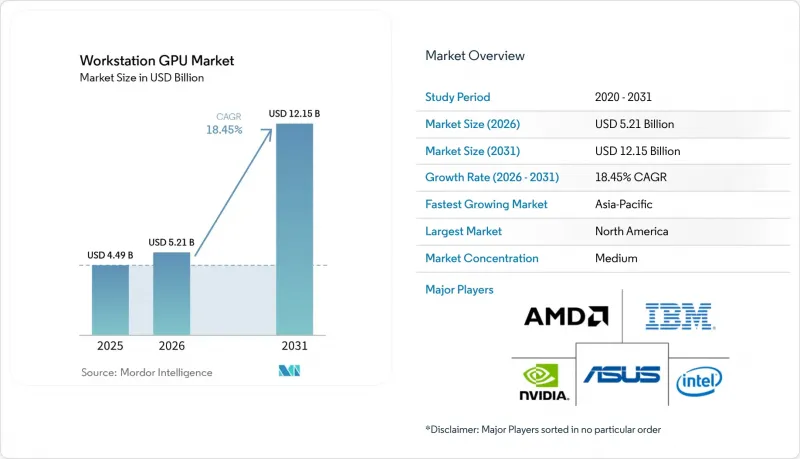
本報告按產品類型(桌面工作站用GPU、行動工作站用GPU)、應用領域(CAD、CAM、CAE、3D渲染和視覺化、媒體製作和內容創作等)、公司規模(中小企業、大型企業)、產業領域(媒體和娛樂等)以及地區進行細分。市場預測以美元(USD)為單位。
全球工作站GPU市場趨勢與洞察
工作站上人工智慧推理和本地模型工作流程的興起
工作站GPU市場正蓬勃發展,這主要得益於企業對本地AI推理的需求,尤其是在難以取得雲端處理核准和論證的環境下。 2025年3月,NVIDIA發布了RTX PRO Blackwell系列,這是其旗艦級工作站顯示卡,擁有高達4000 AI TOPS的運算能力和96GB的GDDR7 ECC顯存,將本地模型執行性能提升到了一個全新的水平。此次發布將AI開發、模型推理、視覺化和內容創作工作流程整合到一個專業平台中,拓展了工作站GPU市場的範圍。 2025年7月,AMD也推出了Radeon AI PRO R9700,這是一款專為工作站系統設計的32GB專業顯示卡,支援ROCm 6.3。這一趨勢意義重大,因為企業不再只是追求渲染速度,而是需要足夠的本地記憶體和經過認證的效能,以便隨時處理AI工作。隨著這些需求的日益普及,工作站GPU市場正在擺脫以往僅依賴CAD和渲染的局面。
工程團隊中 CAD、模擬和數位孿生技術的工作量不斷增加。
工作站GPU市場的發展也受到工程團隊的推動,他們期望在專業硬體上實現前所未有的模擬和數位孿生執行速度。據NVIDIA稱,Ansys、Altair、Cadence、Siemens和Synopsys等領先的CAE供應商已透過Blackwell在某些工作負載下實現了高達50倍的加速,從而改變了工作站模擬的經濟性。報告也指出,BMW和Volvo汽車正在採用Blackwell加速的數位孿生技術,這顯示工作站GPU市場不僅與視覺輸出密切相關,還與產品開發和設計檢驗的速度息息相關。 Springer Nature也報告了數位孿生技術在智慧製造環境的設計、模擬、檢驗和最佳化領域的廣泛應用,這支撐了對這些系統的長期需求。這種轉變提高了工程團隊對專業GPU的最低要求,因為他們需要在同一工作流程中,模擬、視覺化和協作都能獲得一致的效能。因此,工作站GPU市場越來越傾向於從工程軟體堆疊中獲取價值,而不是從獨立的圖形加速中獲取價值。
專業GPU工作站整體擁有成本高
工作站GPU市場仍面臨巨大的進入門檻,因為部署和維護功能齊全的專業系統成本仍然很高。 NVIDIA RTX PRO 6000 Blackwell工作站版的零售價預計在2025年約為8500美元,研究數據顯示,配置齊全的高階人工智慧和模擬工作站的單一用戶價格通常超過2萬美元。聯想出版社的一份報告指出,本地部署生成式人工智慧的經濟效益很大程度上取決於利用率,小型企業由於工作負載波動性更大,投資回收期更長。這種成本問題不僅限於GPU本身,企業還需要CPU效能、記憶體、儲存、散熱、電源、安全工具和管理時間等配套支援。這些因素共同導致工作站GPU市場低階型號的普及速度緩慢,即使技術需求明確。這也解釋了為什麼大型企業仍然佔大部分銷售額,而中小企業在採用方面則更加謹慎。
細分市場分析
截至2025年,桌面工作站GPU佔據工作站GPU市場57.68%的佔有率,而行動工作站GPU預計到2031年將以19.63%的複合年成長率成長。桌上型工作站GPU市場仍佔據較大佔有率,因為塔式系統持續提供更大的散熱裕度、更高的擴充性以及對高頻寬PCIe Gen 5資料通路更強大的支援。對於依賴海量記憶體的多GPU擴展和模擬、數位孿生以及高級視覺化應用的用戶而言,這是一個至關重要的因素。此外,部署基礎仍然與長期運行的工程環境緊密相關,在這些環境中,桌面認證和設備標準化以及尖峰時段圖形速度都至關重要。
隨著工程和人工智慧團隊日益分散化,行動工作站GPU的成長速度正在加快,但仍需要支援認證應用和本地推理的專業級硬體。 NVIDIA表示,其RTX PRO Blackwell筆電GPU系列,憑藉高達24GB的GDDR7顯存以及Blackwell Max-Q能源效率特性,縮小了行動裝置和桌面端在許多專業工作流程中的實際效能差距。報告也指出,在某些推理和視覺化任務中,行動端的效能已接近桌面端的80%至90%,這正在改變企業對可接受的現場效能的定義。聯想的2026工作站策略進一步推動了這一轉變,因為OEM廠商正在將移動性和工作站級性能視為同一產品規劃週期的一部分。因此,預計在預測期內,工作站GPU市場中桌上型系統和行動系統之間的市佔率差距將進一步縮小。
截至2025年,CAD、CAM和CAE將佔工作站GPU市場規模的28.14%,而人工智慧開發和資料科學預計將以19.51%的複合年成長率成長至2031年。 CAD、CAM和CAE繼續保持其在工作站GPU市場的核心應用地位,因為設計、結構分析和工程檢驗已整合到企業工作流程中。分析指出,這一主導地位與整合到主流商業軟體平台中的更快求解器、更精細的網格和即時實體模擬功能密切相關。 NVIDIA也指出,Ansys、Siemens和Synopsys等軟體供應商正在為工作站級硬體提供CUDA-X加速版本,這進一步印證了這些應用程式持續推動當前市場需求的原因。
人工智慧開發和資料科學的加速發展,源自於企業尋求專用系統來進行模型微調、推理最佳化和搜尋擴展工作流程,而非完全依賴共用雲端叢集。這種轉變正在將工作站GPU市場拓展到私有AI開發領域,在工作站層面,記憶體容量、安全的小型資料庫和軟體相容性至關重要。其他應用領域,尤其是3D渲染和視覺化、媒體製作和內容創作領域,對工作站GPU的需求依然旺盛,射線追蹤和即時輸出對於面向客戶的工作仍然至關重要。科學計算和模擬也呈現穩定成長,主要得益於研究機構、製藥公司和公共研究環境的需求。同時,醫學影像和醫療保健視覺化領域的需求則更加專業化,主要集中在本地影像診斷和治療計劃工具方面。因此,工作站GPU市場如今能夠滿足眾多希望在同一工作會話中於單一平台上實現AI和可視化,而非為每個任務配備獨立系統的用戶需求。
區域分析
截至2025年,北美將佔據工作站GPU市場36.53%的佔有率,而亞太地區預計到2031年將以20.35%的複合年成長率成長。北美憑藉其龐大的技術預算以及來自國防相關企業、生命科學機構和媒體製作工作室的集中需求,成為工作站GPU市場的主要驅動力。該地區的買家也重視認證平台、安全的本地運算環境和強大的企業支援。 2025年,HPE和NVIDIA透過設計「面向政府的AI工廠」進一步強化了這個環境,旨在確保公共部門和受監管環境中的AI安全部署。加拿大和墨西哥也透過其汽車工程中心和供應鏈設計團隊為市場做出貢獻,這些團隊嚴格遵循美國工作站標準。
歐洲仍是工作站和GPU市場規模第二大的地區,其中德國、英國和法國是主要的需求中心。德國繼續保持核心地位,因為汽車、航太和工業機械公司持續依賴模擬、數位孿生和精密設計工作流程,而這些流程需要專業GPU的性能。 NVIDIA透過與西門子和其他CAE合作夥伴的合作,將更快的工程運算引入生產環境,從而為這些系統提供支援。英國和法國透過視覺特效、媒體製作、科學研究和計算建模產生了穩定的需求。義大利和其他歐洲國家則透過產品設計、建築和輕工業製造做出了貢獻,這有助於歐洲市場保持廣泛的基礎,而不會集中在特定的終端市場。
亞太地區是工作站GPU市場成長最快的地區,中國、印度、日本和韓國的需求均從不同的起點不斷成長。這一趨勢既源自於出口管制壓力下國內GPU的更新換代,也源自於中國自身的發展動能-經合組織指出,這是中國政府為建構更具韌性的半導體價值鏈所做出的廣泛努力。印度則透過不斷擴大的人工智慧開發服務基礎和GPU應用基礎設施建設,進一步推動了該地區專業運算的間接需求。日本和韓國在半導體EDA、機器人設計和汽車工程領域繼續依賴工作站級系統。東南亞憑藉著專業電子代工服務(EMS)和設計能力的成長而崛起,而南美、中東和非洲雖然規模較小,但也是發展中的市場,這得益於數位孿生計畫和能源領域技術服務的拓展。
其他好處:
- Excel格式的市場預測(ME)表
- 3個月的分析師支持
目錄
第1章:引言
- 研究假設和市場定義
- 調查範圍
第2章:調查方法
第3章執行摘要
第4章 市場狀況
- 市場概覽
- 市場促進因素
- 工作站上人工智慧推理和本地模型工作流程的興起
- 專業視覺化與內容創作電腦的更換週期
- 晶片組與先進封裝藍圖:提升專業GPU的效能密度
- 出口限制和供應鏈本地化將促進該地區GPU的更新換代
- 企業對安全可靠的本地部署人工智慧開發環境的需求
- 工程團隊在 CAD、模擬和數位孿生方面的工作量增加。
- 市場限制因素
- 專業GPU工作站整體擁有成本高
- 驅動程式身份驗證和應用程式相容性的複雜性。
- 桌上型電腦和行動系統中的功耗、散熱和外形尺寸限制
- 先進記憶體和基板組件供應緊張。
- 產業價值鏈分析
- 監理情勢
- 技術展望
- 宏觀經濟因素對市場的影響
- 波特五力分析
第5章 市場規模與成長預測
- 依產品類型
- 桌面工作站用GPU
- 行動工作站的GPU
- 透過使用
- 電腦輔助設計 (CAD)、電腦輔助製造 (CAM)、電腦輔助工程 (CAE)
- 3D渲染和視覺化
- 媒體製作與內容創作
- 科學計算與模擬
- 醫學影像和醫療保健可視化
- 人工智慧開發和資料科學
- 其他用途
- 按組織規模
- 小型企業
- 大公司
- 按行業分類
- 建築、工程及施工
- 製造和工業設計
- 媒體與娛樂
- 汽車和運輸業
- 其他工業部門
- 按地區
- 北美洲
- 美國
- 加拿大
- 墨西哥
- 歐洲
- 德國
- 英國
- 法國
- 義大利
- 其他歐洲國家
- 亞太地區
- 中國
- 日本
- 韓國
- 印度
- 東南亞
- 其他亞太國家
- 南美洲
- 中東和非洲
- 北美洲
第6章 競爭情勢
- 市場集中度
- 策略趨勢
- Vendor Positioning Analysis
- 公司簡介
- NVIDIA Corporation
- Advanced Micro Devices, Inc.
- Intel Corporation
- ASUSTeK Computer Inc.
- Micro-Star International Co., Ltd.
- GIGA-BYTE Technology Co., Ltd.
- PNY Technologies, Inc.
- Leadtek Research Inc.
- ZOTAC International(MCO)Limited
- Sapphire Technology Limited
- Matrox Graphics Inc.
- BOXX Technologies, Inc.
- Exxact Corporation
- Colfax International
- Koi Computers, Inc.
- Super Micro Computer, Inc.
- ELSA Japan Inc.
- GUNNIR Technology Co., Ltd.
第7章 市場機會與未來展望
According to Mordor Intelligence, the workstation GPU market size was valued at USD 4.49 billion in 2025 and is projected to reach USD 12.15 billion by 2031, growing at a CAGR of 18.45% from 2026 to 2031.
This report is Segmented by Product Type (Desktop Workstation GPU, and Mobile Workstation GPU), Application (CAD, CAM and CAE, 3D Rendering and Visualization, Media Production and Content Creation, and More), Organization Size (Small and Medium Enterprises, and Large Enterprises), Industry Vertical (Media and Entertainment, and More), and Geography. The Market Forecasts are Provided in Terms of Value (USD).
Global Workstation GPU Market Trends and Insights
Rising AI Inference and Local Model Workflows on Workstations
The workstation GPU market is gaining momentum from enterprise demand for local AI inference in settings where cloud processing is difficult to approve or justify. NVIDIA introduced the RTX PRO Blackwell family in March 2025, and the flagship workstation edition delivered up to 4,000 AI TOPS and 96 GB of GDDR7 ECC memory, elevating local model execution to a much higher performance class. The same launch broadened the workstation GPU market by integrating AI development, model inference, visualization, and content workflows into a single professional platform. AMD also entered this part of the workstation GPU market in July 2025 with the Radeon AI PRO R9700, a 32 GB professional card built for workstation systems and ROCm 6.3 compatibility. This pattern matters because enterprises are no longer buying only rendering speed; they are buying enough local memory and certified performance to keep proprietary AI work close to the user. As that requirement spreads, the workstation GPU market is moving beyond its older dependence on CAD and rendering alone.
Rising CAD, Simulation, and Digital Twin Workloads in Engineering Teams
The workstation GPU market is also being pushed by engineering teams that now expect much faster simulation and digital twin execution on professional hardware. NVIDIA said leading CAE vendors, including Ansys, Altair, Cadence, Siemens, and Synopsys, achieved up to 50x acceleration with Blackwell in selected workloads, thereby changing the economics of workstation-side simulation. The same release noted that BMW and Volvo Cars were using Blackwell-accelerated digital twins, which shows how the workstation GPU market is now tied to product development speed and design validation, not only to visual output. Springer Nature also documented broader digital twin adoption across design, simulation, validation, and optimization in smart manufacturing environments, which supports the longer-term demand base for these systems. That shift raises the minimum specification that engineering teams expect from a professional GPU, because they now need stable performance across simulation, visualization, and collaboration within the same workflow. As a result, the workstation GPU market is pulling more value from engineering software stacks and less from stand-alone graphics acceleration.
High Total Cost of Ownership for Professional GPU Workstations
The workstation GPU market still faces a meaningful adoption barrier because full professional systems remain expensive to acquire and maintain. The NVIDIA RTX PRO 6000 Blackwell Workstation Edition had a retail price near USD 8,500 in 2025, and the input indicated that a fully configured high-end workstation for AI or simulation often exceeded USD 20,000 per seat. Lenovo Press also showed that the financial case for on-premises generative AI depends heavily on utilization, meaning smaller firms with uneven workloads have a longer payback window. This cost issue extends beyond the GPU itself, as enterprises also need supporting CPU power, memory, storage, cooling, energy, security tools, and management time. That combination slows adoption in the lower end of the workstation GPU market, even when the technical need is clear. It also explains why large enterprises still dominate revenue while smaller firms are adopting more selectively.
Other drivers and restraints analyzed in the detailed report include:
- Enterprise Demand for Secure On-Premise AI Development Environments
- Refresh Cycle for Professional Visualization and Content Creation PCs
- Supply Tightness in Advanced Memory and Substrate Components
For complete list of drivers and restraints, kindly check the Table Of Contents.
Segment Analysis
Desktop workstation GPUs accounted for 57.68% of the workstation GPU market size in 2025, while mobile workstation GPUs are projected to grow at a 19.63% CAGR through 2031. The desktop side of the workstation GPU market remained larger because tower systems still offer more thermal headroom, more expansion capacity, and better support for high-bandwidth PCIe Gen 5 data paths. That matters for simulation, digital twin, and advanced visualization users who depend on multi-GPU scaling or very high memory footprints. The installed base also remains tied to long-running engineering environments where desktop certification and fleet standardization matter as much as peak graphics speed.
Mobile workstation GPUs are growing faster as engineering and AI teams are increasingly distributed, yet they still need professional-grade hardware that supports certified applications and local inference. NVIDIA said its RTX PRO Blackwell laptop GPU range scaled up to 24 GB of GDDR7 and added Blackwell Max-Q efficiency features, which reduced the practical gap between mobile and desktop use in many professional workflows. The input also noted that mobile performance is moving toward 80% to 90% of desktop equivalents for several inference and visualization tasks, which is changing how enterprises define acceptable field performance. Lenovo's 2026 workstation push further supports that shift because OEMs are treating mobility and workstation-class output as part of the same product planning cycle. As a result, the workstation GPU market is likely to see a narrower share gap between desktop and mobile systems over the forecast period.
CAD, CAM and CAE held 28.14% of the workstation GPU market size in 2025, while AI Development and Data Science are projected to expand at a 19.51% CAGR through 2031. CAD, CAM and CAE remained the anchor application in the workstation GPU market because design, structural analysis, and engineering validation are already embedded in enterprise workflows. The input tied this leadership to solver acceleration, mesh refinement, and real-time physics simulation features inside major commercial software platforms. NVIDIA also said that Ansys, Siemens, and Synopsys were among the software providers bringing CUDA-X-accelerated releases to workstation-class hardware, which reinforces why this application continues to drive current demand.
AI Development and data science are growing faster because enterprises want dedicated systems for model fine-tuning, inference optimization, and retrieval-augmented workflows without relying fully on shared cloud clusters. That change is broadening the workstation GPU market into private AI development, where memory capacity, secure local storage, and software compatibility all matter at the workstation level. Other applications still carry meaningful demand, especially 3D Rendering and Visualization and Media Production and Content Creation, where ray tracing and real-time output remain essential for client work. Scientific Computing and Simulation also stays stable through demand from research labs, pharmaceutical firms, and public research environments, while Medical Imaging and Healthcare Visualization adds a more specialized layer of demand around on-premise imaging and planning tools. The broader result is that the workstation GPU market now supports many buyers who want one platform for AI and visualization in the same work session, rather than separate systems for each task.
Complete Report Scope:
- By Product Type
- Desktop Workstation GPU
- Mobile Workstation GPU
- By Application
- CAD, CAM and CAE
- 3D Rendering and Visualization
- Media Production and Content Creation
- Scientific Computing and Simulation
- Medical Imaging and Healthcare Visualization
- AI Development and Data Science
- Other Applications
- By Organization Size
- Small and Medium Enterprises
- Large Enterprises
- By Industry Vertical
- Architecture, Engineering and Construction
- Manufacturing and Industrial Design
- Media and Entertainment
- Automotive and Transportation
- Other Industry Verticals
- By Geography
- North America
- United States
- Canada
- Mexico
- Europe
- Germany
- United Kingdom
- France
- Italy
- Rest of Europe
- Asia-Pacific
- China
- Japan
- South Korea
- India
- Southeast Asia
- Rest of Asia-Pacific
- South America
- Middle East and Africa
- North America
Geography Analysis
North America held 36.53% of the workstation GPU market share in 2025, while Asia-Pacific is forecast to grow at a 20.35% CAGR through 2031. North America led the workstation GPU market because it combines large technology budgets with dense demand from defense contractors, life sciences organizations, and media production studios. Buyers in the region also place high value on certified platforms, secure local compute, and stable enterprise support. HPE and NVIDIA reinforced that environment in 2025 with an AI Factory for Government design aimed at secure AI deployment in the public sector and regulated settings. Canada and Mexico also contribute through automotive engineering centers and supply chain design teams that align closely with U.S. workstation standards.
Europe remained the second-largest regional market for workstations and GPUs, with Germany, the United Kingdom, and France as the main demand centers. Germany remained central because automotive, aerospace, and industrial machinery companies continue to depend on simulation, digital twins, and precision design workflows that require professional GPU capabilities. NVIDIA's work with Siemens and other CAE partners supports that setup by bringing faster engineering computation into production environments. The United Kingdom and France add steady demand through visual effects, media work, scientific research, and computational modeling. Italy and the rest of the region contribute through product design, architecture, and light industrial manufacturing, which keeps Europe broad-based rather than concentrated in one end market.
Asia-Pacific is the fastest-growing part of the workstation GPU market because China, India, Japan, and South Korea are all adding demand from different starting points. The input linked China's momentum to domestic GPU substitution under export control pressure, while the OECD noted wider government efforts to build more resilient semiconductor value chains. India is adding another layer through its expanding AI development services base and infrastructure push around GPU deployment, which supports adjacent demand for local professional compute. Japan and South Korea continue to rely on workstation-class systems for semiconductor EDA, robotics design, and automotive engineering. Southeast Asia is emerging through electronics manufacturing services and design capability growth, while South America and the Middle East and Africa remain smaller but developing markets supported by digital twin work in energy and expanding technology services.
- NVIDIA Corporation
- Advanced Micro Devices, Inc.
- Intel Corporation
- ASUSTeK Computer Inc.
- Micro-Star International Co., Ltd.
- GIGA-BYTE Technology Co., Ltd.
- PNY Technologies, Inc.
- Leadtek Research Inc.
- ZOTAC International (MCO) Limited
- Sapphire Technology Limited
- Matrox Graphics Inc.
- BOXX Technologies, Inc.
- Exxact Corporation
- Colfax International
- Koi Computers, Inc.
- Super Micro Computer, Inc.
- ELSA Japan Inc.
- GUNNIR Technology Co., Ltd.
Additional Benefits:
- The market estimate (ME) sheet in Excel format
- 3 months of analyst support
TABLE OF CONTENTS
1 INTRODUCTION
- 1.1 Study Assumptions and Market Definition
- 1.2 Scope of the Study
2 RESEARCH METHODOLOGY
3 EXECUTIVE SUMMARY
4 MARKET LANDSCAPE
- 4.1 Market Overview
- 4.2 Market Drivers
- 4.2.1 Rising AI Inference and Local Model Workflows on Workstations
- 4.2.2 Refresh Cycle for Professional Visualization and Content Creation PCs
- 4.2.3 Chiplet and Advanced Packaging Road Maps Improving Pro GPU Performance Density
- 4.2.4 Export Controls and Supply Chain Localization Supporting Regional GPU Substitution
- 4.2.5 Enterprise Demand for Secure On-Premise AI Development Environments
- 4.2.6 Rising CAD, Simulation, and Digital Twin Workloads in Engineering Teams
- 4.3 Market Restraints
- 4.3.1 High Total Cost of Ownership for Professional GPU Workstations
- 4.3.2 Driver Certification and Application Compatibility Complexity
- 4.3.3 Power, Thermal, and Form Factor Constraints in Desktop and Mobile Systems
- 4.3.4 Supply Tightness in Advanced Memory and Substrate Components
- 4.4 Industry Value Chain Analysis
- 4.5 Regulatory Landscape
- 4.6 Technological Outlook
- 4.7 Impact of Macroeconomic Factors on the Market
- 4.8 Porter's Five Forces Analysis
- 4.8.1 Bargaining Power of Suppliers
- 4.8.2 Bargaining Power of Buyers
- 4.8.3 Threat of New Entrants
- 4.8.4 Threat of Substitutes
- 4.8.5 Competitive Rivalry
5 MARKET SIZE AND GROWTH FORECASTS (VALUE)
- 5.1 By Product Type
- 5.1.1 Desktop Workstation GPU
- 5.1.2 Mobile Workstation GPU
- 5.2 By Application
- 5.2.1 CAD, CAM and CAE
- 5.2.2 3D Rendering and Visualization
- 5.2.3 Media Production and Content Creation
- 5.2.4 Scientific Computing and Simulation
- 5.2.5 Medical Imaging and Healthcare Visualization
- 5.2.6 AI Development and Data Science
- 5.2.7 Other Applications
- 5.3 By Organization Size
- 5.3.1 Small and Medium Enterprises
- 5.3.2 Large Enterprises
- 5.4 By Industry Vertical
- 5.4.1 Architecture, Engineering and Construction
- 5.4.2 Manufacturing and Industrial Design
- 5.4.3 Media and Entertainment
- 5.4.4 Automotive and Transportation
- 5.4.5 Other Industry Verticals
- 5.5 By Geography
- 5.5.1 North America
- 5.5.1.1 United States
- 5.5.1.2 Canada
- 5.5.1.3 Mexico
- 5.5.2 Europe
- 5.5.2.1 Germany
- 5.5.2.2 United Kingdom
- 5.5.2.3 France
- 5.5.2.4 Italy
- 5.5.2.5 Rest of Europe
- 5.5.3 Asia-Pacific
- 5.5.3.1 China
- 5.5.3.2 Japan
- 5.5.3.3 South Korea
- 5.5.3.4 India
- 5.5.3.5 Southeast Asia
- 5.5.3.6 Rest of Asia-Pacific
- 5.5.4 South America
- 5.5.5 Middle East and Africa
- 5.5.1 North America
6 COMPETITIVE LANDSCAPE
- 6.1 Market Concentration
- 6.2 Strategic Moves
- 6.3 Vendor Positioning Analysis
- 6.4 Company Profiles (includes Global Level Overview, Market Level Overview, Core Segments, Financials as available, Strategic Information, Market Rank/Share, Products and Services, Recent Developments)
- 6.4.1 NVIDIA Corporation
- 6.4.2 Advanced Micro Devices, Inc.
- 6.4.3 Intel Corporation
- 6.4.4 ASUSTeK Computer Inc.
- 6.4.5 Micro-Star International Co., Ltd.
- 6.4.6 GIGA-BYTE Technology Co., Ltd.
- 6.4.7 PNY Technologies, Inc.
- 6.4.8 Leadtek Research Inc.
- 6.4.9 ZOTAC International (MCO) Limited
- 6.4.10 Sapphire Technology Limited
- 6.4.11 Matrox Graphics Inc.
- 6.4.12 BOXX Technologies, Inc.
- 6.4.13 Exxact Corporation
- 6.4.14 Colfax International
- 6.4.15 Koi Computers, Inc.
- 6.4.16 Super Micro Computer, Inc.
- 6.4.17 ELSA Japan Inc.
- 6.4.18 GUNNIR Technology Co., Ltd.
7 MARKET OPPORTUNITIES AND FUTURE OUTLOOK
- 7.1 White-Space and Unmet-Need Assessment

 GPU(影像處理)市場:按產品類型、記憶體類型、散熱方式、部署方式、應用和最終用戶分類 - 全球市場預測(2026-2032 年)
 GPU代工廠:市佔率分析、產業趨勢與統計、成長預測(2026-2031年)GPU網路:市佔率分析、產業趨勢與統計、成長預測(2026-2031年)GPU軟體:市佔率分析、產業趨勢與統計、成長預測(2026-2031年)機架式GPU:市佔率分析、產業趨勢與統計及成長預測(2026-2031年)CAD/CAM GPU:市場佔有率分析、產業趨勢與統計、成長預測(2026-2031)GPU半導體:市佔率分析、產業趨勢與統計、成長預測(2026-2031年)工業GPU:市場佔有率分析、產業趨勢與統計、成長預測(2026-2031年)整合顯示卡:市場佔有率分析、產業趨勢與統計、成長預測(2026-2031)
 圖形處理器 (GPU) 市場預測至 2034 年——按 GPU 類型、部署模式、記憶體類型、裝置類型、功能、應用程式、最終用戶和地區分類的全球分析