


 |
市場調查報告書
商品編碼
2099416
GPU軟體:市佔率分析、產業趨勢與統計、成長預測(2026-2031年)GPU Software - Market Share Analysis, Industry Trends & Statistics, Growth Forecasts (2026 - 2031) |
||||||

※ 本網頁內容可能與最新版本有所差異。詳細情況請與我們聯繫。
根據 Mordor Intelligence 預測,GPU 軟體市場預計將從 2025 年的 158.4 億美元成長到 2026 年的 226.7 億美元,到 2031 年達到 849.6 億美元,2026 年至 2031 年的複合年成長率為 30.24%預計。
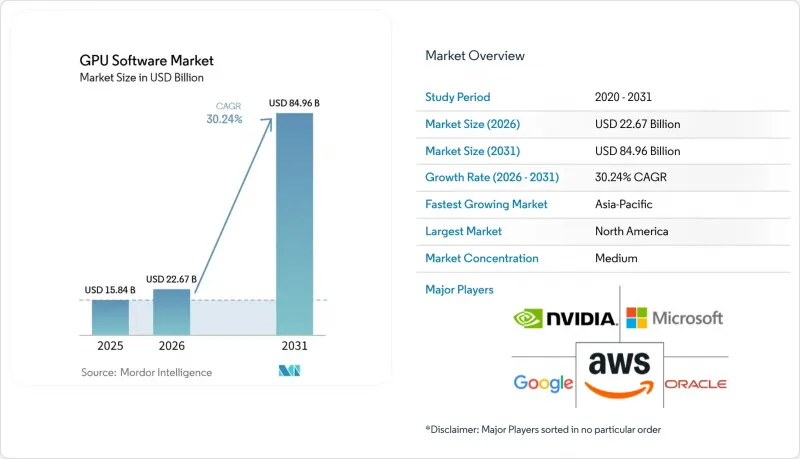
本報告按元件(軟體和服務)、部署類型(雲端、本地部署等)、企業規模(大型企業和中小企業)、應用程式(人工智慧和機器學習等)、最終用戶(雲端服務供應商和超大規模資料中心業者雲端服務商、汽車產業、銀行、金融服務和保險等)以及地區進行細分。市場預測以美元計價。
全球GPU軟體市場趨勢與洞察
生成式人工智慧和大規模語言模型工作負載的日益普及
大規模模型的訓練和推理對調度、記憶體使用和執行效率提出了持續的要求,因此,對生成式人工智慧的投資成為GPU軟體市場最大的成長要素。推理服務尤其重要,因為每次請求的軟體開銷直接影響企業級人工智慧部署的營運成本。 NVIDIA在其2026會計年度財報中宣布,與Hopper相比,Blackwell Ultra在SemiAnalysis InferenceX基準測試中,將為基於代理的人工智慧帶來高達50倍的性能提升和1/35的成本降低。這將加速平台遷移並縮短更新周期。 NVIDIA還表示,CUDA-X生態系統目前已涵蓋近6000個支援加速的應用程式,這表明GPU軟體市場與成熟的軟體基礎架構的聯繫遠比硬體本身更為緊密。同一產品週期也推出了用於實體人工智慧和機器人的開放模型Cosmos和Isaac GR00T,將GPU軟體市場拓展到工廠自動化和自主系統模擬等領域。
混合雲和多重雲端環境中對 GPU編配的需求日益成長
GPU 軟體市場也受惠於對跨公共雲端、私有雲端和主權環境的編配需求日益成長。企業擴大採用永久性混合配置,使其能夠在自身或託管基礎架構上維護敏感模型的訓練,並在處理能力不足時將推理處理轉移到外部雲端資源。 2026 年 4 月,Mirantis 宣布將其 k0rdent AI 平台與 NVIDIA Run:ai 整合。據該公司稱,這將使新雲端和企業能夠在幾分鐘內(而不是幾週)建立可用於生產環境的 AI 環境。同樣在 2026 年 3 月,Mirantis 和 Supermicro 宣布推出檢驗的主權 AI 和混合雲端堆疊,顯示供應商朝著更標準化的混合編配商業服務發展。隨著軟體層管理跨不同基礎架構環境的工作負載放置、資料在局部和使用率,這一趨勢正在推動混合雲端和私有雲端的快速擴展。
跨異構 GPU 和雲端堆疊的高階整合非常複雜。
在生產環境中,整合複雜性仍然是GPU軟體市場的主要障礙,因為不同的晶片、驅動程式、伺服器類型和部署模型經常被組合使用。每一代硬體都會帶來新的互連方式、記憶體層次結構和軟體依賴性,這增加了企業團隊在測試和最佳化方面的負擔。 AMD在其面向Instinct MI350系列的ROCm 7.0軟體中宣布擴展FP4和FP6支持,並為資料中心提供新的可擴展性功能。這表明,儘管替代軟體堆疊正在不斷發展,但用戶在確保相容性方面將面臨更大的挑戰。 NVIDIA的2026會計年度收益報告也強調了其生態系統透過CUDA-X和數千個加速應用程式的深度嵌入,這使得從現有堆疊遷移更加耗時耗力。因此,在GPU軟體市場,多廠商部署通常會導致更長的檢驗週期和更慢的基礎設施投資回報。
細分市場分析
2025 年 GPU 軟體市場中,軟體將佔 76.11% 的佔有率,這表明客戶優先考慮的是編配、可觀測性和推理最佳化,而不僅僅是計算資源的存取。據 NVIDIA 稱,CUDA-X 生態系統支援約 6,000 個加速應用程式,其規模持續支撐著軟體層在人工智慧、科學計算和可視化工作負載領域的廣泛部署。這種情況也解釋了為什麼軟體是市場中成長最快的組成部分,預計到 2031 年將以 31.21% 的複合年成長率成長,因為企業正從孤立的叢集轉向更永續的工作負載管理框架。 2025 年 GPU 軟體市場的剩餘佔有率將由服務部分佔據,其大部分收入來自託管 GPU 雲端和部署支援。
在GPU軟體產業,隨著供應商擴大將編配、監控和最佳化功能整合到其託管基礎設施產品中,軟體和服務之間的商業性界限正變得日益模糊。 Mirantis將其k0rdent AI與NVIDIA Run:ai的整合定位為實現其AI平台部署和生命週期管理自動化的一種手段,這表明軟體功能正日益融入更廣泛的服務產品中。 CoreWeave也報告稱,其在2025會計年度實現了強勁成長,並更加專注於企業級市場,這表明GPU原生供應商正在將軟體控制層與雲端容量結合使用以實現盈利,而不是將其作為獨立產品。雖然這種捆綁銷售模式有助於提高經常性收入,但也使得在整個GPU軟體市場中比較各個組件變得更加困難。
預計到 2025 年,基於雲端的部署將佔 GPU 軟體市場的 45.33%,而混合雲端和私有雲端到 2031 年的複合年成長率將達到 31.62%。雲端環境仍然是最大的部署基礎,因為它們允許企業快速存取 GPU 容量並擴展訓練和推理能力,而無需擁有所有硬體。同時,預計成長最快的將是混合設計,因為這些配置既能保持突發容量,又能讓使用者對資料放置和安全性進行更精細的控制。 Mirantis 和 Supermicro 於 2026 年 3 月發布了檢驗的自主 AI 和混合雲端部署堆疊,這反映了市場對現成混合 GPU 環境日益成長的商業性需求。
在資料居住和系統控制不容妥協的受監管產業和研究環境中,本地部署仍然至關重要。邊緣和嵌入式部署雖然在GPU軟體市場中仍佔較小佔有率,但在汽車檢驗、工業數位孿生和其他資產級推理工作負載中的重要性日益凸顯。 2026年1月,Softbank Corporation發布了“Infrinia AI Cloud OS”,使AI資料中心營運商能夠在GPU基礎設施上提供多租戶Kubernetes即服務和推理即服務。此次發布標誌著軟體對分散式部署模型的支援得到增強。因此,儘管部署形式日益多樣化,但軟體層作為整合這些環境的關鍵工具,仍然發揮著至關重要的作用。
區域分析
預計到2025年,北美將佔據GPU軟體市場48.44%的佔有率,成為全球最大的區域市場。這一主導地位得益於超大規模資料中心業者資料中心營運商的資本投入、企業對人工智慧的廣泛應用,以及在成熟的GPU生態系統中蓬勃發展的軟體開發人員群體。根據CoreWeave預測,截至2026年3月31日,北美GPU軟體累積訂單預計將從2025會計年度末的668億美元增加至994億美元,顯示市場需求強勁,尤其是在北美的雲端運算和企業級市場。 NVIDIA 2026會計年度的業績也顯示,CUDA-X生態系統持續擴張,並向Blackwell平台遷移,從而支援北美客戶持續的升級週期。這將確保北美在整個預測期內保持強勁的市場地位,即使其他地區成長加速。
預計到2031年,亞太地區GPU軟體市場將以31.42%的複合年成長率成長,成為成長最快的地區。 2026年1月,Softbank Corporation發布了針對人工智慧資料中心營運商的“Infrinia AI Cloud OS”,旨在基於GPU基礎設施提供多租戶Kubernetes即服務(Kubernetes-as-a-Service)和推理即服務(Inference-as-a-Service)。 NTT Data也在日本推出了“GPU即服務”,用於大規模機器學習工作負載,目標應用場景包括大規模語言模型(LLM)開發、自動駕駛和藥物研發等。這些發展表明,除了本地平台開發之外,企業優先採用雲端技術的需求、政府主導的人工智慧投資計畫以及本地平台開發,都在推動亞太地區GPU軟體市場的發展。
同時,在歐洲和世界其他地區,GPU軟體市場呈現不同的成長模式,這直接受到資料管理和主權基礎設施需求的影響。歐洲議會2025年關於軟體和網路依賴性的調查凸顯了歐洲對非歐盟供應商的依賴,進一步強調了區域對人工智慧和雲端基礎設施進行管控的重要性。 2026年2月,德國電信和英偉達在慕尼黑運作了德國首個「工業級人工智慧雲端」。該基礎設施配備了約1萬塊英偉達Blackwell GPU和0.5 exaflops的處理能力,顯示這些政策壓力正在轉化為實際的基礎設施建設。此外,據德國資訊科技協會(Bitkom)稱,人工智慧和高效能運算(HPC)工作負載在2025年佔德國資料中心容量的15%,預計到2030年將達到40%。這進一步支持了區域基礎建設應繼續推進的觀點。
其他好處:
- Excel格式的市場預測(ME)表
- 3個月的分析師支持
目錄
第1章:引言
- 研究假設和市場定義
- 調查範圍
第2章:調查方法
第3章執行摘要
第4章 市場狀況
- 市場概覽
- 宏觀經濟因素對市場的影響
- 市場促進因素
- 擴大生成式人工智慧和大規模語言模型工作負載的應用
- 混合雲和多重雲端環境中對 GPU編配的需求日益成長
- 在高效能運算工作負載中擴大GPU軟體的使用
- 拓展雲端遊戲和即時渲染的應用場景。
- GPU分割區配置及向計量收費存取模式的遷移
- 企業對GPU的使用、監控和成本最佳化越來越感興趣。
- 市場限制因素
- 跨異構 GPU 和雲端堆疊的高階整合非常複雜。
- 共用GPU環境中的安全、隱私和資料主權問題
- 先進GPU基礎設施及相關人員供不應求
- 企業級GPU軟體和託管服務的成本持續居高不下。
- 產業價值鏈分析
- 監理情勢
- 技術展望
- 波特五力分析
第5章 市場規模與成長預測
- 按組件
- 軟體
- 服務
- 部署模式
- 基於雲端的
- 現場
- 混合雲端/私有雲端
- 邊緣/嵌入式
- 按公司規模
- 大公司
- 小型企業
- 透過使用
- 人工智慧和機器學習
- 高效能運算
- 資料分析
- 圖形渲染和視覺化
- 仿真和數位孿生
- 影像處理和串流媒體
- 遊戲和雲端遊戲基礎設施
- 其他用途
- 最終用戶
- 雲端服務供應商和超大規模資料中心業者雲端服務商
- 資訊科技/通訊
- 醫療保健和生命科學
- BFSI
- 媒體與娛樂
- 車
- 製造業
- 其他最終用戶(政府/國防、零售/電子商務)
- 地區
- 北美洲
- 美國
- 加拿大
- 墨西哥
- 歐洲
- 德國
- 英國
- 法國
- 義大利
- 其他歐洲國家
- 亞太地區
- 中國
- 日本
- 韓國
- 印度
- 東南亞
- 其他亞太國家
- 南美洲
- 中東和非洲
- 北美洲
第6章 競爭情勢
- 市場集中度
- 策略趨勢
- 市佔率分析
- 公司簡介
- Amazon Web Services, Inc.
- Microsoft Corporation
- Google LLC
- NVIDIA Corporation
- IBM Corporation
- Oracle Corporation
- Alibaba Cloud Computing Co. Ltd.
- CoreWeave, Inc.
- Akamai Technologies, Inc.
- Lambda, Inc.
- DigitalOcean Holdings, Inc.
- OVH Groupe SA
- Scaleway SAS
- Runpod, Inc.
- Vast.ai, Inc.
- Gcore Holding Ltd.
- Nebius Group NV
- Tencent Cloud Computing(Beijing)Co., Ltd.
- Hewlett Packard Enterprise Company
- Red Hat, Inc.
第7章 市場機會與未來展望
According to Mordor Intelligence, the GPU software market size is expected to increase from USD 15.84 billion in 2025 to USD 22.67 billion in 2026 and reach USD 84.96 billion by 2031, growing at a CAGR of 30.24% over 2026-2031.
This report is Segmented by Component (Software, and Services), Deployment Mode (Cloud-Based, On-Premises, and More), Enterprise Size (Large Enterprises, and Small and Medium Enterprises), Application (Artificial Intelligence and Machine Learning, and More), End User (Cloud Service Providers and Hyperscalers, Automotive, BFSI, and More), and Geography. The Market Forecasts are Provided in Terms of Value (USD).
Global GPU Software Market Trends and Insights
Increasing Adoption of Generative AI and Large Language Model Workloads
Generative AI spending remains the strongest growth driver for the GPU software market because large model training and inference place sustained pressure on scheduling, memory use, and runtime efficiency. Inference serving has become especially important because software overhead per request directly affects the operating cost of enterprise AI deployments. NVIDIA stated in its fiscal 2026 results that Blackwell Ultra delivers up to 50x better performance and 35x lower cost for agentic AI than Hopper on the SemiAnalysis InferenceX benchmark, which supports faster platform migration and shorter refresh cycles. NVIDIA also said that the CUDA-X ecosystem now spans nearly 6,000 accelerated applications, which shows how deeply the GPU software market is tied to an established software base rather than hardware alone. The same product cycle also introduced Cosmos and Isaac GR00T open models for physical AI and robotics, which extends the GPU software market into factory automation and autonomous system simulation.
Rising Demand for GPU Orchestration in Hybrid and Multi-Cloud Environments
The GPU software market is also benefiting from rising demand for orchestration across public cloud, private cloud, and sovereign environments. Enterprises are increasingly using permanent hybrid setups where sensitive model training stays on owned or controlled infrastructure and overflow inference runs move to external cloud capacity. Mirantis launched integration between its k0rdent AI platform and NVIDIA Run:ai in April 2026, and the company said this allows neoclouds and enterprises to deploy production-ready AI environments in minutes rather than weeks. Mirantis and Supermicro also announced a validated sovereign AI and hybrid cloud stack in March 2026, which shows that suppliers are turning hybrid orchestration into a more standardized commercial offer. This pattern supports faster expansion in hybrid cloud and private cloud because the software layer manages workload placement, data locality, and utilization across different infrastructure environments.
High Integration Complexity Across Heterogeneous GPU and Cloud Stacks
Integration complexity remains a real brake on the GPU software market because production environments often combine different chips, drivers, server types, and deployment models. Each hardware generation brings new interconnect behavior, memory hierarchies, and software dependencies, which raises testing and optimization work for enterprise teams. AMD said its ROCm 7.0 software for the Instinct MI350 series added broader FP4 and FP6 support and new data center scalability features, which shows that alternative software stacks are advancing but still add another layer of compatibility work for users. NVIDIA's fiscal 2026 results also underline how deeply its ecosystem is embedded through CUDA-X and thousands of accelerated applications, which makes migration away from an established stack slower and more expensive. As a result, multi-vendor deployments often face longer validation cycles and slower returns on infrastructure spending in the GPU software market.
Other drivers and restraints analyzed in the detailed report include:
- Growing Use of GPU Software for High-Performance Computing Workloads
- Expansion of Cloud Gaming and Real-Time Rendering Use Cases
- Security, Privacy, and Data Sovereignty Concerns in Shared GPU Environments
For complete list of drivers and restraints, kindly check the Table Of Contents.
Segment Analysis
Software held 76.11% of the GPU software market in 2025, which shows that customers place more value on orchestration, observability, and inference optimization than on access to compute alone. NVIDIA said the CUDA-X ecosystem supports nearly 6,000 accelerated applications, and that scale continues to support a deep installed base for the software layer across AI, science, and visualization workloads. This position also helps explain why software is the fastest-growing component at 31.21% CAGR through 2031, because enterprises are moving from isolated clusters to more persistent workload management frameworks. The services segment accounted for the remaining share of the GPU software market in 2025, and much of that revenue came from managed GPU cloud and deployment support.
The commercial line between software and services is becoming less clear in the GPU software industry because suppliers increasingly bundle orchestration, monitoring, and optimization into managed infrastructure offers. Mirantis positioned its k0rdent AI integration with NVIDIA Run:ai as a way to automate AI platform deployment and lifecycle management, which shows how software functionality is being wrapped into broader service delivery. CoreWeave also reported strong fiscal 2025 growth and a larger enterprise focus, which indicates that GPU-native providers are monetizing software control layers alongside cloud capacity rather than treating them as separate products. This bundling supports higher recurring revenue and makes stand-alone component comparisons less straightforward across the GPU software market.
Cloud-based deployment accounted for 45.33% of the GPU software market in 2025, while hybrid cloud and private cloud is projected to grow at 31.62% CAGR through 2031. The largest installed base still sits in cloud environments because they give enterprises faster access to GPU capacity and let them scale training and inference without owning all hardware. At the same time, the fastest growth is shifting toward hybrid designs because those setups give users more control over data placement and security while preserving burst capacity. Mirantis and Supermicro announced a validated sovereign AI and hybrid cloud deployment stack in March 2026, which reflects rising commercial demand for ready-built hybrid GPU environments.
On-premises deployment remains relevant in regulated sectors and research settings where data residency and system control cannot be compromised. Edge and embedded deployment is still a smaller base in the GPU software market, but it is becoming more relevant in automotive validation, industrial digital twins, and other asset-level inference workloads. SoftBank launched Infrinia AI Cloud OS in January 2026 to let AI data center operators provide multi-tenant Kubernetes-as-a-Service and inference-as-a-Service on GPU infrastructure, and that release points to stronger software support for distributed deployment models. The deployment mix is therefore widening, but the software layer remains the main tool for tying these environments together.
Complete Report Scope:
- By Component
- Software
- Services
- By Deployment Mode
- Cloud-Based
- On-Premises
- Hybrid Cloud / Private Cloud
- Edge / Embedded
- By Enterprise Size
- Large Enterprises
- Small and Medium Enterprises
- By Application
- Artificial Intelligence and Machine Learning
- High-Performance Computing
- Data Analytics
- Graphics Rendering and Visualization
- Simulation and Digital Twins
- Video Processing and Streaming
- Gaming and Cloud Gaming Infrastructure
- Other Applications
- By End User
- Cloud Service Providers and Hyperscalers
- IT and Telecommunications
- Healthcare and Life Sciences
- BFSI
- Media and Entertainment
- Automotive
- Manufacturing
- Other End Users (Government and Defense, Retail and E-Commerce)
- Geography
- North America
- United States
- Canada
- Mexico
- Europe
- Germany
- United Kingdom
- France
- Italy
- Rest of Europe
- Asia-Pacific
- China
- Japan
- South Korea
- India
- Southeast Asia
- Rest of Asia-Pacific
- South America
- Middle East and Africa
- North America
Geography Analysis
North America accounted for 48.44% of the GPU software market share in 2025, which made it the largest regional contributor. The region leads because it combines hyperscaler capital spending, deep enterprise AI adoption, and a strong installed base of software developers working within established GPU ecosystems. CoreWeave said its revenue backlog rose to USD 99.4 billion as of March 31, 2026, up from USD 66.8 billion at year-end 2025, which points to a large committed demand base centered heavily in North American cloud and enterprise activity. NVIDIA's fiscal 2026 results also showed the continued expansion of the CUDA-X ecosystem and Blackwell platform transition, which supports ongoing upgrade cycles across North American customers. This keeps North America in a strong position through the forecast period even as regional growth rates elsewhere move higher.
Asia-Pacific is projected to expand at 31.42% CAGR through 2031, making it the fastest-growing region in the GPU software market. SoftBank launched Infrinia AI Cloud OS in January 2026 for AI data center operators that want to offer multi-tenant Kubernetes-as-a-Service and inference-as-a-Service on GPU infrastructure. NTT DATA also launched GPU as a Service for large-scale machine learning workloads in Japan, targeting use cases such as LLM development, autonomous driving, and drug discovery. These moves show that the GPU software market in Asia-Pacific is being supported by local platform development as well as demand from cloud-first enterprise adoption and sovereign AI investment programs.
Europe and the rest of the world contribute a different growth profile to the GPU software market, one shaped more directly by data control and sovereign infrastructure needs. The European Parliament's 2025 study on software and cyber dependencies highlighted the extent of Europe's reliance on non-EU providers, which adds urgency to regional control over AI and cloud infrastructure. Deutsche Telekom and NVIDIA brought Germany's first Industrial AI Cloud online in Munich in February 2026 with around 10,000 NVIDIA Blackwell GPUs and 0.5 ExaFLOPS of capacity, which shows how that policy pressure is translating into real infrastructure. Bitkom also said AI and HPC workloads accounted for 15% of German data center capacity in 2025 and are projected to reach 40% by 2030, which supports the case for continued regional build-out.
- Amazon Web Services, Inc.
- Microsoft Corporation
- Google LLC
- NVIDIA Corporation
- IBM Corporation
- Oracle Corporation
- Alibaba Cloud Computing Co. Ltd.
- CoreWeave, Inc.
- Akamai Technologies, Inc.
- Lambda, Inc.
- DigitalOcean Holdings, Inc.
- OVH Groupe SA
- Scaleway SAS
- Runpod, Inc.
- Vast.ai, Inc.
- Gcore Holding Ltd.
- Nebius Group N.V.
- Tencent Cloud Computing (Beijing) Co., Ltd.
- Hewlett Packard Enterprise Company
- Red Hat, Inc.
Additional Benefits:
- The market estimate (ME) sheet in Excel format
- 3 months of analyst support
TABLE OF CONTENTS
1 INTRODUCTION
- 1.1 Study Assumptions and Market Definition
- 1.2 Scope of the Study
2 RESEARCH METHODOLOGY
3 EXECUTIVE SUMMARY
4 MARKET LANDSCAPE
- 4.1 Market Overview
- 4.2 Impact of Macroeconomic Factors on the Market
- 4.3 Market Drivers
- 4.3.1 Increasing Adoption of Generative AI and Large Language Model Workloads
- 4.3.2 Rising Demand for GPU Orchestration in Hybrid and Multi-Cloud Environments
- 4.3.3 Growing Use of GPU Software for High-Performance Computing Workloads
- 4.3.4 Expansion of Cloud Gaming and Real-Time Rendering Use Cases
- 4.3.5 Shift Toward Fractional GPU Provisioning and Pay-Per-Use Access Models
- 4.3.6 Rising Enterprise Focus on GPU Utilization, Monitoring, and Cost Optimization
- 4.4 Market Restraints
- 4.4.1 High Integration Complexity Across Heterogeneous GPU and Cloud Stacks
- 4.4.2 Security, Privacy, and Data Sovereignty Concerns in Shared GPU Environments
- 4.4.3 Limited Availability of Advanced GPU Infrastructure and Related Talent
- 4.4.4 High Ongoing Cost of Enterprise-Grade GPU Software and Managed Services
- 4.5 Industry Value Chain Analysis
- 4.6 Regulatory Landscape
- 4.7 Technological Outlook
- 4.8 Porter's Five Forces Analysis
- 4.8.1 Threat of New Entrants
- 4.8.2 Bargaining Power of Suppliers
- 4.8.3 Bargaining Power of Buyers
- 4.8.4 Threat of Substitutes
- 4.8.5 Competitive Rivalry
5 MARKET SIZE AND GROWTH FORECASTS (VALUE)
- 5.1 By Component
- 5.1.1 Software
- 5.1.2 Services
- 5.2 By Deployment Mode
- 5.2.1 Cloud-Based
- 5.2.2 On-Premises
- 5.2.3 Hybrid Cloud / Private Cloud
- 5.2.4 Edge / Embedded
- 5.3 By Enterprise Size
- 5.3.1 Large Enterprises
- 5.3.2 Small and Medium Enterprises
- 5.4 By Application
- 5.4.1 Artificial Intelligence and Machine Learning
- 5.4.2 High-Performance Computing
- 5.4.3 Data Analytics
- 5.4.4 Graphics Rendering and Visualization
- 5.4.5 Simulation and Digital Twins
- 5.4.6 Video Processing and Streaming
- 5.4.7 Gaming and Cloud Gaming Infrastructure
- 5.4.8 Other Applications
- 5.5 By End User
- 5.5.1 Cloud Service Providers and Hyperscalers
- 5.5.2 IT and Telecommunications
- 5.5.3 Healthcare and Life Sciences
- 5.5.4 BFSI
- 5.5.5 Media and Entertainment
- 5.5.6 Automotive
- 5.5.7 Manufacturing
- 5.5.8 Other End Users (Government and Defense, Retail and E-Commerce)
- 5.6 Geography
- 5.6.1 North America
- 5.6.1.1 United States
- 5.6.1.2 Canada
- 5.6.1.3 Mexico
- 5.6.2 Europe
- 5.6.2.1 Germany
- 5.6.2.2 United Kingdom
- 5.6.2.3 France
- 5.6.2.4 Italy
- 5.6.2.5 Rest of Europe
- 5.6.3 Asia-Pacific
- 5.6.3.1 China
- 5.6.3.2 Japan
- 5.6.3.3 South Korea
- 5.6.3.4 India
- 5.6.3.5 Southeast Asia
- 5.6.3.6 Rest of Asia-Pacific
- 5.6.4 South America
- 5.6.5 Middle East and Africa
- 5.6.1 North America
6 COMPETITIVE LANDSCAPE
- 6.1 Market Concentration
- 6.2 Strategic Moves
- 6.3 Market Share Analysis
- 6.4 Company Profiles (includes Global Level Overview, Market Level Overview, Core Segments, Financials as available, Strategic Information, Market Rank/Share, Products and Services, Recent Developments)
- 6.4.1 Amazon Web Services, Inc.
- 6.4.2 Microsoft Corporation
- 6.4.3 Google LLC
- 6.4.4 NVIDIA Corporation
- 6.4.5 IBM Corporation
- 6.4.6 Oracle Corporation
- 6.4.7 Alibaba Cloud Computing Co. Ltd.
- 6.4.8 CoreWeave, Inc.
- 6.4.9 Akamai Technologies, Inc.
- 6.4.10 Lambda, Inc.
- 6.4.11 DigitalOcean Holdings, Inc.
- 6.4.12 OVH Groupe SA
- 6.4.13 Scaleway SAS
- 6.4.14 Runpod, Inc.
- 6.4.15 Vast.ai, Inc.
- 6.4.16 Gcore Holding Ltd.
- 6.4.17 Nebius Group N.V.
- 6.4.18 Tencent Cloud Computing (Beijing) Co., Ltd.
- 6.4.19 Hewlett Packard Enterprise Company
- 6.4.20 Red Hat, Inc.
7 MARKET OPPORTUNITIES AND FUTURE OUTLOOK
- 7.1 White-Space and Unmet-Need Assessment

 動態圖像設計服務市場:全球市場預測,2026-2032年
 2026年全球人工智慧(AI)資料中心圖形處理器(GPU)市場報告2026年人工智慧圖形處理器(GPU)全球市場報告2026年深度學習圖形處理器(GPU)全球市場報告2026年全球混合圖形處理器(GPU)市場報告
 全球圖形處理器(GPU)市場規模、佔有率、趨勢和成長分析報告(2026-2034年)
 圖形處理器:市場佔有率分析、產業趨勢與統計、成長預測(2026-2031)GPU(影像處理)市場:按產品類型、記憶體類型、散熱方式、部署方式、應用和最終用戶分類 - 全球市場預測(2026-2032 年)GPU代工廠:市佔率分析、產業趨勢與統計、成長預測(2026-2031年)GPU網路:市佔率分析、產業趨勢與統計、成長預測(2026-2031年)