


 |
市場調查報告書
商品編碼
2097257
中東設施管理:市場佔有率分析、產業趨勢與統計及成長預測(2026-2031 年)Middle East Facility Management - Market Share Analysis, Industry Trends & Statistics, Growth Forecasts (2026 - 2031) |
||||||

※ 本網頁內容可能與最新版本有所差異。詳細情況請與我們聯繫。
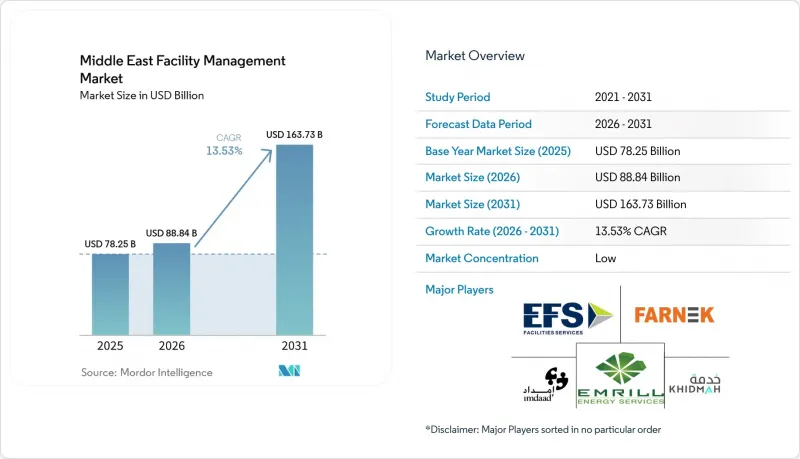
根據 Mordor Intelligence 預測,中東設施管理市場規模將從 2025 年的 782.5 億美元和 2026 年的 888.4 億美元成長到 2031 年的 1637.3 億美元,2026 年至 2031 年的年複合成長率(CAGR)%為 13.53%。
本報告按服務類型(硬性服務、軟性服務)、交付方式(內部交付、外包)、最終用戶行業(商業、酒店、公共基礎設施、醫療保健、工業流程等)和地區(沙烏地阿拉伯、阿拉伯聯合大公國及其他中東國家)進行細分。市場預測以美元計價。
中東設施管理市場趨勢與洞察
「2030願景」及超級專案資產移交
沙烏地阿拉伯從建設階段到營運階段的過渡正在改變中東地區的設施管理格局,尤其是在該國雄心勃勃的超級項目中。諸如NEOM、紅海世界和薩勒曼國王國際機場等舉措,其項目儲備總額超過1兆美元,不僅是里程碑,更是變革的催化劑。隨著每個專案的交付,從工程支援到全生命週期管理等服務需求都在不斷成長。這一演變凸顯了一個關鍵的轉折點:入住後營運正在擴展為涵蓋資產整個生命週期的長期服務合約。此外,隨著交付的推進,開發商的期望也在改變。他們明顯傾向於選擇在數據管理方面表現卓越、能夠確保運轉率並實現績效目標的合作夥伴。例如,NEOM強調了數位孿生整合和持續資料交換等高階要求,這對缺乏強大數位化能力的供應商來說是一個巨大的挑戰。因此,隨著這些專案的推進,大型、技術嫻熟的供應商將主導中東設施管理產業,並從其策略定位中獲益。
向外包轉型為全面性、結果導向合約
中東設施管理市場正在發生顯著變化。傳統上,合約通常較為分散,專注於單一服務。然而,如今外包和整合解決方案的趨勢日益明顯。預計到2025年,外包服務將貢獻高達68.65%的市場收入,尤其在該地區大型資產項目中,外包服務的主導地位更為顯著。正在改變的是合約的形式。業主現在更傾向於選擇能夠管理從硬性服務、軟性服務到永續發展需求和報告義務等所有事務的單一供應商。這一趨勢在大型企劃和政府採購中尤為突出。在這些情況下,競標越來越注重多服務整合、數位化解決方案和切實可見的成果,而不僅僅是提供勞動力。因此,不僅合約金額在增加,合約期限也在延長。擁有完善的系統和管治的供應商顯然更受青睞。儘管客戶關注成本削減,但這種轉變正在為中東設施管理行業拓展商機。
價格主導競標和利潤率降低
在中東設施管理市場,公共部門和大型開發人員在合約中傾向於選擇最低競標,這已成為一個反覆出現的定價難題。中型供應商也面臨同樣的困境,他們必須在人事費用、合規成本和技術成本之間取得平衡,同時也要應對標準化服務領域激烈的價格競爭。直接影響是利潤率下降,但更廣泛的影響是他們不願意投資平台、自動化和預測性維護。這種情況正在造成市場兩極化:資金雄厚的公司追求高價值契約,而中小企業則受制於勞動密集型運營,限制了它們的創新潛力。此外,以價格主導的採購體系使得轉型為以結果為基礎的服務模式變得困難,即使降低長期生命週期成本的益處顯而易見。除非採購框架轉向優先考慮品質、運轉率和績效指標,否則中東設施管理市場將難以提升附加價值。
細分市場分析
到2025年,硬性服務將佔中東設施管理市場60.76%的佔有率,凸顯了該地區以工程為中心的資產基礎。沿岸地區的商業大廈、醫院、機場、飯店、工業設施和綜合用途開發項目高度依賴機電系統、暖通空調系統、消防系統和資產性能支援。該地區的氣候條件推動了對製冷和機械系統的需求,導致與氣候溫和的地區相比,維護週期更頻繁,故障成本更高。新計畫規格擴大從一開始就將資產資料、試運行標準和監控義務納入營運模式。 NEOM的數位孿生要求就是這一演進的典型例證,它將硬性服務職責與即時資產可見性和長期性能管理聯繫起來。
在中東設施管理市場,軟性服務正迅速崛起為成長最快的領域,預計到2031年將以14.76%的年複合成長率(CAGR)成長。這一成長主要得益於酒店業的蓬勃發展、教育機構和政府設施的外包需求,以及對清潔、保全、餐飲和職場支援的廣泛需求。例如,Farnek公司引進了混合清潔單元,將人工團隊與自主機器人清潔設備結合,每小時清潔面積可達5,000平方英尺,這就是產業轉型的一個例證。 Emeril公司的永續發展舉措在2024年實施了143項持續改善措施,預計可減少640噸二氧化碳當量排放,並節省225萬公升水。這凸顯了軟性服務正從單純的日常營運轉向對環境績效的承諾。
其他好處:
- Excel格式的市場預測(ME)表
- 3個月的分析師支持
目錄
第1章:引言
- 研究假設和市場定義
- 調查範圍
第2章:調查方法
第3章執行摘要
第4章 市場狀況
- 市場概覽
- 宏觀經濟因素對市場的影響
- 市場促進因素
- 「2030願景」及超級專案資產移交
- 向外包轉型為全面性、績效導向合約
- 智慧建築、電腦輔助設施管理 (CAFM) 和預測性維護的實施
- 需求受能源效率和綠建築法規合規性的驅動。
- 來自資料中心和數位基礎設施的關鍵任務設施管理需求
- 大型開發案從試運行到全面運作平穩過渡的要求
- 市場限制因素
- 價格主導競標和利潤率降低
- 熟練勞動力短缺和國有化壓力
- 互聯建築中的網路安全和系統互通性風險
- 公共部門付款延遲和多機構採購中的摩擦。
- 產業價值鏈分析
- 監理情勢
- 技術展望
- 波特五力分析
第5章 市場規模與成長預測
- 按服務類型
- 硬服務
- 資產管理
- 機電及暖通空調服務
- 消防系統和安全
- 其他硬體維修服務
- 軟服務
- 辦公室支援和安全
- 清潔服務
- 餐飲服務
- 其他軟調頻服務
- 硬服務
- 按服務類型
- 內部
- 外包
- 單頻調頻
- 捆綁式調頻廣播
- 整合調頻
- 按最終用戶行業分類
- 商業(IT/電信、零售/倉儲等)
- 飯店餐飲業(飯店、餐廳、大型餐廳)
- 公共服務和公共基礎設施(政府、教育、交通)
- 醫療保健(公立和私立機構)
- 工業和流程(製造業、能源業、採礦業)
- 其他終端用戶產業(多用戶住宅、娛樂、運動和休閒)
- 按地區
- 沙烏地阿拉伯
- 阿拉伯聯合大公國
- 科威特
- 巴林
- 其他中東國家
第6章 競爭情勢
- 市場集中度
- 策略趨勢
- 市佔率分析
- 公司簡介
- Emrill Services LLC
- EFS Facilities Services Group LLC
- Farnek Services LLC
- Imdaad LLC
- Khidmah LLC
- Enova Facilities Management Services LLC
- Transguard Group LLC
- Musanadah Facilities Management Company
- Saudi Facility Management Company(FMTECH)
- Muheel Services for Maintenance and Operations LLC
- Initial Saudi Group
- Al Shirawi Facilities Management LLC
- Etisalat Facilities Management LLC
- United Facilities Management
- QBG Facilities Management Group
- ENGIE Cofely Energy Services LLC
- CBRE Group, Inc.
- Jones Lang LaSalle Incorporated
- Serco Group plc
- ISS A/S
第7章 市場機會與未來展望
According to Mordor Intelligence, the Middle East facility management market size is projected to expand from USD 78.25 billion in 2025 and USD 88.84 billion in 2026 to USD 163.73 billion by 2031, registering a CAGR of 13.53% between 2026 and 2031.
This report is Segmented by Service Type (Hard Services, Soft Services), Offering Type (In-House, Outsourced), End-User Industry (Commercial, Hospitality, Institutional and Public Infrastructure, Healthcare, Industrial and Process, and More), and Geography (Saudi Arabia, United Arab Emirates, Rest of Middle East). The Market Forecasts are Provided in Terms of Value (USD).
Middle East Facility Management Market Trends and Insights
Vision 2030 And Giga-Project Asset Handovers
Saudi Arabia's transition from construction to operational asset management is reshaping the Middle East's facility management landscape, particularly across its ambitious giga-projects. With a project pipeline surpassing USD 1 trillion, initiatives like NEOM, Red Sea Global, and King Salman International Airport are not just milestones but catalysts. Each handover amplifies the demand for services ranging from engineering support to lifecycle oversight. This evolution underscores a pivotal shift: post-occupancy work now extends into long-term service contracts, aligning with the asset's entire lifecycle. Furthermore, as handovers occur, developer expectations evolve. There is a pronounced shift towards partners adept at managing data, ensuring uptime, and meeting performance targets. NEOM, for instance, emphasizes advanced requirements such as digital twin integration and ongoing data exchange, setting a high bar for vendors lacking robust digital capabilities. Consequently, as these projects evolve, larger, tech-savvy providers are poised to dominate the Middle East's facility management arena, reaping the rewards of their strategic positioning.
Outsourcing Shift Toward Integrated And Outcome-Based Contracts
In the Middle East, the facility management market is witnessing a notable shift. Traditionally, contracts were often fragmented, focusing on single services. However, there is a clear trend moving towards outsourced and integrated solutions. By 2025, a significant 68.65% of the market revenue was generated from outsourced deliveries, highlighting its dominance, especially for large assets in the region. What is evolving is the format of these contracts. Owners are now favoring a singular provider capable of managing everything, from hard and soft services to sustainability needs and reporting duties. This trend is particularly pronounced in mega-projects and government-linked procurements. Here, tenders are increasingly emphasizing multi-service integration, digital solutions, and tangible results, moving beyond just labor supply. As a result, contracts are not only growing in value but also in duration. There is a marked preference for providers boasting established systems and governance. Even with clients tightening their belts on costs, this shift is broadening the opportunities within the Middle East's facility management landscape.
Price-Driven Tendering And Margin Compression
In the Middle East facility management market, public-sector and large developer contracts often favor the lowest bid, creating a recurring pricing challenge. Mid-tier providers grapple with this issue, as they juggle labor, compliance, and technology costs while contending with aggressive pricing in standardized service lines. The immediate fallout is diminished margins, but the broader consequence is a hesitance to invest in platforms, automation, and predictive maintenance. This dynamic results in a divided market: well-capitalized operators chase premium contracts, while smaller firms find themselves anchored to labor-intensive tasks, stifling their potential for innovation. Furthermore, price-driven procurement complicates the transition to outcome-based service models, even when the benefits of long-term lifecycle savings are evident. Without a shift in procurement frameworks towards prioritizing quality, uptime, and performance metrics, the Middle East facility management market will struggle to elevate its value.
Other drivers and restraints analyzed in the detailed report include:
- Smart-Building, CAFM, And Predictive Maintenance Adoption
- Energy-Efficiency And Green-Building Compliance Demand
- Skilled Labor Shortages And Nationalization Pressures
For complete list of drivers and restraints, kindly check the Table Of Contents.
Segment Analysis
In 2025, hard services accounted for 60.76% of the Middle East's facility management market, underscoring the region's engineering-centric asset base. Gulf commercial towers, hospitals, airports, hotels, industrial sites, and mixed-use developments rely heavily on MEP systems, HVAC, fire safety, and asset performance support. Given the region's climate, there is heightened demand on cooling and mechanical systems, leading to more frequent maintenance cycles and costlier failures compared to milder climates. The specification of new projects increasingly incorporates asset data, commissioning standards, and monitoring obligations into the operating model even before occupancy. A prime example of this evolution is NEOM's digital twin requirement, linking hard-service responsibilities with real-time asset visibility and long-term performance management.
Soft services are emerging as the quicker-growing segment of the Middle East's facility management market, boasting a projected CAGR of 14.76% through 2031. This growth is buoyed by an expanding hospitality sector, outsourcing in education and government campuses, and a broader demand for cleaning, security, catering, and workplace support. Demonstrating the industry's shift, Farnek introduced a hybrid cleaning unit that merges human teams with autonomous robotic cleaners, achieving coverage of up to 5,000 sq ft per hour. Emrill's sustainability initiative, with 143 continuous improvement measures in 2024, successfully reduced emissions by 640 tCO2e and conserved 2.25 million liters of water, highlighting the trend of bundling soft services with environmental performance commitments rather than confining them to routine tasks.
Complete Report Scope:
- By Service Type
- Hard Services
- Asset Management
- MEP and HVAC Services
- Fire Systems and Safety
- Other Hard FM Services
- Soft Services
- Office Support and Security
- Cleaning Services
- Catering Services
- Other Soft FM Services
- Hard Services
- By Offering Type
- In-house
- Outsourced
- Single FM
- Bundled FM
- Integrated FM
- By End-user Industry
- Commercial (IT and Telecom, Retail and Warehouses, etc.)
- Hospitality (Hotels, Eateries, Large-scale Restaurants)
- Institutional and Public Infrastructure (Govt, Education, Transportation)
- Healthcare (Public and Private Facilities)
- Industrial and Process (Manufacturing, Energy, Mining)
- Other End-user Industries (Multi-housing, Entertainment, Sports and Leisure)
- By Region
- Saudi Arabia
- United Arab Emirates
- Kuwait
- Bahrain
- Rest of Middle East
List of Companies Covered in this Report:
- Emrill Services LLC
- EFS Facilities Services Group LLC
- Farnek Services LLC
- Imdaad LLC
- Khidmah LLC
- Enova Facilities Management Services LLC
- Transguard Group LLC
- Musanadah Facilities Management Company
- Saudi Facility Management Company (FMTECH)
- Muheel Services for Maintenance and Operations LLC
- Initial Saudi Group
- Al Shirawi Facilities Management LLC
- Etisalat Facilities Management LLC
- United Facilities Management
- QBG Facilities Management Group
- ENGIE Cofely Energy Services LLC
- CBRE Group, Inc.
- Jones Lang LaSalle Incorporated
- Serco Group plc
- ISS A/S
Additional Benefits:
- The market estimate (ME) sheet in Excel format
- 3 months of analyst support
TABLE OF CONTENTS
1 INTRODUCTION
- 1.1 Study Assumptions and Market Definition
- 1.2 Scope of the Study
2 RESEARCH METHODOLOGY
3 EXECUTIVE SUMMARY
4 MARKET LANDSCAPE
- 4.1 Market Overview
- 4.2 Impact of Macroeconomic Factors on the Market
- 4.3 Market Drivers
- 4.3.1 Vision 2030 and Giga-Project Asset Handovers
- 4.3.2 Outsourcing Shift Toward Integrated and Outcome-Based Contracts
- 4.3.3 Smart-Building, CAFM, and Predictive Maintenance Adoption
- 4.3.4 Energy-Efficiency and Green-Building Compliance Demand
- 4.3.5 Mission-Critical FM Demand From Data Centers and Digital Infrastructure
- 4.3.6 Commissioning-to-Operations Soft-Landing Needs in Mega Developments
- 4.4 Market Restraints
- 4.4.1 Price-Driven Tendering and Margin Compression
- 4.4.2 Skilled Labor Shortages and Nationalization Pressures
- 4.4.3 Cybersecurity and System-Interoperability Risk in Connected Buildings
- 4.4.4 Public-Sector Payment Delays and Multi-Agency Procurement Friction
- 4.5 Industry Value Chain Analysis
- 4.6 Regulatory Landscape
- 4.7 Technological Outlook
- 4.8 Porter's Five Forces Analysis
- 4.8.1 Bargaining Power of Suppliers
- 4.8.2 Bargaining Power of Buyers
- 4.8.3 Threat of New Entrants
- 4.8.4 Threat of Substitutes
- 4.8.5 Competitive Rivalry
5 MARKET SIZE AND GROWTH FORECASTS (VALUE)
- 5.1 By Service Type
- 5.1.1 Hard Services
- 5.1.1.1 Asset Management
- 5.1.1.2 MEP and HVAC Services
- 5.1.1.3 Fire Systems and Safety
- 5.1.1.4 Other Hard FM Services
- 5.1.2 Soft Services
- 5.1.2.1 Office Support and Security
- 5.1.2.2 Cleaning Services
- 5.1.2.3 Catering Services
- 5.1.2.4 Other Soft FM Services
- 5.1.1 Hard Services
- 5.2 By Offering Type
- 5.2.1 In-house
- 5.2.2 Outsourced
- 5.2.2.1 Single FM
- 5.2.2.2 Bundled FM
- 5.2.2.3 Integrated FM
- 5.3 By End-user Industry
- 5.3.1 Commercial (IT and Telecom, Retail and Warehouses, etc.)
- 5.3.2 Hospitality (Hotels, Eateries, Large-scale Restaurants)
- 5.3.3 Institutional and Public Infrastructure (Govt, Education, Transportation)
- 5.3.4 Healthcare (Public and Private Facilities)
- 5.3.5 Industrial and Process (Manufacturing, Energy, Mining)
- 5.3.6 Other End-user Industries (Multi-housing, Entertainment, Sports and Leisure)
- 5.4 By Region
- 5.4.1 Saudi Arabia
- 5.4.2 United Arab Emirates
- 5.4.3 Kuwait
- 5.4.4 Bahrain
- 5.4.5 Rest of Middle East
6 COMPETITIVE LANDSCAPE
- 6.1 Market Concentration
- 6.2 Strategic Moves
- 6.3 Market Share Analysis
- 6.4 Company Profiles (includes Global Level Overview, Market Level Overview, Core Segments, Financials as available, Strategic Information, Market Rank/Share, Products and Services, Recent Developments)
- 6.4.1 Emrill Services LLC
- 6.4.2 EFS Facilities Services Group LLC
- 6.4.3 Farnek Services LLC
- 6.4.4 Imdaad LLC
- 6.4.5 Khidmah LLC
- 6.4.6 Enova Facilities Management Services LLC
- 6.4.7 Transguard Group LLC
- 6.4.8 Musanadah Facilities Management Company
- 6.4.9 Saudi Facility Management Company (FMTECH)
- 6.4.10 Muheel Services for Maintenance and Operations LLC
- 6.4.11 Initial Saudi Group
- 6.4.12 Al Shirawi Facilities Management LLC
- 6.4.13 Etisalat Facilities Management LLC
- 6.4.14 United Facilities Management
- 6.4.15 QBG Facilities Management Group
- 6.4.16 ENGIE Cofely Energy Services LLC
- 6.4.17 CBRE Group, Inc.
- 6.4.18 Jones Lang LaSalle Incorporated
- 6.4.19 Serco Group plc
- 6.4.20 ISS A/S
7 MARKET OPPORTUNITIES AND FUTURE OUTLOOK
- 7.1 White-space and Unmet-Need Assessment

 2026-2030年全球設施管理市場
 設施管理(FM)軟體:市場佔有率分析、行業趨勢和統計數據以及成長預測(2026-2031 年)北美設施管理:市場佔有率分析、產業趨勢與統計、成長預測(2026-2031 年)亞太地區硬設施管理:市場佔有率分析、產業趨勢與統計及成長預測(2026-2031)硬設施管理:市場佔有率分析、產業趨勢與統計、成長預測(2026-2031 年)日本設施管理:市場佔有率分析、產業趨勢與統計及成長預測(2026-2031)
 Frost Radar™:泰國設施管理,2026 年中國設施管理:市場佔有率分析、產業趨勢與統計、成長預測(2026-2031)印尼設施管理:市場佔有率分析、產業趨勢與統計、成長預測(2026-2031)德國設施管理:市場佔有率分析、產業趨勢與統計、成長預測(2026-2031)