


 |
市場調查報告書
商品編碼
2063970
美國聯合收割機:市場佔有率分析、行業趨勢和統計數據以及成長預測(2026-2031 年)United States Combine Harvesters - Market Share Analysis, Industry Trends & Statistics, Growth Forecasts (2026 - 2031) |
||||||

※ 本網頁內容可能與最新版本有所差異。詳細情況請與我們聯繫。
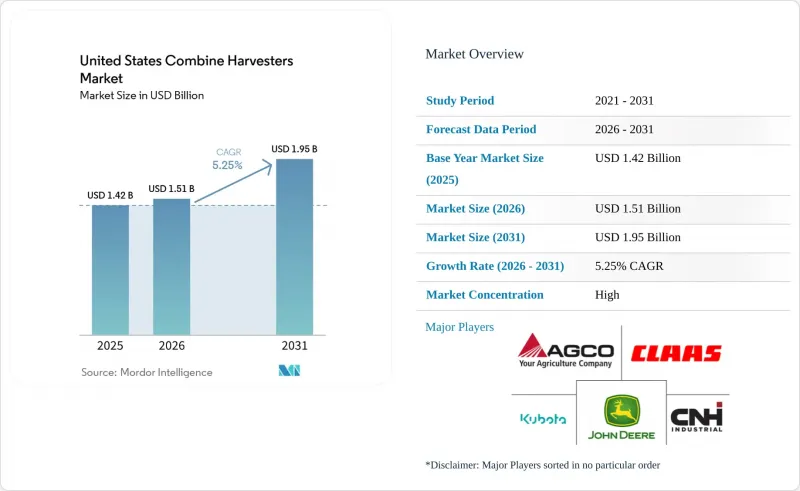
據 Mordor Intelligence 稱,2025 年美國聯合收割機市值為 14.2 億美元,預計到 2031 年將達到 19.5 億美元,而 2026 年為 15.1 億美元,預測期(2026-2031 年)的複合年成長率為 5.25%。
本報告按類型(自走式聯合收割機、曳引機牽引式聯合收割機、動力輸出軸驅動式聯合收割機)、功率輸出(150馬力以下、151-300馬力、301-450馬力、450馬力以上)和驅動技術(傳統柴油、混合動力、純電動)進行分類。市場預測以美元計價。
美國聯合收割機市場趨勢與洞察
老舊 VII-IX 級聯合收割機的更換需求增加
美國聯合收割機的平均使用壽命正在延長,許多在上一輪大宗商品價格上漲期間購買的VII-IX級收割機如今已接近更換閾值。隨著機器使用時間的增加,維修保養成本顯著上升,而老舊運作時數設備的轉售價值則大幅下降。這加劇了更換整批收割機的壓力。此外,近期供應鏈中斷和設備價格飆升導致購買延遲,進一步延長了設備的使用壽命。精密農業的普及也加速了設備的更新換代,因為升級老舊收割機通常不如投資購買配備先進感測器和互聯系統的新型高科技收割機划算。這些因素共同作用,維持了設備的更新換代週期,支撐了長期市場價值的成長,儘管銷售量正在緩慢復甦。
玉米和大豆種植面積的擴大正在加速機械化。
預計到2026年,種植者將種植9,530萬英畝玉米和8,470萬英畝大豆,其中大豆種植面積的增加主要受盈利趨勢變化的驅動。愛荷華州、南達科他州和威斯康辛州等州正在減少玉米面積,增加大豆面積,從而推動了對能夠快速切換作物並配備40-45英尺靈活割台的聯合收割機的需求。此外,2025年收穫的玉米和大豆中,約94%為基因改造品種,產量提高,收穫期縮短。收穫期縮短提升了高產能機械和可減少停機時間的自動運糧車系統的價值。因此,種植面積的變化正在加速美國聯合收割機市場中配備雙割台的中高馬力機型的銷售。
農產品價格波動會影響購買週期。
2024年至2025年玉米和大豆期貨價格的波動顯著擠壓了農民的利潤空間,並減緩了美國聯合收割機市場的機器更新換代速度。克萊頓鄉村主街指數在2026年初之前一直低於成長中性水平,顯示農村經濟持續低迷,農業機械投資資金籌措受限。產業數據顯示,2024年聯合收割機出貨量大幅下降,2025年依然疲軟。這顯示市場對農產品價格波動和生產者信心下降十分敏感。因此,許多農民正在延長設備的使用期限,直到市場狀況穩定下來,這給製造商在週期性需求波動和庫存管理方面帶來了挑戰。
細分市場分析
到2025年,自走式聯合收割機將佔據美國聯合收割機市場約86.0%的佔有率。這一主導地位主要歸功於其在大規模農田的廣泛應用,這些農田能夠提高收割效率並縮短作業時間。相較之下,動力輸出軸驅動式聯合收割機預計在2026年至2031年間保持最高的複合年成長率(CAGR),達到12.4%。這一成長主要得益於有機農場、特色作物種植者以及優先考慮降低資本投資和營運成本的合作社所有權模式的需求不斷成長。
為了提高有限收穫季節的效率,製造商正透過整合高產能糧食處理系統、自動化技術和提升生產力的升級方案,強化其自走式聯合收割機產品線。同時,由動力輸出軸(PTO)驅動的聯合收割機因其較低的購置成本和與現有曳引機基礎設施的兼容性而日益普及。此外,該細分市場還具有對訂閱式數位生態系統和遠端資訊處理平台依賴性較低的優勢。然而,處理能力較低和收割台相容性有限等挑戰仍然阻礙著動力輸出軸驅動的聯合收割機在美國聯合收割機市場大規模商業農業中的應用。
其他好處:
- Excel格式的市場預測(ME)表
- 3個月的分析師支持
目錄
第1章:引言
- 研究假設和市場定義
- 調查範圍
第2章:調查方法
第3章執行摘要
第4章 市場狀況
- 市場概覽
- 市場促進因素
- 對老舊 VII-IX 級車輛的更換需求增加。
- 玉米和大豆種植面積的增加推動了機械化進程。
- 降低初始成本門檻的OEM融資計劃
- 第179條規定的農業機械稅優惠
- 為旗艦車型加裝自動轉向系統。
- 剩餘平衡伐木中的排碳權溢價
- 市場限制因素
- 農產品價格波動影響購買週期
- 比較高昂的初始投資成本與合約收割方案。
- 熟練操作先進機械的工人短缺
- 不確定性有關「維修權」的法律法規正在影響原始設備製造商的利潤率。
- 監理情勢
- 技術展望
- 波特五力分析
第5章 市場規模與成長預測
- 按類型
- 自走式聯合收割機
- 曳引機牽引式聯合收割機
- 動力輸出軸驅動的聯合收割機
- 依輸出類型
- 不到150馬力
- 151-300馬力
- 301-450馬力
- 超過450馬力
- 透過推進技術
- 傳統柴油
- 油電混合
- 純電動
第6章 競爭情勢
- 市場集中度
- 策略趨勢
- 市佔率分析
- 公司簡介
- Deere & Company
- CNH Industrial NV
- AGCO Corporation
- Claas KGaA mbH
- SDF Group
- Kubota Corporation
- Mahindra & Mahindra Ltd.
- Tribine Industries, Inc.
- Rostselmash Group
- Yanmar Holdings Co., Ltd.
- Gomselmash OJSC
- Weichai Lovol Intelligent Agricultural Technology CO., LTD
- Wintersteiger AG
- ALMACO
第7章 市場機會與未來展望
According to Mordor Intelligence, the united states combine harvesters market size was valued at USD 1.42 billion in 2025 and is estimated to grow from USD 1.51 billion in 2026 to reach USD 1.95 billion by 2031, at a CAGR of 5.25% during the forecast period (2026-2031).
This report is Segmented by Type (Self-Propelled Combine, Tractor-Pulled Combine, and PTO-Powered Combine), by Power Output (Less Than 150 HP, 151 - 300 HP, 301 - 450 HP, and Above 450 HP), and by Propulsion Technology (Conventional Diesel, Hybrid-Electric, and Fully Electric). The Market Forecasts are Provided in Terms of Value (USD).
United States Combine Harvesters Market Trends and Insights
Increased Replacement Demand for Aging Class VII to IX fleets
The average combine harvester in the United States is aging, with many Class VII to IX units purchased during the previous commodity upcycle now nearing replacement thresholds. As machine usage hours increase, repair and maintenance costs rise significantly, while resale values for older, high-hour equipment decline sharply. This creates pressure for fleet replacement. Additionally, deferred purchases caused by recent supply chain disruptions and higher equipment prices have further extended ownership cycles. The adoption of precision agriculture is also accelerating replacement demand, as upgrading older combines with advanced sensors and connectivity systems is often less cost-effective than investing in newer, technology-enabled machines. These factors collectively contribute to a sustained replacement cycle, supporting long-term market value growth despite a gradual recovery in unit sales.
Rising Corn and Soybean Acreage Incentivizing Mechanization
Growers are anticipated to plant 95.3 million acres of corn and 84.7 million acres of soybeans in 2026, shifting toward soybeans as profitability signals change. States such as Iowa, South Dakota, and Wisconsin are increasing soybean acres while reducing corn, a pattern that drives demand for combines able to switch quickly between crops and handle flexible 40- to 45-foot draper heads. Additionally, about 94% of corn and 96% of soybeans harvested in 2025 used biotech varieties, raising yields and compressing harvest windows. Shorter harvest periods heighten the value of high-capacity machines and autonomous grain-cart systems that cut downtime. The acreage mix, therefore, pulls forward purchases of mid- to high-horsepower models equipped for dual-header packages within the United States combine harvesters market.
Volatility in Commodity Crop Prices Affecting Purchase Cycles
Fluctuations in corn and soybean futures during 2024-2025 significantly compressed farm margins, leading to delays in equipment upgrades within the United States combine harvesters market. The Creighton Rural Mainstreet Index remained below the growth-neutral threshold through early 2026, indicating persistent weakness in the rural economy and restricted financing conditions for machinery investments. Industry data also shows a sharp decline in combine shipments during 2024, with continued weakness in 2025. This underscores the market's sensitivity to commodity price volatility and declining grower confidence. Consequently, many operators are extending equipment ownership cycles until market conditions stabilize, resulting in cyclical demand patterns and inventory management challenges for manufacturers.
Other drivers and restraints analyzed in the detailed report include:
- OEM Financing Programs Lowering Up-Front Cost Barriers
- Carbon-Credit Premiums for Residue-Balancing Harvesting
- High Initial Capital Cost Versus Custom-Harvesting Alternatives
For complete list of drivers and restraints, kindly check the Table Of Contents.
Segment Analysis
Self-propelled combines accounted for about 86.0% of the United States combine harvesters market share in 2025. This dominance is attributed to their widespread adoption on large-scale row-crop farms, where they enhance harvesting efficiency and reduce operational time. In contrast, the PTO-powered segment is anticipated to exhibit the fastest CAGR of 12.4% from 2026 to 2031. This growth is driven by increasing demand from organic farms, specialty-crop producers, and cooperative ownership models that prioritize lower capital investment and operating costs.
Manufacturers are enhancing self-propelled combine offerings by incorporating higher-capacity grain handling systems, automation technologies, and productivity-focused upgrades to improve efficiency during narrow crop windows. Meanwhile, PTO-powered combines are gaining traction due to their lower purchase costs and compatibility with existing tractor infrastructure. Additionally, this segment benefits from reduced reliance on subscription-based digital ecosystems and telematics platforms. However, challenges such as lower throughput capacity and limited header compatibility continue to hinder the adoption of PTO-powered combines in large commercial farming operations within the United States combine harvesters market.
List of Companies Covered in this Report:
- Deere & Company
- CNH Industrial N.V.
- AGCO Corporation
- Claas KGaA mbH
- SDF Group
- Kubota Corporation
- Mahindra & Mahindra Ltd.
- Tribine Industries, Inc.
- Rostselmash Group
- Yanmar Holdings Co., Ltd.
- Gomselmash OJSC
- Weichai Lovol Intelligent Agricultural Technology CO., LTD
- Wintersteiger AG
- ALMACO
Additional Benefits:
- The market estimate (ME) sheet in Excel format
- 3 months of analyst support
TABLE OF CONTENTS
1 Introduction
- 1.1 Study Assumptions and Market Definition
- 1.2 Scope of the Study
2 Research Methodology
3 Executive Summary
4 Market Landscape
- 4.1 Market Overview
- 4.2 Market Drivers
- 4.2.1 Increased replacement demand for aging Class VII to IX fleets
- 4.2.2 Rising corn and soybean acreage incentivizing mechanization
- 4.2.3 OEM financing programs lowering up-front cost barriers
- 4.2.4 Tax incentives under Section 179 for farm equipment
- 4.2.5 Autonomous guidance retrofits on flagship models
- 4.2.6 Carbon-credit premiums for residue-balancing harvesting
- 4.3 Market Restraints
- 4.3.1 Volatility in commodity crop prices affecting purchase cycles
- 4.3.2 High initial capital cost versus custom-harvesting alternatives
- 4.3.3 Shortage of skilled operators for advanced machines
- 4.3.4 Right-to-repair legislative uncertainty impacting OEM margins
- 4.4 Regulatory Landscape
- 4.5 Technological Outlook
- 4.6 Porter's Five Forces Analysis
- 4.6.1 Threat of New Entrants
- 4.6.2 Bargaining Power of Buyers
- 4.6.3 Bargaining Power of Suppliers
- 4.6.4 Threat of Substitutes
- 4.6.5 Intensity of Competitive Rivalry
5 Market Size and Growth Forecasts (Value)
- 5.1 By Type
- 5.1.1 Self-Propelled Combine
- 5.1.2 Tractor-Pulled Combine
- 5.1.3 PTO-Powered Combine
- 5.2 By Power Output
- 5.2.1 Less Than 150 HP
- 5.2.2 151 - 300 HP
- 5.2.3 301 - 450 HP
- 5.2.4 Above 450 HP
- 5.3 By Propulsion Technology
- 5.3.1 Conventional Diesel
- 5.3.2 Hybrid-Electric
- 5.3.3 Fully Electric
6 Competitive Landscape
- 6.1 Market Concentration
- 6.2 Strategic Moves
- 6.3 Market Share Analysis
- 6.4 Company Profiles (Includes Global Level Overview, Market Level Overview, Core Segments, Financials as Available, Strategic Information, Market Rank/Share for Key Companies, Products and Services, and Recent Developments)
- 6.4.1 Deere & Company
- 6.4.2 CNH Industrial N.V.
- 6.4.3 AGCO Corporation
- 6.4.4 Claas KGaA mbH
- 6.4.5 SDF Group
- 6.4.6 Kubota Corporation
- 6.4.7 Mahindra & Mahindra Ltd.
- 6.4.8 Tribine Industries, Inc.
- 6.4.9 Rostselmash Group
- 6.4.10 Yanmar Holdings Co., Ltd.
- 6.4.11 Gomselmash OJSC
- 6.4.12 Weichai Lovol Intelligent Agricultural Technology CO., LTD
- 6.4.13 Wintersteiger AG
- 6.4.14 ALMACO
7 Market Opportunities and Future Outlook

 自走式履帶穀物聯合收割機市場:全球市場預測(2026-2032年)
 2026年全球搭乘用聯合收割機市場報告
 印度聯合收割機:市場佔有率分析、產業趨勢與統計及成長預測(2026-2031)聯合收割機:市場佔有率分析、產業趨勢與統計、成長預測(2026-2031 年)北美聯合收割機:市場佔有率分析、產業趨勢與統計及成長預測(2026-2031 年)中國聯合收割機:市場佔有率分析、產業趨勢與統計及成長預測(2026-2031年)
 多功能大豆聯合收割機市場預測至2034年-按類型、功能、動力來源、銷售管道、應用和地區分類的全球分析
 聯合收割機市場報告:按類型、驅動類型、切割寬度、產量、應用和地區分類,2026-2034年複合材料鐵路車輪市場:按產品類型、安裝方式、材料、表面處理、塗層、應用類型和最終用戶分類,全球預測,2026-2032年2026年全球聯合收割機市場報告