


 |
市場調查報告書
商品編碼
2063789
泰國折疊式紙盒市場:市場佔有率分析、產業趨勢與統計及成長預測(2026-2031)Thailand Folding Carton - Market Share Analysis, Industry Trends & Statistics, Growth Forecasts (2026 - 2031) |
||||||

※ 本網頁內容可能與最新版本有所差異。詳細情況請與我們聯繫。
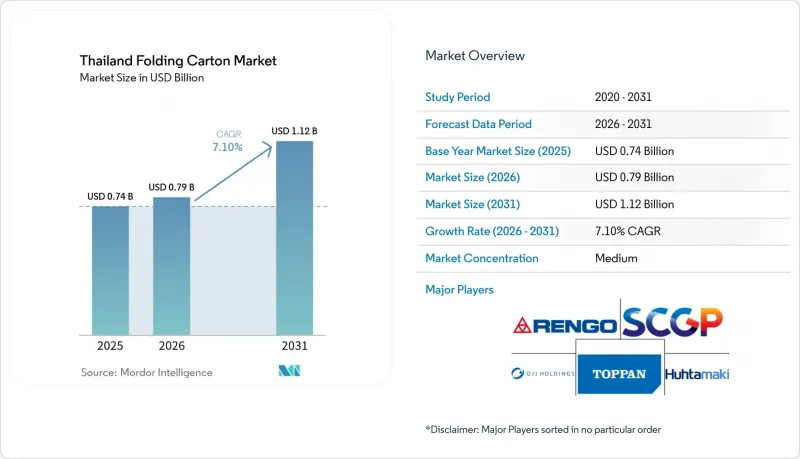
據 Mordor Intelligence 稱,2025 年泰國可折疊瓦楞紙板市場價值 7.4 億美元,預計到 2031 年將從 2026 年的 7.9 億美元成長至 11.2 億美元,預測期(2026-2031 年)複合年成長率為 7.10%。
本報告按材料類型(例如,固態漂白硫酸漿、折疊紙盒用紙板、未漂白塗佈牛皮紙)、印刷技術(例如,膠印、柔版印刷、數位印刷、凹版印刷)和終端用戶行業(例如,食品飲料、醫療保健和製藥、個人護理和化妝品、電氣和電子設備)進行細分。市場預測以美元計價。
泰國折疊紙盒市場趨勢與洞察
泰國食品飲料加工業的擴張
2024年,泰國食品飲料出口額達到509億美元,鞏固了其在全球十大食品出口國中的地位。受旅遊業復甦和雙薪家庭對便利性需求成長的推動,速食食品的產量正以每年2.3%至3.3%的速度成長。泡麵和冷藏食品品牌正從收縮包裝托盤轉向帶有2D碼的折疊式紙盒,這些QR碼與泰國食品藥物管理局(TFDA)的電子標籤系統相容。開泰研究預測,到2025年,環保食品包裝的支出將達到160億泰銖(4.58億美元),顯示消費者願意為回收材料支付更高的價格。這種優質化趨勢有利於固態漂白硫酸漿(SBS)的推廣,與白紙相比,SBS在冷藏配送鏈中能更好地保持品質。
電子商務市場的快速成長正在推動對「貨架即用型」包裝的需求。
預計2025年,國內電子商務市場規模將達320億美元,其中行動端銷售額佔比超過80%。在電商物流履約中,紙箱不僅用作保護性包裝,在商品退貨或轉運時還可用作臨時展示架。加商店正在整合諸如易撕線、防壓底部和自動鎖定功能等特性,以增強紙箱在最後一公里運輸過程中的抗衝擊性,同時減少倉儲人工成本。據泰國印刷協會稱,中小企業正紛紛採用無需製版、可批量印刷500份的數位印刷機,從而能夠開展本地化推廣活動並與網紅合作。目前,線上偵測系統每小時可偵測15,000張紙的條碼,滿足平台對防篡改和掃描準確性的要求。
原生紙漿價格波動
2025年第一季,紙板現貨價格為每噸905美元,第二季度飆升至1,145美元,漲幅高達26%。這一漲幅主要受斯堪地那維亞造紙廠能源成本上升和中國再生紙供應減少的影響。泰國60%的原生紙漿依賴進口,使得加工商極易受到外匯和運費波動的影響。缺乏對沖手段的中小型企業被迫在六週內做出選擇:要麼將成本轉嫁給消費者,要麼自行承擔利潤率下降的風險。 SCG包裝公司透過提高替代燃料的使用比例,使其在2025年的能源結構中佔比達到39%,並確保380萬噸再生纖維的供應,從而緩解了原料價格上漲的壓力。由於非一體化加工商在結構上較為脆弱,產業重組和跨境併購正在推進,以確保纖維供應並降低成本。
細分市場分析
此細分市場,尤其是可折疊紙板(一種經濟高效的穀物和泡麵包裝解決方案),在2025年佔總銷售額的42.13%。預計到2031年,固態漂白硫酸紙漿的複合年成長率將達到8.90%,比可折疊紙板高出近3個百分點,因為化妝品和製藥品牌需要使用原生紙漿以符合過渡法規並實現鮮豔的圖案表現。塗佈未漂白牛皮紙用於耐用消費品,在這些產品中,抗張強度比色調範圍更為重要。白板在低利潤的展示品領域仍佔有一席之地,但正面臨著雙酚A含量不可檢出標準的嚴峻挑戰,這將威脅到合格。
SCG Packaging 已投資 24.5 億泰銖(約 7,000 萬美元)用於一項計劃,旨在將其年產量提高 7.5 萬噸,目標市場為高階食品和醫藥級瓦楞紙板。混合型微瓦楞複合材料兼具緩衝性和印刷性,使其成為多環節電商配送流程的理想之選。泰國工業標準 (TIS) 2948-2562 和 TIS 3438-2565 將於 2026 年 6 月生效,對鄰苯二甲酸酯和重金屬的遷移量做出嚴格限制,鼓勵品牌商使用原生紙漿,並擴大泰國可折疊瓦楞紙板市場。
其他好處:
- Excel格式的市場預測(ME)表
- 3個月的分析師支持
目錄
第1章:引言
- 研究假設和市場定義
- 調查範圍
第2章:調查方法
第3章執行摘要
第4章 市場狀況
- 市場概覽
- 市場促進因素
- 泰國食品飲料加工業的擴張
- 電子商務對「貨架即用包裝」的需求正在激增。
- 消費者越來越偏好選擇永續和可回收的包裝
- 都市區中產階級對包裝食品的消費增加
- 政府對採用數位印刷技術的包裝產業中小企業的支持措施
- 擴大醫藥產業對配備QR碼的紙箱的採用,以實現追蹤溯源。
- 市場限制因素
- 原生紙漿價格波動
- 來自軟質塑膠包裝的競爭壓力
- 高彩瓦楞紙板印刷項目缺乏熟練的印前技術人員
- 對食品接觸表面油墨遷移的嚴格限制推高了合規成本。
- 產業價值鏈分析
- 監理情勢
- 技術展望
- 宏觀經濟因素對市場的影響
- 波特五力分析
第5章 市場規模與成長預測
- 材料類型
- 固態漂白硫酸漿
- 折疊紙板
- 未漂白工藝服
- 白線塑合板
- 其他材料類型
- 透過印刷技術
- 平版印刷
- 柔版印刷
- 數位印刷
- 凹版印刷
- 其他印刷技術
- 按最終用戶行業分類
- 食品/飲料
- 醫療保健/製藥
- 個人護理化妝品
- 電氣和電子設備
- 家用物品和工業產品
- 菸草
- 電子商務與零售包裝
- 其他終端用戶產業
第6章 競爭情勢
- 市場集中度
- 策略趨勢
- 市佔率分析
- 公司簡介
- SCG Packaging Public Company Limited
- Thai Containers Group Co., Ltd.
- Rengo Packaging(Thailand)Co., Ltd.
- Toppan Packaging(Thailand)Co., Ltd.
- Huhtamaki(Thailand)Ltd.
- Amcor Flexibles(Thailand)Ltd.
- Oji Packaging(Thailand)Ltd.
- Printpack(Thailand)Co., Ltd.
- Mayr-Melnhof Packaging(Thailand)Ltd.
- Multi Packaging and Printing Co., Ltd.
- Sealed Air(Thailand)Co., Ltd.
- Asia Packaging Industries(Thailand)Ltd.
- Siam Toppan Packaging Co., Ltd.
- Charoen Pokphand Printing and Packaging Co., Ltd.
- K Packaging Co., Ltd.
- Thai Packaging Industrial Co., Ltd.
- Nan Mee Paper Co., Ltd.
- Sahachai Printing and Packaging Co., Ltd.
- Bangkok Inter Products Co., Ltd.
第7章 市場機會與未來展望
According to Mordor Intelligence, the thailand folding carton market size was valued at USD 0.74 billion in 2025 and estimated to grow from USD 0.79 billion in 2026 to reach USD 1.12 billion by 2031, at a CAGR of 7.10% during the forecast period (2026-2031).
This report is Segmented by Material Type (Solid Bleached Sulfate, Folding Boxboard, Coated Unbleached Kraft, and More), Printing Technology (Lithographic, Flexographic, Digital, Gravure, and More), End-User Industry (Food and Beverage, Healthcare/Pharmaceuticals, Personal Care and Cosmetics, Electrical and Electronics, and More). The Market Forecasts are Provided in Terms of Value (USD).
Thailand Folding Carton Market Trends and Insights
Expansion of Thailand's Food and Beverage Processing Industry
Food and beverage exports reached USD 50.9 billion in 2024, cementing the country's top-ten global food exporter ranking. Production of ready-to-eat meals is growing by 2.3% to 3.3% each year as tourism rebounds and dual-income households demand convenience. Instant noodle and chilled-meal brands are switching from shrink-wrapped trays to QR-enabled folding carton that support the Thai Food and Drug Administration e-labeling system. Kasikorn Research estimates eco-friendly food packaging spend at up to THB 16 billion (USD 458 million) by 2025, indicating a willingness to pay more for recyclable substrates. This premiumization favors solid bleached sulfate, which maintains integrity in refrigerated chains better than white-line chipboard.
Booming E Commerce Demand for Shelf-Ready Packaging
The national e-commerce sector is on track to reach USD 32 billion in 2025, with mobile sales accounting for over 80% of transactions. Online fulfillment uses carton as both protective shippers and instant shelf displays when goods are returned or cross-docked. Converters integrate perforated tear strips, crash-lock bottoms, and auto-lock features that cut warehouse labor while surviving last-mile bumps. The Thai Printing Association reports SMEs flocking to digital presses that handle 500-unit runs without plates, unlocking regional promotions and influencer tie-ins. Inline inspection now checks code readability at 15,000 sheets per hour, meeting platform mandates for tamper-evidence and scan accuracy.
Volatility in Virgin Pulp Prices
Spot paperboard prices jumped from USD 905 per tonne in Q1 2025 to USD 1,145 per tonne in Q2, a 26% leap caused by energy hikes at Scandinavian mills and reduced recovered-paper flow from China. Thailand relies on imports for 60% of its virgin pulp, exposing converters to currency and freight swings. Smaller firms without hedging tools must either pass costs within six weeks or absorb margin hits. SCG Packaging lifted alternative-fuel use to 39% of its energy mix in 2025 and captured 3.8 million tonnes of recovered fiber, containing input inflation. Non-integrated converters are structurally vulnerable, prompting consolidation and cross-border mergers that secure fiber and smooth cost curves.
Other drivers and restraints analyzed in the detailed report include:
- Growing Consumer Preference for Sustainable and Recyclable Packaging
- Rising Urban Middle Class Consumption of Packaged Goods
- Competitive Pressure from Flexible Plastic Packaging
For complete list of drivers and restraints, kindly check the Table Of Contents.
Segment Analysis
The segment captured 42.13% of 2025 revenue through folding boxboard, a cost-efficient solution for cereal and instant noodles. Solid bleached sulfate is tracking an 8.90% CAGR to 2031, almost three points ahead of folding boxboard, because cosmetics and pharma brands need virgin fiber for migration compliance and vivid graphics. Coated unbleached kraft is used for durable goods where tensile strength outweighs color range. White line chipboard maintains a foothold in low-margin displays but faces looming bisphenol A non-detection rules that threaten its direct food contact eligibility.
SCG Packaging directed THB 2,450 million (USD 70 million) toward a 75,000-tonne-per-year expansion targeting premium food and pharma grades. Hybrid micro-flute laminates combine cushioning and printability, making them ideal for e-commerce journeys with multiple handling points. Thai Industrial Standards TIS 2948-2562 and TIS 3438-2565 set strict migration caps for phthalates and heavy metals, effective June 2026, nudging brand owners toward virgin fiber and enlarging the Thailand folding carton market.
List of Companies Covered in this Report:
- SCG Packaging Public Company Limited
- Thai Containers Group Co., Ltd.
- Rengo Packaging (Thailand) Co., Ltd.
- Toppan Packaging (Thailand) Co., Ltd.
- Huhtamaki (Thailand) Ltd.
- Amcor Flexibles (Thailand) Ltd.
- Oji Packaging (Thailand) Ltd.
- Printpack (Thailand) Co., Ltd.
- Mayr-Melnhof Packaging (Thailand) Ltd.
- Multi Packaging and Printing Co., Ltd.
- Sealed Air (Thailand) Co., Ltd.
- Asia Packaging Industries (Thailand) Ltd.
- Siam Toppan Packaging Co., Ltd.
- Charoen Pokphand Printing and Packaging Co., Ltd.
- K Packaging Co., Ltd.
- Thai Packaging Industrial Co., Ltd.
- Nan Mee Paper Co., Ltd.
- Sahachai Printing and Packaging Co., Ltd.
- Bangkok Inter Products Co., Ltd.
Additional Benefits:
- The market estimate (ME) sheet in Excel format
- 3 months of analyst support
TABLE OF CONTENTS
1 INTRODUCTION
- 1.1 Study Assumptions and Market Definition
- 1.2 Scope of the Study
2 RESEARCH METHODOLOGY
3 EXECUTIVE SUMMARY
4 MARKET LANDSCAPE
- 4.1 Market Overview
- 4.2 Market Drivers
- 4.2.1 Expansion of Thailand's Food and Beverage Processing Industry
- 4.2.2 Booming E-Commerce Demand for Shelf-Ready Packaging
- 4.2.3 Growing Consumer Preference for Sustainable and Recyclable Packaging
- 4.2.4 Rising Urban Middle-Class Consumption of Packaged Goods
- 4.2.5 Government Incentives for SMEs Adopting Digital Printing in Packaging
- 4.2.6 Increasing Adoption of QR-Coded Carton for Track and Trace in Pharmaceuticals
- 4.3 Market Restraints
- 4.3.1 Volatility in Virgin Pulp Prices
- 4.3.2 Competitive Pressure from Flexible Plastic Packaging
- 4.3.3 Shortage of Skilled Prepress Technicians for High-Color Carton Jobs
- 4.3.4 Stringent Limits on Ink Migration for Food Contact Surfaces Tightening Compliance Costs
- 4.4 Industry Value Chain Analysis
- 4.5 Regulatory Landscape
- 4.6 Technological Outlook
- 4.7 Impact of Macroeconomic Factors on the Market
- 4.8 Porter's Five Forces Analysis
- 4.8.1 Threat of New Entrants
- 4.8.2 Bargaining Power of Buyers
- 4.8.3 Bargaining Power of Suppliers
- 4.8.4 Threat of Substitutes
- 4.8.5 Competitive Rivalry
5 MARKET SIZE AND GROWTH FORECASTS (VALUE)
- 5.1 By Material Type
- 5.1.1 Solid Bleached Sulfate
- 5.1.2 Folding Boxboard
- 5.1.3 Coated Unbleached Kraft
- 5.1.4 White Line Chipboard
- 5.1.5 Other Material Types
- 5.2 By Printing Technology
- 5.2.1 Lithographic Printing
- 5.2.2 Flexographic Printing
- 5.2.3 Digital Printing
- 5.2.4 Gravure Printing
- 5.2.5 Other Printing Technologies
- 5.3 By End-User Industry
- 5.3.1 Food and Beverage
- 5.3.2 Healthcare/Pharmaceuticals
- 5.3.3 Personal Care and Cosmetics
- 5.3.4 Electrical and Electronics
- 5.3.5 Household and Industrial Goods
- 5.3.6 Tobacco
- 5.3.7 E-Commerce and Retail-Ready Packaging
- 5.3.8 Other End-User Industries
6 COMPETITIVE LANDSCAPE
- 6.1 Market Concentration
- 6.2 Strategic Moves
- 6.3 Market Share Analysis
- 6.4 Company Profiles (includes Global Level Overview, Market Level Overview, Core Segments, Financials as available, Strategic Information, Market Rank/Share, Products and Services, Recent Developments)
- 6.4.1 SCG Packaging Public Company Limited
- 6.4.2 Thai Containers Group Co., Ltd.
- 6.4.3 Rengo Packaging (Thailand) Co., Ltd.
- 6.4.4 Toppan Packaging (Thailand) Co., Ltd.
- 6.4.5 Huhtamaki (Thailand) Ltd.
- 6.4.6 Amcor Flexibles (Thailand) Ltd.
- 6.4.7 Oji Packaging (Thailand) Ltd.
- 6.4.8 Printpack (Thailand) Co., Ltd.
- 6.4.9 Mayr-Melnhof Packaging (Thailand) Ltd.
- 6.4.10 Multi Packaging and Printing Co., Ltd.
- 6.4.11 Sealed Air (Thailand) Co., Ltd.
- 6.4.12 Asia Packaging Industries (Thailand) Ltd.
- 6.4.13 Siam Toppan Packaging Co., Ltd.
- 6.4.14 Charoen Pokphand Printing and Packaging Co., Ltd.
- 6.4.15 K Packaging Co., Ltd.
- 6.4.16 Thai Packaging Industrial Co., Ltd.
- 6.4.17 Nan Mee Paper Co., Ltd.
- 6.4.18 Sahachai Printing and Packaging Co., Ltd.
- 6.4.19 Bangkok Inter Products Co., Ltd.
7 MARKET OPPORTUNITIES AND FUTURE OUTLOOK
- 7.1 White-Space and Unmet-Need Assessment

 金屬化折疊式紙盒市場規模、佔有率和成長分析:按材料、金屬化類型、應用、最終用戶、印刷技術和地區分類 - 行業預測,2026-2033年
 折疊紙盒市場:按材料、封口方式、表面處理方式、銷售管道和最終用途分類-全球市場預測(2026-2032 年)
 新加坡折疊式紙盒市場:市場佔有率分析、產業趨勢與統計及成長預測(2026-2031)印尼折疊式紙盒包裝:市場佔有率分析、產業趨勢與統計及成長預測(2026-2031)可折疊瓦楞紙板包裝:市場佔有率分析、行業趨勢和統計數據、成長預測(2026-2031 年)泰國可折疊瓦楞紙板包裝:市場佔有率分析、行業趨勢與統計數據及成長預測(2026-2031)醫療保健用折疊式紙盒:市場佔有率分析、產業趨勢與統計及成長預測(2026-2031 年)非洲折疊式紙盒市場:市場佔有率分析、產業趨勢與統計、成長預測(2026-2031)亞太地區折疊式紙盒市場:市場佔有率分析、產業趨勢與統計及成長預測(2026-2031年)西班牙折疊式紙盒市場:市場佔有率分析、產業趨勢與統計、成長預測(2026-2031)