


 |
市場調查報告書
商品編碼
2063487
印度瓦楞紙包裝市場:市場佔有率分析、產業趨勢與統計及成長預測(2026-2031)India Corrugated Packaging - Market Share Analysis, Industry Trends & Statistics, Growth Forecasts (2026 - 2031) |
||||||

※ 本網頁內容可能與最新版本有所差異。詳細情況請與我們聯繫。
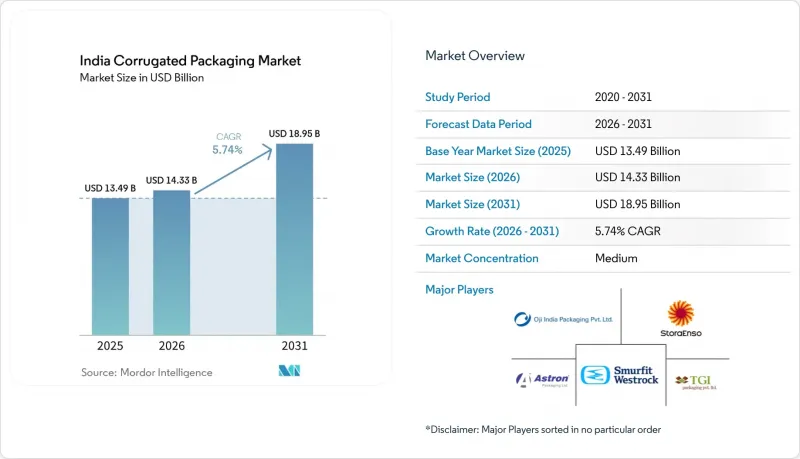
根據 Mordor Intelligence 預測,印度瓦楞紙包裝市場預計將從 2025 年的 134.9 億美元成長到 2026 年的 143.3 億美元,到 2031 年達到 189.5 億美元,2026 年至 2031 年的複合年成長率為 5.74%。
本報告依材料(原生牛皮箱紙板、再生紙板等)、瓦楞類型(A型瓦楞、B型瓦楞等)、包裝類型(普通開槽紙盒等)、壁厚結構(單層、雙層等)、印刷技術(柔版印刷等)和終端用戶行業(加工食品等)進行分類。市場預測以美元計價。
印度瓦楞紙板包裝市場的趨勢與洞察
加速電子商務物流
到2025年,快消企業被迫將配送時間縮短至10-15分鐘,並採用「暗店」佈局,即使用可直接上架的紙板箱,這些紙板箱同時也能作為展示品。亞馬遜印度擁有超過60個履約中心,並正在每個中心統一紙板尺寸,以便與機械臂配合使用,這推動了對精度為±1毫米的高精度模切的需求。 Flipkart的擴增實境(AR)店面計畫也導致膠印貼合加工郵寄包裝的需求激增,因為精美的包裝能夠提高行動端產品頁面的轉換率。除了這些設計上的轉變,各大平台也強制要求包裝的抗破強度比BIS IS 2771標準高出15%,以最大限度地減少雨季的退貨。這迫使加工商將再生襯紙板與進口長纖維牛皮紙混合使用,以確保包裝的抗壓強度。這些因素共同加速了向高速柔版折疊黏合機和單一途徑印刷機的升級換代,使得在幾分鐘內即可更換圖稿而無需停止生產線。
擴大加工食品和飲料的出口
印度加工食品出口預計在2024-2025會計年度達到87億美元,其中約40%的包裝成本用於瓦楞紙板二次包裝。透氣性良好的芒果和葡萄瓦楞紙箱,內襯防潮膜,現已滿足歐洲超級市場超市對海運21天保存期限的要求,從而推動了對覆有可生物分解澱粉膜的三層瓦楞紙箱的需求。旁遮普邦一家巴斯馬蒂米出口商透過將包裝方式從黃麻袋改為托盤式瓦楞紙箱,降低了12個百分點的破損率,使其產品能夠透過在英國超級市場獲得A級貨架的優質定價。在飲料業,隨著北方邦放寬對小規模釀酒廠的監管,精釀烈酒出口激增。符合美國菸酒稅貿易局(TTB)標籤標準的六瓶裝膠印貼合加工已從小眾產品轉變為標準SKU。
再生紙價格波動
2025年初,舊瓦楞紙板箱的進口價格年增18%,但隨後由於中國需求放緩而趨於穩定,導致持有45-60天原料庫存的加工商利潤率出現劇烈波動。國內回收依賴非正式的廢棄物回收代理商網路,缺乏透明的現貨定價,迫使北方邦和比哈爾邦的加工商支付溢價,削弱了再生纖維的成本優勢。 2024年,印度貿易救濟總局設定的原生箱板紙最低進口價格上限縮小了再生紙和原生紙之間的價格差距,進一步加劇了無法透過期貨合約對沖舊瓦楞紙板成本的造紙企業的壓力。大型企業正在採取措施,例如與市政回收代理商簽訂多年供應契約,並在主要消費中心設立包裝站,但只有一台瓦楞紙板生產機的小規模企業缺乏這種議價能力。在印度正式建立 OCC 交易所交易基準之前,印度瓦楞紙包裝市場可能會經歷週期性的價格衝擊,從而在供需緊張時期阻礙產能擴張。
細分市場分析
到2025年,再生瓦楞紙板將佔印度瓦楞包裝市場佔有率的46.68%,凸顯了再生纖維在實現電商和快速消費品紙盒成本目標方面的重要作用。半化學瓦楞紙板是成長最快的基材,複合年成長率達7.48%,吸引了電子組裝製造商的關注,他們需要更輕的內襯以通過跌落測試,同時又不超出空運貨物的重量限制。原生牛皮紙在出口米、酒類和智慧型手機包裝盒領域佔據著一定的市場佔有率,這些產品必須帶有FSC認證標誌,這支撐了北美漂白軟木牛皮紙的進口,儘管國內價格設有上限。其他特殊等級的瓦楞紙板,例如防潮內襯,則被面臨冷藏集裝箱冷凝問題的冷凍水產品出口商所使用,加工商通常會向這類產品收取12-15%的溢價。
隨著2024年《森林保護法》解除對劣化土地上農業和林業的禁令,以及一項旨在減少12億美元紙漿進口的政策訂定,政策發展可能會重塑印度瓦楞紙板包裝市場對原生紙漿的需求。 Astron Packaging公司位於浦那、投資9000萬美元的工廠計劃於2025年8月投產,其建設基於這樣的預期:再生箱板紙仍將是其大規模生產的核心,而進口牛皮紙將繼續用於生產高階產品。對麥秸和甘蔗渣紙漿的測試表明,未來原料來源可能進一步擴大,但由於纖維品質的差異,商業化生產仍然有限。隨著造紙廠改進脫墨製程和水循環利用系統以降低資源消耗強度,再生紙漿將在印度瓦楞紙板包裝市場進一步鞏固其地位。
到2025年,B型瓦楞紙板將佔出貨量的41.37%,其3.2毫米的厚度使其在通用運輸箱中兼顧了緩衝性和可印刷面積,因此備受青睞。 E型瓦楞紙板預計將以6.93%的複合年成長率成長,隨著智慧型手機、製藥和化妝品品牌採用更薄的瓦楞結構以提高托盤裝載密度並符合ISTA 3A測試標準,其在印度瓦楞包裝市場的佔有率有望擴大。 C型瓦楞紙板在承重能力超過1000公斤的重型零件和瓷磚領域仍佔有穩固的地位。 A型瓦楞紙板和F型瓦楞紙板則佔據著截然不同的細分市場:A型瓦楞紙板由於其較高的緩衝性能,常用於易碎玻璃製品;而F型瓦楞紙板由於其超薄的特性,則常用於高階禮品包裝。
2025年3月,王子印度公司在其斯里城工廠引進了一台高速瓦楞紙板生產線,該生產線可在E型瓦楞和F型瓦楞之間切換,使其能夠為需要±0.5毫米厚度精度控制的電子產品OEM廠商供貨。同時,電商平台對尺寸的限制使得笨重的C型瓦楞紙箱處於劣勢,進一步加速了印度瓦楞包裝市場材料減薄的趨勢。為了滿足更薄瓦楞的品質標準,企業正在增加對黏合劑控制、紙板檢測和自動化開槽等技術的投資,這對於大規模加工商而言比仍然依賴手工黏合製程的小規模工廠更具優勢。
其他好處:
- Excel格式的市場預測(ME)表
- 3個月的分析師支持
目錄
第1章:引言
- 研究假設和市場定義
- 調查範圍
第2章:調查方法
第3章執行摘要
第4章 市場狀況
- 市場概覽
- 市場促進因素
- 加速電子商務物流
- 加工食品和飲料出口成長
- 監理政策轉向可回收包裝
- 近岸外包主導的電子產品生產
- 精釀啤酒廠對客製化包裝盒的需求
- 政府對生物基阻隔塗料的補貼
- 市場限制因素
- 再生紙價格波動
- 與可回收塑膠箱的競爭
- 麵粉廠缺水造成了許多限制。
- 對進口原生纖維的依賴
- 產業價值鏈分析
- 監理情勢
- 技術展望
- 波特五力分析
第5章 市場規模與成長預測
- 材料
- 維珍工藝襯板
- 再生襯紙板
- 瓦楞紙板底紙
- 半化學法製槽
- 其他材料
- 長笛類型
- 長笛
- 低音長笛
- C調長笛
- E 長笛
- F調長笛
- 按包裝類型
- 普通插槽容器
- 客製化模切盒
- 折疊紙箱
- 商店展示
- 托盤箱
- 其他包裝類型
- 依牆體類型
- 單層
- 雙層壁
- 三層壁
- 一邊
- 透過印刷技術
- 柔版印刷
- 數位噴墨列印
- Riso層壓
- 網版印刷
- 其他印刷技術
- 按最終用戶行業分類
- 加工食品
- 生鮮食品和農產品
- 飲料
- 電器產品
- 個人護理化妝品
- 電子商務履約中心
- 製藥
- 其他終端用戶產業
第6章 競爭情勢
- 市場集中度
- 策略趨勢
- 市佔率分析
- 公司簡介
- Smurfit WestRock plc
- Rengo Co. Ltd.
- Stora Enso Oyj
- B and B Triplewall Containers Ltd.
- Oji India Packaging Pvt. Ltd.
- Horizon Packs Pvt. Ltd.
- TGI Packaging Pvt. Ltd.
- Astron Packaging Ltd.
- Worth Peripherals Ltd.
- JK Packaging Pvt. Ltd.
- Sri Krishna Packaging
- Kanpur Packaging Industries
- Packman Packaging Pvt. Ltd.
第7章 市場機會與未來展望
According to Mordor Intelligence, the india corrugated packaging market size is expected to increase from USD 13.49 billion in 2025 to USD 14.33 billion in 2026 and reach USD 18.95 billion by 2031, growing at a CAGR of 5.74% over 2026-2031.
This report is Segmented by Material (Virgin Kraft Linerboard, Recycled Linerboard, and More), Flute Type (A Flute, B Flute, and More), Packaging Type (Regular Slotted Containers, and More), Wall Type (Single-Wall, Double-Wall, and More), Printing Technology (Flexographic Printing, and More), End-User Industry (Processed Foods, and More). The Market Forecasts are Provided in Terms of Value (USD).
India Corrugated Packaging Market Trends and Insights
Rising E-Commerce Logistics Acceleration
Quick-commerce operators cut delivery windows to 10-15 minutes in 2025, forcing dark-store layouts that rely on shelf-ready corrugated totes doubling as display units. Amazon India surpassed 60 fulfillment centers, each standardizing corrugate footprints to mesh with robotic arms, which raised demand for high-precision die-cuts with +-1 mm tolerances. Flipkart's augmented-reality storefront initiative triggered a spike in litho-laminated mailers, as photogenic packaging boosts conversion on mobile product pages. Parallel to these design shifts, leading platforms mandated burst strengths 15% above BIS IS 2771 to minimize monsoon-season returns, compelling converters to blend recycled linerboard with imported long-fiber kraft for edge-crush stability. Together, these pressures accelerate upgrade cycles toward high-speed flexo-folder-gluers and single-pass digital presses that can swap artwork in minutes without halting lines.
Growth in Processed Food and Beverage Exports
India's processed food exports climbed to USD 8.7 billion in FY 2024-25, channeling roughly 40% of packaging spend into corrugated secondary formats. Ventilated mango and grape cartons with moisture-barrier liners now meet 21-day sea-freight shelf-life targets for European grocery chains, amplifying demand for triple-wall boxes coated with biodegradable starch films. Punjab basmati shippers achieved a 12-point reduction in breakage after switching from jute sacks to palletized corrugated bins, unlocking A-grade shelf placement premiums in UK supermarkets. On the beverage side, craft spirit exports surged once Uttar Pradesh relaxed micro-distillery rules; litho-laminated six-packs that conform to U.S. TTB labeling moved from a niche to a baseline SKU.
Recycled Paper Price Volatility
Old Corrugated Containers import prices climbed 18% year-on-year in early 2025 and then eased as Chinese demand softened, creating margin whiplash for converters that carry 45-60 days of feedstock inventory. Domestic collection relies on informal waste-picker networks that lack transparent spot pricing, so converters in Uttar Pradesh and Bihar often pay premiums that erode the recycled-fiber cost advantage. The Directorate General of Trade Remedies' 2024 minimum-import-price floor on virgin linerboard narrowed the spread between recycled and virgin grades, further squeezing mills that cannot hedge OCC costs through futures contracts. Larger players have responded by signing multi-year supply pacts with municipal aggregators and by co-locating baling stations at major consumption hubs, but small single-corrugator firms lack that bargaining power. Until India formalizes an exchange-traded OCC benchmark, the Indian corrugated packaging market will see periodic pricing shocks that discourage capacity expansion during tight cycles.
Other drivers and restraints analyzed in the detailed report include:
- Regulatory Shift Toward Recyclable Packaging
- Nearshoring-Led Electronics Output
- Competition from Returnable Plastic Crates
For complete list of drivers and restraints, kindly check the Table Of Contents.
Segment Analysis
Recycled linerboard represented 46.68% of the Indian corrugated packaging market share in 2025, confirming the role of post-consumer fiber in meeting cost targets for e-commerce and FMCG cartons. Semi-chemical fluting, the fastest-rising substrate at 7.48% CAGR, attracts electronics assemblers that need lighter inserts to pass drop tests without breaching air-freight weight bands. Virgin Kraft retains a niche in export-oriented rice, spirits, and smartphone boxes that must carry FSC logos, keeping imports of northern bleached softwood kraft afloat despite domestic price floors. Other specialty grades, such as moisture-resistant liners, serve frozen seafood exporters that face condensation inside reefers, a segment where converters charge 12-15% premiums.
Policy dynamics could reshape the Indian corrugated packaging market for virgin fiber, as the 2024 Forest Conservation Act opened degraded land to farm forestry, a move intended to trim USD 1.2 billion in pulp imports. Astron Packaging's USD 90 million Pune mill, commissioned in August 2025, bets that recycled linerboard will remain the volume workhorse while premium tiers continue to source imported kraft. Experiments with wheat-straw and bagasse pulps signal an eventual broadening of the feedstock base, though inconsistent fiber quality keeps commercial output limited. As mills upgrade de-inking and water-recycling loops to cut resource intensity, recycled grades are likely to deepen their hold on the India corrugated packaging market.
B flute held 41.37% of 2025 shipments, prized for its 3.2 mm height that balances cushioning and print real estate for general-purpose shipping cases. E flute posted a 6.93% CAGR and is on track to expand its market share in India's corrugated packaging market as smartphone, pharma, and cosmetics brands embrace thinner profiles that enable pallet density gains without failing ISTA 3A tests. C flute remains entrenched in heavy parts and ceramic tiles where stacking loads exceed 1,000 kg. A flute and F flute fill opposite niches, fragile glassware on the high-cushion side and luxury gift packs on the ultra-thin side.
Oji India installed high-speed corrugators that switch between E-flute and F-flute at its Sri City plant in March 2025 to serve electronics OEMs that demand +-0.5 mm caliper control. E-commerce platforms, meanwhile, impose dimensional caps that penalize bulky C flute boxes, reinforcing the material-reduction tilt of the Indian corrugated packaging market. Quality compliance for thinner flutes drives capital upgrades in adhesive control, board inspection, and automatic slotting, favoring large converters over cottage-scale plants that still rely on manual glue stations.
List of Companies Covered in this Report:
- Smurfit WestRock plc
- Rengo Co. Ltd.
- Stora Enso Oyj
- B and B Triplewall Containers Ltd.
- Oji India Packaging Pvt. Ltd.
- Horizon Packs Pvt. Ltd.
- TGI Packaging Pvt. Ltd.
- Astron Packaging Ltd.
- Worth Peripherals Ltd.
- JK Packaging Pvt. Ltd.
- Sri Krishna Packaging
- Kanpur Packaging Industries
- Packman Packaging Pvt. Ltd.
Additional Benefits:
- The market estimate (ME) sheet in Excel format
- 3 months of analyst support
TABLE OF CONTENTS
1 INTRODUCTION
- 1.1 Study Assumptions and Market Definition
- 1.2 Scope of the Study
2 RESEARCH METHODOLOGY
3 EXECUTIVE SUMMARY
4 MARKET LANDSCAPE
- 4.1 Market Overview
- 4.2 Market Drivers
- 4.2.1 Rising E-commerce Logistics Acceleration
- 4.2.2 Growth in Processed Food and Beverage Exports
- 4.2.3 Regulatory Shift Toward Recyclable Packaging
- 4.2.4 Nearshoring-Led Electronics Output
- 4.2.5 Craft-Brewery Demand for Custom Boxes
- 4.2.6 Government Subsidies for Bio-Based Barrier Coatings
- 4.3 Market Restraints
- 4.3.1 Recycled Paper Price Volatility
- 4.3.2 Competition from Returnable Plastic Crates
- 4.3.3 Water-Scarcity Constraints on Mills
- 4.3.4 Dependence on Imported Virgin Fiber
- 4.4 Industry Value Chain Analysis
- 4.5 Regulatory Landscape
- 4.6 Technological Outlook
- 4.7 Porter's Five Forces Analysis
- 4.7.1 Threat of New Entrants
- 4.7.2 Bargaining Power of Suppliers
- 4.7.3 Bargaining Power of Buyers
- 4.7.4 Threat of Substitutes
- 4.7.5 Competitive Rivalry
5 MARKET SIZE AND GROWTH FORECASTS (VALUE)
- 5.1 By Material
- 5.1.1 Virgin Kraft Linerboard
- 5.1.2 Recycled Linerboard
- 5.1.3 Corrugating Medium
- 5.1.4 Semi-Chemical Fluting
- 5.1.5 Other Materials
- 5.2 By Flute Type
- 5.2.1 A Flute
- 5.2.2 B Flute
- 5.2.3 C Flute
- 5.2.4 E Flute
- 5.2.5 F Flute
- 5.3 By Packaging Type
- 5.3.1 Regular Slotted Containers
- 5.3.2 Die-Cut Custom Boxes
- 5.3.3 Folding Cartons
- 5.3.4 Point-of-Purchase Displays
- 5.3.5 Pallet Boxes
- 5.3.6 Other Packaging Types
- 5.4 By Wall Type
- 5.4.1 Single-Wall
- 5.4.2 Double-Wall
- 5.4.3 Triple-Wall
- 5.4.4 Single Face
- 5.5 By Printing Technology
- 5.5.1 Flexographic Printing
- 5.5.2 Digital Inkjet Printing
- 5.5.3 Litho-Lamination
- 5.5.4 Screen Printing
- 5.5.5 Other Printing Technologies
- 5.6 By End-User Industry
- 5.6.1 Processed Foods
- 5.6.2 Fresh Food and Produce
- 5.6.3 Beverages
- 5.6.4 Electrical Products
- 5.6.5 Personal Care and Cosmetics
- 5.6.6 E-commerce Fulfillment Centers
- 5.6.7 Pharmaceuticals
- 5.6.8 Other End-User Industries
6 COMPETITIVE LANDSCAPE
- 6.1 Market Concentration
- 6.2 Strategic Moves
- 6.3 Market Share Analysis
- 6.4 Company Profiles (includes Global level Overview, Market level overview, Core Segments, Financials as available, Strategic Information, Market Rank/Share for key companies, Products and Services, and Recent Developments)
- 6.4.1 Smurfit WestRock plc
- 6.4.2 Rengo Co. Ltd.
- 6.4.3 Stora Enso Oyj
- 6.4.4 B and B Triplewall Containers Ltd.
- 6.4.5 Oji India Packaging Pvt. Ltd.
- 6.4.6 Horizon Packs Pvt. Ltd.
- 6.4.7 TGI Packaging Pvt. Ltd.
- 6.4.8 Astron Packaging Ltd.
- 6.4.9 Worth Peripherals Ltd.
- 6.4.10 JK Packaging Pvt. Ltd.
- 6.4.11 Sri Krishna Packaging
- 6.4.12 Kanpur Packaging Industries
- 6.4.13 Packman Packaging Pvt. Ltd.
7 MARKET OPPORTUNITIES AND FUTURE OUTLOOK
- 7.1 White-Space and Unmet-Need Assessment

 南美瓦楞紙包裝市場:市場佔有率分析、產業趨勢與統計及成長預測(2026-2031 年)菲律賓瓦楞紙包裝市場:市場佔有率分析、產業趨勢與統計及成長預測(2026-2031)中國瓦楞紙板包裝市場:市場佔有率分析、產業趨勢與統計及成長預測(2026-2031年)
 瓦楞紙板包裝市場:商業機會、成長要素、產業趨勢分析及 2026-2035 年預測。美國瓦楞紙包裝:市場佔有率分析、行業趨勢和統計數據、成長預測(2026-2031 年)亞太地區瓦楞紙包裝:市佔率分析、產業趨勢與統計及成長預測(2026-2031)歐洲瓦楞紙板包裝:市場佔有率分析、行業趨勢和統計數據以及成長預測(2026-2031 年)印尼瓦楞紙包裝市場:市場佔有率分析、產業趨勢與統計及成長預測(2026-2031)新加坡瓦楞紙包裝市場:市佔率分析、產業趨勢與統計、成長預測(2026-2031)日本瓦楞紙板包裝市場:市佔率分析、產業趨勢與統計及成長預測(2026-2031年)