


 |
市場調查報告書
商品編碼
2063482
新加坡瓦楞紙包裝市場:市佔率分析、產業趨勢與統計、成長預測(2026-2031)Singapore Corrugated Packaging - Market Share Analysis, Industry Trends & Statistics, Growth Forecasts (2026 - 2031) |
||||||

※ 本網頁內容可能與最新版本有所差異。詳細情況請與我們聯繫。
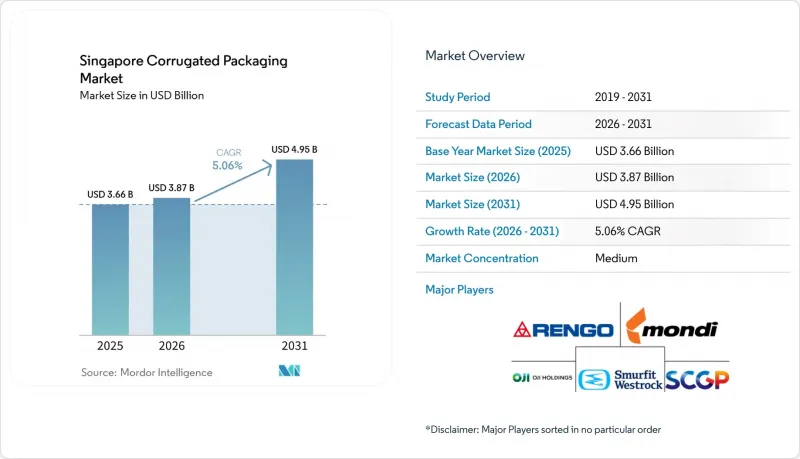
據 Mordor Intelligence 稱,新加坡瓦楞紙包裝市場在 2025 年的價值為 36.6 億美元,預計將從 2026 年的 38.7 億美元成長到 2031 年的 49.5 億美元,2026 年至 2031 年的複合年成長率為 5.06%。
本報告依材料(原生牛皮箱紙板、再生紙板、瓦楞紙核心材料等)、瓦楞類型(A型瓦楞等)、包裝類型(普通開槽紙盒等)、壁厚結構(單層、雙層等)、印刷技術(柔版印刷等)和終端用戶行業(加工食品等)進行細分。市場預測以美元計價。
新加坡瓦楞紙板包裝市場趨勢與洞察
電子商務的快速發展帶動了對瓦楞紙箱的需求。
新加坡的小包裹日處理量已超過過去十年來的最高水平,各大電商平台強烈要求使用可回收的纖維包裝袋,以吸引都市區消費者。新加坡郵政斥資1.82億新元(約1.39億美元)興建的設施以及包括馬士基佔地110萬平方英尺的「世界門戶二期」在內的新型自動化樞紐,每天可分揀10萬個小包裹,進一步鞏固了對尺寸穩定的瓦楞紙箱的需求。因此,瓦楞紙箱已成為高速輸送機系統中的標準選擇,因為在這些系統中,薄膜撕裂或尺寸誤差的風險是不可接受的。能夠生產高精度窄瓦楞紙箱的加工商正在贏得大規模電商合約。儘管新加坡能源成本高昂,但訂單狀態的高度可視性使得多品種生產的高效調度成為可能。
政府推動循環經濟
「包裝報告強制令」要求年銷售額超過1,000萬新元(765萬美元)的公司詳細報告其包裝材料對環境的影響,從而有效懲罰過度使用塑膠的行為。 「飲料容器回收計畫」進一步強化了這種互惠互利的概念,鼓勵品牌採用易於回收的包裝。技術標準109提供了一個通用的可回收性指數,使採購團隊能夠比較和評估供應商的纖維含量。透過採用這些指南,加工商可以獲得經認證的瓦楞紙板的溢價,這些紙板還能為下游回收贏得積分。鑑於監管機構的目標是到2026年將廢棄物掩埋量減少20%,市場需求正迅速轉向紙包裝,而紙質包裝本身就具有很高的回收率。
轉換器面臨的房地產和公用事業成本上漲
由於裕廊集團(JTC)續租,工業租金居高不下,擠壓了集中在大士和樟宜附近的中型瓦楞紙板製造商的利潤空間。新加坡能源集團(SP Group)宣布2026年第二季升息2.1%,進一步推高了本已因新加坡依賴進口天然氣而飆升的投入成本。大型企業正透過安裝屋頂太陽能發電系統和簽訂多年能源供應合約來規避風險,從而獲得結構性的成本優勢。而無法攤銷自動化成本的小規模工廠則難以在大型訂單的競標中脫穎而出。這些壓力正在推動企業併購,達盛集團(Tat Seng)以587萬美元收購聯合包裝工業(United Packaging Industries)就是一個典型的例子。
細分市場分析
由於再生牛皮箱紙板預計將以6.13%的複合年成長率成長至2031年,以提升品牌在貨架上的形象。高階基材的廣泛應用正穩步擴大新加坡瓦楞包裝市場高附加價值產品的規模,使加工商有機會在滿足食品接觸和醫療可追溯性等國際監管要求的同時,獲得更高的利潤率。因此,能夠在同一生產過程中靈活切換再生纖維和原生纖維的加工商對跨國買家更具吸引力,因為他們無需因切換纖維而增加停機時間,即可覆蓋多樣化的產品系列。
採用原生牛皮紙符合新加坡致力於成為永續、高性能包裝區域設計實驗室的願景,同時與下游押金返還物流系統保持一致。為新加坡供貨的造紙商正積極回應,採用輕質而堅固的配方,從而實現貨櫃重量兩位數的降低,進而減少空運和海運的貨物排放。更光滑的表面使高清噴墨印刷成為可能,品牌經理可以將裝飾性折疊盒專案過渡到瓦楞紙板包裝,而不會影響視覺效果。最終,即使出貨量成長放緩,對原生牛皮紙需求的持續成長仍能提升收入,保護加工商免受再生纖維成本波動的影響,並支持新加坡瓦楞紙包裝市場的長期穩定。
B型瓦楞紙板仍是新加坡瓦楞包裝市場的主導產品,預計到2025年將佔新加坡瓦楞包裝市場出貨量的37.74%。這是因為其3毫米的厚度在用於履約中心的瓦楞紙箱中,兼顧了緩衝性、覆膜性和成本效益。然而,零售商和宅配業者擴大選擇0.8毫米厚的F型瓦楞紙板,以降低體積重量費用,並允許零售包裝箱在貨架上更緊湊地存放,預計到2031年,F型瓦楞紙板的複合年成長率將達到6.91%。隨著圖形需求的成長,F型瓦楞紙板光滑的表面可以實現單一途徑噴墨列印而不會出現波紋狀變形,從而提升個人保健產品和消費電子產品包裝的展示效果。投資伺服控制瓦楞紙板生產線的加工商現在可以在10分鐘內更換瓦楞形狀,從而在滿足不同客戶規格的同時,保持機器的運轉率。
隨著F型瓦楞紙板的普及,新加坡瓦楞紙板包裝市場(包括數位印刷油墨和用於確保不同SKU顏色一致性的偵測系統)也不斷擴大。小批量生產避免了柔版印刷特有的製版成本,使品牌能夠靈活地測試季節性設計,並與網紅進行聯合品牌推廣。同時,B型瓦楞紙板在食品飲料物流領域保持著主導地位,該領域對托盤穩定性的重視程度高於展示美觀,從而為箱板紙供應商帶來了可觀的銷售。兩種瓦楞類型的共存使得加工商能夠靈活調整定價結構,對需要高印刷效果的微型瓦楞紙板產品設定溢價,同時對用於區域內再出口的通用紙箱保持規模經濟效益。
其他好處:
- Excel格式的市場預測(ME)表
- 3個月的分析師支持
目錄
第1章:引言
- 研究假設和市場定義
- 調查範圍
第2章:調查方法
第3章執行摘要
第4章 市場狀況
- 市場概覽
- 市場促進因素
- 電子商務的快速發展帶動了對瓦楞紙箱的需求。
- 政府推動循環經濟
- 新加坡加工食品出口正在成長。
- 零售商正在加快採用即用型包裝。
- 本地轉換器自動化投資
- 對永續二次包裝的需求日益成長
- 市場限制因素
- 轉換器的高昂房地產和公用事業成本
- 對再生纖維進口限制的波動
- 與柔軟性塑膠容器爭奪生鮮食品市場
- 國內木漿資源短缺
- 產業價值鏈分析
- 監理情勢
- 技術展望
- 波特五力分析
- 宏觀經濟因素對市場的影響
第5章 市場規模與成長預測
- 材料
- 維珍工藝襯板
- 再生襯紙板
- 瓦楞紙板底紙
- 半化學法製槽
- 其他材料
- 長笛類型
- 長笛
- 低音長笛
- C調長笛
- E 長笛
- F調長笛
- 按包裝類型
- 普通插槽容器
- 客製化模切盒
- 折疊紙箱
- 商店展示
- 托盤箱
- 其他包裝類型
- 依牆體類型
- 單層
- 雙層壁
- 三層壁
- 一邊
- 透過印刷技術
- 柔版印刷
- 數位噴墨列印
- Riso層壓
- 網版印刷
- 其他印刷技術
- 按最終用戶行業分類
- 加工食品
- 生鮮食品和農產品
- 飲料
- 電器產品
- 個人護理化妝品
- 電子商務履約中心
- 製藥
- 其他終端用戶產業
第6章 競爭情勢
- 市場集中度
- 策略趨勢
- 市佔率分析
- 公司簡介
- Smurfit Westrock plc
- Mondi Plc
- Oji Holdings Corporation
- SCG Packaging Public Company Limited
- Rengo Co., Ltd.
- International Paper Company
- Asia Pulp & Paper Co., Ltd.
- Nine Dragons Paper Holdings Limited
- Tat Seng Packaging Group Ltd.
- Greatprint Packaging Pte Ltd.
- Pacrimex Packaging Pte Ltd.
- Lee & Man Paper Manufacturing Ltd.
- New Toyo International Holdings Ltd.
- Orora Limited
- Visy Industries Holdings Pty Ltd.
- Sonoco Products Company
第7章 市場機會與未來展望
According to Mordor Intelligence, the singapore corrugated packaging market size was valued at USD 3.66 billion in 2025 and is expected to rise from USD 3.87 billion in 2026 to USD 4.95 billion by 2031, recording a 5.06% CAGR between 2026 and 2031.
This report is Segmented by Material (Virgin Kraft Linerboard, Recycled Linerboard, Corrugating Medium, and More), Flute Type (A Flute, and More), Packaging Type (Regular Slotted Containers, and More), Wall Type (Single, Double, and More), Printing Technology (Flexographic, and More), and End-User Industry (Processed Foods, and More). The Market Forecasts are Provided in Terms of Value (USD).
Singapore Corrugated Packaging Market Trends and Insights
E-Commerce Boom Driving Corrugated Box Demand
Daily parcel volumes now exceed prior decade highs, and leading marketplaces insist on fiber mailers that signal recyclability to urban consumers. New automated hubs, including SingPost's SGD 182 million (USD 139 million) facility and Maersk's 1.1 million ft2 World Gateway II, each sort 100,000 parcels daily, entrenching demand for dimensionally stable cartons. Corrugated therefore becomes the default for high-speed conveyor systems that cannot risk film tears or dimensional variance. Converters capable of producing narrow flute boxes at tight tolerances win the largest e-commerce contracts. Robust order visibility lets them schedule multi-grade runs efficiently despite Singapore's high energy tariffs.
Government Push Toward a Circular Economy
Mandatory Packaging Reporting requires companies with a turnover above SGD 10 million (USD 7.65 million) to detail their material footprints, effectively penalizing excessive plastic use. The Beverage Container Return Scheme extends the payback logic, encouraging brands to adopt packaging that is easily recyclable. Technical Reference 109 provides common recyclability metrics, enabling procurement teams to benchmark suppliers on fiber content. Integrating such guidelines, converters secure price premiums for certified corrugated that earn downstream recycling credits. As regulators target a 20% cut in waste sent to landfill by 2026, demand shifts decisively toward paper-based formats that already enjoy strong collection rates.
High Real-Estate and Utility Costs for Converters
JTC lease renewals keep industrial rents elevated, compressing margins for mid-sized corrugators clustered around Tuas and Changi. SP Group's 2.1% tariff increase in Q2 2026 further magnifies input costs, already elevated by Singapore's reliance on imported natural gas. Larger players hedge with rooftop solar arrays and multiyear energy contracts, securing a structural cost advantage. Smaller plants that are unable to amortize automation costs struggle to compete on high-volume tenders. These pressures catalyze mergers, exemplified by Tat Seng's recent USD 5.87 million acquisition of United Packaging Industries.
Other drivers and restraints analyzed in the detailed report include:
- Growth in Singapore's Food Processing Exports
- Accelerating Adoption of Shelf-Ready Packaging by Retailers
- Volatility in Recycled Fiber Import Regulations
For complete list of drivers and restraints, kindly check the Table Of Contents.
Segment Analysis
Recycled linerboard secured 45.71% of Singapore's corrugated packaging market share in 2025 because it aligns with strict circular-economy goals and offers a clear unit-cost edge for mass-volume shippers. Virgin Kraft linerboard, however, is projected to grow at a 6.13% CAGR through 2031 as pharmaceutical, electronics, and luxury-food exporters demand superior burst strength and pristine print surfaces that elevate brand perception at the shelf. This surge in premium substrate adoption steadily enlarges the Singapore corrugated packaging market size within value-added grades, giving converters opportunities to command higher margins while meeting overseas regulatory requirements for food contact and medical traceability. Converters that can hot-swap between recovered and virgin fibers during the same production run, therefore capture mixed portfolios without increasing changeover downtime, reinforcing their appeal to multinational buyers.
Virgin Kraft uptake also dovetails with Singapore's ambition to serve as a regional design lab for sustainable, high-performance packaging that still aligns with downstream deposit-return logistics. Mills serving the city-state have responded by introducing lightweight yet high-stiffness formulations that trim container weight by double-digit percentages, which subsequently reduces freight emissions on air and sea lanes. Enhanced surface smoothness supports high-definition inkjet graphics, allowing brand managers to shift decorative folding-carton programs onto corrugated without visual compromise. Ultimately, sustained virgin kraft gains lift revenue even when tonnage growth moderates, buffering converters against recycled-fiber cost volatility and underpinning long-term stability in the Singapore corrugated packaging market.
B flute remained the workhorse with 37.74% share of Singapore corrugated packaging market shipments in 2025 because its 3-millimeter profile balances cushioning, stacking, and economics for fulfillment-center cartons. Retailers and parcel carriers, however, increasingly specify 0.8-millimeter F flute to lower dimensional-weight charges and to nest retail cases tightly on shelf, which accelerates its 6.91% CAGR outlook through 2031. As graphics expectations climb, F flute's fine surface accepts single-pass inkjet printing without washboarding, enhancing shelf appeal for personal-care and consumer-electronics packages. Converters investing in servo-controlled corrugators can now switch flute profiles in under ten minutes, preserving machine utilization while satisfying diverse customer specifications.
Rising F flute penetration simultaneously expands the Singapore corrugated packaging market size for digital printing inks and inspection systems that guarantee color consistency across SKU variants. Brands gain agility to test seasonal artwork or influencer co-branding because small production lots avoid plate-making costs inherent to flexography. Meanwhile, B flute maintains dominance in food and beverage logistics where pallet stability outweighs shelf aesthetics, preserving volume critical mass for linerboard suppliers. The coexistence of both flute styles lets converters segment price architecture, charging premiums for high-graphic micro flute runs while protecting scale on commodity boxes destined for regional re-export.
List of Companies Covered in this Report:
- Smurfit Westrock plc
- Mondi Plc
- Oji Holdings Corporation
- SCG Packaging Public Company Limited
- Rengo Co., Ltd.
- International Paper Company
- Asia Pulp & Paper Co., Ltd.
- Nine Dragons Paper Holdings Limited
- Tat Seng Packaging Group Ltd.
- Greatprint Packaging Pte Ltd.
- Pacrimex Packaging Pte Ltd.
- Lee & Man Paper Manufacturing Ltd.
- New Toyo International Holdings Ltd.
- Orora Limited
- Visy Industries Holdings Pty Ltd.
- Sonoco Products Company
Additional Benefits:
- The market estimate (ME) sheet in Excel format
- 3 months of analyst support
TABLE OF CONTENTS
1 INTRODUCTION
- 1.1 Study Assumptions and Market Definition
- 1.2 Scope of the Study
2 RESEARCH METHODOLOGY
3 EXECUTIVE SUMMARY
4 MARKET LANDSCAPE
- 4.1 Market Overview
- 4.2 Market Drivers
- 4.2.1 E-commerce Boom Driving Corrugated Box Demand
- 4.2.2 Government Push Toward a Circular Economy
- 4.2.3 Growth in Singapore's Food Processing Exports
- 4.2.4 Accelerating Adoption of Shelf-Ready Packaging by Retailers
- 4.2.5 Automation Investments by Local Converters
- 4.2.6 Rising Demand for Sustainable Secondary Packaging
- 4.3 Market Restraints
- 4.3.1 High Real-Estate and Utility Costs for Converters
- 4.3.2 Volatility in Recycled Fiber Import Regulations
- 4.3.3 Competition From Flexible Plastic Formats in Fresh Produce
- 4.3.4 Limited Domestic Wood Pulp Resources
- 4.4 Industry Value Chain Analysis
- 4.5 Regulatory Landscape
- 4.6 Technological Outlook
- 4.7 Porter's Five Forces Analysis
- 4.7.1 Bargaining Power of Buyers
- 4.7.2 Bargaining Power of Suppliers
- 4.7.3 Threat of New Entrants
- 4.7.4 Threat of Substitutes
- 4.7.5 Competitive Rivalry
- 4.8 Impact of Macroeconomic Factors on the Market
5 MARKET SIZE AND GROWTH FORECASTS (VALUE)
- 5.1 By Material
- 5.1.1 Virgin Kraft Linerboard
- 5.1.2 Recycled Linerboard
- 5.1.3 Corrugating Medium
- 5.1.4 Semi-Chemical Fluting
- 5.1.5 Other Materials
- 5.2 By Flute Type
- 5.2.1 A Flute
- 5.2.2 B Flute
- 5.2.3 C Flute
- 5.2.4 E Flute
- 5.2.5 F Flute
- 5.3 By Packaging Type
- 5.3.1 Regular Slotted Containers
- 5.3.2 Die-Cut Custom Boxes
- 5.3.3 Folding Cartons
- 5.3.4 Point-of-Purchase Displays
- 5.3.5 Pallet Boxes
- 5.3.6 Other Packaging Types
- 5.4 By Wall Type
- 5.4.1 Single-Wall
- 5.4.2 Double-Wall
- 5.4.3 Triple-Wall
- 5.4.4 Single Face
- 5.5 By Printing Technology
- 5.5.1 Flexographic Printing
- 5.5.2 Digital Inkjet Printing
- 5.5.3 Litho-Lamination
- 5.5.4 Screen Printing
- 5.5.5 Other Printing Technologies
- 5.6 By End-User Industry
- 5.6.1 Processed Foods
- 5.6.2 Fresh Food and Produce
- 5.6.3 Beverages
- 5.6.4 Electrical Products
- 5.6.5 Personal Care and Cosmetics
- 5.6.6 E-Commerce Fulfillment Centers
- 5.6.7 Pharmaceuticals
- 5.6.8 Other End-User Industries
6 COMPETITIVE LANDSCAPE
- 6.1 Market Concentration
- 6.2 Strategic Moves
- 6.3 Market Share Analysis
- 6.4 Company Profiles (includes Global Level Overview, Market Level Overview, Core Segments, Financials as available, Strategic Information, Market Rank/Share, Products and Services, Recent Developments)
- 6.4.1 Smurfit Westrock plc
- 6.4.2 Mondi Plc
- 6.4.3 Oji Holdings Corporation
- 6.4.4 SCG Packaging Public Company Limited
- 6.4.5 Rengo Co., Ltd.
- 6.4.6 International Paper Company
- 6.4.7 Asia Pulp & Paper Co., Ltd.
- 6.4.8 Nine Dragons Paper Holdings Limited
- 6.4.9 Tat Seng Packaging Group Ltd.
- 6.4.10 Greatprint Packaging Pte Ltd.
- 6.4.11 Pacrimex Packaging Pte Ltd.
- 6.4.12 Lee & Man Paper Manufacturing Ltd.
- 6.4.13 New Toyo International Holdings Ltd.
- 6.4.14 Orora Limited
- 6.4.15 Visy Industries Holdings Pty Ltd.
- 6.4.16 Sonoco Products Company
7 MARKET OPPORTUNITIES AND FUTURE OUTLOOK
- 7.1 White-Space and Unmet-Need Assessment

 南美瓦楞紙包裝市場:市場佔有率分析、產業趨勢與統計及成長預測(2026-2031 年)菲律賓瓦楞紙包裝市場:市場佔有率分析、產業趨勢與統計及成長預測(2026-2031)中國瓦楞紙板包裝市場:市場佔有率分析、產業趨勢與統計及成長預測(2026-2031年)
 瓦楞紙板包裝市場:商業機會、成長要素、產業趨勢分析及 2026-2035 年預測。美國瓦楞紙包裝:市場佔有率分析、行業趨勢和統計數據、成長預測(2026-2031 年)亞太地區瓦楞紙包裝:市佔率分析、產業趨勢與統計及成長預測(2026-2031)歐洲瓦楞紙板包裝:市場佔有率分析、行業趨勢和統計數據以及成長預測(2026-2031 年)印尼瓦楞紙包裝市場:市場佔有率分析、產業趨勢與統計及成長預測(2026-2031)印度瓦楞紙包裝市場:市場佔有率分析、產業趨勢與統計及成長預測(2026-2031)日本瓦楞紙板包裝市場:市佔率分析、產業趨勢與統計及成長預測(2026-2031年)