


 |
市場調查報告書
商品編碼
2063307
德國貨運代理服務:市場佔有率分析、行業趨勢和統計數據以及成長預測(2026-2031 年)Germany Freight Brokerage Services - Market Share Analysis, Industry Trends & Statistics, Growth Forecasts (2026 - 2031) |
||||||

※ 本網頁內容可能與最新版本有所差異。詳細情況請與我們聯繫。
根據 Mordor Intelligence 預測,德國貨運代理服務市場規模預計將在 2025 年達到 26.1 億美元,2026 年達到 27.9 億美元,到 2031 年達到 38.2 億美元,2026 年至 2031 年的複合年成長率為 6.43%。
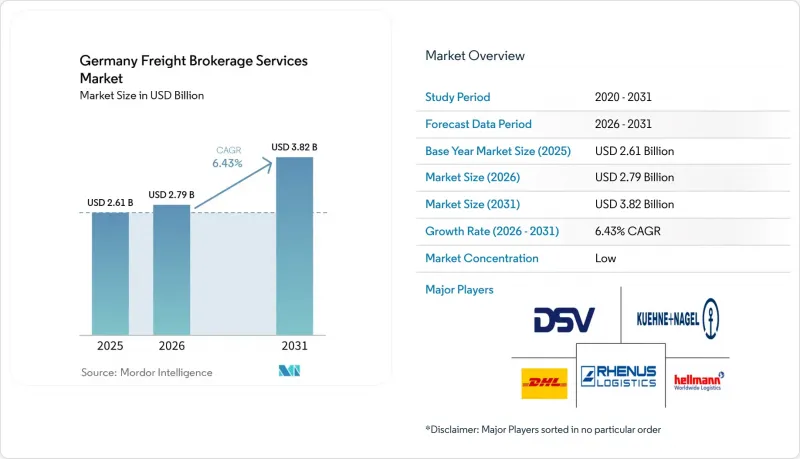
推動需求成長的因素包括:製造商在歐亞大陸拓展多元化貿易路線;托運人對即時貨物可視性的需求;以及聯邦政府維持零排放卡車通行費豁免政策。本報告按服務類型(整車運輸、其他)、車輛/拖車類型(乾貨車、冷藏貨車、其他)、運輸距離(長途、區域、近距離)、經營模式(傳統模式、資產持有模式、其他)、終端用戶行業(製造業/汽車業、其他)以及客戶規模(大型企業、其他)進行細分。市場預測以美元計價。
德國貨運代理服務市場的趨勢與洞察
由於紅海繞行路線的開通,需求增加,貨物經由德國從鐵路轉運到歐亞大陸公路的趨勢正在擴大。
由於海盜風險持續存在,亞歐之間的海運正逐漸轉向歐亞鐵路運輸。預計到2024年,中國與歐盟之間的鐵路貨運量將達到380,434標準箱,年增80.2%。杜伊斯堡和漢堡作為內陸碼頭貨櫃轉運至公路的門戶,為仲介帶來了利潤豐厚且時效性極強的貨物。由於西行鐵路運輸的增加,德國境內的空箱數量減少,也推高了空箱的再利用需求,迫使仲介安排回程傳輸運輸至北海沿岸港口。除非紅海航線的狀況恢復正常,否則仲介至少在2027年之前都可以依靠鐵路主導帶來的這一需求成長,從而在德國貨運代理服務市場開闢新的收入來源。
加大對電動卡車的補貼力度,正在打造新的運輸走廊。
德國已撥款17.4億美元,用於在主要高速公路沿線安裝1410個高功率充電樁。此舉將使純電動卡車每公里的能源成本降低40%,並為仲介提供更多路線選擇。零排放重型車輛的通行費豁免政策已延長至2031年中期,這將降低車輛總擁有成本,並鼓勵中型運輸公司加快更換柴油牽引車。仲介可以利用電動車隊的遠端資訊處理數據,繞過充電樁不足的區域,從而減少停車時間,並憑藉其低碳運輸能力吸引尋求更環保貨物的托運人。 A3、A5和A7高速公路沿線的充電樁叢集已經開始將部分貨物從柴油車道轉移出去。因此,該計劃正在推動德國貨運仲介服務市場的成長,既節省成本,也創造新的賣點。
歐盟流動性方案IV:同工同酬審計推高合規成本
自2026年1月起,德國將對自由業司機實施每小時15.10美元的最低工資標準,這將消除東歐運輸商長期以來享有的25%的工資優勢。目前,仲介正花費更多時間審核薪資單和行車記錄器記錄,否則將面臨嚴厲的處罰。隨著「智慧行車記錄器2」法規的實施,審核範圍將進一步擴大,該法規將於2026年7月起適用於小型貨車。一些小規模仲介為了避免投資合規工具,正在退出跨境運輸路線,這不僅壓縮了仲介的利潤空間,還加劇了運輸能力緊張,並推高了現貨價格。
細分市場分析
2025年,整車運輸(FTL)佔據了德國貨運仲介服務市場73.22%的佔有率。這主要歸功於汽車業和散裝化學品運輸對專用拖車進行按需運輸的依賴。合約路線為托運人提供了可預測的運費,而仲介透過重複運輸獲得了穩定的利潤率。 A4、A6和A9公路沿線的廣泛網路實現了南北之間的當日送達,這對一級供應商而言至關重要。
受電子商務小包裹和小批量工業訂單整合的推動,小批量到大批量(LTL)運輸解決方案預計到2031年將以8.09%的複合年成長率成長。 IDS Logistik與Spedition Kleine的合作,每天為該公司位於Grävenbroich的樞紐帶來800個包裹的配送量,充分展現了碼頭調度API如何將堆場停留時間縮短70%。目前,整合2-10個托盤貨物的仲介正在利用人工智慧最佳化裝載效率並減少空載停留時間,從而提高盈利,並擴大德國零擔貨運代理服務市場的規模。
預計到2025年,乾貨廂型車將佔資本收入的38.41%,主要用於運輸消費品、包裝食品和需要少量特殊處理的工業零件。其高滲透率確保了最廣泛的承運商資源,並維持了現貨價格的競爭。
受疫苗低溫運輸審核和線上食品雜貨銷售成長的推動,冷藏貨車預計將以8.67%的複合年成長率成長。來自西班牙和義大利的季節性水果運輸使得冬季旺季期間,德國冷藏拖車的現貨運費是普通貨車的兩倍。預訂併網停車位上的電動冷藏設備的仲介正獲得碳中和食品零售商的支持,同時柴油額外費用的降低也促進了德國貨運代理服務市場在需要溫控的細分領域的擴張。
其他好處
- Excel格式的市場預測(ME)表
- 3個月的分析師支持
目錄
第1章:引言
- 研究假設和市場定義
- 調查範圍
第2章:調查方法
第3章執行摘要
第4章 市場狀況
- 市場概覽
- 市場促進因素
- 電動卡車補貼的激增為運輸路線開闢了新的可能性。
- 500 家德國大型貨運公司要求採用人工智慧驅動的動態運費設定機制。
- 紅海繞道路線開通後,歐亞大陸鐵路和公路經德國的轉運量增加。
- 為可追蹤包裹設立額外費用
- 中型企業出口條款從FOB轉向DDP,增加了門到門管理仲介服務的需求。
- 聯邦政府的「ETA透明度指令」正在加速API的普及應用。
- 市場限制因素
- 歐盟第四輪人員流動方案:薪資差距審計增加合規負擔
- 針對貨運交易API的網路攻擊導致保險費上漲。
- 北萊茵-威斯特法倫州凍結指定物流樞紐區域限制了交叉轉運業務的擴張。
- 由於電動車和半導體的供需波動,OEM 生產週期出現波動,導致需求預測變得困難。
- 價值供應鏈分析
- 監理情勢
- 技術展望
- 波特五力模型
第5章 市場規模與成長預測
- 按服務
- 全軌道公路(FTL)
- 低於100%的運費(零擔運輸)
- 其他
- 車輛/拖車類型
- 乾燒
- 冷藏車
- 平板/階梯式平板車
- 油輪(散裝液體和化學品)
- 其他
- 按運輸距離
- 長途(500英里或以上)
- 該區域內(100-500英里)
- 近距離(100英里以內)
- 按經營模式
- 傳統的
- 資產持有類型
- 基於代理的
- 數位的
- 按最終用戶行業分類
- 製造業/汽車
- 基礎建設項目
- 石油、天然氣、採礦和化工
- 農業/食品/飲料
- 零售、快速消費品和批發分銷
- 醫療和藥品
- 電子商務與第三方物流履約
- 其他
- 按客戶規模
- 大型企業(年營業額超過1億美元)
- 中型企業(年營業額1000萬美元至1億美元)
- 中小企業(營業額低於1000萬美元)
第6章 競爭情勢
- 市場集中度
- 策略趨勢
- 市佔率分析
- 公司簡介
- DSV A/S(含 DB Schenker)
- DHL Group
- Kuehne+Nagel
- Rhenus Logistics
- Hellmann Worldwide Logistics
- Dachser
- Sennder
- Transporeon
- CH Robinson
- 郵船物流(日本郵船株式會社旗下)
- GEODIS
- Rohlig Logistics
- Emo Trans
- Trucksters
- Fiege Logistics
- Cargoline
- System Alliance Europe
- Carmovia
- Ontruck
- SLYNX
第7章 市場機會與未來展望
According to Mordor Intelligence, the germany freight brokerage services market size is projected to be USD 2.61 billion in 2025, USD 2.79 billion in 2026, and reach USD 3.82 billion by 2031, growing at a CAGR of 6.43% from 2026 to 2031.
Demand expands because manufacturers diversify Eurasian trade routes, shippers chase real-time load visibility, and federal policy keeps toll exemptions for zero-emission trucks. This report is Segmented by Service (Full-Truckload, and More), Equipment/Trailer Type (Dry Van, Refrigerated Van, and More), Haul Length (Long-Haul, Regional, and Local), Business Model (Traditional, Asset-Based, and More), End-User Industry (Manufacturing & Automotive, and More), Customer Size (Large Enterprise, and More). The Market Forecasts are Provided in Terms of Value (USD).
Germany Freight Brokerage Services Market Trends and Insights
Post-Red-Sea Diversion boosting Eurasian Rail-to-Road Trans-loading through Germany
Persistent piracy risk has pushed Asia-Europe ocean cargo toward Eurasian rail, lifting China-EU rail volume to 380,434 TEU in 2024, an 80.2% jump year on year. Duisburg and Hamburg act as gateways where inland terminals shift containers to trucks for final delivery, creating high-margin, time-sensitive loads for brokers. Empty-box repositioning also grows as westbound rail leaves fewer empties in Germany, compelling brokers to organize backhauls to North Sea ports. Unless Red Sea routes normalize, brokers can rely on this rail-driven uplift through at least 2027, embedding new revenue channels in Germany freight brokerage services market operations.
Electrified-Truck Subsidy Wave Unlocking New Capacity Corridors
Germany has allocated USD 1.74 billion for 1,410 high-power chargers along major autobahns, a move that lowers per-kilometer energy cost by 40% for battery trucks and widens lane options for brokers. Toll exemptions for zero-emission heavy vehicles now run to mid-2031, shrinking the total cost of ownership and encouraging mid-sized carriers to replace diesel tractors sooner. Brokers that ingest telematics data from electric fleets can reroute around scarce chargers, cut dwell time, and advertise low-carbon capacity to shippers seeking greener loads. Charging clusters on A3, A5, and A7 already shift volume from diesel lanes. The program therefore delivers both cost savings and new selling points that propel Germany freight brokerage services market growth.
EU Mobility Package IV Wage-Parity Audits Inflating Compliance Overhead
From January 2026, Germany will enforce a USD 15.1 hourly wage floor for posted drivers, erasing the historical 25% rate edge held by Eastern European carriers. Brokers now spend extra hours auditing payroll files and tachograph logs, or risk stiff penalties. Smart Tachograph 2 rules, hitting light vans in July 2026, widen the audit scope. Some small brokers are exiting cross-border lanes rather than funding compliance tools, which tightens capacity and raises spot prices but also crimps broker margins.
Other drivers and restraints analyzed in the detailed report include:
- AI-Based Dynamic Lane-Pricing Demanded by Top 500 German Shippers
- Corporate Scope-3 Emissions Audits Creating Premium for Tracked Loads
- Cyber-Attacks on Freight-Exchange APIs Increasing Insurance Premiums
For complete list of drivers and restraints, kindly check the Table Of Contents.
Segment Analysis
Full-truckload commanded 73.22% of Germany freight brokerage services market share in 2025, as automotive just-in-sequence shipments and bulk chemicals relied on dedicated trailers. Contract lanes give shippers predictable rates, and brokers earn steady margins from repeat volume. Network depth along A4, A6, and A9 supports same-day north-south runs, a critical feature for tier-one suppliers.
Less-than-truckload solutions are projected to grow at an 8.09% CAGR to 2031, supported by e-commerce parcel consolidation and small-batch industrial orders. IDS Logistik's tie-up with Spedition Kleine brings 800 daily deliveries into its Grevenbroich hub, a case that proves how dock-scheduling APIs can cut yard dwell by 70%. Brokers aggregating 2-10-pallet loads now leverage AI to optimize cube and reduce empty miles, lifting yield and enhancing the Germany freight brokerage services market size for LTL operators.
Dry-van trailers held 38.41% of equipment revenue in 2025 because they move consumer goods, packaged foods, and industrial parts with minimal special handling. Their ubiquity ensures the widest carrier pool, which keeps spot quotes competitive.
Refrigerated vans are forecast to expand at an 8.67% CAGR, fueled by cold-chain audits for vaccines and the spread of online grocery. Seasonal fruit runs from Spain and Italy boost Germany-bound reefer spot rates to double dry-van levels during winter peaks. Brokers that pre-book electric reefer units at grid-connected parking bays enjoy lower diesel surcharges and gain loyalty from carbon-conscious food retailers, increasing the size of the German freight brokerage services market captured in the temperature-controlled niche.
List of Companies Covered in this Report:
- DSV A/S (including DB Schenker)
- DHL Group
- Kuehne+Nagel
- Rhenus Logistics
- Hellmann Worldwide Logistics
- Dachser
- Sennder
- Transporeon
- C.H. Robinson
- Yusen Logistics (Part of NYK Line)
- GEODIS
- Rohlig Logistics
- Emo Trans
- Trucksters
- Fiege Logistics
- Cargoline
- System Alliance Europe
- Carmovia
- Ontruck
- SLYNX
Additional Benefits:
- The market estimate (ME) sheet in Excel format
- 3 months of analyst support
TABLE OF CONTENTS
1 Introduction
- 1.1 Study Assumptions and Market Definition
- 1.2 Scope of the Study
2 Research Methodology
3 Executive Summary
4 Market Landscape
- 4.1 Market Overview
- 4.2 Market Drivers
- 4.2.1 Electrified-Truck Subsidy Wave Unlocking New Capacity Corridors
- 4.2.2 AI-Based Dynamic Lane-Pricing Demanded by Top 500 German Shippers
- 4.2.3 Post-Red-Sea Diversion Boosting Eurasian Rail-to-Road Trans-loading through Germany
- 4.2.4 Corporate Scope-3 Emissions Audits Creating Premium for Tracked Loads
- 4.2.5 Shift from FOB to DDP Terms in Mittelstand Exports Raising Brokerage Need for Door-To-Door Control
- 4.2.6 Federal "ETA Transparency Mandate" Accelerating API Adoption
- 4.3 Market Restraints
- 4.3.1 EU Mobility Package IV Wage-Parity Audits Inflating Compliance Overhead
- 4.3.2 Cyber-Attacks on Freight-Exchange APIs Increasing Insurance Premiums
- 4.3.3 Logistic-Hub Zoning Freeze in Nordrhein-Westfalen Limiting Cross-Dock Expansion
- 4.3.4 Volatile OEM Production Cycles (EV and Semiconductor Swings) Driving Demand Unpredictability
- 4.4 Value / Supply-Chain Analysis
- 4.5 Regulatory Landscape
- 4.6 Technological Outlook
- 4.7 Porter's Five Forces
- 4.7.1 Threat of New Entrants
- 4.7.2 Bargaining Power of Buyers
- 4.7.3 Bargaining Power of Suppliers
- 4.7.4 Threat of Substitutes
- 4.7.5 Competitive Rivalry
5 Market Size and Growth Forecasts
- 5.1 By Service
- 5.1.1 Full-Truckload (FTL)
- 5.1.2 Less-than-Truckload (LTL)
- 5.1.3 Others
- 5.2 By Equipment / Trailer Type
- 5.2.1 Dry Van
- 5.2.2 Refrigerated Van
- 5.2.3 Flatbed / Step-Deck
- 5.2.4 Tanker (Bulk Liquid & Chemical)
- 5.2.5 Others
- 5.3 By Haul Length
- 5.3.1 Long-Haul (More than 500 miles)
- 5.3.2 Regional (100-500 miles)
- 5.3.3 Local (Less than 100 miles)
- 5.4 By Business Model
- 5.4.1 Traditional Freight Brokerage
- 5.4.2 Asset-Based Freight Brokerage
- 5.4.3 Agent Model Freight Brokerage
- 5.4.4 Digital Freight Brokerage
- 5.5 By End-User Industry
- 5.5.1 Manufacturing & Automotive
- 5.5.2 Construction & Infrastructure Projects
- 5.5.3 Oil, Gas, Mining & Chemicals
- 5.5.4 Agriculture & Food / Beverage
- 5.5.5 Retail, FMCG & Wholesale Distribution
- 5.5.6 Healthcare & Pharmaceuticals
- 5.5.7 E-commerce & 3PL Fulfilment
- 5.5.8 Other End-User Industry
- 5.6 By Customer Size
- 5.6.1 Large Enterprise Shippers (More than USD 100 M)
- 5.6.2 Mid-Market Shippers (USD 10-100 M)
- 5.6.3 Small Businesses (Less than USD 10 M)
6 Competitive Landscape
- 6.1 Market Concentration
- 6.2 Strategic Moves
- 6.3 Market Share Analysis
- 6.4 Company Profiles (includes Global level Overview, Market level overview, Core Segments, Financials as available, Strategic Information, Market Rank/Share for key companies, Products & Services, and Recent Developments)
- 6.4.1 DSV A/S (including DB Schenker)
- 6.4.2 DHL Group
- 6.4.3 Kuehne+Nagel
- 6.4.4 Rhenus Logistics
- 6.4.5 Hellmann Worldwide Logistics
- 6.4.6 Dachser
- 6.4.7 Sennder
- 6.4.8 Transporeon
- 6.4.9 C.H. Robinson
- 6.4.10 Yusen Logistics (Part of NYK Line)
- 6.4.11 GEODIS
- 6.4.12 Rohlig Logistics
- 6.4.13 Emo Trans
- 6.4.14 Trucksters
- 6.4.15 Fiege Logistics
- 6.4.16 Cargoline
- 6.4.17 System Alliance Europe
- 6.4.18 Carmovia
- 6.4.19 Ontruck
- 6.4.20 SLYNX
7 Market Opportunities and Future Outlook
- 7.1 White-Space and Unmet-Need Assessment

 金融資產中介服務市場規模、佔有率和成長分析:按資產類型、服務類型、客戶類型、服務管道、經營模式和地區分類-產業預測,2026-2033年
 美國貨運代理市場:市場佔有率分析、產業趨勢與統計、成長預測(2026-2031)歐洲貨運代理服務:市場佔有率分析、行業趨勢和統計數據以及成長預測(2026-2031 年)法國貨運代理服務:市場佔有率分析、行業趨勢和統計數據以及成長預測(2026-2031 年)貨運代理服務:市場佔有率分析、產業趨勢與統計、成長預測(2026-2031 年)東協貨運代理服務:市場佔有率分析、產業趨勢與統計及成長預測(2026-2031)
 貨運代理服務市場:依服務類型、運輸方式、客戶規模、貨物類型、技術應用及最終用戶產業分類-2026-2032年全球市場預測美國整車貨運經紀市場:市場佔有率分析、產業趨勢與統計、成長預測(2026-2031 年)
 全球貨運仲介市場規模、佔有率、趨勢和成長分析報告(2026-2034)
 2026-2030年全球數位貨運經紀市場