


 |
市場調查報告書
商品編碼
1939716
中東歐貨運與物流:市場佔有率分析、產業趨勢與統計、成長預測(2026-2031 年)Central And Eastern Europe Freight And Logistics - Market Share Analysis, Industry Trends & Statistics, Growth Forecasts (2026 - 2031) |
||||||

※ 本網頁內容可能與最新版本有所差異。詳細情況請與我們聯繫。
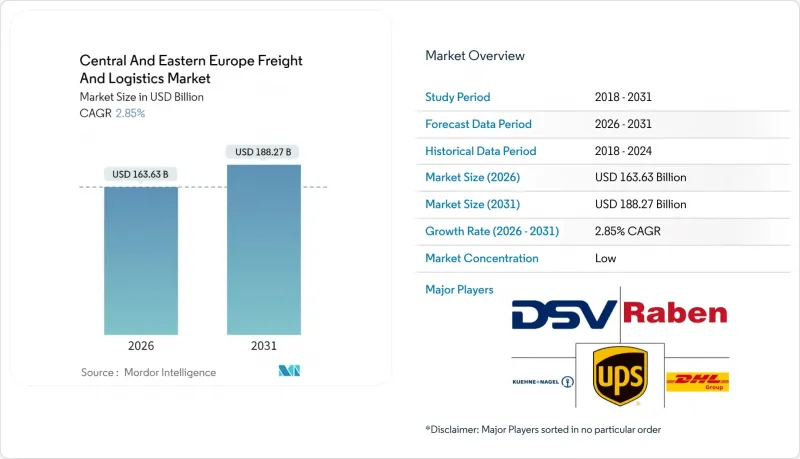
預計中東歐貨運和物流市場規模將從 2025 年的 1,590.9 億美元成長到 2026 年的 1,636.3 億美元,到 2031 年將達到 1,882.7 億美元,2026 年至 2031 年的複合年成長率為 2.85%。
德國原始設備製造商的近岸外包、加速發展的泛歐交通運輸網路(TEN-T)走廊以及該地區的數位轉型,正整體關鍵物流職能的持續需求。波蘭作為中歐鐵路走廊的樞紐地位、重點物流園區5G技術的普及以及歐盟綠色交易對鐵路和水路運輸的激勵措施,進一步凸顯了中東歐貨運和物流市場與西方市場的差異。諸如DSV收購德鐵信可(DB Schenker)等整合活動,正透過規模經濟提升效率,而技術賦能的貨運代理公司則加劇了市場競爭。主要風險包括專業司機日益短缺、歐盟外部邊界間歇性堵塞以及低溫運輸能力的延遲,這些都可能減緩成長勢頭。
中東歐貨運物流市場趨勢及洞察
歐盟的泛歐交通運輸網路(TEN-T)走廊計畫促進多式聯運效率
最新一輪泛歐交通網路(TEN-T)資金籌措為2024年中東歐計劃撥款25億歐元(約27.5億美元),旨在加速歐洲鐵路交通管理系統(ERTMS)的實施,並將跨國鐵路停留時間縮短高達30%。華沙-柏林和布達佩斯-維也納線路的營運商報告稱,效率提升了15-20%,為新型鐵路-公路聯運服務奠定了基礎,從而增強了中東歐貨運和物流市場的多模態能力。互聯互通的改善使波蘭的貨運站能夠有效率地將中歐鐵路貨運送至鄰近的捷克和斯洛伐克樞紐,形成網路效應,即使在尖峰時段也能維持貨運價格的穩定。修訂後的多式聯運指令目標進一步獎勵托運人將中程運輸從公路轉向鐵路,從而推動長期碳排放的減少和成本的降低。
德國汽車供應鏈加速回流,聚焦在波蘭和斯洛伐克
現代汽車、Vitesco Technologies 和 Chassix 正在中東歐地區聯合投資超過 5.76 億歐元(約 6.3569 億美元)新建廠,旨在加強當地電池系統和動力傳動系統的生產生態系統。僅匈牙利一國就吸引了 188 億美元的電氣化領域外國直接投資 (FDI),使其成為歐洲電池中心。一級供應商的遷址需要保稅、溫控貨運和專業倉儲服務,這提高了中東歐貨運和物流市場公路、鐵路和航空運輸方式的需求彈性。斯洛伐克優惠的稅收政策和波蘭成熟的汽車產業叢集促進了密集的通路,使那些專門為德國組裝廠提供準時交付服務的貨運代理商受益。
中歐和東歐地區長期存在的司機短缺問題日益凸顯。
到2024年,歐盟範圍內的司機缺口將超過23.3萬人,捷克運輸協會報告稱,該國目前有2.5萬個職位空缺。司機的平均年齡已超過50歲,歐盟「流動性一攬子計畫」中嚴格的休息時間規定也給車輛運轉率帶來了壓力。每年15%至20%的薪資成長可能會推高公路貨運價格,並促使托運人轉向鐵路和多式聯運。一些波蘭運輸公司正在部署高級駕駛輔助系統(ADAS),並在指定路段進行自動駕駛試驗,但全面商業部署預計還需要數年時間。長期人手不足正在影響中東歐貨運和物流市場的運力限制和服務可靠性。
細分市場分析
到2025年,批發和零售將佔據最大的市場佔有率,達到30.12%,電子商務商品交易總額(GMV)預計將在2024年達到429億美元,並在2026年至2031年期間以3.08%的複合年成長率成長。大型零售商和連鎖超市正在改造物流中心,以實現當日送達的目標,並將自動化投資注入中東歐的貨運和物流市場。
製造業正經歷顯著成長,這主要得益於汽車和電子產業叢集的蓬勃發展。波蘭和匈牙利的電池超級工廠正在推動專業化的入境物流,包括需要符合ADR標準的溫控運輸的鋰離子電池,為企業創造了豐厚的商機。
到2025年,貨運將佔總收入的64.72%,凸顯其在滿足中東歐貨運和物流市場製造和分銷需求方面發揮的根本性作用。公路、鐵路和多式聯運營運商受益於強勁的跨境貿易,尤其是在波蘭-德國路線。在汽車產業近岸外包和歐亞鐵路運輸流量的推動下,中東歐貨運和物流市場規模預計將持續成長。小包裹貨運(CEP)雖然規模較小,但卻是成長最快的細分市場。小包裹樞紐的自動化和不斷擴展的收貨點網路縮短了配送週期,推動其在2026年至2031年間實現3.32%的複合年成長率。數位化平台實現了即時價格發現和運力匹配,使貨運代理商能夠在統一的控制面板下整合貨運和小包裹貨運服務。這些服務的互動為靈活的端到端解決方案奠定了基礎,吸引了尋求韌性的跨國托運人。
歷史韌性顯而易見。儘管主權挑戰和疫情衝擊導致2020年經濟活動放緩,但電子商務的成長將推動中東歐物流(CEP)業務在2024年市場佔有率的擴張。倉儲物流行業保持了穩定的中個位數成長,這得益於全通路零售商對更高庫存緩衝的需求。貨運代理商透過貿易路線多元化提升了價值,而數位仲介利用API介面與航空公司和鐵路營運商連接,成為中東歐貨運物流行業新的差異化競爭者。
其他福利:
- Excel格式的市場預測(ME)表
- 分析師支持(3個月)
目錄
第1章 引言
- 研究假設和市場定義
- 調查範圍
第2章調查方法
第3章執行摘要
第4章 市場情勢
- 市場概覽
- 人口統計數據
- 按經濟活動分類的GDP分配
- 按經濟活動分類的GDP成長
- 通貨膨脹
- 經濟表現及概覽
- 電子商務產業的趨勢
- 製造業趨勢
- 運輸和倉儲業的GDP
- 出口趨勢
- 進口趨勢
- 燃油價格
- 物流績效
- 按交通方式分享
- 貨運費率趨勢
- 貨物運輸量趨勢
- 基礎設施
- 法規結構(公路和鐵路)
- 法規結構(海事和航空)
- 價值鍊和通路分析
- 市場促進因素
- 歐盟的泛歐交通運輸網路(TEN-T)走廊計畫促進多式聯運效率
- 德國汽車供應鏈加速回流,聚焦在波蘭和斯洛伐克
- 根據歐盟綠色交易,鐵路和水路運輸的運輸模式轉換資金將用於推動交通方式轉型。
- 能源安全舉措和供應鏈多元化
- 經新絲路連接中國和歐洲的鐵路貨運量成長已得到證實
- 5G/ITS正在主要物流樞紐引入
- 市場限制
- 中歐和東歐公路貨運長期面臨司機短缺問題。
- 歐盟外部邊界堵塞
- 低溫運輸基礎設施不發達阻礙成長
- 該地區A級倉庫供應分散
- 市場創新
- 波特五力分析
- 新進入者的威脅
- 供應商的議價能力
- 買方的議價能力
- 替代品的威脅
- 競爭對手之間的競爭
第5章 市場規模與成長預測
- 終端用戶產業
- 農業、漁業、林業
- 建造
- 製造業
- 石油天然氣、採礦和採石
- 批發和零售
- 其他
- 物流職能
- 快遞小包裹(CEP)
- 目的地類型
- 國內的
- 國際的
- 目的地類型
- 貨運代理
- 透過交通工具
- 航空
- 海路和內河航道
- 其他
- 透過交通工具
- 貨物運輸
- 透過交通工具
- 航空
- 管道
- 鐵路
- 路
- 海路和內河航道
- 透過交通工具
- 倉儲和存儲
- 透過溫度控制
- 非溫控型
- 溫度控制
- 透過溫度控制
- 其他服務
- 快遞小包裹(CEP)
- 地區
- 阿爾巴尼亞
- 保加利亞
- 克羅埃西亞
- 捷克共和國
- 愛沙尼亞
- 匈牙利
- 拉脫維亞
- 立陶宛
- 波蘭
- 羅馬尼亞
- 斯洛伐克共和國
- 斯洛維尼亞
- 其他中東歐國家
第6章 競爭情勢
- 市場集中度
- 重大策略舉措
- 市佔率分析
- 公司簡介
- Cargus
- CMA CGM Group(Including CEVA Logistics)
- DACHSER
- DHL Group
- DSV A/S(Including DB Schenker)
- Expeditors International
- FedEx
- Gebruder Weiss
- GEODIS
- Hamburger Hafen und Logistik AG(Including METRANS)
- Kuehne+Nagel
- La Poste Group(Including GeoPost)
- Magyar Posta Zrt
- NYK(Nippon Yusen Kaisha)Line
- OBB-Holding AG(Including Rail Cargo Group)
- PKP CARGO SA
- Raben Group
- Rhenus Group
- ROHLIG SUUS Logistics SA
- United Parcel Service of America, Inc.(UPS)
- Waberer's International Nyrt.
- Walter Group
第7章 市場機會與未來展望
The Central and Eastern Europe freight and logistics market is expected to grow from USD 159.09 billion in 2025 to USD 163.63 billion in 2026 and is forecast to reach USD 188.27 billion by 2031 at 2.85% CAGR over 2026-2031.
Nearshoring by German OEMs, accelerated TEN-T corridor upgrades, and the region's digital transformation are reinforcing sustained demand across all major logistics functions. Poland's hub status along the China-Europe rail corridor, rising 5G deployments in core logistics parks, and EU Green Deal incentives for rail and waterways further differentiate the Central and Eastern Europe freight and logistics market from Western European peers. Consolidation activity, such as DSV's purchase of DB Schenker, is elevating scale-driven efficiencies, while technology-enabled forwarders inject competitive dynamism. Key risks include a widening professional driver deficit, intermittent border congestion at EU external frontiers, and lagging cold-chain capacity that could temper growth momentum.
Central And Eastern Europe Freight And Logistics Market Trends and Insights
European Union TEN-T Corridor Upgrades Enabling Intermodal Efficiencies
The latest Trans-European transport network (TEN-T) financing round earmarked EUR 2.5 billion (USD 2.75 billion) for CEE projects in 2024, accelerating European rail traffic management system (ERTMS) deployment and cutting cross-border rail dwell times by up to 30%. Operators on the Warsaw-Berlin and Budapest-Vienna routes report 15-20% efficiency gains, underpinning new rail-road service offerings that deepen the Central and Eastern Europe freight and logistics market's multimodal capabilities. Improved connectivity allows Polish terminals to funnel higher China-Europe rail volumes into adjacent Czech and Slovak hubs, creating network effects that sustain rate stability during seasonal peaks. Revised Combined Transport Directive targets further incentivize shippers to shift medium-distance traffic from road to rail, fostering long-run carbon and cost savings.
German Auto Supply Chains Shift Closer to Home with Poland and Slovakia in Focus
Hyundai, Vitesco Technologies, and Chassix have collectively slated more than EUR 576 million (USD 635.69 million) toward new CEE plants, reinforcing the local production ecosystem for battery systems and powertrains. Hungary alone secured USD 18.8 billion in electromobility FDI, positioning the country among Europe's battery capitals. Relocated tier-1 suppliers require bonded, temperature-controlled freight and specialized warehousing, with lifting demand elasticity across road, rail, and air modes within the Central and Eastern Europe freight and logistics market. Slovakia's favorable tax framework and Poland's established automotive clusters cultivate dense distribution lanes that benefit freight forwarders specializing in time-critical deliveries to German assembly plants.
Chronic Driver Shortage Noticed in CEE Road Haulage
EU-wide driver gaps topped 233,000 positions in 2024, with Czech transport associations citing 25,000 vacancies locally. The average driver age now exceeds 50, and stricter rest-time mandates under the EU Mobility Package squeeze fleet productivity. Wage inflation of 15-20% annually elevates road freight tariffs, potentially nudging shippers toward rail and intermodal options. Several Polish carriers have introduced advanced driver assistance Systems (ADAS) and autonomous trials on controlled corridors, though full commercial roll-out remains years away. Persistent shortages weigh on the Central and Eastern Europe freight and logistics market's capacity ceiling and service reliability.
Other drivers and restraints analyzed in the detailed report include:
- China-Europe Rail Freight Growth Witnessed via New Silk Road
- European Union Green Deal Modal Shift Funding to Rail and Waterways
- Border Congestion Witnessed at EU External Frontiers
For complete list of drivers and restraints, kindly check the Table Of Contents.
Segment Analysis
Wholesale and retail trade dominated with a 30.12% share in 2025 and is projected to grow at a 3.08% CAGR (2026-2031) as e-commerce gross merchandise value (GMV) hits USD 42.9 billion in 2024. Big-box and grocery chains are overhauling distribution centers to meet same-day delivery benchmarks, injecting automation spending into the Central and Eastern Europe freight and logistics market.
Manufacturing is growing significantly, largely on the back of auto and electronics clusters. Battery gigafactories in Poland and Hungary drive specialized inbound flows, including lithium-ion cells that demand ADR-compliant, temperature-controlled transport, boosting premium yields for operators.
Freight transport captured 64.72% of 2025 revenue, underscoring its foundational role in meeting manufacturing and distribution needs across the Central and Eastern Europe Freight and Logistics market. Road, rail, and intermodal carriers benefit from robust cross-border trade, particularly along Poland-Germany lanes. The Central and Eastern Europe freight and logistics market size is projected to grow, supported by automotive nearshoring and Eurasian rail flows. CEP, although smaller, is rising fastest; automation in parcel hubs and expansion of pick-up point networks shorten delivery cycles and fuel a 3.32% CAGR (2026-2031). Digital platforms enable real-time price discovery and capacity matching, allowing forwarders to integrate Freight Transport and CEP services under unified dashboards. The interplay of these services underpins flexible, end-to-end solutions that attract multinational shippers seeking resilience.
Historical resilience is evident: sovereignty-related challenges and pandemic shocks slowed activity in 2020, yet e-commerce growth spurred the CEP segment's share in 2024. Warehousing and storage posted stable, mid-single-digit growth as omnichannel retailers demanded higher inventory buffers. Freight Forwarding added value through trade route diversification, with digital brokers exploiting API connectivity to airlines and rail operators, an emerging differentiator in the Central and Eastern Europe freight and logistics industry.
The Central and Eastern Europe Freight and Logistics Market Report is Segmented by End User Industry (Construction, Manufacturing, Wholesale and Retail Trade, and More), by Logistics Function (Courier, Express, and Parcel (CEP), Freight Forwarding, Freight Transport, Warehousing and Storage, and More) and by Geography (Albania, Bulgaria, Croatia, Czech Republic, and More). The Market Forecasts are Provided in Terms of Value (USD).
List of Companies Covered in this Report:
- Cargus
- CMA CGM Group (Including CEVA Logistics)
- DACHSER
- DHL Group
- DSV A/S (Including DB Schenker)
- Expeditors International
- FedEx
- Gebruder Weiss
- GEODIS
- Hamburger Hafen und Logistik AG (Including METRANS)
- Kuehne+Nagel
- La Poste Group (Including GeoPost)
- Magyar Posta Zrt
- NYK (Nippon Yusen Kaisha) Line
- OBB-Holding AG (Including Rail Cargo Group)
- PKP CARGO SA
- Raben Group
- Rhenus Group
- ROHLIG SUUS Logistics SA
- United Parcel Service of America, Inc. (UPS)
- Waberer's International Nyrt.
- Walter Group
Additional Benefits:
- The market estimate (ME) sheet in Excel format
- 3 months of analyst support
TABLE OF CONTENTS
1 Introduction
- 1.1 Study Assumptions and Market Definition
- 1.2 Scope of the Study
2 Research Methodology
3 Executive Summary
4 Market Landscape
- 4.1 Market Overview
- 4.2 Demographics
- 4.3 GDP Distribution by Economic Activity
- 4.4 GDP Growth by Economic Activity
- 4.5 Inflation
- 4.6 Economic Performance and Profile
- 4.6.1 Trends in E-Commerce Industry
- 4.6.2 Trends in Manufacturing Industry
- 4.7 Transport and Storage Sector GDP
- 4.8 Export Trends
- 4.9 Import Trends
- 4.10 Fuel Price
- 4.11 Logistics Performance
- 4.12 Modal Share
- 4.13 Freight Pricing Trends
- 4.14 Freight Tonnage Trends
- 4.15 Infrastructure
- 4.16 Regulatory Framework (Road and Rail)
- 4.17 Regulatory Framework (Sea and Air)
- 4.18 Value Chain and Distribution Channel Analysis
- 4.19 Market Drivers
- 4.19.1 European Union TEN-T Corridor Upgrades Enabling Intermodal Efficiencies
- 4.19.2 German Auto Supply Chains Shift Closer to Home with Poland and Slovakia in Focus
- 4.19.3 European Union Green Deal Modal Shift Funding to Rail and Waterways
- 4.19.4 Energy Security Initiatives and Supply Route Diversification
- 4.19.5 China-Europe Rail Freight Growth Witnessed via New Silk Road
- 4.19.6 5G / ITS Roll-Out Witnessed in Key Logistics Hubs
- 4.20 Market Restraints
- 4.20.1 Chronic Driver Shortage Noticed in CEE Road Haulage
- 4.20.2 Border Congestion Witnessed at EU External Frontiers
- 4.20.3 Under-Developed Cold-Chain Infrastructure Curtailing Growth
- 4.20.4 Fragmented Grade-A Warehousing Supply in the Region
- 4.21 Technology Innovations in the Market
- 4.22 Porter's Five Forces Analysis
- 4.22.1 Threat of New Entrants
- 4.22.2 Bargaining Power of Suppliers
- 4.22.3 Bargaining Power of Buyers
- 4.22.4 Threat of Substitutes
- 4.22.5 Competitive Rivalry
5 Market Size and Growth Forecasts (Value, USD)
- 5.1 End User Industry
- 5.1.1 Agriculture, Fishing, and Forestry
- 5.1.2 Construction
- 5.1.3 Manufacturing
- 5.1.4 Oil and Gas, Mining and Quarrying
- 5.1.5 Wholesale and Retail Trade
- 5.1.6 Others
- 5.2 Logistics Function
- 5.2.1 Courier, Express, and Parcel (CEP)
- 5.2.1.1 By Destination Type
- 5.2.1.1.1 Domestic
- 5.2.1.1.2 International
- 5.2.1.1 By Destination Type
- 5.2.2 Freight Forwarding
- 5.2.2.1 By Mode of Transport
- 5.2.2.1.1 Air
- 5.2.2.1.2 Sea and Inland Waterways
- 5.2.2.1.3 Others
- 5.2.2.1 By Mode of Transport
- 5.2.3 Freight Transport
- 5.2.3.1 By Mode of Transport
- 5.2.3.1.1 Air
- 5.2.3.1.2 Pipelines
- 5.2.3.1.3 Rail
- 5.2.3.1.4 Road
- 5.2.3.1.5 Sea and Inland Waterways
- 5.2.3.1 By Mode of Transport
- 5.2.4 Warehousing and Storage
- 5.2.4.1 By Temperature Control
- 5.2.4.1.1 Non-Temperature Controlled
- 5.2.4.1.2 Temperature Controlled
- 5.2.4.1 By Temperature Control
- 5.2.5 Other Services
- 5.2.1 Courier, Express, and Parcel (CEP)
- 5.3 Geography
- 5.3.1 Albania
- 5.3.2 Bulgaria
- 5.3.3 Croatia
- 5.3.4 Czech Republic
- 5.3.5 Estonia
- 5.3.6 Hungary
- 5.3.7 Latvia
- 5.3.8 Lithuania
- 5.3.9 Poland
- 5.3.10 Romania
- 5.3.11 Slovak Republic
- 5.3.12 Slovenia
- 5.3.13 Rest of CEE
6 Competitive Landscape
- 6.1 Market Concentration
- 6.2 Key Strategic Moves
- 6.3 Market Share Analysis
- 6.4 Company Profiles (Includes Global Level Overview, Market Level Overview, Core Segments, Financials as Available, Strategic Information, Market Rank/Share for Key Companies, Products and Services, and Recent Developments)
- 6.4.1 Cargus
- 6.4.2 CMA CGM Group (Including CEVA Logistics)
- 6.4.3 DACHSER
- 6.4.4 DHL Group
- 6.4.5 DSV A/S (Including DB Schenker)
- 6.4.6 Expeditors International
- 6.4.7 FedEx
- 6.4.8 Gebruder Weiss
- 6.4.9 GEODIS
- 6.4.10 Hamburger Hafen und Logistik AG (Including METRANS)
- 6.4.11 Kuehne+Nagel
- 6.4.12 La Poste Group (Including GeoPost)
- 6.4.13 Magyar Posta Zrt
- 6.4.14 NYK (Nippon Yusen Kaisha) Line
- 6.4.15 OBB-Holding AG (Including Rail Cargo Group)
- 6.4.16 PKP CARGO SA
- 6.4.17 Raben Group
- 6.4.18 Rhenus Group
- 6.4.19 ROHLIG SUUS Logistics SA
- 6.4.20 United Parcel Service of America, Inc. (UPS)
- 6.4.21 Waberer's International Nyrt.
- 6.4.22 Walter Group
7 Market Opportunities and Future Outlook
- 7.1 White-Space and Unmet-Need Assessment

 2034年全球貨運市場預測-依運輸方式、貨物類型、燃料和推進方式、所有權類型、最終用戶和地區分類的分析
 印度貨運與物流:市場佔有率分析、產業趨勢與統計及成長預測(2026-2031)
 全球貨運和物流市場:市場規模、佔有率、趨勢和成長分析(2026-2034 年)
 2026年全球貨車市場報告2026年全球貨運和物流市場報告2026年全球零碳運輸市場報告
 貨運及物流市場分析及預測(至2035年):依類型、產品類型、服務、技術、組件、應用、流程、最終使用者及運輸方式分類
 2026-2030年全球貨物審核與支付市場亞太地區貨運與物流:市場佔有率分析、產業趨勢與統計、成長預測(2026-2031)南美貨運與物流:市場佔有率分析、產業趨勢與統計、成長預測(2026-2031)