


 |
市場調查報告書
商品編碼
2157144
印尼合約物流:市場佔有率分析、產業趨勢與統計及成長預測(2026-2031)Indonesia Contract Logistics - Market Share Analysis, Industry Trends & Statistics, Growth Forecasts (2026 - 2031) |
||||||

※ 本網頁內容可能與最新版本有所差異。詳細情況請與我們聯繫。
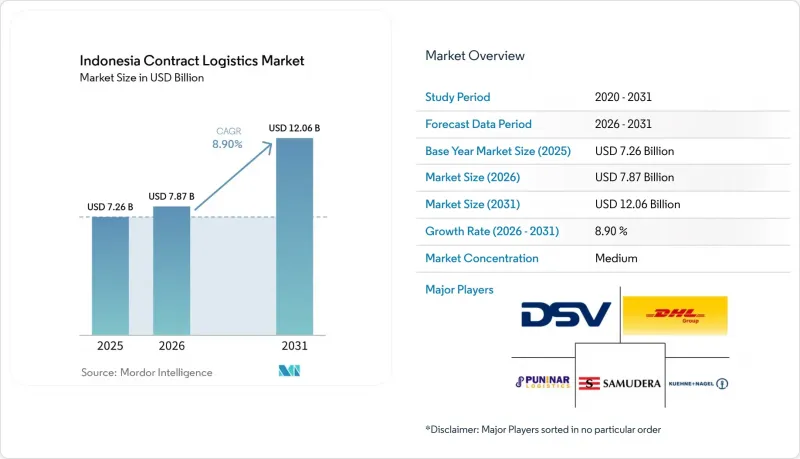
據 Mordor Intelligence 稱,2025 年印尼合約物流市場價值為 72.6 億美元,預計到 2031 年將達到 120.6 億美元,而 2026 年為 78.7 億美元,預測期(2026-2031 年)複合年成長率為 8.90%。
印尼合約物流市場的趨勢與洞察
電子商務履約外包正在加速對合約物流的需求。
預計到2025年,印尼的電子商務活動將維持兩位數的成長,小包裹處理量、庫存需求和逆向物流工作量也將隨之增加。這要求品牌商在更多地點管理庫存,並服務雅加達大都會圈以外的消費者。由於品牌商將這些業務外包給擁有成熟倉儲和配送網路的供應商,印尼的合約物流市場從中受益。在更複雜的履約合約中,常溫、冷藏和保稅庫存被整合到一個營運基地。這種架構減少了與各倉庫專家協調的需求。在二、三線城市擁有區域基地的供應商的價值也隨之提升。
製造業的擴張增加了對一體化供應鏈的需求。
印尼的下游產業政策促使鎳、銅和礬土在出口前在國內進行加工的量顯著增加。汽車產業的投資進一步推動了這些需求,例如比亞迪位於梳邦的工廠和吉利飛世爾的散件組裝廠,這兩家工廠均於2026年投產。這些工廠需要零件採購、保稅物流以及跨多個工業區的準時制(JIT)交付。豐田汽車印尼公司統籌到2026年將擁有超過240家一級供應商和520家二級及三級供應商。不斷擴大的供應商群體推動了對能夠管理進口貨物和清關流程的物流合作夥伴的需求。此外,紡織服裝生產向中爪哇的轉移也使得三寶壟周邊地區對貨運路線、倉儲和出口支援的需求日益成長。
島際運輸成本推高了合約物流費用。
島際運輸涉及海運或空運、裝卸以及港口停留時間。這些流程並不適用於越南、泰國或馬來半島類似的陸路運輸路線。即使海運費用降低,由於貨物收集、集散、倉儲和港口裝卸的持續需求,成本仍居高不下。回程貨物量的不平衡進一步加劇了這種壓力,因為爪哇島的出口需求超過了返回爪哇島的貨物量。新加坡國立大學2025年的研究指出,基礎設施和貨物處理能力的不足仍然是西加里曼丹物流競爭的持續阻礙因素。因此,如果成本波動無法轉嫁給客戶,離島運輸路線的固定價格合約將對利潤率構成風險。
細分市場分析
2025年,運輸業仍是印尼合約物流市場中最大的服務類別,佔58.97%的市佔率。爪哇島的公路網和島際海運為其在整個國內物流流程中的地位提供了支撐。道路運輸服務連接了主要島嶼上的工業園區、物流中心和零售通路。鐵路為爪哇島內的特定路線提供了替代方案,而空運則支持了運往印尼東部的貨物及時送達。 NX 物流 Indonesia和KAI 物流於2025年5月開始在卡拉里、卡拉旺和泗水之間進行鐵路貨運合作。隨著A級倉儲設施從大雅加達地區擴展到泗水、三寶壟、棉蘭和望加錫,倉儲和物流服務構成了服務組合的核心。
預計2026年至2031年間,附加價值服務將以11.46%的複合年成長率成長,成為服務組合中成長率最高的領域。組裝、貼標和配套服務使電子產品、汽車和消費品托運人能夠將生產支援和履約活動更緊密地結合起來,從而減少了工廠、倉儲設施和配送營運之間的交接環節。隨著這些活動在同一設施內完成,印尼的合約物流行業受益於更長期、更一體化的客戶關係。保稅區資格也成為服務於出口製造商的供應商之間的差異化優勢。馬士基物流印尼公司於2026年初獲得了其位於三寶壟的「物流中心 Berikat」(保稅物流中心)的資格。該中心為服裝、鞋類和配件出口商提供一體化的倉儲和報關管理服務。
其他好處:
- Excel格式的市場預測(ME)表
- 3個月的分析師支持
目錄
第1章:引言
- 研究假設和市場定義
- 調查範圍
第2章:調查方法
第3章執行摘要
- 市場規模、成長率與未來預測
- 合約物流的主要需求促進因素和趨勢
- 主要物流網路與需求集中度
- 競爭格局與主要合約物流供應商
第4章 市場狀況
- 市場概況及合約物流的重要性
- 市場促進因素
- 電子商務履約外包正在加速對合約物流的需求。
- 隨著製造業的擴張,對一體化供應鏈的需求也日益成長。
- 發展島際物流和擴展合約物流網路
- 冷鏈的發展正在推動對專業物流的需求。
- 對整合可視化的需求正在加速控制塔服務的普及。
- 努沙登加拉群島的發展正在將物流需求轉移到爪哇島走廊區域之外。
- 市場限制因素
- 島際運輸成本增加推高了合約物流費用。
- 監管碎片化和基礎設施不平衡加劇了問題的複雜性。
- 遵守零里程法規給車輛營運成本帶來了更大的壓力。
- 由於回程回程傳輸容量有限,爪哇島以外地區的成本正在上升。
- 價值鏈結構與合約物流流程分析
- 法律規範和物流合規要求分析
- 技術採納及合約物流數位化分析
- 貨運和運輸成本趨勢分析
- 燃油價格對運費的影響
- 區域物流投資及產能擴張分析
- 波特五力分析
- 地緣政治事件對供應鏈變化的影響
第5章 市場規模與成長預測
- 按服務類型
- 運輸
- 路
- 鐵路
- 航空
- 海
- 倉儲/物流
- 附加價值服務(組裝、貼標、套件包裝)
- 運輸
- 按合約期限
- 1-3年
- 3年或以上
- 按最終用戶行業分類
- 製造業/汽車
- 食品/飲料
- 零售與電子商務
- 醫療和藥品
- 化學品
- 其他行業
- 按地區
- 爪哇島(雅加達和博多)
- 蘇門答臘
- 加里曼丹
- 蘇拉威西
- 峇裡島和努沙登加拉
- 巴布亞地區和摩鹿加群島
第6章 競爭情勢
- 市場集中度
- 策略趨勢
- 市佔率分析
- 公司簡介
- DHL Group
- DSV A/S
- Kuehne+Nagel
- CMA CGM Group
- AP Moller-Maersk
- GEODIS
- NX Group
- NYK Line(Including Yusen Logistics Co., Ltd.)
- Linfox Pty Ltd.
- CJ Logistics Corporation
- PT Karyatama Mitra Terampil(KMT Logistics)
- PT Mega Manunggal Property Tbk
- Rhenus Group
- Kiat Ananda Group
- PT Samudera Indonesia Tbk
- LINC Group
- PT Puninar Logistics
- PT Kamadjaja Logistics
- PT Cipta Krida Bahari
- Waresix
- Shipper
- MGM Bosco Logistics
第7章 市場機會與未來展望
第8章附錄
According to Mordor Intelligence, the Indonesia contract logistics market size was valued at USD 7.26 billion in 2025 and is estimated to grow from USD 7.87 billion in 2026 to reach USD 12.06 billion by 2031, at a CAGR of 8.90% during the forecast period (2026-2031).
Indonesia Contract Logistics Market Trends and Insights
E-Commerce Fulfillment Outsourcing Accelerating Contract Logistics Demand
Indonesia's e-commerce activity sustained double-digit volume growth through 2025, increasing parcel volumes, inventory needs, and reverse-logistics workloads. This activity required brands to manage stock across more locations and serve consumers beyond Greater Jakarta. The Indonesia contract logistics market benefited when brands shifted these tasks to providers with established warehouse and delivery networks. More complex fulfillment contracts combined ambient, refrigerated, and bonded-zone inventory within a single operating location. This arrangement reduced the need to coordinate separate warehouse specialists. It also increased the value of providers that had regional facilities in tier-2 and tier-3 cities.
Manufacturing Expansion Increasing Integrated Supply Chain Requirements
Indonesia's downstream industrial policy kept more nickel, copper, and bauxite processing within the country before export. Automotive investment added to these requirements, including BYD's Subang plant and Geely Farizon's knock-down assembly facility, which became operational in 2026. These facilities required component sequencing, bonded-zone flows, and just-in-time delivery across industrial locations. Toyota Motor Manufacturing Indonesia coordinates more than 240 Tier-1 suppliers and 520 Tier-2 and Tier-3 suppliers in 2026. The supplier base strengthens demand for logistics partners that can manage inbound flows and customs procedures. Textile and garment production moving toward Central Java also created a need for freight links, storage, and export support around Semarang.
Inter-Island Handling Costs Increasing Contract Logistics Expenses
Every inter-island shipment involved sea or air transfer, loading, unloading, and port dwell time. These operating steps did not apply to comparable overland routes in Vietnam, Thailand, or peninsular Malaysia. Costs remained high even after Sea Toll improvements because freight still required collection, consolidation, storage, and handling at ports. Uneven return cargo flows added further pressure because outbound demand from Java exceeded shipments moving back to Java. A 2025 National University of Singapore study identified infrastructure and cargo-handling gaps as ongoing constraints on West Kalimantan's logistics competitiveness. Fixed-price contracts in outer-island corridors, therefore, carried margin risk when cost movements could not be passed through to clients.
Other drivers and restraints analyzed in the detailed report include:
- Inter-Island Distribution Development Expanding Contract Logistics Networks
- Cold Chain Growth Driving Specialized Logistics Demand
- Zero-ODOL Compliance Increasing Fleet Operating Cost Pressures
For complete list of drivers and restraints, kindly check the Table Of Contents.
Segment Analysis
Transportation held 58.97% of the Indonesia contract logistics market share in 2025 and remained the largest service category. Java's road network and inter-island sea freight supported that position across domestic distribution flows. Road services connected industrial zones, distribution centers, and retail channels on the main islands. Rail provided an alternative on selected Java corridors, while air freight supported time-sensitive cargo moving to eastern Indonesia. NX Logistics Indonesia and KAI Logistik began a rail freight collaboration between Klari, Karawang, and Surabaya in May 2025. Warehousing and distribution formed the middle tier of the service mix as Grade-A stock expanded from Greater Jakarta into Surabaya, Semarang, Medan, and Makassar.
Value-added services are forecast to grow at an 11.46% CAGR from 2026 to 2031, the fastest rate within the service mix. Assembly, labeling, and kitting allowed electronics, automotive, and consumer goods shippers to place production support and fulfillment activities closer together. This reduced handoffs between factories, storage sites, and delivery operations. The Indonesia contract logistics industry gained from longer and more integrated client relationships when these activities sat within a single facility. Bonded-zone authorization also differentiated providers serving export manufacturers. Maersk Logistics Indonesia received approval for a Pusat Logistik Berikat facility in Semarang in early 2026. The facility supported integrated storage and customs management for apparel, footwear, and accessory exporters.
Complete Report Scope:
- By Service Type
- Transportation
- Road
- Rail
- Air
- Sea
- Warehousing & Distribution
- Value-Added Services (Assembly, Labelling, Kitting)
- Transportation
- By Contract Duration
- 1-3 Years
- Above 3 Years
- By End-User Industry
- Manufacturing and Automotive
- Food and Beverage
- Retail and E-commerce
- Healthcare and Pharmaceuticals
- Chemicals
- Other Industries
- By Region
- Java (Jakarta and BOD)
- Sumatra
- Kalimantan
- Sulawesi
- Bali and Nusa Tenggara
- Papua Region and Maluku Islands
List of Companies Covered in this Report:
- DHL Group
- DSV A/S
- Kuehne+Nagel
- CMA CGM Group
- A.P. Moller - Maersk
- GEODIS
- NX Group
- NYK Line (Including Yusen Logistics Co., Ltd.)
- Linfox Pty Ltd.
- CJ Logistics Corporation
- PT Karyatama Mitra Terampil (KMT Logistics)
- PT Mega Manunggal Property Tbk
- Rhenus Group
- Kiat Ananda Group
- PT Samudera Indonesia Tbk
- LINC Group
- PT Puninar Logistics
- PT Kamadjaja Logistics
- PT Cipta Krida Bahari
- Waresix
- Shipper
- MGM Bosco Logistics
Additional Benefits:
- The market estimate (ME) sheet in Excel format
- 3 months of analyst support
TABLE OF CONTENTS
1 INTRODUCTION
- 1.1 Study Assumptions and Market Definition
- 1.2 Scope of the Study
2 RESEARCH METHODOLOGY
3 EXECUTIVE SUMMARY
- 3.1 Market Size, Growth, and Forecast Outlook
- 3.2 Key Demand Drivers and Contract Logistics Trends
- 3.3 Major Logistics Networks and Demand Concentration
- 3.4 Competitive Landscape and Leading Contract Logistics Providers
4 MARKET LANDSCAPE
- 4.1 Market Overview and Importance of Contract Logistics
- 4.2 Market Drivers
- 4.2.1 E-commerce Fulfillment Outsourcing Accelerating Contract Logistics Demand
- 4.2.2 Manufacturing Expansion Increasing Integrated Supply Chain Requirements
- 4.2.3 Inter-Island Distribution Development Expanding Contract Logistics Networks
- 4.2.4 Cold Chain Growth Driving Specialized Logistics Demand
- 4.2.5 Integrated Visibility Demand Accelerating Control-Tower Service Adoption
- 4.2.6 Nusantara Development Shifting Logistics Demand Beyond Java Corridors
- 4.3 Market Restraints
- 4.3.1 Inter-Island Handling Costs Increasing Contract Logistics Expenses
- 4.3.2 Fragmented Regulations and Infrastructure Gaps Increasing Complexity
- 4.3.3 Zero-ODOL Compliance Increasing Fleet Operating Cost Pressures
- 4.3.4 Limited Backhaul Availability Raising Costs Outside Java
- 4.4 Value Chain Structure and Contract Logistics Flow Analysis
- 4.5 Regulatory Framework and Logistics Compliance Requirements Analysis
- 4.6 Technology Adoption and Contract Logistics Digitalization Analysis
- 4.7 Freight Rate and Transportation Cost Trend Analysis
- 4.8 Fuel Price Impact on Freight Rate Trends
- 4.9 Regional Logistics Investment and Capacity Expansion Analysis
- 4.10 Porter's Five Forces Analysis
- 4.10.1 Threat of New Entrants
- 4.10.2 Bargaining Power of Buyers
- 4.10.3 Bargaining Power of Suppliers
- 4.10.4 Threat of Substitute Services
- 4.10.5 Intensity of Competitive Rivalry
- 4.11 Impact of Geo-Political Events on Supply Chain Shifts
5 MARKET SIZE AND GROWTH FORECASTS
- 5.1 By Service Type
- 5.1.1 Transportation
- 5.1.1.1 Road
- 5.1.1.2 Rail
- 5.1.1.3 Air
- 5.1.1.4 Sea
- 5.1.2 Warehousing & Distribution
- 5.1.3 Value-Added Services (Assembly, Labelling, Kitting)
- 5.1.1 Transportation
- 5.2 By Contract Duration
- 5.2.1 1-3 Years
- 5.2.2 Above 3 Years
- 5.3 By End-User Industry
- 5.3.1 Manufacturing and Automotive
- 5.3.2 Food and Beverage
- 5.3.3 Retail and E-commerce
- 5.3.4 Healthcare and Pharmaceuticals
- 5.3.5 Chemicals
- 5.3.6 Other Industries
- 5.4 By Region
- 5.4.1 Java (Jakarta and BOD)
- 5.4.2 Sumatra
- 5.4.3 Kalimantan
- 5.4.4 Sulawesi
- 5.4.5 Bali and Nusa Tenggara
- 5.4.6 Papua Region and Maluku Islands
6 COMPETITIVE LANDSCAPE
- 6.1 Market Concentration
- 6.2 Strategic Moves
- 6.3 Market Share Analysis
- 6.4 Company Profiles (includes Global Level Overview, Market Level Overview, Core Segments, Financials as available, Strategic Information, Geographic Coverage, Products and Services, Recent Developments)
- 6.4.1 DHL Group
- 6.4.2 DSV A/S
- 6.4.3 Kuehne+Nagel
- 6.4.4 CMA CGM Group
- 6.4.5 A.P. Moller - Maersk
- 6.4.6 GEODIS
- 6.4.7 NX Group
- 6.4.8 NYK Line (Including Yusen Logistics Co., Ltd.)
- 6.4.9 Linfox Pty Ltd.
- 6.4.10 CJ Logistics Corporation
- 6.4.11 PT Karyatama Mitra Terampil (KMT Logistics)
- 6.4.12 PT Mega Manunggal Property Tbk
- 6.4.13 Rhenus Group
- 6.4.14 Kiat Ananda Group
- 6.4.15 PT Samudera Indonesia Tbk
- 6.4.16 LINC Group
- 6.4.17 PT Puninar Logistics
- 6.4.18 PT Kamadjaja Logistics
- 6.4.19 PT Cipta Krida Bahari
- 6.4.20 Waresix
- 6.4.21 Shipper
- 6.4.22 MGM Bosco Logistics
7 MARKET OPPORTUNITIES AND FUTURE OUTLOOK
- 7.1 White-Space Opportunities and Unmet Contract Logistics Needs
- 7.2 High-Potential End-User Segments and Growth Opportunities
- 7.3 Strategic Growth Priorities Across Contract Logistics Ecosystem
- 7.4 Future Market Outlook and Emerging Demand Pockets
8 APPENDIX

 印度合約物流:市場佔有率分析、產業趨勢與統計及成長預測(2026-2031)德國合約物流:市場佔有率分析、產業趨勢與統計及成長預測(2026-2031)美國合約物流:市場佔有率分析、行業趨勢和統計數據、成長預測(2026-2031)英國合約物流:市場佔有率分析、產業趨勢與統計及成長預測(2026-2031)
 全球合約物流市場(2026 年)南美洲合約物流:市場佔有率分析、產業趨勢與統計及成長預測(2026-2031 年)
 合約物流市場:按服務、類型、運輸方式、行業和地區分類
 2026年全球合約物流市場報告
 合約物流市場:2026-2032年全球市場預測(依服務類型、貨物類型、運輸方式、客戶規模及最終用途分類)歐洲合約物流:市場佔有率分析、產業趨勢與統計、成長預測(2026-2031)