


 |
市場調查報告書
商品編碼
2124011
美國合約物流:市場佔有率分析、行業趨勢和統計數據、成長預測(2026-2031)United States Contract Logistics - Market Share Analysis, Industry Trends & Statistics, Growth Forecasts (2026 - 2031) |
||||||

※ 本網頁內容可能與最新版本有所差異。詳細情況請與我們聯繫。
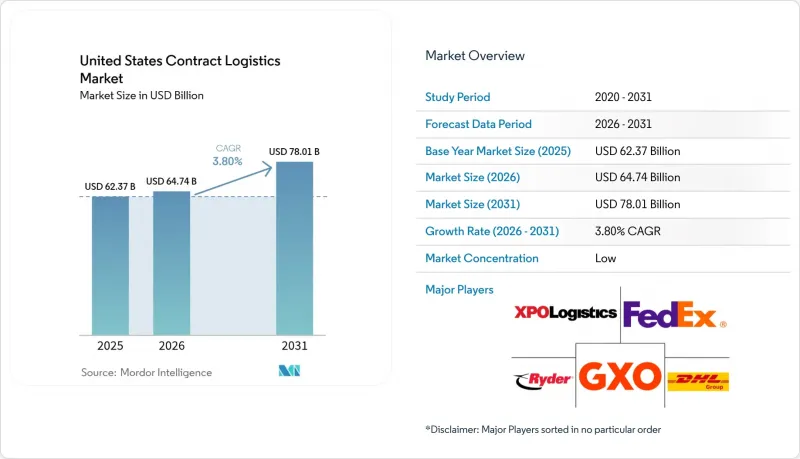
據 Mordor Intelligence 稱,2025 年美國合約物流市場價值 623.7 億美元,預計到 2031 年將達到 780.1 億美元,而 2026 年為 647.4 億美元,預測期(2026-2031 年)複合年成長率為 3.80%。
本報告按服務類型(運輸、倉儲和配送、附加價值服務)、合約期間(1-3年和3年及以上)以及最終用戶行業(製造業和汽車業、食品飲料業、零售和電子商務業、醫療保健和製藥業、化工業及其他行業)進行細分。市場預測以美元計價。
美國合約物流市場的趨勢與洞察
電子商務履約需求的爆炸性成長
隨著網路購物的蓬勃發展,存貨周轉已成為全年阻礙因素。 2024年,亞馬遜透過當日達和隔日達服務交付了超過90億件商品,較去年同期成長30%。其業務已滲透到農村地區,覆蓋超過4000個小規模,正在重塑物流網路格局,迫使承包商建立微型倉配中心和靈活的運力模式。沃爾瑪關閉傳統履約中心,轉而開設自動化配送中心,將流程從12道減少到5道,顯示速度比規模更重要。美國運輸部(DOT)的駕駛時間法規進一步限制了路線規劃,迫使企業調整設施位置以符合法規要求。美國合約物流市場持續投資於即時視覺化和短途運輸解決方案,以縮短訂單到交付的前置作業時間。
冷鍊和醫療保健物流的激增
DHL在北美11億美元的投資表明,溫控技術已發展成為進入門檻。收購Cryopdp等公司(該公司每年處理60萬件臨床試驗相關貨物)標誌著市場正向更精細的服務轉型,以滿足細胞和基因療法在零下溫度管理方面的需求。美國食品藥物管理局(FDA)的良好分銷規範(GDP)對溫度偏差施加了更嚴格的處罰,要求營運商部署物聯網感測器和冗餘電源。因此,獲得食品藥物管理局認證的設施和訓練有素的人員在美國合約物流市場備受青睞,而冷鏈設施的面積,例如Cold Zone位於斯普林菲爾德的17萬平方英尺的設施,預示著市場將進一步成長。
倉庫工人和司機嚴重人手不足
美國聯邦機動車輛安全管理局 (FMCSA) 的英語能力標準將於 2025 年 6 月生效,屆時可能導致 10% 的駕駛者失去資格,進而造成競標被拒率上升,並加劇運輸能力緊張。儘管 2024 年 7 月運輸和倉儲行業新增了 14,000 個就業崗位,但 51% 的司機離職率削弱了就業保障。薪資持續上漲,亞馬遜區域配送員的薪資遠高於聯邦最低工資標準。需要持有 A 級商業駕駛執照 (CDL-A) 和危險品處理資格的職位嚴重短缺,直接影響美國合約物流市場的醫療和化學品運輸路線。
細分市場分析
到2025年,運輸業將占美國合約物流市場佔有率的64.35%,其中道路運輸運輸商承擔了美墨之間72.2%的貨物運輸量。同時,倉儲和配送業的成長速度更快,年複合成長率達3.12%,這主要得益於電子商務需求對分散式庫存的需求,以及倉儲和揀貨服務日益成長的重要性。加拿大太平洋鐵路公司(CP)和堪薩斯城鐵路公司(KC)的合併創建了連接加拿大和墨西哥的單一鐵路網路,提高了多式聯運的可靠性,但市場力量的集中可能會導致運費上漲。航空運輸能夠快速運送對時間要求較高的貨物,但仍容易受到燃油價格波動的影響。海運受益於港口設施的現代化,但面臨勞動力和自動化之間的矛盾。
隨著自動化提高揀貨效率和貨位密度,大量資金被投入倉庫占地面積建設。亞馬遜從馬奇空軍預備役基地搬遷至聖貝納迪諾,體現了其網路的靈活性。 Veritib 以 6,000 萬美元收購 AmeriPak,顯示市場對高價值的套件組裝、組裝和延遲交付後處理流程的需求強勁,這些流程能夠幫助客戶應對季節性需求高峰。與純粹的運輸相比,這些服務的利潤率更高,並有助於穩定美國合約物流市場的收入波動。
其他好處:
- Excel格式的市場預測(ME)表
- 3個月的分析師支持
目錄
第1章:引言
- 研究假設和市場定義
- 調查範圍
第2章:調查方法
第3章執行摘要
第4章 市場狀況
- 市場概覽
- 市場促進因素
- 電子商務履約需求的爆炸性成長
- 冷鍊和醫療保健物流的激增
- 倉庫優先考慮自動化和人工智慧驅動的編配
- 將業務外包至墨西哥正在重振跨境物流。
- 原始設備製造商向按訂單訂單的物流模式過渡。
- 由於退貨和再銷售,逆向物流交易量激增。
- 市場限制因素
- 倉庫工人和司機嚴重人手不足
- 燃油價格和運費的波動
- 沿海港口的重組正在造成網路風險。
- 與網路安全和資料隱私相關的合規成本不斷增加
- 價值供應鏈分析
- 監理情勢
- 技術展望
- 波特五力模型
第5章 市場規模與成長預測
- 按服務類型
- 運輸
- 路
- 鐵路
- 航空
- 海
- 倉儲/物流
- 附加價值服務(組裝、貼標、套件包裝)
- 運輸
- 按合約期限
- 1-3年
- 3年或以上
- 按最終用戶行業分類
- 製造業/汽車
- 食品/飲料
- 零售與電子商務
- 醫療和藥品
- 化學品
- 其他行業
第6章 競爭情勢
- 市場集中度
- 策略趨勢
- 市佔率分析
- 公司簡介
- DHL Supply Chain
- XPO Logistics
- GXO Logistics
- Ryder Supply Chain Solutions
- FedEx Logistics
- UPS Supply Chain Solutions
- CH Robinson
- Penske Logistics
- Buske Logistics
- DSV
- GEODIS
- Kuehne+Nagel
- Ceva Logistics
- Werner Enterprises
- Burris Logistics
- Hub Group
- Penske Logistics
- JB Hunt
- Saddle Creek Logistics
- Capstone Logistics
第7章 市場機會與未來展望
According to Mordor Intelligence, the United States contract logistics market size was valued at USD 62.37 billion in 2025 and estimated to grow from USD 64.74 billion in 2026 to reach USD 78.01 billion by 2031, at a CAGR of 3.80% during the forecast period (2026-2031).
This report is Segmented by Service Type (Transportation, Warehousing & Distribution, and Value-Added Services), Contract Duration (1-3 Years and Above 3 Years), End-User Industry (Manufacturing & Automotive, Food & Beverage, Retail & E-Commerce, Healthcare & Pharmaceuticals, Chemicals, and Other Industries). The Market Forecasts are Provided in Terms of Value (USD).
United States Contract Logistics Market Trends and Insights
Explosive e-commerce fulfillment demand
Persistent online shopping makes inventory velocity a year-round constraint. Amazon delivered more than 9 billion items via same-day and next-day services in 2024, a 30% year-over-year jump. Rural penetration covering 4,000+ small towns reshapes network topology, compelling contractors to craft micro-fulfillment and flexible capacity models. Walmart's closure of a legacy fulfillment site while opening automated centers that cut 12 process steps to 5 shows how speed trumps footprint. DOT hours-of-service regulations further dictate route planning, forcing compliance-aligned shifts in facility location. The United States contract logistics market continues to funnel capital into real-time visibility and short-haul transport solutions that shrink order-to-delivery windows.
Surge in cold-chain & healthcare logistics
DHL's USD 1.1 billion North American outlay illustrates how temperature-controlled know-how has evolved into an entry barrier. Acquisitions such as Cryopdp, which handles 600,000 clinical-trial moves yearly, exemplify the push toward white-glove services for cell-and-gene therapies requiring sub-zero maintenance. The FDA Good Distribution Practice mandates now attach steep penalties to temperature excursions, compelling providers to deploy IoT sensors and redundant power. The United States contract logistics market, therefore, prizes GDP-certified space and trained personnel, with cold-chain square footage like Cold Zone's 170,000-sq-ft Springfield site signaling further expansion.
Acute warehouse & driver labor shortages
FMCSA English-proficiency rules, effective June 2025, risk sidelining 10% of drivers, lifting tender rejections, and tightening capacity. Transportation and warehousing hiring added 14,000 positions in July 2024, yet 51% driver turnover undermined headcount stability. Wage inflation persists as Amazon's rural delivery wages far exceed federal minimums. Shortfalls are profound in CDL-A and hazmat-certified positions, directly constraining healthcare and chemical freight lanes within the United States contract logistics market.
Other drivers and restraints analyzed in the detailed report include:
- Automation-first warehouses & AI orchestration
- Near-shoring to Mexico boosting cross-border flows
- Fuel-price and freight-rate volatility
For complete list of drivers and restraints, kindly check the Table Of Contents.
Segment Analysis
Transportation claims 64.35% of the United States contract logistics market share in 2025, buoyed by road carriers that moved 72.2% of U.S.-Mexico freight. Yet, warehousing & distribution is growing faster at 3.12% CAGR as e-commerce demands distributed inventory that elevates storage-and-pick services. Rail's single-line Canada-to-Mexico network following the CP-KC merger improves intermodal reliability, although market power concentration may raise rates. Air lifts time-sensitive cargo but remains vulnerable to fuel swings. Sea lanes gain from port upgrades but confront labor-automation gridlock.
Warehouse square footage receives disproportionate capital as automation boosts pick rates and slot-density. Amazon's shift from March Air Reserve Base to San Bernardino proves network fluidity. Veritiv's USD 60 million AmeriPac buy points to a strong appetite for value-added kitting, assembly, and postponement processes that lock in customers during seasonal bursts. These services carry higher margins than pure transport and reduce revenue volatility across the United States contract logistics market.
Complete Report Scope:
- By Service Type
- Transportation
- Road
- Rail
- Air
- Sea
- Warehousing & Distribution
- Value-added Services (Assembly, Labelling, Kitting)
- Transportation
- By Contract Duration
- 1 - 3 Years
- Above 3 years
- By End-user Industry
- Manufacturing & Automotive
- Food & Beverage
- Retail & E-commerce
- Healthcare & Pharmaceuticals
- Chemicals
- Other Industries
List of Companies Covered in this Report:
- DHL Supply Chain
- XPO Logistics
- GXO Logistics
- Ryder Supply Chain Solutions
- FedEx Logistics
- UPS Supply Chain Solutions
- C.H. Robinson
- Penske Logistics
- Buske Logistics
- DSV
- GEODIS
- Kuehne + Nagel
- Ceva Logistics
- Werner Enterprises
- Burris Logistics
- Hub Group
- Penske Logistics
- J.B. Hunt
- Saddle Creek Logistics
- Capstone Logistics
Additional Benefits:
- The market estimate (ME) sheet in Excel format
- 3 months of analyst support
TABLE OF CONTENTS
1 Introduction
- 1.1 Study Assumptions & Market Definition
- 1.2 Scope of the Study
2 Research Methodology
3 Executive Summary
4 Market Landscape
- 4.1 Market Overview
- 4.2 Market Drivers
- 4.2.1 Explosive e-commerce fulfilment demand
- 4.2.2 Surge in cold-chain & healthcare logistics
- 4.2.3 Automation-first warehouses & AI orchestration
- 4.2.4 Near-shoring to Mexico boosting cross-border flows
- 4.2.5 OEM shift to Build-to-Order logistics models
- 4.2.6 Exploding reverse-logistics volumes from returns & recommerce
- 4.3 Market Restraints
- 4.3.1 Acute warehouse & driver labour shortages
- 4.3.2 Fuel-price and freight-rate volatility
- 4.3.3 Coastal port realignments creating network risk
- 4.3.4 Rising cybersecurity & data-privacy compliance costs
- 4.4 Value / Supply-Chain Analysis
- 4.5 Regulatory Landscape
- 4.6 Technological Outlook
- 4.7 Porter's Five Forces
- 4.7.1 Threat of New Entrants
- 4.7.2 Bargaining Power of Buyers
- 4.7.3 Bargaining Power of Suppliers
- 4.7.4 Threat of Substitutes
- 4.7.5 Competitive Rivalry
5 Market Size & Growth Forecasts
- 5.1 By Service Type
- 5.1.1 Transportation
- 5.1.1.1 Road
- 5.1.1.2 Rail
- 5.1.1.3 Air
- 5.1.1.4 Sea
- 5.1.2 Warehousing & Distribution
- 5.1.3 Value-added Services (Assembly, Labelling, Kitting)
- 5.1.1 Transportation
- 5.2 By Contract Duration
- 5.2.1 1 - 3 Years
- 5.2.2 Above 3 years
- 5.3 By End-user Industry
- 5.3.1 Manufacturing & Automotive
- 5.3.2 Food & Beverage
- 5.3.3 Retail & E-commerce
- 5.3.4 Healthcare & Pharmaceuticals
- 5.3.5 Chemicals
- 5.3.6 Other Industries
6 Competitive Landscape
- 6.1 Market Concentration
- 6.2 Strategic Moves
- 6.3 Market Share Analysis
- 6.4 Company Profiles
- 6.4.1 DHL Supply Chain
- 6.4.2 XPO Logistics
- 6.4.3 GXO Logistics
- 6.4.4 Ryder Supply Chain Solutions
- 6.4.5 FedEx Logistics
- 6.4.6 UPS Supply Chain Solutions
- 6.4.7 C.H. Robinson
- 6.4.8 Penske Logistics
- 6.4.9 Buske Logistics
- 6.4.10 DSV
- 6.4.11 GEODIS
- 6.4.12 Kuehne + Nagel
- 6.4.13 Ceva Logistics
- 6.4.14 Werner Enterprises
- 6.4.15 Burris Logistics
- 6.4.16 Hub Group
- 6.4.17 Penske Logistics
- 6.4.18 J.B. Hunt
- 6.4.19 Saddle Creek Logistics
- 6.4.20 Capstone Logistics
7 Market Opportunities & Future Outlook
- 7.1 White-space & Unmet-need Assessment

 印度合約物流:市場佔有率分析、產業趨勢與統計及成長預測(2026-2031)德國合約物流:市場佔有率分析、產業趨勢與統計及成長預測(2026-2031)英國合約物流:市場佔有率分析、產業趨勢與統計及成長預測(2026-2031)
 全球合約物流市場(2026 年)南美洲合約物流:市場佔有率分析、產業趨勢與統計及成長預測(2026-2031 年)
 合約物流市場:按服務、類型、運輸方式、行業和地區分類
 2026年全球合約物流市場報告
 合約物流市場規模、佔有率、成長及全球產業分析:按類型、應用和地區分類的洞察,2026-2034 年預測
 合約物流市場:2026-2032年全球市場預測(依服務類型、貨物類型、運輸方式、客戶規模及最終用途分類)亞太地區合約物流:市場佔有率分析、產業趨勢與統計、成長預測(2026-2031)