


 |
市場調查報告書
商品編碼
1939743
歐洲合約物流:市場佔有率分析、產業趨勢與統計、成長預測(2026-2031)Europe Contract Logistics - Market Share Analysis, Industry Trends & Statistics, Growth Forecasts (2026 - 2031) |
||||||

※ 本網頁內容可能與最新版本有所差異。詳細情況請與我們聯繫。
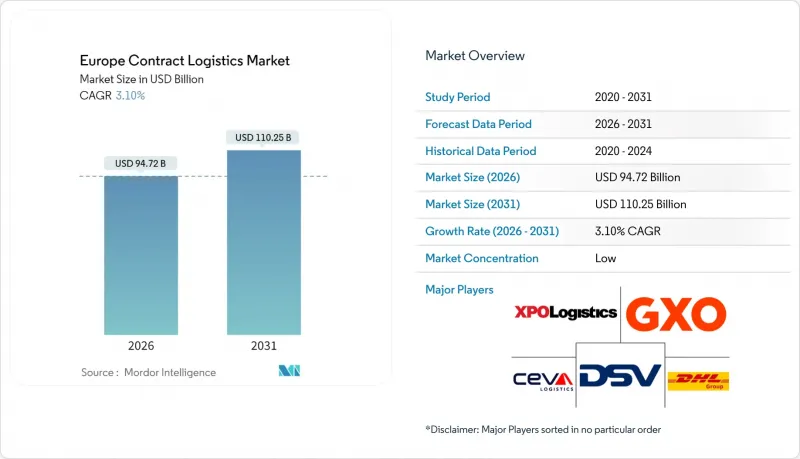
預計到 2026 年,歐洲合約物流市場規模將達到 947.2 億美元,高於 2025 年的 918.7 億美元,預計到 2031 年將達到 1,102.5 億美元。
預計從 2026 年到 2031 年,其複合年成長率將達到 3.10%。
隨著履約、供應鏈韌性增強和人工智慧驅動的最佳化等因素的出現,成熟的市場環境正穩步向加值解決方案轉型,傳統營運模式也隨之改變。東歐近岸外包正在重塑貿易走廊,歐盟「Fit for 55」計畫下的永續性目標正推動對低碳運輸資產和綠色倉庫的投資。 DSV對DB Schenker的重大收購所體現的加速整合表明,營運商正在尋求規模經濟,以應對勞動力短缺、房地產價格上漲和監管日益複雜等問題。採用機器人技術、端到端視覺化平台和靈活倉庫佈局的營運商,最有可能抓住歐洲合約物流市場下一波外包需求的浪潮。
歐洲合約物流市場趨勢與洞察
電子商務的快速成長推動了外包物流配送的履約
隨著零售商轉向輕資產模式,以靈活的倉儲合約取代固定的房地產成本,第三方物流(3PL) 營運商正抓住日益成長的電商需求。對大型物流中心的需求不斷成長,導致供應緊張,促使零售商簽訂長期租賃契約,並將日常營運外包給 3PL。為了在歐洲合約物流市場實現當日送達目標,供應商正在投資全通路分類、機器人揀選和與承運商無關的最後一公里配送網路。時尚和鞋類行業的高退貨率增加了逆向物流的複雜性,整合退貨處理已成為新契約的標配。先驅企業履約和退貨處理整合到單一技術平台上的企業,正在獲得更高的客戶留存率和溢價。
加強後疫情時代供應鏈的韌性
疫情已將韌性從成本中心提升至董事會層面的優先事項,推動了歐洲各地供應商的雙重採購、區域緩衝和多元化。將海運、陸運、鐵路和空運資訊整合到單一儀錶板的多模態視覺化系統,已成為歐洲合約物流市場競標的核心選擇標準。客戶優先考慮能夠協調多個庫存地點並在中斷期間動態重新安排貨物運輸路線的第三方物流公司。在2024年至2025年間投資建設控制塔架構的供應商報告稱,由於承運商尋求能夠為其緊急應變計劃提供數據支持的合作夥伴,其中訂單率有所提高。視覺化的重要性也延伸至環境、社會和治理(ESG)報告,即時碳排放追蹤正日益成為服務水準協議中的重要內容。
司機和倉庫工人短缺
歐洲正面臨日益嚴重的駕駛人,國際道路運輸聯盟(IRU)警告稱,到2026年,卡車司機缺口可能超過200萬人。倉庫工人離職率也加速上升,老員工退休速度遠超新進員工入職速度。薪資上漲對歐洲合約物流市場的利潤率帶來壓力,儘管營運商正透過提供入職獎金、靈活的工作安排和內部培訓機構等方式來應對。自動化可以緩解部分壓力,但前期投資和變革管理週期意味著較長的投資回報期。除非企業對其勞動力策略進行現代化改造,否則將面臨服務中斷和運能調整的風險,最終導致客戶滿意度下降。
細分市場分析
2025年,運輸服務在歐洲合約物流市場佔有率中佔比達到60.35%,主要由公路、鐵路、航空和海運驅動,為洲際貿易提供支援。然而,倉儲和配送業預計將以3.92%的複合年成長率(CAGR)實現最快成長,直至2031年,因為托運人將庫存佈局置於單純的運輸速度之上。儘管運輸業在歐洲合約物流市場仍保持強勁勢頭,但價值正向整合貨運、倉儲和輕型製造業務的打包服務轉移。預計2024年鐵路貨運量將下降0.7%,凸顯了這種運輸方式的局限性,而歐盟的目標是將其市場佔有率增加一倍。雖然道路運輸仍然是門到門運輸的主流方式,但承運商網路正在引入數位化貨運平台以實現動態路線規劃。航空貨運專注於高價值和時效性貨物,而短途海運則將地中海和波羅的海門戶與多式聯運網路連接起來。
倉儲和配送領域也出現了類似的趨勢。對人口密集區附近大型樞紐的需求與土地稀缺和嚴格的規劃法規相衝突,推高了黃金地段物業的租金。營運商正利用高層自動化、夾層機器人和暗庫配置來控制成本,並將每平方公尺的容量提高三倍。低溫運輸,尤其是對藥品和生鮮食品的運輸,進一步提高了准入的技術門檻。因此,合約中現在規定了除托盤移動之外的其他績效指標,例如揀貨準確率、逆向物流週期和微型倉配處理速度。歐洲合約物流市場的結構旨在獎勵那些能夠將房地產專業知識與先進程式工程相結合的公司。
其他福利:
- Excel格式的市場預測(ME)表
- 3個月的分析師支持
目錄
第1章 引言
- 研究假設和市場定義
- 調查範圍
第2章調查方法
第3章執行摘要
第4章 市場情勢
- 市場概覽
- 市場促進因素
- 電子商務的快速成長正在推動外包履約。
- 加強後疫情時代供應鏈韌性的措施
- 東歐製造業近岸外包
- 利用人工智慧進行倉庫和路線最佳化
- 歐盟「Fit for 55」脫碳獎勵
- 由於退貨,對整合逆向物流的需求增加。
- 市場限制
- 促進要素和倉庫工人短缺
- 分散的競爭性定價壓力
- 符合ESG標準的倉庫房地產成本飆升
- 複雜的多國海關和增值稅合規
- 價值/供應鏈分析
- 監管環境
- 技術展望
- 波特五力模型
- 新進入者的威脅
- 買方的議價能力
- 供應商的議價能力
- 替代品的威脅
- 激烈的競爭
- 電子商務(國內和跨境)洞察
- 售後服務/逆向物流洞察
- 英國脫歐的影響
- 新冠疫情與地緣政治事件的影響
第5章 市場規模與成長預測
- 按服務類型
- 運輸
- 道路運輸
- 鐵路
- 航空
- 海上運輸
- 倉儲/配送
- 附加價值服務(組裝、貼標、套件包裝)
- 運輸
- 按合約期限
- 1-3年
- 3年或以上
- 按最終用戶行業分類
- 製造業和汽車業
- 食品/飲料
- 零售與電子商務
- 醫療和藥品
- 化學品
- 其他行業
- 按國家/地區
- 德國
- 英國
- 法國
- 義大利
- 西班牙
- 荷蘭
- 波蘭
- 比利時
- 瑞典
- 其他歐洲地區
第6章 競爭情勢
- 市場集中度
- 策略性舉措(併購、合資、創新)
- 市佔率分析
- 公司簡介
- Deutsche Post DHL Group
- DSV
- GXO Logistics
- XPO Logistics
- CEVA Logistics
- Geodis
- Kuehne+Nagel
- Rhenus Logistics
- ID Logistics
- Hellmann Worldwide Logistics
- DACHSER
- United Parcel Service(UPS SCS)
- Neovia Logistics
- FIEGE Logistik Stiftung & Co. KG
- Savino Del Bene
- Rohlig Logistics
- BLG Logistics Group
- Groupe BBL
- Raben Group
- Noerpel Group
第7章 市場機會與未來展望
第8章附錄
- 各行業對GDP的貢獻
- 資金流分析
- 貿易統計
- 主要進出口路線
The Europe Contract Logistics Market size in 2026 is estimated at USD 94.72 billion, growing from 2025 value of USD 91.87 billion with 2031 projections showing USD 110.25 billion, growing at 3.10% CAGR over 2026-2031.
The mature landscape is steadily pivoting toward value-added solutions as e-commerce fulfillment, supply-chain resilience, and AI-enabled optimization transform traditional operating models. Nearshoring into Eastern Europe is redrawing trade corridors, while sustainability targets under the EU Fit for 55 package amplify investment in low-carbon transport assets and green warehousing. Intensifying consolidation-exemplified by DSV's recent mega-acquisition of DB Schenker-shows providers chasing economies of scale to blunt labor shortages, real-estate inflation, and regulatory complexity. Providers that embed robotics, end-to-end visibility platforms, and flexible warehousing footprints are best placed to capture the next wave of outsourced demand across the Europe contract logistics market.
Europe Contract Logistics Market Trends and Insights
E-commerce Boom Accelerates Outsourced Fulfillment
Third-party logistics (3PL) operators are capturing rising e-commerce volumes as retailers shift toward asset-light models that trade fixed real-estate costs for flexible warehousing contracts. Demand for XXL distribution centers has tightened availability, prompting retailers to secure long leases while outsourcing day-to-day operations to 3PLs. Providers are investing in omnichannel sortation, robotic picking, and carrier-agnostic last-mile networks to achieve same-day delivery targets across the Europe contract logistics market. High return rates in fashion and footwear elevate reverse-logistics complexity, making integrated returns processing a standard feature of new contracts. Early movers that bundle fulfillment and returns under one technology stack enhance customer stickiness and unlock premium pricing.
Post-COVID Supply-Chain Resilience Initiatives
The pandemic reframed resilience from a cost center to a board-level priority, driving dual-sourcing, regional buffers, and supplier diversification across Europe. Multimodal visibility systems that consolidate ocean, road, rail, and air events into a single dashboard are now core selection criteria when tendering for Europe contract logistics market contracts. Customers prioritize 3PLs capable of orchestrating parallel inventory locations and dynamically rerouting freight during disruption. Providers that invested in control-tower architectures in 2024-2025 report win-rate uplifts as shippers seek data-rich partners able to evidence contingency playbooks. The visibility imperative extends to ESG reporting, with real-time carbon tracking increasingly written into service-level agreements.
Driver & Warehouse-Labor Shortages
Europe faces a looming shortfall of professional truck drivers, with the International Road Transport Union warning that vacancies could top 2 million by 2026. Warehouse attrition has accelerated as aging workforces retire faster than recruits enter the sector. Operators respond through signing bonuses, flexible schedules, and in-house training academies, but wage inflation squeezes margins in the Europe contract logistics market. Automation offsets some pressure, yet up-front capex and change-management cycles lengthen payback periods. Service disruptions and capacity rationing risk eroding customer satisfaction unless workforce strategies are modernized.
Other drivers and restraints analyzed in the detailed report include:
- Eastern Europe Near-Shoring of Manufacturing
- AI-Driven Warehouse & Route Optimization
- Fragmented Competitive Pricing Pressure
For complete list of drivers and restraints, kindly check the Table Of Contents.
Segment Analysis
Transportation services captured 60.35% of the Europe contract logistics market share in 2025 as road, rail, air, and sea movements underpin continental trade. Yet Warehousing & Distribution is growing fastest at 3.92% CAGR to 2031 as shippers prioritize inventory positioning over pure transit speed. The Europe contract logistics market size allocated to Transportation remains healthy, but value is shifting toward integrated bundles that combine freight, storage, and light manufacturing tasks. Rail freight slipped 0.7% in 2024, underscoring modal constraints despite EU ambitions to double its share. Road continues to dominate door-to-door flows, although carrier networks now embed digital freight platforms for dynamic routing. Air freight retains a niche, serving high-value or time-critical goods, while short-sea lanes link Mediterranean and Baltic gateways into wider multimodal offerings.
A parallel narrative unfolds in Warehousing & Distribution. Demand for XXL hubs near population centers collides with scarce land and stricter zoning, inflating prime rents. Operators mitigate costs by adopting high-bay automation, mezzanine robotics, and dark-store configurations that triple throughput per square meter. Cold-chain extensions support pharmaceuticals and fresh food, deepening technical barriers to entry. Consequently, contracts now stipulate performance metrics beyond pallet moves, tracking pick accuracy, reverse-logistics cycles, and micro-fulfillment turnaround. The Europe contract logistics market thus rewards firms able to marry real-estate acumen with advanced process engineering.
The Europe Contract Logistics Market Report is Segmented by Service Type (Transportation, Warehousing & Distribution, and Value-Added Services), Contract Duration (1-3 Years and Above 3 Years), End-User Industry (Manufacturing & Automotive, Retail & E-Commerce, Healthcare & Pharmaceuticals, and More), Country (Germany, United Kingdom, France, Italy, Spain, and More). The Market Forecasts are Provided in Terms of Value (USD).
List of Companies Covered in this Report:
- Deutsche Post DHL Group
- DSV
- GXO Logistics
- XPO Logistics
- CEVA Logistics
- Geodis
- Kuehne + Nagel
- Rhenus Logistics
- ID Logistics
- Hellmann Worldwide Logistics
- DACHSER
- United Parcel Service (UPS SCS)
- Neovia Logistics
- FIEGE Logistik Stiftung & Co. KG
- Savino Del Bene
- Rohlig Logistics
- BLG Logistics Group
- Groupe BBL
- Raben Group
- Noerpel Group
Additional Benefits:
- The market estimate (ME) sheet in Excel format
- 3 months of analyst support
TABLE OF CONTENTS
1 Introduction
- 1.1 Study Assumptions & Market Definition
- 1.2 Scope of the Study
2 Research Methodology
3 Executive Summary
4 Market Landscape
- 4.1 Market Overview
- 4.2 Market Drivers
- 4.2.1 E-commerce boom accelerates outsourced fulfilment
- 4.2.2 Post-COVID supply-chain resilience initiatives
- 4.2.3 Eastern-Europe near-shoring of manufacturing
- 4.2.4 AI-driven warehouse & route optimisation
- 4.2.5 EU "Fit-for-55" decarbonisation incentives
- 4.2.6 Integrated reverse-logistics demand from returns
- 4.3 Market Restraints
- 4.3.1 Driver & warehouse-labour shortages
- 4.3.2 Fragmented competitive pricing pressure
- 4.3.3 Surging ESG-compliant warehouse real-estate costs
- 4.3.4 Complex multi-country customs / VAT compliance
- 4.4 Value / Supply-Chain Analysis
- 4.5 Regulatory Landscape
- 4.6 Technological Outlook
- 4.7 Porter's Five Forces
- 4.7.1 Threat of New Entrants
- 4.7.2 Bargaining Power - Buyers
- 4.7.3 Bargaining Power - Suppliers
- 4.7.4 Threat of Substitutes
- 4.7.5 Intensity of Rivalry
- 4.8 E-commerce (Domestic & Cross-border) Insights
- 4.9 After-sales / Reverse-logistics Insights
- 4.10 Brexit Implications
- 4.11 Impact of COVID-19 & Geo-Political Events
5 Market Size & Growth Forecasts
- 5.1 By Service Type
- 5.1.1 Transportation
- 5.1.1.1 Road
- 5.1.1.2 Rail
- 5.1.1.3 Air
- 5.1.1.4 Sea
- 5.1.2 Warehousing & Distribution
- 5.1.3 Value-added Services (Assembly, Labelling, Kitting)
- 5.1.1 Transportation
- 5.2 By Contract Duration
- 5.2.1 1 - 3 Years
- 5.2.2 Above 3 years
- 5.3 By End-user Industry
- 5.3.1 Manufacturing & Automotive
- 5.3.2 Food & Beverage
- 5.3.3 Retail & E-commerce
- 5.3.4 Healthcare & Pharmaceuticals
- 5.3.5 Chemicals
- 5.3.6 Other Industries
- 5.4 By Country
- 5.4.1 Germany
- 5.4.2 United Kingdom
- 5.4.3 France
- 5.4.4 Italy
- 5.4.5 Spain
- 5.4.6 Netherlands
- 5.4.7 Poland
- 5.4.8 Belgium
- 5.4.9 Sweden
- 5.4.10 Rest of Europe
6 Competitive Landscape
- 6.1 Market Concentration
- 6.2 Strategic Moves (M&A, JV, Innovation)
- 6.3 Market Share Analysis
- 6.4 Company Profiles {(includes Global level Overview, Market level overview, Core Segments, Financials as available, Strategic Information, Market Rank/Share for key companies, Products & Services, and Recent Developments)}
- 6.4.1 Deutsche Post DHL Group
- 6.4.2 DSV
- 6.4.3 GXO Logistics
- 6.4.4 XPO Logistics
- 6.4.5 CEVA Logistics
- 6.4.6 Geodis
- 6.4.7 Kuehne + Nagel
- 6.4.8 Rhenus Logistics
- 6.4.9 ID Logistics
- 6.4.10 Hellmann Worldwide Logistics
- 6.4.11 DACHSER
- 6.4.12 United Parcel Service (UPS SCS)
- 6.4.13 Neovia Logistics
- 6.4.14 FIEGE Logistik Stiftung & Co. KG
- 6.4.15 Savino Del Bene
- 6.4.16 Rohlig Logistics
- 6.4.17 BLG Logistics Group
- 6.4.18 Groupe BBL
- 6.4.19 Raben Group
- 6.4.20 Noerpel Group
7 Market Opportunities & Future Outlook
- 7.1 White-space & Unmet-need Assessment
8 Appendix
- 8.1 GDP Contribution by Industry
- 8.2 Capital-flow Insights
- 8.3 External-trade Statistics
- 8.4 Key Import / Export Corridors

 全球合約物流市場(2026 年)
 南美洲合約物流:市場佔有率分析、產業趨勢與統計及成長預測(2026-2031 年)
 合約物流市場:按服務、類型、運輸方式、行業和地區分類
 2026年全球合約物流市場報告
 合約物流市場規模、佔有率、成長及全球產業分析:按類型、應用和地區分類的洞察,2026-2034 年預測
 合約物流市場:2026-2032年全球市場預測(依服務類型、貨物類型、運輸方式、客戶規模及最終用途分類)亞太地區合約物流:市場佔有率分析、產業趨勢與統計、成長預測(2026-2031)北美合約物流:市場佔有率分析、產業趨勢與統計、成長預測(2026-2031)
 日本合約物流市場報告(按類型(內部物流、外部物流)、最終用戶(汽車、消費品和零售、能源、高科技和醫療保健、工業和航太、技術及其他)和地區分類,2026-2034 年)
 合約物流市場規模及預測 2021 - 2031、全球及地區佔有率、趨勢及成長機會分析報告涵蓋範圍:按類型、服務類型、最終用戶及地理分類