


 |
市場調查報告書
商品編碼
2124010
英國合約物流:市場佔有率分析、產業趨勢與統計及成長預測(2026-2031)United Kingdom Contract Logistics - Market Share Analysis, Industry Trends & Statistics, Growth Forecasts (2026 - 2031) |
||||||

※ 本網頁內容可能與最新版本有所差異。詳細情況請與我們聯繫。
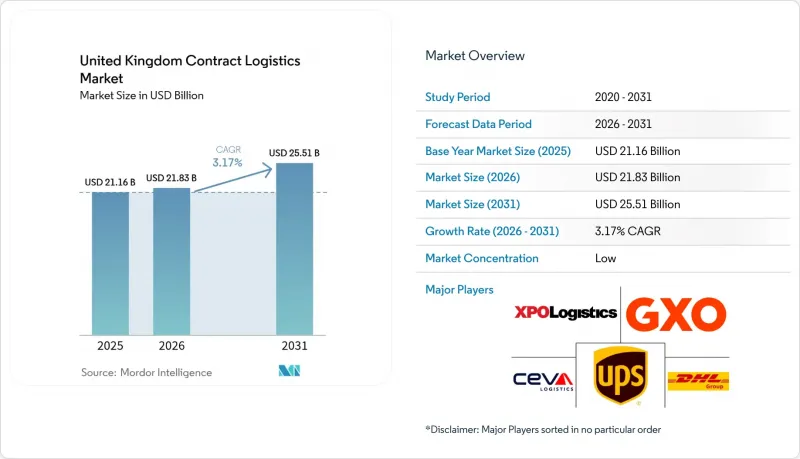
據 Mordor Intelligence 稱,英國合約物流市場預計到 2026 年價值 218.3 億美元,高於 2025 年的 211.6 億美元,預計到 2031 年將達到 255.1 億美元。
預計 2026 年至 2031 年的複合年成長率為 3.17%。
本報告按服務類型(運輸、倉儲和配送、附加價值服務)、合約期間(1-3年和3年以上)、最終用戶行業(製造業和汽車業、零售和電子商務、醫療保健和製藥業、其他)以及地區(英格蘭、蘇格蘭、威爾斯和北愛爾蘭)進行細分。市場預測以美元計價。
英國合約物流市場的趨勢與洞察
電子商務小包裹數量的激增正在加速對履約基礎設施的需求。
隨著線上零售量的成長,小包裹遞送網路也不斷擴張,都市區微型樞紐和大規模自動化履約中心相繼投入使用。亞馬遜宣布,到2027年將在英國投資500億美元,用於建造四個新的區域性設施,以縮短「最後一公里」的配送時間。倫敦的一個試點微型樞紐在九個月內成功減少了每天多達12輛柴油貨車的使用,並減少了4,186公斤的二氧化碳排放,展現了其商業性和環境的雙重價值。隨著食品雜貨和時尚連鎖店將營運外包給第三方物流(3PL)公司,到2030年,在地化履約方面的支出可能達到55億美元。由於更短的配送週期已成為衡量服務品質的關鍵標準,合約物流供應商正面臨擴大當日達配送能力的壓力。面對日益成長的小包裹密度,英國合約物流市場正在透過最佳化都市區路線和投資電動配送車輛來應對這項挑戰,以滿足城市排放法規的要求。
倉庫自動化和整合正在改變營運效率。
機器人技術、人工智慧和數位孿生技術如今已成為倉庫設計的核心。 Ocado位於盧頓的倉庫便是這一轉變的鮮明例證,其機械臂已處理了15%的貨物,併計劃在幾年內將這一比例提升至70%。政府平均為每家物流公司提供38,315美元的人工智慧津貼,凸顯了英國對自動化的高度重視。數位孿生平台能夠持續監控空間利用率和流程,從而縮短新設施運作的時間。機器人即服務(RaaS)訂閱協議降低了前期投資,使中型企業能夠採用先進的自動化技術。預測分析能夠改善人員配置規劃,鑑於目前司機和揀貨員的持續短缺,這無疑是一項至關重要的優勢。這些投資增強了長期合約的價值提案,並推動英國合約物流市場轉型為數據驅動的服務模式。
司機和倉庫工人嚴重短缺,限制了營運能力。
2024年第一季,重型貨車司機短缺率達19%,主要原因是退休潮和與其他行業的薪資競爭。英國脫歐抑制了歐盟司機的湧入,疫情導致提前退休,使得在小包裹量激增之際,熟練工人數量減少。格蘭特桑頓會計師事務所也指出,燃油價格上漲和通貨膨脹進一步加劇了薪資成長空間受限的困境。物流業僱用了英國8%的勞動力,但儘管實施了學徒制和技能發展計劃,關鍵職位的招聘仍然困難重重。自動化可以減輕部分壓力,但其實施需要時間和資金。短期來看,勞動力短缺正在限制英國合約物流市場的產能,並推高營運成本。
細分市場分析
預計到2025年,運輸服務將佔總收入的60.45%,反映出英國合約物流市場對可靠的多模態網路的持續強勁需求。受中國長途進口量增加的推動,2024年海運量成長4%,達到6,070萬噸。同時,杜拜環球港務集團(DP World)在倫敦門戶港投資13億美元的擴建計畫正在提升泊位容量並引進全電動起重機。道路運輸仍然佔據核心地位,但都市區排放氣體法規和司機短缺迫使營運商轉向替代燃料和路線最佳化平台。英國皇家郵政的退出降低了鐵路運輸能力,加重了港口周邊公路和倉庫的負擔。
儘管附加價值服務目前規模仍然相對較小,但隨著品牌商擴大將包裝、套件組裝和客製化外包,其複合年成長率 (CAGR) 已達到 3.28%。 GXO 為食品雜貨和電商客戶提供最終組裝和冷鏈包裝管理服務,是整合解決方案如何減輕托運人工作量的絕佳例證。機器人技術的引入實現了最終階段的客製化,使企業能夠在不影響處理能力的前提下滿足行銷需求。隨著環境、社會和治理 (ESG) 報告要求的日益嚴格,供應商正透過將包裝重新設計與減少廢棄物分析相結合來提供差異化價值。這種發展勢頭表明,在整個預測期內,附加價值服務在英國合約物流市場的佔有率將不斷擴大。
其他好處:
- Excel格式的市場預測(ME)表
- 3個月的分析師支持
目錄
第1章:引言
- 研究假設和市場定義
- 調查範圍
第2章:調查方法
第3章執行摘要
第4章 市場狀況
- 市場概覽
- 市場促進因素
- 電子商務帶來的小包裹數量激增
- 倉庫自動化與數位孿生
- 端到端供應鏈可視性的需求
- 英國脫歐後海關清關業務的整合
- 受城市地區房地產成本飆升的推動,零售商紛紛將微型倉配業務外包。
- 醫藥和食品產業冷鏈的擴展
- 市場限制因素
- 駕駛人和倉庫工人嚴重短缺
- 老舊公路和鐵路基礎設施的運輸能力
- 都市區交通壅塞收費不斷上漲
- ESG合規成本負擔加重
- 價值供應鏈分析
- 監理情勢
- 技術展望
- 波特五力模型
- 洞察:電子商務(國內和跨境)
- 逆向物流洞察
- 英國脫歐對物流的影響
- 新冠疫情與地緣政治事件的影響
第5章 市場規模與成長預測
- 按服務類型
- 運輸
- 路
- 鐵路
- 航空
- 海
- 倉儲/物流
- 附加價值服務(組裝、貼標、套件包裝)
- 運輸
- 按合約期限
- 1-3年
- 3年或以上
- 按最終用戶行業分類
- 製造業/汽車
- 食品/飲料
- 零售與電子商務
- 醫療和藥品
- 化學品
- 其他行業
- 按地區
- 英格蘭
- 蘇格蘭
- 威爾斯
- 北愛爾蘭
第6章 競爭情勢
- 市場集中度
- 策略趨勢
- 市佔率分析
- 公司簡介
- DHL Supply Chain
- XPO Logistics
- UPS SCS
- GXO Logistics
- CEVA Logistics
- DSV
- Kuehne+Nagel
- FedEx Supply Chain
- Rhenus Logistics
- EV Cargo
- Eddie Stobart Logistics
- Yusen Logistics
- Howard Tenens
- Great Bear Distribution
- Kinaxia Logistics
- Hellmann Worldwide Logistics
- Savino Del Bene
- Rohlig Logistics
- Premier Logistics
- Noatum Logistics
第7章 市場機會與未來展望
According to Mordor Intelligence, the United Kingdom contract logistics market size market size in 2026 is estimated at USD 21.83 billion, growing from 2025 value of USD 21.16 billion with 2031 projections showing USD 25.51 billion, growing at 3.17% CAGR over 2026-2031.
This report is Segmented by Service Type (Transportation, Warehousing & Distribution, and Value-Added Services), Contract Duration (1-3 Years and Above 3 Years), End-User Industry (Manufacturing & Automotive, Retail & E-Commerce, Healthcare & Pharmaceuticals, and More), and Region (England, Scotland, Wales, and Northern Ireland). The Market Forecasts are Provided in Terms of Value (USD).
United Kingdom Contract Logistics Market Trends and Insights
E-commerce Parcel Surge Accelerates Fulfilment Infrastructure Demand
Online retail volumes have pushed parcel networks to add urban microhubs and larger automated fulfillment centers. Amazon's announced USD 50 billion UK investment through 2027 funds four new regional facilities that shorten last-mile distances. Pilot microhubs in London removed up to 12 diesel vans per day and cut 4,186 kg CO2 in nine months, proving both commercial and environmental value. Localized fulfillment spending could top USD 5.5 billion by 2030 as grocery and fashion chains outsource the task to 3PL specialists. Faster cycle times are becoming a decisive service benchmark, prompting contract logistics providers to expand same-day capabilities. As parcel density grows, the United Kingdom contract logistics market responds by optimizing urban routes and investing in electric delivery fleets to meet city emission rules.
Warehouse Automation Integration Transforms Operational Efficiency
Robotics, AI, and digital twins are now central to warehouse design. Ocado's Luton site illustrates the shift, with robotic arms already handling 15% of items and targeting 70% within a few years. Government AI grants averaging USD 38,315 per logistics firm underscore national priorities for automation. Digital-twin platforms allow continuous monitoring of space utilization and process flows, cutting commissioning time for new facilities. Robotics-as-a-Service subscriptions lower upfront capital outlays, bringing advanced automation within reach of mid-sized operators. Predictive analytics improves labor scheduling, a critical advantage amid driver and picker shortages. These investments reinforce the value proposition of long-term contracts and push the United Kingdom contract logistics market toward data-driven service models.
Acute Driver and Warehouse Labor Shortages Constrain Operational Capacity
Heavy-goods-vehicle driver vacancies reached 19% in Q1 2024, driven by retirements and pay competition from other sectors. Brexit curtailed EU driver inflows while the pandemic prompted early retirements, cutting available skills just as parcel volumes surged. Grant Thornton notes additional headwinds, such as high fuel prices and inflation, that limit wage headroom. Logistics employs 8% of the national workforce, yet critical hands-on roles remain hard to fill despite apprenticeships and upskilling schemes. Automation eases some strain, but adoption takes time and capital. In the near term, limited labor availability caps throughput and increases operating costs in the United Kingdom contract logistics market.
Other drivers and restraints analyzed in the detailed report include:
- Post-Brexit Customs Brokerage Integration Elevates Service Complexity
- Cold-Chain Infrastructure Expansion Supports Pharmaceutical Growth
- Aging Infrastructure Capacity Limits Growth Potential
For complete list of drivers and restraints, kindly check the Table Of Contents.
Segment Analysis
Transportation services generated 60.45% of 2025 revenue, reflecting the enduring need for reliable multimodal links in the United Kingdom contract logistics market. Sea freight tonnage grew 4% to 60.7 million tons in 2024, boosted by deep-sea imports from China, while DP World's USD 1.3 billion London Gateway expansion adds berth capacity and full-electric cranes. Road remains the backbone, yet urban emission rules and driver shortages push operators toward alternative fuels and route optimization platforms. Rail capacity suffers after Royal Mail's withdrawal, adding pressure on highways and warehousing near ports.
Value-added services, though smaller, post a 3.28% CAGR as brands outsource packaging, kitting, and customization. GXO manages end-of-line assembly and cold-chain packing for grocery and e-commerce clients, illustrating how integrated solutions lighten shipper workloads. Robotics enables late-stage customization, meeting marketing needs without slowing throughput. As ESG reporting grows stricter, providers bundle packaging redesign with waste reduction analytics, offering differentiated value. This momentum positions value-added operations to capture incremental share in the United Kingdom contract logistics market over the forecast horizon.
Complete Report Scope:
- By Service Type
- Transportation
- Road
- Rail
- Air
- Sea
- Warehousing & Distribution
- Value-added Services (Assembly, Labelling, Kitting)
- Transportation
- By Contract Duration
- 1 - 3 Years
- Above 3 years
- By End-user Industry
- Manufacturing & Automotive
- Food & Beverage
- Retail & E-commerce
- Healthcare & Pharmaceuticals
- Chemicals
- Other Industries
- By Region
- England
- Scotland
- Wales
- Northern Ireland
List of Companies Covered in this Report:
- DHL Supply Chain
- XPO Logistics
- UPS SCS
- GXO Logistics
- CEVA Logistics
- DSV
- Kuehne + Nagel
- FedEx Supply Chain
- Rhenus Logistics
- EV Cargo
- Eddie Stobart Logistics
- Yusen Logistics
- Howard Tenens
- Great Bear Distribution
- Kinaxia Logistics
- Hellmann Worldwide Logistics
- Savino Del Bene
- Rohlig Logistics
- Premier Logistics
- Noatum Logistics
Additional Benefits:
- The market estimate (ME) sheet in Excel format
- 3 months of analyst support
TABLE OF CONTENTS
1 Introduction
- 1.1 Study Assumptions & Market Definition
- 1.2 Scope of the Study
2 Research Methodology
3 Executive Summary
4 Market Landscape
- 4.1 Market Overview
- 4.2 Market Drivers
- 4.2.1 E-commerce parcel surge
- 4.2.2 Warehouse automation & digital twins
- 4.2.3 End-to-end supply-chain visibility demand
- 4.2.4 Post-Brexit customs brokerage integration
- 4.2.5 Retailer micro-fulfilment outsourcing amid soaring urban real-estate costs
- 4.2.6 Cold-chain expansion for pharma & food
- 4.3 Market Restraints
- 4.3.1 Acute driver & warehouse-labour shortages
- 4.3.2 Ageing road & rail infrastructure capacity
- 4.3.3 Urban congestion-charge escalation
- 4.3.4 Rising ESG-compliance cost burden
- 4.4 Value / Supply-Chain Analysis
- 4.5 Regulatory Landscape
- 4.6 Technological Outlook
- 4.7 Porter's Five Forces
- 4.7.1 Bargaining Power of Suppliers
- 4.7.2 Bargaining Power of Buyers
- 4.7.3 Threat of New Entrants
- 4.7.4 Threat of Substitutes
- 4.7.5 Intensity of Competitive Rivalry
- 4.8 Insights: E-commerce (Domestic & Cross-border)
- 4.9 Insights on Reverse Logistics
- 4.10 Impact of Brexit on the Logistics
- 4.11 Impact of COVID-19 and Geo-Political Events
5 Market Size & Growth Forecasts
- 5.1 By Service Type
- 5.1.1 Transportation
- 5.1.1.1 Road
- 5.1.1.2 Rail
- 5.1.1.3 Air
- 5.1.1.4 Sea
- 5.1.2 Warehousing & Distribution
- 5.1.3 Value-added Services (Assembly, Labelling, Kitting)
- 5.1.1 Transportation
- 5.2 By Contract Duration
- 5.2.1 1 - 3 Years
- 5.2.2 Above 3 years
- 5.3 By End-user Industry
- 5.3.1 Manufacturing & Automotive
- 5.3.2 Food & Beverage
- 5.3.3 Retail & E-commerce
- 5.3.4 Healthcare & Pharmaceuticals
- 5.3.5 Chemicals
- 5.3.6 Other Industries
- 5.4 By Region
- 5.4.1 England
- 5.4.2 Scotland
- 5.4.3 Wales
- 5.4.4 Northern Ireland
6 Competitive Landscape
- 6.1 Market Concentration
- 6.2 Strategic Moves
- 6.3 Market Share Analysis
- 6.4 Company Profiles (includes Global level Overview, Market level overview, Core Segments, Financials as available, Strategic Information, Market Rank/Share for key companies, Products & Services, and Recent Developments)
- 6.4.1 DHL Supply Chain
- 6.4.2 XPO Logistics
- 6.4.3 UPS SCS
- 6.4.4 GXO Logistics
- 6.4.5 CEVA Logistics
- 6.4.6 DSV
- 6.4.7 Kuehne + Nagel
- 6.4.8 FedEx Supply Chain
- 6.4.9 Rhenus Logistics
- 6.4.10 EV Cargo
- 6.4.11 Eddie Stobart Logistics
- 6.4.12 Yusen Logistics
- 6.4.13 Howard Tenens
- 6.4.14 Great Bear Distribution
- 6.4.15 Kinaxia Logistics
- 6.4.16 Hellmann Worldwide Logistics
- 6.4.17 Savino Del Bene
- 6.4.18 Rohlig Logistics
- 6.4.19 Premier Logistics
- 6.4.20 Noatum Logistics
7 Market Opportunities & Future Outlook
- 7.1 White-space & Unmet-need Assessment

 印度合約物流:市場佔有率分析、產業趨勢與統計及成長預測(2026-2031)德國合約物流:市場佔有率分析、產業趨勢與統計及成長預測(2026-2031)美國合約物流:市場佔有率分析、行業趨勢和統計數據、成長預測(2026-2031)
 全球合約物流市場(2026 年)南美洲合約物流:市場佔有率分析、產業趨勢與統計及成長預測(2026-2031 年)
 合約物流市場:按服務、類型、運輸方式、行業和地區分類
 2026年全球合約物流市場報告
 合約物流市場規模、佔有率、成長及全球產業分析:按類型、應用和地區分類的洞察,2026-2034 年預測
 合約物流市場:2026-2032年全球市場預測(依服務類型、貨物類型、運輸方式、客戶規模及最終用途分類)亞太地區合約物流:市場佔有率分析、產業趨勢與統計、成長預測(2026-2031)