


 |
市場調查報告書
商品編碼
2114841
德國合約物流:市場佔有率分析、產業趨勢與統計及成長預測(2026-2031)Germany Contract Logistics - Market Share Analysis, Industry Trends & Statistics, Growth Forecasts (2026 - 2031) |
||||||

※ 本網頁內容可能與最新版本有所差異。詳細情況請與我們聯繫。
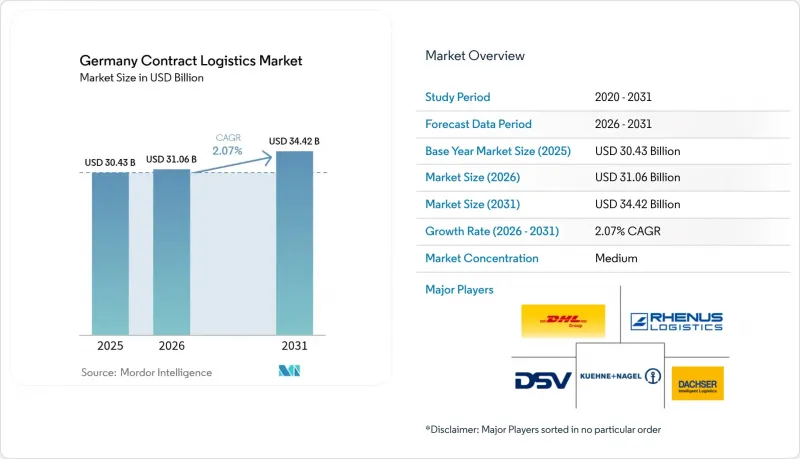
根據 Mordor Intelligence 估計,德國合約物流市場在 2026 年的價值將達到 310.6 億美元,高於 2025 年的 304.3 億美元,預計到 2031 年將達到 344.2 億美元。
預計 2026 年至 2031 年的複合年成長率為 2.07%。
本報告按服務類型(運輸管理、倉儲物流及其他)、終端用戶行業(消費品和零售、醫療保健及其他)、合約期限(短期和長期)以及地區(北萊茵-威斯特法倫州、漢堡-石勒蘇益格-荷爾斯泰因州及其他)進行細分。報告提供了上述所有細分市場的規模和預測(以美元計)。
德國合約物流市場的趨勢與洞察
電子商務的加速發展導致小包裹處理量增加。
如今,B2C電子商務已滲透到74%的德國消費者中,履約和最後一公里配送量達到歷史新高,並提升了外包給第三方物流(3PL)公司的吸引力,因為這些公司能夠擴展自動化和全通路能力。小包裹的高度集中,尤其是在魯爾區和柏林大都會圈,使得路線最佳化和單件配送成本降低成為可能,促使零售商在德國的合約物流市場簽訂多年訂單履約合約。機器人和「貨到人」系統正在縮短從訂單到出貨的周期,並支持「當日送達」的承諾,這已成為時尚和家電經銷商的差異化優勢。
向電動車的轉變將重塑入境旅遊模式。
德國仍然是歐洲最大的汽車生產國,但隨著平台電氣化,高價值電池模組和危險品的處理也納入了入境的準時制 (JIT) 和順序制 (JIS) 物流體系中。巴伐利亞州和巴登-符騰堡州組裝廠附近的專用定序中心正在擴張,能夠保證符合 ISO 45001 和 ADR 標準的供應商正在贏得多工廠合約。由於整車製造商 (OEM) 將資金集中於電池生產線而非倉儲用地面積,這種複雜性正在增加德國合約物流市場的外包程度。
人手不足推高了營運成本。
2024年,德國司機和倉庫工人的職缺數量約為50萬個,司機的平均年齡上升至47.2歲,導致法定薪資上漲3.42%。德國合約物流市場的供應商正在投資培訓機構並實施靈活的工作安排,但人手不足正在影響成本基礎,並限制旺季的處理能力。
細分市場分析
到2025年,倉儲和配送業務將佔德國合約物流市場收入的43.60%,這主要得益於沿線規劃建設的大規模越庫作業設施和區域履約中心。該業務受益於密集的公路、鐵路和內河航運網路,這些網路縮短了西歐消費市場的前置作業時間。然而,土地和人手不足帶來的成本壓力正在推動自動化技術的快速普及。自主移動機器人將負責小型包裹的揀選和放置,而自動化倉庫系統(AS/RS)將提高托盤密度,從而將處理能力提升25%,並促進有限占地面積的有效利用。
從套件組裝、包裝到最終組裝等附加價值服務預計將以3.92%的複合年成長率成長,超過德國整體合約物流市場的成長速度。客戶,尤其是消費性電子和工業機械產業的客戶,越來越需要更貼近市場的配置方案,以降低庫存風險並加快產品上市速度。這些專業服務的利潤率比基礎倉儲高出200-300個基點,供應商正在利用數位孿生技術在部署實體資產之前對流程進行建模。因此,小規模企業面臨越來越大的壓力,需要投資技能和技術,或與大型第三方物流公司合作。
其他好處:
- Excel格式的市場預測(ME)表
- 3個月的分析師支持
目錄
第1章:引言
- 研究假設和市場定義
- 調查範圍
第2章:調查方法
第3章執行摘要
第4章 市場狀況
- 市場概覽
- 市場促進因素
- B2C電子商務的加速成長導致全國小包裹和履約量增加。
- 汽車製造商向電動車和電池生產轉型,增加了德國境內入境制/即時制物流的複雜性。
- 《供應鏈實質審查法》強制要求實現可審計的端到端可視性,迫使製造商將業務外包給法規的第三方物流公司。
- 隨著日本製藥和生物技術製造地的擴張,對符合GDP標準的低溫運輸物流解決方案的需求日益成長。
- 倉庫中機器人和人工智慧的快速普及正在提高生產力並降低單位成本,從而促進長期第三方物流合約的簽訂。
- 企業脫碳目標正在推動對由第三方物流 (3PL) 管理的綠色物流的需求(電池電動卡車、向多模態轉型)。
- 市場限制因素
- 全國範圍內卡車駕駛人和倉庫工人長期短缺,導致工資上漲,並限制了加工能力。
- 用於物流的黃金地段租金租金飆升,加上土地短缺,導致承包物流公司的營運成本不斷上升。
- 更嚴格的排放氣體法規(歐VII標準、都市區的低排放氣體區)增加了車輛合規和改裝的相關成本。
- 在工業生產成長乏力、消費者信心波動的情況下,通膨導致的成本上升給物流利潤率帶來了壓力。
- 價值供應鏈分析
- 主要政府法規和舉措
- 技術概覽(物聯網、人工智慧等)
- 波特五力模型
- 電子商務合約物流洞察
- 逆向物流/售後服務
- 分析地緣政治事件對市場的影響
第5章 市場規模與成長預測
- 按服務
- 運輸管理
- 路
- 鐵路
- 航空
- 海
- 倉儲/物流
- 低溫運輸/溫度控制
- 非低溫運輸/非溫控
- 附加價值服務(套件組裝、包裝、組裝等)
- 運輸管理
- 按最終用戶行業分類
- 製造業/汽車
- 消費品和零售(包括電子商務)
- 高科技電子產品
- 醫療和藥品
- 石油、天然氣和化學品
- 其他最終用戶
- 按合約期限
- 短期(不足1年)
- 長期(超過1年)
- 按地區
- 北萊茵-威斯特法倫州
- 漢堡與石勒蘇益格-荷爾斯泰因州
- 下薩克森州和不來梅州
- 黑森/萊茵-美因地區
- 巴伐利亞
- 巴登-符騰堡州
- 萊茵蘭-普法爾茨州和薩爾州
- 東德(柏林、布蘭登堡、薩克森、薩克森-安哈特、圖林根)
第6章 競爭情勢
- 市場集中度
- 策略趨勢
- 市佔率分析
- 公司簡介
- DHL Supply Chain and Global Forwarding
- Dachser SE
- Kuehne+Nagel
- Rhenus Logistics
- DSV Solutions
- Hellmann Worldwide Logistics
- BLG Logistics Group
- Yusen Logistics
- CEVA Logistics
- APL Logistics
- GXO Logistics
- Fiege Logistik
- GEODIS
- UPS Supply Chain Solutions
- FedEx Supply Chain
- DPD Group(GeoPost)
- Arvato Supply Chain Solutions
- Loxxess AG
- Pfenning Logistics
- Simon Hegele Logistics
- Hermes Fulfilment GmbH
第7章 市場機會與未來展望
According to Mordor Intelligence, Germany contract logistics market size in 2026 is estimated at USD 31.06 billion, growing from 2025 value of USD 30.43 billion with 2031 projections showing USD 34.42 billion, growing at 2.07% CAGR over 2026-2031.
This report is Segmented by Service (Transportation Management, Warehouse and Distribution, and More), by End-User Industry (Consumer Goods and Retail, Healthcare and More), by Contract Duration (Short-Term and Long Term), and by Geography (North Rhine-Westphalia, Hamburg and Schleswig-Holstein, and More). The Report Offers Market Size and Forecasts in Value (USD) for all the Above Segments.
Germany Contract Logistics Market Trends and Insights
Accelerating e-commerce amplifies parcel volumes
B2C e-commerce now reaches 74% of German consumers and pushes fulfilment and last-mile traffic to record highs, raising the attractiveness of outsourcing to 3PLs that can scale automation and omnichannel capabilities. Parcel density, especially inside the Ruhr and Berlin metropolitan areas, enables route optimization that lowers per-unit delivery costs, incentivizing retailers to award multi-year fulfilment mandates within the Germany contract logistics market. Robots and goods-to-person systems shorten order-to-ship cycles, supporting same-day delivery commitments that have become a differentiator for fashion and consumer electronics sellers.
Electric-vehicle transition reshapes inbound flows
Germany remains Europe's largest vehicle producer, yet platform electrification adds high-value battery modules and hazardous materials handling to inbound JIT and JIS logistics. Dedicated sequencing centers close to assembly plants in Bavaria and Baden-Wurttemberg are expanding, and providers able to guarantee ISO 45001 and ADR compliance are securing multi-plant contracts. This complexity lifts outsourcing intensity within the Germany contract logistics market as OEMs focus capital on cell production lines rather than warehouse footprints.
Labor scarcity inflates operating costs
Vacancies for drivers and warehouse operatives reached about 500,000 in 2024, with the average driver age climbing to 47.2 years, prompting 3.42% statutory wage hikes. Providers in the Germany contract logistics market are investing in academies and flexible rosters, but labor adds volatility to cost bases and limits capacity during peak seasons.
Other drivers and restraints analyzed in the detailed report include:
- Supply Chain Due Diligence Act stimulates compliance-focused outsourcing
- Domestic pharma expansion escalates cold-chain demand
- Emission standards trigger fleet spending
For complete list of drivers and restraints, kindly check the Table Of Contents.
Segment Analysis
Warehousing and distribution generated 43.60% of Germany contract logistics market revenue in 2025 on the back of extensive cross-docking and regional fulfilment centers aligned along the Rhine-Ruhr axis. The segment benefits from dense road, rail, and inland waterway links that shorten lead times to West European consumer markets, yet cost pressures from land scarcity and labor mean automation adoption is climbing steeply. Autonomous mobile robots pick and place small parcels, while automated storage and retrieval systems enhance pallet density, raising throughput by 25% and supporting higher utilization of scarce floor space.
Value-added services ranging from kitting to packaging and end-of-line light assembly are forecast to expand at 3.92% CAGR, outpacing the overall Germany contract logistics market. Clients increasingly require configuration near market to cut inventory risk and accelerate product launches, particularly for consumer electronics and industrial machinery. These specialized tasks command margins of 200-300 basis points above basic warehousing, and providers leverage digital twins to model process flows before committing physical assets. As a result, pressure mounts on smaller operators to invest in skills and technology or partner with larger 3PLs.
Complete Report Scope:
- By Service
- Transportation Management
- Road
- Rail
- Air
- Sea
- Warehousing and Distribution
- Cold Chain/Temperature-Controlled
- Non-Cold Chain/Non-Temperature-Controlled
- Value-Added Services (Kitting, Packaging, Assembly, etc.)
- Transportation Management
- By End-User Industry
- Manufacturing and Automotive
- Consumer Goods and Retail (incl. E-commerce)
- High-Tech and Electronics
- Healthcare and Pharmaceuticals
- Oil, Gas and Chemicals
- Other End Users
- By Contract Duration
- Short-Term (Less Than 1 Year)
- Long-Term (Greater than or equal to 1 Year)
- By Geography
- North Rhine-Westphalia
- Hamburg and Schleswig-Holstein
- Lower Saxony and Bremen
- Hesse / Rhine-Main
- Bavaria
- Baden-Wurttemberg
- Rhineland-Palatinate and Saarland
- Eastern Germany (Berlin, Brandenburg, Saxony, Saxony-Anhalt, Thuringia)
List of Companies Covered in this Report:
- DHL Supply Chain and Global Forwarding
- Dachser SE
- Kuehne + Nagel
- Rhenus Logistics
- DSV Solutions
- Hellmann Worldwide Logistics
- BLG Logistics Group
- Yusen Logistics
- CEVA Logistics
- APL Logistics
- GXO Logistics
- Fiege Logistik
- GEODIS
- UPS Supply Chain Solutions
- FedEx Supply Chain
- DPD Group (GeoPost)
- Arvato Supply Chain Solutions
- Loxxess AG
- Pfenning Logistics
- Simon Hegele Logistics
- Hermes Fulfilment GmbH
Additional Benefits:
- The market estimate (ME) sheet in Excel format
- 3 months of analyst support
TABLE OF CONTENTS
1 Introduction
- 1.1 Study Assumptions and Market Definition
- 1.2 Scope of the Study
2 Research Methodology
3 Executive Summary
4 Market Landscape
- 4.1 Market Overview
- 4.2 Market Drivers
- 4.2.1 Accelerating B2C e-commerce penetration elevating parcel and fulfilment volumes nationwide
- 4.2.2 OEM pivot to electric-vehicle and battery production intensifying inbound JIT/JIS logistics complexity across Germany
- 4.2.3 Supply-Chain Due-Diligence Act requiring auditable end-to-end visibility, pushing manufacturers to outsource to compliant 3PLs
- 4.2.4 Expanding domestic pharma and biotech manufacturing base demanding GDP-compliant cold-chain logistics solutions
- 4.2.5 Rapid adoption of warehouse robotics/AI boosting productivity and lowering per-unit costs, encouraging long-term 3PL contracts
- 4.2.6 Corporate decarbonisation targets driving demand for 3PL-managed green logistics (battery-electric trucks, multimodal shifts)
- 4.3 Market Restraints
- 4.3.1 Persistent shortage of truck drivers and warehouse labour inflating wages and constraining capacity country-wide
- 4.3.2 Escalating prime logistics real-estate rents and land scarcity raising operating costs for contract-logistics providers
- 4.3.3 Stricter emission regulations (Euro VII, urban low-emission zones) elevating fleet compliance and retrofit expenditure
- 4.3.4 Inflation-linked cost increases amid tepid industrial output and consumer-confidence swings, compressing logistics margins
- 4.4 Value / Supply-Chain Analysis
- 4.5 Key Government Regulations and Initiatives
- 4.6 Technology Snapshot (IoT, AI, etc.)
- 4.7 Porter's Five Forces
- 4.7.1 Threat of New Entrants
- 4.7.2 Bargaining Power of Buyers
- 4.7.3 Bargaining Power of Suppliers
- 4.7.4 Threat of Substitutes
- 4.7.5 Industry Rivalry
- 4.8 Insights on E-commerce Contract Logistics
- 4.9 Reverse Logistics / After-Sales Services
- 4.10 Impact Analysis of Geopolitical Events on the Market
5 Market Size and Growth Forecasts (Value)
- 5.1 By Service
- 5.1.1 Transportation Management
- 5.1.1.1 Road
- 5.1.1.2 Rail
- 5.1.1.3 Air
- 5.1.1.4 Sea
- 5.1.2 Warehousing and Distribution
- 5.1.2.1 Cold Chain/Temperature-Controlled
- 5.1.2.2 Non-Cold Chain/Non-Temperature-Controlled
- 5.1.3 Value-Added Services (Kitting, Packaging, Assembly, etc.)
- 5.1.1 Transportation Management
- 5.2 By End-User Industry
- 5.2.1 Manufacturing and Automotive
- 5.2.2 Consumer Goods and Retail (incl. E-commerce)
- 5.2.3 High-Tech and Electronics
- 5.2.4 Healthcare and Pharmaceuticals
- 5.2.5 Oil, Gas and Chemicals
- 5.2.6 Other End Users
- 5.3 By Contract Duration
- 5.3.1 Short-Term (Less Than 1 Year)
- 5.3.2 Long-Term (Greater than or equal to 1 Year)
- 5.4 By Geography
- 5.4.1 North Rhine-Westphalia
- 5.4.2 Hamburg and Schleswig-Holstein
- 5.4.3 Lower Saxony and Bremen
- 5.4.4 Hesse / Rhine-Main
- 5.4.5 Bavaria
- 5.4.6 Baden-Wurttemberg
- 5.4.7 Rhineland-Palatinate and Saarland
- 5.4.8 Eastern Germany (Berlin, Brandenburg, Saxony, Saxony-Anhalt, Thuringia)
6 Competitive Landscape
- 6.1 Market Concentration
- 6.2 Strategic Moves
- 6.3 Market Share Analysis
- 6.4 Company Profiles {(includes Global level Overview, Market level overview, Core Segments, Financials as available, Strategic Information, Market Rank/Share for key companies, Products and Services, and Recent Developments)}
- 6.4.1 DHL Supply Chain and Global Forwarding
- 6.4.2 Dachser SE
- 6.4.3 Kuehne + Nagel
- 6.4.4 Rhenus Logistics
- 6.4.5 DSV Solutions
- 6.4.6 Hellmann Worldwide Logistics
- 6.4.7 BLG Logistics Group
- 6.4.8 Yusen Logistics
- 6.4.9 CEVA Logistics
- 6.4.10 APL Logistics
- 6.4.11 GXO Logistics
- 6.4.12 Fiege Logistik
- 6.4.13 GEODIS
- 6.4.14 UPS Supply Chain Solutions
- 6.4.15 FedEx Supply Chain
- 6.4.16 DPD Group (GeoPost)
- 6.4.17 Arvato Supply Chain Solutions
- 6.4.18 Loxxess AG
- 6.4.19 Pfenning Logistics
- 6.4.20 Simon Hegele Logistics
- 6.4.21 Hermes Fulfilment GmbH
7 Market Opportunities and Future Outlook
- 7.1 White-Space and Unmet-Need Assessment

 印度合約物流:市場佔有率分析、產業趨勢與統計及成長預測(2026-2031)美國合約物流:市場佔有率分析、行業趨勢和統計數據、成長預測(2026-2031)英國合約物流:市場佔有率分析、產業趨勢與統計及成長預測(2026-2031)
 全球合約物流市場(2026 年)南美洲合約物流:市場佔有率分析、產業趨勢與統計及成長預測(2026-2031 年)
 合約物流市場:按服務、類型、運輸方式、行業和地區分類
 2026年全球合約物流市場報告
 合約物流市場規模、佔有率、成長及全球產業分析:按類型、應用和地區分類的洞察,2026-2034 年預測
 合約物流市場:2026-2032年全球市場預測(依服務類型、貨物類型、運輸方式、客戶規模及最終用途分類)亞太地區合約物流:市場佔有率分析、產業趨勢與統計、成長預測(2026-2031)