


 |
市場調查報告書
商品編碼
2125693
印度合約物流:市場佔有率分析、產業趨勢與統計及成長預測(2026-2031)India Contract Logistics - Market Share Analysis, Industry Trends & Statistics, Growth Forecasts (2026 - 2031) |
||||||

※ 本網頁內容可能與最新版本有所差異。詳細情況請與我們聯繫。
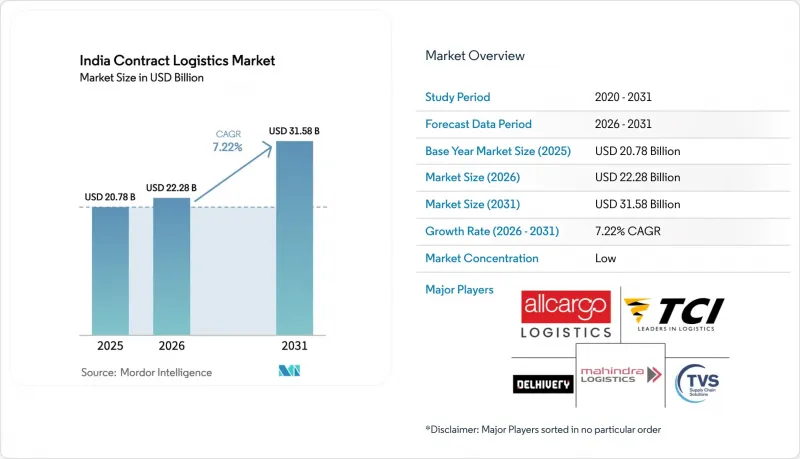
據 Mordor Intelligence 稱,2025 年印度合約物流市場價值為 207.8 億美元,預計到 2031 年將達到 315.8 億美元,而 2026 年為 222.8 億美元,預測期(2026-2031 年)的複合年成長率為 7.2%。
本報告按服務類型(運輸、倉儲和配送、附加價值服務)、合約期間(1-3年和3年以上)以及最終用戶行業(製造業和汽車業、食品飲料業、零售和電子商務業、醫療保健和製藥業、化工業及其他行業)進行細分。市場預測以美元計價。
印度合約物流市場的趨勢與洞察
電子商務和全通路零售的激增
電子商務交易量持續維持兩位數成長,預計到2027年,光是線上雜貨銷售額就將達到21億盧比(約246億美元)。目前,印度主要大都會圈已分佈著4000多家“暗店”,而二三線城市的網路密度也在不斷提高,因為這些地區的“最後一公里”配送成本仍然很高。採用全通路模式的零售商需要協調庫存和逆向物流流程,這促使第三方物流公司在距離客戶2-3公里範圍內部署微型倉配中心。在此背景下,印度的合約物流市場正將重心轉向動態路線最佳化軟體和按需運輸能力,以實現30分鐘送達的承諾。預計到2028年,正規零售滲透率將達到60%,因此,將B2B補貨業務與直接面對消費者配送相結合的綜合服務供應商正在獲得競爭優勢。
政府促進基礎設施發展(NLP,Gati Shakti)
「總理物流能力」(PM Gati Shakti)平台涵蓋44個中央政府部會,透過將200多個專案整合到一個統一的地理資訊系統(GIS)介面,加速多模態走廊的建設。高速公路延伸段、專用貨運走廊和物流園區的同步核准流程正在縮短先前的瓶頸——跨州運輸時間。 「統一物流介面平台」集中管理港口、鐵路和道路運輸的貨物訊息,大幅縮短了先前因文件處理而導致運輸時間延長高達60%的流程。儘管土地徵用延誤依然存在,但資產規格的標準化和數位化許可證的引入正在穩步提高印度合約物流市場中車輛所有者和倉庫營運商的資產利用率。
熟練的倉儲和供應鏈管理(SCM)工人短缺
印度1.5億藍領工人中,僅有5%接受過正規培訓,導致堆高機操作員、庫存分析師、機器人技術員和其他技術工人長期短缺。製造地的雇主為了招攬人才,不得不延長加班時間並提高工資,這推高了印度合約物流市場的營運成本。雖然自動化減少了重複性工作,但也增加了對專業維修人員的需求,進一步凸顯了訓練的重要性。
細分市場分析
到2025年,運輸服務將佔印度合約物流市場的61.34%。儘管鐵路走廊的使用不斷擴大,但大部分電子商務和日常消費品(FMCG)貨物仍將透過卡車運輸。附加價值服務正處於成長最快的階段,預計到2031年將以6.18%的複合年成長率成長。這一領域受益於製造商將套件組裝和貼標工作外包給配備手持掃描器和人工智慧限速引擎的第三方物流供應商(3PL)。 Bludat位於德里的樞紐,配備自動化分類機,每天可處理55萬個小包裹,是轉型為高容量樞紐的典型例子。
倉儲配送產業蓬勃發展,這主要得益於商品及服務稅(GST)帶來的倉庫整合,孟買、德里首都區和班加羅爾等地對大型甲級倉庫的需求不斷成長。雖然專用貨運走廊吸引了大宗貨物運輸,並推動了運輸方式的多樣化,但道路運輸在最後一公里配送的柔軟性方面仍然保持優勢。此外,各項服務的技術應用也在加速推進;Allcargo Gati 正在印度合約物流市場引入機器學習驅動的手持印表機,以減少分類錯誤並提高準時交付率。
其他好處:
- Excel格式的市場預測(ME)表
- 3個月的分析師支持
目錄
第1章:引言
- 研究假設和市場定義
- 調查範圍
第2章:調查方法
第3章執行摘要
第4章 市場狀況
- 市場概覽
- 市場促進因素
- 電子商務和全通路零售的激增
- 政府促進基礎設施發展(NLP,Gati Shakti)
- 製造商向第三方物流公司外包業務增多
- GST實施後網路整合的益處
- 二、三線地區超本地化暗店的蓬勃發展
- 來自D2C和快消品牌的CLaaS需求
- 市場限制因素
- 倉儲和供應鏈管理(SCM)產業技術純熟勞工短缺
- A級自動化需要高資本投資
- 商品及服務稅(GST)實施後,各州之間的合規摩擦日益加劇。
- 數位控制塔面臨的網路安全風險
- 價值供應鏈分析
- 監理情勢
- 技術展望
- 電子商務趨勢分析
- 逆向物流洞察
- 影響分析-商品及服務稅的引入
- 主要經濟特區和製造地
- 地緣政治因素與疫情的影響
- 波特五力模型
第5章 市場規模與成長預測
- 按服務類型
- 運輸
- 路
- 鐵路
- 航空
- 海
- 倉儲/物流
- 附加價值服務(組裝、貼標、套件包裝)
- 運輸
- 按合約期限
- 1-3年
- 3年或以上
- 按最終用戶行業分類
- 製造業/汽車
- 食品/飲料
- 零售與電子商務
- 醫療和藥品
- 化學品
- 其他行業
第6章 競爭情勢
- 市場集中度
- 策略性舉措(併購、合資、資金籌措、技術合作)
- 市佔率分析
- 公司簡介
- Allcargo Logistics Ltd
- TVS Supply Chain Solutions
- Transport Corporation of India(TCI)
- Mahindra Logistics Ltd
- Delhivery Ltd
- Blue Dart Express Ltd
- Safexpress Pvt Ltd
- Adani Logistics Ltd
- Yusen Logistics
- VRL Logistics
- Deutsche Post DHL Group
- Kuehne+Nagel Pvt Ltd
- CEVA Logistics
- DSV
- FedEx Corp.
- Nippon Express
- CH Robinson
- Hellmann Worldwide Logistics
- Holisol Logistics
- Varuna Group
第7章 市場機會與未來展望
According to Mordor Intelligence, the India contract logistics market size was valued at USD 20.78 billion in 2025 and estimated to grow from USD 22.28 billion in 2026 to reach USD 31.58 billion by 2031, at a CAGR of 7.22% during the forecast period (2026-2031).
This report is Segmented by Service Type (Transportation, Warehousing & Distribution, and Value-Added Services), Contract Duration (1-3 Years and Above 3 Years), End-User Industry (Manufacturing & Automotive, Food & Beverage, Retail & E-Commerce, Healthcare & Pharmaceuticals, Chemicals, and Other Industries). The Market Forecasts are Provided in Terms of Value (USD).
India Contract Logistics Market Trends and Insights
Surge in e-commerce & omni-channel retail
E-commerce volumes continue to double-digit climb, with online grocery alone tracking toward INR 2.1 lakh crore (USD 24.6 billion) by 2027. More than 4,000 dark stores now dot major metros, and network densification is migrating into tier-II and III clusters where last-mile costs remain elevated. Retailers adopting omni-channel models require synchronized inventory and reverse-logistics flows, prompting 3PLs to deploy micro-fulfillment sites within 2-3 km of customers. The India contract logistics market thus pivots toward dynamic routing software and on-demand capacity to uphold sub-30-minute delivery promises. As organized retail penetration is expected to reach 60% by 2028, integrated service providers that combine B2B replenishment with direct-to-consumer fulfillment gain a competitive edge.
Government infrastructure push (NLP, Gati-Shakti)
The PM Gati Shakti platform has onboarded 44 central ministries, mapping 200+ projects to a single GIS interface to accelerate multimodal corridor execution. Expressway mileage, dedicated freight corridors, and logistics parks receive synchronized clearances, shrinking cross-state transit at erstwhile choke points. The Unified Logistics Interface Platform unifies shipment visibility across ports, railways, and road transport, trimming documentation time that earlier inflated travel duration by 60%. While land acquisition delays persist, standardized asset specifications and digital permits are steadily lifting asset utilization rates for fleet owners and warehouse operators within the India contract logistics market.
Skilled warehouse & SCM labour shortage
Only 5% of India's 150 million blue-collar workforce is formally trained, resulting in chronic shortages for forklift operators, inventory analysts, and robotics technicians. Employers in manufacturing hubs extend overtime and boost wages to secure talent, inflating operating costs for the India contract logistics market. Automation alleviates repetitive tasks yet raises demand for specialized maintenance roles, reinforcing the training imperative.
Other drivers and restraints analyzed in the detailed report include:
- Rising 3PL outsourcing by manufacturers
- Post-GST network consolidation benefits
- High CAPEX for Grade-A automation
For complete list of drivers and restraints, kindly check the Table Of Contents.
Segment Analysis
Transportation services stood at 61.34% of the India contract logistics market in 2025, with road fleets carrying the bulk of e-commerce and FMCG loads despite rail corridor gains. Value-added services represent the swiftest trajectory, registering a 6.18% CAGR through 2031. The segment benefits from manufacturers outsourcing kitting and labeling to 3PLs equipped with handheld scanners and AI slotting engines. Blue Dart's Delhi hub, capable of processing 550,000 parcels daily via automated sorters, typifies the shift toward high-throughput nodes.
Warehousing and distribution thrive on GST-driven depot consolidation, lifting large-box Grade-A stock across Mumbai, NCR, and Bengaluru. Modal mix diversification progresses as dedicated freight corridors attract bulk cargo, yet road retains primacy for last-mile flexibility. Tech adoption across service types accelerates; Allcargo Gati introduced machine-learning-guided handheld printers to shave mis-sort errors and boost on-time performance within the India contract logistics market.
Complete Report Scope:
- By Service Type
- Transportation
- Road
- Rail
- Air
- Sea
- Warehousing & Distribution
- Value-added Services (Assembly, Labelling, Kitting)
- Transportation
- By Contract Duration
- 1 - 3 Years
- Above 3 years
- By End-user Industry
- Manufacturing & Automotive
- Food & Beverage
- Retail & E-commerce
- Healthcare & Pharmaceuticals
- Chemicals
- Other Industries
List of Companies Covered in this Report:
- Allcargo Logistics Ltd
- TVS Supply Chain Solutions
- Transport Corporation of India (TCI)
- Mahindra Logistics Ltd
- Delhivery Ltd
- Blue Dart Express Ltd
- Safexpress Pvt Ltd
- Adani Logistics Ltd
- Yusen Logistics
- VRL Logistics
- Deutsche Post DHL Group
- Kuehne + Nagel Pvt Ltd
- CEVA Logistics
- DSV
- FedEx Corp.
- Nippon Express
- CH Robinson
- Hellmann Worldwide Logistics
- Holisol Logistics
- Varuna Group
Additional Benefits:
- The market estimate (ME) sheet in Excel format
- 3 months of analyst support
TABLE OF CONTENTS
1 Introduction
- 1.1 Study Assumptions & Market Definition
- 1.2 Scope of the Study
2 Research Methodology
3 Executive Summary
4 Market Landscape
- 4.1 Market Overview
- 4.2 Market Drivers
- 4.2.1 Surge in e-commerce & omni-channel retail
- 4.2.2 Government infrastructure push (NLP, Gati-Shakti)
- 4.2.3 Rising 3PL outsourcing by manufacturers
- 4.2.4 Post-GST network consolidation benefits
- 4.2.5 Tier-II/III hyper-local dark-store boom
- 4.2.6 CLaaS demand from D2C & quick-commerce brands
- 4.3 Market Restraints
- 4.3.1 Skilled warehouse & SCM labour shortage
- 4.3.2 High CAPEX for Grade-A automation
- 4.3.3 Inter-state compliance frictions post-GST
- 4.3.4 Cyber-security risks to digital control towers
- 4.4 Value / Supply-Chain Analysis
- 4.5 Regulatory Landscape
- 4.6 Technological Outlook
- 4.7 Insights on E-Commerce Landscape
- 4.8 Insights on Reverse Logistics
- 4.9 Impact Analysis - Implementation of GST
- 4.10 Key Special Economic Zones (SEZs) & Manufacturing Hubs
- 4.11 Impact of Geopolitics & Pandemic Events
- 4.12 Porter's Five Forces
- 4.12.1 Bargaining Power of Suppliers
- 4.12.2 Bargaining Power of Buyers
- 4.12.3 Threat of New Entrants
- 4.12.4 Threat of Substitutes
- 4.12.5 Intensity of Competitive Rivalry
5 Market Size & Growth Forecasts
- 5.1 By Service Type
- 5.1.1 Transportation
- 5.1.1.1 Road
- 5.1.1.2 Rail
- 5.1.1.3 Air
- 5.1.1.4 Sea
- 5.1.2 Warehousing & Distribution
- 5.1.3 Value-added Services (Assembly, Labelling, Kitting)
- 5.1.1 Transportation
- 5.2 By Contract Duration
- 5.2.1 1 - 3 Years
- 5.2.2 Above 3 years
- 5.3 By End-user Industry
- 5.3.1 Manufacturing & Automotive
- 5.3.2 Food & Beverage
- 5.3.3 Retail & E-commerce
- 5.3.4 Healthcare & Pharmaceuticals
- 5.3.5 Chemicals
- 5.3.6 Other Industries
6 Competitive Landscape
- 6.1 Market Concentration
- 6.2 Strategic Moves (M&A, JV, Fund-Raising, Tech Partnerships)
- 6.3 Market Share Analysis
- 6.4 Company Profiles (includes Global level Overview, Market level overview, Core Segments, Financials as available, Strategic Information, Market Rank/Share for key companies, Products & Services, and Recent Developments)
- 6.4.1 Allcargo Logistics Ltd
- 6.4.2 TVS Supply Chain Solutions
- 6.4.3 Transport Corporation of India (TCI)
- 6.4.4 Mahindra Logistics Ltd
- 6.4.5 Delhivery Ltd
- 6.4.6 Blue Dart Express Ltd
- 6.4.7 Safexpress Pvt Ltd
- 6.4.8 Adani Logistics Ltd
- 6.4.9 Yusen Logistics
- 6.4.10 VRL Logistics
- 6.4.11 Deutsche Post DHL Group
- 6.4.12 Kuehne + Nagel Pvt Ltd
- 6.4.13 CEVA Logistics
- 6.4.14 DSV
- 6.4.15 FedEx Corp.
- 6.4.16 Nippon Express
- 6.4.17 CH Robinson
- 6.4.18 Hellmann Worldwide Logistics
- 6.4.19 Holisol Logistics
- 6.4.20 Varuna Group
7 Market Opportunities & Future Outlook
- 7.1 White-space & Unmet-need Assessment

 德國合約物流:市場佔有率分析、產業趨勢與統計及成長預測(2026-2031)美國合約物流:市場佔有率分析、行業趨勢和統計數據、成長預測(2026-2031)英國合約物流:市場佔有率分析、產業趨勢與統計及成長預測(2026-2031)
 全球合約物流市場(2026 年)南美洲合約物流:市場佔有率分析、產業趨勢與統計及成長預測(2026-2031 年)
 合約物流市場:按服務、類型、運輸方式、行業和地區分類
 2026年全球合約物流市場報告
 合約物流市場規模、佔有率、成長及全球產業分析:按類型、應用和地區分類的洞察,2026-2034 年預測
 合約物流市場:2026-2032年全球市場預測(依服務類型、貨物類型、運輸方式、客戶規模及最終用途分類)亞太地區合約物流:市場佔有率分析、產業趨勢與統計、成長預測(2026-2031)