


 |
市場調查報告書
商品編碼
2125744
中國藥品包裝市場:市場佔有率分析、產業趨勢與統計及成長預測(2026-2031年)China Pharmaceutical Packaging - Market Share Analysis, Industry Trends & Statistics, Growth Forecasts (2026 - 2031) |
||||||

※ 本網頁內容可能與最新版本有所差異。詳細情況請與我們聯繫。
根據 Mordor Intelligence 預測,中國藥品包裝市場規模預計將從 2025 年的 211.3 億美元成長到 2026 年的 224.1 億美元,並將從 2026 年到 2031 年以 6.05% 的複合年成長率成長,到 20317 億美元。
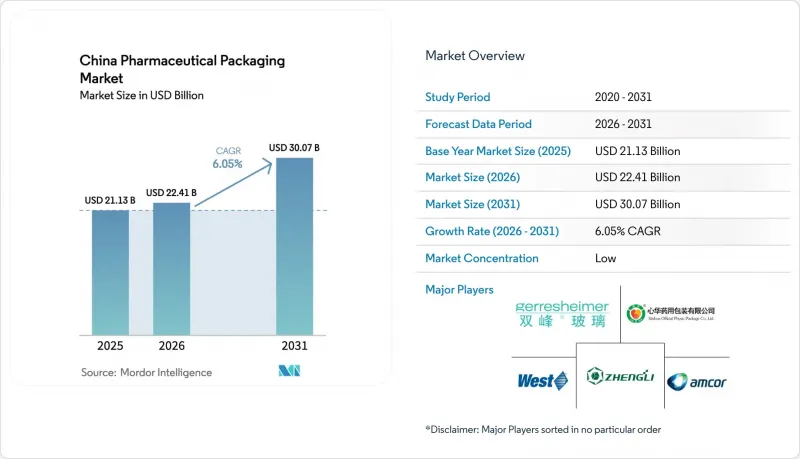
本報告按包裝類型(一級包裝、二級包裝和三級包裝)、材料(塑膠、玻璃等)、劑型(固態口服藥物、注射藥物等)、最終用戶(製藥企業等)、技術(傳統技術、無菌技術等)和地區進行細分。市場預測以價值(美元)表示。
中國藥品包裝市場趨勢與洞察
加強對假藥的監管
隨著國家藥品監督管理局(NMPA)制定全玻璃注射器YY 1001-2024標準,監管範圍已從活性成分擴展到包裝的每一層。強制對每件銷售產品進行序列化,消除了供應鏈的不透明性,主要加工商正在實施符合歐盟《反詐欺指令》(FMD)和美國《藥品安全與追蹤法案》(DSCSA)的互通追蹤溯源系統。上海和深圳的地方政府引進了基於區塊鏈的海關通道,在驗證序號的同時縮短了通關時間。早期採用開放式架構解決方案的企業產品召回率較低,並能與跨國公司談判溢價。同時,中小企業正面臨前期投資和維護成本的重壓。不合規產品退出市場減少了供給能力,中國藥品包裝市場序列化包裝的平均售價正在逐步上漲。
擴大國內學名藥和生物製藥製造地。
預計到2024年,中國生物製藥市場規模將超過6,506億元人民幣(約915億美元),到2029年將加倍,這將加速從通用包裝瓶向無菌屏障包裝系統的轉變。江蘇、山東和廣東三省形成的叢集正在建造一體化供應鏈的核心,將散裝樹脂供應商、容器製造商和填充/包裝廠集中在同一地點,從而降低物流成本。綠葉藥業的長效注射劑ERZOFRI®獲得美國FDA批准,證實了國內創新企業對能夠耐受低溫儲存的環烯烴聚合物注射器的需求日益成長。跨國公司正透過研發培養箱和合資企業加強在當地的業務基礎,加劇了對符合美國和歐盟藥典標準的包裝合作夥伴的競爭。由此產生的產能競爭正在推動對ISO 5級無塵室和嵌套式管瓶托盤的投資,鞏固了中國醫藥包裝市場的成長前景。
石油基原料價格的波動推高了塑膠包裝的成本。
2024年高高密度聚苯乙烯(HDPE)的平均價格為每噸910美元,但由於2025年將新增500萬噸產能,價格走勢變得難以預測。同時,聚氯乙烯(PVC)的進口關稅已從1%提高到5.5%,導致每噸成本增加23美元,給依賴特種薄膜等級的加工商帶來壓力。外匯波動和原油價格的劇烈波動使長期樹脂合約的簽訂變得複雜,迫使包裝製造商盡可能轉向玻璃纖維和纖維基材。無法對沖樹脂價格風險的製造商正面臨中國醫藥包裝市場利潤率下降的困境。
細分市場分析
預計到2025年,初級包裝容器將佔據61.88%的市場佔有率,並將在2031年之前以8.96%的複合年成長率成長,這主要得益於藥物輸送和封裝功能的融合。肖特製藥的TOPPAC聚合物注射器系列在2024年實現了54%的銷售成長,顯示市場對適用於mRNA疫苗的環烯烴解決方案的需求不斷成長。在中國藥品包裝市場,嵌套式即用包裝正在縮短注射劑填充和包裝工廠的無菌準備時間。二級和三級包裝也隨著快速成長的電子商務市場而不斷發展。瓦楞紙箱內建衝擊感測器,使其符合位於上海自貿區的全球出口樞紐的小包裹運輸標準。
二級包裝正以中等個位數的速度擴張,這主要得益於市場對帶有序列化QR碼和彩色物流標籤的可折疊紙盒的需求。三級包裝則透過與人工智慧智慧海關掃描器整合,加快托盤清關速度,從而降低保稅倉庫的倉儲費用。這些變化共同鞏固了創新(尤其是在一級包裝領域)作為中國醫藥包裝市場驅動力的地位。
到2025年,塑膠仍將維持50.05%的市場佔有率,這主要得益於高密度聚乙烯(HDPE)瓶和聚丙烯吸塑包裝的成本效益。然而,隨著碳定價機制和醫院綠色採購政策的日益普及,纖維基材預計將以8.35%的複合年成長率成長。 DS Smith公司的「TailorTemp」運輸包裝表明,模塑纖維可以在不影響熱性能的前提下,減少40%的二氧化碳排放。受生物製藥產業成長和高階定位的推動,中國醫藥包裝市場中管瓶和玻璃筒的市場規模正在穩步擴大。
當鋁的阻隔性能優於其成本時,它仍然是冷泡殼包裝的重要材料。中小企業正在探索使用聚碳酸丙烯酯混合物來應對即將到來的 PFAS 禁令,同時又不影響其防潮性能。因此,中國醫藥包裝市場整體面臨材料替代決策的權衡,需要在監管阻力、碳排放核算以及確保藥品穩定性等因素之間取得平衡。
其他好處:
- Excel格式的市場預測(ME)表
- 3個月的分析師支持
目錄
第1章:引言
- 研究假設和市場定義
- 調查範圍
第2章:調查方法
第3章執行摘要
第4章 市場狀況
- 市場概覽
- 市場促進因素
- 嚴格監管仿冒藥品
- 日本學名藥和生物製藥製造地的擴張
- 人口老化正在推動慢性病藥物的銷售量。
- 各州的健保報銷方案正轉向以病人為中心的模式。
- 跨境網路藥局的蓬勃發展需要適合小包裹遞送的包裝。
- 碳中和目標正在推動可回收和生物聚合物包裝的普及。
- 市場限制因素
- 石油基原料價格的波動推高了塑膠包裝的成本。
- 中小企業序列化與防偽生產線的資本投資負擔
- 即將訂定的 PFAS 法規可能會導致泡殼包裝的衰落。
- GMP包裝設計人才短缺阻礙了創新。
- 供應鏈分析
- 監理情勢
- 技術展望
- 波特五力分析
- 產業生態系分析
- 原料分析
- 近期技術創新與新產品開發
- 分析新趨勢和成功的關鍵因素
第5章 市場規模與成長預測
- 按包裝類型
- 初級包裝
- 塑膠瓶(HDPE、PET)
- 吸塑包裝(PVC,冷成型鋁)
- 預灌封注射器
- 病毒安瓿
- 靜脈輸液容器
- 吸入器
- 其他主要包裝
- 二級包裝
- 折疊紙箱
- 紙板運輸箱
- 袋子和小袋
- 翻蓋式托盤
- 三級包裝
- 初級包裝
- 材料
- 塑膠
- 玻璃
- 鋁箔/層壓板
- 紙張和紙板
- 按劑型
- 固態口服藥物
- 腸外
- 外用製劑/經皮吸收劑
- 吸入劑
- 眼科
- 其他劑型
- 最終用戶
- 製藥公司
- 契約製造公司(CMO)
- 醫院和診所
- 透過技術
- 傳統的
- 無菌和滅菌
- 智慧互聯(NFC/RFID)
- 防偽/序列化
- 永續/可回收解決方案
第6章 競爭情勢
- 市場集中度
- 策略趨勢
- 市佔率分析
- 公司簡介
- Amcor Plc
- Gerresheimer AG(Gerresheimer Shuangfeng)
- West Pharmaceutical Services Inc.
- Shandong Pharmaceutical Glass Co. Ltd
- Taishan Xinhua Pharmaceutical Packaging Co. Ltd
- SCHOTT AG
- Nipro PharmaPackaging
- AptarGroup Inc.
- Perlen Packaging(Suzhou)Co. Ltd
- Ningbo Zhengli Pharmaceutical Packaging
- Yuhuan Kang-jia Enterprise Co. Ltd
- Dongguan Fukang Plastic Products Co. Ltd
- Hangzhou Xunda Packaging Co. Ltd
- Jiangsu Hanlin Pharmaceutical Packaging
- Luoyang Dirante Pharmaceutical Packaging
- JOTOP Glass
- SGD Pharma
- Chongqing Zhengchuan Pharmaceutical Packaging
- Zhejiang BI Industrial Co. Ltd
- China National Pharmaceutical Packaging Corp.
第7章 市場機會與未來展望
According to Mordor Intelligence, the China pharmaceutical packaging market size is expected to grow from USD 21.13 billion in 2025 to USD 22.41 billion in 2026 and is forecast to reach USD 30.07 billion by 2031 at 6.05% CAGR over 2026-2031.
This report is Segmented by Packaging Type (Primary Packaging, Secondary Packaging, Tertiary Packaging), Material (Plastics, Glass, and More), Drug Form (Solid Oral, Parenteral, and More), End-User (Pharma Manufacturers, and More), Technology (Conventional, Aseptic and Sterile, and More), and Geography. The Market Forecasts are Provided in Terms of Value (USD).
China Pharmaceutical Packaging Market Trends and Insights
Stringent Regulatory Clamp-Down on Counterfeit Medicines
Enhanced oversight now extends from active ingredients to every packaging layer, underpinned by the National Medical Products Administration's YY 1001-2024 standards for all-glass syringes. Mandatory serialization at each saleable unit has curtailed supply-chain opacity, prompting larger converters to install interoperable track-and-trace systems that harmonize with EU FMD and U.S. DSCSA rules. Provincial authorities in Shanghai and Shenzhen deploy blockchain-enabled customs channels that shorten clearance times while authenticating serialized codes. Early adopters of open architecture solutions record fewer product-recall incidents and negotiate premium pricing with multinational clients, whereas SMEs grapple with upfront investment and maintenance fees. Market exit of non-compliant lines removes low-price capacity, slowly lifting average selling prices for serialized packs in the China pharmaceutical packaging market.
Expansion of Domestic Generics and Biologics Manufacturing Base
China's biopharma value exceeded CNY 650.6 billion (USD 91.5 billion) in 2024 and is projected to double by 2029, fueling a pivot from commodity bottles toward sterile barrier systems. Provincial clusters in Jiangsu, Shandong, and Guangdong anchor integrated supply networks where bulk resin suppliers, container converters, and fill-finish plants co-locate to pare logistics cost. Luye Pharma's U.S. FDA clearance for ERZOFRI(R), a long-acting injectable, underscores domestic innovators' rising demand for cyclic olefin polymer syringes that resist low-temperature storage. Multinationals deepen local footprints through R&D incubators and joint ventures, intensifying competition for packaging partners certified to U.S. and EU pharmacopeia standards. The resulting capacity race spurs capex in ISO 5 cleanrooms and nested vial trays, fortifying growth prospects for the China pharmaceutical packaging market.
Volatile Petro-Feedstock Prices Inflating Plastic Pack Costs
High-density polyethylene averaged USD 910 per ton in 2024, but a 5 million-ton capacity influx in 2025 skews pricing unpredictably. Simultaneously, PVC import duties rose from 1% to 5.5%, adding USD 23 per ton and squeezing converters reliant on specialized film grades. Currency volatility and crude-oil price swings complicate long-term resin contracts, forcing packaging makers to diversify into glass or fiber substrates when feasible. Manufacturers unable to hedge resin exposure face shrinking margins within the China pharmaceutical packaging market.
Other drivers and restraints analyzed in the detailed report include:
- Ageing Population Driving Chronic-Care Drug Volumes
- Provincial Reimbursement Tilt Toward Patient-Friendly Formats
- Capex Burden of Serialisation/Anti-Counterfeit Lines for SMEs
For complete list of drivers and restraints, kindly check the Table Of Contents.
Segment Analysis
Primary containers captured 61.88% share in 2025 and are projected to grow at 8.96% CAGR through 2031 as drug-delivery functionality merges with containment. SCHOTT Pharma's TOPPAC polymer syringe range posted 54% sales growth in 2024, signaling appetite for cyclic olefin solutions suitable for mRNA vaccines.Within the China pharmaceutical packaging market size for parenteral packs, nested ready-to-use configurations lower aseptic setup time in fill-finish plants. Secondary and tertiary packs evolve alongside booming e-commerce; corrugated shippers integrate shock sensors, enabling parcel-ready compliance for global export hubs in Shanghai free-trade zones.
Secondary packs advance at mid-single-digit growth, propelled by folding-carton demand that accompanies serialized QR codes and color-coded logistics labels. Tertiary formats integrate with AI-enabled Smart Customs scanners that clear pallets faster, reducing in-bond detention fees. Collectively, these shifts entrench primary-pack-centric innovation as the engine of the China pharmaceutical packaging market.
Plastics retained 50.05% share in 2025, buttressed by cost-effective HDPE bottles and polypropylene blisters. Yet fiber substrates clock an 8.35% CAGR as carbon-pricing schemes and hospital green-procurement policies gain traction. DS Smith's TailorTemp shipper shows that molded-fiber can match thermal performance while trimming CO2 by 40%. The China pharmaceutical packaging market size for glass vials and cartridges expands steadily amid biologics growth and premium positioning.
Aluminum remains critical for cold-form blisters when barrier integrity outweighs cost. SMEs explore poly(propylene carbonate) blends to meet impending PFAS prohibitions without sacrificing moisture resistance. Material substitution decisions thus balance regulatory headwinds, carbon accounting, and drug-stability imperatives across the China pharmaceutical packaging market.
Complete Report Scope:
- By Packaging Type
- Primary Packaging
- Plastic Bottles (HDPE, PET)
- Blister Packs (PVC, Cold-form Alu)
- Pre-fillable Syringes
- Vials and Ampoules
- IV Containers
- Inhalers
- Others Primary Packaging
- Secondary Packaging
- Folding Cartons
- Corrugated Shippers
- Bags and Pouches
- Clamshells and Trays
- Tertiary Packaging
- Primary Packaging
- By Material
- Plastics
- Glass
- Aluminium Foil / Laminate
- Paper and Paperboard
- By Drug Form
- Solid Oral
- Parenteral
- Topical / Transdermal
- Inhalation
- Ophthalmic
- Other Drug Form
- By End-User
- Pharma Manufacturers
- Contract Manufacturing Organisations (CMOs)
- Hospitals and Clinics
- By Technology
- Conventional
- Aseptic and Sterile
- Smart and Connected (NFC/RFID)
- Anti-counterfeit / Serialisation
- Sustainable / Recyclable Solutions
List of Companies Covered in this Report:
- Amcor Plc
- Gerresheimer AG (Gerresheimer Shuangfeng)
- West Pharmaceutical Services Inc.
- Shandong Pharmaceutical Glass Co. Ltd
- Taishan Xinhua Pharmaceutical Packaging Co. Ltd
- SCHOTT AG
- Nipro PharmaPackaging
- AptarGroup Inc.
- Perlen Packaging (Suzhou) Co. Ltd
- Ningbo Zhengli Pharmaceutical Packaging
- Yuhuan Kang-jia Enterprise Co. Ltd
- Dongguan Fukang Plastic Products Co. Ltd
- Hangzhou Xunda Packaging Co. Ltd
- Jiangsu Hanlin Pharmaceutical Packaging
- Luoyang Dirante Pharmaceutical Packaging
- JOTOP Glass
- SGD Pharma
- Chongqing Zhengchuan Pharmaceutical Packaging
- Zhejiang B.I. Industrial Co. Ltd
- China National Pharmaceutical Packaging Corp.
Additional Benefits:
- The market estimate (ME) sheet in Excel format
- 3 months of analyst support
TABLE OF CONTENTS
1 INTRODUCTION
- 1.1 Study Assumptions and Market Definition
- 1.2 Scope of the Study
2 RESEARCH METHODOLOGY
3 EXECUTIVE SUMMARY
4 MARKET LANDSCAPE
- 4.1 Market Overview
- 4.2 Market Drivers
- 4.2.1 Stringent regulatory clamp-down on counterfeit medicines
- 4.2.2 Expansion of domestic generics and biologics manufacturing base
- 4.2.3 Ageing population driving chronic-care drug volumes
- 4.2.4 Provincial reimbursement tilt toward patient-friendly formats
- 4.2.5 Cross-border e-pharmacy boom needing parcel-ready packs
- 4.2.6 Carbon-neutrality targets boosting recyclable/biopolymer packs
- 4.3 Market Restraints
- 4.3.1 Volatile petro-feedstock prices inflating plastic pack costs
- 4.3.2 Capex burden of serialisation/anti-counterfeit lines for SMEs
- 4.3.3 Impending PFAS restrictions threatening blister film obsolescence
- 4.3.4 GMP packaging-design talent shortage slows innovation
- 4.4 Supply-Chain Analysis
- 4.5 Regulatory Landscape
- 4.6 Technological Outlook
- 4.7 Porter's Five Forces Analysis
- 4.7.1 Bargaining Power of Suppliers
- 4.7.2 Bargaining Power of Buyers
- 4.7.3 Threat of New Entrants
- 4.7.4 Threat of Substitutes
- 4.7.5 Intensity of Competitive Rivalry
- 4.8 Industry Ecosystem Analysis
- 4.9 Raw-Material Analysis
- 4.10 Recent Innovations and New Product Development
- 4.11 Emerging Trend Analysis and Key Success Factors
5 MARKET SIZE AND GROWTH FORECASTS (VALUE)
- 5.1 By Packaging Type
- 5.1.1 Primary Packaging
- 5.1.1.1 Plastic Bottles (HDPE, PET)
- 5.1.1.2 Blister Packs (PVC, Cold-form Alu)
- 5.1.1.3 Pre-fillable Syringes
- 5.1.1.4 Vials and Ampoules
- 5.1.1.5 IV Containers
- 5.1.1.6 Inhalers
- 5.1.1.7 Others Primary Packaging
- 5.1.2 Secondary Packaging
- 5.1.2.1 Folding Cartons
- 5.1.2.2 Corrugated Shippers
- 5.1.2.3 Bags and Pouches
- 5.1.2.4 Clamshells and Trays
- 5.1.3 Tertiary Packaging
- 5.1.1 Primary Packaging
- 5.2 By Material
- 5.2.1 Plastics
- 5.2.2 Glass
- 5.2.3 Aluminium Foil / Laminate
- 5.2.4 Paper and Paperboard
- 5.3 By Drug Form
- 5.3.1 Solid Oral
- 5.3.2 Parenteral
- 5.3.3 Topical / Transdermal
- 5.3.4 Inhalation
- 5.3.5 Ophthalmic
- 5.3.6 Other Drug Form
- 5.4 By End-User
- 5.4.1 Pharma Manufacturers
- 5.4.2 Contract Manufacturing Organisations (CMOs)
- 5.4.3 Hospitals and Clinics
- 5.5 By Technology
- 5.5.1 Conventional
- 5.5.2 Aseptic and Sterile
- 5.5.3 Smart and Connected (NFC/RFID)
- 5.5.4 Anti-counterfeit / Serialisation
- 5.5.5 Sustainable / Recyclable Solutions
6 COMPETITIVE LANDSCAPE
- 6.1 Market Concentration
- 6.2 Strategic Moves
- 6.3 Market Share Analysis
- 6.4 Company Profiles (includes Global-level Overview, Market-level Overview, Core Segments, Financials as available, Strategic Information, Market Rank/Share, Products and Services, Recent Developments)
- 6.4.1 Amcor Plc
- 6.4.2 Gerresheimer AG (Gerresheimer Shuangfeng)
- 6.4.3 West Pharmaceutical Services Inc.
- 6.4.4 Shandong Pharmaceutical Glass Co. Ltd
- 6.4.5 Taishan Xinhua Pharmaceutical Packaging Co. Ltd
- 6.4.6 SCHOTT AG
- 6.4.7 Nipro PharmaPackaging
- 6.4.8 AptarGroup Inc.
- 6.4.9 Perlen Packaging (Suzhou) Co. Ltd
- 6.4.10 Ningbo Zhengli Pharmaceutical Packaging
- 6.4.11 Yuhuan Kang-jia Enterprise Co. Ltd
- 6.4.12 Dongguan Fukang Plastic Products Co. Ltd
- 6.4.13 Hangzhou Xunda Packaging Co. Ltd
- 6.4.14 Jiangsu Hanlin Pharmaceutical Packaging
- 6.4.15 Luoyang Dirante Pharmaceutical Packaging
- 6.4.16 JOTOP Glass
- 6.4.17 SGD Pharma
- 6.4.18 Chongqing Zhengchuan Pharmaceutical Packaging
- 6.4.19 Zhejiang B.I. Industrial Co. Ltd
- 6.4.20 China National Pharmaceutical Packaging Corp.
7 MARKET OPPORTUNITIES AND FUTURE OUTLOOK
- 7.1 White-space and Unmet-need Assessment

 2026-2030年全球實驗室耗材初級包裝市場
 全球藥品包裝市場規模、佔有率、趨勢和成長分析報告(2026-2034年)
 菲律賓藥品包裝市場:市場佔有率分析、產業趨勢與統計及成長預測(2026-2031)印度藥品包裝市場:市場佔有率分析、產業趨勢與統計及成長預測(2026-2031)
 實驗室耗材初級包裝市場-2026-2032年全球市場預測北美藥品包裝市場:市佔率分析、產業趨勢與統計及成長預測(2026-2031 年)歐洲藥品包裝:市場佔有率分析、產業趨勢與統計及成長預測(2026-2031)醫藥包裝器材:市場佔有率分析、產業趨勢與統計、成長預測(2026-2031)醫藥瓶市場:2026-2032年全球市場預測(依產品類型、材質、容量、瓶蓋、瓶型、應用及通路分類)全球生物製藥包裝市場規模、佔有率、趨勢和成長分析報告(2026-2034)