


 |
市場調查報告書
商品編碼
2122177
印度藥品包裝市場:市場佔有率分析、產業趨勢與統計及成長預測(2026-2031)India Pharmaceutical Packaging - Market Share Analysis, Industry Trends & Statistics, Growth Forecasts (2026 - 2031) |
||||||

※ 本網頁內容可能與最新版本有所差異。詳細情況請與我們聯繫。
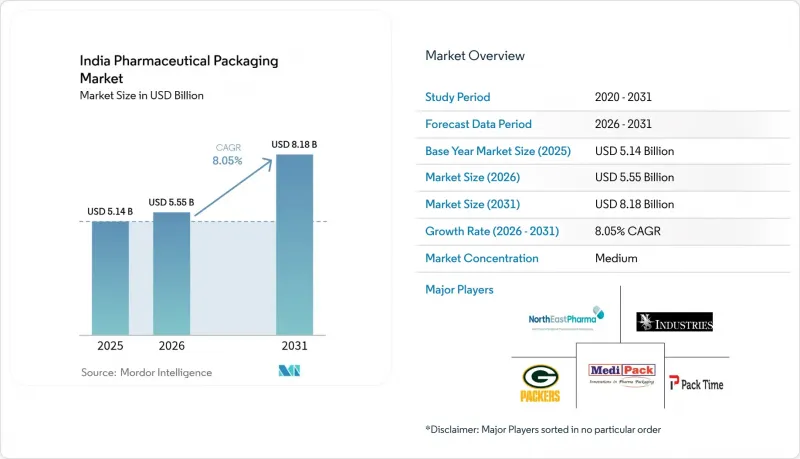
據 Mordor Intelligence 稱,2025 年印度藥品包裝市場價值 51.4 億美元,預計到 2031 年將達到 81.8 億美元,而 2026 年為 55.5 億美元,預測期(2026-2031 年)複合年成長率為 8.05%。
本報告按材料類型(塑膠、玻璃、金屬等)、產品類型(瓶子、管瓶和安瓿瓶、泡殼包裝等)、包裝等級(一級、二級、三級)和最終用戶產業(製藥企業、合約包裝公司等)進行細分。市場預測以貨幣價值(美元)表示。
印度藥品包裝市場趨勢與洞察
擴大印度疫苗和生物製藥灌裝及包裝能力
印度致力於成為全球生物製藥中心,這項雄心壯志正推動著對專用容器和包裝材料的需求。包括龍沙公司在雷瓦里建設的明膠膠囊生產線在內的持續投資項目,需要能夠承受滅菌並在長途物流鏈中保持零下溫度穩定性的高阻隔薄膜。內建溫度指示器的冷鏈包裝的普及,確保了產品從生產工廠到患者手中的完整性不受影響。此外,生物製藥研發公司優先考慮防篡改密封和單元序列化,以提高供應鏈的透明度,促使加工商在ISO 8級無塵室中擴大生產規模。
政府主導的出口導向製藥業生產責任保險和藥品生產品質管理規範升級
生產連結獎勵計畫計畫 (PLI) 將在 2025-2026 財政年度撥款 2444.93 印度盧比(約 2.93 億美元),用於推動包裝基礎設施的系統性升級,並支持企業同時符合美國食品藥物管理局 (FDA) 21 CFR 211.132 和歐盟食品藥品監督管理局 (EU FMD) 的序列化要求。申請該計劃的企業必須實現雄心勃勃的出口目標,這將帶來對優質複合薄膜、防篡改瓶蓋和雲端連接視覺檢測設備的訂單。隨著 2025 年 12 月 GMP維修截止日期的臨近,各企業將被要求實施符合 ISO-8 標準的生產線,這將持續推動對經過驗證的初級包裝材料和無塵室耗材的需求。
醫用級聚合物和玻璃原料成本的波動
2025年,聚丙烯價格(以印度到岸價計算)在每公噸970美元至990美元之間波動,對加工商的利潤率帶來壓力,並使合約定價更加複雜。玻璃容器製造商面臨能源成本上漲和矽砂短缺的雙重困境,導致高價值管瓶的成本轉嫁增加。由於樹脂過剩和出口需求疲軟,2024-2025會計年度軟包裝產業的EBITDA獲利率降至8%。這些因素迫使包裝製造商對沖原料風險並最佳化配方,以維持盈利。
細分市場分析
預計到2025年,塑膠仍將保持領先地位,佔銷售額的40.85%,而複合材料和生物基樹脂預計將以9.65%的複合年成長率飆升,成為所有材料中成長最快的。嚴格的生產者延伸責任制(EPR)標準正在推動再生PET內襯和甘蔗衍生HDPE產品線的試點部署。製藥買家要求對萃取物和洗脫液進行全面驗證,促使加工商建立應用實驗室並確保符合監管規定的主文件。在印度製藥包裝市場,隨著合約包裝公司向跨國贊助商強調其環境承諾,生物基材料市場預計將快速擴張。此外,對酵素解釋放技術的同步投資預計將能夠從無菌紙盒中回收鋁層,展現了創新的深度。未來的成長將取決於強大的供應鏈,該供應鏈能夠提供高純度的再生材料,並實現各國統一的檢測標準。
永續性理念也正在改變人們對玻璃和金屬的需求。硼矽酸管瓶因其惰性,在生物製藥領域仍佔據重要地位;同時,為了降低熔化過程中的能耗,人們正在研發輕質塗層管瓶。鋁製折疊式軟管因其零滲漏阻隔性和可回收性的雙重優勢,被廣泛應用於外用製劑中。瓦楞紙板作為二級包裝材料,由於其水性塗層可提供95%的防潮性能,既能確保患者安全,又能實現纖維回收,因此重新受到關注。這些變化共同反映了整個印度醫藥包裝市場對材料管理意識的日益增強。
2025年,瓶裝藥品佔總銷售額的21.05%,而袋裝藥品則以9.1%的複方年成長率成長,在所有品類中增速最快。這主要得益於線上藥局小包裹配送業務的擴張。在印度藥品包裝市場,隨著生物製藥的普及,預填充式注射器的佔有率不斷上升,市場對不含矽油的推桿和嚴格的顆粒控制要求也日益成長。同時,泡殼包裝的改進重點在於兒童難以打開的按壓式蓋子,以及可將患者連接至處方箋續藥平台的NFC標籤。此外,軟性包裝袋還引入了智慧功能,例如整合式濕度感測器,用於監測患者在家中的用藥依從性。
在下游市場,快速檢測拭子試劑盒和鼻噴霧的需求不斷成長,帶動了對卡扣式瓶蓋、整合滴管和低死體積閥門的需求增加。提供承包成型和脈衝光滅菌服務的加工商在精益供應鏈至關重要的項目中獲得了訂單。在印度藥品包裝市場,隨著個人化治療包裝和微劑量裝置的增加,自適應瓶蓋的市場規模預計將擴大。由此產生的產品種類複雜性將有利於那些能夠進行小批量數位印刷和快速生產切換的公司。
其他好處:
- Excel格式的市場預測(ME)表
- 3個月的分析師支持
目錄
第1章:引言
- 研究假設和市場定義
- 調查範圍
第2章:調查方法
第3章執行摘要
第4章 市場狀況
- 市場概覽
- 市場促進因素
- 新冠疫情爆發後,預灌裝產品的普及速度加快。
- 印度擴大疫苗和生技藥品填充和包裝產能
- 政府對出口導向製藥公司的生產責任保險和藥品生產品質管理規範升級
- 網路藥局的蓬勃發展推動了具有防篡改功能的宅配包裝的廣泛應用。
- 永續性法規正在推動 rPET 和 PCR硬質塑膠的採用。
- 市場限制因素
- 醫用聚合物和玻璃原料成本的波動。
- 一次性塑膠的生產者責任制(EPR)及回收物流的挑戰
- 建造一條符合 ISO-8 標準的無塵室包裝生產線需要很高的資本投入。
- 下游分銷網路分散,導致單位包裝成本上升。
- 產業價值鏈分析
- 波特五力分析
- 宏觀經濟因素對市場的影響
第5章 市場規模與成長預測
- 依材料類型
- 塑膠
- 高密度聚苯乙烯(HDPE)
- 低密度聚乙烯(LDPE)
- 聚對苯二甲酸乙二醇酯(PET)
- 其他塑膠
- 玻璃
- 金屬
- 紙張和紙板
- 複合材料/生物基材料
- 塑膠
- 依產品類型
- 瓶子
- 管瓶和安瓿
- 吸塑包裝
- 預填充式注射器和藥筒
- 管子
- 帽子和帽子
- 小袋和袋子
- 標籤
- 其他產品類型
- 按包裝級別
- 初級包裝
- 二級包裝
- 三級包裝
- 按最終用戶行業分類
- 製藥公司
- 合約包裝業務
- 零售藥局和醫療機構藥局
- 醫院和診所
- 其他終端用戶產業
第6章 競爭情勢
- 市場集中度
- 策略趨勢
- 市佔率分析
- 公司簡介
- Amcor plc
- West Pharmaceutical Services Inc.
- Huhtamaki Oyj(Huhtamaki India Ltd)
- Uflex Limited
- Gerresheimer AG
- Schott AG(Schott Glass India Pvt Ltd)
- SGD SA(SGD Pharma India Ltd)
- EPL Limited(Essel Propack Ltd)
- Parekhplast India Ltd
- Hoffmann Neopac AG
- Medipack Innovations Pvt Ltd
- Packtime Innovations Pvt Ltd
- Manjushree Technopack Ltd
- Graham Blow Pack Pvt Ltd
- Regent Plast Pvt Ltd
- North East Pharmapack Pvt Ltd
- TPAC Packaging India Pvt Ltd
- JK Print Packs
- NS Industries
- AS Packers
第7章 市場機會與未來展望
According to Mordor Intelligence, the India pharmaceutical packaging market size was valued at USD 5.14 billion in 2025 and estimated to grow from USD 5.55 billion in 2026 to reach USD 8.18 billion by 2031, at a CAGR of 8.05% during the forecast period (2026-2031).
This report is Segmented by Material Type (Plastic, Glass, Metal, and More), Product Type (Bottles, Vials and Ampoules, Blister Packs and More), Packaging Level (Primary, Secondary, and Tertiary), End-User Industry (Pharmaceutical Manufacturing Companies, Contract Packaging Organizations, and More). The Market Forecasts are Provided in Terms of Value (USD).
India Pharmaceutical Packaging Market Trends and Insights
Expansion of India's Vaccine and Biologics Fill-Finish Capacity
India's ambition to become a global biologics hub is fueling specialized containment demand. Ongoing investments, including Lonza's gelatin capsule line in Rewari, require high-barrier films that withstand sterilization and maintain sub-zero stability across extended logistics chains. Growth in cold-chain packaging with integrated temperature indicators is enabling uninterrupted product integrity from plant to patient. Biologic developers also favor tamper-evident seals and unit-level serialization for supply chain visibility, encouraging converters to scale ISO-8 clean-room production.
Government PLI and GMP Upgrades for Export-Oriented Pharma
The Production-Linked Incentive scheme earmarked INR 2,444.93 crore (USD 293 million) for FY 2025-26, driving systematic upgrades in packaging infrastructure and supporting simultaneous compliance with FDA 21 CFR 211.132 and EU FMD serialisation requirements. Subsidy applicants must meet ambitious export targets, which translate into orders for premium laminated foils, tamper-proof closures, and cloud-connected vision inspection units. The December 2025 GMP upgrade deadline compels facilities to install ISO-8 compatible lines, raising recurring demand for validated primary packs and cleanroom consumables.
Volatility in Medical-Grade Polymer and Glass Input Costs
Polypropylene fluctuated between USD 970-990 per metric ton CFR India in 2025, eroding converter margins and complicating contract pricing. Glass container makers face rising energy tariffs and silica sand shortages, adding pass-through costs for high-value vials. Overall EBITDA margins for flexible packaging dipped to 8% in FY 2024-25 amid resin oversupply and lukewarm export demand. These factors force packaging firms to hedge raw materials and optimize formulations to cushion profitability.
Other drivers and restraints analyzed in the detailed report include:
- E-Pharmacy Boom Driving Tamper-Evident, Home-Delivery Packs
- Sustainability Mandates Pushing rPET and PCR Rigid Plastics
- Single-Use-Plastic EPR and Recycling Logistics Gaps
For complete list of drivers and restraints, kindly check the Table Of Contents.
Segment Analysis
In 2025, plastics led with 40.85% revenue, yet composites and bio-based resins surged at a 9.65% CAGR, the highest among all materials. Stringent Extended Producer Responsibility norms are spurring trials of recycled PET inserts and sugarcane-based HDPE lines. Pharmaceutical buyers insist on full extractable-leachable validation, prompting converters to build application labs and secure regulatory master files. India's pharmaceutical packaging market size for bio-based materials is set to expand quickly as contract packers market greener credentials to multinational sponsors. Parallel investments in enzymatic delamination promise recovery of aluminum layers from aseptic cartons, illustrating innovation depth. Future growth depends on a robust supply chain for high-purity recycled feedstock and harmonized national testing standards.
Sustainability themes also reshape glass and metal demand. Borosilicate vials retain relevance for biologics owing to inertness, yet lightweight coated glass variants target energy reductions during melt. Aluminum collapsible tubes find use in topical formulations where zero-leach barriers and recyclability offer dual appeal. Paperboard is regaining favor for secondary cartons as water-based coatings achieve 95% humidity resistance, satisfying patient safety while enabling fiber recovery. Collectively these shifts reflect heightened material stewardship across the India pharmaceutical packaging market.
Bottles commanded 21.05% of 2025 revenue, yet pouches and bags logged a 9.1% CAGR, the fastest among all categories, fueled by e-pharmacy parcel shipping. India's pharmaceutical packaging market share for prefilled syringes is climbing as biologic therapies proliferate, demanding silicon-oil-free plungers and tight particulate controls. Meanwhile, blister-pack upgrades focus on child-resistant push-through lidding and NFC tags that connect patients to refill portals. Smart features migrate into flexible sachets, embedding humidity sensors for at-home adherence monitoring.
Downstream, rapid swab kits and nasal sprays push demand for snap-fit caps, integrated droppers, and low-dead-volume valves. Converters offering turnkey molding plus pulsed-light sterilization win contracts where lean supply chains are pivotal. India pharmaceutical packaging market size for adaptive closures is projected to widen as personalized therapy packs and micro-dosing devices multiply. The resulting SKU complexity rewards firms capable of short-run digital printing and agile changeovers.
Complete Report Scope:
- By Material Type
- Plastic
- High-Density Polyethylene (HDPE)
- Low-Density Polyethylene (LDPE)
- Polyethylene Terephthalate (PET)
- Other Plastics
- Glass
- Metal
- Paper and Paperboard
- Composites/ Bio-based Materials
- Plastic
- By Product Type
- Bottles
- Vials and Ampoules
- Blister Packs
- Prefilled Syringes and Cartridges
- Tubes
- Caps and Closures
- Pouches and Bags
- Labels
- Other Product Types
- By Packaging Level
- Primary
- Secondary
- Tertiary
- By End-user Industry
- Pharmaceutical Manufacturing Companies
- Contract Packaging Organizations
- Retail and Institutional Pharmacies
- Hospitals and Clinics
- Other End-user Industries
List of Companies Covered in this Report:
- Amcor plc
- West Pharmaceutical Services Inc.
- Huhtamaki Oyj ( Huhtamaki India Ltd )
- Uflex Limited
- Gerresheimer AG
- Schott AG ( Schott Glass India Pvt Ltd )
- SGD S.A. ( SGD Pharma India Ltd )
- EPL Limited ( Essel Propack Ltd )
- Parekhplast India Ltd
- Hoffmann Neopac AG
- Medipack Innovations Pvt Ltd
- Packtime Innovations Pvt Ltd
- Manjushree Technopack Ltd
- Graham Blow Pack Pvt Ltd
- Regent Plast Pvt Ltd
- North East Pharmapack Pvt Ltd
- TPAC Packaging India Pvt Ltd
- JK Print Packs
- N S Industries
- A S Packers
Additional Benefits:
- The market estimate (ME) sheet in Excel format
- 3 months of analyst support
TABLE OF CONTENTS
1 INTRODUCTION
- 1.1 Study Assumptions and Market Definition
- 1.2 Scope of the Study
2 RESEARCH METHODOLOGY
3 EXECUTIVE SUMMARY
4 MARKET LANDSCAPE
- 4.1 Market Overview
- 4.2 Market Drivers
- 4.2.1 Accelerated shift to pre-fillable formats post-COVID-19
- 4.2.2 Expansion of India's vaccine and biologics fill-finish capacity
- 4.2.3 Government PLI and GMP upgrades for export-oriented pharma
- 4.2.4 E-pharmacy boom driving tamper-evident, home-delivery packs
- 4.2.5 Sustainability mandates pushing rPET and PCR rigid plastics
- 4.3 Market Restraints
- 4.3.1 Volatility in medical-grade polymer and glass input costs
- 4.3.2 Single-use-plastic EPR and recycling logistics gaps
- 4.3.3 High cap-ex for ISO-8 clean-room packaging lines
- 4.3.4 Fragmented downstream distribution inflating unit pack costs
- 4.4 Industry Value Chain Analysis
- 4.5 Porter's Five Forces Analysis
- 4.5.1 Bargaining Power of Suppliers
- 4.5.2 Bargaining Power of Buyers
- 4.5.3 Threat of New Entrants
- 4.5.4 Threat of Substitutes
- 4.5.5 Degree of Competition
- 4.6 The Impact of Macroeconomic Factors on the Market
5 MARKET SIZE AND GROWTH FORECASTS (VALUE)
- 5.1 By Material Type
- 5.1.1 Plastic
- 5.1.1.1 High-Density Polyethylene (HDPE)
- 5.1.1.2 Low-Density Polyethylene (LDPE)
- 5.1.1.3 Polyethylene Terephthalate (PET)
- 5.1.1.4 Other Plastics
- 5.1.2 Glass
- 5.1.3 Metal
- 5.1.4 Paper and Paperboard
- 5.1.5 Composites/ Bio-based Materials
- 5.1.1 Plastic
- 5.2 By Product Type
- 5.2.1 Bottles
- 5.2.2 Vials and Ampoules
- 5.2.3 Blister Packs
- 5.2.4 Prefilled Syringes and Cartridges
- 5.2.5 Tubes
- 5.2.6 Caps and Closures
- 5.2.7 Pouches and Bags
- 5.2.8 Labels
- 5.2.9 Other Product Types
- 5.3 By Packaging Level
- 5.3.1 Primary
- 5.3.2 Secondary
- 5.3.3 Tertiary
- 5.4 By End-user Industry
- 5.4.1 Pharmaceutical Manufacturing Companies
- 5.4.2 Contract Packaging Organizations
- 5.4.3 Retail and Institutional Pharmacies
- 5.4.4 Hospitals and Clinics
- 5.4.5 Other End-user Industries
6 COMPETITIVE LANDSCAPE
- 6.1 Market Concentration
- 6.2 Strategic Moves
- 6.3 Market Share Analysis
- 6.4 Company Profiles (includes Global level Overview, Market level overview, Core Segments, Financials as available, Strategic Information, Market Rank/Share for key companies, Products and Services, and Recent Developments)
- 6.4.1 Amcor plc
- 6.4.2 West Pharmaceutical Services Inc.
- 6.4.3 Huhtamaki Oyj ( Huhtamaki India Ltd )
- 6.4.4 Uflex Limited
- 6.4.5 Gerresheimer AG
- 6.4.6 Schott AG ( Schott Glass India Pvt Ltd )
- 6.4.7 SGD S.A. ( SGD Pharma India Ltd )
- 6.4.8 EPL Limited ( Essel Propack Ltd )
- 6.4.9 Parekhplast India Ltd
- 6.4.10 Hoffmann Neopac AG
- 6.4.11 Medipack Innovations Pvt Ltd
- 6.4.12 Packtime Innovations Pvt Ltd
- 6.4.13 Manjushree Technopack Ltd
- 6.4.14 Graham Blow Pack Pvt Ltd
- 6.4.15 Regent Plast Pvt Ltd
- 6.4.16 North East Pharmapack Pvt Ltd
- 6.4.17 TPAC Packaging India Pvt Ltd
- 6.4.18 JK Print Packs
- 6.4.19 N S Industries
- 6.4.20 A S Packers
7 MARKET OPPORTUNITIES AND FUTURE OUTLOOK
- 7.1 White-space and Unmet-Need Assessment

 2026-2030年全球實驗室耗材初級包裝市場
 中國藥品包裝市場:市場佔有率分析、產業趨勢與統計及成長預測(2026-2031年)
 全球藥品包裝市場規模、佔有率、趨勢和成長分析報告(2026-2034年)菲律賓藥品包裝市場:市場佔有率分析、產業趨勢與統計及成長預測(2026-2031)
 實驗室耗材初級包裝市場-2026-2032年全球市場預測北美藥品包裝市場:市佔率分析、產業趨勢與統計及成長預測(2026-2031 年)歐洲藥品包裝:市場佔有率分析、產業趨勢與統計及成長預測(2026-2031)醫藥包裝器材:市場佔有率分析、產業趨勢與統計、成長預測(2026-2031)醫藥瓶市場:2026-2032年全球市場預測(依產品類型、材質、容量、瓶蓋、瓶型、應用及通路分類)全球生物製藥包裝市場規模、佔有率、趨勢和成長分析報告(2026-2034)