

 |
市場調查報告書
商品編碼
2125467
菲律賓藥品包裝市場:市場佔有率分析、產業趨勢與統計及成長預測(2026-2031)Philippines Pharmaceutical Packaging - Market Share Analysis, Industry Trends & Statistics, Growth Forecasts (2026 - 2031) |
||||||

※ 本網頁內容可能與最新版本有所差異。詳細情況請與我們聯繫。
據 Mordor Intelligence 稱,菲律賓的藥品包裝市場預計到 2026 年價值將達到 1.8397 億美元,高於 2025 年的 1.7652 億美元,預計到 2031 年將達到 2.2615 億美元。
預計從 2026 年到 2031 年,其複合年成長率將達到 4.22%。
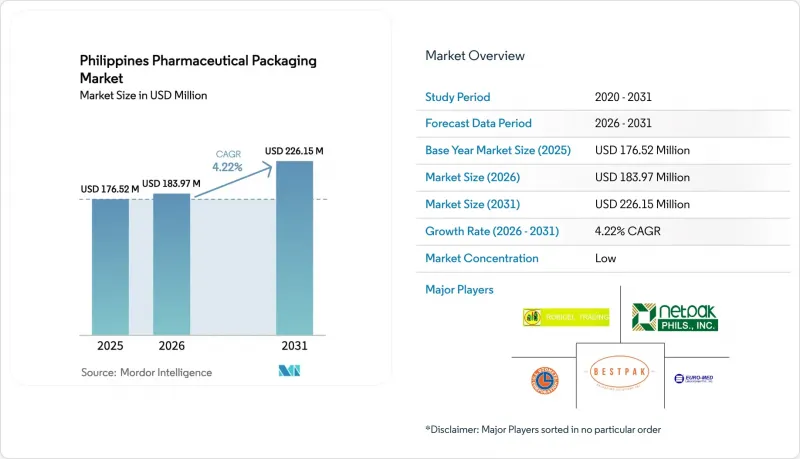
本報告按材料類型(塑膠、玻璃等)、產品類型(瓶子、管瓶和安瓿瓶、泡殼包裝、預填充式注射器和藥筒等)、包裝等級(初級包裝、二級包裝、三級包裝)和最終用戶行業(製藥企業、合約包裝公司等)進行細分。市場預測以價值(美元)表示。
菲律賓藥品包裝市場趨勢及洞察
擴大學名藥生產
由於目前的快速核准流程已縮短至45天,產品上市時間正在縮短,這迫使當地企業重新設計標籤,並投資於符合監管規定的泡殼包裝、瓶裝和袋裝解決方案。預計到2028年,學名藥市場規模將達到38億美元,所有新分子都需要符合衛生署學名藥標籤要求的可序列化包裝。菲律賓經濟特區管理局(PEZA)轄區內的稅收優惠政策正在促進生產,而五家印度公司在2024年8月對菲律賓進行位置調查後表示,未來對阻隔性瓶子和防篡改密封件的需求將會增加。已獲得符合良好生產規範(GMP)指南的材料預認證的包裝製造商正在從這些新參與企業那裡獲得早期供應商地位,並鞏固2025年至2028年整個合約週期內的產量承諾。
擴大政府對基本藥物的採購
菲律賓藥品採購公司(Philippine Pharma Procurement Inc.)的藍圖旨在到2030年將國內生產商在競標中的佔有率提高到50%,從而確保已通過「綠色通道」(Green Lane)許可計劃認證的供應商獲得穩定的訂單。克拉克藥品物流中心(Clark Pharmaceutical Logistics Hub)投資3,525萬美元,擁有符合GDP認證的倉庫,為序列化紙匣和預印標籤的供應商提供服務。目前,基本藥物包裝、糖尿病試紙、降血壓藥泡殼包裝和抗癌藥泡殼包裝均需顯示可追溯性QR碼,並與衛生署的庫存管理平台同步。提供端到端編碼服務和資料完整性審計的加工公司正在獲得多年期契約,並賺取溢價,從而加速菲律賓藥品包裝市場的收入多元化。
對進口原料的高度依賴
由於98%的活性成分和大部分塑膠樹脂依賴進口,加工商面臨外匯波動和運輸中斷的雙重壓力,利潤率受到擠壓。根據菲律賓製藥商協會統計,2015年至2019年間,原料進口量增加了15%。疫情期間,前置作業時間週期超過120天,迫使加工商將緩衝庫存增加一倍。由於缺乏國內石化產業基礎,樹脂價格仍比鄰國高出8%至12%,一些填充劑生產商目前正從泰國和馬來西亞採購瓶坯。貿易和工業部正在考慮降低顆粒進口關稅,但短期價格波動持續存在,使得難以在單次競標週期之外獲得成本加成合約。
細分市場分析
預計到2025年,塑膠將佔菲律賓藥品包裝市場39.85%的佔有率,展現出顯著的銷售優勢。高密度聚乙烯(HDPE)瓶、聚對苯二甲酸乙二醇酯(PET)槽和聚丙烯瓶蓋是最常用的材料。這是因為這些資料的過渡資料已包含在監管文件中,從而縮短了核准前置作業時間。即使新的生產者延伸責任制(EPR)規則將回收目標提高到2028年的80%,菲律賓藥品包裝市場中塑膠產業的規模預計仍將穩定成長。由於EPR帶來的成本增加,品牌商正在試點使用生物基內襯和再生PET材料,雖然這會導致價格上漲,但也能享受稅額扣抵。
永續複合材料目前仍屬於小眾領域,但隨著全球客戶將生命週期指標納入供應商評估標準,預計將以5.96%的複合年成長率實現最高成長。菲律賓科技部綠色包裝研究所正在進行幾丁聚醣和果膠薄膜的試點測試,一些跨國公司的早期採用者正共同資助規模化試驗。玻璃在注射劑領域擁有強勁的需求基礎,因為該領域需要I型硼矽酸玻璃的完整性;而鋁管則用於填充類固醇乳膏,因為該領域需要良好的氧氣阻隔性。這些材料的轉變正在共同推動供應鏈的重組,並促進在生態區內建立包含樹脂回收生產線的合資企業的成立,這將在中期內為菲律賓藥品包裝市場提供支援。
到2025年,瓶裝藥品將佔菲律賓藥品包裝市場21.09%的佔有率。這主要歸功於瓶裝藥品與高速生產線的兼容性,這些生產線能夠處理非處方止咳感冒糖漿和維生素液。自動化視覺檢測系統和導引密封襯墊降低了污染風險,瓶裝藥品也逐漸成為公立醫院競標的標準配備。同時,袋裝藥品市場在菲律賓藥品包裝市場成長最快,複合年成長率達5.34%。這是因為線上藥局更傾向於使用輕便的複合袋,這種包裝可以降低30%的運輸成本。
對於固態劑型藥物而言,泡殼包裝在提高患者用藥依從性方面仍發揮核心作用。自FDA批准與QR碼藥物管理應用程式相容的「錢包式泡殼包裝」用於慢性病患者以來,其重要性進一步提升。預填充式注射器和藥筒在疫苗接種宣傳活動中日益普及,而管瓶和安瓿則確保了特殊注射藥物的安全性。紙盒正融入RFID嵌體和點字壓印等功能性改進,托盤護角板也正逐步轉向使用再生紙,以符合生產者責任延伸(EPR)審核的要求。產品配置的這種演變使加工商受益匪淺,他們可以靈活地在短週期、個人化套裝和大批量、通用批次之間切換,而不會造成停機損失。
其他好處:
- Excel格式的市場預測(ME)表
- 3個月的分析師支持
目錄
第1章:引言
- 研究假設和市場定義
- 調查範圍
第2章:調查方法
第3章執行摘要
第4章 市場狀況
- 市場概覽
- 市場促進因素
- 擴大學名藥生產
- 政府對基本藥物的採購量正在增加。
- 本地契約製造組織(CMO)的擴張
- 嚴格的反假冒法規
- 對患者友善包裝的需求日益成長
- 電子藥局分銷通路的成長
- 市場限制因素
- 對進口原料的高度依賴
- 冷鏈基礎設施有限
- 本地製造商的價格敏感性
- 遵守環境法規的成本
- 產業價值鏈分析
- 宏觀經濟因素對市場的影響
- 監理情勢
- 技術展望
- 波特五力分析
第5章 市場規模與成長預測
- 依材料類型
- 塑膠
- 高密度聚苯乙烯(HDPE)
- 低密度聚乙烯(LDPE)
- 聚對苯二甲酸乙二醇酯(PET)
- 其他塑膠
- 玻璃
- 金屬
- 紙張和紙板
- 複合材料/生物基材料
- 塑膠
- 依產品類型
- 瓶子
- 病毒安瓿
- 吸塑包裝
- 預填充式注射器和藥筒
- 管子
- 調色盤
- 小袋和袋子
- 瓦楞紙箱
- 其他產品類型
- 按包裝級別
- 初級包裝
- 二級包裝
- 三級包裝
- 按最終用戶行業分類
- 製藥公司
- 合約包裝業務
- 零售藥局和醫療機構藥局
- 醫院和診所
- 其他終端用戶產業
第6章 競爭情勢
- 市場集中度
- 策略趨勢
- 市佔率分析
- 公司簡介
- Amcor Flexibles Philippines Corp.(Amcor plc)
- Shandong Pharmaceutical Glass Co., Ltd.
- Robicel Trading
- Bestpak Packaging Solutions, Inc.
- Euro-Med Laboratories Philippines Inc.
- Netpak Phils., Inc.
- GL Otometz Corporation
- Plastic Container Packaging Corporation
- APO International Marketing Corporation
- Merfel Plastic Products
- Versa Group Philippines Corporation
- SwissPac
- Gerresheimer AG
- Schott AG
- Nipro PharmaPackaging International NV
- SGD Pharma
- West Pharmaceutical Services Inc.
- Catalent Inc.
- Datwyler Holding AG
第7章 市場機會與未來展望
According to Mordor Intelligence, the Philippines pharmaceutical packaging market size in 2026 is estimated at USD 183.97 million, growing from 2025 value of USD 176.52 million with 2031 projections showing USD 226.15 million, growing at 4.22% CAGR over 2026-2031.
This report is Segmented by Material Type (Plastic, Glass, and More), Product Type (Bottles, Vials and Ampoules, Blister Packs, Prefilled Syringes and Cartridges, and More), Packaging Level (Primary, Secondary, and Tertiary), End-User Industry (Pharmaceutical Manufacturing Companies, Contract Packaging Organizations, and More). The Market Forecasts are Provided in Terms of Value (USD).
Philippines Pharmaceutical Packaging Market Trends and Insights
Growing Generic Drug Production
Fast-tracked approvals, now limited to 45 days, have cut market-entry timelines, prompting local firms to reformulate labels and invest in compliant blister, bottle, and pouch solutions. The generic-drug spending pool is projected to reach USD 3.8 billion by 2028, and every new molecule requires serialization-ready packaging that meets the Department of Health's generic-label mandate. Fiscal perks inside PEZA parks amplify volumes, while five India-based firms that scouted Philippine sites in August 2024 signal future demand for high-barrier bottles and tamper-evident seals. Packaging converters that pre-qualify materials under Good Manufacturing Practice guidelines are winning early supplier status with these green-field entrants, cementing volume commitments across 2025-2028 contract cycles.
Increasing Government Procurement of Essential Medicines
The Philippine Pharma Procurement Inc. roadmap aims to increase the local-producer share of tenders to 50% by 2030, securing routine orders for suppliers already accredited under the Green Lane licensing system. The Clark pharmaceutical logistics hub, a USD 35.25 million investment, features GDP-certified warehousing that caters to suppliers of serialized cartons and pre-printed labels. Essential-medicine packs, diabetes strips, anti-hypertensive blister sleeves, and oncology vals must now carry traceability QR codes that sync with the Department of Health inventory platform. Converters offering end-to-end coding services and data-integrity audits command price premiums yet secure multiyear contracts, accelerating revenue diversification within the Philippines pharmaceutical packaging market.
Heavy Reliance on Imported Raw Materials
With 98% of active ingredients and most plastic resins imported, converters face currency swings and freight disruptions that compress margins. The Philippine Pharmaceutical Industry Association notes raw-material imports grew 15% between 2015-2019; the pandemic exposed lead-time spikes beyond 120 days, forcing converters to double buffer stocks. The lack of a domestic petrochemical base keeps resin prices 8-12% higher than those of regional peers, prompting some fillers to source preforms from Thailand and Malaysia. Although the Department of Trade and Industry considers tariff relief for pellet imports, short-term volatility persists, making cost-plus contracts difficult to secure for more than one bid cycle.
Other drivers and restraints analyzed in the detailed report include:
- Expansion of Local Contract Manufacturing Organizations
- Stringent Anti-Counterfeiting Regulations
- Limited Cold Chain Infrastructure
For complete list of drivers and restraints, kindly check the Table Of Contents.
Segment Analysis
Plastics deliver the core volume advantage, capturing 39.85% of the Philippines pharmaceutical packaging market in 2025. HDPE bottles, PET jars, and polypropylene closures are the most commonly used materials because regulatory dossiers already reference their migration data, thereby reducing approval lead times. The Philippines pharmaceutical packaging market size for plastics is set to grow steadily, even as new Extended Producer Responsibility (EPR) rules raise recovery targets to 80% by 2028. EPR costs prompt brand owners to trial bio-based liners and recycled-content PET, which command price increases while unlocking tax credits.
Sustainable composites, although niche today, are projected to chart the fastest 5.96% CAGR as global clients incorporate life-cycle metrics into supplier scorecards. The Department of Science and Technology's Green Packaging Laboratory pilots chitosan and pectin films, and early adopters among multinationals co-fund scale-up trials. Glass retains a loyal base in injectables that require Type I borosilicate integrity, while aluminum tubes fill steroid creams that require oxygen barriers. Collectively, these material pivots re-align supply chains, inviting joint ventures that embed resin recycling lines within ecozones, moves that sustain the Philippines pharmaceutical packaging market over the medium term.
Bottles owned 21.09% of the Philippines pharmaceutical packaging market share in 2025, thanks to their compatibility with high-speed lines serving OTC cough-cold syrups and vitamin liquids. Automated vision systems and induction-seal liners reduce contamination risk, solidifying their use in public hospital tenders. Meanwhile, the Philippines pharmaceutical packaging market size for pouches and bags grows fastest at 5.34% CAGR as e-pharmacies prefer lightweight laminate sachets that slash freight costs by 30%.
Blister packs remain central to solid-dose compliance, especially after the FDA endorsed wallet blister formats that support QR-linked adherence apps for patients with chronic diseases. Prefilled syringes and cartridges gain popularity in vaccination drives; vials and ampules maintain the security of specialty injectables. Cartons receive functional upgrades, including RFID inlays and braille embossing, while pallet corner boards transition to recycled paper to meet EPR audits. This product-mix evolution rewards converters who are agile enough to switch between short-run, personalized kits and high-volume, commodity batches without incurring downtime penalties.
Complete Report Scope:
- By Material Type
- Plastic
- High-Density Polyethylene (HDPE)
- Low-Density Polyethylene (LDPE)
- Polyethylene Terephthalate (PET)
- Other Plastics
- Glass
- Metal
- Paper and Paperboard
- Composites/ Bio-based Materials
- Plastic
- By Product Type
- Bottles
- Vials and Ampoules
- Blister Packs
- Prefilled Syringes and Cartridges
- Tubes
- Pallets
- Pouches and Bags
- Carton Boxes
- Other Product Types
- By Packaging Level
- Primary
- Secondary
- Tertiary
- By End-user Industry
- Pharmaceutical Manufacturing Companies
- Contract Packaging Organizations
- Retail and Institutional Pharmacies
- Hospitals and Clinics
- Other End-user Industries
List of Companies Covered in this Report:
- Amcor Flexibles Philippines Corp. (Amcor plc)
- Shandong Pharmaceutical Glass Co., Ltd.
- Robicel Trading
- Bestpak Packaging Solutions, Inc.
- Euro-Med Laboratories Philippines Inc.
- Netpak Phils., Inc.
- GL Otometz Corporation
- Plastic Container Packaging Corporation
- APO International Marketing Corporation
- Merfel Plastic Products
- Versa Group Philippines Corporation
- SwissPac
- Gerresheimer AG
- Schott AG
- Nipro PharmaPackaging International NV
- SGD Pharma
- West Pharmaceutical Services Inc.
- Catalent Inc.
- Datwyler Holding AG
Additional Benefits:
- The market estimate (ME) sheet in Excel format
- 3 months of analyst support
TABLE OF CONTENTS
1 INTRODUCTION
- 1.1 Study Assumptions and Market Definition
- 1.2 Scope of the Study
2 RESEARCH METHODOLOGY
3 EXECUTIVE SUMMARY
4 MARKET LANDSCAPE
- 4.1 Market Overview
- 4.2 Market Drivers
- 4.2.1 Growing Generic Drug Production
- 4.2.2 Increasing Government Procurement of Essential Medicines
- 4.2.3 Expansion of Local Contract Manufacturing Organizations
- 4.2.4 Stringent Anti-Counterfeiting Regulations
- 4.2.5 Rising Demand for Patient-Friendly Packaging
- 4.2.6 Growth of E-Pharmacy Distribution Channels
- 4.3 Market Restraints
- 4.3.1 Heavy Reliance on Imported Raw Materials
- 4.3.2 Limited Cold Chain Infrastructure
- 4.3.3 Price Sensitivity among Local Manufacturers
- 4.3.4 Environmental Compliance Costs
- 4.4 Industry Value Chain Analysis
- 4.5 Impact of Macroeconomic Factors on the Market
- 4.6 Regulatory Landscape
- 4.7 Technological Outlook
- 4.8 Porter's Five Forces Analysis
- 4.8.1 Threat of New Entrants
- 4.8.2 Bargaining Power of Suppliers
- 4.8.3 Bargaining Power of Buyers
- 4.8.4 Threat of Substitutes
- 4.8.5 Competitive Rivalry
5 MARKET SIZE AND GROWTH FORECASTS (VALUE)
- 5.1 By Material Type
- 5.1.1 Plastic
- 5.1.1.1 High-Density Polyethylene (HDPE)
- 5.1.1.2 Low-Density Polyethylene (LDPE)
- 5.1.1.3 Polyethylene Terephthalate (PET)
- 5.1.1.4 Other Plastics
- 5.1.2 Glass
- 5.1.3 Metal
- 5.1.4 Paper and Paperboard
- 5.1.5 Composites/ Bio-based Materials
- 5.1.1 Plastic
- 5.2 By Product Type
- 5.2.1 Bottles
- 5.2.2 Vials and Ampoules
- 5.2.3 Blister Packs
- 5.2.4 Prefilled Syringes and Cartridges
- 5.2.5 Tubes
- 5.2.6 Pallets
- 5.2.7 Pouches and Bags
- 5.2.8 Carton Boxes
- 5.2.9 Other Product Types
- 5.3 By Packaging Level
- 5.3.1 Primary
- 5.3.2 Secondary
- 5.3.3 Tertiary
- 5.4 By End-user Industry
- 5.4.1 Pharmaceutical Manufacturing Companies
- 5.4.2 Contract Packaging Organizations
- 5.4.3 Retail and Institutional Pharmacies
- 5.4.4 Hospitals and Clinics
- 5.4.5 Other End-user Industries
6 COMPETITIVE LANDSCAPE
- 6.1 Market Concentration
- 6.2 Strategic Moves
- 6.3 Market Share Analysis
- 6.4 Company Profiles (includes Global level Overview, Market level overview, Core Segments, Financials as available, Strategic Information, Market Rank/Share for key companies, Products and Services, and Recent Developments)
- 6.4.1 Amcor Flexibles Philippines Corp. (Amcor plc)
- 6.4.2 Shandong Pharmaceutical Glass Co., Ltd.
- 6.4.3 Robicel Trading
- 6.4.4 Bestpak Packaging Solutions, Inc.
- 6.4.5 Euro-Med Laboratories Philippines Inc.
- 6.4.6 Netpak Phils., Inc.
- 6.4.7 GL Otometz Corporation
- 6.4.8 Plastic Container Packaging Corporation
- 6.4.9 APO International Marketing Corporation
- 6.4.10 Merfel Plastic Products
- 6.4.11 Versa Group Philippines Corporation
- 6.4.12 SwissPac
- 6.4.13 Gerresheimer AG
- 6.4.14 Schott AG
- 6.4.15 Nipro PharmaPackaging International NV
- 6.4.16 SGD Pharma
- 6.4.17 West Pharmaceutical Services Inc.
- 6.4.18 Catalent Inc.
- 6.4.19 Datwyler Holding AG
7 MARKET OPPORTUNITIES AND FUTURE OUTLOOK
- 7.1 White-space and Unmet-need Assessment

 2026-2030年全球實驗室耗材初級包裝市場
 中國藥品包裝市場:市場佔有率分析、產業趨勢與統計及成長預測(2026-2031年)
 全球藥品包裝市場規模、佔有率、趨勢和成長分析報告(2026-2034年)印度藥品包裝市場:市場佔有率分析、產業趨勢與統計及成長預測(2026-2031)
 實驗室耗材初級包裝市場-2026-2032年全球市場預測北美藥品包裝市場:市佔率分析、產業趨勢與統計及成長預測(2026-2031 年)歐洲藥品包裝:市場佔有率分析、產業趨勢與統計及成長預測(2026-2031)醫藥包裝器材:市場佔有率分析、產業趨勢與統計、成長預測(2026-2031)醫藥瓶市場:2026-2032年全球市場預測(依產品類型、材質、容量、瓶蓋、瓶型、應用及通路分類)全球生物製藥包裝市場規模、佔有率、趨勢和成長分析報告(2026-2034)