


 |
市場調查報告書
商品編碼
2100667
醫藥包裝器材:市場佔有率分析、產業趨勢與統計、成長預測(2026-2031)Pharmaceutical Packaging Machinery - Market Share Analysis, Industry Trends & Statistics, Growth Forecasts (2026 - 2031) |
||||||

※ 本網頁內容可能與最新版本有所差異。詳細情況請與我們聯繫。
據 Mordor Intelligence 稱,2025 年製藥包裝器材市場價值為 66.2 億美元,預計到 2031 年將達到 100.2 億美元,而 2026 年為 70.9 億美元,預測期(2026-2031 年)的複合年成長率為 7.15%。
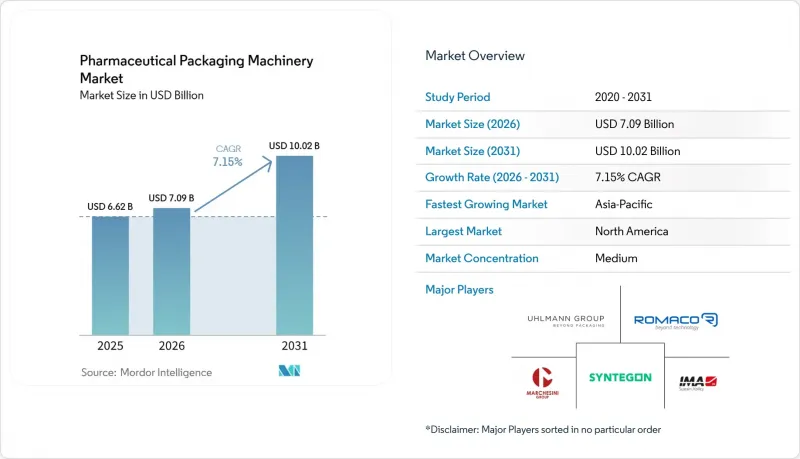
本報告按機器類型(初級包裝、二級包裝、貼標和序列化、三級包裝)、自動化程度(手動、半自動、全自動)、包裝形式(泡殼包裝、瓶/管瓶、袋裝和條狀包裝、紙盒包裝和箱裝)、應用領域(固態、液體製劑、半固態製劑、固體製劑)和地區進行細分。市場預測以美元計價。
全球醫藥包裝器材市場趨勢及洞察
嚴格的序列化和追蹤/追溯規定
藥品可追溯性法規要求從泡殼包裝腔到托盤進行單元級標識符和聚合,這使得包裝器材成為必不可少的合規基礎設施。美國《藥品安全追蹤法案》(DSCSA) 要求在2023年11月前實現完全互通性的可追溯性,儘管到2024年底,超過70%的美國國內工廠已實施序列化模組,但箱級聚合仍然是一個挑戰。歐洲指令要求使用唯一識別碼和防篡改封裝裝置,推動了傳統泡殼包裝和瓶裝填充生產線的維修進程。中國將進口藥品的最後期限延長至2025年,加速了服務歐美市場的契約製造(CMO)的設備採購。雖然供應商軟體現在包含區域合規模板,但這種區域化正在增加藥品包裝器材市場的總擁有成本(TCO)和驗證時間。 ISO 15378已成為事實上的競標要求,將供應商候選人限制在那些能夠使設備規格與良好生產規範(GMP)記錄相符的公司。
生技藥品和注射劑的快速成長
2024年十大暢銷治療藥物中有八種是生物製藥產品,包裝形式包括管瓶、注射器或自動注射器,這些產品需要符合ISO 5級無塵室標準並具備精密玻璃製品處理能力。 2024年,美國食品藥物管理局(FDA)發布了47封關於顆粒物污染的警告信,強化了零缺陷要求,並推動了自動化視覺檢測攝影機的應用。由於基因和細胞療法的批量較小,使用傳統的高速填充機成本效益不高,因此能夠在30分鐘內完成包裝規格更換的模組化填充機更受歡迎。 2024年,歐洲藥品管理局(EMA)批准了92種生技藥品,每種製劑都需要進行專門的包裝驗證測試,許多公司將這項測試外包給了靈活的合約開發和生產(CDMO)合作夥伴。供應商也積極回應,提供伺服驅動計量幫浦和一次性流路,以縮短清洗週期並保持無菌狀態。
大量資金投入先進機械設備
包含隔離器、序列化模組和線上顆粒檢測功能的無菌填充線造價可能超過800萬美元,這使得許多學名藥生產商不得不繼續使用過時的設備。新興地區40%的工廠運作超過15年的老舊設備,而北美地區的比例僅為12%,這種日益擴大的合規差距正在阻礙出口核准。租賃模式正在興起,但數據共用條款引發了人們對智慧財產權的擔憂。歐洲投資銀行等公共金融機構計劃在2024年向東歐提供5億歐元(約5.65億美元)的貸款,以支持設備現代化改造,這表明鑑於私人貸款成本持續高企,外部資金籌措至關重要。
細分市場分析
2025年,初級包裝設備佔藥品包裝器材市場的54.18%,凸顯了其在確保包裝容器完整性和無菌性方面發揮的關鍵作用。然而,隨著全球運輸中強制要求箱體和托盤的整合,二級包裝生產線預計將以8.05%的複合年成長率更快成長。受視覺偵測攝影機和2D條碼印表機等維修需求的推動,二級包裝設備市場預計到2031年將達到34.4億美元。安泰視視(Antares Vision)報告稱,亞太地區序列化模組的訂單量激增22%,顯示以出口為導向的學名藥生產商優先考慮下游製程升級,而非整條生產線的更換。
標籤和序列化設備是成長最快的細分市場,這得益於製藥包裝器材市場中高速噴墨和雷射打碼機(每分鐘超過400包)運作的不斷成長。隨著企業從瓶裝轉向單劑量包裝以提高用藥依從性,對泡殼包裝平台的投資正在復甦,而裝盒機則透過整合可變數據列印和防篡改密封技術,向上游價值鏈推進。 Uhlmann 的 2024 模組化裝盒機無需工具即可在黏扣式和黏合式密封方式之間無縫切換,從而滿足特種藥品 SKU 快速成長的需求。
預計到2025年,自動化系統將佔總安裝量的64.12%,這反映了人事費用的上升以及對零缺陷包裝精度的要求。協作機器人能夠在不中斷生產線的情況下實現快速換型,從而推動了製藥包裝器材市場自動化設備的成長。在印度和中國,預計2019年至2024年間製造業薪資將以每年8%的速度成長,這將縮小曾經足以支撐人工操作的勞動成本差距。
在臨床試驗機構和新興市場工廠中,半自動化設備的需求依然旺盛,因為這些機構更注重產品多樣性而非加工能力。據 Romaco 公司稱,半自動化設備佔其在新興市場銷售額的 35%,是邁向全自動化的墊腳石。 Marchesini 公司於 2024 年推出的協作式裝盒單元,將換型時間從 45 分鐘大幅縮短至 12 分鐘,這表明,在熟練的機電一體化工程師人才儲備成熟之前,人機協作的混合單元可以彌補能力缺口。
區域分析
北美是我們最大的區域中心,占我們2025年銷售額的39.10%,這得益於《藥品供應鏈安全法案》(DSCSA)的實施、回流激勵措施以及對北卡羅來納州和馬薩諸塞州等州無菌灌裝項目資本投資的稅額扣抵津貼。對數位孿生和能源監控的投資旨在縮短試運行時間和降低營運成本。美國契約製造對符合FDA電子記錄標準的、帶有預驗證文件的承包解決方案的需求日益成長,這縮短了產品上市時間。
亞太地區呈現最快成長勢頭,複合年成長率達9.30%,這主要得益於印度和中國的工廠為滿足美國和歐盟的出口規格而採取的措施。印度2024會計年度成品藥出口額達279億美元,這種高度的出口依賴促使企業採用歐洲標準的序列化和視覺系統。中國政府已將進口藥品序列化合規期限延長至2025年,這導致以出口為導向的契約製造製造商(CMO)短期內出現設備採購熱潮。
在歐洲,穩定的市場需求主要來自設備升級週期,而非工廠擴張。製造商正在維修其瓶裝、泡殼包裝和管瓶生產線,加裝集中式鏡頭,以符合預計2024年全面實施的歐盟指令。他們也在努力透過提高能源效率來降低區域內高昂的電力成本。德國、義大利和瑞士仍然是全球工程技術中心,擁有Syntegon、IMA和Marchesini等公司。這形成了一個緊密的服務網路,跨國製藥公司在選擇設備合作夥伴時更傾向於選擇這些國家。
儘管南美洲、中東和非洲的市場佔有率較小,但這些地區蘊藏著與各國國內生產政策相關的獨特商機。在巴西和阿根廷,已引入以《藥品供應鏈安全法案》(DSCSA)為藍本的序列化法規,刺激了噴墨打碼機和包裝箱聚合機的採購。在波灣合作理事會(GCC)成員國,在經濟多元化的框架下,本地疫苗填充和包裝廠的建設正在穩步推進,能夠提供培訓和驗證支持一站式服務的供應商在這些新興市場中獲得了先發優勢。
其他好處:
- Excel格式的市場預測(ME)表
- 3個月的分析師支持
目錄
第1章:引言
- 研究假設和市場定義
- 調查範圍
第2章:調查方法
第3章執行摘要
第4章 市場狀況
- 市場概覽
- 市場促進因素
- 嚴格的序列化和追蹤/追溯規定
- 生技藥品和注射劑的快速成長
- 對自動化和與工業4.0整合的需求日益成長
- 個性化、小批量生產工作流程的興起
- 為因應地緣政治緊張局勢,醫藥供應鏈正在向國內轉移或近岸外包。
- 在環境、社會及公司治理(ESG)目標的驅動下,節能型機械正成為採購標準。
- 市場限制因素
- 大量資金投入先進機械設備
- 嚴格的檢驗和合規性的複雜性
- 半導體和伺服驅動器供應供不應求導致設備交付延遲。
- 生產線整合需要大量熟練的機電一體化人員,但目前存在短缺。
- 產業價值鏈分析
- 宏觀經濟因素對市場的影響
- 監理情勢
- 技術展望
- 波特五力分析
第5章 市場規模與成長預測
- 按機器類型
- 初級包裝設備
- 二級包裝設備
- 標籤和序列化設備
- 三級包裝設備
- 按自動化級別
- 手動的
- 半自動
- 自動的
- 按包裝類型
- 吸塑包裝
- 瓶裝/管瓶包裝
- 小袋和條狀包裝
- 裝盒和裝箱
- 透過使用
- 固態劑型(錠劑和膠囊)
- 液體
- 半固態製劑
- 注射劑(腸外製劑)
- 按地區
- 北美洲
- 美國
- 加拿大
- 墨西哥
- 南美洲
- 巴西
- 阿根廷
- 智利
- 其他南美國家
- 歐洲
- 英國
- 德國
- 法國
- 義大利
- 西班牙
- 其他歐洲國家
- 亞太地區
- 中國
- 日本
- 印度
- 韓國
- 澳洲和紐西蘭
- 其他亞太國家
- 中東和非洲
- 中東
- 阿拉伯聯合大公國
- 沙烏地阿拉伯
- 土耳其
- 其他中東國家
- 非洲
- 南非
- 肯亞
- 奈及利亞
- 其他非洲國家
- 中東
- 北美洲
第6章 競爭情勢
- 市場集中度
- 策略趨勢
- 市佔率分析
- 公司簡介
- Syntegon Technology GmbH
- IMA SpA
- Marchesini Group SpA
- Uhlmann Group
- Romaco Holding GmbH
- Optima Packaging Group GmbH
- MULTIVAC Group
- Korber AG(Medipak Systems)
- Antares Vision Group SpA
- Coesia SpA
- Bausch+Strobel Maschinenfabrik Ilshofen GmbH+Co. KG
- ACG Packaging Private Limited
- Ishida Co. Ltd.
- PAC Machinery Group Inc.
- Accutek Packaging Equipment Companies Inc.
- Vanguard Pharmaceutical Machinery Inc.
- MG2 srl
- Becton Dickinson and Company
- SSI SCHAFER Group
- Herma GmbH
- Videojet Technologies Inc.
第7章 市場機會與未來展望
According to Mordor Intelligence, the pharmaceutical packaging machinery market size was valued at USD 6.62 billion in 2025 and estimated to grow from USD 7.09 billion in 2026 to reach USD 10.02 billion by 2031, at a CAGR of 7.15% during the forecast period (2026-2031).
This report is Segmented by Machinery Type (Primary, Secondary, Labelling and Serialization, and Tertiary), Automation Level (Manual, Semi-Automatic, and Automatic), Packaging Format (Blister, Bottle/Vial, Sachet and Stick Pack, and Cartoning and Case Packing), Application (Solid, Liquid, Semi-Solids, and Parenterals), and Geography. The Market Forecasts are Provided in Terms of Value (USD).
Global Pharmaceutical Packaging Machinery Market Trends and Insights
Stringent Serialization and Track and Trace Regulations
Drug traceability laws require unit-level identifiers and aggregation from blister cavity to pallet, converting packaging machinery into essential compliance infrastructure. The U.S. DSCSA mandated fully interoperable traceability by November 2023, and by late 2024, more than 70% of domestic sites had installed serialization modules; however, case-level aggregation gaps persist. Europe's directive enforces unique identifiers and tamper-evident closures, prompting retrofit cycles across legacy blister and bottle lines. China extended its deadline to 2025 for import drugs, spurring contract manufacturers that serve Western markets to fast-track equipment purchases. Supplier software now ships with region-specific compliance templates; however, this localization increases the total cost of ownership and validation timelines in the pharmaceutical packaging machinery market. ISO 15378 has become a de facto tender prerequisite, narrowing vendor pools to firms that can align equipment files with Good Manufacturing Practice records.
Rapid Growth of Biologics and Injectable Drugs
Eight of the top 10 therapies sold in 2024 were biologics packaged in vials, syringes, or autoinjectors that require ISO Class 5 environments and precise glass handling. The FDA issued 47 warning letters in 2024 for particulate contamination, reinforcing the zero-defect mandate and driving the installation of automated visual inspection cameras. Small batch sizes of gene and cell therapies make high-speed legacy fillers uneconomic, so modular machines capable of 30-minute format changes are preferred. The European Medicines Agency cleared 92 biologics in 2024, each requiring dedicated packaging validation runs that many firms outsource to flexible contract development and manufacturing partners. Suppliers respond with servo-driven dosing pumps and single-use flow paths that maintain sterility and shorten cleaning cycles.
High Capital Expenditure for Advanced Machinery
Aseptic lines incorporating isolators, serialization modules, and in-line particle inspection can top USD 8 million, locking many generic manufacturers into aging assets. Forty percent of plants in emerging regions operate equipment that is more than 15 years old, compared with 12% in North America, widening a compliance gap that hinders export approvals. Leasing models have emerged, yet data-sharing clauses raise concerns about intellectual property. Public lenders, such as the European Investment Bank, offered EUR 500 million (USD 565 million) in loans in 2024 to support Eastern European upgrades, signaling that external financing is essential where private credit costs remain elevated.
Other drivers and restraints analyzed in the detailed report include:
- Increasing Demand for Automation and Industry 4.0 Integration
- Rise of Personalized Small-Batch Manufacturing Workflows
- Stringent Validation and Compliance Complexity
For complete list of drivers and restraints, kindly check the Table Of Contents.
Segment Analysis
Primary equipment accounted for 54.18% of the pharmaceutical packaging machinery market in 2025, underscoring its mission-critical role in ensuring container integrity and sterility. However, secondary lines will expand at a faster rate of 8.05% CAGR because case- and pallet-level aggregation has become mandatory for global shipments. The pharmaceutical packaging machinery market size for secondary equipment is forecast to reach USD 3.44 billion by 2031, driven by retrofits that incorporate vision-inspection cameras and two-dimensional code printers. Antares Vision logged a 22% order spike for serialization modules in the Asia-Pacific region, revealing how export-oriented generic manufacturers prioritize downstream upgrades over full-line replacements.
Labeling and serialization machines form the fastest-moving niche, aided by the pharmaceutical packaging machinery market share gains of high-speed inkjet and laser coders operating at more than 400 packs per minute. Blister platforms are experiencing renewed investment as companies shift from bottles to unit-dose packs to enhance adherence, while cartoners are moving up the value chain by integrating variable data printing and tamper-evident sealing. Uhlmann's 2024 modular cartoner allows for seamless switching between tuck-end and glue-seal formats without the need for tools, aligning with the high SKU proliferation of specialty drugs.
Automatic systems accounted for 64.12% of installations in 2025, reflecting wage inflation and the precision needed for zero-defect packaging. The pharmaceutical packaging machinery market growth for automatic equipment is driven by collaborative robots that enable rapid changeovers without interrupting production lines. In India and China, manufacturing wages increased by 8% annually from 2019 to 2024, narrowing the labor arbitrage that once justified manual operations.
Semi-automatic machines still appeal to clinical-trial sites and emerging-market factories where product diversity outweighs throughput. Romaco reports that 35% of its emerging-market sales are semi-automatic units, serving as stepping-stones toward full automation. Marchesini's collaborative cartoning cells, deployed in 2024, slash changeover times from 45 to 12 minutes, demonstrating how hybrid human-robot cells bridge capability gaps until skilled mechatronics labor pools mature.
Complete Report Scope:
- By Machinery Type
- Primary Packaging Equipment
- Secondary Packaging Equipment
- Labelling and Serialization Equipment
- Tertiary Packaging Equipment
- By Automation Level
- Manual
- Semi-Automatic
- Automatic
- By Packaging Format
- Blister Packaging
- Bottle/Vial Packaging
- Sachet and Stick Pack
- Cartoning and Case Packing
- By Application
- Solids (Tablets/Capsules)
- Liquids
- Semi-Solids
- Parenterals (Injectables)
- By Geography
- North America
- United States
- Canada
- Mexico
- South America
- Brazil
- Argentina
- Chile
- Rest of South America
- Europe
- United Kingdom
- Germany
- France
- Italy
- Spain
- Rest of Europe
- Asia-Pacific
- China
- Japan
- India
- South Korea
- Australia and New Zealand
- Rest of Asia-Pacific
- Middle East and Africa
- Middle East
- United Arab Emirates
- Saudi Arabia
- Turkey
- Rest of Middle East
- Africa
- South Africa
- Kenya
- Nigeria
- Rest of Africa
- Middle East
- North America
Geography Analysis
North America represents the largest regional base, accounting for 39.10% of 2025 revenue, thanks to DSCSA enforcement, reshoring incentives, and tax credits that subsidize capital outlays for sterile-fill projects in states such as North Carolina and Massachusetts. Investments in digital twins and energy monitoring aim to reduce commissioning time and operating expenses. Contract manufacturers in the United States are increasingly requiring turnkey solutions with validation documentation pre-aligned to FDA electronic record standards, thereby shortening the time to market.
The Asia-Pacific region exhibits the fastest trajectory, forecast at a 9.30% CAGR, driven by Indian and Chinese factories that seek to meet export specifications for the United States and the European Union. India shipped USD 27.9 billion in finished drugs in fiscal 2024, and this export dependency motivates firms to install European-grade serialization and vision systems. Chinese authorities have extended the serialization compliance deadline for imports to 2025, creating a short-term equipment procurement boom among export-oriented contract manufacturers.
Europe maintains a steady demand tied to replacement cycles rather than plant expansions. Manufacturers retrofit bottle, blister, and vial lines with aggregation cameras to comply with the EU directive's full enforcement, which is expected to be reached in 2024, while energy-efficiency upgrades mitigate regionally high electricity costs. Germany, Italy, and Switzerland remain global engineering hubs, home to Syntegon, IMA, and Marchesini, which creates a dense service network that multinational drugmakers favor when sourcing equipment partners.
South America and the Middle East, and Africa contribute smaller shares but offer targeted opportunities tied to domestic production policies. Brazil and Argentina introduced serialization regulations modeled after the DSCSA, stimulating the purchase of inkjet coders and case aggregators. Gulf Cooperation Council states are promoting local vaccine fill-finish plants under economic diversification frameworks, and suppliers who bundle training and validation support gain an early-mover advantage in these nascent markets.
- Syntegon Technology GmbH
- IMA S.p.A.
- Marchesini Group S.p.A.
- Uhlmann Group
- Romaco Holding GmbH
- Optima Packaging Group GmbH
- MULTIVAC Group
- Korber AG (Medipak Systems)
- Antares Vision Group S.p.A.
- Coesia S.p.A.
- Bausch + Strobel Maschinenfabrik Ilshofen GmbH + Co. KG
- ACG Packaging Private Limited
- Ishida Co. Ltd.
- PAC Machinery Group Inc.
- Accutek Packaging Equipment Companies Inc.
- Vanguard Pharmaceutical Machinery Inc.
- MG2 s.r.l.
- Becton Dickinson and Company
- SSI SCHAFER Group
- Herma GmbH
- Videojet Technologies Inc.
Additional Benefits:
- The market estimate (ME) sheet in Excel format
- 3 months of analyst support
TABLE OF CONTENTS
1 INTRODUCTION
- 1.1 Study Assumptions and Market Definition
- 1.2 Scope of the Study
2 RESEARCH METHODOLOGY
3 EXECUTIVE SUMMARY
4 MARKET LANDSCAPE
- 4.1 Market Overview
- 4.2 Market Drivers
- 4.2.1 Stringent Serialization and Track and Trace Regulations
- 4.2.2 Rapid Growth of Biologics and Injectable Drugs
- 4.2.3 Increasing Demand for Automation and Industry 4.0 Integration
- 4.2.4 Rise of Personalized Small-Batch Manufacturing Workflows
- 4.2.5 Reshoring and Nearshoring of Pharma Supply Chains in Response to Geopolitical Strains
- 4.2.6 Energy-Efficient Machinery Becoming a Procurement Criterion Amid ESG Targets
- 4.3 Market Restraints
- 4.3.1 High Capital Expenditure for Advanced Machinery
- 4.3.2 Stringent Validation and Compliance Complexity
- 4.3.3 Semiconductor and Servo Drive Shortages Disrupting Equipment Lead Times
- 4.3.4 Limited Availability of Skilled Mechatronics Talent for Line Integration
- 4.4 Industry Value Chain Analysis
- 4.5 Impact of Macroeconomic Factors on the Market
- 4.6 Regulatory Landscape
- 4.7 Technological Outlook
- 4.8 Porter's Five Forces Analysis
- 4.8.1 Threat of New Entrants
- 4.8.2 Bargaining Power of Buyers
- 4.8.3 Bargaining Power of Suppliers
- 4.8.4 Threat of Substitute Products
- 4.8.5 Intensity of Competitive Rivalry
5 MARKET SIZE AND GROWTH FORECASTS (VALUE)
- 5.1 By Machinery Type
- 5.1.1 Primary Packaging Equipment
- 5.1.2 Secondary Packaging Equipment
- 5.1.3 Labelling and Serialization Equipment
- 5.1.4 Tertiary Packaging Equipment
- 5.2 By Automation Level
- 5.2.1 Manual
- 5.2.2 Semi-Automatic
- 5.2.3 Automatic
- 5.3 By Packaging Format
- 5.3.1 Blister Packaging
- 5.3.2 Bottle/Vial Packaging
- 5.3.3 Sachet and Stick Pack
- 5.3.4 Cartoning and Case Packing
- 5.4 By Application
- 5.4.1 Solids (Tablets/Capsules)
- 5.4.2 Liquids
- 5.4.3 Semi-Solids
- 5.4.4 Parenterals (Injectables)
- 5.5 By Geography
- 5.5.1 North America
- 5.5.1.1 United States
- 5.5.1.2 Canada
- 5.5.1.3 Mexico
- 5.5.2 South America
- 5.5.2.1 Brazil
- 5.5.2.2 Argentina
- 5.5.2.3 Chile
- 5.5.2.4 Rest of South America
- 5.5.3 Europe
- 5.5.3.1 United Kingdom
- 5.5.3.2 Germany
- 5.5.3.3 France
- 5.5.3.4 Italy
- 5.5.3.5 Spain
- 5.5.3.6 Rest of Europe
- 5.5.4 Asia-Pacific
- 5.5.4.1 China
- 5.5.4.2 Japan
- 5.5.4.3 India
- 5.5.4.4 South Korea
- 5.5.4.5 Australia and New Zealand
- 5.5.4.6 Rest of Asia-Pacific
- 5.5.5 Middle East and Africa
- 5.5.5.1 Middle East
- 5.5.5.1.1 United Arab Emirates
- 5.5.5.1.2 Saudi Arabia
- 5.5.5.1.3 Turkey
- 5.5.5.1.4 Rest of Middle East
- 5.5.5.2 Africa
- 5.5.5.2.1 South Africa
- 5.5.5.2.2 Kenya
- 5.5.5.2.3 Nigeria
- 5.5.5.2.4 Rest of Africa
- 5.5.5.1 Middle East
- 5.5.1 North America
6 COMPETITIVE LANDSCAPE
- 6.1 Market Concentration
- 6.2 Strategic Moves
- 6.3 Market Share Analysis
- 6.4 Company Profiles (includes Global level Overview, Market level overview, Core Segments, Financials as available, Strategic Information, Market Rank/Share for key companies, Products and Services, and Recent Developments)
- 6.4.1 Syntegon Technology GmbH
- 6.4.2 IMA S.p.A.
- 6.4.3 Marchesini Group S.p.A.
- 6.4.4 Uhlmann Group
- 6.4.5 Romaco Holding GmbH
- 6.4.6 Optima Packaging Group GmbH
- 6.4.7 MULTIVAC Group
- 6.4.8 Korber AG (Medipak Systems)
- 6.4.9 Antares Vision Group S.p.A.
- 6.4.10 Coesia S.p.A.
- 6.4.11 Bausch + Strobel Maschinenfabrik Ilshofen GmbH + Co. KG
- 6.4.12 ACG Packaging Private Limited
- 6.4.13 Ishida Co. Ltd.
- 6.4.14 PAC Machinery Group Inc.
- 6.4.15 Accutek Packaging Equipment Companies Inc.
- 6.4.16 Vanguard Pharmaceutical Machinery Inc.
- 6.4.17 MG2 s.r.l.
- 6.4.18 Becton Dickinson and Company
- 6.4.19 SSI SCHAFER Group
- 6.4.20 Herma GmbH
- 6.4.21 Videojet Technologies Inc.
7 MARKET OPPORTUNITIES AND FUTURE OUTLOOK
- 7.1 White-Space and Unmet-Need Assessment

 2026-2030年全球實驗室耗材初級包裝市場
 中國藥品包裝市場:市場佔有率分析、產業趨勢與統計及成長預測(2026-2031年)
 全球藥品包裝市場規模、佔有率、趨勢和成長分析報告(2026-2034年)菲律賓藥品包裝市場:市場佔有率分析、產業趨勢與統計及成長預測(2026-2031)印度藥品包裝市場:市場佔有率分析、產業趨勢與統計及成長預測(2026-2031)
 實驗室耗材初級包裝市場-2026-2032年全球市場預測北美藥品包裝市場:市佔率分析、產業趨勢與統計及成長預測(2026-2031 年)歐洲藥品包裝:市場佔有率分析、產業趨勢與統計及成長預測(2026-2031)醫藥瓶市場:2026-2032年全球市場預測(依產品類型、材質、容量、瓶蓋、瓶型、應用及通路分類)全球生物製藥包裝市場規模、佔有率、趨勢和成長分析報告(2026-2034)