


 |
市場調查報告書
商品編碼
2113440
北美藥品包裝市場:市佔率分析、產業趨勢與統計及成長預測(2026-2031 年)North America Pharmaceutical Packaging - Market Share Analysis, Industry Trends & Statistics, Growth Forecasts (2026 - 2031) |
||||||

※ 本網頁內容可能與最新版本有所差異。詳細情況請與我們聯繫。
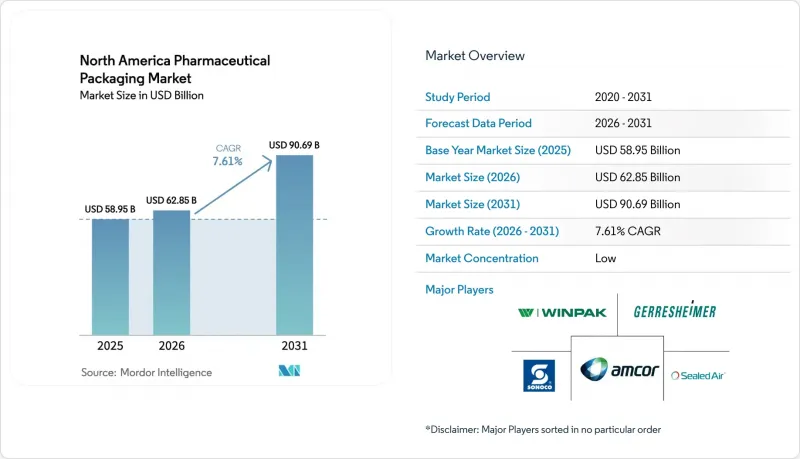
根據 Mordor Intelligence 預測,北美藥品包裝市場規模將從 2025 年的 589.5 億美元成長到 2026 年的 628.5 億美元,然後在 2031 年達到 906.9 億美元,2026 年至 2031 年的複合年成長率為 7.61%。
本報告按材料類型(塑膠、玻璃、金屬等)、產品類型(瓶、管瓶和安瓿、泡殼包裝、軟管等)、包裝等級(一級、二級、三級)、最終用戶產業(製藥企業、合約包裝公司等)和國家進行細分。市場預測以美元(USD)為單位。
北美藥品包裝市場趨勢與洞察
生物製藥產業的成長需要專用容器和密封系統
到2025年,生物製藥將佔FDA核准藥物總數的近30%,每種分子都需要經過嚴格檢驗的彈性體塞、阻隔塗層和確定性完整性測試,以防止氧氣滲入和顆粒遷移。預填充式注射器和藥筒正成為單株抗體和GLP-1療法自我給藥的主要包裝形式,West Pharmaceutical Services公司正在加速擴建其位於北卡羅來納州的NovaPure生產線,以滿足兩位數的訂單成長。製藥公司願意為降低批次不相容風險的組件支付溢價,並要求進行氦氣洩漏測試和模擬實際運輸振動的雷射測試。從管瓶到注射裝置的轉變縮短了填充和表面處理工程週期,減少了護理人員分發藥物的操作,使得高價值的密封組件對治療效果至關重要。因此,擁有位於生技藥品製藥廠附近的技術實驗室的初級包裝供應商正在簽訂多年供應合約。
嚴格的防偽法規有助於實現更先進的追蹤溯源。
隨著《藥品安全追蹤法案》(DSCSA)於2024年11月全面實施,所有在美國境內運輸的處方藥包裝都必須附有唯一的2D碼。 2025年,美國食品藥物管理局(FDA)發布的警告要求批發商對單一藥品的序號進行檢驗。品牌商已部署高速視覺系統,每分鐘可驗證400個包裝,而合約包裝公司則已將聚合軟體與其企業資源計劃(ERP)系統整合,以便向客戶提供合規資料。支援近場通訊(NFC)的標籤和防篡改封條使藥劑師和患者能夠透過智慧型手機驗證藥品的真偽,從而遏止藥品被盜用和流入灰色市場。序列化會使每個包裝的成本增加最多12美分,但製藥公司認為這是進入市場的必要補償。這促使製藥公司持續投資於數位印刷機、可變資料印刷和雲端可追溯性儀表板。
醫用塑膠原料價格波動
由於美國墨西哥灣沿岸石化工廠計畫外停產,2025年第一季醫用級高密度聚苯乙烯和聚丙烯樹脂價格飆升22%,擠壓了加工商的利潤空間。樹脂供應商的不可抗力聲明年增40%,凸顯了供應易受天氣相關中斷的影響。長期合約將價格鎖定12-24個月,加上成本轉嫁的限制,迫使加工商在合約中期重新談判,否則只能承受利潤率下降的損失。永續發展法規進一步加劇了價格波動,因為再生樹脂的交易價格溢價15-20%,品質參差不齊,而且需要額外的分類和清潔。儘管供應商正在加快原料來源多元化,並對替代供應商進行認證以對沖風險,但價格不確定性仍然是整個價值鏈上盈利面臨的緊迫威脅。
細分市場分析
預計2026年至2031年間,複合材料和生物基塑膠的複合年成長率將達到9.21%,超過傳統基材的成長速度,這主要得益於加工商為履行加州、科羅拉多和緬因州的生產者延伸責任制(EPR)義務而採取的措施。 2025年,塑膠在北美藥品包裝市場佔據40.32%的佔有率。這主要得益於高密度聚苯乙烯(HDPE)瓶和低密度聚乙烯(LDPE)擠壓瓶的普及,但樹脂價格波動和回收的挑戰正在擠壓利潤空間。玻璃在注射劑領域仍然佔據重要地位,因為惰性是關鍵因素,但人們對重量和破損風險的擔憂促使人們考慮使用環烯烴共聚物(COC)管瓶來包裝超高價值生物製藥產品。用於外用藥物的金屬管正面臨鋁價飆升的困境,而重量更輕但阻隔性替代品正在不斷擴大市場佔有率。
在二級和三級包裝中,紙箱和瓦楞紙箱仍然必不可少,但它們對水分的敏感性使得在潮濕的運輸路線中需要使用阻隔塗層。安姆科公司已透過其北美藥品系列產品在雜質去除方面的技術進步,實現了2025年30%的再生材料含量。雖然甘蔗衍生的生物基聚乙烯展現出良好的前景,但有限的原料供應和10-15%的價格上漲阻礙了其廣泛應用。隨著品牌所有者量化其範圍3排放量,那些能夠最快獲得符合美國藥典(USP)指南的新型複合材料認證的供應商,將在未來競標中佔據有利地位。
預計到2031年,軟包裝袋市場將以8.54%的複合年成長率成長,這主要得益於製藥公司對軟性包裝的偏好,此類包裝能夠顯著減輕材料重量、滿足單劑量治療需求並整合防篡改密封。 2025年,瓶裝產品在北美藥品包裝市場仍將佔22.43%的佔有率,而泡殼包裝和條狀包裝在固態口服藥物和非處方藥(OTC)領域正逐漸佔據主導地位。管瓶和小瓶仍然是注射藥物(尤其是在低溫運輸物流中)的必備包裝,而預填充藥筒在GLP-1療法的自動注射器平台中正逐漸佔據主導地位。
合約包裝公司對吸塑包裝生產線的投資,加上線上序列化功能,目前已達到每分鐘1200個吸塑腔的產能,從而縮短了臨床試驗樣品的批量處理時間。眼科和皮膚科產品採用軟管包裝,而使用先進鋁箔替代品的層壓結構在不影響阻隔性的前提下,降低了碳排放。瓶蓋和封口必須滿足防止兒童意外開啟的要求,並提供老年人易於操作的扭矩範圍,設計也在不斷改進,以平衡安全性和易用性。標籤正從紙質轉向採用全像圖和變色油墨的多層薄膜,這增加了回收過程的複雜性,同時也加強了品牌所有者的安全策略。
其他好處:
- Excel格式的市場預測(ME)表
- 3個月的分析師支持
目錄
第1章:引言
- 研究假設和市場定義
- 調查範圍
第2章:調查方法
第3章執行摘要
第4章 市場狀況
- 市場概覽
- 市場促進因素
- 智慧吸塑包裝解決方案的廣泛應用
- 嚴格的防偽法規有助於實現更先進的追蹤溯源。
- 生技藥品的生長需要特殊的容器和封閉系統。
- 居家照護需求的增加推動了對以病人為中心的照護方式的需求。
- 製藥業向永續和可回收包裝材料的轉型
- 擴大對需要溫度控制的藥品低溫運輸基礎設施。
- 市場限制因素
- 醫用塑膠原料價格波動
- 與新型包裝技術創新相關的複雜法規核准流程
- 對一次性塑膠的環境監測導致合規成本高。
- 供應鏈中斷導致產能受限
- 宏觀經濟因素對市場的影響
- 產業價值鏈分析
- 監理情勢
- 技術展望
- 波特五力分析
- 投資分析
第5章 市場規模與成長預測
- 依材料類型
- 塑膠
- 高密度聚苯乙烯(HDPE)
- 低密度聚乙烯(LDPE)
- 聚對苯二甲酸乙二醇酯(PET)
- 其他塑膠
- 玻璃
- 金屬
- 紙張和紙板
- 複合材料/生物基材料
- 塑膠
- 依產品類型
- 瓶子
- 病毒安瓿
- 吸塑包裝
- 預填充式注射器和藥筒
- 管子
- 帽子和帽子
- 小袋和袋子
- 標籤
- 其他產品類型
- 按包裝級別
- 基本的
- 次要
- 第三
- 按最終用戶行業分類
- 製藥公司
- 合約包裝業務
- 零售藥局和醫療機構藥局
- 醫院和診所
- 其他終端用戶產業
- 國家
- 美國
- 加拿大
- 墨西哥
第6章 競爭情勢
- 市場集中度
- 策略趨勢
- 市佔率分析
- 公司簡介
- Amcor plc
- West Pharmaceutical Services Inc.
- AptarGroup Inc.
- Gerresheimer AG
- Schott AG
- Becton, Dickinson and Company
- Cardinal Health Inc.
- Sealed Air Corporation
- Sonoco Products Company
- Alpha Packaging
- Catalent Inc.
- Winpak Ltd.
- Graham Packaging Company LP
- COMAR LLC
- Origin Pharma Packaging
- Rohrer Corporation
- Owens-Illinois Inc.
- Placon Corporation
- Neopac US Inc.
第7章 市場機會與未來展望
According to Mordor Intelligence, the North America pharmaceutical packaging market size is expected to grow from USD 58.95 billion in 2025 to USD 62.85 billion in 2026 and is forecast to reach USD 90.69 billion by 2031 at 7.61% CAGR over 2026-2031.
This report is Segmented by Material Type (Plastic, Glass, Metal, and More), Product Type (Bottles, Vials and Ampoules, Blister Packs, Tubes, and More ), Packaging Level (Primary, Secondary, and Tertiary), End-User Industry (Pharmaceutical Manufacturing Companies, Contract Packaging Organizations, and More), and Country. The Market Forecasts are Provided in Terms of Value (USD).
North America Pharmaceutical Packaging Market Trends and Insights
Growth of Biologics Requiring Specialized Container-Closure Systems
Biologics represented nearly 30% of FDA approvals in 2025, and each molecule demands rigorously validated elastomer stoppers, barrier coatings, and deterministic integrity testing that prevent oxygen ingress and particulate migration. Prefilled syringes and cartridges dominate self-administered monoclonal antibody and GLP-1 therapies, prompting West Pharmaceutical Services to accelerate NovaPure production lines in North Carolina to meet double-digit order growth. Drug owners are willing to pay premium prices for components that lower batch rejection risk, and are requesting helium-leak and laser-based inspections that simulate real-world transport vibration. The migration from vials to ready-to-inject devices shortens fill-finish cycles and reduces nurse preparation steps, making high-value closures critical to therapeutic outcomes. As a result, primary packaging suppliers that co-locate technical laboratories near biologics plants are winning multiyear supply contracts.
Stringent Anti-Counterfeiting Regulations Stimulating Advanced Track-and-Trace
Full DSCSA enforcement in November 2024 required every prescription pack shipped in the United States to carry a unique 2D code, and FDA warning letters issued in 2025 pushed wholesalers to verify serial numbers at unit level. Brand owners installed high-speed vision systems capable of authenticating 400 packs per minute, while contract packagers integrated aggregation software with enterprise resource planning suites to supply compliance data to trading partners. NFC-enabled labels and tamper-evident seals now allow pharmacists and patients to authenticate drugs with a smartphone, curbing diversion and gray-market infiltration. Although serialization raises per-unit costs by up to 12 cents, pharmaceutical sponsors view this as the price of market access. The downstream effect is sustained capital spending on digital presses, variable-data printing, and cloud-hosted traceability dashboards.
Volatility in Raw Material Prices of Medical-Grade Plastics
Medical-grade high-density polyethylene and polypropylene resin prices surged 22% in Q1 2025 following unplanned outages at petrochemical plants along the U.S. Gulf Coast, compressing converter margins. Force-majeure declarations by resin suppliers rose 40% year-on-year, underscoring supply vulnerability to weather-related disruptions. Long-term contracts fixing prices for 12-24 months, combined with limited pass-through, are forcing converters to renegotiate mid-term or absorb margin erosion. Sustainability mandates are amplifying volatility because recycled resin trades at a 15-20% premium and suffers from inconsistent quality that requires extra sorting and washing. Suppliers are accelerating diversification of feedstock sources and qualifying alternative suppliers to hedge risk, but price uncertainty remains an immediate profitability threat across the value chain.
Other drivers and restraints analyzed in the detailed report include:
- Rise in At-Home Care Driving Demand for Patient-Friendly Delivery Formats
- Increasing Adoption of Smart Blister Packaging Solutions
- Complex Regulatory Approval Cycles for New Packaging Innovations
For complete list of drivers and restraints, kindly check the Table Of Contents.
Segment Analysis
Composites and bio-based grades are projected to increase at a 9.21% CAGR from 2026 to 2031, outpacing incumbent substrates as converters meet EPR obligations in California, Colorado, and Maine. Plastics dominated 40.32% North America pharmaceutical packaging market share in 2025, driven by high-density polyethylene bottles and low-density polyethylene squeezers, yet resin price swings and recycling hurdles weigh on margins. Glass maintains its position for parenteral formats where inertness is paramount, but weight and breakage risk prompt exploration of cyclic olefin copolymer vials for ultra-high value biologics. Metal tubes for topicals face aluminum cost inflation, and laminate alternatives are gaining share by delivering equivalent barrier at lower gram weight.
Paperboard cartons and corrugated shippers remain essential for secondary and tertiary containment, although moisture sensitivity necessitates barrier coatings for humid routes. Amcor achieved 30% post-consumer recycled content in its North America pharmaceutical portfolio in 2025, showcasing technical progress on contaminant removal. Bio-based polyethylene sourced from sugarcane holds promise, but limited feedstock and a 10-15% premium constrain uptake. Suppliers moving the fastest to certify new composites under USP guidelines are positioned to capture forthcoming tenders as brand owners quantify Scope 3 emissions.
Pouches and bags are forecast to expand at an 8.54% CAGR through 2031 as drug makers favor flexible containment that slashes material weight, supports unit-dose therapy, and integrates tamper-evident seals. Bottles retained 22.43% North America pharmaceutical packaging market share in 2025, yet blister packs and stick packs are encroaching on solid oral and over-the-counter categories. Vials and ampoules remain indispensable for injectables, especially in cold-chain logistics, and prefilled cartridges dominate auto-injector platforms for GLP-1 therapies.
Blister line investments by contract packagers now top 1,200 cavities per minute with in-line serialization, shrinking batch turnaround for trial materials. Tubes service ophthalmic and dermal products, and laminate structures leveraging advanced foil replacements lower carbon footprint without sacrificing barrier. Caps and closures must meet child-resistant and senior-friendly torque windows, prompting design iterations that balance safety with accessibility. Labels have migrated from paper to multilayer films harboring holograms and color-shifting inks, creating downstream complexity in recycling but boosting brand owner security strategies.
Complete Report Scope:
- By Material Type
- Plastic
- High-Density Polyethylene (HDPE)
- Low-Density Polyethylene (LDPE)
- Polyethylene Terephthalate (PET)
- Other Plastics
- Glass
- Metal
- Paper and Paperboard
- Composites/ Bio-based Materials
- Plastic
- By Product Type
- Bottles
- Vials and Ampoules
- Blister Packs
- Prefilled Syringes and Cartridges
- Tubes
- Caps and Closures
- Pouches and Bags
- Labels
- Other Product Types
- By Packaging Level
- Primary
- Secondary
- Tertiary
- By End-user Industry
- Pharmaceutical Manufacturing Companies
- Contract Packaging Organizations
- Retail and Institutional Pharmacies
- Hospitals and Clinics
- Other End-user Industries
- By Country
- United States
- Canada
- Mexico
List of Companies Covered in this Report:
- Amcor plc
- West Pharmaceutical Services Inc.
- AptarGroup Inc.
- Gerresheimer AG
- Schott AG
- Becton, Dickinson and Company
- Cardinal Health Inc.
- Sealed Air Corporation
- Sonoco Products Company
- Alpha Packaging
- Catalent Inc.
- Winpak Ltd.
- Graham Packaging Company L.P.
- COMAR LLC
- Origin Pharma Packaging
- Rohrer Corporation
- Owens-Illinois Inc.
- Placon Corporation
- Neopac US Inc.
Additional Benefits:
- The market estimate (ME) sheet in Excel format
- 3 months of analyst support
TABLE OF CONTENTS
1 INTRODUCTION
- 1.1 Study Assumptions and Market Definition
- 1.2 Scope of the Study
2 RESEARCH METHODOLOGY
3 EXECUTIVE SUMMARY
4 MARKET LANDSCAPE
- 4.1 Market Overview
- 4.2 Market Drivers
- 4.2.1 Increasing Adoption of Smart Blister Packaging Solutions
- 4.2.2 Stringent Anti-Counterfeiting Regulations Stimulating Advanced Track-and-Trace
- 4.2.3 Growth of Biologics Requiring Specialized Container-Closure Systems
- 4.2.4 Rise in At-Home Care Driving Demand for Patient-Friendly Delivery Formats
- 4.2.5 Shift Toward Sustainable and Recyclable Packaging Materials in Pharma
- 4.2.6 Expansion of Cold Chain Infrastructure for Temperature-Sensitive Drugs
- 4.3 Market Restraints
- 4.3.1 Volatility in Raw Material Prices of Medical-Grade Plastics
- 4.3.2 Complex Regulatory Approval Cycles for New Packaging Innovations
- 4.3.3 Environmental Scrutiny on Single-Use Plastics Leading to Costly Compliance
- 4.3.4 Supply Chain Disruptions Causing Capacity Constraints
- 4.4 Impact of Macroeconomic Factors on the Market
- 4.5 Industry Value Chain Analysis
- 4.6 Regulatory Landscape
- 4.7 Technological Outlook
- 4.8 Porter's Five Forces Analysis
- 4.8.1 Bargaining Power of Suppliers
- 4.8.2 Bargaining Power of Buyers
- 4.8.3 Threat of New Entrants
- 4.8.4 Intensity of Competitive Rivalry
- 4.8.5 Threat of Substitute Products
- 4.9 Investment Analysis
5 MARKET SIZE AND GROWTH FORECASTS (VALUE)
- 5.1 By Material Type
- 5.1.1 Plastic
- 5.1.1.1 High-Density Polyethylene (HDPE)
- 5.1.1.2 Low-Density Polyethylene (LDPE)
- 5.1.1.3 Polyethylene Terephthalate (PET)
- 5.1.1.4 Other Plastics
- 5.1.2 Glass
- 5.1.3 Metal
- 5.1.4 Paper and Paperboard
- 5.1.5 Composites/ Bio-based Materials
- 5.1.1 Plastic
- 5.2 By Product Type
- 5.2.1 Bottles
- 5.2.2 Vials and Ampoules
- 5.2.3 Blister Packs
- 5.2.4 Prefilled Syringes and Cartridges
- 5.2.5 Tubes
- 5.2.6 Caps and Closures
- 5.2.7 Pouches and Bags
- 5.2.8 Labels
- 5.2.9 Other Product Types
- 5.3 By Packaging Level
- 5.3.1 Primary
- 5.3.2 Secondary
- 5.3.3 Tertiary
- 5.4 By End-user Industry
- 5.4.1 Pharmaceutical Manufacturing Companies
- 5.4.2 Contract Packaging Organizations
- 5.4.3 Retail and Institutional Pharmacies
- 5.4.4 Hospitals and Clinics
- 5.4.5 Other End-user Industries
- 5.5 By Country
- 5.5.1 United States
- 5.5.2 Canada
- 5.5.3 Mexico
6 COMPETITIVE LANDSCAPE
- 6.1 Market Concentration
- 6.2 Strategic Moves
- 6.3 Market Share Analysis
- 6.4 Company Profiles (Includes Global Level Overview, Market Level Overview, Core Segments, Financials as Available, Strategic Information, Market Rank/Share, Products and Services, and Recent Developments)
- 6.4.1 Amcor plc
- 6.4.2 West Pharmaceutical Services Inc.
- 6.4.3 AptarGroup Inc.
- 6.4.4 Gerresheimer AG
- 6.4.5 Schott AG
- 6.4.6 Becton, Dickinson and Company
- 6.4.7 Cardinal Health Inc.
- 6.4.8 Sealed Air Corporation
- 6.4.9 Sonoco Products Company
- 6.4.10 Alpha Packaging
- 6.4.11 Catalent Inc.
- 6.4.12 Winpak Ltd.
- 6.4.13 Graham Packaging Company L.P.
- 6.4.14 COMAR LLC
- 6.4.15 Origin Pharma Packaging
- 6.4.16 Rohrer Corporation
- 6.4.17 Owens-Illinois Inc.
- 6.4.18 Placon Corporation
- 6.4.19 Neopac US Inc.
7 MARKET OPPORTUNITIES AND FUTURE OUTLOOK
- 7.1 White-Space and Unmet-Need Assessment

 2026-2030年全球實驗室耗材初級包裝市場
 中國藥品包裝市場:市場佔有率分析、產業趨勢與統計及成長預測(2026-2031年)
 全球藥品包裝市場規模、佔有率、趨勢和成長分析報告(2026-2034年)菲律賓藥品包裝市場:市場佔有率分析、產業趨勢與統計及成長預測(2026-2031)印度藥品包裝市場:市場佔有率分析、產業趨勢與統計及成長預測(2026-2031)
 實驗室耗材初級包裝市場-2026-2032年全球市場預測歐洲藥品包裝:市場佔有率分析、產業趨勢與統計及成長預測(2026-2031)醫藥包裝器材:市場佔有率分析、產業趨勢與統計、成長預測(2026-2031)醫藥瓶市場:2026-2032年全球市場預測(依產品類型、材質、容量、瓶蓋、瓶型、應用及通路分類)全球生物製藥包裝市場規模、佔有率、趨勢和成長分析報告(2026-2034)