

 |
市場調查報告書
商品編碼
2125459
英國網路安全:市場佔有率分析、產業趨勢與統計資料、成長預測(2026-2031 年)UK Cybersecurity - Market Share Analysis, Industry Trends & Statistics, Growth Forecasts (2026 - 2031) |
||||||

※ 本網頁內容可能與最新版本有所差異。詳細情況請與我們聯繫。
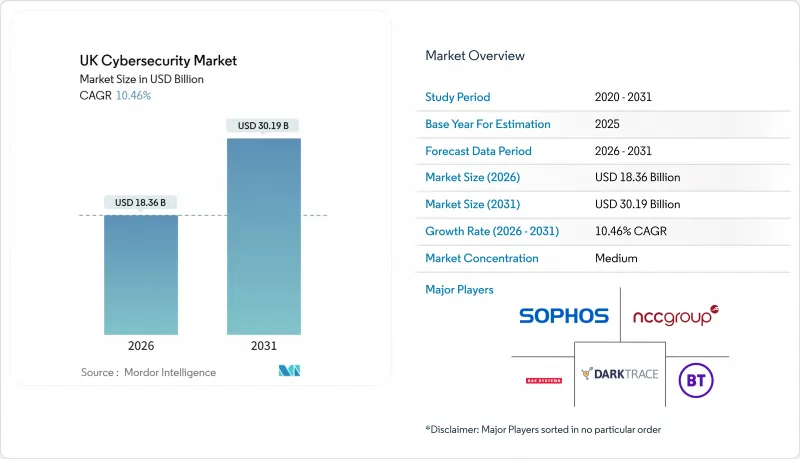
根據 Mordor Intelligence 預測,英國網路安全市場規模預計將在 2026 年達到 183.6 億美元,到 2031 年達到 301.9 億美元,複合年成長率為 10.46%。
本報告按交付方式(解決方案[應用安全、雲端安全、資料安全、網路安全、終端安全等]和服務)、部署方式(雲端和本地部署)、最終用戶產業(銀行、金融服務和保險 (BFSI)、政府和公共部門等)以及最終用戶公司規模(大型企業和中小企業)進行細分。市場預測以美元為單位,以以金額為準呈現。
英國網路安全市場的趨勢與洞察
數位化進程的加速以及混合辦公模式導致攻擊面的擴大
混合辦公模式的普及使得傳統的邊界防禦措施失效。如今,企業需要保護數千個連接到家庭寬頻且網路修補程式不完善的終端設備。國家指南建議部署安全存取服務邊際(SASE),它將防火牆、安全 Web 閘道器和零信任網路存取整合到單一雲端堆疊中,從而實現統一的策略應用,不受用戶位置的限制。受監管的企業必須保持持續身份驗證和微隔離,這項要求正在有效地推動金融和科技中心採用雲端原生技術。 73% 的大型企業表示有意繼續保持靈活的工作安排,因此,以身分為中心的安全已成為長期需求。因此,雲端採用率正在超過本地部署解決方案,供應商正在大力推廣能夠覆蓋遠端網路和園區網路的策略引擎。
勒索軟體和國家支持的威脅正在增加。
根據英國國家網路安全中心 (NCSC) 的記錄,2025 年勒索軟體事件數量較前一年增加了 68%。這一激增歸因於「勒索軟體即服務 (RaaS)」工具包的出現,這些工具包使得即使是新手也能執行複雜的攻擊。醫療系統遭受了長時間的服務中斷,而能源公司則面臨供應鏈入侵,這些入侵被確認為由俄羅斯和伊朗的組織所為。政府調查估計,2025 年將有 32% 的企業遭受資料洩露,平均恢復成本為 15,300 英鎊(約 20,534.97 美元)。在日益嚴峻的威脅壓力下,企業被迫採用託管偵測與回應 (MDR) 服務,以確保全天候回應並允許直接升級至事件回應團隊。
網路安全人員嚴重短缺
政府預測,到2025年,全國將出現14,100個網路安全相關崗位的缺口,倫敦高級雲端安全工程師的年薪中位數將達到85,000英鎊(約11,4083.18美元)。人才短缺推高了人事費用,延長了專案實施週期,迫使企業將保全行動外包給專業服務商。由於學徒計畫和大學投資預計在中期內對解決人才短缺問題收效甚微,託管服務仍然是主要的過渡方案,而且其兩位數的成長勢頭還在持續增強。
細分市場分析
預計到2025年,服務業將佔英國網路安全市場佔有率的62.73%,複合年成長率(CAGR)為12.22%。託管偵測與回應(MDR)是成長最快的服務項目,因為它允許企業在幾天內運作雲端感測器,並以固定費用獲得全天候威脅搜尋服務,這比組建內部安全營運中心(SOC)更便於預算。由於合規性要求不斷提高以及董事會要求進行差距分析、滲透測試和彈性演練,對專業服務的需求也在不斷成長。相比之下,解決方案產業仍然至關重要,但成長速度有所放緩。買家傾向於選擇將防火牆、零信任網路存取和安全Web閘道器功能整合到單一訂閱中的雲端原生工具。身分和存取管理是購買量最大的解決方案,因為零信任設計是基於強身份驗證和最小權限原則。在應用安全工具領域,將靜態、動態和軟體配置分析整合到持續整合(CI)管道中的SaaS供應商正受到越來越多的關注。雖然人們對終端安全、網路安全和資料安全產品的興趣仍然濃厚,但支出正在轉向將這些技術與專家監督相結合的服務合約。
隨著公共機構強制要求關鍵供應商提供全天候安全監控認證,英國網路安全保全服務市場預計將進一步加速成長。同時,在多地營運安全營運中心的供應商正在採取措施規避延遲風險、滿足資料居住要求,並確保在發生局部故障時業務永續營運。因此,多年期外包預計將在監管嚴格的行業以及先前依賴臨時性、被動式外包的中型企業中變得更加普遍。
預計到2025年,雲端將佔英國網路安全市場63.84%的佔有率,複合年成長率(CAGR)為12.32%,而本地部署預計將以中等個位數的成長率成長。遠端和混合辦公模式需要以身分為中心的架構,這促使企業採用保全服務邊緣平台,以在所有位置強制執行一致的策略。政府和金融監管機構正在倡導多重雲端戰略與集中式身分聯合,這進一步證明了圍繞「雲端優先」控制構建的供應商藍圖的合理性。企業發現,啟用雲端保護可能需要數天時間,而採購、機架安裝和維護週期卻拖慢了本地平台的運作速度。即使是資料本地化法規嚴格的行業也在採用混合設計,將敏感記錄保留在本地,同時將分析處理遷移到彈性雲節點。
在製造業、能源和公共產業等運作傳統操作技術(OT) 的產業中,本地部署環境仍然存在。由於空氣間隙的可程式邏輯控制器 (PLC) 無法連接到外部平台,資產所有者正在部署中間感測器和網路分路器來獲取遙測資料。供應商正在將這些部署與雲端託管的管理主機整合,這表明靈活使用模式正在成為更廣泛的趨勢。然而,這種遷移存在配置錯誤的風險,且雲端安全態勢管理現在已內建於大多數企業合約中,可自動驗證是否符合網路安全中心 (CIS) 的基準。
其他好處:
- Excel格式的市場預測(ME)表
- 3個月的分析師支持
目錄
第1章:引言
- 研究假設和市場定義
- 調查範圍
第2章:調查方法
第3章執行摘要
第4章 市場狀況
- 市場概覽
- 市場促進因素
- 數位化進程的推進和混合辦公模式帶來的攻擊面擴大正在加劇。
- 勒索軟體和國家支持的威脅正在增加。
- 英國合規要求的擴展(通訊安全法案、DORA)
- 人工智慧驅動的安全分析的迅速普及
- 政府零信任採購要求
- 迫於承保網路保險的壓力,建立了一套管理體系。
- 市場限制因素
- 網路安全人員嚴重短缺
- 先進平台的總擁有成本高
- 傳統OT系統與難以保障安全的關鍵基礎設施系統
- 缺乏明確的投資報酬率導致中小企業投資不足。
- 產業價值鏈分析
- 監理情勢
- 技術展望
- 波特五力分析
- 價格分析
- 宏觀經濟因素對市場的影響
- 新興市場趨勢(人工智慧、SASE、MDR)
第5章 市場規模與成長預測
- 報價
- 解決方案
- 應用程式安全
- 雲端安全
- 資料安全
- 網路安全
- 端點安全
- 基礎設施保護
- 綜合風險管理
- 身分和存取管理 (IAM)
- 服務
- 專業服務
- 託管服務
- 解決方案
- 部署模式
- 雲
- 現場
- 按最終用戶行業分類
- BFSI
- 政府/公共部門
- 石油和天然氣
- 資訊科技/通訊
- 零售、電子商務與消費者
- 製造業和工業
- 能源公用事業
- 衛生保健
- 其他終端使用者產業(交通運輸、物流、教育、飯店)
- 按最終用戶公司規模分類
- 大公司
- 中小企業
第6章 競爭情勢
- 市場集中度
- 策略趨勢
- 市佔率分析
- 公司簡介
- Darktrace plc
- Sophos Group plc
- NCC Group plc
- BAE Systems Digital Intelligence
- BT Group plc(BT Security)
- Clearswift Ltd(Fortra LLC)
- Gen Digital UK Ltd(Avast)
- Becrypt Ltd
- LRQA Nettitude Ltd
- Reliance Cyber Science Ltd
- Quorum Cyber Ltd
- Adarma Ltd
- CybSafe Ltd
- Orpheus Cyber Ltd
- Titania Ltd
- Sophos Rapid Response Ltd
- Bridewell Consulting Ltd
- Integrity360 UK Ltd
- Trustwave SpiderLabs UK Ltd
- Thales UK Ltd(e-Security Division)
- XM Cyber UK Ltd
- Immersive Labs Ltd
- Censornet Ltd
- Bulletproof Cyber Security Services Ltd
- SureCloud Ltd
第7章 市場機會與未來展望
According to Mordor Intelligence, the UK cybersecurity market reached USD 18.36 billion in 2026 and is projected to attain USD 30.19 billion by 2031, reflecting a 10.46% CAGR.
This report is Segmented by Offering (Solutions [Application Security, Cloud Security, Data Security, Network Security, Endpoint Security, and More], and Services), Deployment Mode (Cloud, and On-Premise), End-User Industry (BFSI, Government and Public Sector, and More), End-User Enterprise Size (Large Enterprises, and Small and Medium Enterprises). The Market Forecasts are Provided in Terms of Value in USD.
UK Cybersecurity Market Trends and Insights
Escalating Digitalization And Hybrid-Work Attack Surface
Hybrid work dismantled the traditional perimeter, so organizations now defend thousands of endpoints that sit on domestic broadband with inconsistent patch regimes. National guidance urges secure access service edge rollouts that blend firewall, secure web gateway, and zero-trust network access in a single cloud stack, enabling uniform policies regardless of user location. Regulated firms must also maintain continuous authentication and micro-segmentation, a requirement that effectively pushes cloud-native adoption across finance and technology hubs. Seventy-three percent of large employers intend to keep flexible work patterns, which cements identity-centric security as a long-term necessity. As a result, cloud deployments outpace on-premise alternatives, and vendors heavily promote policy engines that span both remote and campus networks.
Surge In Ransomware And Nation-State Threats
The National Cyber Security Centre recorded a 68% year-on-year jump in ransomware incidents during 2025, linking the spike to ransomware-as-a-service kits that allow entry-level affiliates to execute sophisticated attacks. Healthcare systems suffered prolonged outages, while energy utilities confronted supply-chain intrusions traced to Russian and Iranian groups. A government survey found that 32% of businesses endured breaches in 2025, with remediation costs averaging GBP 15,300 (USD 20534.97). Heightened threat pressure pushes enterprises toward managed detection and response contracts that guarantee 24 x 7 coverage and direct escalation to incident-response teams.
Acute Cyber-Skills Deficit
Government estimates indicate 14,100 cybersecurity vacancies nationwide in 2025, with senior cloud security engineers in London commanding median salaries of GBP 85,000 (USD 114083.18). Supply shortages inflate labor costs and prolong implementation schedules, prompting enterprises to outsource security operations to specialist providers. Apprenticeship schemes and university investment will ease shortages only in the medium term, so managed services remain the primary stopgap, reinforcing their double-digit growth trajectory.
Other drivers and restraints analyzed in the detailed report include:
- Growing UK Compliance Mandates Under Telecom Security Act And DORA
- Rapid Adoption Of AI-Driven Security Analytics
- High Total Cost Of Ownership For Advanced Platforms
For complete list of drivers and restraints, kindly check the Table Of Contents.
Segment Analysis
Services captured 62.73% of UK cybersecurity market share in 2025, and this slice is projected to widen at a 12.22% CAGR. Managed detection and response has become the fastest-growing line item because enterprises can activate cloud sensors within days and receive round-the-clock threat hunting for a recurring fee that is simpler to budget than staffing an internal security operations center. Professional services demand also rises as compliance mandates proliferate and boards commission gap analyses, penetration tests, and resilience rehearsals. In contrast, the solutions segment remains essential but lags in percentage growth, with buyers favoring cloud-native tools that bundle firewall, zero-trust network access, and secure web gateway features into a single subscription. Identity and access management ranks as the most consistently purchased solution because zero-trust designs rest on strong authentication and least-privilege authorizations. Application security tooling attracts software-as-a-service vendors that integrate static, dynamic, and software composition analysis into continuous-integration pipelines. Despite steady interest in endpoint, network, and data security products, spending tilts toward service engagements that wrap expert oversight around these technologies.
The UK cybersecurity market size for services is forecast to accelerate further as public entities mandate that critical suppliers hold round-the-clock security monitoring certifications. Meanwhile, vendors that operate multiple regional security operations centers hedge latency risks, meet data-residency clauses, and guarantee continuity in the event of localized outages. Multiyear outsourcing is therefore likely to reach a higher penetration rate among both highly regulated industries and mid-market firms that once relied on reactive outsourcing on an ad hoc basis.
Cloud captured 63.84% of UK cybersecurity market size in 2025, growing at a 12.32% CAGR, while on-premises deployments expand at mid-single-digit rates. Remote and hybrid workforces require identity-centric architectures, so organizations adopt security service edge platforms that enforce consistent policies across any location. Government and financial regulators endorse multi-cloud strategies paired with centralized identity federation, which further validates vendor roadmaps built around cloud-first controls. Enterprises note that activating cloud protection can take days, whereas procurement, racking, and maintenance cycles slow on-premises platforms. Even industries with strict data localization rules embrace hybrid designs that keep sensitive records onsite but shift analytics to elastic cloud nodes.
On-premises estates persist in segments that run legacy operational technology, such as manufacturing, energy, and utilities. Air-gapped programmable logic controllers cannot interface with external platforms, so asset owners deploy intermediary sensors and network taps to gain telemetry. Vendors blend these deployments with cloud-hosted management consoles, which illustrates the broader trend toward flexible consumption models. However, migration introduces misconfiguration risks, and cloud security posture management is now bundled into most enterprise contracts to check compliance against Center for Internet Security benchmarks automatically.
Complete Report Scope:
- By Offering
- Solutions
- Application Security
- Cloud Security
- Data Security
- Network Security
- Endpoint Security
- Infrastructure Protection
- Integrated Risk Management
- Identity and Access Management (IAM)
- Services
- Professional Services
- Managed Services
- Solutions
- By Deployment Mode
- Cloud
- On-Premise
- By End-user Industry
- BFSI
- Government and Public Sector
- Oil and Gas
- IT and Telecom
- Retail, E-commerce and Consumers
- Manufacturing and Industrial
- Energy and Utilities
- Healthcare
- Other End-user Industries (Transport, Logistics, Education, Hospitality)
- By End-user Enterprise Size
- Large Enterprises
- Small and Medium Enterprises (SMEs)
List of Companies Covered in this Report:
- Darktrace plc
- Sophos Group plc
- NCC Group plc
- BAE Systems Digital Intelligence
- BT Group plc (BT Security)
- Clearswift Ltd (Fortra LLC)
- Gen Digital UK Ltd (Avast)
- Becrypt Ltd
- LRQA Nettitude Ltd
- Reliance Cyber Science Ltd
- Quorum Cyber Ltd
- Adarma Ltd
- CybSafe Ltd
- Orpheus Cyber Ltd
- Titania Ltd
- Sophos Rapid Response Ltd
- Bridewell Consulting Ltd
- Integrity360 UK Ltd
- Trustwave SpiderLabs UK Ltd
- Thales UK Ltd (e-Security Division)
- XM Cyber UK Ltd
- Immersive Labs Ltd
- Censornet Ltd
- Bulletproof Cyber Security Services Ltd
- SureCloud Ltd
Additional Benefits:
- The market estimate (ME) sheet in Excel format
- 3 months of analyst support
TABLE OF CONTENTS
1 INTRODUCTION
- 1.1 Study Assumptions and Market Definition
- 1.2 Scope of the Study
2 RESEARCH METHODOLOGY
3 EXECUTIVE SUMMARY
4 MARKET LANDSCAPE
- 4.1 Market Overview
- 4.2 Market Drivers
- 4.2.1 Escalating Digitalisation and Hybrid-Work Attack Surface
- 4.2.2 Surge in Ransomware and Nation-State Threats
- 4.2.3 Growing UK Compliance Mandates (Telecom Security Act, DORA)
- 4.2.4 Rapid Adoption of AI-Driven Security Analytics
- 4.2.5 Government Zero-Trust Procurement Requirements
- 4.2.6 Cyber-Insurance Underwriting Pressures Shaping Controls
- 4.3 Market Restraints
- 4.3.1 Acute Cyber-Skills Deficit
- 4.3.2 High Total Cost of Ownership for Advanced Platforms
- 4.3.3 Legacy OT and Critical-Infrastructure Systems Hard to Secure
- 4.3.4 SME Under-Investment Given Unclear ROI
- 4.4 Industry Value Chain Analysis
- 4.5 Regulatory Landscape
- 4.6 Technological Outlook
- 4.7 Porter's Five Forces Analysis
- 4.7.1 Bargaining Power of Buyers
- 4.7.2 Bargaining Power of Suppliers
- 4.7.3 Threat of New Entrants
- 4.7.4 Threat of Substitutes
- 4.7.5 Intensity of Competitive Rivalry
- 4.8 Pricing Analysis
- 4.9 Impact of Macroeconomic Factors on the Market
- 4.10 Emerging Market Trends (AI, SASE, MDR)
5 MARKET SIZE AND GROWTH FORECASTS (VALUE)
- 5.1 By Offering
- 5.1.1 Solutions
- 5.1.1.1 Application Security
- 5.1.1.2 Cloud Security
- 5.1.1.3 Data Security
- 5.1.1.4 Network Security
- 5.1.1.5 Endpoint Security
- 5.1.1.6 Infrastructure Protection
- 5.1.1.7 Integrated Risk Management
- 5.1.1.8 Identity and Access Management (IAM)
- 5.1.2 Services
- 5.1.2.1 Professional Services
- 5.1.2.2 Managed Services
- 5.1.1 Solutions
- 5.2 By Deployment Mode
- 5.2.1 Cloud
- 5.2.2 On-Premise
- 5.3 By End-user Industry
- 5.3.1 BFSI
- 5.3.2 Government and Public Sector
- 5.3.3 Oil and Gas
- 5.3.4 IT and Telecom
- 5.3.5 Retail, E-commerce and Consumers
- 5.3.6 Manufacturing and Industrial
- 5.3.7 Energy and Utilities
- 5.3.8 Healthcare
- 5.3.9 Other End-user Industries (Transport, Logistics, Education, Hospitality)
- 5.4 By End-user Enterprise Size
- 5.4.1 Large Enterprises
- 5.4.2 Small and Medium Enterprises (SMEs)
6 COMPETITIVE LANDSCAPE
- 6.1 Market Concentration
- 6.2 Strategic Moves
- 6.3 Market Share Analysis
- 6.4 Company Profiles (includes Global level Overview, Market level overview, Core Segments, Financials as available, Strategic Information, Market Rank/Share for key companies, Products and Services, and Recent Developments)
- 6.4.1 Darktrace plc
- 6.4.2 Sophos Group plc
- 6.4.3 NCC Group plc
- 6.4.4 BAE Systems Digital Intelligence
- 6.4.5 BT Group plc (BT Security)
- 6.4.6 Clearswift Ltd (Fortra LLC)
- 6.4.7 Gen Digital UK Ltd (Avast)
- 6.4.8 Becrypt Ltd
- 6.4.9 LRQA Nettitude Ltd
- 6.4.10 Reliance Cyber Science Ltd
- 6.4.11 Quorum Cyber Ltd
- 6.4.12 Adarma Ltd
- 6.4.13 CybSafe Ltd
- 6.4.14 Orpheus Cyber Ltd
- 6.4.15 Titania Ltd
- 6.4.16 Sophos Rapid Response Ltd
- 6.4.17 Bridewell Consulting Ltd
- 6.4.18 Integrity360 UK Ltd
- 6.4.19 Trustwave SpiderLabs UK Ltd
- 6.4.20 Thales UK Ltd (e-Security Division)
- 6.4.21 XM Cyber UK Ltd
- 6.4.22 Immersive Labs Ltd
- 6.4.23 Censornet Ltd
- 6.4.24 Bulletproof Cyber Security Services Ltd
- 6.4.25 SureCloud Ltd
7 MARKET OPPORTUNITIES AND FUTURE OUTLOOK
- 7.1 White-Space and Unmet-Need Assessment

 中東網路安全:市場佔有率分析、產業趨勢與統計及成長預測(2026-2031 年)
 全球網路安全代理人工智慧市場規模、佔有率、趨勢和成長分析報告(2026-2034)印度網路安全:市場佔有率分析、產業趨勢與統計及成長預測(2026-2031)菲律賓網路安全:市場佔有率分析、產業趨勢與統計及成長預測(2026-2031 年)馬來西亞網路安全:市場佔有率分析、產業趨勢與統計及成長預測(2026-2031)義大利網路安全:市場佔有率分析、產業趨勢與統計、成長預測(2026-2031)越南網路安全:市場佔有率分析、產業趨勢與統計及成長預測(2026-2031)
 2026-2030年全球安全態勢管理(SPM)市場
 2026-2030年全球網路安全市場中國網路安全:市場佔有率分析、產業趨勢與統計及成長預測(2026-2031)