


 |
市場調查報告書
商品編碼
2125413
中國網路安全:市場佔有率分析、產業趨勢與統計及成長預測(2026-2031)China Cybersecurity - Market Share Analysis, Industry Trends & Statistics, Growth Forecasts (2026 - 2031) |
||||||

※ 本網頁內容可能與最新版本有所差異。詳細情況請與我們聯繫。
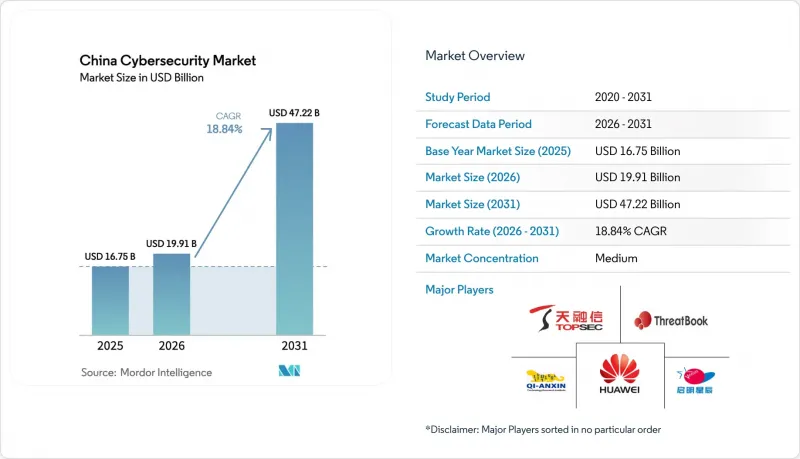
根據 Mordor Intelligence 預測,中國網路安全市場規模將從 2025 年的 167.5 億美元成長到 2026 年的 199.1 億美元。
本報告按交付方式(解決方案和服務)、部署方式(本地部署和雲端部署)、組織規模(中小企業和大型企業)以及最終用戶產業(銀行、金融服務和保險、醫療保健和生命科學、IT和電信、政府和公共管理等)進行細分。市場預測以美元計價。
中國網路安全市場趨勢與洞察
遵守中國網路安全和資料安全法律的義務
2024年,中國加強了《國家資料安全管理條例》(NDSMR)的執行力度,當局對資料安全違規行為開出了786張行政罰單,較2023年成長了32%。這項成長凸顯了監管機構對資料保護日益成長的重視,並促使企業董事會將加密、日誌和資料分類工具列為必要的預算項目,而非可有可無的技術投資。 2025年,各組織將不再進行定期合規審查,許多組織將以持續合規儀錶板取代三年一次的審計週期,從而即時監控風險和合規情況。這種轉變增加了對資安管理服務的需求,加速了銀行、醫療保健和電信等關鍵產業採用多年期MSSP合約的趨勢。
國營企業向雲端原生架構的快速遷移
國務院國營資產監督管理委員會(國資委)確認,截至2024年底,78家中央國營企業已將其至少一半的新增工作負載遷移至國內雲端平台。這使得雲端原生應用程式成為中國網路安全需求的主要驅動力。伴隨這項轉型,市場對能夠保護容器化環境、強化Kubernetes配置並在統一框架內管理API相關風險的整合安全態勢管理解決方案的需求日益成長。與多家供應商的零散解決方案相比,結合了Kubernetes強化和API閘道器封閉功能的安全態勢工具已將競標週期縮短了17%,這表明中央國有企業在採購決策中優先考慮了快速部署、簡化整合和營運效率。
供應商生態系統分散會導致整合差距。
中國工業和資訊化部(工信部)已在中國登記了827家網路安全供應商,導致供應商生態系統高度分散。這種分散性造成了整合障礙,並延長了在保全行動中使用超過25種產品的公司的事件回應時間。企業在實現互通性、保持集中可見性以及協調跨多個工具的威脅偵測和回應方面常常面臨挑戰。因此,在首席資訊安全(CISO)尋求統一的控制面板、簡化的安全管理和更有效率的事件回應能力的支持下,市場對整合的需求日益成長。
細分市場分析
到2025年,隨著企業加快將令牌化、預防資料外泄和行為分析防火牆等合規功能整合到核心網路中,相關解決方案將佔據中國網路安全市場59.48%的佔有率。由於合規期限臨近,即使是融資不佳的出口企業,其許可收入依然強勁;同時,軟硬體捆綁銷售也縮短了大型銀行和醫院的審計時間。能夠同時取得GB/T 35273和《網路資料安全管理規則》認證的供應商,如今正制定高價策略,凸顯了監管重疊如何鞏固市場需求。同時,隨著董事會轉向承諾提供統一儀錶板和降低維護負擔的全端平台,那些提供細分領域工具的供應商正被市場淘汰。
由於企業長期面臨分析人才短缺的問題,預計服務市場將以19.96%的複合年成長率成長,超過中國整體網路安全市場的成長速度。中國電信2024年的保全服務收入累計124億元人民幣(約17億美元),較去年同期成長31%。這顯示託管偵測與回應(MDR)合約正逐漸被主流企業接受。一級安全營運中心(SOC)外包服務使企業內部員工能夠專注於威脅搜尋,而固定費率的事件回應合約則保證了平均遏制時間(MTOC)符合監管要求。在整個預測期內,每項新的合規規則預計都將持續推動服務支出成長,從而為擁有全天候營運中心的平台提供者創造結構性成長潛力。
在中國網路安全市場,基於雲端的部署已成為主導力量,預計到2025年將佔據69.72%的市場佔有率。這一主導地位反映了銀行、金融和保險(BFSI)、醫療、製造和政府部門對雲端運算的快速採用,而這又得益於《網路安全法》、《資料安全法》和《個人資訊保護法》等法規的合規要求。企業持續將工作負載遷移到雲端,以支援更高的可擴展性、成本效益、更強的營運彈性以及安全的數位轉型(DX)計劃。同時,超大規模資料中心業者雲端服務和國內雲端服務供應商已將高階安全功能直接整合到基礎設施即服務(IaaS)中,使企業能夠應對不斷演變的網路風險,同時降低管理獨立安全工具的複雜性。
預計到2031年,基於雲端的安全將以19.12%的複合年成長率成長,成為中國網路安全市場成長最快的部署方式。這一成長預計將受到中國持續推進「自主雲端」部署、5G專網擴展以及將人工智慧安全技術整合到雲端平台等因素的推動。隨著企業擴大採用混合雲和多重雲端策略,對雲端工作負載保護、身分管治、持續監控、威脅偵測和零信任框架等高階解決方案的需求預計將進一步加速成長。這些趨勢將進一步鞏固雲端作為中國網路安全核心要素的地位,並成為企業安全現代化轉型的重要驅動力。
其他好處:
- Excel格式的市場預測(ME)表
- 3個月的分析師支持
目錄
第1章:引言
- 研究假設和市場定義
- 調查範圍
第2章:調查方法
第3章執行摘要
第4章 市場狀況
- 市場概覽
- 市場促進因素
- 遵守中國網路安全和資料安全法律的義務
- 在智慧製造地部署5G專用網路
- 國營企業向雲端原生架構的快速轉型
- 人工智慧驅動的工業網際網路興起所帶來的威脅因素
- 跨境電子商務的爆炸性成長對安全的支付基礎設施提出了更高的要求。
- 政府的「數據在東方,計算在西方」舉措正在推動該地區安全運營中心(SOC)的發展。
- 市場限制因素
- 供應商生態系統碎片化造成了整合方面的差距。
- 高技能威脅分析人員嚴重短缺。
- 對價格較為敏感的中小型企業正在減少在高級安全方面的支出。
- 地緣政治對技術出口的限制正在擾亂供應鏈。
- 重要法規結構的評估
- 產業價值鏈分析
- 技術展望
- 波特五力分析
- 主要用例和案例研究
- 宏觀經濟因素對市場的影響
- 投資分析
第5章 市場區隔
- 報價
- 解決方案
- 應用程式安全
- 雲端安全
- 資料安全
- 身分和存取管理
- 基礎設施保護
- 綜合風險管理
- 網路安全
- 端點安全
- 服務
- 專業服務
- 託管服務
- 解決方案
- 部署模式
- 現場
- 雲
- 按最終用戶行業分類
- 銀行、金融服務和保險(BFSI)
- 醫療保健和生命科學
- IT/通訊
- 政府和公共行政
- 工業製造
- 零售與電子商務
- 能源公用事業
- 運輸/物流
- 其他終端用戶產業
- 按組織規模
- 中小企業
- 大公司
第6章 競爭情勢
- 市場集中度
- 策略趨勢
- 市佔率分析
- 公司簡介
- Qi-Anxin Technology Group Inc.
- Huawei Technologies Co., Ltd.
- Venustech Group Inc.
- ThreatBook
- Beijing TopSec Network Security Technology Co.
- 360 Enterprise Security Group
- NSFOCUS Technologies Group
- Tencent Cloud Security
- Beijing Chaitin Future Technology Co.
- Sangfor Technologies Inc.
- iJiami
- IDsManager
- CoreShield Times
- River Security
- Asiainfo Security
- TopHant Inc.
- Beijing Lingxin Technology(Legendsec)
- DBAPPSecurity
- Ant Group Zoloz Security
- Hillstone Networks
- Meiya Pico
- Palo Alto Networks
第7章 市場機會與未來展望
According to Mordor Intelligence, China's cybersecurity market size is estimated at USD 19.91 billion in 2026, up from USD 16.75 billion in 2025. This report is Segmented by Offerings (Solutions, and Services), Deployment (On-Premise, and Cloud), Organization Size (Small and Medium Enterprises (SMEs), and Large Enterprises), and End-User Industry (Banking, Financial Services, and Insurance, Healthcare and Life Sciences, IT and Telecommunication, Government and Public Administration, and More). The Market Forecasts are Provided in Terms of Value (USD).
China Cybersecurity Market Trends and Insights
Mandatory Compliance with China's Cybersecurity and Data-Security Laws
Regulatory enforcement under China's NDSMR intensified in 2024, with authorities issuing 786 administrative penalties for data security lapses, representing a 32% increase from 2023. This increase underscored the growing regulatory focus on data protection and compelled corporate boards to prioritize encryption, logging, and data classification tools as essential budget items rather than discretionary technology investments. By 2025, organizations had moved beyond periodic compliance reviews, with many replacing three-year audit cycles with continuous compliance dashboards to monitor risks and regulatory adherence in real time. This shift strengthened demand for managed security services and accelerated the adoption of multi-year MSSP contracts across key industries, including banking, healthcare, and telecom.
Rapid Shift of State-Owned Enterprises to Cloud-Native Architectures
The State-owned Assets Supervision and Administration Commission (SASAC) confirmed that, by the end of 2024, 78 central SOEs had migrated at least half of their new workloads to domestic cloud platforms, making cloud-native adoption a key driver of cybersecurity demand in China. This shift increased the need for integrated security-posture management solutions that can secure containerized environments, strengthen Kubernetes configurations, and manage API-related risks within a unified framework. Security posture tools that combine Kubernetes hardening with API gateway closures reduce tender cycles by 17% faster than multi-vendor patchwork, indicating that SOEs prioritized faster deployment, simplified integration, and operational efficiency in procurement decisions.
Fragmented Vendor Ecosystem Creating Integration Gaps
The Ministry of Industry and Information Technology (MIIT) listed 827 licensed cybersecurity suppliers in China, creating a highly fragmented vendor ecosystem. This fragmentation created integration gaps and extended incident response times for enterprises managing more than 25 point products across their security operations. Organizations often face challenges in achieving interoperability, maintaining centralized visibility, and coordinating threat detection and response across multiple tools. As a result, market consolidation became increasingly necessary and gained support from chief information security officers seeking unified dashboards, streamlined security management, and more efficient incident response capabilities.
Other drivers and restraints analyzed in the detailed report include:
- Proliferation of 5G Private Networks in Smart-Manufacturing Hubs
- Government "Eastern Data, Western Computing" Initiative Driving Regional SOC Build-outs
- Acute Shortage of Advanced Threat-Analytics Talent
For complete list of drivers and restraints, kindly check the Table Of Contents.
Segment Analysis
Solutions captured 59.48% of the China cybersecurity market share in 2025 as enterprises rushed to hardwire compliance features such as tokenization, data loss prevention, and behavioral analytics firewalls into core networks. The up-front nature of compliance deadlines kept license revenue buoyant even among cash-constrained exporters, while bundled hardware software packages shortened time-to-audit for large banks and hospitals. Vendors able to certify appliances under both GB/T 35273 and the Network Data Security Management Regulations now command premium pricing, underscoring how statutory overlap cements demand. In parallel, niche suppliers of point tools are being edged out as boards turn to full-stack platforms that promise unified dashboards and lower maintenance friction.
Services are set to expand at a 19.96% CAGR, outpacing the broader China cybersecurity market, as enterprises confront a chronic analytics talent shortfall. China Telecom recorded security-service revenue of CNY 12.4 billion (USD 1.7 billion) in 2024, a 31% lift that signals mainstream acceptance of managed detection and response contracts. Tier-one SOC outsourcing frees internal staff for threat hunting, while incident-response retainers guarantee regulator-friendly mean time to contain metrics. Over the forecast window, every incremental compliance rule is expected to translate into higher recurring services spend, giving platform players with 24/7 operations centres a structural growth runway.
In China's cybersecurity market, cloud-based deployments dominated, accounting for 69.72% of the market in 2025. This leadership reflected the country's rapid adoption of cloud computing across the BFSI, healthcare, manufacturing, and government sectors, supported by the need to comply with the Cybersecurity Law, Data Security Law (DSL), and Personal Information Protection Law (PIPL). Enterprises continued to migrate workloads to the cloud to enhance scalability, improve cost efficiency, strengthen operational resilience, and support secure digital transformation initiatives. At the same time, hyperscalers and domestic cloud providers embedded advanced security capabilities directly into infrastructure-as-a-service offerings, enabling organizations to address evolving cyber risks while reducing the complexity of managing standalone security tools.
Cloud-based security is projected to expand at a CAGR of 19.12% through 2031, making it the fastest-growing deployment mode in the China cybersecurity market. China's continued focus on sovereign cloud adoption, the expansion of 5G private networks, and the integration of AI-enabled security into cloud platforms are expected to support this growth. As organizations increasingly implement hybrid and multi-cloud strategies, demand for advanced solutions, such as cloud workload protection, identity governance, continuous monitoring, threat detection, and zero-trust frameworks, is expected to accelerate further. These trends are likely to strengthen cloud's position as a core component of China's cybersecurity landscape and a critical enabler of secure enterprise modernization.
Complete Report Scope:
- By Offering
- Solutions
- Application Security
- Cloud Security
- Data Security
- Identity and Access Management
- Infrastructure Protection
- Integrated Risk Management
- Network Security
- Endpoint Security
- Services
- Professional Services
- Managed Services
- Solutions
- By Deployment Mode
- On-Premise
- Cloud
- By End-User Industry
- Banking, Financial Services, and Insurance (BFSI)
- Healthcare and Life Sciences
- IT and Telecommunication
- Government and Public Administration
- Industrial Manufacturing
- Retail and E-Commerce
- Energy and Utilities
- Transportation and Logistics
- Other End-User Industries
- By Organization Size
- Small and Medium Enterprises (SMEs)
- Large Enterprises
List of Companies Covered in this Report:
- Qi-Anxin Technology Group Inc.
- Huawei Technologies Co., Ltd.
- Venustech Group Inc.
- ThreatBook
- Beijing TopSec Network Security Technology Co.
- 360 Enterprise Security Group
- NSFOCUS Technologies Group
- Tencent Cloud Security
- Beijing Chaitin Future Technology Co.
- Sangfor Technologies Inc.
- iJiami
- IDsManager
- CoreShield Times
- River Security
- Asiainfo Security
- TopHant Inc.
- Beijing Lingxin Technology (Legendsec)
- DBAPPSecurity
- Ant Group Zoloz Security
- Hillstone Networks
- Meiya Pico
- Palo Alto Networks
Additional Benefits:
- The market estimate (ME) sheet in Excel format
- 3 months of analyst support
TABLE OF CONTENTS
1 INTRODUCTION
- 1.1 Study Assumptions and Market Definition
- 1.2 Scope of the Study
2 RESEARCH METHODOLOGY
3 EXECUTIVE SUMMARY
4 MARKET LANDSCAPE
- 4.1 Market Overview
- 4.2 Market Drivers
- 4.2.1 Mandatory Compliance with China's Cybersecurity and Data-Security Laws
- 4.2.2 Proliferation of 5G Private Networks in Smart-Manufacturing Hubs
- 4.2.3 Rapid Shift of State-Owned Enterprises to Cloud-Native Architectures
- 4.2.4 Rise of AI-Powered Industrial Internet Threat Vectors
- 4.2.5 Explosive Growth in Cross-Border E-commerce Requiring Secure Payment Rails
- 4.2.6 Government "Eastern Data, Western Computing" Initiative Driving Regional SOC Build-outs
- 4.3 Market Restraints
- 4.3.1 Fragmented Vendor Ecosystem Creating Integration Gaps
- 4.3.2 Acute Shortage of Advanced Threat-Analytics Talent
- 4.3.3 Price-Sensitive SMB Segment Limiting Premium Security Spend
- 4.3.4 Geopolitical Tech-Export Restrictions Disrupting Supply Chains
- 4.4 Evaluation of Critical Regulatory Framework
- 4.5 Industry Value-Chain Analysis
- 4.6 Technological Outlook
- 4.7 Porter's Five Forces Analysis
- 4.7.1 Bargaining Power of Suppliers
- 4.7.2 Bargaining Power of Buyers
- 4.7.3 Threat of New Entrants
- 4.7.4 Threat of Substitutes
- 4.7.5 Intensity of Competitive Rivalry
- 4.8 Key Use Cases and Case Studies
- 4.9 Impact on Macroeconomic Factors of the Market
- 4.10 Investment Analysis
5 MARKET SEGMENTATION
- 5.1 By Offering
- 5.1.1 Solutions
- 5.1.1.1 Application Security
- 5.1.1.2 Cloud Security
- 5.1.1.3 Data Security
- 5.1.1.4 Identity and Access Management
- 5.1.1.5 Infrastructure Protection
- 5.1.1.6 Integrated Risk Management
- 5.1.1.7 Network Security
- 5.1.1.8 Endpoint Security
- 5.1.2 Services
- 5.1.2.1 Professional Services
- 5.1.2.2 Managed Services
- 5.1.1 Solutions
- 5.2 By Deployment Mode
- 5.2.1 On-Premise
- 5.2.2 Cloud
- 5.3 By End-User Industry
- 5.3.1 Banking, Financial Services, and Insurance (BFSI)
- 5.3.2 Healthcare and Life Sciences
- 5.3.3 IT and Telecommunication
- 5.3.4 Government and Public Administration
- 5.3.5 Industrial Manufacturing
- 5.3.6 Retail and E-Commerce
- 5.3.7 Energy and Utilities
- 5.3.8 Transportation and Logistics
- 5.3.9 Other End-User Industries
- 5.4 By Organization Size
- 5.4.1 Small and Medium Enterprises (SMEs)
- 5.4.2 Large Enterprises
6 COMPETITIVE LANDSCAPE
- 6.1 Market Concentration
- 6.2 Strategic Moves
- 6.3 Market Share Analysis
- 6.4 Company Profiles {(includes Global level Overview, Market level overview, Core Segments, Financials as available, Strategic Information, Market Rank/Share for key companies, Products and Services, and Recent Developments)}
- 6.4.1 Qi-Anxin Technology Group Inc.
- 6.4.2 Huawei Technologies Co., Ltd.
- 6.4.3 Venustech Group Inc.
- 6.4.4 ThreatBook
- 6.4.5 Beijing TopSec Network Security Technology Co.
- 6.4.6 360 Enterprise Security Group
- 6.4.7 NSFOCUS Technologies Group
- 6.4.8 Tencent Cloud Security
- 6.4.9 Beijing Chaitin Future Technology Co.
- 6.4.10 Sangfor Technologies Inc.
- 6.4.11 iJiami
- 6.4.12 IDsManager
- 6.4.13 CoreShield Times
- 6.4.14 River Security
- 6.4.15 Asiainfo Security
- 6.4.16 TopHant Inc.
- 6.4.17 Beijing Lingxin Technology (Legendsec)
- 6.4.18 DBAPPSecurity
- 6.4.19 Ant Group Zoloz Security
- 6.4.20 Hillstone Networks
- 6.4.21 Meiya Pico
- 6.4.22 Palo Alto Networks
7 MARKET OPPORTUNITIES AND FUTURE OUTLOOK
- 7.1 White-space and Unmet-Need Assessment

 中東網路安全:市場佔有率分析、產業趨勢與統計及成長預測(2026-2031 年)
 全球網路安全代理人工智慧市場規模、佔有率、趨勢和成長分析報告(2026-2034)印度網路安全:市場佔有率分析、產業趨勢與統計及成長預測(2026-2031)菲律賓網路安全:市場佔有率分析、產業趨勢與統計及成長預測(2026-2031 年)馬來西亞網路安全:市場佔有率分析、產業趨勢與統計及成長預測(2026-2031)義大利網路安全:市場佔有率分析、產業趨勢與統計、成長預測(2026-2031)英國網路安全:市場佔有率分析、產業趨勢與統計資料、成長預測(2026-2031 年)越南網路安全:市場佔有率分析、產業趨勢與統計及成長預測(2026-2031)
 2026-2030年全球安全態勢管理(SPM)市場
 2026-2030年全球網路安全市場